Compare commits
2 Commits
dev/miniks
...
dev/duhowe
| Author | SHA1 | Date | |
|---|---|---|---|

|
49691f891a | ||
|
|
26d3fcb1d2 |
3
.github/PULL_REQUEST_TEMPLATE.md
vendored
@@ -9,8 +9,7 @@
|
||||
* [ ] Closes #xxx
|
||||
* [ ] CLA signed. If not, go over [here](https://cla.opensource.microsoft.com/microsoft/Terminal) and sign the CLA
|
||||
* [ ] Tests added/passed
|
||||
* [ ] Documentation updated. If checked, please file a pull request on [our docs repo](https://github.com/MicrosoftDocs/terminal) and link it here: #xxx
|
||||
* [ ] Schema updated.
|
||||
* [ ] Requires documentation to be updated
|
||||
* [ ] I've discussed this with core contributors already. If not checked, I'm ready to accept this work might be rejected in favor of a different grand plan. Issue number where discussion took place: #xxx
|
||||
|
||||
<!-- Provide a more detailed description of the PR, other things fixed or any additional comments/features here -->
|
||||
|
||||
15
.github/actions/spelling/README.md
vendored
@@ -1,15 +0,0 @@
|
||||
# check-spelling/check-spelling configuration
|
||||
|
||||
File | Purpose | Format | Info
|
||||
-|-|-|-
|
||||
[allow/*.txt](allow/) | Add words to the dictionary | one word per line (only letters and `'`s allowed) | [allow](https://github.com/check-spelling/check-spelling/wiki/Configuration#allow)
|
||||
[reject.txt](reject.txt) | Remove words from the dictionary (after allow) | grep pattern matching whole dictionary words | [reject](https://github.com/check-spelling/check-spelling/wiki/Configuration-Examples%3A-reject)
|
||||
[excludes.txt](excludes.txt) | Files to ignore entirely | perl regular expression | [excludes](https://github.com/check-spelling/check-spelling/wiki/Configuration-Examples%3A-excludes)
|
||||
[patterns/*.txt](patterns/) | Patterns to ignore from checked lines | perl regular expression (order matters, first match wins) | [patterns](https://github.com/check-spelling/check-spelling/wiki/Configuration-Examples%3A-patterns)
|
||||
[candidate.patterns](candidate.patterns) | Patterns that might be worth adding to [patterns.txt](patterns.txt) | perl regular expression with optional comment block introductions (all matches will be suggested) | [candidates](https://github.com/check-spelling/check-spelling/wiki/Feature:-Suggest-patterns)
|
||||
[line_forbidden.patterns](line_forbidden.patterns) | Patterns to flag in checked lines | perl regular expression (order matters, first match wins) | [patterns](https://github.com/check-spelling/check-spelling/wiki/Configuration-Examples%3A-patterns)
|
||||
[expect/*.txt](expect.txt) | Expected words that aren't in the dictionary | one word per line (sorted, alphabetically) | [expect](https://github.com/check-spelling/check-spelling/wiki/Configuration#expect)
|
||||
[advice.md](advice.md) | Supplement for GitHub comment when unrecognized words are found | GitHub Markdown | [advice](https://github.com/check-spelling/check-spelling/wiki/Configuration-Examples%3A-advice)
|
||||
|
||||
Note: you can replace any of these files with a directory by the same name (minus the suffix)
|
||||
and then include multiple files inside that directory (with that suffix) to merge multiple files together.
|
||||
48
.github/actions/spelling/advice.md
vendored
@@ -1,48 +0,0 @@
|
||||
<!-- See https://github.com/check-spelling/check-spelling/wiki/Configuration-Examples%3A-advice --> <!-- markdownlint-disable MD033 MD041 -->
|
||||
<details>
|
||||
<summary>
|
||||
:pencil2: Contributor please read this
|
||||
</summary>
|
||||
|
||||
By default the command suggestion will generate a file named based on your commit. That's generally ok as long as you add the file to your commit. Someone can reorganize it later.
|
||||
|
||||
:warning: The command is written for posix shells. If it doesn't work for you, you can manually _add_ (one word per line) / _remove_ items to `expect.txt` and the `excludes.txt` files.
|
||||
|
||||
If the listed items are:
|
||||
|
||||
* ... **misspelled**, then please *correct* them instead of using the command.
|
||||
* ... *names*, please add them to `.github/actions/spelling/allow/names.txt`.
|
||||
* ... APIs, you can add them to a file in `.github/actions/spelling/allow/`.
|
||||
* ... just things you're using, please add them to an appropriate file in `.github/actions/spelling/expect/`.
|
||||
* ... tokens you only need in one place and shouldn't *generally be used*, you can add an item in an appropriate file in `.github/actions/spelling/patterns/`.
|
||||
|
||||
See the `README.md` in each directory for more information.
|
||||
|
||||
:microscope: You can test your commits **without** *appending* to a PR by creating a new branch with that extra change and pushing it to your fork. The [check-spelling](https://github.com/marketplace/actions/check-spelling) action will run in response to your **push** -- it doesn't require an open pull request. By using such a branch, you can limit the number of typos your peers see you make. :wink:
|
||||
|
||||
|
||||
<details><summary>If the flagged items are :exploding_head: false positives</summary>
|
||||
|
||||
If items relate to a ...
|
||||
* binary file (or some other file you wouldn't want to check at all).
|
||||
|
||||
Please add a file path to the `excludes.txt` file matching the containing file.
|
||||
|
||||
File paths are Perl 5 Regular Expressions - you can [test](
|
||||
https://www.regexplanet.com/advanced/perl/) yours before committing to verify it will match your files.
|
||||
|
||||
`^` refers to the file's path from the root of the repository, so `^README\.md$` would exclude [README.md](
|
||||
../tree/HEAD/README.md) (on whichever branch you're using).
|
||||
|
||||
* well-formed pattern.
|
||||
|
||||
If you can write a [pattern](https://github.com/check-spelling/check-spelling/wiki/Configuration-Examples:-patterns) that would match it,
|
||||
try adding it to the `patterns.txt` file.
|
||||
|
||||
Patterns are Perl 5 Regular Expressions - you can [test](
|
||||
https://www.regexplanet.com/advanced/perl/) yours before committing to verify it will match your lines.
|
||||
|
||||
Note that patterns can't match multiline strings.
|
||||
</details>
|
||||
|
||||
</details>
|
||||
21
.github/actions/spelling/allow/README.md
vendored
@@ -1,21 +0,0 @@
|
||||
# Allow files are lists of words to accept unconditionally
|
||||
|
||||
While check spelling will complain about an expected word
|
||||
which is no longer present, you can include things here even if
|
||||
they are not otherwise present in the repository.
|
||||
|
||||
E.g., you could include a list of system APIs here, or potential
|
||||
contributors (so that if a future commit includes their name,
|
||||
it'll be accepted).
|
||||
|
||||
## Files
|
||||
|
||||
| File | Description |
|
||||
| ---- | ----------- |
|
||||
| [Allow](allow.txt) | Supplements to the dictionary |
|
||||
| [Chinese](chinese.txt) | Chinese words |
|
||||
| [Japanese](japanese.txt) | Japanese words |
|
||||
| [Microsoft](microsoft.txt) | Microsoft brand items |
|
||||
| [Fonts](fonts.txt) | Font names |
|
||||
| [Names](names.txt) | Names of people |
|
||||
| [Colors](colors.txt) | Names of color |
|
||||
108
.github/actions/spelling/allow/allow.txt
vendored
@@ -1,108 +0,0 @@
|
||||
admins
|
||||
allcolors
|
||||
Apc
|
||||
apc
|
||||
breadcrumb
|
||||
breadcrumbs
|
||||
bsd
|
||||
calt
|
||||
ccmp
|
||||
changelog
|
||||
clickable
|
||||
clig
|
||||
CMMI
|
||||
copyable
|
||||
cybersecurity
|
||||
dalet
|
||||
Dcs
|
||||
dcs
|
||||
dialytika
|
||||
dje
|
||||
downside
|
||||
downsides
|
||||
dze
|
||||
dzhe
|
||||
EDDB
|
||||
EDDC
|
||||
Enum'd
|
||||
Fitt
|
||||
formattings
|
||||
FTCS
|
||||
ftp
|
||||
fvar
|
||||
gantt
|
||||
gcc
|
||||
geeksforgeeks
|
||||
ghe
|
||||
github
|
||||
gje
|
||||
godbolt
|
||||
hostname
|
||||
hostnames
|
||||
https
|
||||
hyperlink
|
||||
hyperlinking
|
||||
hyperlinks
|
||||
iconify
|
||||
img
|
||||
inlined
|
||||
It'd
|
||||
kje
|
||||
libfuzzer
|
||||
libuv
|
||||
liga
|
||||
lje
|
||||
Llast
|
||||
llvm
|
||||
Lmid
|
||||
locl
|
||||
lol
|
||||
lorem
|
||||
Lorigin
|
||||
maxed
|
||||
minimalistic
|
||||
mkmk
|
||||
mnt
|
||||
mru
|
||||
nje
|
||||
noreply
|
||||
ogonek
|
||||
ok'd
|
||||
overlined
|
||||
pipeline
|
||||
postmodern
|
||||
ptys
|
||||
qof
|
||||
qps
|
||||
rclt
|
||||
reimplementation
|
||||
reserialization
|
||||
reserialize
|
||||
reserializes
|
||||
rlig
|
||||
runtimes
|
||||
shcha
|
||||
slnt
|
||||
Sos
|
||||
ssh
|
||||
timeline
|
||||
timelines
|
||||
timestamped
|
||||
TLDR
|
||||
tokenizes
|
||||
tonos
|
||||
toolset
|
||||
tshe
|
||||
ubuntu
|
||||
uiatextrange
|
||||
UIs
|
||||
und
|
||||
unregister
|
||||
versioned
|
||||
vsdevcmd
|
||||
We'd
|
||||
wildcards
|
||||
XBox
|
||||
YBox
|
||||
yeru
|
||||
zhe
|
||||
248
.github/actions/spelling/allow/apis.txt
vendored
@@ -1,248 +0,0 @@
|
||||
ACCEPTFILES
|
||||
ACCESSDENIED
|
||||
acl
|
||||
aclapi
|
||||
alignas
|
||||
alignof
|
||||
APPLYTOSUBMENUS
|
||||
appxrecipe
|
||||
bitfield
|
||||
bitfields
|
||||
BUILDBRANCH
|
||||
BUILDMSG
|
||||
BUILDNUMBER
|
||||
BYCOMMAND
|
||||
BYPOSITION
|
||||
charconv
|
||||
CLASSNOTAVAILABLE
|
||||
CLOSEAPP
|
||||
cmdletbinding
|
||||
COLORPROPERTY
|
||||
colspan
|
||||
COMDLG
|
||||
commandlinetoargv
|
||||
comparand
|
||||
cstdint
|
||||
CXICON
|
||||
CYICON
|
||||
Dacl
|
||||
dataobject
|
||||
dcomp
|
||||
DERR
|
||||
dlldata
|
||||
DNE
|
||||
DONTADDTORECENT
|
||||
DWMSBT
|
||||
DWMWA
|
||||
DWMWA
|
||||
DWORDLONG
|
||||
endfor
|
||||
ENDSESSION
|
||||
enumset
|
||||
environstrings
|
||||
EXPCMDFLAGS
|
||||
EXPCMDSTATE
|
||||
filetime
|
||||
FILTERSPEC
|
||||
FORCEFILESYSTEM
|
||||
FORCEMINIMIZE
|
||||
frac
|
||||
fullkbd
|
||||
futex
|
||||
GETDESKWALLPAPER
|
||||
GETHIGHCONTRAST
|
||||
GETMOUSEHOVERTIME
|
||||
Hashtable
|
||||
HIGHCONTRASTON
|
||||
HIGHCONTRASTW
|
||||
hotkeys
|
||||
href
|
||||
hrgn
|
||||
HTCLOSE
|
||||
hwinsta
|
||||
HWINSTA
|
||||
IActivation
|
||||
IApp
|
||||
IAppearance
|
||||
IAsync
|
||||
IBind
|
||||
IBox
|
||||
IClass
|
||||
IComparable
|
||||
IComparer
|
||||
IConnection
|
||||
ICustom
|
||||
IDialog
|
||||
IDirect
|
||||
IExplorer
|
||||
IFACEMETHOD
|
||||
IFile
|
||||
IGraphics
|
||||
IInheritable
|
||||
IMap
|
||||
IMonarch
|
||||
IObject
|
||||
iosfwd
|
||||
IPackage
|
||||
IPeasant
|
||||
ISetup
|
||||
isspace
|
||||
IStorage
|
||||
istream
|
||||
IStringable
|
||||
ITab
|
||||
ITaskbar
|
||||
itow
|
||||
IUri
|
||||
IVirtual
|
||||
KEYSELECT
|
||||
LCID
|
||||
llabs
|
||||
llu
|
||||
localtime
|
||||
lround
|
||||
Lsa
|
||||
lsass
|
||||
LSHIFT
|
||||
LTGRAY
|
||||
MAINWINDOW
|
||||
memchr
|
||||
memicmp
|
||||
MENUCOMMAND
|
||||
MENUDATA
|
||||
MENUINFO
|
||||
MENUITEMINFOW
|
||||
mmeapi
|
||||
MOUSELEAVE
|
||||
mov
|
||||
mptt
|
||||
msappx
|
||||
MULTIPLEUSE
|
||||
NCHITTEST
|
||||
NCLBUTTONDBLCLK
|
||||
NCMOUSELEAVE
|
||||
NCMOUSEMOVE
|
||||
NCRBUTTONDBLCLK
|
||||
NIF
|
||||
NIN
|
||||
NOAGGREGATION
|
||||
NOASYNC
|
||||
NOCHANGEDIR
|
||||
NOPROGRESS
|
||||
NOREDIRECTIONBITMAP
|
||||
NOREPEAT
|
||||
NOTIFYBYPOS
|
||||
NOTIFYICON
|
||||
NOTIFYICONDATA
|
||||
ntprivapi
|
||||
oaidl
|
||||
ocidl
|
||||
ODR
|
||||
offsetof
|
||||
ofstream
|
||||
onefuzz
|
||||
osver
|
||||
OSVERSIONINFOEXW
|
||||
otms
|
||||
OUTLINETEXTMETRICW
|
||||
overridable
|
||||
PACL
|
||||
PAGESCROLL
|
||||
PATINVERT
|
||||
PEXPLICIT
|
||||
PICKFOLDERS
|
||||
pmr
|
||||
ptstr
|
||||
QUERYENDSESSION
|
||||
rcx
|
||||
REGCLS
|
||||
RETURNCMD
|
||||
rfind
|
||||
ROOTOWNER
|
||||
roundf
|
||||
RSHIFT
|
||||
SACL
|
||||
schandle
|
||||
semver
|
||||
serializer
|
||||
SETVERSION
|
||||
SHELLEXECUTEINFOW
|
||||
shobjidl
|
||||
SHOWHIDE
|
||||
SHOWMINIMIZED
|
||||
SHOWTIP
|
||||
SINGLEUSE
|
||||
SIZENS
|
||||
smoothstep
|
||||
snprintf
|
||||
spsc
|
||||
sregex
|
||||
SRWLOC
|
||||
SRWLOCK
|
||||
STDCPP
|
||||
STDMETHOD
|
||||
strchr
|
||||
strcpy
|
||||
streambuf
|
||||
strtoul
|
||||
Stubless
|
||||
Subheader
|
||||
Subpage
|
||||
syscall
|
||||
SYSTEMBACKDROP
|
||||
TABROW
|
||||
TASKBARCREATED
|
||||
TBPF
|
||||
THEMECHANGED
|
||||
tlg
|
||||
TME
|
||||
tmp
|
||||
tmpdir
|
||||
tolower
|
||||
toupper
|
||||
TRACKMOUSEEVENT
|
||||
TTask
|
||||
TVal
|
||||
UChar
|
||||
UFIELD
|
||||
ULARGE
|
||||
UOI
|
||||
UPDATEINIFILE
|
||||
userenv
|
||||
USEROBJECTFLAGS
|
||||
Viewbox
|
||||
virtualalloc
|
||||
wcsstr
|
||||
wcstoui
|
||||
winmain
|
||||
winsta
|
||||
winstamin
|
||||
wmemcmp
|
||||
wpc
|
||||
WSF
|
||||
wsregex
|
||||
wwinmain
|
||||
xchg
|
||||
XDocument
|
||||
XElement
|
||||
xfacet
|
||||
xhash
|
||||
XIcon
|
||||
xiosbase
|
||||
xlocale
|
||||
xlocbuf
|
||||
xlocinfo
|
||||
xlocmes
|
||||
xlocmon
|
||||
xlocnum
|
||||
xloctime
|
||||
XMax
|
||||
xmemory
|
||||
XParse
|
||||
xpath
|
||||
xstddef
|
||||
xstring
|
||||
xtree
|
||||
xutility
|
||||
YIcon
|
||||
YMax
|
||||
5
.github/actions/spelling/allow/chinese.txt
vendored
@@ -1,5 +0,0 @@
|
||||
CHINESEBIG
|
||||
choseong
|
||||
Jongseong
|
||||
Jungseong
|
||||
ssangtikeut
|
||||
117
.github/actions/spelling/allow/colors.txt
vendored
@@ -1,117 +0,0 @@
|
||||
alice
|
||||
aliceblue
|
||||
antiquewhite
|
||||
blanchedalmond
|
||||
blueviolet
|
||||
burlywood
|
||||
cadetblue
|
||||
cornflowerblue
|
||||
cornsilk
|
||||
cyan
|
||||
darkblue
|
||||
darkcyan
|
||||
darkgoldenrod
|
||||
darkgray
|
||||
darkgreen
|
||||
darkgrey
|
||||
darkkhaki
|
||||
darkmagenta
|
||||
darkolivegreen
|
||||
darkorange
|
||||
darkorchid
|
||||
darkred
|
||||
darksalmon
|
||||
darkseagreen
|
||||
darkslateblue
|
||||
darkslategray
|
||||
darkslategrey
|
||||
darkturquoise
|
||||
darkviolet
|
||||
deeppink
|
||||
deepskyblue
|
||||
dimgray
|
||||
dimgrey
|
||||
dodgerblue
|
||||
firebrick
|
||||
floralwhite
|
||||
forestgreen
|
||||
gainsboro
|
||||
ghostwhite
|
||||
greenyellow
|
||||
hotpink
|
||||
indian
|
||||
indianred
|
||||
lavenderblush
|
||||
lawngreen
|
||||
lemonchiffon
|
||||
lightblue
|
||||
lightcoral
|
||||
lightcyan
|
||||
lightgoldenrod
|
||||
lightgoldenrodyellow
|
||||
lightgray
|
||||
lightgreen
|
||||
lightgrey
|
||||
lightpink
|
||||
lightsalmon
|
||||
lightseagreen
|
||||
lightskyblue
|
||||
lightslateblue
|
||||
lightslategray
|
||||
lightslategrey
|
||||
lightsteelblue
|
||||
lightyellow
|
||||
limegreen
|
||||
mediumaquamarine
|
||||
mediumblue
|
||||
mediumorchid
|
||||
mediumpurple
|
||||
mediumseagreen
|
||||
mediumslateblue
|
||||
mediumspringgreen
|
||||
mediumturquoise
|
||||
mediumvioletred
|
||||
midnightblue
|
||||
mintcream
|
||||
mistyrose
|
||||
navajo
|
||||
navajowhite
|
||||
navyblue
|
||||
oldlace
|
||||
olivedrab
|
||||
orangered
|
||||
palegoldenrod
|
||||
palegreen
|
||||
paleturquoise
|
||||
palevioletred
|
||||
papayawhip
|
||||
peachpuff
|
||||
peru
|
||||
powderblue
|
||||
rebecca
|
||||
rebeccapurple
|
||||
rosybrown
|
||||
royalblue
|
||||
saddlebrown
|
||||
sandybrown
|
||||
seagreen
|
||||
sienna
|
||||
skyblue
|
||||
slateblue
|
||||
slategray
|
||||
slategrey
|
||||
springgreen
|
||||
steelblue
|
||||
violetred
|
||||
webgray
|
||||
webgreen
|
||||
webgrey
|
||||
webmaroon
|
||||
webpurple
|
||||
whitesmoke
|
||||
xaroon
|
||||
xray
|
||||
xreen
|
||||
xrey
|
||||
xurple
|
||||
yellowgreen
|
||||
10
.github/actions/spelling/allow/fonts.txt
vendored
@@ -1,10 +0,0 @@
|
||||
Consolas
|
||||
emoji
|
||||
emojis
|
||||
Extralight
|
||||
Gabriola
|
||||
Iosevka
|
||||
MDL
|
||||
Monofur
|
||||
Segoe
|
||||
wght
|
||||
4
.github/actions/spelling/allow/japanese.txt
vendored
@@ -1,4 +0,0 @@
|
||||
arigatoo
|
||||
doomo
|
||||
Kaomojis
|
||||
TATEGAKI
|
||||
11
.github/actions/spelling/allow/math.txt
vendored
@@ -1,11 +0,0 @@
|
||||
atan
|
||||
CPrime
|
||||
HBar
|
||||
HPrime
|
||||
isnan
|
||||
LPrime
|
||||
LStep
|
||||
powf
|
||||
RSub
|
||||
sqrtf
|
||||
ULP
|
||||
85
.github/actions/spelling/allow/microsoft.txt
vendored
@@ -1,85 +0,0 @@
|
||||
ACLs
|
||||
ADMINS
|
||||
advapi
|
||||
altform
|
||||
altforms
|
||||
appendwttlogging
|
||||
appx
|
||||
appxbundle
|
||||
appxerror
|
||||
appxmanifest
|
||||
ATL
|
||||
backplating
|
||||
bitmaps
|
||||
BOMs
|
||||
CPLs
|
||||
cpptools
|
||||
cppvsdbg
|
||||
CPRs
|
||||
cryptbase
|
||||
DACL
|
||||
DACLs
|
||||
defaultlib
|
||||
diffs
|
||||
disposables
|
||||
dotnetfeed
|
||||
DTDs
|
||||
DWINRT
|
||||
enablewttlogging
|
||||
Intelli
|
||||
IVisual
|
||||
libucrt
|
||||
libucrtd
|
||||
LKG
|
||||
LOCKFILE
|
||||
Lxss
|
||||
mfcribbon
|
||||
microsoft
|
||||
microsoftonline
|
||||
MSAA
|
||||
msixbundle
|
||||
MSVC
|
||||
MSVCP
|
||||
muxc
|
||||
netcore
|
||||
Onefuzz
|
||||
osgvsowi
|
||||
PFILETIME
|
||||
pgc
|
||||
pgo
|
||||
pgosweep
|
||||
powerrename
|
||||
powershell
|
||||
propkey
|
||||
pscustomobject
|
||||
QWORD
|
||||
regedit
|
||||
robocopy
|
||||
SACLs
|
||||
sdkddkver
|
||||
Shobjidl
|
||||
Skype
|
||||
SRW
|
||||
sxs
|
||||
Sysinternals
|
||||
sysnative
|
||||
systemroot
|
||||
taskkill
|
||||
tasklist
|
||||
tdbuildteamid
|
||||
ucrt
|
||||
ucrtd
|
||||
unvirtualized
|
||||
VCRT
|
||||
vcruntime
|
||||
Virtualization
|
||||
visualstudio
|
||||
vscode
|
||||
VSTHRD
|
||||
winsdkver
|
||||
wlk
|
||||
wslpath
|
||||
wtl
|
||||
wtt
|
||||
wttlog
|
||||
Xamarin
|
||||
91
.github/actions/spelling/allow/names.txt
vendored
@@ -1,91 +0,0 @@
|
||||
Anup
|
||||
austdi
|
||||
arkthur
|
||||
Ballmer
|
||||
bhoj
|
||||
Bhojwani
|
||||
Bluloco
|
||||
carlos
|
||||
dhowett
|
||||
Diviness
|
||||
dsafa
|
||||
duhowett
|
||||
DXP
|
||||
ekg
|
||||
eryksun
|
||||
ethanschoonover
|
||||
Firefox
|
||||
Gatta
|
||||
glsl
|
||||
Gravell
|
||||
Grie
|
||||
Griese
|
||||
Hernan
|
||||
Howett
|
||||
Illhardt
|
||||
iquilezles
|
||||
italo
|
||||
jantari
|
||||
jerrysh
|
||||
Kaiyu
|
||||
kimwalisch
|
||||
KMehrain
|
||||
KODELIFE
|
||||
Kodelife
|
||||
Kourosh
|
||||
kowalczyk
|
||||
leonmsft
|
||||
Lepilleur
|
||||
lhecker
|
||||
lukesampson
|
||||
Macbook
|
||||
Manandhar
|
||||
masserano
|
||||
mbadolato
|
||||
Mehrain
|
||||
menger
|
||||
mgravell
|
||||
michaelniksa
|
||||
michkap
|
||||
migrie
|
||||
mikegr
|
||||
mikemaccana
|
||||
miloush
|
||||
miniksa
|
||||
niksa
|
||||
nvaccess
|
||||
nvda
|
||||
oising
|
||||
oldnewthing
|
||||
opengl
|
||||
osgwiki
|
||||
pabhojwa
|
||||
panos
|
||||
paulcam
|
||||
pauldotknopf
|
||||
PGP
|
||||
Pham
|
||||
Rincewind
|
||||
rprichard
|
||||
Schoonover
|
||||
shadertoy
|
||||
Shomnipotence
|
||||
simioni
|
||||
Somuah
|
||||
sonph
|
||||
sonpham
|
||||
stakx
|
||||
talo
|
||||
thereses
|
||||
Walisch
|
||||
WDX
|
||||
Wellons
|
||||
Wirt
|
||||
Wojciech
|
||||
zadjii
|
||||
Zamor
|
||||
Zamora
|
||||
zamora
|
||||
Zoey
|
||||
zorio
|
||||
Zverovich
|
||||
523
.github/actions/spelling/candidate.patterns
vendored
@@ -1,523 +0,0 @@
|
||||
# marker to ignore all code on line
|
||||
^.*/\* #no-spell-check-line \*/.*$
|
||||
# marker for ignoring a comment to the end of the line
|
||||
// #no-spell-check.*$
|
||||
|
||||
# patch hunk comments
|
||||
^\@\@ -\d+(?:,\d+|) \+\d+(?:,\d+|) \@\@ .*
|
||||
# git index header
|
||||
index [0-9a-z]{7,40}\.\.[0-9a-z]{7,40}
|
||||
|
||||
# cid urls
|
||||
(['"])cid:.*?\g{-1}
|
||||
|
||||
# data url in parens
|
||||
\(data:[^)]*?(?:[A-Z]{3,}|[A-Z][a-z]{2,}|[a-z]{3,})[^)]*\)
|
||||
# data url in quotes
|
||||
([`'"])data:.*?(?:[A-Z]{3,}|[A-Z][a-z]{2,}|[a-z]{3,}).*\g{-1}
|
||||
# data url
|
||||
data:[-a-zA-Z=;:/0-9+]*,\S*
|
||||
|
||||
# mailto urls
|
||||
mailto:[-a-zA-Z=;:/?%&0-9+@.]{3,}
|
||||
|
||||
# magnet urls
|
||||
magnet:[?=:\w]+
|
||||
|
||||
# magnet urls
|
||||
"magnet:[^"]+"
|
||||
|
||||
# obs:
|
||||
"obs:[^"]*"
|
||||
|
||||
# The `\b` here means a break, it's the fancy way to handle urls, but it makes things harder to read
|
||||
# In this examples content, I'm using a number of different ways to match things to show various approaches
|
||||
# asciinema
|
||||
\basciinema\.org/a/[0-9a-zA-Z]+
|
||||
|
||||
# apple
|
||||
\bdeveloper\.apple\.com/[-\w?=/]+
|
||||
# Apple music
|
||||
\bembed\.music\.apple\.com/fr/playlist/usr-share/[-\w.]+
|
||||
|
||||
# appveyor api
|
||||
\bci\.appveyor\.com/api/projects/status/[0-9a-z]+
|
||||
# appveyor project
|
||||
\bci\.appveyor\.com/project/(?:[^/\s"]*/){2}builds?/\d+/job/[0-9a-z]+
|
||||
|
||||
# Amazon
|
||||
|
||||
# Amazon
|
||||
\bamazon\.com/[-\w]+/(?:dp/[0-9A-Z]+|)
|
||||
# AWS S3
|
||||
\b\w*\.s3[^.]*\.amazonaws\.com/[-\w/&#%_?:=]*
|
||||
# AWS execute-api
|
||||
\b[0-9a-z]{10}\.execute-api\.[-0-9a-z]+\.amazonaws\.com\b
|
||||
# AWS ELB
|
||||
\b\w+\.[-0-9a-z]+\.elb\.amazonaws\.com\b
|
||||
# AWS SNS
|
||||
\bsns\.[-0-9a-z]+.amazonaws\.com/[-\w/&#%_?:=]*
|
||||
# AWS VPC
|
||||
vpc-\w+
|
||||
|
||||
# While you could try to match `http://` and `https://` by using `s?` in `https?://`, sometimes there
|
||||
# YouTube url
|
||||
\b(?:(?:www\.|)youtube\.com|youtu.be)/(?:channel/|embed/|user/|playlist\?list=|watch\?v=|v/|)[-a-zA-Z0-9?&=_%]*
|
||||
# YouTube music
|
||||
\bmusic\.youtube\.com/youtubei/v1/browse(?:[?&]\w+=[-a-zA-Z0-9?&=_]*)
|
||||
# YouTube tag
|
||||
<\s*youtube\s+id=['"][-a-zA-Z0-9?_]*['"]
|
||||
# YouTube image
|
||||
\bimg\.youtube\.com/vi/[-a-zA-Z0-9?&=_]*
|
||||
# Google Accounts
|
||||
\baccounts.google.com/[-_/?=.:;+%&0-9a-zA-Z]*
|
||||
# Google Analytics
|
||||
\bgoogle-analytics\.com/collect.[-0-9a-zA-Z?%=&_.~]*
|
||||
# Google APIs
|
||||
\bgoogleapis\.(?:com|dev)/[a-z]+/(?:v\d+/|)[a-z]+/[-@:./?=\w+|&]+
|
||||
# Google Storage
|
||||
\b[-a-zA-Z0-9.]*\bstorage\d*\.googleapis\.com(?:/\S*|)
|
||||
# Google Calendar
|
||||
\bcalendar\.google\.com/calendar(?:/u/\d+|)/embed\?src=[@./?=\w&%]+
|
||||
\w+\@group\.calendar\.google\.com\b
|
||||
# Google DataStudio
|
||||
\bdatastudio\.google\.com/(?:(?:c/|)u/\d+/|)(?:embed/|)(?:open|reporting|datasources|s)/[-0-9a-zA-Z]+(?:/page/[-0-9a-zA-Z]+|)
|
||||
# The leading `/` here is as opposed to the `\b` above
|
||||
# ... a short way to match `https://` or `http://` since most urls have one of those prefixes
|
||||
# Google Docs
|
||||
/docs\.google\.com/[a-z]+/(?:ccc\?key=\w+|(?:u/\d+|d/(?:e/|)[0-9a-zA-Z_-]+/)?(?:edit\?[-\w=#.]*|/\?[\w=&]*|))
|
||||
# Google Drive
|
||||
\bdrive\.google\.com/(?:file/d/|open)[-0-9a-zA-Z_?=]*
|
||||
# Google Groups
|
||||
\bgroups\.google\.com/(?:(?:forum/#!|d/)(?:msg|topics?|searchin)|a)/[^/\s"]+/[-a-zA-Z0-9$]+(?:/[-a-zA-Z0-9]+)*
|
||||
# Google Maps
|
||||
\bmaps\.google\.com/maps\?[\w&;=]*
|
||||
# Google themes
|
||||
themes\.googleusercontent\.com/static/fonts/[^/\s"]+/v\d+/[^.]+.
|
||||
# Google CDN
|
||||
\bclients2\.google(?:usercontent|)\.com[-0-9a-zA-Z/.]*
|
||||
# Goo.gl
|
||||
/goo\.gl/[a-zA-Z0-9]+
|
||||
# Google Chrome Store
|
||||
\bchrome\.google\.com/webstore/detail/[-\w]*(?:/\w*|)
|
||||
# Google Books
|
||||
\bgoogle\.(?:\w{2,4})/books(?:/\w+)*\?[-\w\d=&#.]*
|
||||
# Google Fonts
|
||||
\bfonts\.(?:googleapis|gstatic)\.com/[-/?=:;+&0-9a-zA-Z]*
|
||||
# Google Forms
|
||||
\bforms\.gle/\w+
|
||||
# Google Scholar
|
||||
\bscholar\.google\.com/citations\?user=[A-Za-z0-9_]+
|
||||
# Google Colab Research Drive
|
||||
\bcolab\.research\.google\.com/drive/[-0-9a-zA-Z_?=]*
|
||||
|
||||
# GitHub SHAs (api)
|
||||
\bapi.github\.com/repos(?:/[^/\s"]+){3}/[0-9a-f]+\b
|
||||
# GitHub SHAs (markdown)
|
||||
(?:\[`?[0-9a-f]+`?\]\(https:/|)/(?:www\.|)github\.com(?:/[^/\s"]+){2,}(?:/[^/\s")]+)(?:[0-9a-f]+(?:[-0-9a-zA-Z/#.]*|)\b|)
|
||||
# GitHub SHAs
|
||||
\bgithub\.com(?:/[^/\s"]+){2}[@#][0-9a-f]+\b
|
||||
# GitHub wiki
|
||||
\bgithub\.com/(?:[^/]+/){2}wiki/(?:(?:[^/]+/|)_history|[^/]+(?:/_compare|)/[0-9a-f.]{40,})\b
|
||||
# githubusercontent
|
||||
/[-a-z0-9]+\.githubusercontent\.com/[-a-zA-Z0-9?&=_\/.]*
|
||||
# githubassets
|
||||
\bgithubassets.com/[0-9a-f]+(?:[-/\w.]+)
|
||||
# gist github
|
||||
\bgist\.github\.com/[^/\s"]+/[0-9a-f]+
|
||||
# git.io
|
||||
\bgit\.io/[0-9a-zA-Z]+
|
||||
# GitHub JSON
|
||||
"node_id": "[-a-zA-Z=;:/0-9+]*"
|
||||
# Contributor
|
||||
\[[^\]]+\]\(https://github\.com/[^/\s"]+\)
|
||||
# GHSA
|
||||
GHSA(?:-[0-9a-z]{4}){3}
|
||||
|
||||
# GitLab commit
|
||||
\bgitlab\.[^/\s"]*/\S+/\S+/commit/[0-9a-f]{7,16}#[0-9a-f]{40}\b
|
||||
# GitLab merge requests
|
||||
\bgitlab\.[^/\s"]*/\S+/\S+/-/merge_requests/\d+/diffs#[0-9a-f]{40}\b
|
||||
# GitLab uploads
|
||||
\bgitlab\.[^/\s"]*/uploads/[-a-zA-Z=;:/0-9+]*
|
||||
# GitLab commits
|
||||
\bgitlab\.[^/\s"]*/(?:[^/\s"]+/){2}commits?/[0-9a-f]+\b
|
||||
|
||||
# binanace
|
||||
accounts.binance.com/[a-z/]*oauth/authorize\?[-0-9a-zA-Z&%]*
|
||||
|
||||
# bitbucket diff
|
||||
\bapi\.bitbucket\.org/\d+\.\d+/repositories/(?:[^/\s"]+/){2}diff(?:stat|)(?:/[^/\s"]+){2}:[0-9a-f]+
|
||||
# bitbucket repositories commits
|
||||
\bapi\.bitbucket\.org/\d+\.\d+/repositories/(?:[^/\s"]+/){2}commits?/[0-9a-f]+
|
||||
# bitbucket commits
|
||||
\bbitbucket\.org/(?:[^/\s"]+/){2}commits?/[0-9a-f]+
|
||||
|
||||
# bit.ly
|
||||
\bbit\.ly/\w+
|
||||
|
||||
# bitrise
|
||||
\bapp\.bitrise\.io/app/[0-9a-f]*/[\w.?=&]*
|
||||
|
||||
# bootstrapcdn.com
|
||||
\bbootstrapcdn\.com/[-./\w]+
|
||||
|
||||
# cdn.cloudflare.com
|
||||
\bcdnjs\.cloudflare\.com/[./\w]+
|
||||
|
||||
# circleci
|
||||
\bcircleci\.com/gh(?:/[^/\s"]+){1,5}.[a-z]+\?[-0-9a-zA-Z=&]+
|
||||
|
||||
# gitter
|
||||
\bgitter\.im(?:/[^/\s"]+){2}\?at=[0-9a-f]+
|
||||
|
||||
# gravatar
|
||||
\bgravatar\.com/avatar/[0-9a-f]+
|
||||
|
||||
# ibm
|
||||
[a-z.]*ibm\.com/[-_#=:%!?~.\\/\d\w]*
|
||||
|
||||
# imgur
|
||||
\bimgur\.com/[^.]+
|
||||
|
||||
# Internet Archive
|
||||
\barchive\.org/web/\d+/(?:[-\w.?,'/\\+&%$#_:]*)
|
||||
|
||||
# discord
|
||||
/discord(?:app\.com|\.gg)/(?:invite/)?[a-zA-Z0-9]{7,}
|
||||
|
||||
# Disqus
|
||||
\bdisqus\.com/[-\w/%.()!?&=_]*
|
||||
|
||||
# medium link
|
||||
\blink\.medium\.com/[a-zA-Z0-9]+
|
||||
# medium
|
||||
\bmedium\.com/\@?[^/\s"]+/[-\w]+
|
||||
|
||||
# microsoft
|
||||
\b(?:https?://|)(?:(?:download\.visualstudio|docs|msdn2?|research)\.microsoft|blogs\.msdn)\.com/[-_a-zA-Z0-9()=./%]*
|
||||
# powerbi
|
||||
\bapp\.powerbi\.com/reportEmbed/[^"' ]*
|
||||
# vs devops
|
||||
\bvisualstudio.com(?::443|)/[-\w/?=%&.]*
|
||||
# microsoft store
|
||||
\bmicrosoft\.com/store/apps/\w+
|
||||
|
||||
# mvnrepository.com
|
||||
\bmvnrepository\.com/[-0-9a-z./]+
|
||||
|
||||
# now.sh
|
||||
/[0-9a-z-.]+\.now\.sh\b
|
||||
|
||||
# oracle
|
||||
\bdocs\.oracle\.com/[-0-9a-zA-Z./_?#&=]*
|
||||
|
||||
# chromatic.com
|
||||
/\S+.chromatic.com\S*[")]
|
||||
|
||||
# codacy
|
||||
\bapi\.codacy\.com/project/badge/Grade/[0-9a-f]+
|
||||
|
||||
# compai
|
||||
\bcompai\.pub/v1/png/[0-9a-f]+
|
||||
|
||||
# mailgun api
|
||||
\.api\.mailgun\.net/v3/domains/[0-9a-z]+\.mailgun.org/messages/[0-9a-zA-Z=@]*
|
||||
# mailgun
|
||||
\b[0-9a-z]+.mailgun.org
|
||||
|
||||
# /message-id/
|
||||
/message-id/[-\w@./%]+
|
||||
|
||||
# Reddit
|
||||
\breddit\.com/r/[/\w_]*
|
||||
|
||||
# requestb.in
|
||||
\brequestb\.in/[0-9a-z]+
|
||||
|
||||
# sched
|
||||
\b[a-z0-9]+\.sched\.com\b
|
||||
|
||||
# Slack url
|
||||
slack://[a-zA-Z0-9?&=]+
|
||||
# Slack
|
||||
\bslack\.com/[-0-9a-zA-Z/_~?&=.]*
|
||||
# Slack edge
|
||||
\bslack-edge\.com/[-a-zA-Z0-9?&=%./]+
|
||||
# Slack images
|
||||
\bslack-imgs\.com/[-a-zA-Z0-9?&=%.]+
|
||||
|
||||
# shields.io
|
||||
\bshields\.io/[-\w/%?=&.:+;,]*
|
||||
|
||||
# stackexchange -- https://stackexchange.com/feeds/sites
|
||||
\b(?:askubuntu|serverfault|stack(?:exchange|overflow)|superuser).com/(?:questions/\w+/[-\w]+|a/)
|
||||
|
||||
# Sentry
|
||||
[0-9a-f]{32}\@o\d+\.ingest\.sentry\.io\b
|
||||
|
||||
# Twitter markdown
|
||||
\[\@[^[/\]:]*?\]\(https://twitter.com/[^/\s"')]*(?:/status/\d+(?:\?[-_0-9a-zA-Z&=]*|)|)\)
|
||||
# Twitter hashtag
|
||||
\btwitter\.com/hashtag/[\w?_=&]*
|
||||
# Twitter status
|
||||
\btwitter\.com/[^/\s"')]*(?:/status/\d+(?:\?[-_0-9a-zA-Z&=]*|)|)
|
||||
# Twitter profile images
|
||||
\btwimg\.com/profile_images/[_\w./]*
|
||||
# Twitter media
|
||||
\btwimg\.com/media/[-_\w./?=]*
|
||||
# Twitter link shortened
|
||||
\bt\.co/\w+
|
||||
|
||||
# facebook
|
||||
\bfburl\.com/[0-9a-z_]+
|
||||
# facebook CDN
|
||||
\bfbcdn\.net/[\w/.,]*
|
||||
# facebook watch
|
||||
\bfb\.watch/[0-9A-Za-z]+
|
||||
|
||||
# dropbox
|
||||
\bdropbox\.com/sh?/[^/\s"]+/[-0-9A-Za-z_.%?=&;]+
|
||||
|
||||
# ipfs protocol
|
||||
ipfs://[0-9a-z]*
|
||||
# ipfs url
|
||||
/ipfs/[0-9a-z]*
|
||||
|
||||
# w3
|
||||
\bw3\.org/[-0-9a-zA-Z/#.]+
|
||||
|
||||
# loom
|
||||
\bloom\.com/embed/[0-9a-f]+
|
||||
|
||||
# regex101
|
||||
\bregex101\.com/r/[^/\s"]+/\d+
|
||||
|
||||
# figma
|
||||
\bfigma\.com/file(?:/[0-9a-zA-Z]+/)+
|
||||
|
||||
# freecodecamp.org
|
||||
\bfreecodecamp\.org/[-\w/.]+
|
||||
|
||||
# image.tmdb.org
|
||||
\bimage\.tmdb\.org/[/\w.]+
|
||||
|
||||
# mermaid
|
||||
\bmermaid\.ink/img/[-\w]+|\bmermaid-js\.github\.io/mermaid-live-editor/#/edit/[-\w]+
|
||||
|
||||
# Wikipedia
|
||||
\ben\.wikipedia\.org/wiki/[-\w%.#]+
|
||||
|
||||
# gitweb
|
||||
[^"\s]+/gitweb/\S+;h=[0-9a-f]+
|
||||
|
||||
# HyperKitty lists
|
||||
/archives/list/[^@/]+\@[^/\s"]*/message/[^/\s"]*/
|
||||
|
||||
# lists
|
||||
/thread\.html/[^"\s]+
|
||||
|
||||
# list-management
|
||||
\blist-manage\.com/subscribe(?:[?&](?:u|id)=[0-9a-f]+)+
|
||||
|
||||
# kubectl.kubernetes.io/last-applied-configuration
|
||||
"kubectl.kubernetes.io/last-applied-configuration": ".*"
|
||||
|
||||
# pgp
|
||||
\bgnupg\.net/pks/lookup[?&=0-9a-zA-Z]*
|
||||
|
||||
# Spotify
|
||||
\bopen\.spotify\.com/embed/playlist/\w+
|
||||
|
||||
# Mastodon
|
||||
\bmastodon\.[-a-z.]*/(?:media/|\@)[?&=0-9a-zA-Z_]*
|
||||
|
||||
# scastie
|
||||
\bscastie\.scala-lang\.org/[^/]+/\w+
|
||||
|
||||
# images.unsplash.com
|
||||
\bimages\.unsplash\.com/(?:(?:flagged|reserve)/|)[-\w./%?=%&.;]+
|
||||
|
||||
# pastebin
|
||||
\bpastebin\.com/[\w/]+
|
||||
|
||||
# heroku
|
||||
\b\w+\.heroku\.com/source/archive/\w+
|
||||
|
||||
# quip
|
||||
\b\w+\.quip\.com/\w+(?:(?:#|/issues/)\w+)?
|
||||
|
||||
# badgen.net
|
||||
\bbadgen\.net/badge/[^")\]'\s]+
|
||||
|
||||
# statuspage.io
|
||||
\w+\.statuspage\.io\b
|
||||
|
||||
# media.giphy.com
|
||||
\bmedia\.giphy\.com/media/[^/]+/[\w.?&=]+
|
||||
|
||||
# tinyurl
|
||||
\btinyurl\.com/\w+
|
||||
|
||||
# getopts
|
||||
\bgetopts\s+(?:"[^"]+"|'[^']+')
|
||||
|
||||
# ANSI color codes
|
||||
(?:\\(?:u00|x)1b|\x1b)\[\d+(?:;\d+|)m
|
||||
|
||||
# URL escaped characters
|
||||
\%[0-9A-F][A-F]
|
||||
# IPv6
|
||||
\b(?:[0-9a-fA-F]{0,4}:){3,7}[0-9a-fA-F]{0,4}\b
|
||||
# c99 hex digits (not the full format, just one I've seen)
|
||||
0x[0-9a-fA-F](?:\.[0-9a-fA-F]*|)[pP]
|
||||
# Punycode
|
||||
\bxn--[-0-9a-z]+
|
||||
# sha
|
||||
sha\d+:[0-9]*[a-f]{3,}[0-9a-f]*
|
||||
# sha-... -- uses a fancy capture
|
||||
(['"]|")[0-9a-f]{40,}\g{-1}
|
||||
# hex runs
|
||||
\b[0-9a-fA-F]{16,}\b
|
||||
# hex in url queries
|
||||
=[0-9a-fA-F]*?(?:[A-F]{3,}|[a-f]{3,})[0-9a-fA-F]*?&
|
||||
# ssh
|
||||
(?:ssh-\S+|-nistp256) [-a-zA-Z=;:/0-9+]{12,}
|
||||
|
||||
# PGP
|
||||
\b(?:[0-9A-F]{4} ){9}[0-9A-F]{4}\b
|
||||
# GPG keys
|
||||
\b(?:[0-9A-F]{4} ){5}(?: [0-9A-F]{4}){5}\b
|
||||
# Well known gpg keys
|
||||
.well-known/openpgpkey/[\w./]+
|
||||
|
||||
# uuid:
|
||||
\b[0-9a-fA-F]{8}-(?:[0-9a-fA-F]{4}-){3}[0-9a-fA-F]{12}\b
|
||||
# hex digits including css/html color classes:
|
||||
(?:[\\0][xX]|\\u|[uU]\+|#x?|\%23)[0-9_a-fA-FgGrR]*?[a-fA-FgGrR]{2,}[0-9_a-fA-FgGrR]*(?:[uUlL]{0,3}|u\d+)\b
|
||||
# integrity
|
||||
integrity="sha\d+-[-a-zA-Z=;:/0-9+]{40,}"
|
||||
|
||||
# https://www.gnu.org/software/groff/manual/groff.html
|
||||
# man troff content
|
||||
\\f[BCIPR]
|
||||
# '
|
||||
\\\(aq
|
||||
|
||||
# .desktop mime types
|
||||
^MimeTypes?=.*$
|
||||
# .desktop localized entries
|
||||
^[A-Z][a-z]+\[[a-z]+\]=.*$
|
||||
# Localized .desktop content
|
||||
Name\[[^\]]+\]=.*
|
||||
|
||||
# IServiceProvider
|
||||
\bI(?=(?:[A-Z][a-z]{2,})+\b)
|
||||
|
||||
# crypt
|
||||
"\$2[ayb]\$.{56}"
|
||||
|
||||
# scrypt / argon
|
||||
\$(?:scrypt|argon\d+[di]*)\$\S+
|
||||
|
||||
# Input to GitHub JSON
|
||||
content: "[-a-zA-Z=;:/0-9+]*="
|
||||
|
||||
# Python stringprefix / binaryprefix
|
||||
# Note that there's a high false positive rate, remove the `?=` and search for the regex to see if the matches seem like reasonable strings
|
||||
(?<!')\b(?:B|BR|Br|F|FR|Fr|R|RB|RF|Rb|Rf|U|UR|Ur|b|bR|br|f|fR|fr|r|rB|rF|rb|rf|u|uR|ur)'(?:[A-Z]{3,}|[A-Z][a-z]{2,}|[a-z]{3,})
|
||||
|
||||
# Regular expressions for (P|p)assword
|
||||
\([A-Z]\|[a-z]\)[a-z]+
|
||||
|
||||
# JavaScript regular expressions
|
||||
# javascript test regex
|
||||
/.*/[gim]*\.test\(
|
||||
# javascript match regex
|
||||
\.match\(/[^/\s"]*/[gim]*\s*
|
||||
# javascript match regex
|
||||
\.match\(/\\[b].*?/[gim]*\s*\)(?:;|$)
|
||||
# javascript regex
|
||||
^\s*/\\[b].*/[gim]*\s*(?:\)(?:;|$)|,$)
|
||||
# javascript replace regex
|
||||
\.replace\(/[^/\s"]*/[gim]*\s*,
|
||||
|
||||
# Go regular expressions
|
||||
regexp?\.MustCompile\(`[^`]*`\)
|
||||
|
||||
# sed regular expressions
|
||||
sed 's/(?:[^/]*?[a-zA-Z]{3,}[^/]*?/){2}
|
||||
|
||||
# go install
|
||||
go install(?:\s+[a-z]+\.[-@\w/.]+)+
|
||||
|
||||
# kubernetes pod status lists
|
||||
# https://kubernetes.io/docs/concepts/workloads/pods/pod-lifecycle/#pod-phase
|
||||
\w+(?:-\w+)+\s+\d+/\d+\s+(?:Running|Pending|Succeeded|Failed|Unknown)\s+
|
||||
|
||||
# kubectl - pods in CrashLoopBackOff
|
||||
\w+-[0-9a-f]+-\w+\s+\d+/\d+\s+CrashLoopBackOff\s+
|
||||
|
||||
# kubernetes object suffix
|
||||
-[0-9a-f]{10}-\w{5}\s
|
||||
|
||||
# posthog secrets
|
||||
posthog\.init\((['"])phc_[^"',]+\g{-1},
|
||||
|
||||
# xcode
|
||||
|
||||
# xcodeproject scenes
|
||||
(?:Controller|ID|id)="\w{3}-\w{2}-\w{3}"
|
||||
|
||||
# xcode api botches
|
||||
customObjectInstantitationMethod
|
||||
|
||||
# font awesome classes
|
||||
\.fa-[-a-z0-9]+
|
||||
|
||||
# Update Lorem based on your content (requires `ge` and `w` from https://github.com/jsoref/spelling; and `review` from https://github.com/check-spelling/check-spelling/wiki/Looking-for-items-locally )
|
||||
# grep '^[^#].*lorem' .github/actions/spelling/patterns.txt|perl -pne 's/.*i..\?://;s/\).*//' |tr '|' "\n"|sort -f |xargs -n1 ge|perl -pne 's/^[^:]*://'|sort -u|w|sed -e 's/ .*//'|w|review -
|
||||
# Warning, while `(?i)` is very neat and fancy, if you have some binary files that aren't proper unicode, you might run into:
|
||||
## Operation "substitution (s///)" returns its argument for non-Unicode code point 0x1C19AE (the code point will vary).
|
||||
## You could manually change `(?i)X...` to use `[Xx]...`
|
||||
## or you could add the files to your `excludes` file (a version after 0.0.19 should identify the file path)
|
||||
# Lorem
|
||||
(?:\w|\s|[,.])*\b(?i)(?:amet|consectetur|cursus|dolor|eros|ipsum|lacus|libero|ligula|lorem|magna|neque|nulla|suscipit|tempus)\b(?:\w|\s|[,.])*
|
||||
|
||||
# Non-English
|
||||
[a-zA-Z]*[ÀÁÂÃÄÅÆÇÈÉÊËÌÍÎÏÐÑÒÓÔÕÖØÙÚÛÜÝßàáâãäåæçèéêëìíîïðñòóôõöøùúûüýÿĀāŁłŃńŅņŒœŚśŠšŜŝŸŽžź][a-zA-Z]{3}[a-zA-ZÀÁÂÃÄÅÆÇÈÉÊËÌÍÎÏÐÑÒÓÔÕÖØÙÚÛÜÝßàáâãäåæçèéêëìíîïðñòóôõöøùúûüýÿĀāŁłŃńŅņŒœŚśŠšŜŝŸŽžź]*
|
||||
|
||||
# French
|
||||
# This corpus only had capital letters, but you probably want lowercase ones as well.
|
||||
\b[LN]'+[a-z]{2,}\b
|
||||
|
||||
# latex
|
||||
\\(?:n(?:ew|ormal|osub)|r(?:enew)|t(?:able(?:of|)|he|itle))(?=[a-z]+)
|
||||
|
||||
# the negative lookahead here is to allow catching 'templatesz' as a misspelling
|
||||
# but to otherwise recognize a Windows path with \templates\foo.template or similar:
|
||||
\\(?:necessary|r(?:eport|esolve[dr]?|esult)|t(?:arget|emplates?))(?![a-z])
|
||||
# ignore long runs of a single character:
|
||||
\b([A-Za-z])\g{-1}{3,}\b
|
||||
# Note that the next example is no longer necessary if you are using
|
||||
# to match a string starting with a `#`, use a character-class:
|
||||
[#]backwards
|
||||
# version suffix <word>v#
|
||||
(?:(?<=[A-Z]{2})V|(?<=[a-z]{2}|[A-Z]{2})v)\d+(?:\b|(?=[a-zA-Z_]))
|
||||
# Compiler flags (Scala)
|
||||
(?:^|[\t ,>"'`=(])-J-[DPWXY](?=[A-Z]{2,}|[A-Z][a-z]|[a-z]{2,})
|
||||
# Compiler flags
|
||||
#(?:^|[\t ,"'`=(])-[DPWXYLlf](?=[A-Z]{2,}|[A-Z][a-z]|[a-z]{2,})
|
||||
|
||||
# Compiler flags (linker)
|
||||
,-B
|
||||
# curl arguments
|
||||
\b(?:\\n|)curl(?:\s+-[a-zA-Z]{1,2}\b)*(?:\s+-[a-zA-Z]{3,})(?:\s+-[a-zA-Z]+)*
|
||||
# set arguments
|
||||
\bset(?:\s+-[abefimouxE]{1,2})*\s+-[abefimouxE]{3,}(?:\s+-[abefimouxE]+)*
|
||||
# tar arguments
|
||||
\b(?:\\n|)g?tar(?:\.exe|)(?:(?:\s+--[-a-zA-Z]+|\s+-[a-zA-Z]+|\s[ABGJMOPRSUWZacdfh-pr-xz]+\b)(?:=[^ ]*|))+
|
||||
# tput arguments -- https://man7.org/linux/man-pages/man5/terminfo.5.html -- technically they can be more than 5 chars long...
|
||||
\btput\s+(?:(?:-[SV]|-T\s*\w+)\s+)*\w{3,5}\b
|
||||
# macOS temp folders
|
||||
/var/folders/\w\w/[+\w]+/(?:T|-Caches-)/
|
||||
117
.github/actions/spelling/excludes.txt
vendored
@@ -1,117 +0,0 @@
|
||||
# See https://github.com/check-spelling/check-spelling/wiki/Configuration-Examples:-excludes
|
||||
(?:(?i)\.png$)
|
||||
(?:^|/)(?i)COPYRIGHT
|
||||
(?:^|/)(?i)LICEN[CS]E
|
||||
(?:^|/)3rdparty/
|
||||
(?:^|/)dirs$
|
||||
(?:^|/)go\.mod$
|
||||
(?:^|/)go\.sum$
|
||||
(?:^|/)package(?:-lock|)\.json$
|
||||
(?:^|/)sources(?:|\.dep)$
|
||||
(?:^|/)vendor/
|
||||
\.a$
|
||||
\.ai$
|
||||
\.avi$
|
||||
\.bmp$
|
||||
\.bz2$
|
||||
\.cer$
|
||||
\.class$
|
||||
\.crl$
|
||||
\.crt$
|
||||
\.csr$
|
||||
\.dll$
|
||||
\.docx?$
|
||||
\.drawio$
|
||||
\.DS_Store$
|
||||
\.eot$
|
||||
\.eps$
|
||||
\.exe$
|
||||
\.gif$
|
||||
\.gitattributes$
|
||||
\.graffle$
|
||||
\.gz$
|
||||
\.icns$
|
||||
\.ico$
|
||||
\.jar$
|
||||
\.jks$
|
||||
\.jpeg$
|
||||
\.jpg$
|
||||
\.key$
|
||||
\.lib$
|
||||
\.lock$
|
||||
\.map$
|
||||
\.min\..
|
||||
\.mod$
|
||||
\.mp3$
|
||||
\.mp4$
|
||||
\.o$
|
||||
\.ocf$
|
||||
\.otf$
|
||||
\.pbxproj$
|
||||
\.pdf$
|
||||
\.pem$
|
||||
\.png$
|
||||
\.psd$
|
||||
\.pyc$
|
||||
\.runsettings$
|
||||
\.s$
|
||||
\.sig$
|
||||
\.so$
|
||||
\.svg$
|
||||
\.svgz$
|
||||
\.svgz?$
|
||||
\.tar$
|
||||
\.tgz$
|
||||
\.tiff?$
|
||||
\.ttf$
|
||||
\.vsdx$
|
||||
\.wav$
|
||||
\.webm$
|
||||
\.webp$
|
||||
\.woff
|
||||
\.woff2?$
|
||||
\.xcf$
|
||||
\.xls
|
||||
\.xlsx?$
|
||||
\.xpm$
|
||||
\.yml$
|
||||
\.zip$
|
||||
^\.github/actions/spelling/
|
||||
^\.github/fabricbot.json$
|
||||
^\.gitignore$
|
||||
^\Q.git-blame-ignore-revs\E$
|
||||
^\Q.github/workflows/spelling.yml\E$
|
||||
^\Qdoc/reference/windows-terminal-logo.ans\E$
|
||||
^\Qsamples/ConPTY/EchoCon/EchoCon/EchoCon.vcxproj.filters\E$
|
||||
^\Qsrc/host/exe/Host.EXE.vcxproj.filters\E$
|
||||
^\Qsrc/host/ft_host/chafa.txt\E$
|
||||
^\Qsrc/tools/closetest/CloseTest.vcxproj.filters\E$
|
||||
^\XamlStyler.json$
|
||||
^build/config/
|
||||
^consolegit2gitfilters\.json$
|
||||
^dep/
|
||||
^doc/reference/master-sequence-list.csv$
|
||||
^doc/reference/UTF8-torture-test\.txt$
|
||||
^oss/
|
||||
^src/host/ft_uia/run\.bat$
|
||||
^src/host/runft\.bat$
|
||||
^src/host/runut\.bat$
|
||||
^src/interactivity/onecore/BgfxEngine\.
|
||||
^src/renderer/atlas/
|
||||
^src/renderer/wddmcon/WddmConRenderer\.
|
||||
^src/terminal/adapter/ut_adapter/run\.bat$
|
||||
^src/terminal/parser/delfuzzpayload\.bat$
|
||||
^src/terminal/parser/ft_fuzzer/run\.bat$
|
||||
^src/terminal/parser/ft_fuzzer/VTCommandFuzzer\.cpp$
|
||||
^src/terminal/parser/ft_fuzzwrapper/run\.bat$
|
||||
^src/terminal/parser/ut_parser/Base64Test.cpp$
|
||||
^src/terminal/parser/ut_parser/run\.bat$
|
||||
^src/tools/integrity/packageuwp/ConsoleUWP\.appxSources$
|
||||
^src/tools/lnkd/lnkd\.bat$
|
||||
^src/tools/pixels/pixels\.bat$
|
||||
^src/tools/texttests/fira\.txt$
|
||||
^src/tools/U8U16Test/(?:fr|ru|zh)\.txt$
|
||||
^src/types/ut_types/UtilsTests.cpp$
|
||||
^tools/ReleaseEngineering/ServicingPipeline.ps1$
|
||||
ignore$
|
||||
SUMS$
|
||||
13
.github/actions/spelling/expect/README.md
vendored
@@ -1,13 +0,0 @@
|
||||
The contents of each `.txt` file in this directory are merged together.
|
||||
|
||||
* [alphabet](alphabet.txt) is a sample for alphabet related items
|
||||
* [web](web.txt) is a sample for web/html related items
|
||||
* [expect](expect.txt) is the main list of expected items -- there is nothing
|
||||
particularly special about the file name (beyond the extension which is
|
||||
important).
|
||||
|
||||
These terms are things which temporarily exist in the project, but which
|
||||
aren't necessarily words.
|
||||
|
||||
If something is a word that could come and go, it probably belongs in a
|
||||
[dictionary](../dictionary/README.md).
|
||||
40
.github/actions/spelling/expect/alphabet.txt
vendored
@@ -1,40 +0,0 @@
|
||||
AAAa
|
||||
AAAAA
|
||||
AAAAAAAAAAAAA
|
||||
AAAAAABBBBBBCCC
|
||||
AAAAABBBBBBCCC
|
||||
abcd
|
||||
abcd
|
||||
ABCDEFGHIJ
|
||||
abcdefghijk
|
||||
ABCDEFGHIJKLMNO
|
||||
abcdefghijklmnop
|
||||
ABCDEFGHIJKLMNOPQRST
|
||||
ABCG
|
||||
ABE
|
||||
abf
|
||||
BBBBB
|
||||
BBBBBBBB
|
||||
BBBBBCCC
|
||||
BBBBCCCCC
|
||||
BBGGRR
|
||||
EFG
|
||||
EFGh
|
||||
QQQQQQQQQQABCDEFGHIJ
|
||||
QQQQQQQQQQABCDEFGHIJKLMNOPQRSTQQQQQQQQQ
|
||||
QQQQQQQQQQABCDEFGHIJKLMNOPQRSTQQQQQQQQQQ
|
||||
QQQQQQQQQQABCDEFGHIJPQRSTQQQQQQQQQQ
|
||||
qrstuvwxyz
|
||||
qwerty
|
||||
qwertyuiopasdfg
|
||||
YYYYYYYDDDDDDDDDDD
|
||||
ZAAZZ
|
||||
ZABBZ
|
||||
ZBAZZ
|
||||
ZBBBZ
|
||||
ZBBZZ
|
||||
ZYXWVUT
|
||||
ZZBBZ
|
||||
ZZZBB
|
||||
ZZZBZ
|
||||
ZZZZZ
|
||||
2296
.github/actions/spelling/expect/expect.txt
vendored
6
.github/actions/spelling/expect/web.txt
vendored
@@ -1,6 +0,0 @@
|
||||
WCAG
|
||||
winui
|
||||
appshellintegration
|
||||
mdtauk
|
||||
gfycat
|
||||
Guake
|
||||
62
.github/actions/spelling/line_forbidden.patterns
vendored
@@ -1,62 +0,0 @@
|
||||
# reject `m_data` as there's a certain OS which has evil defines that break things if it's used elsewhere
|
||||
# \bm_data\b
|
||||
|
||||
# If you have a framework that uses `it()` for testing and `fit()` for debugging a specific test,
|
||||
# you might not want to check in code where you were debugging w/ `fit()`, in which case, you might want
|
||||
# to use this:
|
||||
#\bfit\(
|
||||
|
||||
# s.b. GitHub
|
||||
\bGithub\b
|
||||
|
||||
# s.b. GitLab
|
||||
\bGitlab\b
|
||||
|
||||
# s.b. JavaScript
|
||||
\bJavascript\b
|
||||
|
||||
# s.b. Microsoft
|
||||
\bMicroSoft\b
|
||||
|
||||
# s.b. another
|
||||
\ban[- ]other\b
|
||||
|
||||
# s.b. greater than
|
||||
\bgreater then\b
|
||||
|
||||
# s.b. into
|
||||
#\sin to\s
|
||||
|
||||
# s.b. opt-in
|
||||
\sopt in\s
|
||||
|
||||
# s.b. less than
|
||||
\bless then\b
|
||||
|
||||
# s.b. otherwise
|
||||
\bother[- ]wise\b
|
||||
|
||||
# s.b. nonexistent
|
||||
\bnon existing\b
|
||||
\b[Nn]o[nt][- ]existent\b
|
||||
|
||||
# s.b. preexisting
|
||||
[Pp]re[- ]existing
|
||||
|
||||
# s.b. preempt
|
||||
[Pp]re[- ]empt\b
|
||||
|
||||
# s.b. preemptively
|
||||
[Pp]re[- ]emptively
|
||||
|
||||
# s.b. reentrancy
|
||||
[Rr]e[- ]entrancy
|
||||
|
||||
# s.b. reentrant
|
||||
[Rr]e[- ]entrant
|
||||
|
||||
# s.b. workaround(s)
|
||||
#\bwork[- ]arounds?\b
|
||||
|
||||
# Reject duplicate words
|
||||
\s([A-Z]{3,}|[A-Z][a-z]{2,}|[a-z]{3,})\s\g{-1}\s
|
||||
2
.github/actions/spelling/patterns/0_n.txt
vendored
@@ -1,2 +0,0 @@
|
||||
\\native(?![a-z])
|
||||
\\nihilist(?![a-z])
|
||||
8
.github/actions/spelling/patterns/0_r.txt
vendored
@@ -1,8 +0,0 @@
|
||||
\\registry(?![a-z])
|
||||
\\release(?![a-z])
|
||||
\\resources?(?![a-z])
|
||||
\\result(?![a-z])
|
||||
\\resultmacros(?![a-z])
|
||||
\\rules(?![a-z])
|
||||
\\renderer(?![a-z])
|
||||
\\rectread(?![a-z])
|
||||
13
.github/actions/spelling/patterns/0_t.txt
vendored
@@ -1,13 +0,0 @@
|
||||
\\telemetry(?![a-z])
|
||||
\\templates(?![a-z])
|
||||
\\term(?![a-z])
|
||||
\\terminal(?![a-z])
|
||||
\\terminalcore(?![a-z])
|
||||
\\terminalinput(?![a-z])
|
||||
\\testlist(?![a-z])
|
||||
\\testmd(?![a-z])
|
||||
\\testpasses(?![a-z])
|
||||
\\tests(?![a-z])
|
||||
\\thread(?![a-z])
|
||||
\\tools(?![a-z])
|
||||
\\types(?![a-z])
|
||||
16
.github/actions/spelling/patterns/README.md
vendored
@@ -1,16 +0,0 @@
|
||||
The contents of each `.txt` file in this directory are merged together.
|
||||
Each line is a Perl 5 regular expression.
|
||||
Nothing is guaranteed about the order in which they're merged.
|
||||
-- If this is a problem, please reach out.
|
||||
|
||||
Note: order of the contents of these files can matter.
|
||||
Lines from an individual file are handled in file order.
|
||||
Files are selected in alphabetical order.
|
||||
|
||||
* [n](0_n.txt), [r](0_r.txt), and [t](0_t.txt) are specifically to work around
|
||||
a quirk in the spell checker:
|
||||
it often sees C strings of the form "Hello\nwerld". And would prefer to
|
||||
spot the typo of `werld`.
|
||||
* [patterns](patterns.txt) is the main list -- there is nothing
|
||||
particularly special about the file name (beyond the extension which is
|
||||
important).
|
||||
96
.github/actions/spelling/patterns/patterns.txt
vendored
@@ -1,96 +0,0 @@
|
||||
# See https://github.com/check-spelling/check-spelling/wiki/Configuration-Examples:-patterns
|
||||
|
||||
https?://\S+
|
||||
[Pp]ublicKeyToken="?[0-9a-fA-F]{16}"?
|
||||
(?:[{"]|UniqueIdentifier>)[0-9a-fA-F]{8}-(?:[0-9a-fA-F]{4}-){3}[0-9a-fA-F]{12}(?:[}"]|</UniqueIdentifier)
|
||||
(?:0[Xx]|\\x|U\+|#)[a-f0-9A-FGgRr]{2,}[Uu]?[Ll]{0,2}\b
|
||||
microsoft/cascadia-code\@[0-9a-fA-F]{40}
|
||||
\d+x\d+Logo
|
||||
Scro\&ll
|
||||
# selectionInput.cpp
|
||||
:\\windows\\syste\b
|
||||
TestUtils::VerifyExpectedString\(tb, L"[^"]+"
|
||||
(?:hostSm|mach)\.ProcessString\(L"[^"]+"
|
||||
\b([A-Za-z])\g{-1}{3,}\b
|
||||
0x[0-9A-Za-z]+
|
||||
Base64::s_(?:En|De)code\(L"[^"]+"
|
||||
VERIFY_ARE_EQUAL\(L"[^"]+"
|
||||
"ABCDEFGHIJKLMNOPQRSTUVWXYZabcdefghijklmnopqrstuvwxyz0123456789\+/"
|
||||
std::memory_order_[\w]+
|
||||
D2DERR_SHADER_COMPILE_FAILED
|
||||
TIL_FEATURE_[0-9A-Z_]+
|
||||
vcvars\w*
|
||||
ROY\sG\.\sBIV
|
||||
!(?:(?i)ESC)!\[
|
||||
!(?:(?i)CSI)!(?:\d+(?:;\d+|)m|[ABCDF])
|
||||
|
||||
# Python stringprefix / binaryprefix
|
||||
\b(?:B|BR|Br|F|FR|Fr|R|RB|RF|Rb|Rf|U|UR|Ur|b|bR|br|f|fR|fr|r|rB|rF|rb|rf|u|uR|ur)'
|
||||
|
||||
# Automatically suggested patterns
|
||||
# hit-count: 3831 file-count: 582
|
||||
# IServiceProvider
|
||||
\bI(?=(?:[A-Z][a-z]{2,})+\b)
|
||||
|
||||
# hit-count: 71 file-count: 35
|
||||
# Compiler flags
|
||||
(?:^|[\t ,"'`=(])-[D](?=[A-Z]{2,}|[A-Z][a-z])
|
||||
(?:^|[\t ,"'`=(])-[X](?=[A-Z]{2,}|[A-Z][a-z]|[a-z]{2,})
|
||||
|
||||
# hit-count: 41 file-count: 28
|
||||
# version suffix <word>v#
|
||||
(?:(?<=[A-Z]{2})V|(?<=[a-z]{2}|[A-Z]{2})v)\d+(?:\b|(?=[a-zA-Z_]))
|
||||
|
||||
# hit-count: 20 file-count: 9
|
||||
# hex runs
|
||||
\b[0-9a-fA-F]{16,}\b
|
||||
|
||||
# hit-count: 10 file-count: 7
|
||||
# uuid:
|
||||
\b[0-9a-fA-F]{8}-(?:[0-9a-fA-F]{4}-){3}[0-9a-fA-F]{12}\b
|
||||
|
||||
# hit-count: 4 file-count: 4
|
||||
# mailto urls
|
||||
mailto:[-a-zA-Z=;:/?%&0-9+@.]{3,}
|
||||
|
||||
# hit-count: 4 file-count: 1
|
||||
# ANSI color codes
|
||||
(?:\\(?:u00|x)1b|\x1b)\[\d+(?:;\d+|)m
|
||||
|
||||
# hit-count: 2 file-count: 1
|
||||
# latex
|
||||
\\(?:n(?:ew|ormal|osub)|r(?:enew)|t(?:able(?:of|)|he|itle))(?=[a-z]+)
|
||||
|
||||
# hit-count: 1 file-count: 1
|
||||
# hex digits including css/html color classes:
|
||||
(?:[\\0][xX]|\\u|[uU]\+|#x?|\%23)[0-9_a-fA-FgGrR]*?[a-fA-FgGrR]{2,}[0-9_a-fA-FgGrR]*(?:[uUlL]{0,3}|u\d+)\b
|
||||
|
||||
# hit-count: 1 file-count: 1
|
||||
# Non-English
|
||||
[a-zA-Z]*[ÀÁÂÃÄÅÆÇÈÉÊËÌÍÎÏÐÑÒÓÔÕÖØÙÚÛÜÝßàáâãäåæçèéêëìíîïðñòóôõöøùúûüýÿĀāŁłŃńŅņŒœŚśŠšŜŝŸŽžź][a-zA-Z]{3}[a-zA-ZÀÁÂÃÄÅÆÇÈÉÊËÌÍÎÏÐÑÒÓÔÕÖØÙÚÛÜÝßàáâãäåæçèéêëìíîïðñòóôõöøùúûüýÿĀāŁłŃńŅņŒœŚśŠšŜŝŸŽžź]*
|
||||
|
||||
# hit-count: 1 file-count: 1
|
||||
# French
|
||||
# This corpus only had capital letters, but you probably want lowercase ones as well.
|
||||
\b[LN]'+[a-z]{2,}\b
|
||||
|
||||
# acceptable duplicates
|
||||
# ls directory listings
|
||||
[-bcdlpsw](?:[-r][-w][-sx]){3}\s+\d+\s+(\S+)\s+\g{-1}\s+\d+\s+
|
||||
# C/idl types + English ...
|
||||
\s(Guid|long|LONG|that) \g{-1}\s
|
||||
|
||||
# javadoc / .net
|
||||
(?:[\\@](?:groupname|param)|(?:public|private)(?:\s+static|\s+readonly)*)\s+(\w+)\s+\g{-1}\s
|
||||
|
||||
# Commit message -- Signed-off-by and friends
|
||||
^\s*(?:(?:Based-on-patch|Co-authored|Helped|Mentored|Reported|Reviewed|Signed-off)-by|Thanks-to): (?:[^<]*<[^>]*>|[^<]*)\s*$
|
||||
|
||||
# Autogenerated revert commit message
|
||||
^This reverts commit [0-9a-f]{40}\.$
|
||||
|
||||
# vtmode
|
||||
--vtmode\s+(\w+)\s+\g{-1}\s
|
||||
|
||||
# ignore long runs of a single character:
|
||||
\b([A-Za-z])\g{-1}{3,}\b
|
||||
12
.github/actions/spelling/reject.txt
vendored
@@ -1,12 +0,0 @@
|
||||
^attache$
|
||||
^attacher$
|
||||
^attachers$
|
||||
benefitting
|
||||
occurences?
|
||||
^dependan.*
|
||||
^oer$
|
||||
Sorce
|
||||
^[Ss]pae.*
|
||||
^untill$
|
||||
^untilling$
|
||||
^wether.*
|
||||
134
.github/workflows/spelling2.yml
vendored
@@ -1,134 +0,0 @@
|
||||
# spelling.yml is blocked per https://github.com/check-spelling/check-spelling/security/advisories/GHSA-g86g-chm8-7r2p
|
||||
name: Spell checking
|
||||
|
||||
# Comment management is handled through a secondary job, for details see:
|
||||
# https://github.com/check-spelling/check-spelling/wiki/Feature%3A-Restricted-Permissions
|
||||
#
|
||||
# `jobs.comment-push` runs when a push is made to a repository and the `jobs.spelling` job needs to make a comment
|
||||
# (in odd cases, it might actually run just to collapse a commment, but that's fairly rare)
|
||||
# it needs `contents: write` in order to add a comment.
|
||||
#
|
||||
# `jobs.comment-pr` runs when a pull_request is made to a repository and the `jobs.spelling` job needs to make a comment
|
||||
# or collapse a comment (in the case where it had previously made a comment and now no longer needs to show a comment)
|
||||
# it needs `pull-requests: write` in order to manipulate those comments.
|
||||
|
||||
# Updating pull request branches is managed via comment handling.
|
||||
# For details, see: https://github.com/check-spelling/check-spelling/wiki/Feature:-Update-expect-list
|
||||
#
|
||||
# These elements work together to make it happen:
|
||||
#
|
||||
# `on.issue_comment`
|
||||
# This event listens to comments by users asking to update the metadata.
|
||||
#
|
||||
# `jobs.update`
|
||||
# This job runs in response to an issue_comment and will push a new commit
|
||||
# to update the spelling metadata.
|
||||
#
|
||||
# `with.experimental_apply_changes_via_bot`
|
||||
# Tells the action to support and generate messages that enable it
|
||||
# to make a commit to update the spelling metadata.
|
||||
#
|
||||
# `with.ssh_key`
|
||||
# In order to trigger workflows when the commit is made, you can provide a
|
||||
# secret (typically, a write-enabled github deploy key).
|
||||
#
|
||||
# For background, see: https://github.com/check-spelling/check-spelling/wiki/Feature:-Update-with-deploy-key
|
||||
|
||||
on:
|
||||
push:
|
||||
branches:
|
||||
- "**"
|
||||
tags-ignore:
|
||||
- "**"
|
||||
pull_request_target:
|
||||
branches:
|
||||
- "**"
|
||||
tags-ignore:
|
||||
- "**"
|
||||
types:
|
||||
- 'opened'
|
||||
- 'reopened'
|
||||
- 'synchronize'
|
||||
issue_comment:
|
||||
types:
|
||||
- 'created'
|
||||
|
||||
jobs:
|
||||
spelling:
|
||||
name: Spell checking
|
||||
permissions:
|
||||
contents: read
|
||||
pull-requests: read
|
||||
actions: read
|
||||
outputs:
|
||||
followup: ${{ steps.spelling.outputs.followup }}
|
||||
runs-on: ubuntu-latest
|
||||
if: "contains(github.event_name, 'pull_request') || github.event_name == 'push'"
|
||||
concurrency:
|
||||
group: spelling-${{ github.event.pull_request.number || github.ref }}
|
||||
# note: If you use only_check_changed_files, you do not want cancel-in-progress
|
||||
cancel-in-progress: true
|
||||
steps:
|
||||
- name: check-spelling
|
||||
id: spelling
|
||||
uses: check-spelling/check-spelling@v0.0.21
|
||||
with:
|
||||
suppress_push_for_open_pull_request: 1
|
||||
checkout: true
|
||||
check_file_names: 1
|
||||
spell_check_this: check-spelling/spell-check-this@prerelease
|
||||
post_comment: 0
|
||||
use_magic_file: 1
|
||||
extra_dictionary_limit: 10
|
||||
extra_dictionaries:
|
||||
cspell:software-terms/src/software-terms.txt
|
||||
cspell:python/src/python/python-lib.txt
|
||||
cspell:node/node.txt
|
||||
cspell:cpp/src/stdlib-c.txt
|
||||
cspell:cpp/src/stdlib-cpp.txt
|
||||
cspell:fullstack/fullstack.txt
|
||||
cspell:filetypes/filetypes.txt
|
||||
cspell:html/html.txt
|
||||
cspell:cpp/src/compiler-msvc.txt
|
||||
cspell:python/src/common/extra.txt
|
||||
cspell:powershell/powershell.txt
|
||||
cspell:aws/aws.txt
|
||||
cspell:cpp/src/lang-keywords.txt
|
||||
cspell:npm/npm.txt
|
||||
cspell:dotnet/dotnet.txt
|
||||
cspell:python/src/python/python.txt
|
||||
cspell:css/css.txt
|
||||
cspell:cpp/src/stdlib-cmath.txt
|
||||
check_extra_dictionaries: ''
|
||||
|
||||
comment-push:
|
||||
name: Report (Push)
|
||||
# If your workflow isn't running on push, you can remove this job
|
||||
runs-on: ubuntu-latest
|
||||
needs: spelling
|
||||
permissions:
|
||||
contents: write
|
||||
if: (success() || failure()) && needs.spelling.outputs.followup && github.event_name == 'push'
|
||||
steps:
|
||||
- name: comment
|
||||
uses: check-spelling/check-spelling@v0.0.21
|
||||
with:
|
||||
checkout: true
|
||||
spell_check_this: check-spelling/spell-check-this@prerelease
|
||||
task: ${{ needs.spelling.outputs.followup }}
|
||||
|
||||
comment-pr:
|
||||
name: Report (PR)
|
||||
# If you workflow isn't running on pull_request*, you can remove this job
|
||||
runs-on: ubuntu-latest
|
||||
needs: spelling
|
||||
permissions:
|
||||
pull-requests: write
|
||||
if: (success() || failure()) && needs.spelling.outputs.followup && contains(github.event_name, 'pull_request')
|
||||
steps:
|
||||
- name: comment
|
||||
uses: check-spelling/check-spelling@v0.0.21
|
||||
with:
|
||||
checkout: true
|
||||
spell_check_this: check-spelling/spell-check-this@prerelease
|
||||
task: ${{ needs.spelling.outputs.followup }}
|
||||
10
.gitignore
vendored
@@ -48,7 +48,6 @@ dlldata.c
|
||||
project.lock.json
|
||||
artifacts/
|
||||
|
||||
*_h.h
|
||||
*_i.c
|
||||
*_p.c
|
||||
*_i.h
|
||||
@@ -145,13 +144,13 @@ publish/
|
||||
# Publish Web Output
|
||||
*.[Pp]ublish.xml
|
||||
*.azurePubxml
|
||||
# TODO: Comment the next line if you want to check in your web deploy settings
|
||||
# TODO: Comment the next line if you want to checkin your web deploy settings
|
||||
# but database connection strings (with potential passwords) will be unencrypted
|
||||
*.pubxml
|
||||
*.publishproj
|
||||
|
||||
# Microsoft Azure Web App publish settings. Comment the next line if you want to
|
||||
# check in your Azure Web App publish settings, but sensitive information contained
|
||||
# checkin your Azure Web App publish settings, but sensitive information contained
|
||||
# in these scripts will be unencrypted
|
||||
PublishScripts/
|
||||
|
||||
@@ -163,7 +162,7 @@ PublishScripts/
|
||||
!**/packages/build/
|
||||
# Uncomment if necessary however generally it will be regenerated when needed
|
||||
#!**/packages/repositories.config
|
||||
# NuGet v3's project.json files produces more ignorable files
|
||||
# NuGet v3's project.json files produces more ignoreable files
|
||||
*.nuget.props
|
||||
*.nuget.targets
|
||||
|
||||
@@ -262,9 +261,6 @@ build*.rec
|
||||
build*.wrn
|
||||
build*.metadata
|
||||
|
||||
# MS Build binary logs
|
||||
*.binlog
|
||||
|
||||
# .razzlerc.cmd file - used by dev environment
|
||||
tools/.razzlerc.*
|
||||
# .PowershellModules - if one needs a powershell module dependency, one
|
||||
|
||||
@@ -1,9 +1,8 @@
|
||||
# Microsoft Open Source Code of Conduct
|
||||
# Code of Conduct
|
||||
|
||||
This project has adopted the [Microsoft Open Source Code of Conduct](https://opensource.microsoft.com/codeofconduct/).
|
||||
This project has adopted the [Microsoft Open Source Code of Conduct][conduct-code].
|
||||
For more information see the [Code of Conduct FAQ][conduct-FAQ] or contact [opencode@microsoft.com][conduct-email] with any additional questions or comments.
|
||||
|
||||
Resources:
|
||||
|
||||
- [Microsoft Open Source Code of Conduct](https://opensource.microsoft.com/codeofconduct/)
|
||||
- [Microsoft Code of Conduct FAQ](https://opensource.microsoft.com/codeofconduct/faq/)
|
||||
- Contact [opencode@microsoft.com](mailto:opencode@microsoft.com) with questions or concerns
|
||||
[conduct-code]: https://opensource.microsoft.com/codeofconduct/
|
||||
[conduct-FAQ]: https://opensource.microsoft.com/codeofconduct/faq/
|
||||
[conduct-email]: mailto:opencode@microsoft.com
|
||||
|
||||
171
NOTICE.md
@@ -47,174 +47,3 @@ ACTION OF CONTRACT, TORT OR OTHERWISE, ARISING FROM, OUT OF OR IN
|
||||
CONNECTION WITH THE SOFTWARE OR THE USE OR OTHER DEALINGS IN THE
|
||||
SOFTWARE.
|
||||
```
|
||||
|
||||
## telnetpp
|
||||
|
||||
**Source**: https://github.com/KazDragon/telnetpp
|
||||
|
||||
### License
|
||||
|
||||
```
|
||||
The MIT License (MIT)
|
||||
|
||||
Copyright (c) 2015-2017 Matthew Chaplain a.k.a KazDragon
|
||||
|
||||
Permission is hereby granted, free of charge, to any person obtaining a copy
|
||||
of this software and associated documentation files (the "Software"), to deal
|
||||
in the Software without restriction, including without limitation the rights
|
||||
to use, copy, modify, merge, publish, distribute, sublicense, and/or sell
|
||||
copies of the Software, and to permit persons to whom the Software is
|
||||
furnished to do so, subject to the following conditions:
|
||||
|
||||
The above copyright notice and this permission notice shall be included in all
|
||||
copies or substantial portions of the Software.
|
||||
|
||||
THE SOFTWARE IS PROVIDED "AS IS", WITHOUT WARRANTY OF ANY KIND, EXPRESS OR
|
||||
IMPLIED, INCLUDING BUT NOT LIMITED TO THE WARRANTIES OF MERCHANTABILITY,
|
||||
FITNESS FOR A PARTICULAR PURPOSE AND NONINFRINGEMENT. IN NO EVENT SHALL THE
|
||||
AUTHORS OR COPYRIGHT HOLDERS BE LIABLE FOR ANY CLAIM, DAMAGES OR OTHER
|
||||
LIABILITY, WHETHER IN AN ACTION OF CONTRACT, TORT OR OTHERWISE, ARISING FROM,
|
||||
OUT OF OR IN CONNECTION WITH THE SOFTWARE OR THE USE OR OTHER DEALINGS IN THE
|
||||
SOFTWARE.
|
||||
```
|
||||
|
||||
## chromium/base/numerics
|
||||
|
||||
**Source**: https://github.com/chromium/chromium/tree/master/base/numerics
|
||||
|
||||
### License
|
||||
|
||||
```
|
||||
Copyright 2015 The Chromium Authors. All rights reserved.
|
||||
|
||||
Redistribution and use in source and binary forms, with or without
|
||||
modification, are permitted provided that the following conditions are
|
||||
met:
|
||||
|
||||
* Redistributions of source code must retain the above copyright
|
||||
notice, this list of conditions and the following disclaimer.
|
||||
* Redistributions in binary form must reproduce the above
|
||||
copyright notice, this list of conditions and the following disclaimer
|
||||
in the documentation and/or other materials provided with the
|
||||
distribution.
|
||||
* Neither the name of Google Inc. nor the names of its
|
||||
contributors may be used to endorse or promote products derived from
|
||||
this software without specific prior written permission.
|
||||
|
||||
THIS SOFTWARE IS PROVIDED BY THE COPYRIGHT HOLDERS AND CONTRIBUTORS
|
||||
"AS IS" AND ANY EXPRESS OR IMPLIED WARRANTIES, INCLUDING, BUT NOT
|
||||
LIMITED TO, THE IMPLIED WARRANTIES OF MERCHANTABILITY AND FITNESS FOR
|
||||
A PARTICULAR PURPOSE ARE DISCLAIMED. IN NO EVENT SHALL THE COPYRIGHT
|
||||
OWNER OR CONTRIBUTORS BE LIABLE FOR ANY DIRECT, INDIRECT, INCIDENTAL,
|
||||
SPECIAL, EXEMPLARY, OR CONSEQUENTIAL DAMAGES (INCLUDING, BUT NOT
|
||||
LIMITED TO, PROCUREMENT OF SUBSTITUTE GOODS OR SERVICES; LOSS OF USE,
|
||||
DATA, OR PROFITS; OR BUSINESS INTERRUPTION) HOWEVER CAUSED AND ON ANY
|
||||
THEORY OF LIABILITY, WHETHER IN CONTRACT, STRICT LIABILITY, OR TORT
|
||||
(INCLUDING NEGLIGENCE OR OTHERWISE) ARISING IN ANY WAY OUT OF THE USE
|
||||
OF THIS SOFTWARE, EVEN IF ADVISED OF THE POSSIBILITY OF SUCH DAMAGE.
|
||||
```
|
||||
|
||||
## kimwalisch/libpopcnt
|
||||
|
||||
**Source**: https://github.com/kimwalisch/libpopcnt
|
||||
|
||||
### License
|
||||
|
||||
```
|
||||
BSD 2-Clause License
|
||||
|
||||
Copyright (c) 2016 - 2019, Kim Walisch
|
||||
Copyright (c) 2016 - 2019, Wojciech Muła
|
||||
|
||||
All rights reserved.
|
||||
|
||||
Redistribution and use in source and binary forms, with or without
|
||||
modification, are permitted provided that the following conditions are met:
|
||||
|
||||
1. Redistributions of source code must retain the above copyright notice, this
|
||||
list of conditions and the following disclaimer.
|
||||
2. Redistributions in binary form must reproduce the above copyright notice,
|
||||
this list of conditions and the following disclaimer in the documentation
|
||||
and/or other materials provided with the distribution.
|
||||
|
||||
THIS SOFTWARE IS PROVIDED BY THE COPYRIGHT HOLDERS AND CONTRIBUTORS "AS IS" AND
|
||||
ANY EXPRESS OR IMPLIED WARRANTIES, INCLUDING, BUT NOT LIMITED TO, THE IMPLIED
|
||||
WARRANTIES OF MERCHANTABILITY AND FITNESS FOR A PARTICULAR PURPOSE ARE
|
||||
DISCLAIMED. IN NO EVENT SHALL THE COPYRIGHT OWNER OR CONTRIBUTORS BE LIABLE FOR
|
||||
ANY DIRECT, INDIRECT, INCIDENTAL, SPECIAL, EXEMPLARY, OR CONSEQUENTIAL DAMAGES
|
||||
(INCLUDING, BUT NOT LIMITED TO, PROCUREMENT OF SUBSTITUTE GOODS OR SERVICES;
|
||||
LOSS OF USE, DATA, OR PROFITS; OR BUSINESS INTERRUPTION) HOWEVER CAUSED AND
|
||||
ON ANY THEORY OF LIABILITY, WHETHER IN CONTRACT, STRICT LIABILITY, OR TORT
|
||||
(INCLUDING NEGLIGENCE OR OTHERWISE) ARISING IN ANY WAY OUT OF THE USE OF THIS
|
||||
SOFTWARE, EVEN IF ADVISED OF THE POSSIBILITY OF SUCH DAMAGE.
|
||||
|
||||
```
|
||||
|
||||
## dynamic_bitset
|
||||
|
||||
**Source**: https://github.com/pinam45/dynamic_bitset
|
||||
|
||||
### License
|
||||
|
||||
```
|
||||
MIT License
|
||||
|
||||
Copyright (c) 2019 Maxime Pinard
|
||||
|
||||
Permission is hereby granted, free of charge, to any person obtaining a copy
|
||||
of this software and associated documentation files (the "Software"), to deal
|
||||
in the Software without restriction, including without limitation the rights
|
||||
to use, copy, modify, merge, publish, distribute, sublicense, and/or sell
|
||||
copies of the Software, and to permit persons to whom the Software is
|
||||
furnished to do so, subject to the following conditions:
|
||||
|
||||
The above copyright notice and this permission notice shall be included in all
|
||||
copies or substantial portions of the Software.
|
||||
|
||||
THE SOFTWARE IS PROVIDED "AS IS", WITHOUT WARRANTY OF ANY KIND, EXPRESS OR
|
||||
IMPLIED, INCLUDING BUT NOT LIMITED TO THE WARRANTIES OF MERCHANTABILITY,
|
||||
FITNESS FOR A PARTICULAR PURPOSE AND NONINFRINGEMENT. IN NO EVENT SHALL THE
|
||||
AUTHORS OR COPYRIGHT HOLDERS BE LIABLE FOR ANY CLAIM, DAMAGES OR OTHER
|
||||
LIABILITY, WHETHER IN AN ACTION OF CONTRACT, TORT OR OTHERWISE, ARISING FROM,
|
||||
OUT OF OR IN CONNECTION WITH THE SOFTWARE OR THE USE OR OTHER DEALINGS IN THE
|
||||
SOFTWARE.
|
||||
|
||||
```
|
||||
|
||||
## {fmt}
|
||||
|
||||
**Source**: https://github.com/fmtlib/fmt
|
||||
|
||||
### License
|
||||
|
||||
```
|
||||
MIT License
|
||||
|
||||
Copyright (c) 2012 - present, Victor Zverovich
|
||||
|
||||
Permission is hereby granted, free of charge, to any person obtaining
|
||||
a copy of this software and associated documentation files (the
|
||||
"Software"), to deal in the Software without restriction, including
|
||||
without limitation the rights to use, copy, modify, merge, publish,
|
||||
distribute, sublicense, and/or sell copies of the Software, and to
|
||||
permit persons to whom the Software is furnished to do so, subject to
|
||||
the following conditions:
|
||||
|
||||
The above copyright notice and this permission notice shall be
|
||||
included in all copies or substantial portions of the Software.
|
||||
|
||||
THE SOFTWARE IS PROVIDED "AS IS", WITHOUT WARRANTY OF ANY KIND,
|
||||
EXPRESS OR IMPLIED, INCLUDING BUT NOT LIMITED TO THE WARRANTIES OF
|
||||
MERCHANTABILITY, FITNESS FOR A PARTICULAR PURPOSE AND
|
||||
NONINFRINGEMENT. IN NO EVENT SHALL THE AUTHORS OR COPYRIGHT HOLDERS BE
|
||||
LIABLE FOR ANY CLAIM, DAMAGES OR OTHER LIABILITY, WHETHER IN AN ACTION
|
||||
OF CONTRACT, TORT OR OTHERWISE, ARISING FROM, OUT OF OR IN CONNECTION
|
||||
WITH THE SOFTWARE OR THE USE OR OTHER DEALINGS IN THE SOFTWARE.
|
||||
|
||||
--- Optional exception to the license ---
|
||||
|
||||
As an exception, if, as a result of your compiling your source code, portions
|
||||
of this Software are embedded into a machine-executable object form of such
|
||||
source code, you may redistribute such embedded portions in such object form
|
||||
without including the above copyright and permission notices.
|
||||
```
|
||||
|
||||
1097
OpenConsole.sln
183
README.md
@@ -1,50 +1,33 @@
|
||||
# Welcome to the Windows Terminal, Console and Command-Line repo
|
||||
# Welcome
|
||||
|
||||
This repository contains the source code for:
|
||||
|
||||
* [Windows Terminal](https://aka.ms/terminal)
|
||||
* [Windows Terminal Preview](https://aka.ms/terminal-preview)
|
||||
* [Windows Terminal](https://www.microsoft.com/en-us/p/windows-terminal-preview/9n0dx20hk701)
|
||||
* The Windows console host (`conhost.exe`)
|
||||
* Components shared between the two projects
|
||||
* [ColorTool](https://github.com/Microsoft/Terminal/tree/master/src/tools/ColorTool)
|
||||
* [Sample projects](https://github.com/Microsoft/Terminal/tree/master/samples) that show how to consume the Windows Console APIs
|
||||
|
||||
Other related repositories include:
|
||||
|
||||
Related repositories include:
|
||||
|
||||
* [Windows Terminal Documentation](https://docs.microsoft.com/windows/terminal) ([Repo: Contribute to the docs](https://github.com/MicrosoftDocs/terminal))
|
||||
* [Console API Documentation](https://github.com/MicrosoftDocs/Console-Docs)
|
||||
* [Cascadia Code Font](https://github.com/Microsoft/Cascadia-Code)
|
||||
|
||||
## Installing and running Windows Terminal
|
||||
## Installing & running Windows Terminal
|
||||
|
||||
> 👉 Note: Windows Terminal requires Windows 10 1903 (build 18362) or later
|
||||
> 👉 Note: To run the Windows Terminal you'll need to be running Windows 10 1903 (build 18362) or later
|
||||
|
||||
### Microsoft Store [Recommended]
|
||||
### From the Microsoft Store
|
||||
|
||||
Install the [Windows Terminal from the Microsoft Store][store-install-link]. This allows you to always be on the latest version when we release new builds with automatic upgrades.
|
||||
Download the Microsoft Terminal free from the Microsoft Store and it'll be continuously updated:
|
||||
|
||||
This is our preferred method.
|
||||
<a href='//www.microsoft.com/store/apps/9n0dx20hk701?cid=storebadge&ocid=badge'><img src='https://assets.windowsphone.com/85864462-9c82-451e-9355-a3d5f874397a/English_get-it-from-MS_InvariantCulture_Default.png' alt='English badge' width="284" height="104" style='width: 284px; height: 104px;'/></a>
|
||||
|
||||
### Other install methods
|
||||
### From this repository
|
||||
Every public release of Windows Terminal is available for manual download from [this repo's Releases page](https://github.com/microsoft/terminal/releases)
|
||||
|
||||
#### Via GitHub
|
||||
> ⚠ Note: If you manually install Terminal from [releases](https://github.com/microsoft/terminal/releases) they won't auto-update so be sure to regularly install the latest Terminal release to receive all the latest fixes and improvements!
|
||||
|
||||
For users who are unable to install Terminal from the Microsoft Store, Terminal builds can be manually downloaded from this repository's [Releases page](https://github.com/microsoft/terminal/releases).
|
||||
|
||||
> ⚠ Note: If you install Terminal manually:
|
||||
>
|
||||
> * Be sure to install the [Desktop Bridge VC++ v14 Redistributable Package](https://www.microsoft.com/en-us/download/details.aspx?id=53175) otherwise Terminal may not install and/or run and may crash at startup
|
||||
> * Terminal will not auto-update when new builds are released so you will need to regularly install the latest Terminal release to receive all the latest fixes and improvements!
|
||||
|
||||
#### Via Windows Package Manager CLI (aka winget)
|
||||
|
||||
[winget](https://github.com/microsoft/winget-cli) users can download and install the latest Terminal release by installing the `Microsoft.WindowsTerminal` package:
|
||||
|
||||
```powershell
|
||||
winget install --id=Microsoft.WindowsTerminal -e
|
||||
```
|
||||
|
||||
#### Via Chocolatey (unofficial)
|
||||
### Via Chocolatey (unofficial)
|
||||
|
||||
[Chocolatey](https://chocolatey.org) users can download and install the latest Terminal release by installing the `microsoft-windows-terminal` package:
|
||||
|
||||
@@ -58,14 +41,10 @@ To upgrade Windows Terminal using Chocolatey, run the following:
|
||||
choco upgrade microsoft-windows-terminal
|
||||
```
|
||||
|
||||
If you have any issues when installing/upgrading the package please go to the [Windows Terminal package page](https://chocolatey.org/packages/microsoft-windows-terminal) and follow the [Chocolatey triage process](https://chocolatey.org/docs/package-triage-process)
|
||||
If you have any issues when installing/upgrading the package please go to the [package page](https://chocolatey.org/packages/microsoft-windows-terminal) and follow the [Chocolatey triage process](https://chocolatey.org/docs/package-triage-process)
|
||||
|
||||
---
|
||||
|
||||
## Windows Terminal 2.0 Roadmap
|
||||
|
||||
The plan for delivering Windows Terminal 2.0 [is described here](/doc/terminal-v2-roadmap.md) and will be updated as the project proceeds.
|
||||
|
||||
## Project Build Status
|
||||
|
||||
Project|Build Status
|
||||
@@ -75,6 +54,12 @@ ColorTool|, and will be updated as the project proceeds.
|
||||
|
||||
---
|
||||
|
||||
## Terminal & Console Overview
|
||||
|
||||
Please take a few minutes to review the overview below before diving into the code:
|
||||
@@ -83,63 +68,49 @@ Please take a few minutes to review the overview below before diving into the co
|
||||
|
||||
Windows Terminal is a new, modern, feature-rich, productive terminal application for command-line users. It includes many of the features most frequently requested by the Windows command-line community including support for tabs, rich text, globalization, configurability, theming & styling, and more.
|
||||
|
||||
The Terminal will also need to meet our goals and measures to ensure it remains fast and efficient, and doesn't consume vast amounts of memory or power.
|
||||
The Terminal will also need to meet our goals and measures to ensure it remains fast, and efficient, and doesn't consume vast amounts of memory or power.
|
||||
|
||||
### The Windows Console Host
|
||||
### The Windows Console host
|
||||
|
||||
The Windows Console host, `conhost.exe`, is Windows' original command-line user experience. It also hosts Windows' command-line infrastructure and the Windows Console API server, input engine, rendering engine, user preferences, etc. The console host code in this repository is the actual source from which the `conhost.exe` in Windows itself is built.
|
||||
The Windows Console host, `conhost.exe`, is Windows' original command-line user experience. It implements Windows' command-line infrastructure, and is responsible for hosting the Windows Console API, input engine, rendering engine, and user preferences. The console host code in this repository is the actual source from which the `conhost.exe` in Windows itself is built.
|
||||
|
||||
Since taking ownership of the Windows command-line in 2014, the team added several new features to the Console, including background transparency, line-based selection, support for [ANSI / Virtual Terminal sequences](https://en.wikipedia.org/wiki/ANSI_escape_code), [24-bit color](https://devblogs.microsoft.com/commandline/24-bit-color-in-the-windows-console/), a [Pseudoconsole ("ConPTY")](https://devblogs.microsoft.com/commandline/windows-command-line-introducing-the-windows-pseudo-console-conpty/), and more.
|
||||
Since assuming ownership of the Windows command-line in 2014, the team has added several new features to the Console, including window transparency, line-based selection, support for [ANSI / Virtual Terminal sequences](https://en.wikipedia.org/wiki/ANSI_escape_code), [24-bit color](https://devblogs.microsoft.com/commandline/24-bit-color-in-the-windows-console/), a [Pseudoconsole ("ConPTY")](https://devblogs.microsoft.com/commandline/windows-command-line-introducing-the-windows-pseudo-console-conpty/), and more.
|
||||
|
||||
However, because Windows Console's primary goal is to maintain backward compatibility, we have been unable to add many of the features the community (and the team) have been wanting for the last several years including tabs, unicode text, and emoji.
|
||||
However, because Windows Console's primary goal is to maintain backward compatibility, we've been unable to add many of the features the community has been asking for (and which we've been wanting to add) for the last several years including tabs, unicode text, emoji, etc.
|
||||
|
||||
These limitations led us to create the new Windows Terminal.
|
||||
|
||||
> You can read more about the evolution of the command-line in general, and the Windows command-line specifically in [this accompanying series of blog posts](https://devblogs.microsoft.com/commandline/windows-command-line-backgrounder/) on the Command-Line team's blog.
|
||||
|
||||
### Shared Components
|
||||
|
||||
While overhauling Windows Console, we modernized its codebase considerably, cleanly separating logical entities into modules and classes, introduced some key extensibility points, replaced several old, home-grown collections and containers with safer, more efficient [STL containers](https://docs.microsoft.com/en-us/cpp/standard-library/stl-containers?view=vs-2019), and made the code simpler and safer by using Microsoft's [Windows Implementation Libraries - WIL](https://github.com/Microsoft/wil).
|
||||
While overhauling the Console, we've modernized its codebase considerably. We've cleanly separated logical entities into modules and classes, introduced some key extensibility points, replaced several old, home-grown collections and containers with safer, more efficient [STL containers](https://docs.microsoft.com/en-us/cpp/standard-library/stl-containers?view=vs-2019), and made the code simpler and safer by using Microsoft's [WIL](https://github.com/Microsoft/wil) header library.
|
||||
|
||||
This overhaul resulted in several of Console's key components being available for re-use in any terminal implementation on Windows. These components include a new DirectWrite-based text layout and rendering engine, a text buffer capable of storing both UTF-16 and UTF-8, a VT parser/emitter, and more.
|
||||
This overhaul work resulted in the creation of several key components that would be useful for any terminal implementation on Windows, including a new DirectWrite-based text layout and rendering engine, a text buffer capable of storing both UTF-16 and UTF-8, and a VT parser/emitter.
|
||||
|
||||
### Creating the new Windows Terminal
|
||||
## Building a new terminal
|
||||
|
||||
When we started planning the new Windows Terminal application, we explored and evaluated several approaches and technology stacks. We ultimately decided that our goals would be best met by continuing our investment in our C++ codebase, which would allow us to reuse several of the aforementioned modernized components in both the existing Console and the new Terminal. Further, we realized that this would allow us to build much of the Terminal's core itself as a reusable UI control that others can incorporate into their own applications.
|
||||
When we started building the new terminal application, we explored and evaluated several approaches and technology stacks. We ultimately decided that our goals would be best met by sticking with C++ and sharing the aforementioned modernized components, placing them atop the modern Windows application platform and UI framework.
|
||||
|
||||
The result of this work is contained within this repo and delivered as the Windows Terminal application you can download from the Microsoft Store, or [directly from this repo's releases](https://github.com/microsoft/terminal/releases).
|
||||
|
||||
---
|
||||
|
||||
## Resources
|
||||
|
||||
For more information about Windows Terminal, you may find some of these resources useful and interesting:
|
||||
|
||||
* [Command-Line Blog](https://devblogs.microsoft.com/commandline)
|
||||
* [Command-Line Backgrounder Blog Series](https://devblogs.microsoft.com/commandline/windows-command-line-backgrounder/)
|
||||
* Windows Terminal Launch: [Terminal "Sizzle Video"](https://www.youtube.com/watch?v=8gw0rXPMMPE&list=PLEHMQNlPj-Jzh9DkNpqipDGCZZuOwrQwR&index=2&t=0s)
|
||||
* Windows Terminal Launch: [Build 2019 Session](https://www.youtube.com/watch?v=KMudkRcwjCw)
|
||||
* Run As Radio: [Show 645 - Windows Terminal with Richard Turner](http://www.runasradio.com/Shows/Show/645)
|
||||
* Azure Devops Podcast: [Episode 54 - Kayla Cinnamon and Rich Turner on DevOps on the Windows Terminal](http://azuredevopspodcast.clear-measure.com/kayla-cinnamon-and-rich-turner-on-devops-on-the-windows-terminal-team-episode-54)
|
||||
* Microsoft Ignite 2019 Session: [The Modern Windows Command Line: Windows Terminal - BRK3321](https://myignite.techcommunity.microsoft.com/sessions/81329?source=sessions)
|
||||
Further, we realized that this would allow us to build the terminal's renderer and input stack as a reusable Windows UI control that others can incorporate into their applications.
|
||||
|
||||
---
|
||||
|
||||
## FAQ
|
||||
|
||||
### I built and ran the new Terminal, but it looks just like the old console
|
||||
## I built and ran the new Terminal, but I just get a blank window app!
|
||||
|
||||
Cause: You're launching the incorrect solution in Visual Studio.
|
||||
Make sure you are building for your computer's architecture. If your box has a 64-bit Windows, change your Solution Platform to x64.
|
||||
To check your OS architecture go to Settings -> System -> About (or Win+X -> System) and under `Device specifications` check for the `System type`.
|
||||
|
||||
Solution: Make sure you're building & deploying the `CascadiaPackage` project in Visual Studio.
|
||||
## I built and ran the new Terminal, but it looks just like the old console
|
||||
|
||||
> ⚠ Note: `OpenConsole.exe` is just a locally-built `conhost.exe`, the classic Windows Console that hosts Windows' command-line infrastructure. OpenConsole is used by Windows Terminal to connect to and communicate with command-line applications (via [ConPty](https://devblogs.microsoft.com/commandline/windows-command-line-introducing-the-windows-pseudo-console-conpty/)).
|
||||
Firstly, make sure you're building & deploying `CascadiaPackage` in Visual Studio, _NOT_ `Host.EXE`. `OpenConsole.exe` is just `conhost.exe`, the same old console you know and love. `opencon.cmd` will launch `openconsole.exe`, and unfortunately, `openterm.cmd` is currently broken.
|
||||
|
||||
---
|
||||
Secondly, try pressing <kbd>Ctrl</kbd> + <kbd>T</kbd>. The tabs are hidden when you only have one tab by default. In the future, the UI will be dramatically different, but for now, the defaults are _supposed_ to look like the console defaults.
|
||||
|
||||
## Documentation
|
||||
## I tried running WindowsTerminal.exe and it crashes
|
||||
|
||||
All project documentation is located at aka.ms/terminal-docs. If you would like to contribute to the documentation, please submit a pull request on the [Windows Terminal Documentation repo](https://github.com/MicrosoftDocs/terminal).
|
||||
* Don't try to run it unpackaged. Make sure to build & deploy `CascadiaPackage` from Visual Studio, and run the Windows Terminal (Dev Build) app.
|
||||
* Make sure you're on the right version of Windows. You'll need to be on Windows version 1903 or later, as the Windows Terminal **REQUIRES** features from the latest Windows release.
|
||||
|
||||
---
|
||||
|
||||
@@ -147,36 +118,47 @@ All project documentation is located at aka.ms/terminal-docs. If you would like
|
||||
|
||||
We are excited to work alongside you, our amazing community, to build and enhance Windows Terminal\!
|
||||
|
||||
***BEFORE you start work on a feature/fix***, please read & follow our [Contributor's Guide](https://github.com/microsoft/terminal/blob/master/CONTRIBUTING.md) to help avoid any wasted or duplicate effort.
|
||||
We ask that **before you start work on a feature that you would like to contribute**, please read our [Contributor's Guide](https://github.com/microsoft/terminal/blob/master/doc/contributing.md). We will be happy to work with you to figure out the best approach, provide guidance and mentorship throughout feature development, and help avoid any wasted or duplicate effort.
|
||||
|
||||
> 👉 **Remember\!** Your contributions may be incorporated into future versions of Windows\! Because of this, all pull requests will be subject to the same level of scrutiny for quality, coding standards, performance, globalization, accessibility, and compatibility as those of our internal contributors.
|
||||
|
||||
> ⚠ **Note**: The Command-Line Team is actively working out of this repository and will be periodically re-structuring the code to make it easier to comprehend, navigate, build, test, and contribute to, so **DO expect significant changes to code layout on a regular basis**.
|
||||
|
||||
## Documentation
|
||||
|
||||
All documentation is located in the `./doc` folder. If you would like to contribute to the documentation, please submit a pull request.
|
||||
|
||||
## Communicating with the Team
|
||||
|
||||
The easiest way to communicate with the team is via GitHub issues.
|
||||
The easiest way to communicate with the team is via GitHub issues. Please file new issues, feature requests and suggestions, but **DO search for similar open/closed pre-existing issues before you do**.
|
||||
|
||||
Please file new issues, feature requests and suggestions, but **DO search for similar open/closed pre-existing issues before creating a new issue.**
|
||||
Please help us keep this repository clean, inclusive, and fun\! We will not tolerate any abusive, rude, disrespectful or inappropriate behavior. Read our [Code of Conduct](https://opensource.microsoft.com/codeofconduct/) for more details.
|
||||
|
||||
If you would like to ask a question that you feel doesn't warrant an issue (yet), please reach out to us via Twitter:
|
||||
|
||||
* Kayla Cinnamon, Program Manager: [@cinnamon\_msft](https://twitter.com/cinnamon_msft)
|
||||
* Dustin Howett, Engineering Lead: [@dhowett](https://twitter.com/DHowett)
|
||||
* Michael Niksa, Senior Developer: [@michaelniksa](https://twitter.com/MichaelNiksa)
|
||||
* Mike Griese, Developer: [@zadjii](https://twitter.com/zadjii)
|
||||
* Carlos Zamora, Developer: [@cazamor_msft](https://twitter.com/cazamor_msft)
|
||||
* Leon Liang, Developer: [@leonmsft](https://twitter.com/leonmsft)
|
||||
* Rich Turner, Program Manager: [@richturn\_ms](https://twitter.com/richturn_ms)
|
||||
|
||||
* Dustin Howett, Engineering Lead: [@dhowett](https://twitter.com/DHowett)
|
||||
|
||||
* Michael Niksa, Senior Developer: [@michaelniksa](https://twitter.com/MichaelNiksa)
|
||||
|
||||
* Kayla Cinnamon, Program Manager (especially for UX issues): [@cinnamon\_msft](https://twitter.com/cinnamon_msft)
|
||||
|
||||
|
||||
## Developer Guidance
|
||||
|
||||
## Prerequisites
|
||||
## Build Prerequisites
|
||||
|
||||
* You must be running Windows 1903 (build >= 10.0.18362.0) or later to run Windows Terminal
|
||||
* You must [enable Developer Mode in the Windows Settings app](https://docs.microsoft.com/en-us/windows/uwp/get-started/enable-your-device-for-development) to locally install and run Windows Terminal
|
||||
* You must have the [Windows 10 1903 SDK](https://developer.microsoft.com/en-us/windows/downloads/windows-10-sdk) installed
|
||||
* You must have at least [VS 2019](https://visualstudio.microsoft.com/downloads/) installed
|
||||
* You must install the following Workloads via the VS Installer. Note: Opening the solution in VS 2019 will [prompt you to install missing components automatically](https://devblogs.microsoft.com/setup/configure-visual-studio-across-your-organization-with-vsconfig/):
|
||||
* Desktop Development with C++
|
||||
* Universal Windows Platform Development
|
||||
* **The following Individual Components**
|
||||
* C++ (v142) Universal Windows Platform Tools
|
||||
* You must be running Windows 1903 (build >= 10.0.18362.0) or above in order to run Windows Terminal.
|
||||
* You must have the [1903 SDK](https://developer.microsoft.com/en-us/windows/downloads/windows-10-sdk) (build 10.0.18362.0) installed.
|
||||
* You must have at least [VS 2019](https://visualstudio.microsoft.com/downloads/) installed.
|
||||
* You must install the following Workloads via the VS Installer. Opening the solution will [prompt you to install missing components automatically](https://devblogs.microsoft.com/setup/configure-visual-studio-across-your-organization-with-vsconfig/).
|
||||
- Desktop Development with C++
|
||||
- Universal Windows Platform Development
|
||||
- **The following Individual Components**
|
||||
- C++ (v142) Universal Windows Platform Tools
|
||||
|
||||
* You must also [enable Developer Mode in the Windows Settings app](https://docs.microsoft.com/en-us/windows/uwp/get-started/enable-your-device-for-development) to locally install and run the Terminal app.
|
||||
|
||||
## Building the Code
|
||||
|
||||
@@ -186,9 +168,9 @@ This repository uses [git submodules](https://git-scm.com/book/en/v2/Git-Tools-S
|
||||
git submodule update --init --recursive
|
||||
```
|
||||
|
||||
OpenConsole.sln may be built from within Visual Studio or from the command-line using a set of convenience scripts & tools in the **/tools** directory:
|
||||
OpenConsole.sln may be built from within Visual Studio or from the command-line using MSBuild. To build from the command line, find your shell below.
|
||||
|
||||
### Building in PowerShell
|
||||
### PowerShell
|
||||
|
||||
```powershell
|
||||
Import-Module .\tools\OpenConsole.psm1
|
||||
@@ -196,33 +178,31 @@ Set-MsBuildDevEnvironment
|
||||
Invoke-OpenConsoleBuild
|
||||
```
|
||||
|
||||
### Building in Cmd
|
||||
### CMD
|
||||
|
||||
```shell
|
||||
.\tools\razzle.cmd
|
||||
bcz
|
||||
```
|
||||
|
||||
## Running & Debugging
|
||||
We've provided a set of convenience scripts as well as [README](./tools/README.md) in the **/tools** directory to help automate the process of building and running tests.
|
||||
|
||||
To debug the Windows Terminal in VS, right click on `CascadiaPackage` (in the Solution Explorer) and go to properties. In the Debug menu, change "Application process" and "Background task process" to "Native Only".
|
||||
### Debugging
|
||||
|
||||
You should then be able to build & debug the Terminal project by hitting <kbd>F5</kbd>.
|
||||
|
||||
> 👉 You will _not_ be able to launch the Terminal directly by running the WindowsTerminal.exe. For more details on why, see [#926](https://github.com/microsoft/terminal/issues/926), [#4043](https://github.com/microsoft/terminal/issues/4043)
|
||||
* To debug in VS, right click on CascadiaPackage (from VS Solution Explorer) and go to properties, in the Debug menu, change "Application process" and "Background task process" to "Native Only".
|
||||
|
||||
### Coding Guidance
|
||||
|
||||
Please review these brief docs below about our coding practices.
|
||||
Please review these brief docs below relating to our coding standards etc.
|
||||
|
||||
> 👉 If you find something missing from these docs, feel free to contribute to any of our documentation files anywhere in the repository (or write some new ones!)
|
||||
> 👉 If you find something missing from these docs, feel free to contribute to any of our documentation files anywhere in the repository (or make some new ones\!)
|
||||
|
||||
This is a work in progress as we learn what we'll need to provide people in order to be effective contributors to our project.
|
||||
|
||||
* [Coding Style](https://github.com/Microsoft/Terminal/blob/master/doc/STYLE.md)
|
||||
* [Code Organization](https://github.com/Microsoft/Terminal/blob/master/doc/ORGANIZATION.md)
|
||||
* [Exceptions in our legacy codebase](https://github.com/Microsoft/Terminal/blob/master/doc/EXCEPTIONS.md)
|
||||
* [Helpful smart pointers and macros for interfacing with Windows in WIL](https://github.com/Microsoft/Terminal/blob/master/doc/WIL.md)
|
||||
- [Coding Style](https://github.com/Microsoft/Terminal/blob/master/doc/STYLE.md)
|
||||
- [Code Organization](https://github.com/Microsoft/Terminal/blob/master/doc/ORGANIZATION.md)
|
||||
- [Exceptions in our legacy codebase](https://github.com/Microsoft/Terminal/blob/master/doc/EXCEPTIONS.md)
|
||||
- [Helpful smart pointers and macros for interfacing with Windows in WIL](https://github.com/Microsoft/Terminal/blob/master/doc/WIL.md)
|
||||
|
||||
---
|
||||
|
||||
@@ -234,4 +214,3 @@ For more information see the [Code of Conduct FAQ][conduct-FAQ] or contact [open
|
||||
[conduct-code]: https://opensource.microsoft.com/codeofconduct/
|
||||
[conduct-FAQ]: https://opensource.microsoft.com/codeofconduct/faq/
|
||||
[conduct-email]: mailto:opencode@microsoft.com
|
||||
[store-install-link]: https://aka.ms/terminal
|
||||
|
||||
4
build/.nuget/packages.config
Normal file
@@ -0,0 +1,4 @@
|
||||
<?xml version="1.0" encoding="utf-8"?>
|
||||
<packages>
|
||||
<package id="Taef.TestAdapter" version="10.30.180808002" />
|
||||
</packages>
|
||||
@@ -1,15 +0,0 @@
|
||||
<?xml version="1.0" encoding="utf-8"?>
|
||||
<Modules>
|
||||
<Module name="Microsoft.WindowsTerminal" tdbuildteamid="7105">
|
||||
<File location="TerminalApp"
|
||||
path="%BUILD_SOURCESDIRECTORY%\src\cascadia\TerminalApp\Resources\en-US\Resources.resw" />
|
||||
<File location="TerminalControl"
|
||||
path="%BUILD_SOURCESDIRECTORY%\src\cascadia\TerminalControl\Resources\en-US\Resources.resw" />
|
||||
<File location="TerminalConnection"
|
||||
path="%BUILD_SOURCESDIRECTORY%\src\cascadia\TerminalConnection\Resources\en-US\Resources.resw" />
|
||||
<File location="WindowsTerminalUniversal"
|
||||
path="%BUILD_SOURCESDIRECTORY%\src\cascadia\WindowsTerminalUniversal\Resources\en-US\Resources.resw" />
|
||||
<File location="CascadiaPackage"
|
||||
path="%BUILD_SOURCESDIRECTORY%\src\cascadia\CascadiaPackage\Resources\en-US\Resources.resw" />
|
||||
</Module>
|
||||
</Modules>
|
||||
9
build/config/NuGet.config
Normal file
@@ -0,0 +1,9 @@
|
||||
<?xml version="1.0" encoding="utf-8"?>
|
||||
<configuration>
|
||||
<packageSources>
|
||||
<add key="TAEF Internal" value="https://microsoft.pkgs.visualstudio.com/_packaging/Taef/nuget/v3/index.json" />
|
||||
</packageSources>
|
||||
<config>
|
||||
<add key="repositorypath" value="..\..\packages" />
|
||||
</config>
|
||||
</configuration>
|
||||
@@ -1,5 +0,0 @@
|
||||
<SignConfigXML>
|
||||
<job platform="" configuration="" dest="__INPATHROOT__" jobname="EngFunSimpleSign" approvers="">
|
||||
<file src="__INPATHROOT__\Microsoft.Terminal*.nupkg" signType="NuGet" />
|
||||
</job>
|
||||
</SignConfigXML>
|
||||
@@ -1,5 +1,5 @@
|
||||
<SignConfigXML>
|
||||
<job platform="" configuration="" certSubject="CN=Microsoft Corporation, O=Microsoft Corporation, L=Redmond, S=Washington, C=US" jobname="EngFunSimpleSign" approvers="">
|
||||
<file src="__INPATHROOT__\Microsoft.WindowsTerminal*.msixbundle" signType="136020001" />
|
||||
<file src="__INPATHROOT__\Microsoft.WindowsTerminal_8wekyb3d8bbwe.msixbundle" signType="136020001" dest="__OUTPATHROOT__\Microsoft.WindowsTerminal_8wekyb3d8bbwe.msixbundle" />
|
||||
</job>
|
||||
</SignConfigXML>
|
||||
|
||||
@@ -19,50 +19,25 @@ pr:
|
||||
- samples/*
|
||||
- tools/*
|
||||
|
||||
variables:
|
||||
- name: runCodesignValidationInjectionBG
|
||||
value: false
|
||||
|
||||
# 0.0.yyMM.dd##
|
||||
# 0.0.1904.0900
|
||||
name: 0.0.$(Date:yyMM).$(Date:dd)$(Rev:rr)
|
||||
|
||||
stages:
|
||||
- stage: Audit_x64
|
||||
displayName: Audit Mode
|
||||
dependsOn: []
|
||||
condition: succeeded()
|
||||
jobs:
|
||||
- template: ./templates/build-console-audit-job.yml
|
||||
parameters:
|
||||
platform: x64
|
||||
- stage: Build_x64
|
||||
displayName: Build x64
|
||||
dependsOn: []
|
||||
condition: succeeded()
|
||||
jobs:
|
||||
- template: ./templates/build-console-ci.yml
|
||||
parameters:
|
||||
platform: x64
|
||||
- stage: Build_x86
|
||||
displayName: Build x86
|
||||
dependsOn: []
|
||||
jobs:
|
||||
- template: ./templates/build-console-ci.yml
|
||||
parameters:
|
||||
platform: x86
|
||||
- stage: Build_ARM64
|
||||
displayName: Build ARM64
|
||||
dependsOn: []
|
||||
condition: not(eq(variables['Build.Reason'], 'PullRequest'))
|
||||
jobs:
|
||||
- template: ./templates/build-console-ci.yml
|
||||
parameters:
|
||||
platform: ARM64
|
||||
- stage: Scripts
|
||||
displayName: Code Health Scripts
|
||||
dependsOn: []
|
||||
condition: succeeded()
|
||||
jobs:
|
||||
- template: ./templates/check-formatting.yml
|
||||
jobs:
|
||||
- template: ./templates/build-console-audit-job.yml
|
||||
parameters:
|
||||
platform: x64
|
||||
|
||||
- template: ./templates/build-console-ci.yml
|
||||
parameters:
|
||||
platform: x64
|
||||
|
||||
- template: ./templates/build-console-ci.yml
|
||||
parameters:
|
||||
platform: x86
|
||||
|
||||
- template: ./templates/build-console-ci.yml
|
||||
parameters:
|
||||
platform: ARM64
|
||||
|
||||
- template: ./templates/check-formatting.yml
|
||||
|
||||
@@ -15,14 +15,6 @@ variables:
|
||||
# store publication machinery happy.
|
||||
name: 'Terminal_$(date:yyMM).$(date:dd)$(rev:rrr)'
|
||||
|
||||
# Build Arguments:
|
||||
# WindowsTerminalOfficialBuild=[true,false]
|
||||
# true - this is running on our build agent
|
||||
# false - running locally
|
||||
# WindowsTerminalBranding=[Dev,Preview,Release]
|
||||
# <none> - Development build resources (default)
|
||||
# Preview - Preview build resources
|
||||
# Release - regular build resources
|
||||
jobs:
|
||||
- template: ./templates/build-console-audit-job.yml
|
||||
parameters:
|
||||
@@ -31,17 +23,17 @@ jobs:
|
||||
- template: ./templates/build-console-int.yml
|
||||
parameters:
|
||||
platform: x64
|
||||
additionalBuildArguments: /p:WindowsTerminalOfficialBuild=true;WindowsTerminalBranding=Preview
|
||||
additionalBuildArguments: /p:WindowsTerminalReleaseBuild=true
|
||||
|
||||
- template: ./templates/build-console-int.yml
|
||||
parameters:
|
||||
platform: x86
|
||||
additionalBuildArguments: /p:WindowsTerminalOfficialBuild=true;WindowsTerminalBranding=Preview
|
||||
additionalBuildArguments: /p:WindowsTerminalReleaseBuild=true
|
||||
|
||||
- template: ./templates/build-console-int.yml
|
||||
parameters:
|
||||
platform: arm64
|
||||
additionalBuildArguments: /p:WindowsTerminalOfficialBuild=true;WindowsTerminalBranding=Preview
|
||||
additionalBuildArguments: /p:WindowsTerminalReleaseBuild=true
|
||||
|
||||
- template: ./templates/check-formatting.yml
|
||||
|
||||
|
||||
@@ -31,6 +31,16 @@ jobs:
|
||||
restoreSolution: OpenConsole.sln
|
||||
restoreDirectory: '$(Build.SourcesDirectory)\packages'
|
||||
|
||||
- task: 333b11bd-d341-40d9-afcf-b32d5ce6f23b@2
|
||||
displayName: 'NuGet restore packages for CI'
|
||||
inputs:
|
||||
command: restore
|
||||
restoreSolution: build/.nuget/packages.config
|
||||
feedsToUse: config
|
||||
externalFeedCredentials: 'TAEF NuGet Feed'
|
||||
nugetConfigPath: build/config/NuGet.config
|
||||
restoreDirectory: '$(Build.SourcesDirectory)/packages'
|
||||
|
||||
- task: VSBuild@1
|
||||
displayName: 'Build solution **\OpenConsole.sln'
|
||||
inputs:
|
||||
|
||||
@@ -25,6 +25,16 @@ steps:
|
||||
restoreSolution: OpenConsole.sln
|
||||
restoreDirectory: '$(Build.SourcesDirectory)\packages'
|
||||
|
||||
- task: 333b11bd-d341-40d9-afcf-b32d5ce6f23b@2
|
||||
displayName: 'NuGet restore packages for CI'
|
||||
inputs:
|
||||
command: restore
|
||||
restoreSolution: build/.nuget/packages.config
|
||||
feedsToUse: config
|
||||
externalFeedCredentials: 'TAEF NuGet Feed'
|
||||
nugetConfigPath: build/config/NuGet.config
|
||||
restoreDirectory: '$(Build.SourcesDirectory)/packages'
|
||||
|
||||
- task: VSBuild@1
|
||||
displayName: 'Build solution **\OpenConsole.sln'
|
||||
inputs:
|
||||
@@ -32,9 +42,9 @@ steps:
|
||||
vsVersion: 16.0
|
||||
platform: '$(BuildPlatform)'
|
||||
configuration: '$(BuildConfiguration)'
|
||||
msbuildArgs: "${{ parameters.additionalBuildArguments }}"
|
||||
msbuildArgs: ${{ parameters.additionalBuildArguments }}
|
||||
clean: true
|
||||
maximumCpuCount: true
|
||||
maximumCpuCount: false
|
||||
|
||||
- task: PowerShell@2
|
||||
displayName: 'Check MSIX for common regressions'
|
||||
@@ -44,37 +54,32 @@ steps:
|
||||
$Package = Get-ChildItem -Recurse -Filter "CascadiaPackage_*.msix"
|
||||
.\build\scripts\Test-WindowsTerminalPackage.ps1 -Verbose -Path $Package.FullName
|
||||
|
||||
- task: powershell@2
|
||||
displayName: 'Source Index PDBs'
|
||||
inputs:
|
||||
targetType: filePath
|
||||
filePath: build\scripts\Index-Pdbs.ps1
|
||||
arguments: -SearchDir '$(Build.SourcesDirectory)' -SourceRoot '$(Build.SourcesDirectory)' -recursive -Verbose -CommitId $(Build.SourceVersion)
|
||||
errorActionPreference: silentlyContinue
|
||||
|
||||
- task: PowerShell@2
|
||||
displayName: 'Rationalize build platform'
|
||||
inputs:
|
||||
targetType: inline
|
||||
script: |
|
||||
$Arch = "$(BuildPlatform)"
|
||||
If ($Arch -Eq "x86") { $Arch = "Win32" }
|
||||
Write-Host "##vso[task.setvariable variable=RationalizedBuildPlatform]${Arch}"
|
||||
|
||||
- task: PowerShell@2
|
||||
- task: VSTest@2
|
||||
displayName: 'Run Unit Tests'
|
||||
inputs:
|
||||
targetType: filePath
|
||||
filePath: build\scripts\Run-Tests.ps1
|
||||
arguments: -MatchPattern '*unit.test*.dll' -Platform '$(RationalizedBuildPlatform)' -Configuration '$(BuildConfiguration)'
|
||||
testAssemblyVer2: |
|
||||
$(BUILD.SOURCESDIRECTORY)\**\*unit.test*.dll
|
||||
!**\obj\**
|
||||
runSettingsFile: '$(BUILD.SOURCESDIRECTORY)\src\unit.tests.$(BuildPlatform).runsettings'
|
||||
codeCoverageEnabled: true
|
||||
runInParallel: False
|
||||
testRunTitle: 'Console Unit Tests'
|
||||
platform: '$(BuildPlatform)'
|
||||
configuration: '$(BuildConfiguration)'
|
||||
condition: and(succeeded(), or(eq(variables['BuildPlatform'], 'x64'), eq(variables['BuildPlatform'], 'x86')))
|
||||
|
||||
- task: PowerShell@2
|
||||
- task: VSTest@2
|
||||
displayName: 'Run Feature Tests (x64 only)'
|
||||
inputs:
|
||||
targetType: filePath
|
||||
filePath: build\scripts\Run-Tests.ps1
|
||||
arguments: -MatchPattern '*feature.test*.dll' -Platform '$(RationalizedBuildPlatform)' -Configuration '$(BuildConfiguration)'
|
||||
testAssemblyVer2: |
|
||||
$(BUILD.SOURCESDIRECTORY)\**\*feature.test*.dll
|
||||
!**\obj\**
|
||||
runSettingsFile: '$(BUILD.SOURCESDIRECTORY)\src\unit.tests.$(BuildPlatform).runsettings'
|
||||
codeCoverageEnabled: true
|
||||
runInParallel: False
|
||||
testRunTitle: 'Console Feature Tests'
|
||||
platform: '$(BuildPlatform)'
|
||||
configuration: '$(BuildConfiguration)'
|
||||
condition: and(succeeded(), eq(variables['BuildPlatform'], 'x64'))
|
||||
|
||||
- task: CopyFiles@2
|
||||
|
||||
@@ -6,7 +6,6 @@ jobs:
|
||||
|
||||
steps:
|
||||
- checkout: self
|
||||
fetchDepth: 1
|
||||
submodules: false
|
||||
clean: true
|
||||
|
||||
|
||||
@@ -1,38 +0,0 @@
|
||||
<?xml version="1.0" encoding="utf-8"?>
|
||||
<Project DefaultTargets="Build" ToolsVersion="16.0" xmlns="http://schemas.microsoft.com/developer/msbuild/2003">
|
||||
<PropertyGroup>
|
||||
</PropertyGroup>
|
||||
|
||||
<Target Name="BeforeGenerateProjectPriFile" DependsOnTargets="OpenConsoleCollectWildcardPRIFiles" />
|
||||
|
||||
<!--
|
||||
The vcxproj system does not support wildcards at the root level of a project.
|
||||
This poses a problem, as we want to include resw files that are not checked into the
|
||||
repository. Since they're usually localized and stored in directories named after
|
||||
their languages, we can't exactly explicitly simultaneously list them all and remain
|
||||
sane. We want to use wildcards to make our lives easier.
|
||||
|
||||
This rule takes OCResourceDirectory items and includes all resw files that live
|
||||
underneath them.
|
||||
|
||||
** TIRED **
|
||||
(does not work because of wildcards)
|
||||
<PRIResource Include="Resources/*/Resources.resw" />
|
||||
|
||||
** WIRED **
|
||||
(keep the en-US resource in the project, because it is checked in and VS will show it)
|
||||
<PRIResource Include="Resources/en-US/Resources.resw" />
|
||||
<OCResourceDirectory Include="Resources" />
|
||||
-->
|
||||
<Target Name="OpenConsoleCollectWildcardPRIFiles">
|
||||
<CreateItem Include="@(OCResourceDirectory->'%(Identity)\**\*.resw')">
|
||||
<Output TaskParameter="Include" ItemName="_OCFoundPRIFiles" />
|
||||
</CreateItem>
|
||||
<ItemGroup>
|
||||
<_OCFoundPRIFiles Include="@(PRIResource)" />
|
||||
<PRIResource Remove="@(PRIResource)" />
|
||||
<PRIResource Include="@(_OCFoundPRIFiles->Distinct())" />
|
||||
</ItemGroup>
|
||||
<Message Text="$(ProjectName) (wildcard PRIs) -> @(PRIResource)" />
|
||||
</Target>
|
||||
</Project>
|
||||
@@ -10,7 +10,7 @@
|
||||
<Target Name="_ConsoleMapWinmdsToManifestFiles" DependsOnTargets="ResolveAssemblyReferences">
|
||||
<ItemGroup>
|
||||
<!-- For each non-system .winmd file in References, generate a .manifest in IntDir for it. -->
|
||||
<_ConsoleWinmdManifest Include="@(ReferencePath->'$(IntDir)\%(FileName).manifest')" Condition="'%(ReferencePath.IsSystemReference)' != 'true' and '%(ReferencePath.WinMDFile)' == 'true' and '%(ReferencePath.ReferenceSourceTarget)' == 'ResolveAssemblyReference' and '%(ReferencePath.Implementation)' != ''">
|
||||
<_ConsoleWinmdManifest Include="@(ReferencePath->'$(IntDir)\%(FileName).manifest')" Condition="'%(ReferencePath.IsSystemReference)' != 'true' and '%(ReferencePath.WinMDFile)' == 'true' and '%(ReferencePath.ReferenceSourceTarget)' == 'ResolveAssemblyReference'">
|
||||
<WinMDPath>%(ReferencePath.FullPath)</WinMDPath>
|
||||
<Implementation>%(ReferencePath.Implementation)</Implementation>
|
||||
</_ConsoleWinmdManifest>
|
||||
|
||||
@@ -1,14 +0,0 @@
|
||||
[CmdletBinding()]
|
||||
Param(
|
||||
[Parameter(Position=0, Mandatory=$true)][string]$MarkdownNoticePath,
|
||||
[Parameter(Position=1, Mandatory=$true)][string]$OutputPath
|
||||
)
|
||||
|
||||
@"
|
||||
<html>
|
||||
<head><title>Third-Party Notices</title></head>
|
||||
<body>
|
||||
$(ConvertFrom-Markdown $MarkdownNoticePath | Select -Expand Html)
|
||||
</body>
|
||||
</html>
|
||||
"@ | Out-File -Encoding UTF-8 $OutputPath -Force
|
||||
@@ -1,85 +0,0 @@
|
||||
[CmdLetBinding()]
|
||||
Param(
|
||||
[Parameter(Mandatory=$true, Position=0)][string]$SearchDir,
|
||||
[Parameter(Mandatory=$true, Position=1)][string]$SourceRoot,
|
||||
[Parameter(Mandatory=$true, Position=2)][string]$CommitId,
|
||||
[string]$Organization = "microsoft",
|
||||
[string]$Repo = "terminal",
|
||||
[switch]$recursive
|
||||
)
|
||||
|
||||
$debuggerPath = (Get-ItemProperty -path "HKLM:\SOFTWARE\WOW6432Node\Microsoft\Windows Kits\Installed Roots" -name WindowsDebuggersRoot10).WindowsDebuggersRoot10
|
||||
$srcsrvPath = Join-Path $debuggerPath "x64\srcsrv"
|
||||
$srctoolExe = Join-Path $srcsrvPath "srctool.exe"
|
||||
$pdbstrExe = Join-Path $srcsrvPath "pdbstr.exe"
|
||||
|
||||
$fileTable = @{}
|
||||
foreach ($gitFile in & git ls-files)
|
||||
{
|
||||
$fileTable[$gitFile] = $gitFile
|
||||
}
|
||||
|
||||
$mappedFiles = New-Object System.Collections.ArrayList
|
||||
|
||||
foreach ($file in (Get-ChildItem -r:$recursive "$SearchDir\*.pdb"))
|
||||
{
|
||||
Write-Verbose "Found $file"
|
||||
|
||||
$ErrorActionPreference = "Continue" # Azure Pipelines defaults to "Stop", continue past errors in this script.
|
||||
|
||||
$allFiles = & $srctoolExe -r "$file"
|
||||
|
||||
# If the pdb didn't have enough files then skip it (the srctool output has a blank line even when there's no info
|
||||
# so check for less than 2 lines)
|
||||
if ($allFiles.Length -lt 2)
|
||||
{
|
||||
continue
|
||||
}
|
||||
|
||||
for ($i = 0; $i -lt $allFiles.Length; $i++)
|
||||
{
|
||||
if ($allFiles[$i].StartsWith($SourceRoot, [StringComparison]::OrdinalIgnoreCase))
|
||||
{
|
||||
$relative = $allFiles[$i].Substring($SourceRoot.Length).TrimStart("\")
|
||||
$relative = $relative.Replace("\", "/")
|
||||
|
||||
# Git urls are case-sensitive but the PDB might contain a lowercased version of the file path.
|
||||
# Look up the relative url in the output of "ls-files". If it's not there then it's not something
|
||||
# in git, so don't index it.
|
||||
$relative = $fileTable[$relative]
|
||||
if ($relative)
|
||||
{
|
||||
$mapping = $allFiles[$i] + "*$relative"
|
||||
$mappedFiles.Add($mapping)
|
||||
|
||||
Write-Verbose "Mapped path $($i): $mapping"
|
||||
}
|
||||
}
|
||||
}
|
||||
|
||||
$pdbstrFile = Join-Path "$env:TEMP" "pdbstr.txt"
|
||||
|
||||
Write-Verbose "pdbstr.txt = $pdbstrFile"
|
||||
|
||||
@"
|
||||
SRCSRV: ini ------------------------------------------------
|
||||
VERSION=2
|
||||
VERCTRL=http
|
||||
SRCSRV: variables ------------------------------------------
|
||||
ORGANIZATION=$Organization
|
||||
REPO=$Repo
|
||||
COMMITID=$CommitId
|
||||
HTTP_ALIAS=https://raw.githubusercontent.com/%ORGANIZATION%/%REPO%/%COMMITID%/
|
||||
HTTP_EXTRACT_TARGET=%HTTP_ALIAS%%var2%
|
||||
SRCSRVTRG=%HTTP_EXTRACT_TARGET%
|
||||
SRC_INDEX=public
|
||||
SRCSRV: source files ---------------------------------------
|
||||
$($mappedFiles -join "`r`n")
|
||||
SRCSRV: end ------------------------------------------------
|
||||
"@ | Set-Content $pdbstrFile
|
||||
|
||||
& $pdbstrExe -p:"$file" -w -s:srcsrv -i:$pdbstrFile
|
||||
}
|
||||
|
||||
# Return with exit 0 to override any weird error code from other tools
|
||||
Exit 0
|
||||
@@ -1,14 +0,0 @@
|
||||
[CmdLetBinding()]
|
||||
Param(
|
||||
[Parameter(Mandatory=$true, Position=0)][string]$MatchPattern,
|
||||
[Parameter(Mandatory=$true, Position=1)][string]$Platform,
|
||||
[Parameter(Mandatory=$true, Position=2)][string]$Configuration
|
||||
)
|
||||
|
||||
$testdlls = Get-ChildItem -Path ".\bin\$Platform\$Configuration" -Recurse -Filter $MatchPattern
|
||||
|
||||
&".\bin\$Platform\$Configuration\te.exe" $testdlls.FullName
|
||||
|
||||
if ($lastexitcode -Ne 0) { Exit $lastexitcode }
|
||||
|
||||
Exit 0
|
||||
@@ -68,27 +68,6 @@ Try {
|
||||
}
|
||||
}
|
||||
|
||||
$dependencies = $Manifest.Package.Dependencies.PackageDependency.Name
|
||||
$depsHasVclibsDesktop = ("Microsoft.VCLibs.140.00.UWPDesktop" -in $dependencies) -or ("Microsoft.VCLibs.140.00.Debug.UWPDesktop" -in $dependencies)
|
||||
$depsHasVcLibsAppX = ("Microsoft.VCLibs.140.00" -in $dependencies) -or ("Microsoft.VCLibs.140.00.Debug" -in $dependencies)
|
||||
$filesHasVclibsDesktop = ($null -ne (Get-Item "$AppxPackageRootPath\vcruntime140.dll" -EA:Ignore)) -or ($null -ne (Get-Item "$AppxPackageRootPath\vcruntime140d.dll" -EA:Ignore))
|
||||
$filesHasVclibsAppX = ($null -ne (Get-Item "$AppxPackageRootPath\vcruntime140_app.dll" -EA:Ignore)) -or ($null -ne (Get-Item "$AppxPackageRootPath\vcruntime140d_app.dll" -EA:Ignore))
|
||||
|
||||
If ($depsHasVclibsDesktop -Eq $filesHasVclibsDesktop) {
|
||||
$eitherBoth = if ($depsHasVclibsDesktop) { "both" } else { "neither" }
|
||||
$neitherNor = if ($depsHasVclibsDesktop) { "and" } else { "nor" }
|
||||
Throw "Package has $eitherBoth Dependency $neitherNor Integrated Desktop VCLibs"
|
||||
}
|
||||
|
||||
If ($depsHasVclibsAppx -Eq $filesHasVclibsAppx) {
|
||||
if ($depsHasVclibsAppx) {
|
||||
# We've shipped like this forever, so downgrade to warning.
|
||||
Write-Warning "Package has both Dependency and Integrated AppX VCLibs"
|
||||
} else {
|
||||
Throw "Package has neither Dependency nor Integrated AppX VCLibs"
|
||||
}
|
||||
}
|
||||
|
||||
### Check that we have an App.xbf (which is a proxy for our resources having been merged)
|
||||
$resourceXpath = '/PriInfo/ResourceMap/ResourceMapSubtree[@name="Files"]/NamedResource[@name="App.xbf"]'
|
||||
$AppXbf = $PRIFile.SelectSingleNode($resourceXpath)
|
||||
@@ -96,16 +75,13 @@ Try {
|
||||
Throw "Failed to find App.xbf (TerminalApp project) in resources.pri"
|
||||
}
|
||||
|
||||
If (($null -eq (Get-Item "$AppxPackageRootPath\cpprest142_2_10.dll" -EA:Ignore)) -And
|
||||
($null -eq (Get-Item "$AppxPackageRootPath\cpprest142_2_10d.dll" -EA:Ignore))) {
|
||||
Throw "Failed to find cpprest142_2_10.dll -- check the WAP packaging project"
|
||||
If ($Manifest.Package.Identity.ProcessorArchitecture -Ne "arm64") {
|
||||
### ARM64 doesn't package cpprest_2_10.
|
||||
If (($null -eq (Get-Item "$AppxPackageRootPath\cpprest_2_10.dll" -EA:Ignore)) -And
|
||||
($null -eq (Get-Item "$AppxPackageRootPath\cpprest_2_10d.dll" -EA:Ignore))) {
|
||||
Throw "Failed to find cpprest_2_10.dll -- check the WAP packaging project"
|
||||
}
|
||||
}
|
||||
|
||||
If (($null -eq (Get-Item "$AppxPackageRootPath\wtd.exe" -EA:Ignore)) -And
|
||||
($null -eq (Get-Item "$AppxPackageRootPath\wt.exe" -EA:Ignore))) {
|
||||
Throw "Failed to find wt.exe/wtd.exe -- check the WAP packaging project"
|
||||
}
|
||||
|
||||
} Finally {
|
||||
Remove-Item -Recurse -Force $AppxPackageRootPath
|
||||
}
|
||||
|
||||
@@ -17,11 +17,7 @@
|
||||
"/src/winconpty/",
|
||||
"/.nuget/",
|
||||
"/.github/",
|
||||
"/samples/",
|
||||
"/res/terminal/",
|
||||
"/doc/specs/",
|
||||
"/doc/cascadia/",
|
||||
"/doc/user-docs/"
|
||||
"/samples/"
|
||||
],
|
||||
"SuffixFilters": [
|
||||
".dbb",
|
||||
@@ -36,7 +32,6 @@
|
||||
".db",
|
||||
".wrn",
|
||||
".rec",
|
||||
".err",
|
||||
".xlsx"
|
||||
".err"
|
||||
]
|
||||
}
|
||||
|
||||
11
custom.props
@@ -1,11 +0,0 @@
|
||||
<?xml version="1.0" encoding="utf-8"?>
|
||||
<Project ToolsVersion="4.0" xmlns="http://schemas.microsoft.com/developer/msbuild/2003">
|
||||
<!-- This file is read by XES, which we use in our Release builds. -->
|
||||
<PropertyGroup Label="Version">
|
||||
<XesUseOneStoreVersioning>true</XesUseOneStoreVersioning>
|
||||
<XesBaseYearForStoreVersion>2020</XesBaseYearForStoreVersion>
|
||||
<VersionMajor>1</VersionMajor>
|
||||
<VersionMinor>2</VersionMinor>
|
||||
<VersionInfoProductName>Windows Terminal</VersionInfoProductName>
|
||||
</PropertyGroup>
|
||||
</Project>
|
||||
9675
dep/CLI11/CLI11.hpp
@@ -1,5 +0,0 @@
|
||||
# CLI11
|
||||
|
||||
Taken from [release v1.9.0](https://github.com/CLIUtils/CLI11/releases/tag/v1.9.0), source commit
|
||||
[dd0d8e4](https://github.com/CLIUtils/CLI11/commit/dd0d8e4fe729e5b1110232c7a5c9566dad884686)
|
||||
|
||||
@@ -1,13 +0,0 @@
|
||||
{"Registrations":[
|
||||
{
|
||||
"component": {
|
||||
"type": "git",
|
||||
"git": {
|
||||
"repositoryUrl": "https://github.com/CLIUtils/CLI11",
|
||||
"commitHash": "dd0d8e4fe729e5b1110232c7a5c9566dad884686"
|
||||
}
|
||||
}
|
||||
}
|
||||
],
|
||||
"Version": 1
|
||||
}
|
||||
2
dep/gsl
@@ -2,15 +2,6 @@
|
||||
|
||||
[Amalgamated](https://github.com/open-source-parsers/jsoncpp/wiki/Amalgamated)
|
||||
from source commit
|
||||
[6aba23f](https://github.com/open-source-parsers/jsoncpp/commit/6aba23f4a8628d599a9ef7fa4811c4ff6e4070e2),
|
||||
release 1.9.3.
|
||||
[ddabf50](https://github.com/open-source-parsers/jsoncpp/commit/ddabf50f72cf369bf652a95c4d9fe31a1865a781),
|
||||
release 1.8.4.
|
||||
|
||||
> Generating amalgamated source and header JsonCpp is provided with a script to
|
||||
> generate a single header and a single source file to ease inclusion into an
|
||||
> existing project. The amalgamated source can be generated at any time by
|
||||
> running the following command from the top-directory (this requires Python
|
||||
> 3.4+):
|
||||
>
|
||||
> ```
|
||||
> python amalgamate.py
|
||||
> ```
|
||||
|
||||
@@ -1,13 +0,0 @@
|
||||
{"Registrations":[
|
||||
{
|
||||
"component": {
|
||||
"type": "git",
|
||||
"git": {
|
||||
"repositoryUrl": "https://github.com/open-source-parsers/jsoncpp",
|
||||
"commitHash": "6aba23f4a8628d599a9ef7fa4811c4ff6e4070e2"
|
||||
}
|
||||
}
|
||||
}
|
||||
],
|
||||
"Version": 1
|
||||
}
|
||||
@@ -79,151 +79,6 @@ license you like.
|
||||
/// to prevent private header inclusion.
|
||||
#define JSON_IS_AMALGAMATION
|
||||
|
||||
// //////////////////////////////////////////////////////////////////////
|
||||
// Beginning of content of file: include/json/version.h
|
||||
// //////////////////////////////////////////////////////////////////////
|
||||
|
||||
#ifndef JSON_VERSION_H_INCLUDED
|
||||
#define JSON_VERSION_H_INCLUDED
|
||||
|
||||
// Note: version must be updated in three places when doing a release. This
|
||||
// annoying process ensures that amalgamate, CMake, and meson all report the
|
||||
// correct version.
|
||||
// 1. /meson.build
|
||||
// 2. /include/json/version.h
|
||||
// 3. /CMakeLists.txt
|
||||
// IMPORTANT: also update the SOVERSION!!
|
||||
|
||||
#define JSONCPP_VERSION_STRING "1.9.3"
|
||||
#define JSONCPP_VERSION_MAJOR 1
|
||||
#define JSONCPP_VERSION_MINOR 9
|
||||
#define JSONCPP_VERSION_PATCH 3
|
||||
#define JSONCPP_VERSION_QUALIFIER
|
||||
#define JSONCPP_VERSION_HEXA \
|
||||
((JSONCPP_VERSION_MAJOR << 24) | (JSONCPP_VERSION_MINOR << 16) | \
|
||||
(JSONCPP_VERSION_PATCH << 8))
|
||||
|
||||
#ifdef JSONCPP_USING_SECURE_MEMORY
|
||||
#undef JSONCPP_USING_SECURE_MEMORY
|
||||
#endif
|
||||
#define JSONCPP_USING_SECURE_MEMORY 0
|
||||
// If non-zero, the library zeroes any memory that it has allocated before
|
||||
// it frees its memory.
|
||||
|
||||
#endif // JSON_VERSION_H_INCLUDED
|
||||
|
||||
// //////////////////////////////////////////////////////////////////////
|
||||
// End of content of file: include/json/version.h
|
||||
// //////////////////////////////////////////////////////////////////////
|
||||
|
||||
|
||||
|
||||
|
||||
|
||||
|
||||
// //////////////////////////////////////////////////////////////////////
|
||||
// Beginning of content of file: include/json/allocator.h
|
||||
// //////////////////////////////////////////////////////////////////////
|
||||
|
||||
// Copyright 2007-2010 Baptiste Lepilleur and The JsonCpp Authors
|
||||
// Distributed under MIT license, or public domain if desired and
|
||||
// recognized in your jurisdiction.
|
||||
// See file LICENSE for detail or copy at http://jsoncpp.sourceforge.net/LICENSE
|
||||
|
||||
#ifndef JSON_ALLOCATOR_H_INCLUDED
|
||||
#define JSON_ALLOCATOR_H_INCLUDED
|
||||
|
||||
#include <cstring>
|
||||
#include <memory>
|
||||
|
||||
#pragma pack(push, 8)
|
||||
|
||||
namespace Json {
|
||||
template <typename T> class SecureAllocator {
|
||||
public:
|
||||
// Type definitions
|
||||
using value_type = T;
|
||||
using pointer = T*;
|
||||
using const_pointer = const T*;
|
||||
using reference = T&;
|
||||
using const_reference = const T&;
|
||||
using size_type = std::size_t;
|
||||
using difference_type = std::ptrdiff_t;
|
||||
|
||||
/**
|
||||
* Allocate memory for N items using the standard allocator.
|
||||
*/
|
||||
pointer allocate(size_type n) {
|
||||
// allocate using "global operator new"
|
||||
return static_cast<pointer>(::operator new(n * sizeof(T)));
|
||||
}
|
||||
|
||||
/**
|
||||
* Release memory which was allocated for N items at pointer P.
|
||||
*
|
||||
* The memory block is filled with zeroes before being released.
|
||||
* The pointer argument is tagged as "volatile" to prevent the
|
||||
* compiler optimizing out this critical step.
|
||||
*/
|
||||
void deallocate(volatile pointer p, size_type n) {
|
||||
std::memset(p, 0, n * sizeof(T));
|
||||
// free using "global operator delete"
|
||||
::operator delete(p);
|
||||
}
|
||||
|
||||
/**
|
||||
* Construct an item in-place at pointer P.
|
||||
*/
|
||||
template <typename... Args> void construct(pointer p, Args&&... args) {
|
||||
// construct using "placement new" and "perfect forwarding"
|
||||
::new (static_cast<void*>(p)) T(std::forward<Args>(args)...);
|
||||
}
|
||||
|
||||
size_type max_size() const { return size_t(-1) / sizeof(T); }
|
||||
|
||||
pointer address(reference x) const { return std::addressof(x); }
|
||||
|
||||
const_pointer address(const_reference x) const { return std::addressof(x); }
|
||||
|
||||
/**
|
||||
* Destroy an item in-place at pointer P.
|
||||
*/
|
||||
void destroy(pointer p) {
|
||||
// destroy using "explicit destructor"
|
||||
p->~T();
|
||||
}
|
||||
|
||||
// Boilerplate
|
||||
SecureAllocator() {}
|
||||
template <typename U> SecureAllocator(const SecureAllocator<U>&) {}
|
||||
template <typename U> struct rebind { using other = SecureAllocator<U>; };
|
||||
};
|
||||
|
||||
template <typename T, typename U>
|
||||
bool operator==(const SecureAllocator<T>&, const SecureAllocator<U>&) {
|
||||
return true;
|
||||
}
|
||||
|
||||
template <typename T, typename U>
|
||||
bool operator!=(const SecureAllocator<T>&, const SecureAllocator<U>&) {
|
||||
return false;
|
||||
}
|
||||
|
||||
} // namespace Json
|
||||
|
||||
#pragma pack(pop)
|
||||
|
||||
#endif // JSON_ALLOCATOR_H_INCLUDED
|
||||
|
||||
// //////////////////////////////////////////////////////////////////////
|
||||
// End of content of file: include/json/allocator.h
|
||||
// //////////////////////////////////////////////////////////////////////
|
||||
|
||||
|
||||
|
||||
|
||||
|
||||
|
||||
// //////////////////////////////////////////////////////////////////////
|
||||
// Beginning of content of file: include/json/config.h
|
||||
// //////////////////////////////////////////////////////////////////////
|
||||
@@ -235,14 +90,19 @@ bool operator!=(const SecureAllocator<T>&, const SecureAllocator<U>&) {
|
||||
|
||||
#ifndef JSON_CONFIG_H_INCLUDED
|
||||
#define JSON_CONFIG_H_INCLUDED
|
||||
#include <cstddef>
|
||||
#include <cstdint>
|
||||
#include <istream>
|
||||
#include <memory>
|
||||
#include <ostream>
|
||||
#include <sstream>
|
||||
#include <string>
|
||||
#include <type_traits>
|
||||
#include <stddef.h>
|
||||
#include <string> //typedef String
|
||||
#include <stdint.h> //typedef int64_t, uint64_t
|
||||
|
||||
/// If defined, indicates that json library is embedded in CppTL library.
|
||||
//# define JSON_IN_CPPTL 1
|
||||
|
||||
/// If defined, indicates that json may leverage CppTL library
|
||||
//# define JSON_USE_CPPTL 1
|
||||
/// If defined, indicates that cpptl vector based map should be used instead of
|
||||
/// std::map
|
||||
/// as Value container.
|
||||
//# define JSON_USE_CPPTL_SMALLMAP 1
|
||||
|
||||
// If non-zero, the library uses exceptions to report bad input instead of C
|
||||
// assertion macros. The default is to use exceptions.
|
||||
@@ -250,132 +110,164 @@ bool operator!=(const SecureAllocator<T>&, const SecureAllocator<U>&) {
|
||||
#define JSON_USE_EXCEPTION 1
|
||||
#endif
|
||||
|
||||
// Temporary, tracked for removal with issue #982.
|
||||
#ifndef JSON_USE_NULLREF
|
||||
#define JSON_USE_NULLREF 1
|
||||
#endif
|
||||
|
||||
/// If defined, indicates that the source file is amalgamated
|
||||
/// to prevent private header inclusion.
|
||||
/// Remarks: it is automatically defined in the generated amalgamated header.
|
||||
// #define JSON_IS_AMALGAMATION
|
||||
|
||||
// Export macros for DLL visibility
|
||||
#if defined(JSON_DLL_BUILD)
|
||||
#ifdef JSON_IN_CPPTL
|
||||
#include <cpptl/config.h>
|
||||
#ifndef JSON_USE_CPPTL
|
||||
#define JSON_USE_CPPTL 1
|
||||
#endif
|
||||
#endif
|
||||
|
||||
#ifdef JSON_IN_CPPTL
|
||||
#define JSON_API CPPTL_API
|
||||
#elif defined(JSON_DLL_BUILD)
|
||||
#if defined(_MSC_VER) || defined(__MINGW32__)
|
||||
#define JSON_API __declspec(dllexport)
|
||||
#define JSONCPP_DISABLE_DLL_INTERFACE_WARNING
|
||||
#elif defined(__GNUC__) || defined(__clang__)
|
||||
#define JSON_API __attribute__((visibility("default")))
|
||||
#endif // if defined(_MSC_VER)
|
||||
|
||||
#elif defined(JSON_DLL)
|
||||
#if defined(_MSC_VER) || defined(__MINGW32__)
|
||||
#define JSON_API __declspec(dllimport)
|
||||
#define JSONCPP_DISABLE_DLL_INTERFACE_WARNING
|
||||
#endif // if defined(_MSC_VER)
|
||||
#endif // ifdef JSON_DLL_BUILD
|
||||
|
||||
#endif // ifdef JSON_IN_CPPTL
|
||||
#if !defined(JSON_API)
|
||||
#define JSON_API
|
||||
#endif
|
||||
|
||||
#if defined(_MSC_VER) && _MSC_VER < 1800
|
||||
#error \
|
||||
"ERROR: Visual Studio 12 (2013) with _MSC_VER=1800 is the oldest supported compiler with sufficient C++11 capabilities"
|
||||
#endif
|
||||
|
||||
#if defined(_MSC_VER) && _MSC_VER < 1900
|
||||
// As recommended at
|
||||
// https://stackoverflow.com/questions/2915672/snprintf-and-visual-studio-2010
|
||||
extern JSON_API int msvc_pre1900_c99_snprintf(char* outBuf, size_t size,
|
||||
const char* format, ...);
|
||||
#define jsoncpp_snprintf msvc_pre1900_c99_snprintf
|
||||
#else
|
||||
#define jsoncpp_snprintf std::snprintf
|
||||
#endif
|
||||
|
||||
// If JSON_NO_INT64 is defined, then Json only support C++ "int" type for
|
||||
// integer
|
||||
// Storages, and 64 bits integer support is disabled.
|
||||
// #define JSON_NO_INT64 1
|
||||
|
||||
// JSONCPP_OVERRIDE is maintained for backwards compatibility of external tools.
|
||||
// C++11 should be used directly in JSONCPP.
|
||||
#define JSONCPP_OVERRIDE override
|
||||
#if defined(_MSC_VER) // MSVC
|
||||
# if _MSC_VER <= 1200 // MSVC 6
|
||||
// Microsoft Visual Studio 6 only support conversion from __int64 to double
|
||||
// (no conversion from unsigned __int64).
|
||||
# define JSON_USE_INT64_DOUBLE_CONVERSION 1
|
||||
// Disable warning 4786 for VS6 caused by STL (identifier was truncated to '255'
|
||||
// characters in the debug information)
|
||||
// All projects I've ever seen with VS6 were using this globally (not bothering
|
||||
// with pragma push/pop).
|
||||
# pragma warning(disable : 4786)
|
||||
# endif // MSVC 6
|
||||
|
||||
# if _MSC_VER >= 1500 // MSVC 2008
|
||||
/// Indicates that the following function is deprecated.
|
||||
# define JSONCPP_DEPRECATED(message) __declspec(deprecated(message))
|
||||
# endif
|
||||
|
||||
#endif // defined(_MSC_VER)
|
||||
|
||||
// In c++11 the override keyword allows you to explicitly define that a function
|
||||
// is intended to override the base-class version. This makes the code more
|
||||
// managable and fixes a set of common hard-to-find bugs.
|
||||
#if __cplusplus >= 201103L
|
||||
# define JSONCPP_OVERRIDE override
|
||||
# define JSONCPP_NOEXCEPT noexcept
|
||||
#elif defined(_MSC_VER) && _MSC_VER > 1600 && _MSC_VER < 1900
|
||||
# define JSONCPP_OVERRIDE override
|
||||
# define JSONCPP_NOEXCEPT throw()
|
||||
#elif defined(_MSC_VER) && _MSC_VER >= 1900
|
||||
# define JSONCPP_OVERRIDE override
|
||||
# define JSONCPP_NOEXCEPT noexcept
|
||||
#else
|
||||
# define JSONCPP_OVERRIDE
|
||||
# define JSONCPP_NOEXCEPT throw()
|
||||
#endif
|
||||
|
||||
#ifndef JSON_HAS_RVALUE_REFERENCES
|
||||
|
||||
#if defined(_MSC_VER) && _MSC_VER >= 1600 // MSVC >= 2010
|
||||
#define JSON_HAS_RVALUE_REFERENCES 1
|
||||
#endif // MSVC >= 2010
|
||||
|
||||
#ifdef __clang__
|
||||
#if __has_extension(attribute_deprecated_with_message)
|
||||
#define JSONCPP_DEPRECATED(message) __attribute__((deprecated(message)))
|
||||
#if __has_feature(cxx_rvalue_references)
|
||||
#define JSON_HAS_RVALUE_REFERENCES 1
|
||||
#endif // has_feature
|
||||
|
||||
#elif defined __GNUC__ // not clang (gcc comes later since clang emulates gcc)
|
||||
#if defined(__GXX_EXPERIMENTAL_CXX0X__) || (__cplusplus >= 201103L)
|
||||
#define JSON_HAS_RVALUE_REFERENCES 1
|
||||
#endif // GXX_EXPERIMENTAL
|
||||
|
||||
#endif // __clang__ || __GNUC__
|
||||
|
||||
#endif // not defined JSON_HAS_RVALUE_REFERENCES
|
||||
|
||||
#ifndef JSON_HAS_RVALUE_REFERENCES
|
||||
#define JSON_HAS_RVALUE_REFERENCES 0
|
||||
#endif
|
||||
#elif defined(__GNUC__) // not clang (gcc comes later since clang emulates gcc)
|
||||
#if (__GNUC__ > 4 || (__GNUC__ == 4 && __GNUC_MINOR__ >= 5))
|
||||
#define JSONCPP_DEPRECATED(message) __attribute__((deprecated(message)))
|
||||
#elif (__GNUC__ > 3 || (__GNUC__ == 3 && __GNUC_MINOR__ >= 1))
|
||||
#define JSONCPP_DEPRECATED(message) __attribute__((__deprecated__))
|
||||
#endif // GNUC version
|
||||
#elif defined(_MSC_VER) // MSVC (after clang because clang on Windows emulates
|
||||
// MSVC)
|
||||
#define JSONCPP_DEPRECATED(message) __declspec(deprecated(message))
|
||||
#endif // __clang__ || __GNUC__ || _MSC_VER
|
||||
|
||||
#ifdef __clang__
|
||||
# if __has_extension(attribute_deprecated_with_message)
|
||||
# define JSONCPP_DEPRECATED(message) __attribute__ ((deprecated(message)))
|
||||
# endif
|
||||
#elif defined __GNUC__ // not clang (gcc comes later since clang emulates gcc)
|
||||
# if (__GNUC__ > 4 || (__GNUC__ == 4 && __GNUC_MINOR__ >= 5))
|
||||
# define JSONCPP_DEPRECATED(message) __attribute__ ((deprecated(message)))
|
||||
# elif (__GNUC__ > 3 || (__GNUC__ == 3 && __GNUC_MINOR__ >= 1))
|
||||
# define JSONCPP_DEPRECATED(message) __attribute__((__deprecated__))
|
||||
# endif // GNUC version
|
||||
#endif // __clang__ || __GNUC__
|
||||
|
||||
#if !defined(JSONCPP_DEPRECATED)
|
||||
#define JSONCPP_DEPRECATED(message)
|
||||
#endif // if !defined(JSONCPP_DEPRECATED)
|
||||
|
||||
#if defined(__clang__) || (defined(__GNUC__) && (__GNUC__ >= 6))
|
||||
#define JSON_USE_INT64_DOUBLE_CONVERSION 1
|
||||
#if __GNUC__ >= 6
|
||||
# define JSON_USE_INT64_DOUBLE_CONVERSION 1
|
||||
#endif
|
||||
|
||||
#if !defined(JSON_IS_AMALGAMATION)
|
||||
|
||||
#include "allocator.h"
|
||||
#include "version.h"
|
||||
# include "version.h"
|
||||
|
||||
# if JSONCPP_USING_SECURE_MEMORY
|
||||
# include "allocator.h" //typedef Allocator
|
||||
# endif
|
||||
|
||||
#endif // if !defined(JSON_IS_AMALGAMATION)
|
||||
|
||||
namespace Json {
|
||||
using Int = int;
|
||||
using UInt = unsigned int;
|
||||
typedef int Int;
|
||||
typedef unsigned int UInt;
|
||||
#if defined(JSON_NO_INT64)
|
||||
using LargestInt = int;
|
||||
using LargestUInt = unsigned int;
|
||||
typedef int LargestInt;
|
||||
typedef unsigned int LargestUInt;
|
||||
#undef JSON_HAS_INT64
|
||||
#else // if defined(JSON_NO_INT64)
|
||||
// For Microsoft Visual use specific types as long long is not supported
|
||||
#if defined(_MSC_VER) // Microsoft Visual Studio
|
||||
using Int64 = __int64;
|
||||
using UInt64 = unsigned __int64;
|
||||
typedef __int64 Int64;
|
||||
typedef unsigned __int64 UInt64;
|
||||
#else // if defined(_MSC_VER) // Other platforms, use long long
|
||||
using Int64 = int64_t;
|
||||
using UInt64 = uint64_t;
|
||||
#endif // if defined(_MSC_VER)
|
||||
using LargestInt = Int64;
|
||||
using LargestUInt = UInt64;
|
||||
typedef int64_t Int64;
|
||||
typedef uint64_t UInt64;
|
||||
#endif // if defined(_MSC_VER)
|
||||
typedef Int64 LargestInt;
|
||||
typedef UInt64 LargestUInt;
|
||||
#define JSON_HAS_INT64
|
||||
#endif // if defined(JSON_NO_INT64)
|
||||
|
||||
template <typename T>
|
||||
using Allocator =
|
||||
typename std::conditional<JSONCPP_USING_SECURE_MEMORY, SecureAllocator<T>,
|
||||
std::allocator<T>>::type;
|
||||
using String = std::basic_string<char, std::char_traits<char>, Allocator<char>>;
|
||||
using IStringStream =
|
||||
std::basic_istringstream<String::value_type, String::traits_type,
|
||||
String::allocator_type>;
|
||||
using OStringStream =
|
||||
std::basic_ostringstream<String::value_type, String::traits_type,
|
||||
String::allocator_type>;
|
||||
using IStream = std::istream;
|
||||
using OStream = std::ostream;
|
||||
} // namespace Json
|
||||
|
||||
// Legacy names (formerly macros).
|
||||
using JSONCPP_STRING = Json::String;
|
||||
using JSONCPP_ISTRINGSTREAM = Json::IStringStream;
|
||||
using JSONCPP_OSTRINGSTREAM = Json::OStringStream;
|
||||
using JSONCPP_ISTREAM = Json::IStream;
|
||||
using JSONCPP_OSTREAM = Json::OStream;
|
||||
#if JSONCPP_USING_SECURE_MEMORY
|
||||
#define JSONCPP_STRING std::basic_string<char, std::char_traits<char>, Json::SecureAllocator<char> >
|
||||
#define JSONCPP_OSTRINGSTREAM std::basic_ostringstream<char, std::char_traits<char>, Json::SecureAllocator<char> >
|
||||
#define JSONCPP_OSTREAM std::basic_ostream<char, std::char_traits<char>>
|
||||
#define JSONCPP_ISTRINGSTREAM std::basic_istringstream<char, std::char_traits<char>, Json::SecureAllocator<char> >
|
||||
#define JSONCPP_ISTREAM std::istream
|
||||
#else
|
||||
#define JSONCPP_STRING std::string
|
||||
#define JSONCPP_OSTRINGSTREAM std::ostringstream
|
||||
#define JSONCPP_OSTREAM std::ostream
|
||||
#define JSONCPP_ISTRINGSTREAM std::istringstream
|
||||
#define JSONCPP_ISTREAM std::istream
|
||||
#endif // if JSONCPP_USING_SECURE_MEMORY
|
||||
} // end namespace Json
|
||||
|
||||
#endif // JSON_CONFIG_H_INCLUDED
|
||||
|
||||
@@ -407,23 +299,17 @@ using JSONCPP_OSTREAM = Json::OStream;
|
||||
namespace Json {
|
||||
|
||||
// writer.h
|
||||
class StreamWriter;
|
||||
class StreamWriterBuilder;
|
||||
class Writer;
|
||||
class FastWriter;
|
||||
class StyledWriter;
|
||||
class StyledStreamWriter;
|
||||
|
||||
// reader.h
|
||||
class Reader;
|
||||
class CharReader;
|
||||
class CharReaderBuilder;
|
||||
|
||||
// json_features.h
|
||||
// features.h
|
||||
class Features;
|
||||
|
||||
// value.h
|
||||
using ArrayIndex = unsigned int;
|
||||
typedef unsigned int ArrayIndex;
|
||||
class StaticString;
|
||||
class Path;
|
||||
class PathArgument;
|
||||
|
||||
2
dep/wil
@@ -7,31 +7,4 @@ This file contains notes about debugging various items in the repository.
|
||||
If you want to debug code in the Cascadia package via Visual Studio, your breakpoints will not be hit by default. A tweak is required to the *CascadiaPackage* project in order to enable this.
|
||||
|
||||
1. Right-click on *CascadiaPackage* in Solution Explorer and select Properties.
|
||||
2. Change the *Application process* type from *Mixed (Managed and Native)* to *Native Only*.
|
||||
|
||||
## Popping into the Debugger from Running Code
|
||||
|
||||
Sometimes you will encounter a scenario where you need to break into the console or terminal code under the debugger but you cannot, for whatever reason, do so by launching it from the beginning under the debugger. This can be especially useful for debugging tests with TAEF which usually launch through several child processes and modules before hitting your code.
|
||||
|
||||
To accomplish this, add a `DebugBreak()` statement somewhere in the code and ensure you have a Post-Mortem debugger set.
|
||||
|
||||
**NOTE:** `conhost.exe` already has a provision for a conditional `DebugBreak()` very early in the startup code if it was built in debug mode. Set `HKCU\Console` with `DebugLaunch` as a `REG_DWORD` with the value of `1`.
|
||||
|
||||
### Setting Visual Studio as Post Mortem Debugger
|
||||
|
||||
Go to `Tools > Options` and then make sure that `Native` is checked as the `Just-In-Time Debugging` provider. (Checking the box, if it is not checked, will require that Visual Studio is launched as Administrator.)
|
||||
|
||||
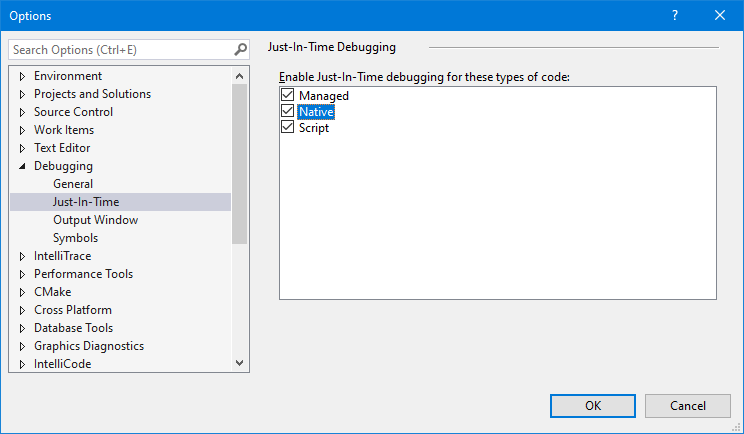
|
||||
|
||||
Then when you run something with `DebugBreak()` in it, you will see this:
|
||||
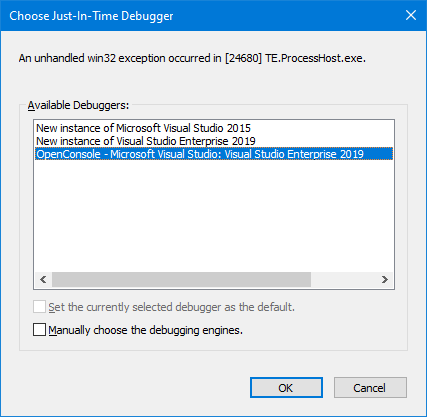
|
||||
|
||||
The top ones will be new instances of the Visual Studios installed on your system. The bottom ones will be the running instances of Visual Studio. You can see in the image that one is open already. If you choose the bottom one, VS will attach straight up as if you F5'd from the solution at the point from the `DebugBreak()`. Step up to get out of the break and back into the code.
|
||||
|
||||
### Setting WinDBG as Post Mortem Debugger
|
||||
|
||||
From an elevated context (a command prompt or whatnot...), run `windbg /I`. This will install the debugger as Post Mortem.
|
||||
|
||||
Then run the thing and it will pop straight into a new WinDBG session. Step up to get out of the break and back into the code.
|
||||
|
||||
**Caveat:** If you are on an x64 system, you may need to do `windbg /I` with both the x64 and x86 versions of the debugger to catch all circumstances (like if you're trying to run x86 code.)
|
||||
2. Change the *Application process* type from *Mixed (Managed and Native)* to *Native Only*.
|
||||
@@ -33,7 +33,7 @@ Also, I'm happy to discuss this with you until you're utterly sick of reading it
|
||||
|
||||
If I had to take an educated guess as to what is making us faster than pretty much any other application on Windows at putting your text on the screen... I would say it is because that is literally our only job! Also probably because we are using darn near the oldest and lowest level APIs that Windows has to accomplish this work.
|
||||
|
||||
Pretty much everything else you've listed has some sort of layer or framework involved, or many, many layers and frameworks, when you start talking about Electron and JavaScript. We don't.
|
||||
Pretty much everything else you've listed has some sort of layer or framework involved, or many, many layers and frameworks, when you start talking about Electron and Javascript. We don't.
|
||||
|
||||
We have one bare, super un-special window with no additional controls attached to it. We get our keys fed into us from just barely above the kernel given that we're processing them from window messages and not from some sort of eventing framework common to pretty much any other more complicated UI framework than ours (WPF, WinForms, UWP, Electron). And we dump our text straight onto the window surface using GDI's [PolyTextOut](https://docs.microsoft.com/en-us/windows/desktop/api/wingdi/nf-wingdi-polytextoutw) with no frills.
|
||||
|
||||
|
||||
@@ -24,16 +24,6 @@
|
||||
* `/ipch` – not checked in is where intellisense data will be generated if you use Visual Studio 2015
|
||||
* `/obj` – not checked in is where objects will be generated by the MSBuild system
|
||||
* `/src` – This is the fun one. In the root is common build system data.
|
||||
* `/src/cascadia` - This directory contains all the code specific to the Windows Terminal
|
||||
* `/src/cascadia/TerminalConnection` - This DLL is responsible for the various different ways a terminal instance can communicate with different terminal backends. Examples include the `ConptyConnection` (for communicating with Windows Console processes), or the `AzureCloudShellConnection` for communicating with Azure.
|
||||
* `/src/cascadia/TerminalSettings` - This is the DLL responsible for abstracting the settings for both the TerminalCore and the TerminalControl. This provides consumers of the TerminalControl a common interface for supplying settings to the Terminal.
|
||||
* `/src/cascadia/TerminalCore` - This LIB is responsible for the core implementation of a terminal instance. This defines one important class `Terminal` which is a complete terminal instance, with buffer, colors table, VT parsing, input handling, etc. It does _not_ prescribe any sort of UI implementation - it should be connected to code that can handle rendering its contents, and provide input to it.
|
||||
* `/src/cascadia/TerminalControl` - This DLL provides the UWP-XAML implementation of a `TermControl`, which can be embedded within an application to provide a terminal instance within the application. It contains a DX renderer for drawing text to the screen, and translates input to send to the core Terminal. It also receives settings to apply to both itself and the core Terminal.
|
||||
* `/src/cascadia/TerminalApp` - This DLL represents the implementation of the Windows Terminal application. This includes parsing settings, hosting tabs & panes with Terminals in them, and displaying other UI elements. This DLL is almost entirely UWP-like code, and shouldn't be doing any Win32-like UI work.
|
||||
* `/src/cascadia/WindowsTerminal` - This EXE provides Win32 hosting for the TerminalApp. It will set up XAML islands, and is responsible for drawing the window, either as a standard window or with content in the titlebar (non-client area).
|
||||
* `/src/cascadia/CascadiaPackage` - This is a project for packaging the Windows Terminal and its dependencies into an .appx/.msix for deploying to the machine.
|
||||
* `/src/cascadia/PublicTerminalCore` - This is a DLL wrapper for the TerminalCore and Renderer, similar to `TermControl`, which exposes some exported functions that so the Terminal can be used from C#.
|
||||
* `/src/cascadia/WpfTerminalControl` - A DLL implementing a WPF version of the Terminal Control.
|
||||
* `/src/host` – The meat of the windows console host. This includes buffer, input, output, windowing, server management, clipboard, and most interactions with the console host window that aren’t stated anywhere else. We’re trying to pull things out that are reusable into other libraries, but it’s a work in progress
|
||||
* `/src/host/lib` – Builds the reusable LIB copy of the host
|
||||
* `/src/host/dll` – Packages LIB into conhostv2.dll to be put into the OS C:\windows\system32\
|
||||
@@ -52,7 +42,7 @@
|
||||
* `/src/renderer/base` – Base interface layer providing non-engine-specific rendering things like choosing the data from the console buffer, deciding how to lay out or transform that data, then dispatching commands to a specific final display engine
|
||||
* `/src/renderer/gdi` – The GDI implementation of rendering to the screen. Takes commands to “draw a line” or “fill the background” or “select a region” from the base and turns them into GDI calls to the screen. Extracted from original console host code.
|
||||
* `/src/renderer/inc` – Interface definitions for all renderer communication
|
||||
* `/src/terminal` – Virtual terminal support for the console. This is the sequences that are found in-band with other text on STDIN/STDOUT that command the display to do things. This is the \*nix way of controlling a console.
|
||||
* `/src/terminal` – Virtual terminal support for the console. This is the sequences that are found in-band with other text on STDIN/STDOUT that command the display to do things. This is the *nix way of controlling a console.
|
||||
* `/src/terminal/parser` – This contains a state machine and sorting engine for feeding in individual characters from STDOUT or STDIN and decoding them into the appropriate verbs that should be performed
|
||||
* `/src/terminal/adapter` – This converts the verbs from the interface into calls on the console API. It doesn’t actually call through the API (for performance reasons since it lives inside the same binary), but it tries to remain as close to an API call as possible. There are some private extensions to the API for behaviors that didn’t exist before this was written that we’ve not made public. We don’t know if we will yet or force people to use VT to get at them.
|
||||
* `/src/tsf` – Text Services Foundation. This provides IME input services to the console. This was historically used for only Chinese, Japanese, and Korean IMEs specifically on OS installations with those as the primary language. It was in the summer of 2016 unrestricted to be able to be used on any OS installation with any IME (whether or not it will display correctly is a different story). It also was unrestricted to allow things like Pen and Touch input (which are routed via IME messages) to display properly inside the console from the TabTip window (the little popup that helps you insert pen/touch writing/keyboard candidates into an application)
|
||||
@@ -100,7 +90,7 @@
|
||||
* Assorted utilities and stuff
|
||||
* `Misc.cpp` (left for us by previous eras of random console devs)
|
||||
* `Util.cpp` (created in our era)
|
||||
* Custom zeroing and non-throwing allocator
|
||||
* Custom zeroing and non-throwing allocator
|
||||
* `Newdelete.cpp`
|
||||
* Related to inserting text into the TextInfo buffer
|
||||
* `Output.cpp`
|
||||
|
||||
@@ -5,4 +5,3 @@
|
||||
1. If it's brand new code or refactoring a complete class or area of the code, please follow as Modern C++ of a style as you can and reference the [C++ Core Guidelines](https://github.com/isocpp/CppCoreGuidelines) as much as you possibly can.
|
||||
1. When working with any Win32 or NT API, please try to use the [Windows Implementation Library](./WIL.md) smart pointers and result handlers.
|
||||
1. The use of NTSTATUS as a result code is discouraged, HRESULT or exceptions are preferred. Functions should not return a status code if they would always return a successful status code. Any function that returns a status code should be marked `noexcept` and have the `nodiscard` attribute.
|
||||
1. When contributing code in `TerminalApp`, be mindful to appropriately use C++/WinRT [strong and weak references](https://docs.microsoft.com/en-us/windows/uwp/cpp-and-winrt-apis/weak-references), and have a good understanding of C++/WinRT [concurrency schemes](https://docs.microsoft.com/en-us/windows/uwp/cpp-and-winrt-apis/concurrency).
|
||||
|
||||
@@ -1,38 +1,13 @@
|
||||
|
||||
# How to build OpenConsole
|
||||
# How to build Openconsole
|
||||
|
||||
This repository uses [git submodules](https://git-scm.com/book/en/v2/Git-Tools-Submodules) for some of its dependencies. To make sure submodules are restored or updated, be sure to run the following prior to building:
|
||||
|
||||
```shell
|
||||
git submodule update --init --recursive
|
||||
```
|
||||
|
||||
OpenConsole.sln may be built from within Visual Studio or from the command-line using a set of convenience scripts & tools in the **/tools** directory:
|
||||
Openconsole can be built with Visual Studio or from the command line. There are build scripts for both cmd and PowerShell in /tools.
|
||||
|
||||
When using Visual Studio, be sure to set up the path for code formatting. This can be done in Visual Studio by going to Tools > Options > Text Editor > C++ > Formatting and checking "Use custom clang-format.exe file" and choosing the clang-format.exe in the repository at /dep/llvm/clang-format.exe by clicking "browse" right under the check box.
|
||||
|
||||
### Building in PowerShell
|
||||
## Building with cmd
|
||||
|
||||
```powershell
|
||||
Import-Module .\tools\OpenConsole.psm1
|
||||
Set-MsBuildDevEnvironment
|
||||
Invoke-OpenConsoleBuild
|
||||
```
|
||||
|
||||
There are a few additional exported functions (look at their documentation for further details):
|
||||
|
||||
- `Invoke-OpenConsoleBuild` - builds the solution. Can be passed msbuild arguments.
|
||||
- `Invoke-OpenConsoleTests` - runs the various tests. Will run the unit tests by default.
|
||||
- `Start-OpenConsole` - starts Openconsole.exe from the output directory. x64 is run by default.
|
||||
- `Debug-OpenConsole` - starts Openconsole.exe and attaches it to the default debugger. x64 is run by default.
|
||||
- `Invoke-CodeFormat` - uses clang-format to format all c++ files to match our coding style.
|
||||
|
||||
### Building in Cmd
|
||||
|
||||
```shell
|
||||
.\tools\razzle.cmd
|
||||
bcz
|
||||
```
|
||||
The cmd scripts are set up to emulate a portion of the OS razzle build environment. razzle.cmd is the first script that should be run. bcz.cmd will build clean and bz.cmd should build incrementally.
|
||||
|
||||
There are also scripts for running the tests:
|
||||
- `runut.cmd` - run the unit tests
|
||||
@@ -40,13 +15,15 @@ There are also scripts for running the tests:
|
||||
- `runuia.cmd` - run the UIA tests
|
||||
- `runformat` - uses clang-format to format all c++ files to match our coding style.
|
||||
|
||||
## Running & Debugging
|
||||
## Build with Powershell
|
||||
|
||||
To debug the Windows Terminal in VS, right click on `CascadiaPackage` (in the Solution Explorer) and go to properties. In the Debug menu, change "Application process" and "Background task process" to "Native Only".
|
||||
Openconsole.psm1 should be loaded with `Import-Module`. From there `Set-MsbuildDevEnvironment` will set up environment variables required to build. There are a few exported functions (look at their documentation for further details):
|
||||
|
||||
You should then be able to build & debug the Terminal project by hitting <kbd>F5</kbd>.
|
||||
|
||||
> 👉 You will _not_ be able to launch the Terminal directly by running the WindowsTerminal.exe. For more details on why, see [#926](https://github.com/microsoft/terminal/issues/926), [#4043](https://github.com/microsoft/terminal/issues/4043)
|
||||
- `Invoke-OpenConsolebuild` - builds the solution. Can be passed msbuild arguments.
|
||||
- `Invoke-OpenConsoleTests` - runs the various tests. Will run the unit tests by default.
|
||||
- `Start-OpenConsole` - starts Openconsole.exe from the output directory. x64 is run by default.
|
||||
- `Debug-OpenConsole` - starts Openconsole.exe and attaches it to the default debugger. x64 is run by default.
|
||||
- `Invoke-CodeFormat` - uses clang-format to format all c++ files to match our coding style.
|
||||
|
||||
## Configuration Types
|
||||
|
||||
@@ -57,27 +34,3 @@ Openconsole has three configuration types:
|
||||
- AuditMode
|
||||
|
||||
AuditMode is an experimental mode that enables some additional static analysis from CppCoreCheck.
|
||||
|
||||
## Updating Nuget package references
|
||||
Certain Nuget package references in this project, like `Microsoft.UI.Xaml`, must be updated outside of the Visual Studio NuGet package manager. This can be done using the snippet below.
|
||||
> Note that to run this snippet, you need to use WSL as the command uses `sed`.
|
||||
To update the version of a given package, use the following snippet
|
||||
|
||||
`git grep -z -l $PackageName | xargs -0 sed -i -e 's/$OldVersionNumber/$NewVersionNumber/g'`
|
||||
|
||||
where:
|
||||
- `$PackageName` is the name of the package, e.g. Microsoft.UI.Xaml
|
||||
- `$OldVersionNumber` is the version number currently used, e.g. 2.5.0-prerelease.200609001
|
||||
- `$NewVersionNumber` is the version number you want to migrate to, e.g. 2.4.200117003-prerelease
|
||||
|
||||
Example usage:
|
||||
|
||||
`git grep -z -l Microsoft.UI.Xaml | xargs -0 sed -i -e 's/2.5.0-prerelease.200609001/2.4.200117003-prerelease/g'`
|
||||
|
||||
## Using .nupkg files instead of downloaded Nuget packages
|
||||
If you want to use .nupkg files instead of the downloaded Nuget package, you can do this with the following steps:
|
||||
|
||||
1. Open the Nuget.config file and uncomment line 8 ("Static Package Dependencies")
|
||||
2. Create the folder /dep/packages
|
||||
3. Put your .nupkg files in /dep/packages
|
||||
4. If you are using different versions than those already being used, you need to update the references as well. How to do that is explained under "Updating Nuget package references".
|
||||
|
||||
@@ -1,257 +0,0 @@
|
||||
# New Json Utility API
|
||||
|
||||
## Raw value conversion (GetValue)
|
||||
|
||||
`GetValue` is a convenience helper that will either read a value into existing storage (type-deduced) or
|
||||
return a JSON value coerced into the specified type.
|
||||
|
||||
When reading into existing storage, it returns a boolean indicating whether that storage was modified.
|
||||
|
||||
If the JSON value cannot be converted to the specified type, an exception will be generated.
|
||||
|
||||
```c++
|
||||
std::string one;
|
||||
std::optional<std::string> two;
|
||||
|
||||
JsonUtils::GetValue(json, one);
|
||||
// one is populated or unchanged.
|
||||
|
||||
JsonUtils::GetValue(json, two);
|
||||
// two is populated, nullopt or unchanged
|
||||
|
||||
auto three = JsonUtils::GetValue<std::string>(json);
|
||||
// three is populated or zero-initialized
|
||||
|
||||
auto four = JsonUtils::GetValue<std::optional<std::string>>(json);
|
||||
// four is populated or nullopt
|
||||
```
|
||||
|
||||
## Key lookup (GetValueForKey)
|
||||
|
||||
`GetValueForKey` follows the same rules as `GetValue`, but takes an additional key.
|
||||
It is assumed that the JSON value passed to GetValueForKey is of `object` type.
|
||||
|
||||
```c++
|
||||
std::string one;
|
||||
std::optional<std::string> two;
|
||||
|
||||
JsonUtils::GetValueForKey(json, "firstKey", one);
|
||||
// one is populated or unchanged.
|
||||
|
||||
JsonUtils::GetValueForKey(json, "secondKey", two);
|
||||
// two is populated, nullopt or unchanged
|
||||
|
||||
auto three = JsonUtils::GetValueForKey<std::string>(json, "thirdKey");
|
||||
// three is populated or zero-initialized
|
||||
|
||||
auto four = JsonUtils::GetValueForKey<std::optional<std::string>>(json, "fourthKey");
|
||||
// four is populated or nullopt
|
||||
```
|
||||
|
||||
## Rationale: Value-Returning Getters
|
||||
|
||||
JsonUtils provides two types of `GetValue...`: value-returning and reference-filling.
|
||||
|
||||
The reference-filling fixtures use type deduction so that a developer does not
|
||||
need to specify template parameters on every `GetValue` call. It excels at
|
||||
populating class members during deserialization.
|
||||
|
||||
The value-returning fixtures, on the other hand, are very useful for partial
|
||||
deserialization and key detection when you do not need to deserialize an entire
|
||||
instance of a class or you need to reason about the presence of members.
|
||||
|
||||
To provide a concrete example of the latter, consider:
|
||||
|
||||
```c++
|
||||
if (const auto guid{ GetValueForKey<std::optional<GUID>>(json, "guid") })
|
||||
// This condition is only true if there was a "guid" member in the provided JSON object.
|
||||
// It can be accessed through *guid.
|
||||
}
|
||||
```
|
||||
|
||||
If you are... | Use
|
||||
--------------|-----
|
||||
Deserializing | `GetValue(..., storage)`
|
||||
Interrogating | `storage = GetValue<T>(...)`
|
||||
|
||||
## Converting User-Defined Types
|
||||
|
||||
All conversions are done using specializations of
|
||||
`JsonUtils::ConversionTrait<T>`. To implement a converter for a user-defined
|
||||
type, you must implement a specialization of `JsonUtils::ConversionTrait<T>`.
|
||||
|
||||
Every specialization over `T` must implement `static T FromJson(const Json::Value&)`
|
||||
and `static bool CanConvert(const Json::Value&)`.
|
||||
|
||||
```c++
|
||||
struct MyCustomType { int val; };
|
||||
|
||||
template<>
|
||||
struct ConversionTrait<MyCustomType>
|
||||
{
|
||||
// This trait converts a string of the format "[0-9]" to a value of type MyCustomType.
|
||||
|
||||
static MyCustomType FromJson(const Json::Value& json)
|
||||
{
|
||||
return MyCustomType{ json.asString()[0] - '0' };
|
||||
}
|
||||
|
||||
static bool CanConvert(const Json::Value& json)
|
||||
{
|
||||
return json.isString();
|
||||
}
|
||||
};
|
||||
```
|
||||
|
||||
### Converting User-Defined Enumerations
|
||||
|
||||
Enumeration types represent a single choice out of multiple options.
|
||||
|
||||
In a JSON data model, they are typically represented as strings.
|
||||
|
||||
For parsing enumerations, JsonUtils provides the `JSON_ENUM_MAPPER` macro. It
|
||||
can be used to establish a converter that will take a set of known strings and
|
||||
convert them to values.
|
||||
|
||||
```c++
|
||||
JSON_ENUM_MAPPER(CursorStyle)
|
||||
{
|
||||
// pair_type is provided by ENUM_MAPPER.
|
||||
JSON_MAPPINGS(5) = {
|
||||
pair_type{ "bar", CursorStyle::Bar },
|
||||
pair_type{ "vintage", CursorStyle::Vintage },
|
||||
pair_type{ "underscore", CursorStyle::Underscore },
|
||||
pair_type{ "filledBox", CursorStyle::FilledBox },
|
||||
pair_type{ "emptyBox", CursorStyle::EmptyBox }
|
||||
};
|
||||
};
|
||||
```
|
||||
|
||||
If the enum mapper fails to convert the provided string, it will throw an
|
||||
exception.
|
||||
|
||||
### Converting User-Defined Flag Sets
|
||||
|
||||
Flags represent a multiple-choice selection. They are typically implemented as
|
||||
enums with bitfield values intended to be ORed together.
|
||||
|
||||
In JSON, a set of flags may be represented by a single string (`"flagName"`) or
|
||||
an array of strings (`["flagOne", "flagTwo"]`).
|
||||
|
||||
JsonUtils provides a `JSON_FLAG_MAPPER` macro that can be used to produce a
|
||||
specialization for a set of flags.
|
||||
|
||||
Given the following flag enum,
|
||||
|
||||
```c++
|
||||
enum class JsonTestFlags : int
|
||||
{
|
||||
FlagOne = 1 << 0,
|
||||
FlagTwo = 1 << 1
|
||||
};
|
||||
```
|
||||
|
||||
You can register a flag mapper with the `JSON_FLAG_MAPPER` macro as follows:
|
||||
|
||||
```c++
|
||||
JSON_FLAG_MAPPER(JsonTestFlags)
|
||||
{
|
||||
JSON_MAPPINGS(2) = {
|
||||
pair_type{ "flagOne", JsonTestFlags::FlagOne },
|
||||
pair_type{ "flagTwo", JsonTestFlags::FlagTwo },
|
||||
};
|
||||
};
|
||||
```
|
||||
|
||||
The `FLAG_MAPPER` also provides two convenience definitions, `AllSet` and
|
||||
`AllClear`, that can be used to represent "all choices" and "no choices"
|
||||
respectively.
|
||||
|
||||
```c++
|
||||
JSON_FLAG_MAPPER(JsonTestFlags)
|
||||
{
|
||||
JSON_MAPPINGS(4) = {
|
||||
pair_type{ "never", AllClear },
|
||||
pair_type{ "flagOne", JsonTestFlags::FlagOne },
|
||||
pair_type{ "flagTwo", JsonTestFlags::FlagTwo },
|
||||
pair_type{ "always", AllSet },
|
||||
};
|
||||
};
|
||||
```
|
||||
|
||||
Because flag values are additive, `["always", "flagOne"]` will result in the
|
||||
same behavior as `"always"`.
|
||||
|
||||
If the flag mapper encounters an unknown flag, it will throw an exception.
|
||||
|
||||
If the flag mapper encounters a logical discontinuity such as `["never", "flagOne"]`
|
||||
(as in the above example), it will throw an exception.
|
||||
|
||||
### Advanced Use
|
||||
|
||||
`GetValue` and `GetValueForKey` can be passed, as their final arguments, any
|
||||
value whose type implements the same interface as `ConversionTrait<T>`--that
|
||||
is, `FromJson(const Json::Value&)` and `CanConvert(const Json::Value&)`.
|
||||
|
||||
This allows for one-off conversions without a specialization of
|
||||
`ConversionTrait` or even stateful converters.
|
||||
|
||||
#### Stateful Converter Sample
|
||||
|
||||
```c++
|
||||
struct MultiplyingConverter {
|
||||
int BaseValue;
|
||||
|
||||
bool CanConvert(const Json::Value&) { return true; }
|
||||
|
||||
int FromJson(const Json::Value& value)
|
||||
{
|
||||
return value.asInt() * BaseValue;
|
||||
}
|
||||
};
|
||||
|
||||
...
|
||||
|
||||
Json::Value json{ 66 }; // A JSON value containing the number 66
|
||||
MultiplyingConverter conv{ 10 };
|
||||
|
||||
auto v = JsonUtils::GetValue<int>(json, conv);
|
||||
// v is equal to 660.
|
||||
```
|
||||
|
||||
## Behavior Chart
|
||||
|
||||
### GetValue(T&) (type-deducing)
|
||||
|
||||
-|json type invalid|json null|valid
|
||||
-|-|-|-
|
||||
`T`|❌ exception|🔵 unchanged|✔ converted
|
||||
`std::optional<T>`|❌ exception|🟨 `nullopt`|✔ converted
|
||||
|
||||
### GetValue<T>() (returning)
|
||||
|
||||
-|json type invalid|json null|valid
|
||||
-|-|-|-
|
||||
`T`|❌ exception|🟨 `T{}` (zero value)|✔ converted
|
||||
`std::optional<T>`|❌ exception|🟨 `nullopt`|✔ converted
|
||||
|
||||
### GetValueForKey(T&) (type-deducing)
|
||||
|
||||
GetValueForKey builds on the behavior set from GetValue by adding
|
||||
a "key not found" state. The remaining three cases are the same.
|
||||
|
||||
val type|key not found|_json type invalid_|_json null_|_valid_
|
||||
-|-|-|-|-
|
||||
`T`|🔵 unchanged|_❌ exception_|_🔵 unchanged_|_✔ converted_
|
||||
`std::optional<T>`|_🔵 unchanged_|_❌ exception_|_🟨 `nullopt`_|_✔ converted_
|
||||
|
||||
### GetValueForKey<T>() (return value)
|
||||
|
||||
val type|key not found|_json type invalid_|_json null_|_valid_
|
||||
-|-|-|-|-
|
||||
`T`|🟨 `T{}` (zero value)|_❌ exception_|_🟨 `T{}` (zero value)_|_✔ converted_
|
||||
`std::optional<T>`|🟨 `nullopt`|_❌ exception_|_🟨 `nullopt`_|_✔ converted_
|
||||
|
||||
### Future Direction
|
||||
|
||||
These converters lend themselves very well to automatic _serialization_.
|
||||
@@ -1,75 +1,55 @@
|
||||
# Settings.json Documentation
|
||||
# Profiles.json Documentation
|
||||
|
||||
## Globals
|
||||
|
||||
Properties listed below affect the entire window, regardless of the profile settings.
|
||||
|
||||
| Property | Necessity | Type | Default | Description |
|
||||
| -------- | --------- | ---- | ------- | ----------- |
|
||||
| `alwaysShowTabs` | _Required_ | Boolean | `true` | When set to `true`, tabs are always displayed. When set to `false` and `showTabsInTitlebar` is set to `false`, tabs only appear after typing <kbd>Ctrl</kbd> + <kbd>T</kbd>. |
|
||||
| `copyOnSelect` | Optional | Boolean | `false` | When set to `true`, a selection is immediately copied to your clipboard upon creation. When set to `false`, the selection persists and awaits further action. |
|
||||
| `copyFormatting` | Optional | Boolean | `false` | When set to `true`, the color and font formatting of selected text is also copied to your clipboard. When set to `false`, only plain text is copied to your clipboard. |
|
||||
| `largePasteWarning` | Optional | Boolean | `true` | When set to `true`, trying to paste text with more than 5 KiB of characters will display a warning asking you whether to continue or not with the paste. |
|
||||
| `multiLinePasteWarning` | Optional | Boolean | `true` | When set to `true`, trying to paste text with a _new line_ character will display a warning asking you whether to continue or not with the paste. |
|
||||
| `defaultProfile` | _Required_ | String | PowerShell guid | Sets the default profile. Opens by typing <kbd>Ctrl</kbd> + <kbd>T</kbd> or by clicking the '+' icon. The guid of the desired default profile is used as the value. |
|
||||
| `initialCols` | _Required_ | Integer | `120` | The number of columns displayed in the window upon first load. |
|
||||
| `initialPosition` | Optional | String | `","` | The position of the top left corner of the window upon first load. On a system with multiple displays, these coordinates are relative to the top left of the primary display. If `launchMode` is set to `"maximized"`, the window will be maximized on the monitor specified by those coordinates. |
|
||||
| `initialRows` | _Required_ | Integer | `30` | The number of rows displayed in the window upon first load. |
|
||||
| `launchMode` | Optional | String | `default` | Defines whether the Terminal will launch as maximized or not. Possible values: `"default"`, `"maximized"` |
|
||||
| `theme` | _Required_ | String | `system` | Sets the theme of the application. Possible values: `"light"`, `"dark"`, `"system"` |
|
||||
| `requestedTheme` | _Required_ | String | `system` | Sets the theme of the application. Possible values: `"light"`, `"dark"`, `"system"` |
|
||||
| `showTerminalTitleInTitlebar` | _Required_ | Boolean | `true` | When set to `true`, titlebar displays the title of the selected tab. When set to `false`, titlebar displays "Windows Terminal". |
|
||||
| `showTabsInTitlebar` | Optional | Boolean | `true` | When set to `true`, the tabs are moved into the titlebar and the titlebar disappears. When set to `false`, the titlebar sits above the tabs. |
|
||||
| `snapToGridOnResize` | Optional | Boolean | `false` | When set to `true`, the window will snap to the nearest character boundary on resize. When `false`, the window will resize "smoothly" |
|
||||
| `tabWidthMode` | Optional | String | `equal` | Sets the width of the tabs. Possible values: <br><ul><li>`"equal"`: sizes each tab to the same width</li><li>`"titleLength"`: sizes each tab to the length of its title</li><li>`"compact"`: sizes each tab to the length of its title when focused, and shrinks to the size of only the icon when the tab is unfocused.</li></ul> |
|
||||
| `wordDelimiters` | Optional | String | <code> /\()"'-:,.;<>~!@#$%^&*|+=[]{}~?│</code><br>_(`│` is `U+2502 BOX DRAWINGS LIGHT VERTICAL`)_ | Determines the delimiters used in a double click selection. |
|
||||
| `confirmCloseAllTabs` | Optional | Boolean | `true` | When set to `true` closing a window with multiple tabs open WILL require confirmation. When set to `false` closing a window with multiple tabs open WILL NOT require confirmation. |
|
||||
| `startOnUserLogin` | Optional | Boolean | `false` | When set to `true` enables the launch of Windows Terminal at startup. Setting to `false` will disable the startup task entry. Note: if the Windows Terminal startup task entry is disabled either by org policy or by user action this setting will have no effect. |
|
||||
| `disabledProfileSources` | Optional | Array[String] | `[]` | Disables all the dynamic profile generators in this list, preventing them from adding their profiles to the list of profiles on startup. This array can contain any combination of `Windows.Terminal.Wsl`, `Windows.Terminal.Azure`, or `Windows.Terminal.PowershellCore`. For more information, see [UsingJsonSettings.md](https://github.com/microsoft/terminal/blob/master/doc/user-docs/UsingJsonSettings.md#dynamic-profiles) |
|
||||
| `experimental.rendering.forceFullRepaint` | Optional | Boolean | `false` | When set to true, we will redraw the entire screen each frame. When set to false, we will render only the updates to the screen between frames. |
|
||||
| `experimental.rendering.software` | Optional | Boolean | `false` | When set to true, we will use the software renderer (a.k.a. WARP) instead of the hardware one. |
|
||||
|
||||
## Profiles
|
||||
|
||||
Properties listed below are specific to each unique profile.
|
||||
|
||||
| Property | Necessity | Type | Default | Description |
|
||||
| -------- | --------- | ---- | ------- | ----------- |
|
||||
| `guid` | _Required_ | String | | Unique identifier of the profile. Written in registry format: `"{00000000-0000-0000-0000-000000000000}"`. |
|
||||
| `name` | _Required_ | String | | Name of the profile. Displays in the dropdown menu. <br>Additionally, this value will be used as the "title" to pass to the shell on startup. Some shells (like `bash`) may choose to ignore this initial value, while others (`cmd`, `powershell`) may use this value over the lifetime of the application. This "title" behavior can be overridden by using `tabTitle`. |
|
||||
| `name` | _Required_ | String | | Name of the profile. Displays in the dropdown menu. <br>Additionally, this value will be used as the "title" to pass to the shell on startup. Some shells (like `bash`) may choose to ignore this initial value, while others (`cmd`, `powershell`) may use this value over the lifetime of the application. This "title" behavior can be overriden by using `tabTitle`. |
|
||||
| `acrylicOpacity` | Optional | Number | `0.5` | When `useAcrylic` is set to `true`, it sets the transparency of the window for the profile. Accepts floating point values from 0-1. |
|
||||
| `antialiasingMode` | Optional | String | `"grayscale"` | Controls how text is antialiased in the renderer. Possible values are "grayscale", "cleartype" and "aliased". Note that changing this setting will require starting a new terminal instance. |
|
||||
| `background` | Optional | String | | Sets the background color of the profile. Overrides `background` set in color scheme if `colorscheme` is set. Uses hex color format: `"#rrggbb"`. |
|
||||
| `backgroundImage` | Optional | String | | Sets the file location of the Image to draw over the window background. |
|
||||
| `backgroundImageAlignment` | Optional | String | `center` | Sets how the background image aligns to the boundaries of the window. Possible values: `"center"`, `"left"`, `"top"`, `"right"`, `"bottom"`, `"topLeft"`, `"topRight"`, `"bottomLeft"`, `"bottomRight"` |
|
||||
| `backgroundImageOpacity` | Optional | Number | `1.0` | Sets the transparency of the background image. Accepts floating point values from 0-1. |
|
||||
| `backgroundImageStretchMode` | Optional | String | `uniformToFill` | Sets how the background image is resized to fill the window. Possible values: `"none"`, `"fill"`, `"uniform"`, `"uniformToFill"` |
|
||||
| `closeOnExit` | Optional | String | `graceful` | Sets how the profile reacts to termination or failure to launch. Possible values: `"graceful"` (close when `exit` is typed or the process exits normally), `"always"` (always close) and `"never"` (never close). `true` and `false` are accepted as synonyms for `"graceful"` and `"never"` respectively. |
|
||||
| `closeOnExit` | Optional | Boolean | `true` | When set to `true`, the selected tab closes when `exit` is typed. When set to `false`, the tab will remain open when `exit` is typed. |
|
||||
| `colorScheme` | Optional | String | `Campbell` | Name of the terminal color scheme to use. Color schemes are defined under `schemes`. |
|
||||
| `colorTable` | Optional | Array[String] | | Array of colors used in the profile if `colorscheme` is not set. Array follows the format defined in `schemes`. |
|
||||
| `commandline` | Optional | String | | Executable used in the profile. |
|
||||
| `cursorColor` | Optional | String | | Sets the cursor color of the profile. Overrides `cursorColor` set in color scheme if `colorscheme` is set. Uses hex color format: `"#rrggbb"`. |
|
||||
| `cursorColor` | Optional | String | `#FFFFFF` | Sets the cursor color for the profile. Uses hex color format: `"#rrggbb"`. |
|
||||
| `cursorHeight` | Optional | Integer | | Sets the percentage height of the cursor starting from the bottom. Only works when `cursorShape` is set to `"vintage"`. Accepts values from 25-100. |
|
||||
| `cursorShape` | Optional | String | `bar` | Sets the cursor shape for the profile. Possible values: `"vintage"` ( ▃ ), `"bar"` ( ┃ ), `"underscore"` ( ▁ ), `"filledBox"` ( █ ), `"emptyBox"` ( ▯ ) |
|
||||
| `fontFace` | Optional | String | `Cascadia Mono` | Name of the font face used in the profile. We will try to fallback to Consolas if this can't be found or is invalid. |
|
||||
| `fontFace` | Optional | String | `Consolas` | Name of the font face used in the profile. We will try to fallback to Consolas if this can't be found or is invalid. |
|
||||
| `fontSize` | Optional | Integer | `12` | Sets the font size. |
|
||||
| `fontWeight` | Optional | String | `normal` | Sets the weight (lightness or heaviness of the strokes) for the given font. Possible values: `"thin"`, `"extra-light"`, `"light"`, `"semi-light"`, `"normal"`, `"medium"`, `"semi-bold"`, `"bold"`, `"extra-bold"`, `"black"`, `"extra-black"`, or the corresponding numeric representation of OpenType font weight. |
|
||||
| `foreground` | Optional | String | | Sets the foreground color of the profile. Overrides `foreground` set in color scheme if `colorscheme` is set. Uses hex color format: `#rgb` or `"#rrggbb"`. |
|
||||
| `hidden` | Optional | Boolean | `false` | If set to true, the profile will not appear in the list of profiles. This can be used to hide default profiles and dynamically generated profiles, while leaving them in your settings file. |
|
||||
| `hidden` | Optional | Boolean | `false` | If set to true, the profile will not appear in the list of profiles. This can be used to hide default profiles and dynamicially generated profiles, while leaving them in your settings file. |
|
||||
| `historySize` | Optional | Integer | `9001` | The number of lines above the ones displayed in the window you can scroll back to. |
|
||||
| `icon` | Optional | String | | Image file location of the icon used in the profile. Displays within the tab and the dropdown menu. |
|
||||
| `padding` | Optional | String | `8, 8, 8, 8` | Sets the padding around the text within the window. Can have three different formats: `"#"` sets the same padding for all sides, `"#, #"` sets the same padding for left-right and top-bottom, and `"#, #, #, #"` sets the padding individually for left, top, right, and bottom. |
|
||||
| `scrollbarState` | Optional | String | `"visible"` | Defines the visibility of the scrollbar. Possible values: `"visible"`, `"hidden"` |
|
||||
| `selectionBackground` | Optional | String | | Sets the selection background color of the profile. Overrides `selectionBackground` set in color scheme if `colorscheme` is set. Uses hex color format: `"#rrggbb"`. |
|
||||
| `scrollbarState` | Optional | String | | Defines the visibility of the scrollbar. Possible values: `"visible"`, `"hidden"` |
|
||||
| `snapOnInput` | Optional | Boolean | `true` | When set to `true`, the window will scroll to the command input line when typing. When set to `false`, the window will not scroll when you start typing. |
|
||||
| `altGrAliasing` | Optional | Boolean | `true` | By default Windows treats Ctrl+Alt as an alias for AltGr. When altGrAliasing is set to false, this behavior will be disabled. |
|
||||
| `source` | Optional | String | | Stores the name of the profile generator that originated this profile. _There are no discoverable values for this field._ |
|
||||
| `startingDirectory` | Optional | String | `%USERPROFILE%` | The directory the shell starts in when it is loaded. |
|
||||
| `suppressApplicationTitle` | Optional | Boolean | `false` | When set to `true`, `tabTitle` overrides the default title of the tab and any title change messages from the application will be suppressed. When set to `false`, `tabTitle` behaves as normal. |
|
||||
| `tabTitle` | Optional | String | | If set, will replace the `name` as the title to pass to the shell on startup. Some shells (like `bash`) may choose to ignore this initial value, while others (`cmd`, `powershell`) may use this value over the lifetime of the application. |
|
||||
| `useAcrylic` | Optional | Boolean | `false` | When set to `true`, the window will have an acrylic background. When set to `false`, the window will have a plain, untextured background. The transparency only applies to focused windows due to OS limitation. |
|
||||
| `experimental.retroTerminalEffect` | Optional | Boolean | `false` | When set to `true`, enable retro terminal effects. This is an experimental feature, and its continued existence is not guaranteed. |
|
||||
| `useAcrylic` | Optional | Boolean | `false` | When set to `true`, the window will have an acrylic background. When set to `false`, the window will have a plain, untextured background. |
|
||||
|
||||
## Schemes
|
||||
|
||||
Properties listed below are specific to each color scheme. [ColorTool](https://github.com/microsoft/terminal/tree/master/src/tools/ColorTool) is a great tool you can use to create and explore new color schemes. All colors use hex color format.
|
||||
|
||||
| Property | Necessity | Type | Description |
|
||||
@@ -77,8 +57,6 @@ Properties listed below are specific to each color scheme. [ColorTool](https://g
|
||||
| `name` | _Required_ | String | Name of the color scheme. |
|
||||
| `foreground` | _Required_ | String | Sets the foreground color of the color scheme. |
|
||||
| `background` | _Required_ | String | Sets the background color of the color scheme. |
|
||||
| `selectionBackground` | Optional | String | Sets the selection background color of the color scheme. |
|
||||
| `cursorColor` | Optional | String | Sets the cursor color of the color scheme. |
|
||||
| `black` | _Required_ | String | Sets the color used as ANSI black. |
|
||||
| `blue` | _Required_ | String | Sets the color used as ANSI blue. |
|
||||
| `brightBlack` | _Required_ | String | Sets the color used as ANSI bright black. |
|
||||
@@ -97,73 +75,66 @@ Properties listed below are specific to each color scheme. [ColorTool](https://g
|
||||
| `yellow` | _Required_ | String | Sets the color used as ANSI yellow. |
|
||||
|
||||
## Keybindings
|
||||
|
||||
Properties listed below are specific to each custom key binding.
|
||||
|
||||
| Property | Necessity | Type | Description |
|
||||
| -------- | ---- | ----------- | ----------- |
|
||||
| `command` | _Required_ | String | The command executed when the associated key bindings are pressed. |
|
||||
| `keys` | _Required_ | Array[String] or String | Defines the key combinations used to call the command. |
|
||||
| `action` | Optional | String | Adds additional functionality to certain commands. |
|
||||
| `keys` | _Required_ | Array[String] | Defines the key combinations used to call the command. |
|
||||
|
||||
### Implemented Commands and Actions
|
||||
### Implemented Keybindings
|
||||
|
||||
Commands listed below are per the implementation in [`src/cascadia/TerminalApp/AppKeyBindingsSerialization.cpp`](https://github.com/microsoft/terminal/blob/master/src/cascadia/TerminalApp/AppKeyBindingsSerialization.cpp).
|
||||
Bindings listed below are per the implementation in `src/cascadia/TerminalApp/AppKeyBindingsSerialization.cpp`
|
||||
|
||||
Keybindings can be structured in the following manners:
|
||||
|
||||
For commands without arguments:
|
||||
<br>
|
||||
`{ "command": "commandName", "keys": [ "modifiers+key" ] }`
|
||||
|
||||
For commands with arguments:
|
||||
<br>
|
||||
`{ "command": { "action": "commandName", "argument": "value" }, "keys": ["modifiers+key"] }`
|
||||
|
||||
| Command | Command Description | Action (*=required) | Action Arguments | Argument Descriptions |
|
||||
| ------- | ------------------- | ------ | ---------------- | ----------------- |
|
||||
| `adjustFontSize` | Change the text size by a specified point amount. | `delta` | integer | Amount of size change per command invocation. |
|
||||
| `closePane` | Close the active pane. | | | |
|
||||
| `closeTab` | Close the current tab. | | | |
|
||||
| `closeWindow` | Close the current window and all tabs within it. | | | |
|
||||
| `copy` | Copy the selected terminal content to your Windows Clipboard. | `singleLine` | boolean | When `true`, the copied content will be copied as a single line. When `false`, newlines persist from the selected text. |
|
||||
| `duplicateTab` | Make a copy and open the current tab. | | | |
|
||||
| `find` | Open the search dialog box. | | | |
|
||||
| `moveFocus` | Focus on a different pane depending on direction. | `direction`* | `left`, `right`, `up`, `down` | Direction in which the focus will move. |
|
||||
| `newTab` | Create a new tab. Without any arguments, this will open the default profile in a new tab. | 1. `commandLine`<br>2. `startingDirectory`<br>3. `tabTitle`<br>4. `index`<br>5. `profile` | 1. string<br>2. string<br>3. string<br>4. integer<br>5. string | 1. Executable run within the tab.<br>2. Directory in which the tab will open.<br>3. Title of the new tab.<br>4. Profile that will open based on its position in the dropdown (starting at 0).<br>5. Profile that will open based on its GUID or name. |
|
||||
| `nextTab` | Open the tab to the right of the current one. | | | |
|
||||
| `openNewTabDropdown` | Open the dropdown menu. | | | |
|
||||
| `openSettings` | Open the settings file. | | | |
|
||||
| `paste` | Insert the content that was copied onto the clipboard. | | | |
|
||||
| `prevTab` | Open the tab to the left of the current one. | | | |
|
||||
| `resetFontSize` | Reset the text size to the default value. | | | |
|
||||
| `resizePane` | Change the size of the active pane. | `direction`* | `left`, `right`, `up`, `down` | Direction in which the pane will be resized. |
|
||||
| `scrollDown` | Move the screen down. | | | |
|
||||
| `scrollUp` | Move the screen up. | | | |
|
||||
| `scrollUpPage` | Move the screen up a whole page. | | | |
|
||||
| `scrollDownPage` | Move the screen down a whole page. | | | |
|
||||
| `splitPane` | Halve the size of the active pane and open another. Without any arguments, this will open the default profile in the new pane. | 1. `split`*<br>2. `commandLine`<br>3. `startingDirectory`<br>4. `tabTitle`<br>5. `index`<br>6. `profile`<br>7. `splitMode` | 1. `vertical`, `horizontal`, `auto`<br>2. string<br>3. string<br>4. string<br>5. integer<br>6. string<br>7. string | 1. How the pane will split. `auto` will split in the direction that provides the most surface area.<br>2. Executable run within the pane.<br>3. Directory in which the pane will open.<br>4. Title of the tab when the new pane is focused.<br>5. Profile that will open based on its position in the dropdown (starting at 0).<br>6. Profile that will open based on its GUID or name.<br>7. Controls how the pane splits. Only accepts `duplicate` which will duplicate the focused pane's profile into a new pane. |
|
||||
| `switchToTab` | Open a specific tab depending on index. | `index`* | integer | Tab that will open based on its position in the tab bar (starting at 0). |
|
||||
| `toggleFullscreen` | Switch between fullscreen and default window sizes. | | | |
|
||||
| `unbound` | Unbind the associated keys from any command. | | | |
|
||||
|
||||
### Accepted Modifiers and Keys
|
||||
|
||||
#### Modifiers
|
||||
`ctrl+`, `shift+`, `alt+`
|
||||
|
||||
#### Keys
|
||||
|
||||
| Type | Keys |
|
||||
| ---- | ---- |
|
||||
| Function and Alphanumeric Keys | `f1-f24`, `a-z`, `0-9` |
|
||||
| Symbols | ``` ` ```, `-`, `=`, `[`, `]`, `\`, `;`, `'`, `,`, `.`, `/` |
|
||||
| Arrow Keys | `down`, `left`, `right`, `up`, `pagedown`, `pageup`, `pgdn`, `pgup`, `end`, `home`, `plus` |
|
||||
| Action Keys | `tab`, `enter`, `esc`, `escape`, `space`, `backspace`, `delete`, `insert` |
|
||||
| Numpad Keys | `numpad_0-numpad_9`, `numpad0-numpad9`, `numpad_add`, `numpad_plus`, `numpad_decimal`, `numpad_period`, `numpad_divide`, `numpad_minus`, `numpad_subtract`, `numpad_multiply` |
|
||||
- copy
|
||||
- copyTextWithoutNewlines
|
||||
- paste
|
||||
- newTab
|
||||
- openNewTabDropdown
|
||||
- duplicateTab
|
||||
- newTabProfile0
|
||||
- newTabProfile1
|
||||
- newTabProfile2
|
||||
- newTabProfile3
|
||||
- newTabProfile4
|
||||
- newTabProfile5
|
||||
- newTabProfile6
|
||||
- newTabProfile7
|
||||
- newTabProfile8
|
||||
- closeWindow
|
||||
- closeTab
|
||||
- closePane
|
||||
- switchToTab
|
||||
- nextTab
|
||||
- prevTab
|
||||
- increaseFontSize
|
||||
- decreaseFontSize
|
||||
- scrollUp
|
||||
- scrollDown
|
||||
- scrollUpPage
|
||||
- scrollDownPage
|
||||
- switchToTab0
|
||||
- switchToTab1
|
||||
- switchToTab2
|
||||
- switchToTab3
|
||||
- switchToTab4
|
||||
- switchToTab5
|
||||
- switchToTab6
|
||||
- switchToTab7
|
||||
- switchToTab8
|
||||
- openSettings
|
||||
- splitHorizontal
|
||||
- splitVertical
|
||||
- resizePaneLeft
|
||||
- resizePaneRight
|
||||
- resizePaneUp
|
||||
- resizePaneDown
|
||||
- moveFocusLeft
|
||||
- moveFocusRight
|
||||
- moveFocusUp
|
||||
- moveFocusDown
|
||||
|
||||
## Background Images and Icons
|
||||
|
||||
Some Terminal settings allow you to specify custom background images and icons. It is recommended that custom images and icons are stored in system-provided folders and are referred to using the correct [URI Schemes](https://docs.microsoft.com/en-us/windows/uwp/app-resources/uri-schemes). URI Schemes provide a way to reference files independent of their physical paths (which may change in the future).
|
||||
|
||||
The most useful URI schemes to remember when customizing background images and icons are:
|
||||
@@ -176,7 +147,6 @@ The most useful URI schemes to remember when customizing background images and i
|
||||
> ⚠ Note: Do not rely on file references using the `ms-appx` URI Scheme (i.e. icons). These files are considered an internal implementation detail and may change name/location or may be omitted in the future.
|
||||
|
||||
### Icons
|
||||
|
||||
Terminal displays icons for each of your profiles which Terminal generates for any built-in shells - PowerShell Core, PowerShell, and any installed Linux/WSL distros. Each profile refers to a stock icon via the `ms-appx` URI Scheme.
|
||||
|
||||
> ⚠ Note: Do not rely on the files referenced by the `ms-appx` URI Scheme - they are considered an internal implementation detail and may change name/location or may be omitted in the future.
|
||||
@@ -190,7 +160,6 @@ You can refer to you own icons if you wish, e.g.:
|
||||
> 👉 Tip: Icons should be sized to 32x32px in an appropriate raster image format (e.g. .PNG, .GIF, or .ICO) to avoid having to scale your icons during runtime (causing a noticeable delay and loss of quality.)
|
||||
|
||||
### Custom Background Images
|
||||
|
||||
You can apply a background image to each of your profiles, allowing you to configure/brand/style each of your profiles independently from one another if you wish.
|
||||
|
||||
To do so, specify your preferred `backgroundImage`, position it using `backgroundImageAlignment`, set its opacity with `backgroundImageOpacity`, and/or specify how your image fill the available space using `backgroundImageStretchMode`.
|
||||
@@ -207,4 +176,4 @@ For example:
|
||||
|
||||
With these settings, your Terminal's Ubuntu profile would look similar to this:
|
||||
|
||||

|
||||

|
||||
@@ -68,7 +68,7 @@ original files. You could alternatively put all the source in one directory, and
|
||||
have separate `dll/` and `lib/` subdirectories from the source that are solely
|
||||
responsible for building their binary.
|
||||
|
||||
At this point, you might face some difficulty including the right winmd
|
||||
At this point, you might face some difficulty including the right wimnd
|
||||
references, especially from other C++/WinRT dependencies for this project that
|
||||
exist in your solution. I don't know why, but I had a fair amount of difficulty
|
||||
using a `ProjectReference` from a C++/WinRT StaticLibrary to another C++/WinRT
|
||||
|
||||
@@ -23,7 +23,7 @@ Therefore, if you do file issues, or create PRs, please keep an eye on your GitH
|
||||
---
|
||||
## Reporting Security Issues
|
||||
|
||||
**Please do not report security vulnerabilities through public GitHub issues.** Instead, please report them to the Microsoft Security Response Center (MSRC). See [SECURITY.md](./SECURITY.md) for more information.
|
||||
**Please do not report security vulnerabilities through public GitHub issues.** Instead, please report them to the Microsoft Security Response Center (MSRC). See [Security.md](../SECURITY.md) for more information.
|
||||
|
||||
## Before you start, file an issue
|
||||
|
||||
@@ -125,7 +125,7 @@ Team members will be happy to help review specs and guide them to completion.
|
||||
|
||||
### Help Wanted
|
||||
|
||||
Once the team have approved an issue/spec, development can proceed. If no developers are immediately available, the spec can be parked ready for a developer to get started. Parked specs' issues will be labeled "Help Wanted". To find a list of development opportunities waiting for developer involvement, visit the Issues and filter on [the Help-Wanted label](https://github.com/microsoft/terminal/labels/Help%20Wanted).
|
||||
Once the team have approved an issue/spec, development can proceed. If no developers are immediately available, the spec can be parked ready for a developer to get started. Parked specs' issues will be labeled "Help Wanted". To find a list of development opportunities waiting for developer involvement, visit the Issues and filter on [the Help-Wanted label](https://github.com/microsoft/terminal/labels/Help-Wanted).
|
||||
|
||||
---
|
||||
|
||||
@@ -155,4 +155,4 @@ Once your code has been reviewed and approved by the requisite number of team me
|
||||
|
||||
## Thank you
|
||||
|
||||
Thank you in advance for your contribution! Now, [what's next on the list](https://github.com/microsoft/terminal/labels/Help%20Wanted)? 😜
|
||||
Thank you in advance for your contribution! Now, [what's next on the list](https://github.com/microsoft/terminal/labels/Help-Wanted)? 😜
|
||||

|
Before Width: | Height: | Size: 300 KiB |

|
Before Width: | Height: | Size: 110 KiB |

|
Before Width: | Height: | Size: 28 KiB |

|
Before Width: | Height: | Size: 110 KiB |
@@ -1,100 +0,0 @@
|
||||
---
|
||||
author: Kaiyu Wang KaiyuWang16/kawa@microsoft.com
|
||||
created on: 2019-09-03
|
||||
last updated: 2020-01-02
|
||||
issue id: #1043
|
||||
---
|
||||
|
||||
# Set the initial position for terminal
|
||||
|
||||
## Abstract
|
||||
|
||||
This spec is for task #1043 “Be able to set an initial position for the terminal”. It goes over the details of a new feature that allows users to set the initial position and size of the terminal. Expected behavior and design of this feature is included. Besides, future possible follow-up works are also addressed.
|
||||
|
||||
## Inspiration
|
||||
|
||||
The idea is to allow users to set the initial position of the Terminal when they launch it, prevent the Terminal from appearing on unexpected position (e.g. outside of the screen bounds). We are also going to let users choose to maximize the window when they launch it.
|
||||
|
||||
## Solution Design
|
||||
|
||||
For now, the Terminal window is put on a default initial position. The program uses CW_USEDEFAULT in the screen coordinates for top-left corner. We have two different types of window – client window and non-client window. However, code path for window creation (WM_CREATE message is shared by the two types of windows) are almost the same for the two types of windows, except that there are some differences in calculation of the width and height of the window.
|
||||
|
||||
Two new properties should be added in the json settings file:
|
||||
|
||||
**initialPosition**: string. This sets the initial horizontal and vertical position of the top-left corner of the window. This property follows a structure: "X value, Y value" and has following rules:
|
||||
|
||||
1. All spaces will be ignored.
|
||||
|
||||
2. Both X value and Y values are optional. If anyone of them is missing, or the value is invalid, system default value will be used. Examples:
|
||||
|
||||
", 1000" equals to (default, 1000)
|
||||
"1000, " equals to (1000, default)
|
||||
"," equals to (default, default)
|
||||
"abc, 1000" equals to (default, 1000)
|
||||
|
||||
**launchMode**: string. Determine the launch mode. There are two modes for now
|
||||
|
||||
1. maximize: the window will be maximized when launch.
|
||||
2. default: the window will be initialized with system default size.
|
||||
|
||||
The steps of this process:
|
||||
|
||||
1. Set the top-left origin, width and height to CW_USEDEFAULT.
|
||||
2. Get the dpi of the nearest monitor; Load settings.
|
||||
3. From settings, find the user-defined initial position and launch mode.
|
||||
4. If the user sets custom initial position, calculate the new position considering the current dpi and monitor. If not, use system default value.
|
||||
5. If the user set launch mode as "maximize", calculate the new height and width. If the user choose "default", use system default size.
|
||||
6. SetWindowPos with the new position and dimension of the window.
|
||||
|
||||
Step 2 to 6 should be done in `AppHost::_HandleCreateWindow`, which is consistent to the current code.
|
||||
|
||||
In step 4, we may need to consider the dpi of the current monitor and multi-monitor scenario when calculating the initial position of the window.
|
||||
|
||||
Edge cases:
|
||||
|
||||
1. Multiple monitors. The user should be able to set the initial position to any monitors attached. For the monitors on the left side of the major monitor, the initial position values are negative.
|
||||
2. If the initial position is larger than the screen resolution and the window top left corner is off-screen, we should let user be able to see and drag the window back on screen. One solution is to set the initial position to the top left corner of the nearest monitor if the top left is off-screen.
|
||||
3. If the user wants to launch maximized and provides an initial position, we should launch the maximized window on the top left corner of the monitor where the position is located.
|
||||
4. Launch the Terminal on a monitor with custom dpi. Changing the dpi of the monitor will not affect the initial position of the top left corner. So we do not need to handle this case.
|
||||
5. Launch the Terminal on a monitor with custom resolution. Changing the resolution will change the available point for the initial position. (2) already covers this case.
|
||||
|
||||
## UI/UX Design
|
||||
|
||||
Upon successful implementation, the user is able to add new properties to the json profile file, which is illustrated in the code block below:
|
||||
```json
|
||||
"initialPosition": "500,500",
|
||||
"launchMode": "default"
|
||||
```
|
||||
The rest of the UI will be the same of the current Terminal experience, except that the initial position may be different.
|
||||
|
||||
### Accessibility
|
||||
|
||||
Users can only set the initial position and launch mode in the Json file with keyboard. Thus, this will not affect accessibility.
|
||||
|
||||
### Reliability
|
||||
We need to make sure that whatever the initial position is set, the user can access the Terminal window. This is guaranteed because if the top left corner position of the Terminal Window is out of screen, we put it on the top left corner of the screen.
|
||||
|
||||
### Performance, Power, and Efficiency
|
||||
|
||||
More data reading and calculation will be included in Terminal Launch process, which may inversely influence the launch time. However, the impact is trivial.
|
||||
|
||||
## Potential Issues
|
||||
|
||||
We need to consider multi-monitor scenario. If the user has multiple monitors, we must guarantee that the Terminal could be initialized as expected. We can keep an eye on the feedbacks of this feature from the community.
|
||||
|
||||
## Future considerations
|
||||
|
||||
For now, this feature only allows the user to set initial position and choose whether to maximize the window when launch. In the future, we may consider follow-up features like:
|
||||
|
||||
1. Save the position of the Terminal on exit, and restore the position on the next launch. This could be a true/false feature that users could choose to set.
|
||||
|
||||
2. We may need to consider multiple Terminal windows scenario. If the user opens multiple Terminal windows, then we need to consider how to save and restore the position.
|
||||
|
||||
3. We may also consider more launch modes. Like full screen mode and minimized mode.
|
||||
|
||||
Github issue for future follow-ups: https://github.com/microsoft/terminal/issues/766
|
||||
|
||||
## Resources
|
||||
|
||||
Github issue:
|
||||
https://github.com/microsoft/terminal/issues/1043
|
||||
@@ -340,7 +340,7 @@ N/A
|
||||
For example, by default, <kbd>Alt+<N></kbd> to focuses the
|
||||
Nth tab. Currently, those are 8 separate entries in the keybindings. Should we
|
||||
enable some way for them be combined into a single binding entry, where the
|
||||
binding automatically receives the number pressed as an arg? I couldn't find
|
||||
binding automatically recieves the number pressed as an arg? I couldn't find
|
||||
any prior art of this, so it doesn't seem worth it to try and invent
|
||||
currently. This might be something that we want to loop back on, but for the
|
||||
time being, it remains out of scope of this PR.
|
||||
|
||||
@@ -53,7 +53,7 @@ This feature will not impact reliability of Windows Terminal.
|
||||
|
||||
### Compatibility
|
||||
|
||||
With the implementation being mostly decoupled from the Windows Terminal app itself, no existing code/behaviors should break due to this feature.
|
||||
With the implementation being mostly decoupled from the Windows Terminal app itself, no existing code/behaviours should break due to this feature.
|
||||
|
||||
### Performance, Power, and Efficiency
|
||||
|
||||
|
||||

|
Before Width: | Height: | Size: 34 KiB |

|
Before Width: | Height: | Size: 32 KiB |

|
Before Width: | Height: | Size: 15 KiB |

|
Before Width: | Height: | Size: 92 KiB |

|
Before Width: | Height: | Size: 345 KiB |

|
Before Width: | Height: | Size: 28 KiB |

|
Before Width: | Height: | Size: 34 KiB |
@@ -1,227 +0,0 @@
|
||||
---
|
||||
author: Leon Liang @leonMSFT
|
||||
created on: 2019-11-27
|
||||
last updated: 2020-06-16
|
||||
issue id: 1502
|
||||
---
|
||||
|
||||
# Advanced Tab Switcher
|
||||
|
||||
## Abstract
|
||||
|
||||
Currently the user is able to cycle through tabs on the tab bar. However, this horizontal cycling can be pretty inconvenient when the tab titles are long or when there are too many tabs on the tab bar. It could also get hard to see all your available tabs if the tab titles are long and your screen is small. In addition, there's a common use case to quickly switch between two tabs, e.g. when one tab is used as reference and the other is the actively worked-on tab. If the tabs are not right next to each other on the tab bar, it could be difficult to quickly swap between the two. Having the tabs displayed in Most Recently Used (MRU) order would help with this problem. It could also make the user experience better when there are a handful of tabs that are frequently used, but are nowhere near each other on the tab bar.
|
||||
|
||||
Having a tab switcher UI, like the ones in Visual Studio and Visual Studio Code, could help with the tab experience. Presenting the tabs vertically in their own little UI allows the user to see more of the tabs at once, compared to scanning the tab row horizontally and scrolling left/right to find the tab you want. The tab order in those tab switchers are also in MRU order by default.
|
||||
|
||||
To try to alleviate some of these user scenarios, we want to create a tab switcher similar to the ones found in VSCode and VS. This spec will cover the design of the switcher, and how a user would interact with the switcher. It would be primarily keyboard driven, and would give a pop-up display of a vertical list of tabs. The tab switcher would also be able to display the tabs in Most Recently Used (MRU) order.
|
||||
|
||||
## Inspiration
|
||||
|
||||
This was mainly inspired by the tab switcher that's found in Visual Studio Code and Visual Studio.
|
||||
|
||||
VS Code's tab switcher appears directly underneath the tab bar.
|
||||
|
||||

|
||||
|
||||
Visual Studio's tab switcher presents itself as a box in the middle of the editor.
|
||||
|
||||

|
||||
|
||||
In terms of navigating the switcher, both VSCode and Visual Studio behave very similarly. Both open with the press of <kbd>ctrl+tab</kbd> and dismiss on release of <kbd>ctrl</kbd>. They both also allow the user to select the tab with the mouse and with <kbd>enter</kbd>. <kbd>esc</kbd> and a mouse click outside of the switcher both dismiss the window as well.
|
||||
|
||||
I'm partial towards looking like VSCode's Tab Switcher - specifically because it seems like both their Command Palette and Tab Switcher use the same UI. You can observe this by first bringing up the command palette, then hitting the keybinding to bring up the tab switcher. You'll notice that they're both using the same centered drop-down from the tab row. In fact, hitting the Tab Switcher keybinding in VSCode while the Command Palette is open simply auto fills the search box with "edit active", signifying that the user wants to select one of the tabs to edit, effectively "swapping" to the tab that's highlighted.
|
||||
|
||||
Since Terminal now has a command palette, it would be amazing to reuse that UI and simply fill it with the names of a user's currently open tabs!
|
||||
|
||||
## Solution Design
|
||||
|
||||
To extend upon the command palette, we simply need to create and maintain two Vector<Commands>, where each command will simply dispatch a `SwitchToTab` `ShortcutAction`. One vector will have the commands in tab row order, and the other will be in MRU order. They'll both have to be maintained along with our existing vector of tabs.
|
||||
|
||||
These vectors of commands can then be set as the commands to pull from in the command palette, and as long as the tab titles are available in these commands, the command palette will be able to naturally filter through the tabs as a user types in its search bar. Just like the command palette, a user will be able to navigate through the list of tabs with the arrow keys and pointer interactions. As part of this implementation, I can supplement these actions with "tab switcher specific" navigation keybindings that would only work if the command palette is in tab switcher mode.
|
||||
|
||||
The `TabSwitcherControl` will use `TerminalPage`'s `ShortcutActionDispatch` to dispatch a `SwitchToTab` `ShortcutAction`. This will eventually cause `TerminalPage::_OnTabSelectionChanged` to be called. We can update the MRU in this function to be sure that changing tabs from the TabSwitcher, clicking on a tab, or nextTab/prevTab-ing will keep the MRU up-to-date. Adding or closing tabs are handled in `_OpenNewTab` and `_CloseFocusedTab`, which will need to be modified to update the command vectors.
|
||||
|
||||
## UI/UX Design
|
||||
|
||||
The Tab Switcher will reuse a lot of the XAML code that's used in the command palette. This means it'll show up as a drop-down from the horizontal center of the tab row. It'll appear as a single overlay over the whole Terminal window. There will also be a search box on top of the list of tabs. Here's a rough mockup of how the command palette/tab switcher looks like:
|
||||
|
||||

|
||||
|
||||
Each entry in the list will show the tab's titles and their assigned number for quick switching, and only one line will be highlighted to signify the tab that is currently selected. The top 9 tabs in the list are numbered for quick switching, and the rest of the tabs will simply have an empty space where a number would be.
|
||||
|
||||
The list would look (roughly) like this:
|
||||
```
|
||||
1 foo (highlighted)
|
||||
2 boo
|
||||
3 Windows
|
||||
4 /c/Users/booboo
|
||||
5 Git Moo
|
||||
6 shoo
|
||||
7 /c/
|
||||
8 /d/
|
||||
9 /e/
|
||||
/f/
|
||||
/g/
|
||||
/h/
|
||||
```
|
||||
|
||||
The highlighted line can move up or down, and if the user moves up while the highlighted line is already at the top of the list, the highlight will wrap around to the bottom of the list. Similarly, it will wrap to the top if the highlight is at the bottom of the list and the user moves down.
|
||||
|
||||
If there's more tabs than the UI can display, the list of tabs will scroll up/down as the user keeps iterating up/down. Even if some of the numbered tabs (the first 9 tabs) are not visible, the user can still press any number 1 through 9 to quick switch to that tab.
|
||||
|
||||
To give an example of what happens after scrolling past the end, imagine a user is starting from the state in the mock above. The user then iterates down past the end of the visible list four times. The below mock shows the result.
|
||||
|
||||
```
|
||||
5 Git Moo
|
||||
6 shoo
|
||||
7 /c/
|
||||
8 /d
|
||||
9 /e/
|
||||
/f/
|
||||
/g/
|
||||
/h/
|
||||
/i/
|
||||
/j/
|
||||
/k/
|
||||
/l/ (highlighted)
|
||||
```
|
||||
|
||||
The tabs designated by numbers 1 through 4 are no longer visible (but still quick-switchable), and the list now starts with "Git Moo", which is associated with number 5.
|
||||
|
||||
### Using the Switcher
|
||||
|
||||
#### Opening the Tab Switcher
|
||||
|
||||
The user can press a keybinding named `tabSwitcher` to bring up the command palette UI with a list of tab titles.
|
||||
The user can also bring up the command palette first, and type a "tab switcher" prefix like "@" into the search bar to switch into "tab switcher mode".
|
||||
The user will be able to change it to whatever they like.
|
||||
There will also be an optional `anchor` arg that may be provided to this keybinding.
|
||||
|
||||
#### Keeping it open
|
||||
|
||||
We use the term `anchor` to illustrate the idea that the UI stays visible as long as something is "anchoring" it down.
|
||||
|
||||
Here's an example of how to set the `anchor` key in the settings:
|
||||
```
|
||||
{"keys": ["ctrl+tab"], "command": {"action": "openTabSwitcher", "anchor": "ctrl" }}
|
||||
```
|
||||
|
||||
This user provided the `anchor` key arg, and set it to <kbd>ctrl</kbd>. So, the user would open the UI with <kbd>ctrl+tab</kbd>, and as long as the user is holding <kbd>ctrl</kbd> down, the UI won't dismiss. The moment the user releases <kbd>ctrl</kbd>, the UI dismisses. The `anchor` key needs to be one of the keys in the `openTabSwitcher` keybinding. If it isn't, we'll display a warning dialog in this case saying that the `anchor` key isn't actually part of the keybinding, and the user might run into some weird behavior.
|
||||
|
||||
If `openTabSwitcher` is not given an `anchor` key, the switcher will stay visible even after the release of the keybinding.
|
||||
|
||||
#### Switching through Tabs
|
||||
|
||||
The user will be able to navigate through the switcher with the following keybindings:
|
||||
|
||||
- Switching Down: <kbd>tab</kbd> or <kbd>downArrow</kbd>
|
||||
- Switching Up: <kbd>shift+tab</kbd> or <kbd>upArrow</kbd>
|
||||
|
||||
As the user is cycling through the tab list, the selected tab will be highlighted but the terminal won't actually switch focus to the selected tab. This also applies to pointer interaction. Hovering over an item with a mouse will highlight the item but not switch to the tab.
|
||||
|
||||
#### Closing the Switcher and Bringing a Tab into Focus
|
||||
|
||||
There are two _dismissal_ keybindings:
|
||||
|
||||
1. <kbd>enter</kbd> : brings the currently selected tab into focus and dismisses the UI.
|
||||
2. <kbd>esc</kbd> : dismisses the UI without changing tab focus.
|
||||
|
||||
The following are ways a user can dismiss the UI, _whether or not_ the `Anchor` key is provided to `openTabSwitcher`.
|
||||
|
||||
1. The user can press a number associated with a tab to instantly switch to the tab and dismiss the switcher.
|
||||
2. The user can click on a tab to instantly switch to the tab and dismiss the switcher.
|
||||
3. The user can click outside of the UI to dismiss the switcher without bringing the selected tab into focus.
|
||||
4. The user can press any of the dismissal keybindings.
|
||||
|
||||
If the `anchor` key is provided, then in addition to the above methods, the UI will dismiss upon the release of the `anchor` key.
|
||||
|
||||
Pressing the `openTabSwitcher` keychord again will not close the switcher, it'll do nothing.
|
||||
|
||||
### Most Recently Used Order
|
||||
|
||||
We'll provide a setting that will allow the list of tabs to be presented in either _in-order_ (how the tabs are ordered on the tab bar), or _Most Recently Used Order_ (MRU). MRU means that the tab that the terminal most recently visited will be on the top of the list, and the tab that the terminal has not visited for the longest time will be on the bottom.
|
||||
|
||||
There will be an argument for the `openTabSwitcher` action called `displayOrder`. This can be either `inOrder` or `mruOrder`. Making the setting an argument passed into `openTabSwitcher` would allow the user to have one keybinding to open an MRU Tab Switcher, and different one for the In-Order Tab Switcher. For example:
|
||||
```
|
||||
{"keys": ["ctrl+tab"], "command": {"action": "openTabSwitcher", "anchor":"ctrl", "displayOrder":"mruOrder"}}
|
||||
{"keys": ["ctrl+shift+p"], "command": {"action": "openTabSwitcher", "anchor":"ctrl", "displayOrder":"inOrder"}}
|
||||
```
|
||||
By default (when the arg isn't specified), `displayOrder` will be "mruOrder".
|
||||
|
||||
### Numbered Tabs
|
||||
|
||||
Similar to how the user can currently switch to a particular tab with a combination of keys such as <kbd>ctrl+shift+1</kbd>, we want to have the tab switcher provide a number to the first nine tabs (1-9) in the list for quick switching. If there are more than nine tabs in the list, then the rest of the tabs will not have a number assigned.
|
||||
|
||||
## Capabilities
|
||||
|
||||
### Accessibility
|
||||
|
||||
- The tab switcher will be using WinUI, and so it'll be automatically linked to the UIA tree. This allows screen readers to find it, and so narrator will be able to navigate the switcher easily.
|
||||
- The UI is also fully keyboard-driven, with the option of using a mouse to interact with the UI.
|
||||
- When the tab switcher pops up, the focus immediately swaps to it.
|
||||
- For the sake of more contrast with the background, we could use a ThemeShadow to bring the UI closer to the user, making the focus clearer.
|
||||
|
||||
### Security
|
||||
|
||||
This shouldn't introduce any security issues.
|
||||
|
||||
### Reliability
|
||||
|
||||
How we're updating the MRU is something to watch out for since it triggers on a lot of tab interactions. However, I don't foresee the update taking long at all, and I can't imagine that users can create and delete tabs fast enough to matter.
|
||||
|
||||
### Compatibility
|
||||
|
||||
- The existing way of navigating horizontally through the tabs on the tab bar should not break.
|
||||
- These should also be separate keybindings from the keybindings associated with using the tab switcher.
|
||||
- When a user reorders their tabs on the tab bar, the MRU order remains unchanged. For example:
|
||||
- Tab Bar:`[cmd(focused), ps, wsl]` and MRU:`[cmd, ps, wsl]`
|
||||
- Reordered Tab Bar:`[wsl, cmd(focused), ps]` and MRU:`[cmd, ps, wsl]`
|
||||
|
||||
### Performance, Power, and Efficiency
|
||||
|
||||
## Potential Issues
|
||||
|
||||
We'll need to be careful about how the UI is presented depending on different sizes of the terminal. We also should test how the UI looks as it's open and resizing is happening. Visual Studio's tab switcher is a fixed size, and is always in the middle. Even when the VS window is smaller than the tab switcher size, the tab switcher will show up larger than the VS window itself.
|
||||
|
||||

|
||||

|
||||
|
||||
Visual Studio Code only allows the user to shrink the window until it hits a minimum width and height. This minimum width and height gives its tab switcher enough space to show a meaningful amount of information.
|
||||
|
||||

|
||||
|
||||
Terminal can't really replicate Visual Studio's version of the tab switcher in this situation. The TabSwitcher needs to be contained within the Terminal. So, if the TabSwitcher is always centered and has a percentage padding from the borders of the Terminal, it'll shrink as Terminal shrinks. Since the Terminal also has a minimum width, the switcher should always have enough space to be usefully visible.
|
||||
|
||||
## Future considerations
|
||||
|
||||
### Pane Navigation
|
||||
|
||||
There was discussion in [#1502] that brought up the idea of pane navigation, inspired by tmux.
|
||||
|
||||

|
||||
|
||||
Tmux allows the user to navigate directly to a pane and even give a preview of the pane. This would be extremely useful since it would allow the user to see a tree of their open tabs and panes. Currently there's no way to see what panes are open in each tab, so if you're looking for a particular pane, you'd need to cycle through your tabs to find it. If something like pane profile names (not sure what information to present in the switcher for panes) were presented in the TabSwitcher, the user could see all the panes in one box.
|
||||
|
||||
To support pane navigation, the tab switcher can simply have another column to the right of the tab list to show a list of panes inside the selected tab. As the user iterates through the tab list, they can simply hit right to dig deeper into the tab's panes, and hit left to come back to the tab list. Each tab's list of panes will be MRU or in-order, depending on which `displayOrder` arg was provided to the `openTabSwitcher` keybinding.
|
||||
|
||||
Pane navigation is a clear next step to build on top of the tab switcher, but this spec will specifically deal with just tab navigation in order to keep the scope tight. The tab switcher implementation just needs to allow for pane navigation to be added in later.
|
||||
|
||||
### Tab Preview on Hover
|
||||
|
||||
With this feature, having a tab highlighted in the switcher would make the Terminal display that tab as if it switched to it. I believe currently there is no way to set focus to a tab in a "preview" mode. This is important because MRU updates whenever a tab is focused, but we don't want the MRU to update on a preview. Given that this feature is a "nice thing to have", I'll leave it for
|
||||
after the tab switcher has landed.
|
||||
|
||||
## Resources
|
||||
|
||||
Feature Request: An advanced tab switcher [#1502]
|
||||
Ctrl+Tab toggle between last two windows like Alt+Tab [#973]
|
||||
The Command Palette Thread [#2046]
|
||||
The Command Palette Spec [#5674]
|
||||
Feature Request: Search [#605]
|
||||
|
||||
<!-- Footnotes -->
|
||||
[#605]: https://github.com/microsoft/terminal/issues/605
|
||||
[#973]: https://github.com/microsoft/terminal/issues/973
|
||||
[#1502]: https://github.com/microsoft/terminal/issues/1502
|
||||
[#2046]: https://github.com/microsoft/terminal/issues/2046
|
||||
[#5674]: https://github.com/microsoft/terminal/pull/5674
|
||||
@@ -1,795 +0,0 @@
|
||||
---
|
||||
author: Mike Griese @zadjii-msft
|
||||
created on: 2019-08-01
|
||||
last updated: 2020-06-16
|
||||
issue id: 2046
|
||||
---
|
||||
|
||||
# Command Palette
|
||||
|
||||
## Abstract
|
||||
|
||||
This spec covers the addition of a "command palette" to the Windows Terminal.
|
||||
The Command Palette is a GUI that the user can activate to search for and
|
||||
execute commands. Beneficially, the command palette allows the user to execute
|
||||
commands _even if they aren't bound to a keybinding_.
|
||||
|
||||
## Inspiration
|
||||
|
||||
This feature is largely inspired by the "Command Palette" in text editors like
|
||||
VsCode, Sublime Text and others.
|
||||
|
||||
This spec was initially drafted in [a
|
||||
comment](https://github.com/microsoft/terminal/issues/2046#issuecomment-514219791)
|
||||
in [#2046]. That was authored during the annual Microsoft Hackathon, where I
|
||||
proceeded to prototype the solution. This spec is influenced by things I learned
|
||||
prototyping.
|
||||
|
||||
Initially, the command palette was designed simply as a method for executing
|
||||
certain actions that the user pre-defined. With the addition of [commandline
|
||||
arguments](https://github.com/microsoft/terminal/issues/4632) to the Windows
|
||||
Terminal in v0.9, we also considered what it might mean to be able to have the
|
||||
command palette work as an effective UI not only for dispatching pre-defined
|
||||
commands, but also `wt.exe` commandlines to the current terminal instance.
|
||||
|
||||
## Solution Design
|
||||
|
||||
Fundamentally, we need to address two different modes of using the command palette:
|
||||
* In the first mode, the command palette can be used to quickly look up
|
||||
pre-defined actions and dispatch them. We'll refer to this as "Action Mode".
|
||||
* The second mode allows the user to run `wt` commandline commands and have them
|
||||
apply immediately to the current Terminal window. We'll refer to this as
|
||||
"commandline mode".
|
||||
|
||||
Both these options will be discussed in detail below.
|
||||
|
||||
### Action Mode
|
||||
|
||||
We'll introduce a new top-level array to the user settings, under the key
|
||||
`commands`. `commands` will contain an array of commands, each with the
|
||||
following schema:
|
||||
|
||||
```js
|
||||
{
|
||||
"name": string|object,
|
||||
"action": string|object,
|
||||
"icon": string
|
||||
}
|
||||
```
|
||||
|
||||
Command names should be human-friendly names of actions, though they don't need
|
||||
to necessarily be related to the action that it fires. For example, a command
|
||||
with `newTab` as the action could have `"Open New Tab"` as the name.
|
||||
|
||||
The command will be parsed into a new class, `Command`:
|
||||
|
||||
```c++
|
||||
class Command
|
||||
{
|
||||
winrt::hstring Name();
|
||||
winrt::TerminalApp::ActionAndArgs ActionAndArgs();
|
||||
winrt::hstring IconSource();
|
||||
}
|
||||
```
|
||||
|
||||
We'll add another structure in GlobalAppSettings to hold all these actions. It
|
||||
will just be a `std::vector<Command>` in `GlobalAppSettings`.
|
||||
|
||||
We'll need app to be able to turn this vector into a `ListView`, or similar, so
|
||||
that we can display this list of actions. Each element in the view will be
|
||||
intrinsically associated with the `Command` object it's associated with. In
|
||||
order to support this, we'll make `Command` a winrt type that implements
|
||||
`Windows.UI.Xaml.Data.INotifyPropertyChanged`. This will let us bind the XAML
|
||||
element to the winrt type.
|
||||
|
||||
When an element is clicked on in the list of commands, we'll raise the event
|
||||
corresponding to that `ShortcutAction`. `AppKeyBindings` already does a great
|
||||
job of dispatching `ShortcutActions` (and their associated arguments), so we'll
|
||||
re-use that. We'll pull the basic parts of dispatching `ActionAndArgs`
|
||||
callbacks into another class, `ShortcutActionDispatch`, with a single
|
||||
`DoAction(ActionAndArgs)` method (and events for each action).
|
||||
`AppKeyBindings` will be initialized with a reference to the
|
||||
`ShortcutActionDispatch` object, so that it can call `DoAction` on it.
|
||||
Additionally, by having a singular `ShortcutActionDispatch` instance, we won't
|
||||
need to re-hook up the ShortcutAction keybindings each time we re-load the
|
||||
settings.
|
||||
|
||||
In `TerminalPage`, when someone clicks on an item in the list, we'll get the
|
||||
`ActionAndArgs` associated with that list element, and call `DoAction` on
|
||||
the app's `ShortcutActionDispatch`. This will trigger the event handler just the
|
||||
same as pressing the keybinding.
|
||||
|
||||
#### Commands for each profile?
|
||||
|
||||
[#3879] Is a request for being able to launch a profile directly, via the
|
||||
command palette. Essentially, the user will type the name of a profile, and hit
|
||||
enter to launch that profile. I quite like this idea, but with the current spec,
|
||||
this won't work great. We'd need to manually have one entry in the command
|
||||
palette for each profile, and every time the user adds a profile, they'd need to
|
||||
update the list of commands to add a new entry for that profile as well.
|
||||
|
||||
This is a fairly complicated addition to this feature, so I'd hold it for
|
||||
"Command Palette v2", though I believe it's solution deserves special
|
||||
consideration from the outset.
|
||||
|
||||
I suggest that we need a mechanism by which the user can specify a single
|
||||
command that would be expanded to one command for every profile in the list of
|
||||
profiles. Consider the following sample:
|
||||
|
||||
```json
|
||||
"commands": [
|
||||
{
|
||||
"expandOn": "profiles",
|
||||
"icon": "${profile.icon}",
|
||||
"name": "New Tab with ${profile.name}",
|
||||
"command": { "action": "newTab", "profile": "${profile.name}" }
|
||||
},
|
||||
{
|
||||
"expandOn": "profiles",
|
||||
"icon": "${profile.icon}",
|
||||
"name": "New Vertical Split with ${profile.name}",
|
||||
"command": { "action": "splitPane", "split":"vertical", "profile": "${profile.name}" }
|
||||
}
|
||||
],
|
||||
```
|
||||
|
||||
In this example:
|
||||
* The `"expandOn": "profiles"` property indicates that each command should be
|
||||
repeated for each individual profile.
|
||||
* The `${profile.name}` value is treated as "when expanded, use the given
|
||||
profile's name". This allows each command to use the `name` and `icon`
|
||||
properties of a `Profile` to customize the text of the command.
|
||||
|
||||
To ensure that this works correctly, we'll need to make sure to expand these
|
||||
commands after all the other settings have been parsed, presumably in the
|
||||
`Validate` phase. If we do it earlier, it's possible that not all the profiles
|
||||
from various sources will have been added yet, which would lead to an incomplete
|
||||
command list.
|
||||
|
||||
We'll need to have a placeholder property to indicate that a command should be
|
||||
expanded for each `Profile`. When the command is first parsed, we'll leave the
|
||||
format strings `${...}` unexpanded at this time. Then, in the validate phase,
|
||||
when we encounter a `"expandOn": "profiles"` command, we'll remove it from the
|
||||
list, and use it as a prototype to generate commands for every `Profile` in our
|
||||
profiles list. We'll do a string find-and-replace on the format strings to
|
||||
replace them with the values from the profile, before adding the completed
|
||||
command to the list of commands.
|
||||
|
||||
Of course, how does this work with localization? Considering the [section
|
||||
below](#localization), we'd update the built-in commands to the following:
|
||||
|
||||
```json
|
||||
"commands": [
|
||||
{
|
||||
"iterateOn": "profiles",
|
||||
"icon": "${profile.icon}",
|
||||
"name": { "key": "NewTabWithProfileCommandName" },
|
||||
"command": { "action": "newTab", "profile": "${profile.name}" }
|
||||
},
|
||||
{
|
||||
"iterateOn": "profiles",
|
||||
"icon": "${profile.icon}",
|
||||
"name": { "key": "NewVerticalSplitWithProfileCommandName" },
|
||||
"command": { "action": "splitPane", "split":"vertical", "profile": "${profile.name}" }
|
||||
}
|
||||
],
|
||||
```
|
||||
|
||||
In this example, we'll look up the `NewTabWithProfileCommandName` resource when
|
||||
we're first parsing the command, to find a string similar to `"New Tab with
|
||||
${profile.name}"`. When we then later expand the command, we'll see the
|
||||
`${profile.name}` bit from the resource, and expand that like we normally would.
|
||||
|
||||
Trickily, we'll need to make sure to have a helper for replacing strings like
|
||||
this that can be used for general purpose arg parsing. As you can see, the
|
||||
`profile` property of the `newTab` command also needs the name of the profile.
|
||||
Either the command validation will need to go through and update these strings
|
||||
manually, or we'll need another of enabling these `IActionArgs` classes to fill
|
||||
those parameters in based on the profile being used. Perhaps the command
|
||||
pre-expansion could just stash the json for the action, then expand it later?
|
||||
This implementation detail is why this particular feature is not slated for
|
||||
inclusion in an initial Command Palette implementation.
|
||||
|
||||
From initial prototyping, it seems like the best solution will be to stash the
|
||||
command's original json around when parsing an expandable command like the above
|
||||
examples. Then, we'll handle the expansion in the settings validation phase,
|
||||
after all the profiles and color schemes have been loaded.
|
||||
|
||||
For each profile, we'll need to replace all the instances in the original json
|
||||
of strings like `${profile.name}` with the profile's name to create a new json
|
||||
string. We'll attempt to parse that new string into a new command to add to the
|
||||
list of commands.
|
||||
|
||||
### Commandline Mode
|
||||
|
||||
One of our more highly requested features is the ability to run a `wt.exe`
|
||||
commandline in the current WT window (see [#4472]). Typically, users want the
|
||||
ability to do this straight from whatever shell they're currently running.
|
||||
However, we don't really have an effective way currently to know if WT is itself
|
||||
being called from another WT instance, and passing those arguments to the
|
||||
hosting WT. Furthermore, in the long term, we see that feature as needing the
|
||||
ability to not only run commands in the current WT window, but an _arbitrary_ WT
|
||||
window.
|
||||
|
||||
The Command Palette seems like a natural fit for a stopgap measure while we
|
||||
design the correct way to have a `wt` commandline apply to the window it's
|
||||
running in.
|
||||
|
||||
In Commandline Mode, the user can simply type a `wt.exe` commandline, and when
|
||||
they hit enter, we'll parse the commandline and dispatch it _to the current
|
||||
window_. So if the user wants to open a new tab, they could type `new-tab` in
|
||||
Commandline Mode, and it would open a new tab in the current window. They're
|
||||
also free to chain multiple commands like they can with `wt` from a shell - by
|
||||
entering something like `split-pane -p "Windows PowerShell" ; split-pane -H
|
||||
wsl.exe`, the terminal would execute two `SplitPane` actions in the currently
|
||||
focused pane, creating one with the "Windows PowerShell" profile and another
|
||||
with the default profile running `wsl` in it.
|
||||
|
||||
## UI/UX Design
|
||||
|
||||
We'll add another action that can be used to toggle the visibility of the
|
||||
command palette. Pressing that keybinding will bring up the command palette. We
|
||||
should make sure to add a argument to this action that specifies whether the
|
||||
palette should be opened directly in Action Mode or Commandline Mode.
|
||||
|
||||
When the command palette appears, we'll want it to appear as a single overlay
|
||||
over all of the panes of the Terminal. The drop-down will be centered
|
||||
horizontally, dropping down from the top (from the tab row). When commands are
|
||||
entered, it will be implied that they are delivered to the focused terminal
|
||||
pane. This will help avoid two problematic scenarios that could arise from
|
||||
having the command palette attached to a single pane:
|
||||
* When attached to a single pane, it might be very easy for the UI to quickly
|
||||
become cluttered, especially at smaller pane sizes.
|
||||
* This avoids the "find the overlay problem" which is common in editors like
|
||||
VS where the dialog appears attached to the active editor pane.
|
||||
|
||||
The palette will consist of two main UI elements: a text box for
|
||||
entering/searching for commands, and in action mode, a list of commands.
|
||||
|
||||
### Action Mode
|
||||
|
||||
The list of commands will be populated with all the commands by default. Each
|
||||
command will appear like a `MenuFlyoutItem`, with an icon at the left (if it has
|
||||
one) and the name visible. When opened, the palette will automatically highlight
|
||||
the first entry in the list.
|
||||
|
||||
The user can navigate the list of entries with the arrow keys. Hitting enter
|
||||
will close the palette and execute the action that's highlighted. Hitting escape
|
||||
will dismiss the palette, returning control to the terminal. When the palette is
|
||||
closed for any reason (executing a command, dismissing with either escape or the
|
||||
`toggleCommandPalette` keybinding), we'll clear out any search text from the
|
||||
palette, so the user can start fresh again.
|
||||
|
||||
We'll also want to enable the command palette to be filterable, so that the user
|
||||
can type the name of a command, and the command palette will automatically
|
||||
filter the list of commands. This should be more powerful then just a simple
|
||||
string compare - the user should be able to type a search string, and get all
|
||||
the commands that match a "fuzzy search" for that string. This will allow users
|
||||
to find the command they're looking for without needing to type the entire
|
||||
command.
|
||||
|
||||
For example, consider the following list of commands:
|
||||
|
||||
```json
|
||||
"commands": [
|
||||
{ "icon": null, "name": "New Tab", "action": "newTab" },
|
||||
{ "icon": null, "name": "Close Tab", "action": "closeTab" },
|
||||
{ "icon": null, "name": "Close Pane", "action": "closePane" },
|
||||
{ "icon": null, "name": "[-] Split Horizontal", "action": { "action": "splitPane", "split": "horizontal" } },
|
||||
{ "icon": null, "name": "[ | ] Split Vertical", "action": { "action": "splitPane", "split": "vertical" } },
|
||||
{ "icon": null, "name": "Next Tab", "action": "nextTab" },
|
||||
{ "icon": null, "name": "Prev Tab", "action": "prevTab" },
|
||||
{ "icon": null, "name": "Open Settings", "action": "openSettings" },
|
||||
{ "icon": null, "name": "Open Media Controls", "action": "openTestPane" }
|
||||
],
|
||||
```
|
||||
|
||||
* "open" should return both "**Open** Settings" and "**Open** Media Controls".
|
||||
* "Tab" would return "New **Tab**", "Close **Tab**", "Next **Tab**" and "Prev
|
||||
**Tab**".
|
||||
* "P" would return "Close **P**ane", "[-] S**p**lit Horizontal", "[ | ]
|
||||
S**p**lit Vertical", "**P**rev Tab", "O**p**en Settings" and "O**p**en Media
|
||||
Controls".
|
||||
* Even more powerfully, "sv" would return "[ | ] Split Vertical" (by matching
|
||||
the **S** in "Split", then the **V** in "Vertical"). This is a great example
|
||||
of how a user could execute a command with very few keystrokes.
|
||||
|
||||
As the user types, we should **bold** each matching character in the command
|
||||
name, to show how their input correlates to the results on screen.
|
||||
|
||||
Additionally, it will be important for commands in the action list to display
|
||||
the keybinding that's bound to them, if there is one.
|
||||
|
||||
### Commandline Mode
|
||||
|
||||
Commandline mode is much simpler. In this mode, we'll simply display a text input,
|
||||
similar to the search box that's rendered for Action Mode. In this box, the
|
||||
user will be able to type a `wt.exe` style commandline. The user does not need
|
||||
to start this commandline with `wt` (or `wtd`, etc) - since we're already
|
||||
running in WT, the user shouldn't really need to repeat themselves.
|
||||
|
||||
When the user hits <kbd>enter</kbd>, we'll attempt to parse the commandline. If
|
||||
we're successful in parsing the commandline, we can close the palette and
|
||||
dispatch the commandline. If the commandline had errors, we should reveal a text
|
||||
box with an error message below the text input. We'll leave the palette open
|
||||
with their entered command, so they can edit the commandline and try again. We
|
||||
should _probably_ leave the message up for a few seconds once they've begun
|
||||
editing the commandline, but eventually hide the message (ideally with a motion
|
||||
animation).
|
||||
|
||||
### Switching Between Modes
|
||||
|
||||
**TODO**: This is a topic for _discussion_.
|
||||
|
||||
How do we differentiate Action Mode from Commandline Mode?
|
||||
|
||||
I think there should be a character that the user types that switches the mode.
|
||||
This is reminiscent of how the command palette works in applications like VsCode
|
||||
and Sublime Text. The same UI is used for a number of functions. In the case of
|
||||
VsCode, when the user opens the palette, it's initially in a "navigate to file"
|
||||
mode. When the user types the prefix character `@`, the menu seamlessly switches
|
||||
to a "navigate to symbol mode". Similarly, users can use `:` for "go to line"
|
||||
and `>` enters an "editor command" mode.
|
||||
|
||||
I believe we should use a similarly implemented UI. The UI would be in one of
|
||||
the two modes by default, and typing the prefix character would enter the other
|
||||
mode. If the user deletes the prefix character, then we'd switch back into the
|
||||
default mode.
|
||||
|
||||
When the user is in Action Mode vs Commandline mode, if the input is empty
|
||||
(besides potentially the prefix character), we should probably have some sort of
|
||||
placeholder text visible to indicate which mode the user is in. Something like
|
||||
_"Enter a command name..."_ for action mode, or _"Type a wt commandline..."_ for
|
||||
commandline mode.
|
||||
|
||||
Initially, I favored having the palette in Action Mode by default, and typing a
|
||||
`:` prefix to enter Commandline Mode. This is fairly similar to how tmux's
|
||||
internal command prompt works, which is bound to `<prefix>-:` by default.
|
||||
|
||||
If we wanted to remain _similar_ to VsCode, we'd have no prefix character be the
|
||||
Commandline Mode, and `>` would enter the Action mode. I'd think that might
|
||||
actually be _backwards_ from what I'd expect, with `>` being the default
|
||||
character for the end of the default `cmd` `%PROMPT%`.
|
||||
|
||||
**FOR DISCUSSION** What option makes the most sense to the team? I'm leaning
|
||||
towards the VsCode style (where Action='>', Commandline='') currently.
|
||||
|
||||
Enabling the user to configure this prefix is discussed below in "[Future
|
||||
Considerations](#Configuring-The-ActionCommandline-Mode-Prefix)".
|
||||
|
||||
### Layering and "Unbinding" Commands
|
||||
|
||||
As we'll be providing a list of default commands, the user will inevitably want
|
||||
to change or remove some of these default commands.
|
||||
|
||||
Commands should be layered based upon the _evaluated_ value of the "name"
|
||||
property. Since the default commands will all use localized strings in the
|
||||
`"name": { "key": "KeyName" }` format, the user should be able to override the
|
||||
command based on the localized string for that command.
|
||||
|
||||
So, assuming that `NewTabCommandName` is evaluated as "Open New Tab", the
|
||||
following command
|
||||
```json
|
||||
{ "icon": null, "name": { "key": "NewTabCommandName" }, "action": "newTab" },
|
||||
```
|
||||
|
||||
Could be overridden with the command:
|
||||
```json
|
||||
{ "icon": null, "name": "Open New Tab", "action": "splitPane" },
|
||||
```
|
||||
|
||||
Similarly, if the user wants to remove that command from the command palette,
|
||||
they could set the action to `null`:
|
||||
|
||||
```json
|
||||
{ "icon": null, "name": "Open New Tab", "action": null },
|
||||
```
|
||||
|
||||
This will remove the command from the command list.
|
||||
|
||||
## Capabilities
|
||||
|
||||
### Accessibility
|
||||
|
||||
As the entire command palette will be a native XAML element, it'll automatically
|
||||
be hooked up to the UIA tree, allowing for screen readers to naturally find it.
|
||||
* When the palette is opened, it will automatically receive focus.
|
||||
* The terminal panes will not be able to be interacted with while the palette
|
||||
is open, which will help keep the UIA tree simple while the palette is open.
|
||||
|
||||
### Security
|
||||
|
||||
This should not introduce any _new_ security concerns. We're relying on the
|
||||
security of jsoncpp for parsing json. Adding new keys to the settings file
|
||||
will rely on jsoncpp's ability to securely parse those json values.
|
||||
|
||||
### Reliability
|
||||
|
||||
We'll need to make sure that invalid commands are ignored. A command could be
|
||||
invalid because:
|
||||
* it has a null `name`, or a name with the empty string for a value.
|
||||
* it has a null `action`, or an action specified that's not an actual
|
||||
`ShortcutAction`.
|
||||
|
||||
We'll ignore invalid commands from the user's settings, instead of hard
|
||||
crashing. I don't believe this is a scenario that warrants an error dialog to
|
||||
indicate to the user that there's a problem with the json.
|
||||
|
||||
### Compatibility
|
||||
|
||||
We will need to define default _commands_ for all the existing keybinding
|
||||
commands. With #754, we could add all the actions (that make sense) as commands
|
||||
to the commands list, so that everyone wouldn't need to define them manually.
|
||||
|
||||
### Performance, Power, and Efficiency
|
||||
|
||||
We'll be adding a few extra XAML elements to our tree which will certainly
|
||||
increase our runtime memory footprint while the palette is open.
|
||||
|
||||
We'll additionally be introducing a few extra json values to parse, so that could
|
||||
increase our load times (though this will likely be negligible).
|
||||
|
||||
## Potential Issues
|
||||
|
||||
This will first require the work in [#1205] to work properly. Right now we
|
||||
heavily lean on the "focused" element to determine which terminal is "active".
|
||||
However, when the command palette is opened, focus will move out of the terminal
|
||||
control into the command palette, which leads to some hard to debug crashes.
|
||||
|
||||
Additionally, we'll need to ensure that the "fuzzy search" algorithm proposed
|
||||
above will work for non-english languages, where a single character might be
|
||||
multiple `char`s long. As we'll be using a standard XAML text box for input, we
|
||||
won't need to worry about handling the input ourselves.
|
||||
|
||||
### Localization
|
||||
|
||||
Because we'll be shipping a set of default commands with the terminal, we should
|
||||
make sure that list of commands can be localizable. Each of the names we'll give
|
||||
to the commands should be locale-specific.
|
||||
|
||||
To facilitate this, we'll use a special type of object in JSON that will let us
|
||||
specify a resource name in JSON. We'll use a syntax like the following to
|
||||
suggest that we should load a string from our resources, as opposed to using the
|
||||
value from the file:
|
||||
|
||||
```json
|
||||
"commands": [
|
||||
{ "icon": null, "name": { "key": "NewTabCommandName" }, "action": "newTab" },
|
||||
{ "icon": null, "name": { "key": "CloseTabCommandKey" }, "action": "closeTab" },
|
||||
{ "icon": null, "name": { "key": "ClosePaneCommandKey" }, "action": "closePane" },
|
||||
{ "icon": null, "name": { "key": "SplitHorizontalCommandKey" }, "action": { "action": "splitPane", "split": "horizontal" } },
|
||||
{ "icon": null, "name": { "key": "SplitVerticalCommandKey" }, "action": { "action": "splitPane", "split": "vertical" } },
|
||||
{ "icon": null, "name": { "key": "NextTabCommandKey" }, "action": "nextTab" },
|
||||
{ "icon": null, "name": { "key": "PrevTabCommandKey" }, "action": "prevTab" },
|
||||
{ "icon": null, "name": { "key": "OpenSettingsCommandKey" }, "action": "openSettings" },
|
||||
],
|
||||
```
|
||||
|
||||
We'll check at parse time if the `name` property is a string or an object. If
|
||||
it's a string, we'll treat that string as the literal text. Otherwise, if it's
|
||||
an object, we'll attempt to use the `key` property of that object to look up a
|
||||
string from our `ResourceDictionary`. This way, we'll be able to ship localized
|
||||
strings for all the built-in commands, while also allowing the user to easily
|
||||
add their own commands.
|
||||
|
||||
During the spec review process, we considered other options for localization as
|
||||
well. The original proposal included options such as having one `defaults.json`
|
||||
file per-locale, and building the Terminal independently for each locale. Those
|
||||
were not really feasible options, so we instead settled on this solution, as it
|
||||
allowed us to leverage the existing localization support provided to us by the
|
||||
platform.
|
||||
|
||||
The `{ "key": "resourceName" }` solution proposed here was also touched on in
|
||||
[#5280].
|
||||
|
||||
### Proposed Defaults
|
||||
|
||||
These are the following commands I'm proposing adding to the command palette by
|
||||
default. These are largely the actions that are bound by default.
|
||||
|
||||
```json
|
||||
"commands": [
|
||||
{ "icon": null, "name": { "key": "NewTabCommandKey" }, "action": "newTab" },
|
||||
{ "icon": null, "name": { "key": "DuplicateTabCommandKey" }, "action": "duplicateTab" },
|
||||
{ "icon": null, "name": { "key": "DuplicatePaneCommandKey" }, "action": { "action": "splitPane", "split":"auto", "splitMode": "duplicate" } },
|
||||
{ "icon": null, "name": { "key": "SplitHorizontalCommandKey" }, "action": { "action": "splitPane", "split": "horizontal" } },
|
||||
{ "icon": null, "name": { "key": "SplitVerticalCommandKey" }, "action": { "action": "splitPane", "split": "vertical" } },
|
||||
|
||||
{ "icon": null, "name": { "key": "CloseWindowCommandKey" }, "action": "closeWindow" },
|
||||
{ "icon": null, "name": { "key": "ClosePaneCommandKey" }, "action": "closePane" },
|
||||
|
||||
{ "icon": null, "name": { "key": "OpenNewTabDropdownCommandKey" }, "action": "openNewTabDropdown" },
|
||||
{ "icon": null, "name": { "key": "OpenSettingsCommandKey" }, "action": "openSettings" },
|
||||
|
||||
{ "icon": null, "name": { "key": "FindCommandKey" }, "action": "find" },
|
||||
|
||||
{ "icon": null, "name": { "key": "NextTabCommandKey" }, "action": "nextTab" },
|
||||
{ "icon": null, "name": { "key": "PrevTabCommandKey" }, "action": "prevTab" },
|
||||
|
||||
{ "icon": null, "name": { "key": "ToggleFullscreenCommandKey" }, "action": "toggleFullscreen" },
|
||||
|
||||
{ "icon": null, "name": { "key": "CopyTextCommandKey" }, "action": { "action": "copy", "singleLine": false } },
|
||||
{ "icon": null, "name": { "key": "PasteCommandKey" }, "action": "paste" },
|
||||
|
||||
{ "icon": null, "name": { "key": "IncreaseFontSizeCommandKey" }, "action": { "action": "adjustFontSize", "delta": 1 } },
|
||||
{ "icon": null, "name": { "key": "DecreaseFontSizeCommandKey" }, "action": { "action": "adjustFontSize", "delta": -1 } },
|
||||
{ "icon": null, "name": { "key": "ResetFontSizeCommandKey" }, "action": "resetFontSize" },
|
||||
|
||||
{ "icon": null, "name": { "key": "ScrollDownCommandKey" }, "action": "scrollDown" },
|
||||
{ "icon": null, "name": { "key": "ScrollDownPageCommandKey" }, "action": "scrollDownPage" },
|
||||
{ "icon": null, "name": { "key": "ScrollUpCommandKey" }, "action": "scrollUp" },
|
||||
{ "icon": null, "name": { "key": "ScrollUpPageCommandKey" }, "action": "scrollUpPage" }
|
||||
]
|
||||
```
|
||||
|
||||
## Addenda
|
||||
|
||||
This spec also has a follow-up spec which introduces further changes upon this
|
||||
original draft. Please also refer to:
|
||||
|
||||
* June 2020: Unified keybindings and commands, and synthesized action names.
|
||||
|
||||
## Future considerations
|
||||
|
||||
* Commands will provide an easy point for allowing an extension to add its
|
||||
actions to the UI, without forcing the user to bind the extension's actions to
|
||||
a keybinding
|
||||
* Also discussed in [#2046] was the potential for adding a command that inputs a
|
||||
certain commandline to be run by the shell. I felt that was out of scope for
|
||||
this spec, so I'm not including it in detail. I believe that would be
|
||||
accomplished by adding a `inputCommand` action, with two args: `commandline`,
|
||||
a string, and `suppressNewline`, an optional bool, defaulted to false. The
|
||||
`inputCommand` action would deliver the given `commandline` as input to the
|
||||
connection, followed by a newline (as to execute the command).
|
||||
`suppressNewline` would prevent the newline from being added. This would work
|
||||
relatively well, so long as you're sitting at a shell prompt. If you were in
|
||||
an application like `vim`, this might be handy for executing a sequence of
|
||||
vim-specific keybindings. Otherwise, you're just going to end up writing a
|
||||
commandline to the buffer of vim. It would be weird, but not unexpected.
|
||||
* Additionally mentioned in [#2046] was the potential for profile-scoped
|
||||
commands. While that's a great idea, I believe it's out of scope for this
|
||||
spec.
|
||||
* Once [#754] lands, we'll need to make sure to include commands for each action
|
||||
manually in the default settings. This will add some overhead that the
|
||||
developer will need to do whenever they add an action. That's unfortunate, but
|
||||
will be largely beneficial to the end user.
|
||||
* We could theoretically also display the keybinding for a certain command in
|
||||
the `ListViewItem` for the command. We'd need some way to correlate a
|
||||
command's action to a keybinding's action. This could be done in a follow-up
|
||||
task.
|
||||
* We might want to alter the fuzzy-search algorithm, to give higher precedence
|
||||
in the results list to commands with more consecutive matching characters.
|
||||
Alternatively we could give more weight to commands where the search matched
|
||||
the initial character of words in the command.
|
||||
- For example: `ot` would give more weight to "**O**pen **T**ab" than
|
||||
"**O**pen Se**t**tings").
|
||||
* We may want to add a button to the New Tab Button's dropdown to "Show Command
|
||||
Palette". I'm hesitant to keep adding new buttons to that UI, but the command
|
||||
palette is otherwise not highly discoverable.
|
||||
- We could add another button to the UI to toggle the visibility of the
|
||||
command palette. This was the idea initially proposed in [#2046].
|
||||
- For both these options, we may want a global setting to hide that button, to
|
||||
keep the UI as minimal as possible.
|
||||
* [#1571] is a request for customizing the "new tab dropdown" menu. When we get
|
||||
to discussing that design, we should consider also enabling users to add
|
||||
commands from their list of commands to that menu as well.
|
||||
- This is included in the spec in [#5888].
|
||||
* I think it would be cool if there was a small timeout as the user was typing
|
||||
in commandline mode before we try to auto-parse their commandline, to check
|
||||
for errors. Might be useful to help sanity check users. We can always parse
|
||||
their `wt` commandlines safely without having to execute them.
|
||||
* It would be cool if the commands the user typed in Commandline Mode could be
|
||||
saved to a history of some sort, so they could easily be re-entered.
|
||||
- It would be especially cool if it could do this across launches.
|
||||
- We don't really have any way of storing transient data like that in the
|
||||
Terminal, so that would need to be figured out first.
|
||||
- Typically the Command Palette is at the top of the view, with the
|
||||
suggestions below it, so navigating through the history would be _backwards_
|
||||
relative to a normal shell.
|
||||
* Perhaps users will want the ability to configure which side of the window the
|
||||
palette appears on?
|
||||
- This might fit in better with [#3327].
|
||||
* [#3753] is a pull request that covers the addition of an "Advanced Tab
|
||||
Switcher". In an application like VsCode, their advanced tab switcher UI is
|
||||
similar to their command palette UI. It might make sense that the user could
|
||||
use the command palette UI to also navigate to active tabs or panes within the
|
||||
terminal, by control name. We've already outlined how the Command Palette
|
||||
could operate in "Action Mode" or "Commandline Mode" - we could also add
|
||||
"Navigate Mode" on `@`, for navigating between tabs or panes.
|
||||
- The tab switcher could probably largely re-use the command palette UI, but
|
||||
maybe hide the input box by default.
|
||||
* We should make sure to add a setting in the future that lets the user opt-in
|
||||
to showing most-recently used commands _first_ in the search order, and
|
||||
possibly even pre-populating the search box with whatever their last entry
|
||||
was.
|
||||
- I'm thinking these are two _separate_ settings.
|
||||
|
||||
### Nested Commands
|
||||
|
||||
Another idea for a future spec is the concept of "nested commands", where a
|
||||
single command has many sub-commands. This would hide the children commands from
|
||||
the entire list of commands, allowing for much more succinct top-level list of
|
||||
commands, and allowing related commands to be grouped together.
|
||||
- For example, I have a text editor plugin that enables rendering markdown to a
|
||||
number of different styles. To use that command in my text editor, first I hit
|
||||
enter on the "Render Markdown..." command, then I select which style I want to
|
||||
render to, in another list of options. This way, I don't need to have three
|
||||
options for "Render Markdown to github", "Render Markdown to gitlab", all in
|
||||
the top-level list.
|
||||
- We probably also want to allow a nested command set to be evaluated at runtime
|
||||
somehow. Like if we had a "Open New Tab..." command that then had a nested
|
||||
menu with the list of profiles.
|
||||
|
||||
The above might be able to be expressed through some JSON like the following:
|
||||
```json
|
||||
"commands": [
|
||||
{
|
||||
"icon": "...",
|
||||
"name": { "key": "NewTabWithProfileRootCommandName" },
|
||||
"commands": [
|
||||
{
|
||||
"iterateOn": "profiles",
|
||||
"icon": "${profile.icon}",
|
||||
"name": { "key": "NewTabWithProfileCommandName" },
|
||||
"command": { "action": "newTab", "profile": "${profile.name}" }
|
||||
}
|
||||
]
|
||||
},
|
||||
{
|
||||
"icon": "...",
|
||||
"name": "Connect to ssh...",
|
||||
"commands": [
|
||||
{
|
||||
"icon": "...",
|
||||
"name": "first.com",
|
||||
"command": { "action": "newTab", "commandline": "ssh me@first.com" }
|
||||
},
|
||||
{
|
||||
"icon": "...",
|
||||
"name": "second.com",
|
||||
"command": { "action": "newTab", "commandline": "ssh me@second.com" }
|
||||
}
|
||||
]
|
||||
}
|
||||
{
|
||||
"icon": "...",
|
||||
"name": { "key": "SplitPaneWithProfileRootCommandName" },
|
||||
"commands": [
|
||||
{
|
||||
"iterateOn": "profiles",
|
||||
"icon": "${profile.icon}",
|
||||
"name": { "key": "SplitPaneWithProfileCommandName" },
|
||||
"commands": [
|
||||
{
|
||||
"icon": "...",
|
||||
"name": { "key": "SplitPaneName" },
|
||||
"command": { "action": "splitPane", "profile": "${profile.name}", "split": "automatic" }
|
||||
},
|
||||
{
|
||||
"icon": "...",
|
||||
"name": { "key": "SplitPaneVerticalName" },
|
||||
"command": { "action": "splitPane", "profile": "${profile.name}", "split": "vertical" }
|
||||
},
|
||||
{
|
||||
"icon": "...",
|
||||
"name": { "key": "SplitPaneHorizontalName" },
|
||||
"command": { "action": "splitPane", "profile": "${profile.name}", "split": "horizontal" }
|
||||
}
|
||||
]
|
||||
}
|
||||
]
|
||||
}
|
||||
]
|
||||
```
|
||||
|
||||
This would define three commands, each with a number of nested commands underneath it:
|
||||
* For the first command:
|
||||
- It uses the XAML resource `NewTabWithProfileRootCommandName` as it's name.
|
||||
- Activating this command would cause us to remove all the other commands from
|
||||
the command palette, and only show the nested commands.
|
||||
- It contains nested commands, one for each profile.
|
||||
- Each nested command would use the XAML resource
|
||||
`NewTabWithProfileCommandName`, which then would also contain the string
|
||||
`${profile.name}`, to be filled with the profile's name in the command's
|
||||
name.
|
||||
- It would also use the profile's icon as the command icon.
|
||||
- Activating any of the nested commands would dispatch an action to create a
|
||||
new tab with that profile
|
||||
* The second command:
|
||||
- It uses the string literal `"Connect to ssh..."` as it's name
|
||||
- It contains two nested commands:
|
||||
- Each nested command has it's own literal name
|
||||
- Activating these commands would cause us to open a new tab with the
|
||||
provided `commandline` instead of the default profile's `commandline`
|
||||
* The third command:
|
||||
- It uses the XAML resource `NewTabWithProfileRootCommandName` as it's name.
|
||||
- It contains nested commands, one for each profile.
|
||||
- Each one of these sub-commands each contains 3 subcommands - one that will
|
||||
create a new split pane automatically, one vertically, and one
|
||||
horizontally, each using the given profile.
|
||||
|
||||
So, you could imagine the entire tree as follows:
|
||||
|
||||
```
|
||||
<Command Palette>
|
||||
├─ New Tab With Profile...
|
||||
│ ├─ Profile 1
|
||||
│ ├─ Profile 2
|
||||
│ └─ Profile 3
|
||||
├─ Connect to ssh...
|
||||
│ ├─ first.com
|
||||
│ └─ second.com
|
||||
└─ New Pane...
|
||||
├─ Profile 1...
|
||||
| ├─ Split Automatically
|
||||
| ├─ Split Vertically
|
||||
| └─ Split Horizontally
|
||||
├─ Profile 2...
|
||||
| ├─ Split Automatically
|
||||
| ├─ Split Vertically
|
||||
| └─ Split Horizontally
|
||||
└─ Profile 3...
|
||||
├─ Split Automatically
|
||||
├─ Split Vertically
|
||||
└─ Split Horizontally
|
||||
```
|
||||
|
||||
Note that the palette isn't displayed like a tree - it only ever displays the
|
||||
commands from one single level at a time. So at first, only:
|
||||
|
||||
* New Tab With Profile...
|
||||
* Connect to ssh...
|
||||
* New Pane...
|
||||
|
||||
are visible. Then, when the user <kbd>enter</kbd>'s on one of these (like "New
|
||||
Pane"), the UI will change to display:
|
||||
|
||||
* Profile 1...
|
||||
* Profile 2...
|
||||
* Profile 3...
|
||||
|
||||
### Configuring the Action/Commandline Mode prefix
|
||||
|
||||
As always, I'm also on board with the "this should be configurable by the user"
|
||||
route, so they can change what mode the command palette is in by default, and
|
||||
what the prefixes for different modes are, but I'm not sure how we'd define that
|
||||
cleanly in the settings.
|
||||
|
||||
```json
|
||||
{
|
||||
"commandPaletteActionModePrefix": "", // or null, for no prefix
|
||||
"commandPaletteCommandlineModePrefix": ">"
|
||||
}
|
||||
```
|
||||
|
||||
We'd need to have validation on that though, what if both of them were set to
|
||||
`null`? One of them would _need_ to be `null`, so if both have a character, do
|
||||
we just assume one is the default?
|
||||
|
||||
## Resources
|
||||
Initial post that inspired this spec: #[2046](https://github.com/microsoft/terminal/issues/2046)
|
||||
|
||||
Keybindings args: #[1349](https://github.com/microsoft/terminal/pull/1349)
|
||||
|
||||
Cascading User & Default Settings: #[754](https://github.com/microsoft/terminal/issues/754)
|
||||
|
||||
Untie "active control" from "currently XAML-focused control" #[1205](https://github.com/microsoft/terminal/issues/1205)
|
||||
|
||||
Allow dropdown menu customization in profiles.json [#1571](https://github.com/microsoft/terminal/issues/1571)
|
||||
|
||||
Search or run a command in Dropdown menu [#3879]
|
||||
|
||||
Spec: Introduce a mini-specification for localized resource use from JSON [#5280]
|
||||
|
||||
<!-- Footnotes -->
|
||||
[#754]: https://github.com/microsoft/terminal/issues/754
|
||||
[#1205]: https://github.com/microsoft/terminal/issues/1205
|
||||
[#1142]: https://github.com/microsoft/terminal/pull/1349
|
||||
[#2046]: https://github.com/microsoft/terminal/issues/2046
|
||||
[#1571]: https://github.com/microsoft/terminal/issues/1571
|
||||
[#3879]: https://github.com/microsoft/terminal/issues/3879
|
||||
[#5280]: https://github.com/microsoft/terminal/pull/5280
|
||||
[#4472]: https://github.com/microsoft/terminal/issues/4472
|
||||
[#3327]: https://github.com/microsoft/terminal/issues/3327
|
||||
[#3753]: https://github.com/microsoft/terminal/pulls/3753
|
||||
[#5888]: https://github.com/microsoft/terminal/pulls/5888
|
||||
@@ -1,608 +0,0 @@
|
||||
---
|
||||
author: Mike Griese @zadjii-msft
|
||||
created on: 2020-06-15
|
||||
last updated: 2020-06-19
|
||||
issue id: 2046
|
||||
---
|
||||
|
||||
# Command Palette, Addendum 1 - Unified keybindings and commands, and synthesized action names
|
||||
|
||||
## Abstract
|
||||
|
||||
This document is intended to serve as an addition to the [Command Palette Spec].
|
||||
While that spec is complete in it's own right, subsequent discussion revealed
|
||||
additional ways to improve the functionality and usability of the command
|
||||
palette. This document builds largely on the topics already introduced in the
|
||||
original spec, so readers should first familiarize themselves with that
|
||||
document.
|
||||
|
||||
One point of note from the original document was that the original specification
|
||||
was entirely too verbose when defining both keybindings and commands for
|
||||
actions. Consider, for instance, a user that wants to bind the action "duplicate
|
||||
the current pane". In that spec, they need to add both a keybinding and a
|
||||
command:
|
||||
|
||||
```json
|
||||
{
|
||||
"keybindings": [
|
||||
{ "keys": [ "ctrl+alt+t" ], "command": { "action": "splitPane", "split":"auto", "splitMode": "duplicate" } },
|
||||
],
|
||||
"commands": [
|
||||
{ "name": "Duplicate Pane", "action": { "action": "splitPane", "split":"auto", "splitMode": "duplicate" }, "icon": null },
|
||||
]
|
||||
}
|
||||
```
|
||||
|
||||
These two entries are practically the same, except for two key differentiators:
|
||||
* the keybinding has a `keys` property, indicating which key chord activates the
|
||||
action.
|
||||
* The command has a `name` property, indicating what name to display for the
|
||||
command in the Command Palette.
|
||||
|
||||
What if the user didn't have to duplicate this action? What if the user could
|
||||
just add this action once, in their `keybindings` or `commands`, and have it
|
||||
work both as a keybinding AND a command?
|
||||
|
||||
|
||||
## Solution Design
|
||||
|
||||
This spec will outline two primary changes to keybindings and commands.
|
||||
1. Unify keybindings and commands, so both `keybindings` and `commands` can
|
||||
specify either actions bound to keys, and/or actions bound to entries in the
|
||||
Command Palette.
|
||||
2. Propose a mechanism by which actions do not _require_ a `name` to appear in
|
||||
the Command Palette.
|
||||
|
||||
These proposals are two atomic units - either could be approved or rejected
|
||||
independently of one another. They're presented together here in the same doc
|
||||
because together, they present a compelling story.
|
||||
|
||||
### Proposal 1: Unify Keybindings and Commands
|
||||
|
||||
As noted above, keybindings and commands have nearly the exact same syntax, save
|
||||
for a couple properties. To make things easier for the user, I'm proposing
|
||||
treating everything in _both_ the `keybindings` _and_ the `commands` arrays as
|
||||
**BOTH** a keybinding and a command.
|
||||
|
||||
Furthermore, as a change from the previous spec, we'll be using `bindings` from
|
||||
here on as the unified `keybindings` and `commands` lists. This is considering
|
||||
that we'll currently be using `bindings` for both commands and keybindings, but
|
||||
we'll potentially also have mouse & touch bindings in this array in the future.
|
||||
We'll "deprecate" the existing `keybindings` property, and begin to exclusively
|
||||
use `bindings` as the new property name. For compatibility reasons, we'll
|
||||
continue to parse `keybindings` in the same way we parse `bindings`. We'll
|
||||
simply layer `bindings` on top of the legacy `keybindings`.
|
||||
|
||||
* Anything entry that has a `keys` value will be added to the keybindings.
|
||||
Pressing that keybinding will activate the action defined in `command`.
|
||||
* Anything with a `name`<sup>[1]</sup> will be added as an entry (using that
|
||||
name) to the Command Palette's Action Mode.
|
||||
|
||||
###### Caveats
|
||||
|
||||
* **Nested commands** (commands with other nested commands). If a command has
|
||||
nested commands in the `commands` property, AND a `keys` property, then
|
||||
pressing that keybinding should open the Command Palette directly to that
|
||||
level of nesting of commands.
|
||||
* **"Iterable" commands** (with an `iterateOn` property): These are commands
|
||||
that are expanded into one command per profile. These cannot really be bound
|
||||
as keybindings - which action should be bound to the key? They can't all be
|
||||
bound to the same key. If a KeyBinding/Command json blob has a valid
|
||||
`iterateOn` property, then we'll ignore it as a keybinding. This includes any
|
||||
commands that are nested as children of this command - we won't be able to
|
||||
know which of the expanded children will be the one to bind the keys to.
|
||||
|
||||
<sup>[1]</sup>: This requirement will be relaxed given **Proposal 2**, below,
|
||||
but ignored for the remainder of this section, for illustrative purposes.
|
||||
|
||||
#### Example
|
||||
|
||||
Consider the following settings:
|
||||
|
||||
```json
|
||||
"bindings": [
|
||||
{ "name": "Duplicate Tab", "command": "duplicateTab", "keys": "ctrl+alt+a" },
|
||||
{ "command": "nextTab", "keys": "ctrl+alt+b" },
|
||||
{
|
||||
"icon": "...",
|
||||
"name": { "key": "NewTabWithProfileRootCommandName" },
|
||||
"commands": [
|
||||
{
|
||||
"iterateOn": "profiles",
|
||||
"icon": "${profile.icon}",
|
||||
"name": { "key": "NewTabWithProfileCommandName" },
|
||||
"command": { "action": "newTab", "profile": "${profile.name}" }
|
||||
}
|
||||
]
|
||||
},
|
||||
{
|
||||
"icon": "...",
|
||||
"name": "Connect to ssh...",
|
||||
"commands": [
|
||||
{
|
||||
"keys": "ctrl+alt+c",
|
||||
"icon": "...",
|
||||
"name": "first.com",
|
||||
"command": { "action": "newTab", "commandline": "ssh me@first.com" }
|
||||
},
|
||||
{
|
||||
"keys": "ctrl+alt+d",
|
||||
"icon": "...",
|
||||
"name": "second.com",
|
||||
"command": { "action": "newTab", "commandline": "ssh me@second.com" }
|
||||
}
|
||||
]
|
||||
}
|
||||
{
|
||||
"keys": "ctrl+alt+e",
|
||||
"icon": "...",
|
||||
"name": { "key": "SplitPaneWithProfileRootCommandName" },
|
||||
"commands": [
|
||||
{
|
||||
"iterateOn": "profiles",
|
||||
"icon": "${profile.icon}",
|
||||
"name": { "key": "SplitPaneWithProfileCommandName" },
|
||||
"commands": [
|
||||
{
|
||||
"keys": "ctrl+alt+f",
|
||||
"icon": "...",
|
||||
"name": { "key": "SplitPaneName" },
|
||||
"command": { "action": "splitPane", "profile": "${profile.name}", "split": "automatic" }
|
||||
},
|
||||
{
|
||||
"icon": "...",
|
||||
"name": { "key": "SplitPaneVerticalName" },
|
||||
"command": { "action": "splitPane", "profile": "${profile.name}", "split": "vertical" }
|
||||
},
|
||||
{
|
||||
"icon": "...",
|
||||
"name": { "key": "SplitPaneHorizontalName" },
|
||||
"command": { "action": "splitPane", "profile": "${profile.name}", "split": "horizontal" }
|
||||
}
|
||||
]
|
||||
}
|
||||
]
|
||||
}
|
||||
]
|
||||
```
|
||||
|
||||
This will generate a tree of commands as follows:
|
||||
|
||||
```
|
||||
<Command Palette>
|
||||
├─ Duplicate tab { ctrl+alt+a }
|
||||
├─ New Tab With Profile...
|
||||
│ ├─ Profile 1
|
||||
│ ├─ Profile 2
|
||||
│ └─ Profile 3
|
||||
├─ Connect to ssh...
|
||||
│ ├─ first.com { ctrl+alt+c }
|
||||
│ └─ second.com { ctrl+alt+d }
|
||||
└─ New Pane... { ctrl+alt+e }
|
||||
├─ Profile 1...
|
||||
| ├─ Split Automatically
|
||||
| ├─ Split Vertically
|
||||
| └─ Split Horizontally
|
||||
├─ Profile 2...
|
||||
| ├─ Split Automatically
|
||||
| ├─ Split Vertically
|
||||
| └─ Split Horizontally
|
||||
└─ Profile 3...
|
||||
├─ Split Automatically
|
||||
├─ Split Vertically
|
||||
└─ Split Horizontally
|
||||
```
|
||||
|
||||
Note also the keybindings in the above example:
|
||||
* <kbd>ctrl+alt+a</kbd>: This key chord is bound to the "Duplicate tab"
|
||||
(`duplicateTab`) action, which is also bound to the command with the same
|
||||
name.
|
||||
* <kbd>ctrl+alt+b</kbd>: This key chord is bound to the `nextTab` action, which
|
||||
doesn't have an associated command.
|
||||
* <kbd>ctrl+alt+c</kbd>: This key chord is bound to the "Connect to
|
||||
ssh../first.com" action, which will open a new tab with the `commandline`
|
||||
`"ssh me@first.com"`. When the user presses this keybinding, the action will
|
||||
be executed immediately, without the Command Palette appearing.
|
||||
* <kbd>ctrl+alt+d</kbd>: This is the same as the above, but with the "Connect to
|
||||
ssh../second.com" action.
|
||||
* <kbd>ctrl+alt+e</kbd>: This key chord is bound to opening the Command Palette
|
||||
to the "New Pane..." command's menu. When the user presses this keybinding,
|
||||
they'll be prompted with this command's sub-commands:
|
||||
```
|
||||
Profile 1...
|
||||
Profile 2...
|
||||
Profile 3...
|
||||
```
|
||||
* <kbd>ctrl+alt+f</kbd>: This key will _not_ be bound to any action. The parent
|
||||
action is iterable, which means that the `SplitPaneName` command is going to
|
||||
get turned into one command for each and every profile, and therefore cannot
|
||||
be bound to just a single action.
|
||||
|
||||
### Proposal 2: Automatically synthesize action names
|
||||
|
||||
Previously, all Commands were required to have a `name`. This name was used as
|
||||
the text for the action in the Action Mode of the Command Palette. However, this
|
||||
is a little tedious for users who already have lots of keys bound. They'll need
|
||||
to go through and add names to each of their existing keybindings to ensure that
|
||||
the actions appear in the palette. Could we instead synthesize the names for the
|
||||
commands ourselves? This would enable users to automatically get each of their
|
||||
existing keybindings to appear in the palette without any extra work.
|
||||
|
||||
To support this, the following changes will be made:
|
||||
* `ActionAndArgs` will get a `GenerateName()` method defined. This will create a
|
||||
string describing the `ShortcutAction` and it's associated `ActionArgs`.
|
||||
- Not EVERY action _needs_ to define a result for `GenerateName`. Actions that
|
||||
don't _won't_ be automatically added to the Command Palette.
|
||||
- Each of the strings used in `GenerateName` will need to come from our
|
||||
resources, so they can be localized appropriately.
|
||||
* When we're parsing commands, if a command doesn't have a `name`, we'll instead
|
||||
attempt to use `GenerateName` to create the unique string for the action
|
||||
associated with this command. If the command does have a `name` set, we'll use
|
||||
that string instead, allowing the user to override the default name.
|
||||
- If a command has it's name set to `null`, then we'll ignore the command
|
||||
entirely, not just use the generated name.
|
||||
|
||||
[**Appendix 1**](#appendix-1-name-generation-samples-for-ShortcutActions) below
|
||||
shows a complete sample of the strings that will be generated for each of the existing
|
||||
`ShortcutActions`, and many of the actions that have been proposed, but not yet
|
||||
implemented.
|
||||
|
||||
These strings should be human-friendly versions of the actions and their
|
||||
associated args. For some of these actions, with very few arguments, the strings
|
||||
can be relatively simple. Take for example, `CopyText`:
|
||||
|
||||
JSON | Generated String
|
||||
-- | --
|
||||
`{ "action":"copyText" }` | "Copy text"
|
||||
`{ "action":"copyText", "singleLine": true }` | "Copy text as a single line"
|
||||
`{ "action":"copyText", "singleLine": false, "copyFormatting": false }` | "Copy text without formatting"
|
||||
`{ "action":"copyText", "singleLine": true, "copyFormatting": true }` | "Copy text as a single line without formatting"
|
||||
|
||||
CopyText is a bit of a simplistic case however, with very few args or
|
||||
permutations of argument values. For things like `newTab`, `splitPane`, where
|
||||
there are many possible arguments and values, it will be acceptable to simply
|
||||
append `", property:value"` strings to the generated names for each of the set
|
||||
values.
|
||||
|
||||
For example:
|
||||
|
||||
JSON | Generated String
|
||||
-- | --
|
||||
`{ "action":"newTab", "profile": "Hello" }` | "Open a new tab, profile:Hello"
|
||||
`{ "action":"newTab", "profile": "Hello", "directory":"C:\\", "commandline": "wsl.exe", title": "Foo" }` | "Open a new tab, profile:Hello, directory:C:\\, commandline:wsl.exe, title:Foo"
|
||||
|
||||
|
||||
This is being chosen in favor of something that might be more human-friendly,
|
||||
like "Open a new tab with profile {profile name} in {directory} with
|
||||
{commandline} and a title of {title}". This string would be much harder to
|
||||
synthesize, especially considering localization concerns.
|
||||
|
||||
#### Remove the resource key notation
|
||||
|
||||
Since we'll be using localized names for each of the actions in `GenerateName`,
|
||||
we no longer _need_ to provide the `{ "name":{ "key": "SomeResourceKey" } }`
|
||||
syntax introduced in the original spec. This functionality was used to allow us
|
||||
to define localizable names for the default commands.
|
||||
|
||||
However, I think we should keep this functionality, to allow us additional
|
||||
flexibility when defining default commands.
|
||||
|
||||
### Complete Defaults
|
||||
|
||||
Considering both of the above proposals, the default keybindings and commands
|
||||
will be defined as follows:
|
||||
|
||||
* The current default keybindings will be untouched. These actions will
|
||||
automatically be added to the Command Palette, using their names generated
|
||||
from `GenerateName`.
|
||||
- **TODO: FOR DISCUSSION**: Should we manually set the names for the default
|
||||
"New Tab, profile index: 0" keybindings to `null`? This seems like a not
|
||||
terribly helpful name for the Command Palette, especially considering the
|
||||
iterable commands listed below.
|
||||
* We'll add a few new commands:
|
||||
- A nested, iterable command for "Open new tab with
|
||||
profile..."/"Profile:{profile name}"
|
||||
- A nested, iterable command for "Select color scheme..."/"{scheme name}"
|
||||
- A nested, iterable command for "New Pane..."/"Profile:{profile
|
||||
name}..."/["Automatic", "Horizontal", "Vertical"]
|
||||
> 👉 NOTE: These default nested commands can be removed by the user defining
|
||||
> `{ "name": "Open new tab with profile...", "action":null }` (et al) in their
|
||||
> settings.
|
||||
- If we so chose, in the future we can add further commands that we think are
|
||||
helpful to `defaults.json`, without needing to give them keys. For example,
|
||||
we could add
|
||||
```json
|
||||
{ "command": { "action": "copy", "singleLine": true } }
|
||||
```
|
||||
to `bindings`, to add a "copy text as a single line" command, without
|
||||
necessarily binding it to a keystroke.
|
||||
|
||||
|
||||
These changes to the `defaults.json` are represented in json as the following:
|
||||
|
||||
```json
|
||||
"bindings": [
|
||||
{
|
||||
"icon": null,
|
||||
"name": { "key": "NewTabWithProfileRootCommandName" },
|
||||
"commands": [
|
||||
{
|
||||
"iterateOn": "profiles",
|
||||
"icon": "${profile.icon}",
|
||||
"name": "${profile.name}",
|
||||
"command": { "action": "newTab", "profile": "${profile.name}" }
|
||||
}
|
||||
]
|
||||
},
|
||||
{
|
||||
"icon": null,
|
||||
"name": { "key": "SelectColorSchemeRootCommandName" },
|
||||
"commands": [
|
||||
{
|
||||
"iterateOn": "schemes",
|
||||
"icon": null,
|
||||
"name": "${scheme.name}",
|
||||
"command": { "action": "selectColorScheme", "scheme": "${scheme.name}" }
|
||||
}
|
||||
]
|
||||
},
|
||||
{
|
||||
"icon": null,
|
||||
"name": { "key": "SplitPaneWithProfileRootCommandName" },
|
||||
"commands": [
|
||||
{
|
||||
"iterateOn": "profiles",
|
||||
"icon": "${profile.icon}",
|
||||
"name": { "key": "SplitPaneWithProfileCommandName" },
|
||||
"commands": [
|
||||
{
|
||||
"icon": null,
|
||||
"name": { "key": "SplitPaneName" },
|
||||
"command": { "action": "splitPane", "profile": "${profile.name}", "split": "automatic" }
|
||||
},
|
||||
{
|
||||
"icon": null,
|
||||
"name": { "key": "SplitPaneVerticalName" },
|
||||
"command": { "action": "splitPane", "profile": "${profile.name}", "split": "vertical" }
|
||||
},
|
||||
{
|
||||
"icon": null,
|
||||
"name": { "key": "SplitPaneHorizontalName" },
|
||||
"command": { "action": "splitPane", "profile": "${profile.name}", "split": "horizontal" }
|
||||
}
|
||||
]
|
||||
}
|
||||
]
|
||||
}
|
||||
]
|
||||
```
|
||||
|
||||
A complete diagram of what the default Command Palette will look like given the
|
||||
default keybindings and these changes is given in [**Appendix
|
||||
2**](#appendix-2-complete-default-command-palette).
|
||||
|
||||
## Concerns
|
||||
|
||||
**DISCUSSION**: "New tab with index {index}". How does this play with
|
||||
the new tab dropdown customizations in [#5888]? In recent iterations of that
|
||||
spec, we changed the meaning of `{ "action": "newTab", "index": 1 }` to mean
|
||||
"open the first entry in the new tab menu". If that's a profile, then we'll open
|
||||
a new tab with it. If it's an action, we'll perform that action. If it's a
|
||||
nested menu, then we'll open the menu to that entry.
|
||||
|
||||
Additionally, how exactly does that play with something like `{ "action":
|
||||
"newTab", "index": 1, "commandline": "wsl.exe" }`? This is really a discussion
|
||||
for that spec, but is an issue highlighted by this spec. If the first entry is
|
||||
anything other than a `profile`, then the `commandline` parameter doesn't really
|
||||
mean anything anymore. I'm tempted to revert this particular portion of the new
|
||||
tab menu customization spec over this.
|
||||
|
||||
We could instead add an `index` to `openNewTabDropdown`, and have that string
|
||||
instead be "Open new tab dropdown, index:1". That would help disambiguate the
|
||||
two.
|
||||
|
||||
Following discussion, it was decided that this was in fact the cleanest
|
||||
solution, when accounting for both the needs of the new tab dropdown and the
|
||||
command palette. The [#5888] spec has been updated to reflect this.
|
||||
|
||||
## Future considerations
|
||||
|
||||
* Some of these command names are starting to get _very_ long. Perhaps we need a
|
||||
netting to display Command Palette entries on two lines (or multiple, as
|
||||
necessary).
|
||||
* When displaying the entries of a nested command to the user, should we display
|
||||
a small label showing the name of the previous command? My gut says _yes_. In
|
||||
the Proposal 1 example, pressing `ctrl+alt+e` to jump to "Split Pane..."
|
||||
should probably show a small label that displays "Split Pane..." above the
|
||||
list of nested commands.
|
||||
* It wouldn't be totally impossible to allow keys to be bound to an iterable
|
||||
command, and then simply have the key work as "open the command palette with
|
||||
only the commands generated by this iterable command". This is left as a
|
||||
future option, as it might require some additional technical plumbing.
|
||||
|
||||
## Appendix 1: Name generation samples for `ShortcutAction`s
|
||||
|
||||
### Current `ShortcutActions`
|
||||
|
||||
* `CopyText`
|
||||
- "Copy text"
|
||||
- "Copy text as a single line"
|
||||
- "Copy text without formatting"
|
||||
- "Copy text as a single line without formatting"
|
||||
* `PasteText`
|
||||
- "Paste text"
|
||||
* `OpenNewTabDropdown`
|
||||
- "Open new tab dropdown"
|
||||
* `DuplicateTab`
|
||||
- "Duplicate tab"
|
||||
* `NewTab`
|
||||
- "Open a new tab, profile:{profile name}, directory:{directory}, commandline:{commandline}, title:{title}"
|
||||
* `NewWindow`
|
||||
- "Open a new window"
|
||||
- "Open a new window, profile:{profile name}, directory:{directory}, commandline:{commandline}, title:{title}"
|
||||
* `CloseWindow`
|
||||
- "Close window"
|
||||
* `CloseTab`
|
||||
- "Close tab"
|
||||
* `ClosePane`
|
||||
- "Close pane"
|
||||
* `NextTab`
|
||||
- "Switch to the next tab"
|
||||
* `PrevTab`
|
||||
- "Switch to the previous tab"
|
||||
* `SplitPane`
|
||||
- "Open a new pane, profile:{profile name}, split direction:{direction}, split size:{X%/Y chars}, resize parents, directory:{directory}, commandline:{commandline}, title:{title}"
|
||||
- "Duplicate the current pane, split direction:{direction}, split size:{X%/Y chars}, resize parents, directory:{directory}, commandline:{commandline}, title:{title}"
|
||||
* `SwitchToTab`
|
||||
- "Switch to tab {index}"
|
||||
* `AdjustFontSize`
|
||||
- "Increase the font size"
|
||||
- "Decrease the font size"
|
||||
* `ResetFontSize`
|
||||
- "Reset the font size"
|
||||
* `ScrollUp`
|
||||
- "Scroll up a line"
|
||||
- "Scroll up {amount} lines"
|
||||
* `ScrollDown`
|
||||
- "Scroll down a line"
|
||||
- "Scroll down {amount} lines"
|
||||
* `ScrollUpPage`
|
||||
- "Scroll up a page"
|
||||
- "Scroll up {amount} pages"
|
||||
* `ScrollDownPage`
|
||||
- "Scroll down a page"
|
||||
- "Scroll down {amount} pages"
|
||||
* `ResizePane`
|
||||
- "Resize pane {direction}"
|
||||
- "Resize pane {direction} {percent}%"
|
||||
* `MoveFocus`
|
||||
- "Move focus {direction}"
|
||||
* `Find`
|
||||
- "Toggle the search box"
|
||||
* `ToggleFullscreen`
|
||||
- "Toggle fullscreen mode"
|
||||
* `OpenSettings`
|
||||
- "Open settings"
|
||||
- "Open settings file"
|
||||
- "Open default settings file"
|
||||
* `ToggleCommandPalette`
|
||||
- "Toggle the Command Palette"
|
||||
- "Toggle the Command Palette in commandline mode"
|
||||
|
||||
### Other yet unimplemented actions:
|
||||
* `SwitchColorScheme`
|
||||
- "Select color scheme {name}"
|
||||
* `ToggleRetroEffect`
|
||||
- "Toggle the retro terminal effect"
|
||||
* `ExecuteCommandline`
|
||||
- "Run a wt commandline: {cmdline}"
|
||||
* `ExecuteActions`
|
||||
- OPINION: THIS ONE SHOULDN'T HAVE A NAME. We're not including any of these by
|
||||
default. The user knows what they're putting in the settings by adding this
|
||||
action, let them name it.
|
||||
- Alternatively: "Run actions: {action.ToName() for action in actions}"
|
||||
* `SendInput`
|
||||
- OPINION: THIS ONE SHOULDN'T HAVE A NAME. We're not including any of these by
|
||||
default. The user knows what they're putting in the settings by adding this
|
||||
action, let them name it.
|
||||
* `ToggleMarkMode`
|
||||
- "Toggle Mark Mode"
|
||||
* `NextTab`
|
||||
- "Switch to the next most-recent tab"
|
||||
* `SetTabColor`
|
||||
- "Set the color of the current tab to {#color}"
|
||||
* It would be _really_ cool if we could display a sample of the color
|
||||
inline, but that's left as a future consideration.
|
||||
- "Set the color for this tab..."
|
||||
* this command isn't nested, but hitting enter immediately does something
|
||||
with the UI, so that's _fine_
|
||||
* `RenameTab`
|
||||
- "Rename this tab to {name}"
|
||||
- "Rename this tab..."
|
||||
* this command isn't nested, but hitting enter immediately does something
|
||||
with the UI, so that's _fine_
|
||||
|
||||
|
||||
## Appendix 2: Complete Default Command Palette
|
||||
|
||||
This diagram shows what the default value of the Command Palette would be. This
|
||||
assumes that the user has 3 profiles, "Profile 1", "Profile 2", and "Profile 3",
|
||||
as well as 3 schemes: "Scheme 1", "Scheme 2", and "Scheme 3".
|
||||
|
||||
```
|
||||
<Command Palette>
|
||||
├─ Close Window
|
||||
├─ Toggle fullscreen mode
|
||||
├─ Open new tab dropdown
|
||||
├─ Open settings
|
||||
├─ Open default settings file
|
||||
├─ Toggle the search box
|
||||
├─ New Tab
|
||||
├─ New Tab, profile index: 0
|
||||
├─ New Tab, profile index: 1
|
||||
├─ New Tab, profile index: 2
|
||||
├─ New Tab, profile index: 3
|
||||
├─ New Tab, profile index: 4
|
||||
├─ New Tab, profile index: 5
|
||||
├─ New Tab, profile index: 6
|
||||
├─ New Tab, profile index: 7
|
||||
├─ New Tab, profile index: 8
|
||||
├─ Duplicate tab
|
||||
├─ Switch to the next tab
|
||||
├─ Switch to the previous tab
|
||||
├─ Switch to tab 0
|
||||
├─ Switch to tab 1
|
||||
├─ Switch to tab 2
|
||||
├─ Switch to tab 3
|
||||
├─ Switch to tab 4
|
||||
├─ Switch to tab 5
|
||||
├─ Switch to tab 6
|
||||
├─ Switch to tab 7
|
||||
├─ Switch to tab 8
|
||||
├─ Close pane
|
||||
├─ Open a new pane, split: horizontal
|
||||
├─ Open a new pane, split: vertical
|
||||
├─ Duplicate the current pane
|
||||
├─ Resize pane down
|
||||
├─ Resize pane left
|
||||
├─ Resize pane right
|
||||
├─ Resize pane up
|
||||
├─ Move focus down
|
||||
├─ Move focus left
|
||||
├─ Move focus right
|
||||
├─ Move focus up
|
||||
├─ Copy Text
|
||||
├─ Paste Text
|
||||
├─ Scroll down a line
|
||||
├─ Scroll down a page
|
||||
├─ Scroll up a line
|
||||
├─ Scroll up a page
|
||||
├─ Increase the font size
|
||||
├─ Decrease the font size
|
||||
├─ Reset the font size
|
||||
├─ New Tab With Profile...
|
||||
│ ├─ Profile 1
|
||||
│ ├─ Profile 2
|
||||
│ └─ Profile 3
|
||||
├─ Select Color Scheme...
|
||||
│ ├─ Scheme 1
|
||||
│ ├─ Scheme 2
|
||||
│ └─ Scheme 3
|
||||
└─ New Pane...
|
||||
├─ Profile 1...
|
||||
| ├─ Split Automatically
|
||||
| ├─ Split Vertically
|
||||
| └─ Split Horizontally
|
||||
├─ Profile 2...
|
||||
| ├─ Split Automatically
|
||||
| ├─ Split Vertically
|
||||
| └─ Split Horizontally
|
||||
└─ Profile 3...
|
||||
├─ Split Automatically
|
||||
├─ Split Vertically
|
||||
└─ Split Horizontally
|
||||
```
|
||||
|
||||
|
||||
<!-- Footnotes -->
|
||||
[Command Palette Spec]: https://github.com/microsoft/terminal/blob/master/doc/specs/%232046%20-%20Command%20Palette.md
|
||||
@@ -1,346 +0,0 @@
|
||||
---
|
||||
author: Mike Griese @zadjii-msft
|
||||
created on: 2019-11-13
|
||||
last updated: 2019-12-05
|
||||
issue id: #2325
|
||||
---
|
||||
|
||||
# Default Profile Settings
|
||||
|
||||
## Abstract
|
||||
|
||||
Oftentimes, users have some common settings that they'd like applied to all of
|
||||
their profiles, without needing to manually edit the settings of each of them.
|
||||
This doc will cover some of the many proposals on how to expose that
|
||||
functionality to the user in our JSON settings model. In this first document,
|
||||
we'll examine a number of proposed solutions, as well as state our finalized
|
||||
design.
|
||||
|
||||
## Inspiration
|
||||
|
||||
During the course of the pull request review on [#3369], the original pull
|
||||
request for this feature's implementation, it became apparent that the entire
|
||||
team has differing opinions on how this feature should be exposed to the user.
|
||||
This doc is born from that discussion.
|
||||
|
||||
## Solution Proposals
|
||||
|
||||
The following are a number of different proposals of different ways to achieve
|
||||
the proposed functionality:
|
||||
|
||||
1. [`defaultSettings` Profile object in the global settings](#proposal-1-defaultsettings-profile-object-in-the-global-settings)
|
||||
2. [`__default__` Profile object in the user's profiles](#proposal-2-__default__-profile-object-in-the-users-profiles)
|
||||
3. [Change `profiles` to an object with a `list` of profiles and a `defaults`](#proposal-3-change-profiles-to-an-object-with-a-list-of-profiles-and-a-defaults-object)
|
||||
object
|
||||
4. [`inheritFrom` in profiles](#proposal-4-inheritfrom-in-profiles)
|
||||
|
||||
### Proposal 1: `defaultSettings` Profile object in the global settings
|
||||
|
||||
```json
|
||||
{
|
||||
"$schema": "https://aka.ms/terminal-profiles-schema",
|
||||
"defaultProfile": "{61c54bbd-c2c6-5271-96e7-009a87ff44bf}",
|
||||
"defaultSettings":
|
||||
{
|
||||
"useAcrylic": true,
|
||||
"acrylicOpacity": 0.1,
|
||||
"fontFace": "Cascadia Code",
|
||||
"fontSize": 10
|
||||
},
|
||||
"requestedTheme" : "dark",
|
||||
"showTabsInTitlebar" : true,
|
||||
"profiles":
|
||||
[
|
||||
{
|
||||
"guid": "{61c54bbd-c2c6-5271-96e7-009a87ff44bf}",
|
||||
"name": "Windows PowerShell",
|
||||
"commandline": "powershell.exe",
|
||||
"hidden": false
|
||||
},
|
||||
{
|
||||
"guid": "{0caa0dad-35be-5f56-a8ff-afceeeaa6101}",
|
||||
"name": "cmd",
|
||||
"commandline": "cmd.exe",
|
||||
"hidden": false
|
||||
}
|
||||
],
|
||||
"schemes": [],
|
||||
"keybindings": []
|
||||
}
|
||||
```
|
||||
#### Benefits
|
||||
|
||||
##### Clearly encapsulates the default profile settings
|
||||
Puts all the default profiles settings in one object. It's immediately obvious
|
||||
when scanning the file where the defaults are.
|
||||
|
||||
##### Simple to understand
|
||||
There's one object that applies to all the subsequent profiles, and that
|
||||
object is the `defaultSettings` object.
|
||||
|
||||
#### Concerns
|
||||
|
||||
##### What do we name this setting?
|
||||
People were concerned about the naming of this property. No one has a name that
|
||||
we're quite happy with:
|
||||
|
||||
* `defaultSettings`: This kinda seems to conflict conceptually with
|
||||
"defaults.json". It's different, but is that obvious?
|
||||
* `defaultProfileSettings`: Implies "settings of the default profile"
|
||||
* `defaults`: This kinda seems to conflict conceptually with "defaults.json"
|
||||
* `baseProfileSettings`: not the worst, but not terribly intuitive
|
||||
* Others considered with less enthusiasm
|
||||
- `profiles.defaults`: people don't love the idea of a `.`, but hey, VsCode does it.
|
||||
- `inheritedSettings`
|
||||
- `rootSettings`
|
||||
- `globalSettings`: again maybe conflicts a bit with other concepts/properties
|
||||
- `profileSettings`
|
||||
- `profilePrototype`
|
||||
|
||||
##### Why is there this random floating profile in the global settings?
|
||||
|
||||
Users may be confused about the purpose of this random `Profile` that's in the
|
||||
globals. What's that profile doing there? Is _it_ the default profile?
|
||||
|
||||
### Proposal 2: `__default__` Profile object in the user's profiles
|
||||
```json
|
||||
{
|
||||
"$schema": "https://aka.ms/terminal-profiles-schema",
|
||||
"defaultProfile": "{61c54bbd-c2c6-5271-96e7-009a87ff44bf}",
|
||||
"requestedTheme" : "dark",
|
||||
"showTabsInTitlebar" : true,
|
||||
"profiles":
|
||||
[
|
||||
{
|
||||
"guid": "__default__",
|
||||
"useAcrylic": true,
|
||||
"acrylicOpacity": 0.1,
|
||||
"fontFace": "Cascadia Code",
|
||||
"fontSize": 10
|
||||
},
|
||||
{
|
||||
"guid": "{61c54bbd-c2c6-5271-96e7-009a87ff44bf}",
|
||||
"name": "Windows PowerShell",
|
||||
"commandline": "powershell.exe",
|
||||
"hidden": false
|
||||
},
|
||||
{
|
||||
"guid": "{0caa0dad-35be-5f56-a8ff-afceeeaa6101}",
|
||||
"name": "cmd",
|
||||
"commandline": "cmd.exe",
|
||||
"hidden": false
|
||||
}
|
||||
],
|
||||
"schemes": [],
|
||||
"keybindings": []
|
||||
}
|
||||
```
|
||||
|
||||
#### Benefits
|
||||
##### Encapsulates the default profile settings
|
||||
Puts all the default profiles settings in one object. Probably not as clear as
|
||||
proposal 1, since it could be _anywhere_ in the list of profiles.
|
||||
|
||||
##### Groups default profile settings with profiles
|
||||
In this proposal, the default profile is grouped into the same list of objects
|
||||
as the other profiles. All the profiles, and the defaults are all under the
|
||||
`"profiles"` object. Makes sense.
|
||||
|
||||
#### Concerns
|
||||
##### Mysterious `__defaults__` GUID
|
||||
The only way to _definitively_ identify that this profile is special is by
|
||||
giving it a constant string. This string is _not_ a guid, which again, would be
|
||||
obvious.
|
||||
|
||||
##### Unintuitive
|
||||
Adding a profile that has a mysterious `guid` value use that profile as the
|
||||
"defaults" is _very_ unintuitive. Nothing aside from documentation would
|
||||
indicate to the user "hey, add this magic profile blob to use as defaults across
|
||||
all your profiles".
|
||||
|
||||
##### Why does this one profile object apply to all the others
|
||||
It might be unintuitive that one profile from the list of profiles affects all
|
||||
the others.
|
||||
|
||||
### Proposal 3: Change `profiles` to an object with a `list` of profiles and a `defaults` object
|
||||
|
||||
```json
|
||||
{
|
||||
"$schema": "https://aka.ms/terminal-profiles-schema",
|
||||
"defaultProfile": "{61c54bbd-c2c6-5271-96e7-009a87ff44bf}",
|
||||
"requestedTheme" : "dark",
|
||||
"showTabsInTitlebar" : true,
|
||||
"profiles":
|
||||
{
|
||||
"defaults": {
|
||||
"useAcrylic": true,
|
||||
"acrylicOpacity": 0.1,
|
||||
"fontFace": "Cascadia Code",
|
||||
"fontSize": 10
|
||||
},
|
||||
"list":[
|
||||
{
|
||||
"guid": "{61c54bbd-c2c6-5271-96e7-009a87ff44bf}",
|
||||
"name": "Windows PowerShell",
|
||||
"commandline": "powershell.exe",
|
||||
"hidden": false
|
||||
},
|
||||
{
|
||||
"guid": "{0caa0dad-35be-5f56-a8ff-afceeeaa6101}",
|
||||
"name": "cmd",
|
||||
"commandline": "cmd.exe",
|
||||
"hidden": false
|
||||
}
|
||||
]
|
||||
},
|
||||
"schemes": [],
|
||||
"keybindings": []
|
||||
}
|
||||
```
|
||||
|
||||
#### Benefits
|
||||
##### Groups default profile settings with profiles
|
||||
In this proposal, the default profile is grouped into the same object as the
|
||||
list of profiles. All the profiles, and the defaults are all under the
|
||||
`"profiles"` object. Makes sense.
|
||||
|
||||
##### Backwards compatible
|
||||
Fortunately, we can add this functionality _without breaking the existing
|
||||
schema_. With Jsoncpp, we can determine at runtime if an object is an _array_ or
|
||||
an _object_. If it's an array, we can fall back to the current behavior, safe in
|
||||
our knowledge that there's no defaults object. If the object is an array
|
||||
however, we can then dig into the object to find the default profile and the
|
||||
list of profiles.
|
||||
|
||||
#### Concerns
|
||||
##### Substantial schema change
|
||||
This is a pretty big delta to the settings schema. Instead of using `profiles`
|
||||
as a list of `Profile` objects, it instead becomes an object, with a list inside
|
||||
it.
|
||||
|
||||
As noted above, we could gracefully upgrade this. If the `profiles` object is a
|
||||
list, then we can assume there's no `defaults`. This ensures that user's current
|
||||
settings files don't break. This is not a major problem.
|
||||
|
||||
##### Adds another level of indentation to all profiles
|
||||
Some people just hate having things indented this much. 4 layers of indentation
|
||||
is quite a lot.
|
||||
|
||||
### Proposal 4: `inheritFrom` in profiles
|
||||
|
||||
```json
|
||||
{
|
||||
"$schema": "https://aka.ms/terminal-profiles-schema",
|
||||
"defaultProfile": "{61c54bbd-c2c6-5271-96e7-009a87ff44bf}",
|
||||
"requestedTheme" : "dark",
|
||||
"showTabsInTitlebar" : true,
|
||||
"profiles":
|
||||
[
|
||||
{
|
||||
"guid": "{11111111-1111-1111-1111-111111111111}",
|
||||
"hidden": true,
|
||||
"useAcrylic": true,
|
||||
"acrylicOpacity": 0.1,
|
||||
"fontFace": "Cascadia Code",
|
||||
"fontSize": 10
|
||||
},
|
||||
{
|
||||
"guid": "{61c54bbd-c2c6-5271-96e7-009a87ff44bf}",
|
||||
"inheritFrom": "{11111111-1111-1111-1111-111111111111}",
|
||||
"name": "Windows PowerShell",
|
||||
"commandline": "powershell.exe",
|
||||
"hidden": false
|
||||
},
|
||||
{
|
||||
"guid": "{0caa0dad-35be-5f56-a8ff-afceeeaa6101}",
|
||||
"inheritFrom": "{11111111-1111-1111-1111-111111111111}",
|
||||
"name": "cmd",
|
||||
"commandline": "cmd.exe",
|
||||
"hidden": false
|
||||
},
|
||||
{
|
||||
"guid": "{0caa0dad-ffff-5f56-a8ff-afceeeaa6101}",
|
||||
"inheritFrom": "{0caa0dad-35be-5f56-a8ff-afceeeaa6101}",
|
||||
"name": "This is another CMD",
|
||||
"commandline": "cmd.exe /c myCoolScript.bat",
|
||||
"hidden": false
|
||||
}
|
||||
],
|
||||
"schemes": [],
|
||||
"keybindings": []
|
||||
}
|
||||
```
|
||||
|
||||
#### Benefits
|
||||
|
||||
##### Matches the existing settings model without major refactoring
|
||||
Simply adding a new property to `Profile` would not majorly alter the structure
|
||||
of the file.
|
||||
|
||||
##### Property name is unique
|
||||
`inheritFrom` is very unique relative to other keys we already have.
|
||||
|
||||
##### Powerful
|
||||
This lets the user have potentially many layers of settings grouping. These
|
||||
layers would let the user separate out common settings however they like,
|
||||
without forcing them to a single "default" profile. They could potentially have
|
||||
many "default" profiles, e.g.
|
||||
* one that's used for all their WSL profiles, with `startingDirectory` set to
|
||||
`~` and `fontFace` set to "Ubuntu Mono"
|
||||
* One that's used for all their powershell profiles
|
||||
|
||||
etc.
|
||||
|
||||
#### Concerns
|
||||
|
||||
##### GUIDs are not human friendly
|
||||
|
||||
Using the guid in the `inheritFrom` field is the only way to be sure we're
|
||||
uniquely identifying profiles. However, guids are notoriously un-friendly. The
|
||||
above example manually uses `"{11111111-1111-1111-1111-111111111111}"` as the
|
||||
guid of the "default" profile, but inheriting from other profiles with "real"
|
||||
GUIDs would be less understandable. Consider the "This is another CMD" case,
|
||||
where it's inheriting from the "cmd" profile. That `"inheritFrom"` value does
|
||||
not mean at a quick glance "cmd".
|
||||
|
||||
##### We have to make sure that there are no cycles as we're layering
|
||||
|
||||
This is mostly a technical challenge, but this does make the implementation a
|
||||
bit trickier.
|
||||
|
||||
##### How does this work with the settings UI?
|
||||
|
||||
When the user edits settings for a profile with the UI, do we only place the
|
||||
changes in the top-most profile?
|
||||
|
||||
How do we communicate in the UI that a profile is inheriting settings from other
|
||||
profiles?
|
||||
|
||||
##### Harder to mentally parse
|
||||
Maybe not as easy to mentally picture how one profile inherits from another. The
|
||||
user would probably need to manually build the tree of profile inheritance in
|
||||
their own head to understand how a profile gets its settings.
|
||||
|
||||
## Conclusions
|
||||
|
||||
After discussion the available options, the team has settled on proposal 3. The
|
||||
major selling points being:
|
||||
* It groups the new "default profile settings" with the rest of the profile
|
||||
settings
|
||||
* While being a schema change, it's not a _breaking_ schema change.
|
||||
* When looking at the settings, it's easy to understand how they're related
|
||||
|
||||
We also like the idea of proposal 4, but felt that it was too heavy-handed of an
|
||||
approach for this relatively simple feature. It's been added to the backlog of
|
||||
terminal features, tracked in [#3818].
|
||||
|
||||
## Resources
|
||||
|
||||
* Default Profile for Common Profile Settings (the original issue) [#2325]
|
||||
* Add support for "User Default" settings (the original PR) [#3369]
|
||||
* Add support for inheriting and overriding another profile's settings [#3818]
|
||||
|
||||
<!-- Footnotes -->
|
||||
[#2325]: https://github.com/microsoft/terminal/issues/2325
|
||||
[#3369]: https://github.com/microsoft/terminal/pull/3369
|
||||
[#3818]: https://github.com/microsoft/terminal/issues/3818
|
||||
@@ -1,135 +0,0 @@
|
||||
---
|
||||
author: Carlos Zamora @carlos-zamora
|
||||
created on: 2020-05-14
|
||||
last updated: 2020-05-14
|
||||
issue id: #2557
|
||||
---
|
||||
|
||||
# Open Settings Keybinding
|
||||
|
||||
## Abstract
|
||||
|
||||
This spec outlines an expansion to the existing `openSettings` keybinding.
|
||||
|
||||
## Inspiration
|
||||
|
||||
As a Settings UI becomes more of a reality, the behavior of this keybinding will be expanded on to better interact with the UI. Prior to a Settings UI, there was only one concept of the modifiable user settings: settings.json.
|
||||
|
||||
Once the Settings UI is created, we can expect users to want to access the following scenarios:
|
||||
- Settings UI: globals page
|
||||
- Settings UI: profiles page
|
||||
- Settings UI: color schemes page
|
||||
- Settings UI: keybindings page
|
||||
- settings.json
|
||||
- defaults.json
|
||||
These are provided as non-comprehensive examples of pages that might be in a future Settings UI. The rest of the doc assumes these are the pages in the Settings UI.
|
||||
|
||||
|
||||
## Solution Design
|
||||
Originally, #2557 was intended to allow for a keybinding arg to access defaults.json. I imagined a keybinding arg such as "openDefaults: true/false" to accomplish this. However, this is not expandable in the following scenarios:
|
||||
- what if we decide to create more settings files in the future? (i.e. themes.json, extensions.json, etc...)
|
||||
- when the Settings UI comes in, there is ambiguity as to what `openSettings` does (json? UI? Which page?)
|
||||
|
||||
### Proposition 1.1: the minimal `target` arg
|
||||
Instead, what if we introduced a new `target` keybinding argument, that could be used as follows:
|
||||
| Keybinding Command | Behavior |
|
||||
|--|--|
|
||||
| `"command": { "action": "openSettings", "target": "settingsFile" }` | opens "settings.json" in your default text editor |
|
||||
| `"command": { "action": "openSettings", "target": "defaultsFile" }` | opens "defaults.json" in your default text editor |
|
||||
| `"command": { "action": "openSettings", "target": "allSettingsFiles" }` | opens all of settings files in your default text editor |
|
||||
| `"command": { "action": "openSettings", "target": "settingsUI" }` | opens the Settings UI |
|
||||
|
||||
This was based on Proposition 1 below, but reduced the overhead of people able to define specific pages to go to.
|
||||
|
||||
### Other options we considered were...
|
||||
|
||||
#### Proposition 1: the `target` arg
|
||||
We considered making target be more specific like this:
|
||||
| Keybinding Command | Behavior |
|
||||
|--|--|
|
||||
| `"command": { "action": "openSettings", "target": "settingsFile" }` | opens "settings.json" in your default text editor |
|
||||
| `"command": { "action": "openSettings", "target": "defaultsFile" }` | opens "defaults.json" in your default text editor |
|
||||
| `"command": { "action": "openSettings", "target": "uiSettings" }` | opens the Settings UI |
|
||||
| `"command": { "action": "openSettings", "target": "uiGlobals" }` | opens the Settings UI to the Globals page |
|
||||
| `"command": { "action": "openSettings", "target": "uiProfiles" }` | opens the Settings UI to the Profiles page |
|
||||
| `"command": { "action": "openSettings", "target": "uiColorSchemes" }` | opens the Settings UI to the Color Schemes page |
|
||||
|
||||
If the Settings UI does not have a home page, `uiGlobals` and `uiSettings` will do the same thing.
|
||||
|
||||
This provides the user with more flexibility to decide what settings page to open and how to access it.
|
||||
|
||||
#### Proposition 2: the `format` and `page` args
|
||||
Another approach would be to break up `target` into `format` and `page`.
|
||||
|
||||
`format` would be either `json` or `ui`, dictating how you can access the setting.
|
||||
`page` would be any of the categories we have for settings: `settings`, `defaults`, `globals`, `profiles`, etc...
|
||||
|
||||
This could look like this:
|
||||
| Keybinding Command | Behavior |
|
||||
|--|--|
|
||||
| `"command": { "action": "openSettings", "format": "json", "page": "settings" }` | opens "settings.json" in your default text editor |
|
||||
| `"command": { "action": "openSettings", "format": "json", "page": "defaults" }` | opens "defaults.json" in your default text editor |
|
||||
| `"command": { "action": "openSettings", "format": "ui", "page": "settings" }` | opens the Settings UI |
|
||||
| `"command": { "action": "openSettings", "format": "ui", "page": "globals" }` | opens the Settings UI to the Globals page |
|
||||
| `"command": { "action": "openSettings", "format": "ui", "page": "profiles" }` | opens the Settings UI to the Profiles page |
|
||||
| `"command": { "action": "openSettings", "format": "ui", "page": "colorSchemes" }` | opens the Settings UI to the Color Schemes page |
|
||||
|
||||
The tricky thing for this approach is, what do we do in the following scenario:
|
||||
```js
|
||||
{ "command": { "action": "openSettings", "format": "json", "page": "colorSchemes" } }
|
||||
```
|
||||
In situations like this, where the user wants a `json` format, but chooses a `page` that is a part of a larger settings file, I propose we simply open `settings.json` (or whichever file contains the settings for the desired feature).
|
||||
|
||||
#### Proposition 3: minimal approach
|
||||
What if we don't need to care about the page, and we really just cared about the format: UI vs json? Then, we still need a way to represent opening defaults.json. We could simplify Proposition 2 to be as follows:
|
||||
- `format`: `json`, `ui`
|
||||
- ~`page`~ `openDefaults`: `true`, `false`
|
||||
|
||||
Here, we take away the ability to specifically choose which page the user wants to open, but the result looks much cleaner.
|
||||
|
||||
If there are concerns about adding more settings files in the future, `openDefaults` could be renamed to be `target`, and this would still serve as a hybrid of Proposition 1 and 2, with less possible options.
|
||||
|
||||
## UI/UX Design
|
||||
|
||||
The user has full control over modifying and adding these keybindings.
|
||||
|
||||
However, the question arises for what the default experience should be. I propose the following:
|
||||
| Keychord | Behavior |
|
||||
| <kbd>ctrl+,</kbd> | Open settings.json |
|
||||
| <kbd>ctrl+alt+,</kbd> | Open defaults.json |
|
||||
|
||||
When the Settings UI gets added in, they will be updated to open their respective pages in the Settings UI.
|
||||
|
||||
## Capabilities
|
||||
|
||||
### Accessibility
|
||||
|
||||
None.
|
||||
|
||||
### Security
|
||||
|
||||
None.
|
||||
|
||||
### Reliability
|
||||
|
||||
None.
|
||||
|
||||
### Compatibility
|
||||
|
||||
Users that expect a json file to open would have to update their keybinding to do so.
|
||||
|
||||
### Performance, Power, and Efficiency
|
||||
|
||||
## Potential Issues
|
||||
|
||||
None.
|
||||
|
||||
## Future considerations
|
||||
|
||||
When the Settings UI becomes available, a new value for `target` of `settingsUI` will be added and it will become the default target.
|
||||
|
||||
If the community finds value in opening to a specific page of the Settings UI, `target` will be responsible for providing that functionality.
|
||||
|
||||
## Resources
|
||||
|
||||
None.
|
||||
@@ -1,107 +0,0 @@
|
||||
---
|
||||
author: Dustin Howett @DHowett-MSFT
|
||||
created on: 2019-07-19
|
||||
last updated: 2019-11-05
|
||||
issue id: "#2563"
|
||||
---
|
||||
|
||||
# Improvements to CloseOnExit
|
||||
|
||||
## Abstract
|
||||
|
||||
This specification describes an improvement to the `closeOnExit` profile feature and the `ITerminalConnection` interface that will offer greater flexibility and allow us to provide saner defaults in the face of unreliable software.
|
||||
|
||||
### Conventions and Terminology
|
||||
|
||||
The key words "MUST", "MUST NOT", "REQUIRED", "SHALL", "SHALL NOT", "SHOULD", "SHOULD NOT", "RECOMMENDED", "MAY", and "OPTIONAL" in this document are to be interpreted as described in [RFC 2119](https://tools.ietf.org/html/rfc2119).
|
||||
|
||||
## Inspiration
|
||||
|
||||
Other terminal emulators like ConEmu have a similar feature.
|
||||
|
||||
## Solution Design
|
||||
|
||||
### `ITerminalConnection` Changes
|
||||
|
||||
* The `TerminalConnection` interface will be augmented with an enumerator and a set of events regarding connection state transitions.
|
||||
* enum `TerminalConnection::ConnectionState`
|
||||
* This enum attempts to encompass all potential connection states, even those which do not make sense for a local terminal.
|
||||
* The wide variety of values will be useful to indicate state changes in a user interface.
|
||||
* `NotConnected`: All new connections will start out in this state
|
||||
* `Connecting`: The connection has been initiated, but has not yet completed connecting.
|
||||
* `Connected`: The connection is active.
|
||||
* `Closing`: The connection is being closed (usually by request).
|
||||
* `Closed`: The connection has been closed, either by request or from the remote end terminating successfully.
|
||||
* `Failed`: The connection was unexpectedly terminated.
|
||||
* event `StateChanged(ITerminalConnection, IInspectable)`
|
||||
* (the `IInspectable` argument is recommended and required for a typed event handler, but it will bear no payload.)
|
||||
* event `TerminalDisconnected` will be removed, as it is replaced by `StateChanged`
|
||||
* **NOTE**: A conforming implementation MUST treat states as a directed acyclic graph. States MUST NOT be transitioned in reverse.
|
||||
* A helper class may be provided for managing state transitions.
|
||||
|
||||
### `TerminalControl` Changes
|
||||
|
||||
* As the decision as to whether to close a terminal control hosting a connection that has transitioned into a terminal state will be made by the application, the unexpressive `Close` event will be removed and replaced with a `ConnectionStateChanged` event.
|
||||
* `event ConnectionStateChanged(TerminalControl, IInspectable)` event will project its connection's `StateChanged` event.
|
||||
* TerminalControl's new `ConnectionState` will project its connection's `State`.
|
||||
* (this is indicated for an eventual data binding; see Future Considerations.)
|
||||
|
||||
### Application and Settings
|
||||
|
||||
1. The existing `closeOnExit` profile key will be replaced with an enumerated string key supporting the following values (behaviors):
|
||||
* `always` - a tab or pane hosting this profile will always be closed when the launched connection reaches a terminal state.
|
||||
* `graceful` - a tab or pane hosting this profile will be closed if and only if the launched connection reaches the `Closed` terminal state.
|
||||
* `never` - a tab or pane hosting this profile will not automatically close.
|
||||
* See the Compatibility section for information on the legacy settings transition.
|
||||
* **The new default value for `closeOnExit` will be `graceful`.**
|
||||
2. `Pane` will remain responsible for making the final determination as to whether it is closed based on the settings of the profile it is hosting.
|
||||
|
||||
## UI/UX Design
|
||||
|
||||
* The existing `ITerminalConnection` implementations will be augmented to print out interesting and useful status information when they transition into a `Closed` or `Failed` state.
|
||||
* Example (ConPTY connection)
|
||||
* The pseudoconsole cannot be opened, or the process fails to launch.<br>`[failed to spawn 'thing': 0x80070002]`, transition to `Failed`.
|
||||
* The process exited unexpectedly.<br>`[process exited with code 300]`, transition to `Failed`.
|
||||
* The process exited normally.<br>`[process exited with code 0]`, transition to `Closed`.
|
||||
* _The final message will always be printed_ regardless of user configuration.
|
||||
* If the user's settings specify `closeOnExit: never/false`, the terminal hosting the connection will never be automatically closed. The message will remain on-screen.
|
||||
* If the user's settings specify `closeOnExit: graceful/true`, the terminal hosting the connection _will_ automatically be closed if the connection's state is `Closed`. A connection in the `Failed` state will not be closed, and the message will remain on-screen.
|
||||
* If the user's settings specify `closeOnExit: always`, the terminal hosting the connection will be closed. The message will not be seen.
|
||||
|
||||
## Capabilities
|
||||
|
||||
### Accessibility
|
||||
|
||||
This will give users of all technologies a way to know when their shell has failed to launch or has exited with an unexpected status code.
|
||||
|
||||
### Security
|
||||
|
||||
There will be no impact to security.
|
||||
|
||||
### Reliability
|
||||
|
||||
Windows Terminal will no longer immediately terminate on startup if the user's shell doesn't exist.
|
||||
|
||||
### Compatibility
|
||||
|
||||
There is an existing `closeOnExit` _boolean_ key that a user may have configured in profiles.json. The boolean values should map as follows:
|
||||
|
||||
* `true` -> `graceful`
|
||||
* `false` -> `never`
|
||||
|
||||
This will make for a clean transition to Windows Terminal's sane new defaults.
|
||||
|
||||
### Performance, Power, and Efficiency
|
||||
|
||||
## Potential Issues
|
||||
|
||||
There will be no impact to Performance, Power or Efficiency.
|
||||
|
||||
## Future considerations
|
||||
|
||||
* Eventually, we may want to implement a feature like "only close on graceful exit if the shell was running for more than X seconds". This puts us in a better position to do that, as we can detect graceful and clumsy exits more readily.
|
||||
* (potential suggestion: `{ "closeOnExit": "10s" }`
|
||||
* The enumerator values for transitioning connection states will be useful for connections that require internet access.
|
||||
* Since the connection states are exposed through `TerminalControl`, they should be able to be data-bound to other Xaml elements. This can be used to provide discrete UI states for terminal controls, panes or tabs _hosting_ terminal controls.
|
||||
* Example: a tab hosting a terminal control whose connection has been broken MAY display a red border.
|
||||
* Example: an inactive tab that reaches the `Connected` state MAY flash to indicate that it is ready.
|
||||
@@ -1,88 +0,0 @@
|
||||
---
|
||||
author: Kayla Cinnamon @cinnamon-msft
|
||||
created on: 2020-04-01
|
||||
last updated: 2020-04-07
|
||||
issue id: #4191
|
||||
---
|
||||
|
||||
# Formatted Copy
|
||||
|
||||
## Abstract
|
||||
|
||||
When copying text, the Terminal should provide the option of including formatting. Not all apps that receive text allow for picking which format you want when pasting. The default should be to only copy plain text, based on the response from this poll on Twitter.
|
||||
|
||||

|
||||
|
||||
## Solution Proposals
|
||||
|
||||
A proposal for the right click behavior as well as two user settings proposals are described below. The conclusion the team arrived at is at the bottom under the [Conclusions section](#conclusions).
|
||||
|
||||
1. [Settings option 1 - global setting](#settings-option-1---global-setting)
|
||||
2. [Settings option 2 - key binding argument](#settings-option-2---key-binding-argument)
|
||||
3. [Right click behavior](#right-click-behavior)
|
||||
|
||||
### Settings option 1 - global setting
|
||||
|
||||
We could have a global setting that when enabled, would copy formatting to the clipboard on all copy operations.
|
||||
|
||||
### Settings option 2 - key binding argument
|
||||
|
||||
We could add an argument to the `copy` key binding argument to allow for formatted copying when the user chooses to do so.
|
||||
|
||||
### Right click behavior
|
||||
|
||||
By default, right clicking to copy would only copy the plain text.
|
||||
|
||||
## UI/UX Design
|
||||
|
||||
### Settings option 1 - global setting
|
||||
|
||||
a. The user could list which kinds of formats they want included when they copy. When right clicking, they would copy with these formats.
|
||||
|
||||
`"copyFormats": ["html","rtf","plain"]`
|
||||
|
||||
b. We could also just combine html and rtf into a single boolean. Users would either get plain text only (`false`) or all formatting (`true`) onto their clipboard. If this is set to `true`, the default right click behavior is reversed: right clicking copies the formatting.
|
||||
|
||||
`"copyFormatting": true`
|
||||
|
||||
### Settings option 2 - key binding argument
|
||||
|
||||
a. Just like the `trimWhitespace` argument you can add to the `copy` key binding, we could add one for text formatting. This would not change the right click behavior.
|
||||
|
||||
`{"command": {"action": "copy", "keepFormatting": true}, "keys": "ctrl+a"}`
|
||||
|
||||
b. We could also split out the html and rtf formats. The right click behavior would still stay as default.
|
||||
|
||||
`{"command": {"action": "copy", "formats": ["html","rtf","plain"]}, "keys": "ctrl+a"}`
|
||||
|
||||
## Capabilities
|
||||
|
||||
### Accessibility
|
||||
|
||||
This shouldn't affect accessibility.
|
||||
|
||||
### Security
|
||||
|
||||
This does not affect security.
|
||||
|
||||
### Reliability
|
||||
|
||||
This does not affect reliability.
|
||||
|
||||
### Compatibility
|
||||
|
||||
This breaks the existing behavior of always copying the formatting. The justification for breaking this default behavior is in response to the community saying the default should be plain text only.
|
||||
|
||||
### Performance, Power, and Efficiency
|
||||
|
||||
## Potential Issues
|
||||
|
||||
One possible issue is that discovering how to copy the formatting might be difficult to find. We could mitigate this by adding it into the settings.json file and commenting it out.
|
||||
|
||||
## Conclusions
|
||||
|
||||
The team has decided to have plain text as the default copy behavior and to enable formatted copying with a global setting that accepts a boolean value (settings option 1 - global setting, option b). In the future, we can modify this setting to also accept an array, so the user can specify which formats they would like to copy. Additionally, a key binding can be added to allow for greater flexibility.
|
||||
|
||||
## Future considerations
|
||||
|
||||
We could always add an additional option if people want more flexibility. For example, if we ship a global setting now, we could ship a key binding later that lets you choose how you want to copy, and vice versa. Additionally, we can add functionality to the global setting that allows for specific formats or styles to be copied.
|
||||

|
Before Width: | Height: | Size: 60 KiB |
@@ -1,559 +0,0 @@
|
||||
---
|
||||
author: Mike Griese @zadjii-msft
|
||||
created on: 2020-05-07
|
||||
last updated: 2020-06-03
|
||||
issue id: 4999
|
||||
---
|
||||
|
||||
# Improved keyboard handling in Conpty
|
||||
|
||||
## Abstract
|
||||
|
||||
The Windows Console internally uses [`INPUT_RECORD`]s to represent the various
|
||||
types of input that a user might send to a client application. This includes
|
||||
things like keypresses, mouse events, window resizes, etc.
|
||||
|
||||
However, conpty's keyboard input is fundamentally backed by VT sequences, which
|
||||
limits the range of keys that a terminal application can actually send relative
|
||||
to what the console was capable of. This results in a number of keys that were
|
||||
previously representable in the console as `INPUT_RECORD`s, but are impossible
|
||||
to send to a client application that's running in conpty mode.
|
||||
|
||||
Some of these issues include, but are not limited to:
|
||||
|
||||
* Some keybindings used by PSReadLine aren't getting through [#879]
|
||||
* Bug Report: Control+Space not sent to terminal emulator. [#2865]
|
||||
* Shift+Enter always submits, breaking PSReadline features [#530]
|
||||
* Powershell: Ctrl-Alt-? does not work in Windows Terminal [#3079]
|
||||
* Bug: ctrl+break is not ctrl+c [#1119]
|
||||
* Something wrong with keyboard modifiers processing? [#1694]
|
||||
* Numeric input not accepted by choice.exe [#3608]
|
||||
* Ctrl+Keys that can't be encoded as VT should still fall through as the unmodified character [#3483]
|
||||
* Modifier keys are not properly propagated to application hosted in Windows Terminal [#4334] / [#4446]
|
||||
|
||||
This spec covers a mechanism by which we can add support to ConPTY so that a
|
||||
terminal application could send `INPUT_RECORD`-like key events to conpty,
|
||||
enabling client applications to receive the full range of keys once again.
|
||||
Included at the bottom of this document is a collection of [options that were
|
||||
investigated](#options-considered) as a part of preparing this document.
|
||||
|
||||
## Considerations
|
||||
|
||||
When evaluating existing encoding schemes for viability, the following things
|
||||
were used to evaluate whether or not a particular encoding would work for our
|
||||
needs:
|
||||
|
||||
* Would a particular encoding be mixable with other normal VT processing easily?
|
||||
- How would the Terminal know when it should send a \<chosen_encoding> key vs
|
||||
a normally encoded one?
|
||||
- For ex, <kbd>Ctrl+space</kbd> - should we send `NUL` or
|
||||
\<chosen_encoding's version of ctrl+space>
|
||||
* If there's a scenario where Windows Terminal might _not_ be connected to a
|
||||
conpty, then how does conpty enable \<chosen_encoding>?
|
||||
* Is the goal "Full `INPUT_RECORD` fidelity" or "Make the above scenarios work"?
|
||||
- One could imagine having the Terminal special-case the above keys, and send
|
||||
the xterm modifyOtherKeys sequences just for those scenarios.
|
||||
- This would _not_ work for <kbd>shift</kbd> all by itself.
|
||||
- In my _opinion_, "just making the above work" is a subset of "full
|
||||
INPUT_RECORD", and inevitably we're going to want "full INPUT_RECORD"
|
||||
|
||||
The goal we're trying to achieve is communicating `INPUT_RECORD`s from the
|
||||
terminal to the client app via conpty. This isn't supposed to be a \*nix
|
||||
terminal compatible communication, it's supposed to be fundamentally Win32-like.
|
||||
|
||||
Keys that we definitely need to support, that don't have unique VT sequences:
|
||||
* <kbd>Ctrl+Space</kbd> ([#879], [#2865])
|
||||
* <kbd>Shift+Enter</kbd> ([#530])
|
||||
* <kbd>Ctrl+Break</kbd> ([#1119])
|
||||
* <kbd>Ctrl+Alt+?</kbd> ([#3079])
|
||||
* <kbd>Ctrl</kbd>, <kbd>Alt</kbd>, <kbd>Shift</kbd>, (without another keydown/up) ([#3608], [#4334], [#4446])
|
||||
|
||||
> 👉 NOTE: There are actually 5 types of events that can all be encoded as an
|
||||
> `INPUT_RECORD`. This spec primarily focuses on the encoding of
|
||||
> `KEY_EVENT_RECORD`s. It is left as a Future Consideration to add support for
|
||||
> the other types of `INPUT_RECORD` as other sequences, which could be done
|
||||
> trivially similarly to the following proposal.
|
||||
|
||||
## Solution Design
|
||||
|
||||
### Inspiration
|
||||
|
||||
The design we've settled upon is one that's highly inspired by a few precedents:
|
||||
* `Application Cursor Keys (DECCKM)` is a long-supported VT sequence which a
|
||||
client application can use to request a different input format from the
|
||||
Terminal. This is the DECSET sequence `^[[?1h`/`^[[?1l` (for enable/disable,
|
||||
respectively). This changes the sequences sent by keys like the Arrow keys
|
||||
from a sequence like `^[[A` to `^[OA` instead.
|
||||
* The `kitty` terminal emulator uses a similar DECSET sequence for enabling
|
||||
their own input format, which they call ["full mode"]. Similar to DECCKM, this
|
||||
changes the format of the sequences that the terminal should send for keyboard
|
||||
input. Their "full mode" contains much more information when keys are pressed
|
||||
or released (though, less than a full `INPUT_RECORD` worth of data). Instead
|
||||
of input being sent to the client as a CSI or SS3 sequence, this `kitty` mode
|
||||
uses "Application Program-Command" (or "APC") sequences , prefixed with `^[_`.
|
||||
* [iTerm2](https://www.iterm2.com/documentation-escape-codes.html) has a region
|
||||
of OSC's that they've carved for themselves all starting with the same initial
|
||||
parameter, `1337`. They then have a number of commands that all use the second
|
||||
parameter to indicate what command specific to iTerm2 they're actually
|
||||
implementing.
|
||||
|
||||
### Requesting `win32-input-mode`
|
||||
|
||||
An application can request `win32-input-mode` with the following private mode sequence:
|
||||
|
||||
```
|
||||
^[ [ ? 9001 h/l
|
||||
l: Disable win32-input-mode
|
||||
h: Enable win32-input-mode
|
||||
```
|
||||
|
||||
Private mode `9001` seems unused according to the [xterm
|
||||
documentation](https://invisible-island.net/xterm/ctlseqs/ctlseqs.html). This is
|
||||
stylistically similar to how `DECKPM`, `DECCKM`, and `kitty`'s ["full mode"] are
|
||||
enabled.
|
||||
|
||||
> 👉 NOTE: an earlier draft of this spec used an OSC sequence for enabling these
|
||||
> sequences. This was abandoned in favor of the more stylistically consistent
|
||||
> private mode params proposed above. Additionally, if implemented as a private
|
||||
> mode, then a client app could query if this setting was set with `DECRQM`
|
||||
|
||||
When a terminal receives a `^[[?9001h` sequence, they should switch into
|
||||
`win32-input-mode`. In `win32-input-mode`, the terminal will send keyboard input
|
||||
to the connected client application in the following format:
|
||||
|
||||
### `win32-input-mode` sequences
|
||||
|
||||
The `KEY_EVENT_RECORD` portion of an input record (the part that's important for
|
||||
us to encode in this feature) is defined as the following:
|
||||
|
||||
```c++
|
||||
typedef struct _KEY_EVENT_RECORD {
|
||||
BOOL bKeyDown;
|
||||
WORD wRepeatCount;
|
||||
WORD wVirtualKeyCode;
|
||||
WORD wVirtualScanCode;
|
||||
union {
|
||||
WCHAR UnicodeChar;
|
||||
CHAR AsciiChar;
|
||||
} uChar;
|
||||
DWORD dwControlKeyState;
|
||||
} KEY_EVENT_RECORD;
|
||||
```
|
||||
|
||||
To encode all of this information, I propose the following sequence. This is a
|
||||
CSI sequence with a final terminator character of `_`. This character appears to
|
||||
only be used as a terminator for the [SCO input
|
||||
sequence](https://vt100.net/docs/vt510-rm/chapter6.html) for
|
||||
<kbd>Ctrl+Shift+F10</kbd>. This conflict isn't a real concern for us
|
||||
compatibility wise. For more details, see [SCO
|
||||
Compatibility](#SCO-compatibility) below.
|
||||
|
||||
```
|
||||
^[ [ Vk ; Sc ; Uc ; Kd ; Cs ; Rc _
|
||||
|
||||
Vk: the value of wVirtualKeyCode - any number. If omitted, defaults to '0'.
|
||||
|
||||
Sc: the value of wVirtualScanCode - any number. If omitted, defaults to '0'.
|
||||
|
||||
Uc: the decimal value of UnicodeChar - for example, NUL is "0", LF is
|
||||
"10", the character 'A' is "65". If omitted, defaults to '0'.
|
||||
|
||||
Kd: the value of bKeyDown - either a '0' or '1'. If omitted, defaults to '0'.
|
||||
|
||||
Cs: the value of dwControlKeyState - any number. If omitted, defaults to '0'.
|
||||
|
||||
Rc: the value of wRepeatCount - any number. If omitted, defaults to '1'.
|
||||
|
||||
```
|
||||
|
||||
> 👉 NOTE: an earlier draft of this spec used an APC sequence for encoding the
|
||||
> input sequences. This was changed to a CSI for stylistic reasons. There's not
|
||||
> a great body of reference anywhere that lists APC sequences in use, so there's
|
||||
> no way to know if the sequence would collide with another terminal emulator's
|
||||
> usage. Furthermore, using an APC seems to give a distinct impression that
|
||||
> this is some "Windows Terminal" specific sequence, which is not intended. This
|
||||
> is a Windows-specific sequence, but one that any Terminal/application could
|
||||
> use.
|
||||
|
||||
In this way, a terminal can communicate input to a connected client application
|
||||
as `INPUT_RECORD`s, without any loss of fidelity.
|
||||
|
||||
#### Example
|
||||
|
||||
When the user presses <kbd>Ctrl+F1</kbd> in the console, the console actually
|
||||
send 4 input records to the client application:
|
||||
* A <kbd>Ctrl</kbd> down event
|
||||
* A <kbd>F1</kbd> down event
|
||||
* A <kbd>F1</kbd> up event
|
||||
* A <kbd>Ctrl</kbd> up event
|
||||
|
||||
Encoded in `win32-input-mode`, this would look like the following:
|
||||
```
|
||||
^[[17;29;0;1;8;1_
|
||||
^[[112;59;0;1;8;1_
|
||||
^[[112;59;0;0;8;1_
|
||||
^[[17;29;0;0;0;1_
|
||||
|
||||
Down: 1 Repeat: 1 KeyCode: 0x11 ScanCode: 0x1d Char: \0 (0x0) KeyState: 0x28
|
||||
Down: 1 Repeat: 1 KeyCode: 0x70 ScanCode: 0x3b Char: \0 (0x0) KeyState: 0x28
|
||||
Down: 0 Repeat: 1 KeyCode: 0x70 ScanCode: 0x3b Char: \0 (0x0) KeyState: 0x28
|
||||
Down: 0 Repeat: 1 KeyCode: 0x11 ScanCode: 0x1d Char: \0 (0x0) KeyState: 0x20
|
||||
```
|
||||
|
||||
Similarly, for a keypress like <kbd>Ctrl+Alt+A</kbd>, which is 6 key events:
|
||||
```
|
||||
^[[17;29;0;1;8;1_
|
||||
^[[18;56;0;1;10;1_
|
||||
^[[65;30;0;1;10;1_
|
||||
^[[65;30;0;0;10;1_
|
||||
^[[18;56;0;0;8;1_
|
||||
^[[17;29;0;0;0;1_
|
||||
|
||||
Down: 1 Repeat: 1 KeyCode: 0x11 ScanCode: 0x1d Char: \0 (0x0) KeyState: 0x28
|
||||
Down: 1 Repeat: 1 KeyCode: 0x12 ScanCode: 0x38 Char: \0 (0x0) KeyState: 0x2a
|
||||
Down: 1 Repeat: 1 KeyCode: 0x41 ScanCode: 0x1e Char: \0 (0x0) KeyState: 0x2a
|
||||
Down: 0 Repeat: 1 KeyCode: 0x41 ScanCode: 0x1e Char: \0 (0x0) KeyState: 0x2a
|
||||
Down: 0 Repeat: 1 KeyCode: 0x12 ScanCode: 0x38 Char: \0 (0x0) KeyState: 0x28
|
||||
Down: 0 Repeat: 1 KeyCode: 0x11 ScanCode: 0x1d Char: \0 (0x0) KeyState: 0x20
|
||||
```
|
||||
|
||||
Or, for something simple like <kbd>A</kbd> (which is 4 key events):
|
||||
```
|
||||
^[[16;42;0;1;16;1_
|
||||
^[[65;30;65;1;16;1_
|
||||
^[[16;42;0;0;0;1_
|
||||
^[[65;30;97;0;0;1_
|
||||
|
||||
Down: 1 Repeat: 1 KeyCode: 0x10 ScanCode: 0x2a Char: \0 (0x0) KeyState: 0x30
|
||||
Down: 1 Repeat: 1 KeyCode: 0x41 ScanCode: 0x1e Char: A (0x41) KeyState: 0x30
|
||||
Down: 0 Repeat: 1 KeyCode: 0x10 ScanCode: 0x2a Char: \0 (0x0) KeyState: 0x20
|
||||
Down: 0 Repeat: 1 KeyCode: 0x41 ScanCode: 0x1e Char: a (0x61) KeyState: 0x20
|
||||
```
|
||||
|
||||
> 👉 NOTE: In all the above examples, I had my NumLock key off. If I had the
|
||||
> NumLock key instead pressed, all the KeyState parameters would have bits 0x20
|
||||
> set. To get these keys with a NumLock, add 32 to the value.
|
||||
|
||||
These parameters are ordered based on how likely they are to be used. Most of
|
||||
the time, the repeat count is not needed (it's almost always `1`), so it can be
|
||||
left off when not required. Similarly, the control key state is probably going
|
||||
to be 0 a lot of the time too, so that is second last. Even keydown will be 0 at
|
||||
least half the time, so that can be omitted some of the time.
|
||||
|
||||
Furthermore, considering omitted values in CSI parameters default to the values
|
||||
specified above, the above sequences could each be shortened to the following.
|
||||
|
||||
* <kbd>Ctrl+F1</kbd>
|
||||
```
|
||||
^[[17;29;;1;8_
|
||||
^[[112;59;;1;8_
|
||||
^[[112;59;;;8_
|
||||
^[[17;29_
|
||||
```
|
||||
|
||||
* <kbd>Ctrl+Alt+A</kbd>
|
||||
```
|
||||
^[[17;29;;1;8_
|
||||
^[[18;56;;1;10_
|
||||
^[[65;30;;1;10_
|
||||
^[[65;30;;;10_
|
||||
^[[18;56;;;8_
|
||||
^[[17;29;;_
|
||||
```
|
||||
|
||||
* <kbd>A</kbd> (which is <kbd>shift+a</kbd>)
|
||||
```
|
||||
^[[16;42;;1;16_
|
||||
^[[65;30;65;1;16_
|
||||
^[[16;42_
|
||||
^[[65;30;97_
|
||||
```
|
||||
|
||||
* Or even easier, just <kbd>a</kbd>
|
||||
```
|
||||
^[[65;30;97;1_
|
||||
^[[65;30;97_
|
||||
```
|
||||
|
||||
### Scenarios
|
||||
|
||||
#### User is typing into WSL from the Windows Terminal
|
||||
|
||||
`WT -> conpty[1] -> wsl`
|
||||
|
||||
* Conpty[1] will ask for `win32-input-mode` from the Windows Terminal when
|
||||
conpty[1] first boots up. Conpty will _always_ ask for win32-input-mode -
|
||||
Terminals that _don't_ support this mode will ignore this sequence on startup.
|
||||
* When the user types keys in Windows Terminal, WT will translate them into
|
||||
win32 sequences and send them to conpty[1]
|
||||
* Conpty[1] will translate those win32 sequences into `INPUT_RECORD`s.
|
||||
- When those `INPUT_RECORD`s are written to the input buffer, they'll be
|
||||
converted into VT sequences corresponding to whatever input mode the linux
|
||||
app is in.
|
||||
* When WSL reads the input, it'll read (using `ReadConsoleInput`) a stream of
|
||||
`INPUT_RECORD`s that contain only character information, which it will then
|
||||
pass to the linux application.
|
||||
- This is how `wsl.exe` behaves today, before this change.
|
||||
|
||||
#### User is typing into `cmd.exe` running in WSL interop
|
||||
|
||||
`WT -> conpty[1] -> wsl -> conpty[2] -> cmd.exe`
|
||||
|
||||
(presuming you start from the previous scenario, and launch `cmd.exe` inside wsl)
|
||||
|
||||
* Conpty[2] will ask for `win32-input-mode` from conpty[1] when conpty[2] first
|
||||
boots up.
|
||||
- As conpty[1] is just a conhost that knows how to handle
|
||||
`win32-input-mode`, it will switch its own VT input handling into
|
||||
`win32-input-mode`
|
||||
* When the user types keys in Windows Terminal, WT will translate them into
|
||||
win32 sequences and send them to conpty[1]
|
||||
* Conpty[1] will translate those win32 sequences into `INPUT_RECORD`s. When
|
||||
conpty[1] writes these to its buffer, it will translate the `INPUT_RECORD`s
|
||||
into VT sequences for the `win32-input-mode`. This is because it believes the
|
||||
client (in this case, the conpty[2] running attached to `wsl`) wants
|
||||
`win32-input-mode`.
|
||||
* When WSL reads the input, it'll read (using `ReadConsoleInput`) a stream of
|
||||
`INPUT_RECORD`s that contain only character information, which it will then
|
||||
use to pass a stream of characters to conpty[2].
|
||||
* Conpty[2] will get those sequences, and will translate those win32 sequences
|
||||
into `INPUT_RECORD`s
|
||||
* When `cmd.exe` reads the input, they'll receive the full `INPUT_RECORD`s
|
||||
they're expecting
|
||||
|
||||
|
||||
## UI/UX Design
|
||||
|
||||
This is not a user-facing feature.
|
||||
|
||||
## Capabilities
|
||||
|
||||
### Accessibility
|
||||
|
||||
_(no change expected)_
|
||||
|
||||
### Security
|
||||
|
||||
_(no change expected)_
|
||||
|
||||
### Reliability
|
||||
|
||||
_(no change expected)_
|
||||
|
||||
### Compatibility
|
||||
|
||||
This isn't expected to break any existing scenarios. The information that we're
|
||||
passing to conpty from the Terminal should strictly have _more_ information in
|
||||
them than they used to. Conhost was already capable of translating
|
||||
`INPUT_RECORD`s back into VT sequences, so this should work the same as before.
|
||||
|
||||
There's some hypothetical future where the Terminal isn't connected to conpty.
|
||||
In that future, the Terminal will still be able to work correctly, even with
|
||||
this ConPTY change. The Terminal will only switch into sending
|
||||
`win32-input-mode` sequences when _conpty asks for them_. Otherwise, the
|
||||
Terminal will still behave like a normal terminal emulator.
|
||||
|
||||
#### Terminals that don't support `?9001h`
|
||||
|
||||
Traditionally, whenever a terminal emulator doesn't understand a particular VT
|
||||
sequence, they simply ignore the unknown sequence. This assumption is being
|
||||
relied upon heavily, as ConPTY will _always_ emit a `^[[?9001h` on
|
||||
initialization, to request `win32-input-mode`.
|
||||
|
||||
#### SCO Compatibility
|
||||
|
||||
As mentioned above, the `_` character is used as a terminator for the [SCO input
|
||||
sequence](https://vt100.net/docs/vt510-rm/chapter6.html) for
|
||||
<kbd>Ctrl+Shift+F10</kbd>. This conflict would be a problem if a hypothetical
|
||||
terminal was connected to conpty that sent input to conpty in SCO format.
|
||||
However, if that terminal was only sending input to conpty in SCO mode, it would
|
||||
have much worse problems than just <kbd>Ctrl+Shift+F10</kbd> not working. If we
|
||||
did want to support SCO mode in the future, I'd even go so far as to say we
|
||||
could maybe treat a `win32-input-mode` sequence with no params as
|
||||
<kbd>Ctrl+Shift+F10</kbd>, considering that `KEY_EVENT_RECORD{0}` isn't really
|
||||
valid anyways.
|
||||
|
||||
#### Remoting `INPUT_RECORD`s
|
||||
|
||||
A potential area of concern is the fact that VT sequences are often used to
|
||||
remote input from one machine to another. For example, a terminal might be
|
||||
running on machine A, and the conpty at the end of the pipe (which is running
|
||||
the client application) might be running on another machine B.
|
||||
|
||||
If these two machines have different keyboard layouts, then it's possible that
|
||||
the `INPUT_RECORD`s synthesized by the terminal on machine A won't really be
|
||||
valid on machine B. It's possible that machine B has a different mapping of scan
|
||||
codes \<-> characters. A client that's running on machine B that uses win32 APIs
|
||||
to try and infer the vkey, scancode, or character from the other information in
|
||||
the `INPUT_RECORD` might end up synthesizing the wrong values.
|
||||
|
||||
At the time of writing, we're not really sure what a good solution to this
|
||||
problem would be. Client applications that use `win32-input-mode` should be
|
||||
aware of this, and be written with the understanding that these values are
|
||||
coming from the terminal's machine, which might not necessarily be the local
|
||||
machine.
|
||||
|
||||
### Performance, Power, and Efficiency
|
||||
|
||||
_(no change expected)_
|
||||
|
||||
## Potential Issues
|
||||
|
||||
_(no change expected)_
|
||||
|
||||
## Future considerations
|
||||
|
||||
* We could also hypothetically use this same mechanism to send Win32-like mouse
|
||||
events to conpty, since similar to VT keyboard events, VT mouse events don't
|
||||
have the same fidelity that Win32 mouse events do.
|
||||
- We could enable this with a different terminating character, to identify
|
||||
which type of `INPUT_RECORD` event we're encoding.
|
||||
* Client applications that want to be able to read full Win32 keyboard input
|
||||
from `conhost` _using VT_ will also be able to use `^[[?9001h` to do this. If
|
||||
they emit `^[[?9001h`, then conhost will switch itself into
|
||||
`win32-input-mode`, and the client will read `win32-input-mode` encoded
|
||||
sequences as input. This could enable other cross-platform applications to
|
||||
also use win32-like input in the future.
|
||||
|
||||
## Options Considered
|
||||
|
||||
_disclaimer: these notes are verbatim from my research notes in [#4999]_.
|
||||
|
||||
### Create our own format for `INPUT_RECORD`s
|
||||
|
||||
* If we wanted to do this, then we'd probably want to have the Terminal only
|
||||
send input as this format, and not use the existing translator to synthesize
|
||||
VT sequences
|
||||
- Consider sending a ctrl down, '^A', ctrl up. We wouldn't want to send this
|
||||
as three sequences, because conpty will take the '^A' and synthesize
|
||||
_another_ ctrl down, ctrl up pair.
|
||||
* With conpty passthrough mode, we'd still need the `InputStateMachineEngine`
|
||||
to convert these sequences into INPUT_RECORDs to translate back to VT
|
||||
* Wouldn't really expect client apps to ever _need_ this format, but it could
|
||||
always be possible for them to need it in the future.
|
||||
|
||||
#### Pros:
|
||||
* Definitely gets us all the information that we need.
|
||||
* Can handle solo modifiers
|
||||
* Can handle keydown and keyup separately
|
||||
* We can make the sequence however we want to parse it.
|
||||
|
||||
#### Cons:
|
||||
* No reference implementation, so we'd be flying blind
|
||||
* We'd be defining our own VT sequences for these, which we've never done
|
||||
before. This was _inevitable_, however, this is still the first time we'd be
|
||||
doing this.
|
||||
* By having the Terminal send all input as _this protocol_, VT Input passthrough
|
||||
to apps that want VT input won't work anymore for the Terminal. That's _okay_
|
||||
|
||||
### kitty extension
|
||||
[Reference](https://sw.kovidgoyal.net/kitty/protocol-extensions.html#keyboard-handling)
|
||||
|
||||
#### Pros:
|
||||
* Not terribly difficult to decode
|
||||
* Unique from anything else we'd be processing, as it's an APC sequence
|
||||
(`\x1b_`)
|
||||
* From their docs:
|
||||
> All printable key presses without modifier keys are sent
|
||||
just as in the normal mode. ... For non printable keys and key combinations
|
||||
including one or more modifiers, an escape sequence encoding the key event is
|
||||
sent
|
||||
- I think I like this. ASCII and other keyboard layout chars (things that would
|
||||
hit `SendChar`) would still just come through as the normal char.
|
||||
|
||||
#### Cons:
|
||||
* Their encoding table is _odd_. [Look at
|
||||
this](https://sw.kovidgoyal.net/kitty/key-encoding.html). What order is that
|
||||
in? Obviously the first column is sorted alphabetically, but the mapping of
|
||||
key->char is in a certainly hard to decipher order.
|
||||
* I can't get it working locally, so hard to test 😐
|
||||
* They do declare the `fullkbd` terminfo capability to identify that they
|
||||
support this mode, but I'm not sure anyone else uses it.
|
||||
- I'm also not sure that any _client_ apps are reading this currently.
|
||||
* This isn't designed to be full `KEY_EVENT`s - where would we put the scancode
|
||||
(for apps that think that's important)?
|
||||
- We'd have to extend this protocol _anyways_
|
||||
|
||||
### `xterm` "Set key modifier options"
|
||||
Notably looking at
|
||||
[`modifyOtherKeys`](https://invisible-island.net/xterm/manpage/xterm.html#VT100-Widget-Resources:modifyOtherKeys).
|
||||
|
||||
#### Pros:
|
||||
* `xterm` implements this so there's a reference implementation
|
||||
* relatively easy to parse these sequences. `CSI 27 ; <modifiers> ; <key> ~`
|
||||
|
||||
#### Cons:
|
||||
* Only sends the sequence on key-up
|
||||
* Doesn't send modifiers all on their own
|
||||
|
||||
### `DECPCTERM`
|
||||
[VT100.net doc](https://vt100.net/docs/vt510-rm/DECPCTERM.html)
|
||||
|
||||
#### Pros:
|
||||
* Enables us to send key-down and key-up keys independently
|
||||
* Enables us to send modifiers on their own
|
||||
* Part of the VT 510 standard
|
||||
|
||||
#### Cons:
|
||||
* neither `xterm` nor `gnome-terminal` (VTE) seem to implement this. I'm not
|
||||
sure if anyone's got a reference implementation for us to work with.
|
||||
* Unsure how this would work with other keyboard layouts
|
||||
- [this doc](https://vt100.net/docs/vt510-rm/chapter8.html#S8.13) seems to
|
||||
list the key-down/up codes for all the en-us keyboard keys, but the
|
||||
scancodes for these are different for up and down. That would seem to
|
||||
imply we couldn't just shove the Win32 scancode in those bits
|
||||
|
||||
### `DECKPM`, `DECSMKR`
|
||||
[DECKPM](https://vt100.net/docs/vt510-rm/DECKPM.html)
|
||||
[DECSMKR](https://vt100.net/docs/vt510-rm/DECSMKR.html)
|
||||
[DECEKBD](https://vt100.net/docs/vt510-rm/DECEKBD.html)
|
||||
|
||||
#### Pros:
|
||||
* Enables us to send key-down and key-up keys independently
|
||||
* Enables us to send modifiers on their own
|
||||
* Part of the VT 510 standard
|
||||
|
||||
#### Cons:
|
||||
* neither `xterm` nor `gnome-terminal` (VTE) seem to implement this. I'm not
|
||||
sure if anyone's got a reference implementation for us to work with.
|
||||
* not sure that "a three-character ISO key position name, for example C01" is
|
||||
super compatible with our Win32 VKEYs.
|
||||
|
||||
|
||||
### `libtickit` encoding
|
||||
[Source](http://www.leonerd.org.uk/hacks/fixterms)
|
||||
|
||||
#### Pros:
|
||||
* Simple encoding scheme
|
||||
|
||||
#### Cons:
|
||||
* Doesn't differentiate between keydowns and keyups
|
||||
* Unsure who implements this - not extensively investigated
|
||||
|
||||
|
||||
## Resources
|
||||
|
||||
* The initial discussion for this topic was done in [#879], and much of the
|
||||
research of available options is also available as a discussion in [#4999].
|
||||
* [Why Is It so Hard to Detect Keyup Event on Linux?](https://blog.robertelder.org/detect-keyup-event-linux-terminal/)
|
||||
- and the [HackerNews discussion](https://news.ycombinator.com/item?id=19012132)
|
||||
* [ConEmu specific OSCs](https://conemu.github.io/en/AnsiEscapeCodes.html#ConEmu_specific_OSC)
|
||||
* [iterm2 specific sequences](https://www.iterm2.com/documentation-escape-codes.html)
|
||||
* [terminal-wg draft list of OSCs](https://gitlab.freedesktop.org/terminal-wg/specifications/-/issues/10)
|
||||
|
||||
<!-- Footnotes -->
|
||||
[#530]: https://github.com/microsoft/terminal/issues/530
|
||||
[#879]: https://github.com/microsoft/terminal/issues/879
|
||||
[#1119]: https://github.com/microsoft/terminal/issues/1119
|
||||
[#1694]: https://github.com/microsoft/terminal/issues/1694
|
||||
[#2865]: https://github.com/microsoft/terminal/issues/2865
|
||||
[#3079]: https://github.com/microsoft/terminal/issues/3079
|
||||
[#3483]: https://github.com/microsoft/terminal/issues/3483
|
||||
[#3608]: https://github.com/microsoft/terminal/issues/3608
|
||||
[#4334]: https://github.com/microsoft/terminal/issues/4334
|
||||
[#4446]: https://github.com/microsoft/terminal/issues/4446
|
||||
[#4999]: https://github.com/microsoft/terminal/issues/4999
|
||||
|
||||
[`INPUT_RECORD`]: https://docs.microsoft.com/en-us/windows/console/input-record-str
|
||||
|
||||
["full mode"]: https://sw.kovidgoyal.net/kitty/protocol-extensions.html#keyboard-handling
|
||||
@@ -53,7 +53,7 @@ When a pane is a parent, its two children are either split vertically or
|
||||
horizontally. Parent nodes don't have a terminal of their own, they merely
|
||||
display the terminals of their children.
|
||||
|
||||
* If a Pane is split vertically, the two panes are separated by a vertical
|
||||
* If a Pane is split vertically, the two panes are seperated by a vertical
|
||||
split, as to appear side-by-side. Think `[|]`
|
||||
* If a Pane is split horizontally, the two panes are split by a horizontal
|
||||
separator, and appear above/below one another. Think `[-]`.
|
||||
@@ -228,7 +228,7 @@ pane. This could be solved a number of ways. There could be keyboard shortcuts
|
||||
for swapping the positions of tabs, or a shortcut for both "zooming" a tab
|
||||
(temporarily making it the full size) or even popping a pane out to it's own
|
||||
tab. Additionally, a right-click menu option could be added to do the
|
||||
aforementioned actions. Discoverability of these two actions is not as high as
|
||||
aformentioned actions. Discoverability of these two actions is not as high as
|
||||
just dragging a tab from one pane to another; however, it's believed that panes
|
||||
are more of a power-user scenario, and power users will not necessarily be
|
||||
turned off by the feature's discoverability.
|
||||
|
||||

|
Before Width: | Height: | Size: 41 KiB |

|
Before Width: | Height: | Size: 11 KiB |

|
Before Width: | Height: | Size: 67 KiB |