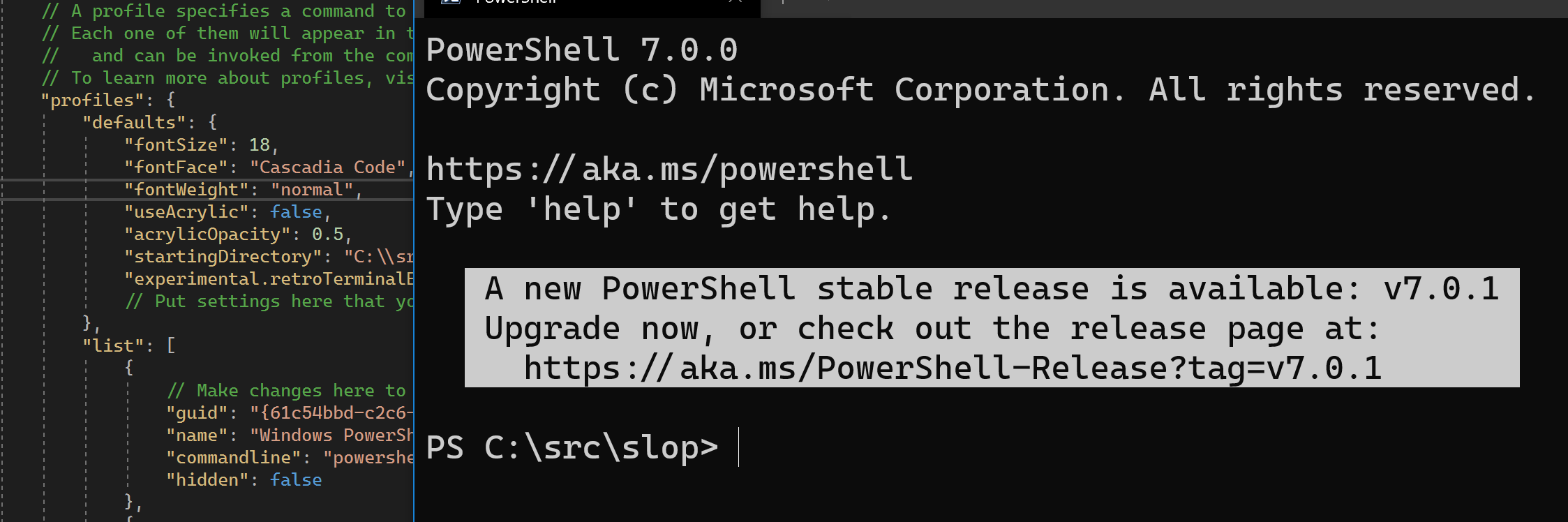
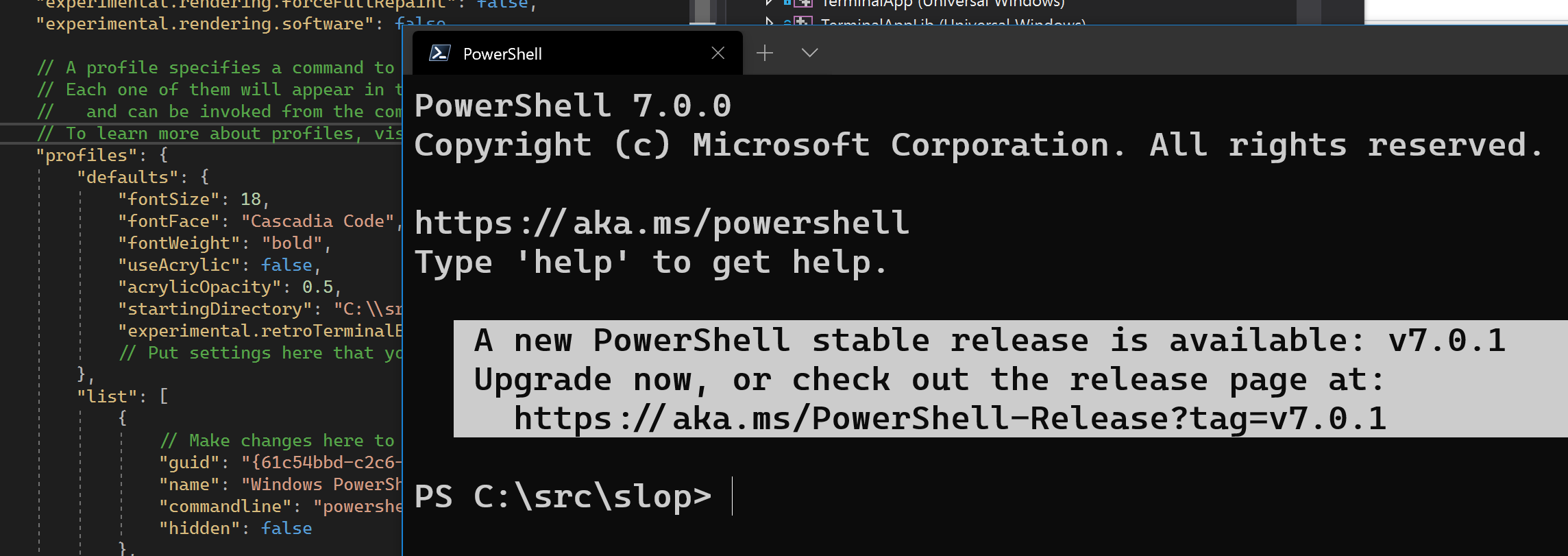
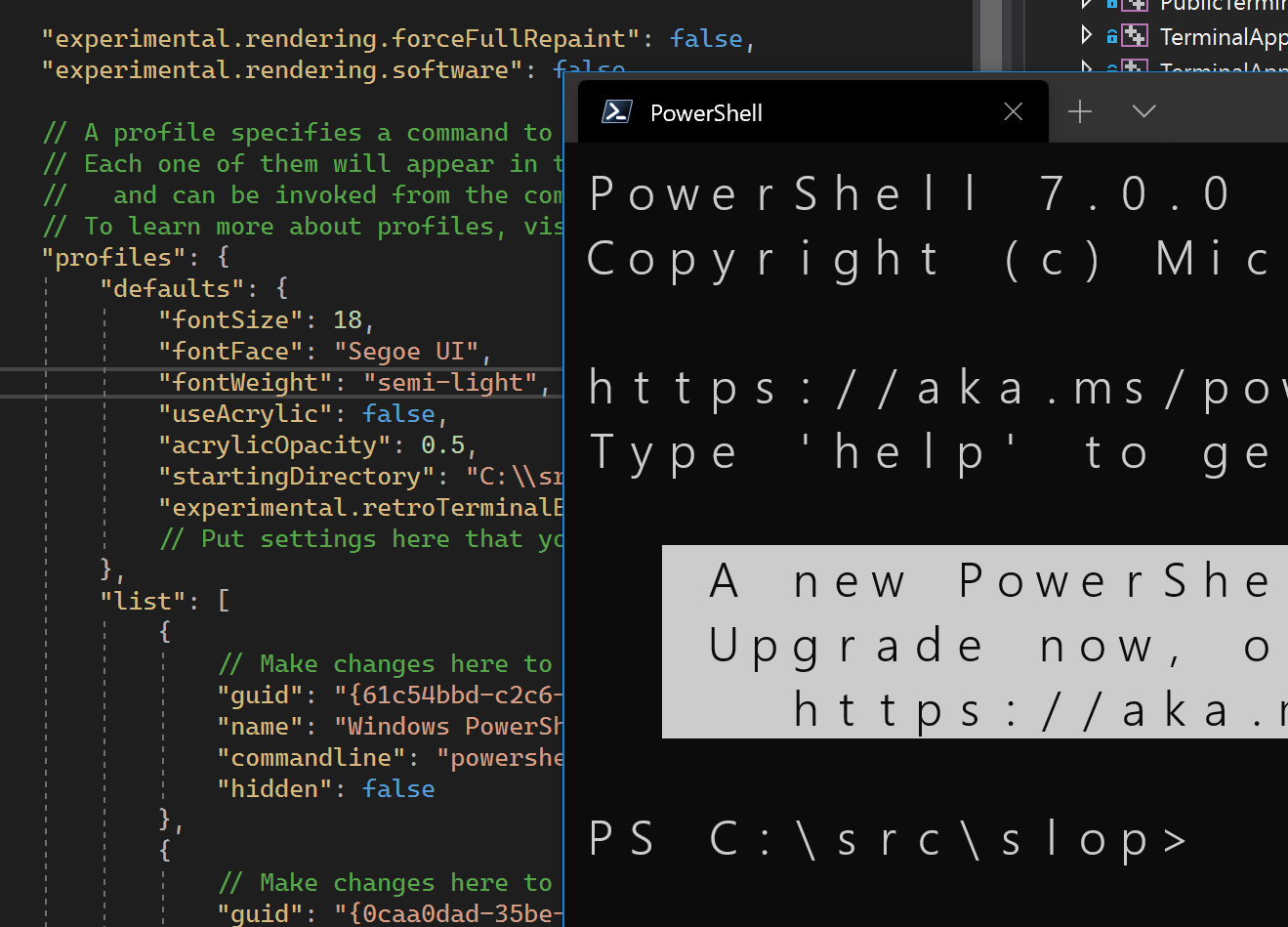
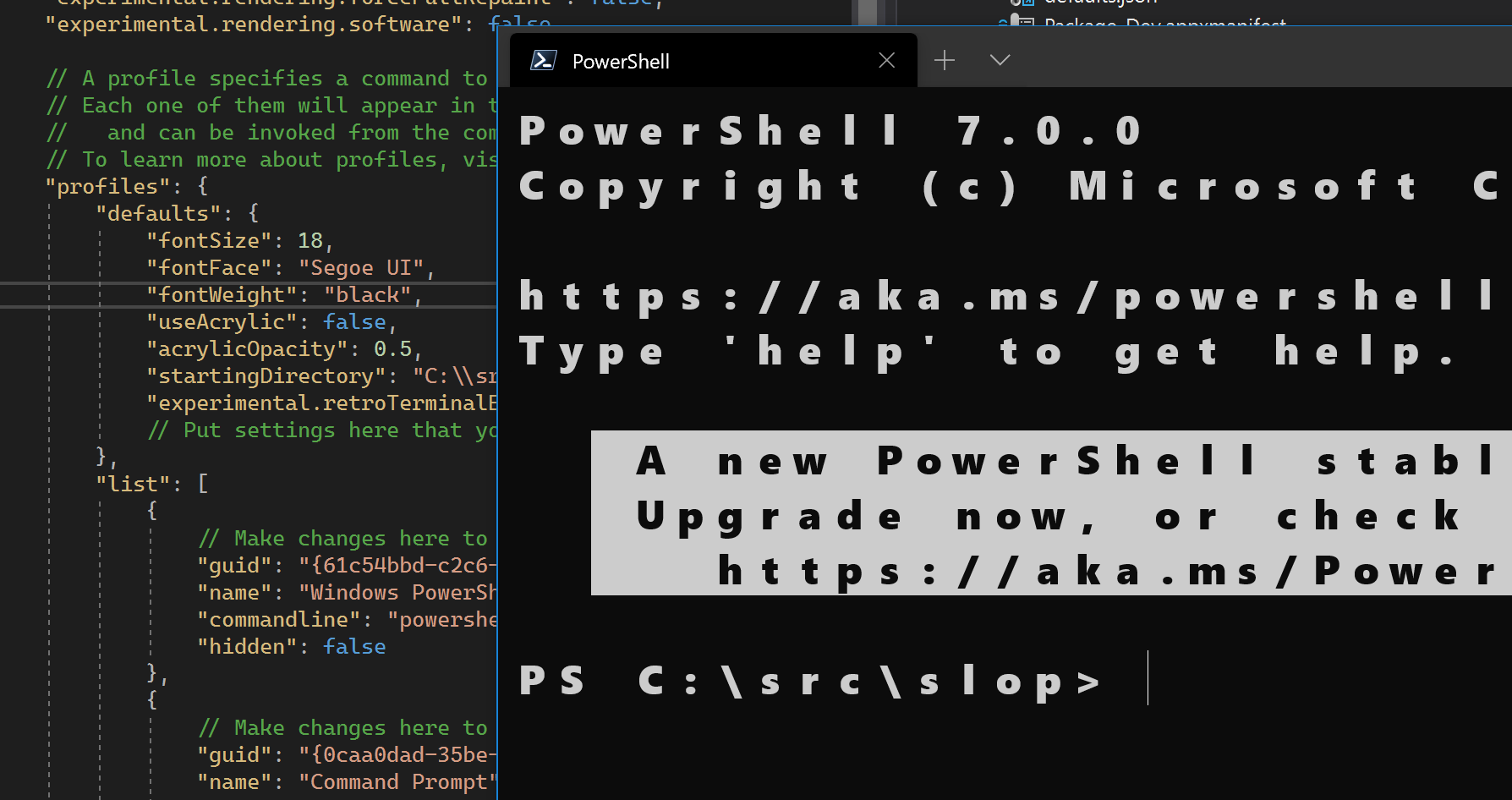
This pull request switches up the treatment we use for pattern-detected
links and OSC 8 hyperlinks:
* Links generated via OSC 8 have a sparse dotted underline instead of a
thick dashed one
* Links generated by pattern detection _are not underlined until they've
hovered_
* This papers over a visual glitch that is a result of us updating
the pattern matches every ~500ms (on change)
Closes#8123
Turns out there's an actual way to specify C++17 for MSBuild purposes
besides just passing the compile flag.
## References
* Future C++20 support (modules)
## PR Checklist
* [x] Closes random fact found while exploring VS16.8 preview C++20
modules.
* [x] I work here.
* [x] It still builds.
## Detailed Description of the Pull Request / Additional comments
* We've been setting C++17 with just the flag passed to the compiler
`cl.exe`. But it turns out that this particular `LanguageStandard`
option will need to be set appropriately one day for us to use C++20
modules (as evidenced by the latest VS16.8 preview that I tried out to
explore modules.) The `AdditionalOption` alone isn't enough to ensure
that modules can be "seen" by other projects after production, but
`LanguageStandard` is (and will set the compiler option as appropriate
as well as whatever internal goo that MSBuild needs to hook up other
stuff.)
## Validation Steps Performed
* Built with it changed.
Fix#8121

<!-- Enter a brief description/summary of your PR here. What does it fix/what does it change/how was it tested (even manually, if necessary)? -->
## Summary of the Pull Request
When calculating the position of the matched pattern, consider the width of the characters.
However, if there are some wide glyphs in the detected hyperlink(not possible for now, for the existing regex will not match wide-character?). The repeated character in the tooltip is not fixed by this PR.
<!-- Other than the issue solved, is this relevant to any other issues/existing PRs? -->
## References
<!-- Please review the items on the PR checklist before submitting-->
## PR Checklist
* [ ] Closes#8121
* [x] CLA signed. If not, go over [here](https://cla.opensource.microsoft.com/microsoft/Terminal) and sign the CLA
* [ ] Tests added/passed
* [ ] Documentation updated. If checked, please file a pull request on [our docs repo](https://github.com/MicrosoftDocs/terminal) and link it here: #xxx
* [ ] Schema updated.
* [ ] I've discussed this with core contributors already. If not checked, I'm ready to accept this work might be rejected in favor of a different grand plan. Issue number where discussion took place: #xxx
<!-- Provide a more detailed description of the PR, other things fixed or any additional comments/features here -->
## Detailed Description of the Pull Request / Additional comments
When calculating the coordinate of the match in #7691, it simply uses the `prefix.size()` as the total prefix width on the screen.
This PR fixes that behavior.
<!-- Describe how you validated the behavior. Add automated tests wherever possible, but list manual validation steps taken as well -->
## Validation Steps Performed
Manually Verified
<!-- Enter a brief description/summary of your PR here. What does it fix/what does it change/how was it tested (even manually, if necessary)? -->
## Summary of the Pull Request
In the focus mode the top border disappears upon resize. While this behavior is expected in the maximized / full screen mode, it should not happen in the focus mode.
<!-- Other than the issue solved, is this relevant to any other issues/existing PRs? -->
## References
<!-- Please review the items on the PR checklist before submitting-->
## PR Checklist
* [x] Closes https://github.com/microsoft/terminal/issues/7012
* [x] CLA signed
* [ ] Tests added/passed - nope, only manual testing
* [ ] Documentation updated - irrelevant
* [ ] Schema updated - irrelevant
* [ ] I've discussed this with core contributors already. If not checked, I'm ready to accept this work might be rejected in favor of a different grand plan. Issue number where discussion took place: #xxx
<!-- Provide a more detailed description of the PR, other things fixed or any additional comments/features here -->
## Detailed Description of the Pull Request / Additional comments
_GetTopBorderHeight method returns 0 when maximized or no title bar is visible. However the existence of top border has nothing to do with whether the title bar is visible. We want to leave the border as long as the window is not in some form of maximizing (maximized / full screen)
<!-- Describe how you validated the behavior. Add automated tests wherever possible, but list manual validation steps taken as well -->
## Validation Steps Performed
* Manual - dragging, resizing, maximizing both in focus and non focus modes + full screen testing
<!-- Enter a brief description/summary of your PR here. What does it fix/what does it change/how was it tested (even manually, if necessary)? -->
## Summary of the Pull Request
<!-- Other than the issue solved, is this relevant to any other issues/existing PRs? -->
## References
<!-- Please review the items on the PR checklist before submitting-->
## PR Checklist
* [x] Closes https://github.com/microsoft/terminal/issues/7996
* [x] CLA signed.
* [ ] Documentation updated - irrelevant
* [ ] Schema updated - irrelevant
* [ ] I've discussed this with core contributors already. If not checked, I'm ready to accept this work might be rejected in favor of a different grand plan. Issue number where discussion took place: #xxx
<!-- Provide a more detailed description of the PR, other things fixed or any additional comments/features here -->
## Detailed Description of the Pull Request / Additional comments
Currently the value of AlwaysOnTop is read by the AppHost from AppLogic that takes this value from the root TerminalPage. However at this stage neither AppLogic nor TerminalPage are initialized, and thus the return value is always false.
This PR introduces a "GetInitialAlwaysOnTop" method to AppLogic that returns a value that is configured in the settings.
In addition, the TerminalPage creation was fixed to read the configuration value upon creation (and not just after settings reload).
<!-- Describe how you validated the behavior. Add automated tests wherever possible, but list manual validation steps taken as well -->
## Validation Steps Performed
* Only manual testing
* Starting the system with both initial value set to true and false
* Verifying that dynamic toggling on / off is not affected
<!-- Enter a brief description/summary of your PR here. What does it fix/what does it change/how was it tested (even manually, if necessary)? -->
## Summary of the Pull Request
A second close command (middle click on taskbar preview) overrides the warning dialog and closes the application.
<!-- Other than the issue solved, is this relevant to any other issues/existing PRs? -->
## References
<!-- Please review the items on the PR checklist before submitting-->
## PR Checklist
* [x] Closes#7451
* [x] CLA signed. If not, go over [here](https://cla.opensource.microsoft.com/microsoft/Terminal) and sign the CLA
* [ ] Tests added/passed
* [ ] Documentation updated. If checked, please file a pull request on [our docs repo](https://github.com/MicrosoftDocs/terminal) and link it here: #xxx
* [ ] Schema updated.
* [ ] I've discussed this with core contributors already. If not checked, I'm ready to accept this work might be rejected in favor of a different grand plan. Issue number where discussion took place: #xxx
<!-- Provide a more detailed description of the PR, other things fixed or any additional comments/features here -->
## Detailed Description of the Pull Request / Additional comments
When a close command is invoked (middle click on taskbar preview or 'X' button), a new flag is set. When the user wants to close again (this time only via the taskbar preview, as the 'X' button is disabled), the application is closed. If the user cancels the dialog, the flag is reset to prevent accidental closing on a subsequent close command.
<!-- Describe how you validated the behavior. Add automated tests wherever possible, but list manual validation steps taken as well -->
## Validation Steps Performed
I am developing with a [Windows 10 virtual machine](https://developer.microsoft.com/en-us/windows/downloads/virtual-machines/) provided by Microsoft. I tested manually. I considered the 'X' button, middle click on taskbar preview, and Alt+F4. Only a middle click on the taskbar preview does override the dialog.
Fire and forget on the hyperlink handler inside the TermControl.
## PR Checklist
* [x] Closes#7994
* [x] Tested manually
* [x] Hi, I work here.
## Detailed Description of the Pull Request / Additional comments
In `TermControl`, `_HyperlinkHandler` is called by
`_PointerPressedHandler` which has taken a write lock for all its
friends. However, `_HyperlinkHandler` downstreams to `ShellExecute`
which can pump the message queue looking for something. That pumping of
the queue can trigger messages that also want the write lock to update
state. They get stuck. Everything hangs.
`_HyperlinkHandler` really only needs read lock and really only for as
long as it takes to fill up its parameters before it's invoked... but
the simpler and more contained solution is to just fire and forget the
rest of the method that causes the deadlock to a continuation at the
tail of the dispatcher queue so `_PointerPressedHandler` can complete
and naturally drop the write lock.
## Validation Steps Performed
- Launched `main` manually on my box and clicked the hyperlink that is
detected when Powershell starts and it froze.
- Launched this change manually on my box and clicked the hyperlink that
is detected when Powershell starts and it did not freeze.
This pull request switches us to the new WinDev scaleset agent pool. It
should be faster than the hosted pool, and the larger disks allow us to
get rid of our PCH cleanup step.
This pull request is the initial implementation of hyperlink auto
detection
Overall design:
- Upon startup, TerminalCore gives the TextBuffer some patterns it
should know about
- Whenever something in the viewport changes (i.e. text
output/scrolling), TerminalControl tells TerminalCore (through a
throttled function for performance) to retrieve the visible pattern
locations from the TextBuffer
- When the renderer encounters a region that is associated with a
pattern, it paints that region differently
References #5001Closes#574
All our JSON files are _actually_ JSONC files - json with comments.
A well-behaved application that accepts JSON should accept and ignore
comments. However, `jsonlint` is not a well behaved application in this
regard.
So, to prevent the linter from complaining about our JSON comments, we
need to disable it entirely. THAT'S RIGHT, there's not a setting to
allow JSONC.
See #8076 as an example of this working.
This will also unblock #7462.
<!-- Enter a brief description/summary of your PR here. What does it fix/what does it change/how was it tested (even manually, if necessary)? -->
## Summary of the Pull Request
Realized that we don't copy the current hyperlink id when we copy buffers, quick fix for that
<!-- Please review the items on the PR checklist before submitting-->
## PR Checklist
* [ ] Closes #xxx
* [x] CLA signed. If not, go over [here](https://cla.opensource.microsoft.com/microsoft/Terminal) and sign the CLA
* [ ] Tests added/passed
* [ ] Documentation updated. If checked, please file a pull request on [our docs repo](https://github.com/MicrosoftDocs/terminal) and link it here: #xxx
* [ ] Schema updated.
* [x] I work here
## Summary of the Pull Request
This PR replaces `CascadiaSettings::_profiles` with...
- `_allProfiles`: the list of all available profiles in the settings model (i.e. settings.json, dynamic profiles, etc...)
- `_activeProfiles`: the list of all non-hidden profiles (used for the new tab dropdown)
## References
#8018: maintaining a list of all profiles allows us to serialize hidden profiles
#1564: Settings UI can link to `AllProfiles()` instead of `ActiveProfiles()` to expose hidden profiles
## PR Checklist
* [x] Closes#4139
* [x] Tests added/passed
## Validation Steps Performed
Deploy and testing succeeded
C++/WinRT added a feature where it will detect a mismatch in some of its
build flags.
Because we build XAML projects and non-XAML projects, and try to link
them together in static libraries, we need those flags to always match.
C++/WinRT only respects this flag when `DEBUG` is set, so our CI missed
this.
With thanks to @carlos-zamora for letting me build/test/commit this on
his computer.
This commit introduces 8 more variants of the .ICO file, embeds the
right ones into WindowsTerminal.exe, and adds code that will select the
most appropriate icon at runtime.
Since we're a Centennial application, the "application" icon inside our
package isn't used by the shell for the taskbar thumbnails or the
Alt-Tab window.
To quote J. Tippet,
> I believe there are two possible fixes:
>
> 1. Fix the OS shell to prefer the MRT icon instead of preferring the
> win32 icon
> 2. Add alternate versions of /res/terminal.ico
> The 1st fix is clearly better, since it benefits any hybrid app. But
> the 2nd fix is much easier, since it'd just take about an hour to gin up
> a new .ico file and hack the .RC file to refer to it when building the
> preview flavor.
... and to quote Michael Ratanapintha,
> Basically, if your MSIX-packaged desktop app's image resources are
> separate files or even separate MSIX packages, they may be loaded by
> MRT. If they're embedded in the .exe, they're the old-fashioned Win32
> resources Mr. Tippet is referring to.
This is the "2nd fix."
Fixes#6777
Co-authored-by: Jeffrey Tippet <jtippet@ntdev.microsoft.com>
This commit fixes our longstanding build artifact output issues and
finally unifies all C++ project output into bin/ and obj/.
In light of that, I've removed NoOutputRedirection.
I've also updated WTU and U8U16Test to use our common build props and
fixed any warnings/compilation errors that popped out.
I validated this change by running repeated incremental builds after
changing individual .cpp files in many of our C++/WinRT projects.
While not explicitly permitted, a wide range of software (including
Windows' own touch keyboard) sets the `wScan` member of the `KEYBDINPUT`
structure to 0, resulting in `scanCode` being 0 as well. In these
situations we'll now use the `vkey` to get a `scanCode`.
Validation
----------
* AutoHotkey
* Use a keyboard layout with `AltGr` key
* Execute the following script:
```ahk
#NoEnv
#Warn
SendMode Input
SetWorkingDir %A_ScriptDir%
<^>!8::SendInput {Raw}»
```
* Press `AltGr+8` while the Terminal is in the foreground
* Ensure » is being echoed ✔️
* PowerToys
* Add a `Ctrl+I -> ↑ (up arrow)` keyboard shortcut
* Press `Ctrl+I` while the Terminal is in the foreground
* Ensure the shell history is being navigated backwards ✔️
* Windows Touch Keyboard
* Right-click or tap and hold the taskbar and select "Show touch
keyboard" button
* Open touch keyboard
* Ensure keyboard works like a regular keyboard ✔️
* Ensure unicode characters are echoed on the Terminal as well (except
for Emojis) ✔️Closes#7438Closes#7495Closes#7843
This commit also adds an override UCD and migrates all of the overrides
from GetQuickCharWidth into it.
GetQuickCharWidth
-----------------
The removal of overrides from GQCW reduces the number of comparisons
required for looking up a single character's width from 41 (32
individual ranged comparisons from GQCW + 8+1 from the binary search in
CPWD) to 11 (2 from GQCW, 8+1 from CPWD).
GQCW also incorrectly marked 67 reserved codepoints as `Wide` when they
should have been `Narrow`.
The codepoints whose definitions have changed from `Wide` to `Narrow` are:
```
2E9A 2EF4 2EF5 2EF6 2EF7 2EF8 2EF9 2EFA 2EFB 2EFC 2EFD 2EFE 2EFF 2FD6
2FD7 2FD8 2FD9 2FDA 2FDB 2FDC 2FDD 2FDE 2FDF 2FE0 2FE1 2FE2 2FE3 2FE4
2FE5 2FE6 2FE7 2FE8 2FE9 2FEA 2FEB 2FEC 2FED 2FEE 2FEF 2FFC 2FFD 2FFE
2FFF 31E4 31E5 31E6 31E7 31E8 31E9 31EA 31EB 31EC 31ED 31EE 31EF 321F
A48D A48E A48F FE1A FE1B FE1C FE1D FE1E FE1F FE53 FE67
```
All of them are reserved, but those reserved regions are marked as narrow
in the UCD.
This change also offers us the chance to document exactly why we're
overriding a specific character range. Comments from the override
document will be copied to the generated CPWD table.
New in Unicode 13.0
------------------
Some widths have changed due to previously-reserved characters becoming
_used_ such as U+32FF SQUARE ERA NAME REIWA, the Tangut components
756-768, the entire Khitan Small Script character set, and the Tangut
Ideographs.
A number of the changes in this diff are due to better/worse comment
tracking and the removal of the Emoji/EPres comments. The script once
mistakenly applied comments to packed regions (and it has been updated
to not do so.)
Validation
----------
I build a test application that compared codepoints 0-FFFF for GQCW
against their new registered widths.
## Summary of the Pull Request
Introduces `IInheritable` as an interface that helps move cascading settings into the Terminal Settings Model. `GlobalAppSettings` and `Profile` both are now `IInheritable`. `CascadiaSettings` was updated to `CreateChild()` for globals and each profile when we are loading the JSON data.
IInheritable does most of the heavy lifting. It introduces a two new macros and the interface. The macros help implement the fallback functionality for nullable and non-nullable settings.
## References
#7876 - Spec Addendum
#6904 - TSM Spec
#1564 - Settings UI
#7876 - `Copy()` needs to be updated to include _parent
Close the tab context menu when clicking on the title bar
## Detailed Description of the Pull Request / Additional comments
Following #2438, hide the tabs context menu on `TerminalPage::TitlebarClicked()`.
We don't know which of the tabs is showing the context menu, do it on all tabs.
## Validation Steps Performed
Open the context menu from any tab, click on title bar and see the context menu disappear.
Closes#7988
We are getting some watson crash reports that the terminal is attempting
to resize to `(0, 0)`. This change makes it so that we prevent such
resizing and if so, throw an exception before we reach native code.
This commit adds resizing checks that prevent resizing the terminal WPF
control to a size of `(0, 0)`
- The number of lines to move upon scroll up scroll down can be defined
in ScrollUp and ScrollDown commands (parameter is called
"rowsToScroll").
- If the number are not provided, use the system default (the one we are
using for mouse scrolls), rather than 1 line.
## Validation Steps Performed
* Manual testing
* Added custom bindings for scroll commands with different values,
verified they and the default appear and behave as expected
* Checked that invalid values are not allowed
Closes#5078
This introduces an addendum to the Terminal Settings Model spec that
covers inheritance and fallback. Basically, settings objects will now
have a reference to a parent object. If the settings object does not
have a setting defined, it will ask its parent to resolve the value. A
parent is set using the `Clone()` function. `Copy()` is used to copy the
value and structure of the settings model, whereas `Clone()` is used to
copy a reference to the settings model and build an inheritance tree.
## References
#6904 - Terminal Settings Model Spec
#1564 - Settings UI
This PR resolves an issue I observed in
Microsoft.Terminal.Wpf.TerminalControl.CalculateMargins(). Specifically,
on line 194 in the project. In this example, the line: `height =
controlSize.Height - (this.TerminalRendererSize.Height /
dpiScale.DpiScaleX);` is associating the height margin with
dpiScale.DpiScaleX instead of dpiScale.DpiScaleY. This PR changes the
association to DpiScaleY.
Closes#8038
The intent of this PR is to resolve the dependency errors reported in
#7931. The Types project has been added as a reference to the
FuzzWrapper project, which fixes the unresolved dependency errors
reported.
For validation steps, I:
1.) Pulled down main.
2.) Rebuilt the FuzzWrapper project and observed the unresolved
dependency errors keeping it from building successfully.
3.) Added a project reference to the Types project.
4.) Rebuilt the FuzzWrapper project and verified that the dependency
errors disappeared.
Closes#7931.
<!-- Enter a brief description/summary of your PR here. What does it fix/what does it change/how was it tested (even manually, if necessary)? -->
Adds the color slider to the tab color picker
<!-- Please review the items on the PR checklist before submitting-->
## PR Checklist
* [x] Closes#7948
* [x] CLA signed. If not, go over [here](https://cla.opensource.microsoft.com/microsoft/Terminal) and sign the CLA
* [ ] ~Tests added/passed~
* [ ] ~Documentation updated. If checked, please file a pull request on [our docs repo](https://github.com/MicrosoftDocs/terminal) and link it here: #xxx~
* [ ] ~Schema updated.~
* [x] I've discussed this with core contributors already. If not checked, I'm ready to accept this work might be rejected in favor of a different grand plan. Issue number where discussion took place: #7948
<!-- Provide a more detailed description of the PR, other things fixed or any additional comments/features here -->
<!-- Describe how you validated the behavior. Add automated tests wherever possible, but list manual validation steps taken as well -->
## Validation Steps Performed
*Not required*
We wrap the call to `_WriteSettings` in
`CascadiaSettingsSerialization.cpp` in a try/catch block, and if we
catch an error we append a warning telling the user to check the
permissions on their settings file.
Closes#7727
Our build pipeline was originally set up such that we could take any
binaries from the Terminal build and seamlessly re-package them with the
release or preview livery. My initial plan was to stamp a stable and
preview build at the same time, out of the same bits, to make ring
promotion easier.
I've never done that. For the last five releases, we've just re-cut a
new stable build along with the new preview build, usually because we
want to backport some fixes to stable.
This commit introduces preprocessor defines, detectable through CL and
RC, for any project that wants them. Right now, that's just going to be
WindowsTerminal.vcxproj (since it hosts the icons and the app entry
point). This list may be extended to include wt (the shim executable)
and the shell extension at some future date.
This will greatly simplify the logic in #7971, as we'll no longer need
to detect if we're dev or preview at runtime. It may also simplify the
logic in the shell extension for determining whether we're Dev or not.
## Summary of the Pull Request
Fixes the bug where `exit`ing inside a closed pane would leave the Terminal blank.
Additionally, removes `Tab::GetRootElement` and replaces it with the _observable_ `Tab::Content`. This should be more resilient in the future.
Also adds some tests, though admittedly not for this exact scenario. This scenario requires a cooperating TerminalConnection that I can drive for the sake of testing, and _ain't nobody got time for that_.
## References
* Introduced in #6989
## PR Checklist
* [x] Closes#7252
* [x] I work here
* [x] Tests added/passed 🎉
* [n/a] Requires documentation to be updated
## Detailed Description of the Pull Request / Additional comments
From notes I had left in `Tab.cpp` while I was working on this:
```
OKAY I see what's happening here the ActivePaneChanged Handler in TerminalPage
doesn't re-attach the tab content to the tree, it just updates the title of the
window.
So when the pane is `exit`ed, the pane's control is removed and re-attached to
the parent grid, which _isn't in the XAML tree_. And no one can go tell the
TerminalPage that it needs to re set up the tab content again.
The Page _manually_ does this in a few places, when various pane actions are
about to take place, it'll unzoom. It would be way easier if the Tab could just
manage the content of the page.
Or if the Tab just had a Content that was observable, that when that changed,
the page would auto readjust. That does sound like a LOT of work though.
```
## Validation Steps Performed
Opened panes, closed panes, exited panes, zoomed panes, moved focus between panes, panes, panes, panes
## Summary of the Pull Request
Just deleting an unnecessary call to `_UpdateCommandsForPalette`
**Note:** This only fixes slowdown when opening/closing a tab, but not upon first startup (we still need to call `_UpdateCommandsForPalette` there
## References
Fixes the slowdown described in #7820 for opening and closing tabs, but doesn't improve startup time dramatically.
## Validation Steps Performed
Tested with ~100 profiles in my settings file
This PR changes the ATS display order to _always_ be in most recently
used (MRU) order. I chose not to give ATS the option to be displayed
in-order because that order is better served through the traditional
left-right TabRow switching.
_Note_: `TabSearch` will stay in-order.
This means that users can only choose one order or another in their
`nextTab/prevTab` bindings. Setting `useTabSwitcher` to true will make
nT/pT open the ATS in MRU order. If it's set to false, the ATS won't
open and nT/pT will simply go left and right on the TabRow.
I'm open to getting rid of the global and making ATS its own keybinding,
but for now I figured I would keep the current behavior and open the PR
to get eyes on the code that doesn't have anything to do with the
settings.
Closes#973
Let's assume the user has bound the dead key ^ to a sendInput command
that sends "b". If the user presses the two keys ^a it'll produce "bâ",
despite us marking the key event as handled. We can use `ToUnicodeEx`
to clear such dead keys from the keyboard state and should make use of
that for keybindings. Unfortunately `SetKeyboardState` cannot be used
for this purpose as it doesn't clear the dead key state.
Validation
* Enabled a German keyboard layout
* Added the following two keybindings:
{ "command": { "action": "sendInput", "input": "x" }, "keys": "q" },
{ "command": { "action": "sendInput", "input": "b" }, "keys": "^" }
* Pressed the following keys → ensured that the given text is printed:
* q → x
* ´ → nothing
* a → á
* ^ → b
* a → a (previously this would print: â)
* ´ → nothing
* ^ → b
* a → a (unfortunately we cannot specifically clear only ^)
Closes#5784
Updates the GH Action and makes a small update to the README to test
changes.
A missing install step for Windows Terminal using Scoop has been added.
The versioning of Super-Linter was also switched to v3 to allow
auto-updates within the v3 series. This can be version-pinned again if a
breaking change comes later. The current updates fix some bugs and bump
the linters utilized.
## Validation Steps Performed
Validation will be shown in the build steps.
Closes#7934
Fix for crash occurring when splitting a pane, due to tab context menu created multiple times.
## References
#7728
## PR Checklist
* [x] Closes#7941
* [x] CLA signed.
## Detailed Description of the Pull Request / Additional comments
When splitting panes the `Tab::Initialize` function is called again. This rebuilt the context menu from scratch and appended the existing Close... sub-menu items to a new parent, thus causing the crash.
It is not necessary to re-create the context menu every time you split panes, it can be created only once.
## Validation Steps Performed
Manual verification:
- Play with the context menu, the Close... submenu is functioning
- Split panes (ALT + New tab), no crash occurs and context menu still functioning
## Summary of the Pull Request
This implements the `Copy` function for `CascadiaSettings`. Copy performs a deep copy of a `CascadiaSettings` object. This is needed for data binding in the Terminal Settings Editor.
The `Copy` function was basically implemented in every settings model object. This was mostly just repetitive work.
## References
#7667 - TSM
#1564 - Settings UI
## PR Checklist
* [X] Tests added/passed
It turns out that we missed part of the OSC 8 spec which indicated that
_hyperlinks with the same ID but different URIs are logically distinct._
> Character cells that have the same target URI and the same nonempty id
> are always underlined together on mouseover.
> The same id is only used for connecting character cells whose URIs is
> also the same. Character cells pointing to different URIs should never
> be underlined together when hovering over.
This pull request fixes that oversight by appending the (hashed) URI to
the generated ID.
When Terminal receives one of these links over ConPTY, it will hash the
URL a second time and therefore append a second hashed ID. This is taken
as an acceptable cost.
Fixes#7698
This commit adds a missing conversion utf8 to utf16 in decoding base64
for handling multibyte text in copying via OSC 52.
## Validation Steps Performed
* automatically
* Tests w/ multibyte characters
* manually
* case1
* Executed `printf "\x1b]52;;%s\x1b\\" "$(printf '👍👍🏻👍🏼👍🏽👍🏾👍🏿' | base64)"`
* Verified `👍👍🏻👍🏼👍🏽👍🏾👍🏿` in my clipboard
* case2
* Copied `👍👍🏻👍🏼👍🏽👍🏾👍🏿` by tmux 2.6 default copy function (OSC 52)
* Verified `👍👍🏻👍🏼👍🏽👍🏾👍🏿` in my clipboard
Closes#7819
This optimizes the binary size of the xorg color table by replacing the
static lookup table with a table of variable colors (indexed "" (0)
through "4"), calculated greys for gr[ae]y0-100, and a table of the
remaining unsuffixed colors.
78 variable colors ...
8 bytes each for pointer+size
5 variants, 4 bytes each for the color data
718 bytes for 0-terminated color names
plus
84 colors ...
8 bytes each for pointer+size
4 bytes each for the color data
955 bytes for 8-terminated color names
2902 = (78 * 8) + (78 * 5 * 4) + 718
+ 1963 = (84 * 8) + (84 * 4) + 955
------
4865 bytes (approximately)
"I couldn't sleep at night thinking that after years of accusing Windows
being bloated and literally making it even more bloated with my hands.
So here you go. The mediocre yet working solution. This reduces the
binary size to 1051k (1067k before) while keeping the code maintainable
for human beings."
VsCode uses `>` as its "prefix" for the equivalent of their "action
mode". This PR aligns the Terminal with their logic here.
We have to be tricky - if we use the `>` in the actual input as the
indicator for action mode, we can't display any placeholder text in the
input to tell users to type a command. This wasn't an issue for the
commandline mode previously, because we'd stick the "prompt" in the "no
matches text" space. However, we can't do that for action mode. Instead,
we'll stick a floating text block over the input box, and when the
user's in action mode, we'll manually place a `>` into that space. When
the user backspaces the `>`, we'll remove it from that block, and switch
into commandline mode.
## Validation Steps Performed
Played with the cmdpal in lots of different modes, this finally feels
good
Closes#7736
This PR adds support for the `DECREQTPARM` (Request Terminal Parameters)
escape sequence, which was originally used on the VT100 terminal to
report the serial communication parameters. Modern terminal emulators
simply hardcode the reported values for backward compatibility.
The `DECREQTPARM` sequence has one parameter, which was originally used
to tell the terminal whether it was permitted to send unsolicited
reports or not. However, since we have no reason to send an unsolicited
report, we don't need to keep track of that state, but the permission
parameter does still determine the value of the first parameter in the
response.
The response parameters are as follows:
| Parameter | Value | Meaning |
| ---------------- | ------ | ------------------------ |
| response type | 2 or 3 | unsolicited or solicited |
| parity | 1 | no parity |
| data bits | 1 | 8 bits per character |
| transmit speed | 128 | 38400 baud |
| receive speed | 128 | 38400 baud |
| clock multiplier | 1 | |
| flags | 0 | |
There is some variation in the baud rate reported by modern terminal
emulators, and 9600 baud seems to be a little more common than 38400
baud, but I thought the higher speed was probably more appropriate,
especially since that's also the value reported by XTerm.
## Validation Steps Performed
I've added a couple of adapter and output engine tests to verify that
the sequence is dispatched correctly, and the expected responses are
generated. I've also manually tested in Vttest and confirmed that we now
pass the `DECREQTPARM` test in the _Test of terminal reports_.
Closes#7852
Adds a new setting, `bellStyle`, to be able to disable the audible bell
added in #7679. Currently, this setting accepts two values:
* `audible`: play a noise on a bell
* `none`: Don't play a noise.
In the future, we can add a `"bellStyle": "visible"` for flashing the
Terminal instead of making a noise on bell.
## Validation Steps Performed
Pressing <kbd>Ctrl+G</kbd> in cmd, and hitting enter is an easy way of
triggering a bell. I set the setting to `none`, and presto, the bell
stopped.
Closes#2360
This commit is in support of WTU.
I initially added support for a new flag, `PSEUDOCONSOLE_UNDOCKED_PREFER_INBOX_CONHOST`,
which I liked because it was more explicit. We chose not to go that route.
### Automatic fallback
#### Pros
* It's easier on the consumer
* We can eventually expand it to support `$ARCH/openconsole.exe`
#### Cons
* Packaging the project wrong will result in a working-but-somewhat-broken experience (old conhost)
* We ameliorated this by checking it in the packaging script.
* Implicit behavior may be bad
Terminal ships with this dependency embedded, and it is not required that you install it separately. Since the link is broken, let's just remove it entirely.
* [x] fixes#7889
* [x] related to https://github.com/microsoft/terminal/issues/7917#issuecomment-707955335
* [x] I work here
* [x] is a docs update
Additionally, update the markdown linter rules in the wake of #7637, because apparently that was never actually applied to any files, so now the onus is on the first person to touch any of our markdown files.
This PR introduces a pair of classes for managing VT parameters that
automatically handle range checking and default fallback values, so the
individual operations don't have to do that validation themselves. In
addition to simplifying the code, this fixes a few cases where we were
mishandling missing or extraneous parameters, and adds support for
parameter sequences on commands that couldn't previously handle them.
This PR also sets a limit on the number of parameters allowed, to help
thwart DoS memory consumption attacks.
## References
* The new parameter class also introduces the concept of an
omitted/default parameter which is not necessarily zero, which is a
prerequisite for addressing issue #4417.
## Detailed Description of the Pull Request / Additional comments
There are two new classes provide by this PR: a `VTParameter` class,
similar in function to a `std::optional<size_t>`, which holds an
individual parameter (which may be an omitted/default value); and a
`VTParameters` class, similar in function to `gsl:span<VTParameter>`,
which holds a sequence of those parameters.
Where `VTParameter` differs from `std::optional` is with the inclusion
of two cast operators. There is a `size_t` cast that interprets omitted
and zero values as 1 (the expected behaviour for most numeric
parameters). And there is a generic cast, for use with the enum
parameter types, which interprets omitted values as 0 (the expected
behaviour for most selective parameters).
The advantage of `VTParameters` class is that it has an `at` method that
can never fail - out of range values simply return the a default
`VTParameter` instance (this is standard behaviour in VT terminals). It
also has a `size` method that will always return a minimum count of 1,
since an empty parameter list is typically the equivalent of a single
"default" parameter, so this guarantees you'll get at least one value
when iterating over the list with `size()`.
For cases where we just need to call the same dispatch method for every
parameter, there is a helper `for_each` method, which repeatedly calls a
given predicate function with each value in the sequence. It also
collates the returned success values to determine the overall result of
the sequence. As with the `size` method, this will always make at least
one call, so it correctly handles empty sequences.
With those two classes in place, we could get rid of all the parameter
validation and default handling code in the `OutputStateMachineEngine`.
We now just use the `VTParameters::at` method to grab a parameter and
typically pass it straight to the appropriate dispatch method, letting
the cast operators automatically handle the assignment of default
values. Occasionally we might need a `value_or` call to specify a
non-standard default value, but those cases are fairly rare.
In some case the `OutputStateMachineEngine` was also checking whether
parameters values were in range, but for the most part this shouldn't
have been necessary, since that is something the dispatch classes would
already have been doing themselves (in the few cases that they weren't,
I've now updated them to do so).
I've also updated the `InputStateMachineEngine` in a similar way to the
`OutputStateMachineEngine`, getting rid of a few of the parameter
extraction methods, and simplifying other parts of the implementation.
It's not as clean a replacement as the output engine, but there are
still benefits in using the new classes.
## Validation Steps Performed
For the most part I haven't had to alter existing tests other than
accounting for changes to the API. There were a couple of tests I needed
to drop because they were checking for failure cases which shouldn't
have been failing (unexpected parameters should never be an error), or
testing output engine validation that is no longer handled at that
level.
I've added a few new tests to cover operations that take sequences of
selective parameters (`ED`, `EL`, `TBC`, `SM`, and `RM`). And I've
extended the cursor movement tests to make sure those operations can
handle extraneous parameters that weren't expected. I've also added a
test to verify that the state machine will correctly ignore parameters
beyond the maximum 32 parameter count limit.
I've also manual confirmed that the various test cases given in issues
#2101 are now working as expected.
Closes#2101
## Summary of the Pull Request
Added watch on desktopImagePath to check when the path equals "DesktopWallpaper"
If it does equal "DesktopWallpaper" it replaces the path with a path to the desktop's wallpaper
*I am a student and this is my first pull request for Terminal so please give feedback no matter how small. It's the best way I can learn.
## PR Checklist
* [X] Closes#7295
* [X] CLA signed. If not, go over [here](https://cla.opensource.microsoft.com/microsoft/Terminal) and sign the CLA
* [?] Tests added/passed
* [X] Documentation updated. If checked, please file a pull request on [our docs repo](https://github.com/MicrosoftDocs/terminal) and link it here: https://github.com/MicrosoftDocs/terminal/pull/155
* [?] Schema updated. (Not sure if this is needed, also not sure where this would be)
* [X] I've discussed this with core contributors already. If not checked, I'm ready to accept this work might be rejected in favor of a different grand plan. Issue number where discussion took place: #7295 (Have only talked with the people on the issue, which I don't think has any core contributors)
## Detailed Description of the Pull Request / Additional comments
I am using SystemParametersInfo for SPI_GETDESKWALLPAPER which puts the path into a WCHAR and that is then inserted as the BackgroundImagePath.
I do not think an additional test would add value. The SPI_GETDESKTOPWALLPAPER uses the computers local wallpaper path and puts it into a WCHAR, which then I feed into BackgroundImagePath() as it's new path. I don't think there adds value in making a static path of the desktop background and testing that, given that static tests are already done for "BackgroundImage()".
## Validation Steps Performed
(Manual Validation - Test False Value)
1. Ran Terminal
2. Set setting ["backgroundImage": "<some random img path>"] under profiles->defaults
3. Verified terminal's background is not the desktops wallpaper.
(Manual Validation - Test True Value)
1. Ran Terminal
2. Set setting ["backgroundImage": "DesktopWallpaper"] under profiles->defaults
3. Verified the background image matches the desktop background image.
(Manual Validation - Multiple Tabs True Value)
1. Ran Terminal
2. Set setting ["backgroundImage": "DesktopWallpaper"] under profiles->defaults
3. Verified the background image matches the desktop background image.
4. Opened new tabs
5. Verified the background image matches the desktop background image for each tab.
For whatever reason, the super linter seems to think that any file it doesn't recognize is an EDITORCONFIG file. That means all our `cpp`, `hpp`, `h`, `resw`, `xaml`, etc files are going to get linted with different rules than the clang-format ones we already use.
This PR disables the EDITORCONFIG linter, and has a minimal change to a cpp file to ensure that it's no longer linted by the action.
See also:
* #7637 added this
* #7799 is blocked by this
* #7924 is blocked by this
<!-- Enter a brief description/summary of your PR here. What does it fix/what does it change/how was it tested (even manually, if necessary)? -->
## Summary of the Pull Request
Add a "Close..." option to the tab context menu, with nested entries to close tabs to the right and close other tabs (actions already available)

<!-- Other than the issue solved, is this relevant to any other issues/existing PRs? -->
## References
#1912
<!-- Please review the items on the PR checklist before submitting-->
## PR Checklist
* [x] Closes#5524
* [x] CLA signed. If not, go over [here](https://cla.opensource.microsoft.com/microsoft/Terminal) and sign the CLA
* [ ] Tests added/passed
* [ ] Documentation updated. If checked, please file a pull request on [our docs repo](https://github.com/MicrosoftDocs/terminal) and link it here: #xxx
* [ ] Schema updated.
* [ ] I've discussed this with core contributors already. If not checked, I'm ready to accept this work might be rejected in favor of a different grand plan. Issue number where discussion took place: #xxx
<!-- Provide a more detailed description of the PR, other things fixed or any additional comments/features here -->
## Detailed Description of the Pull Request / Additional comments
First contribution 🙂
Tried to follow some suggestions from https://github.com/microsoft/terminal/issues/1912#issuecomment-667079311
<!-- Describe how you validated the behavior. Add automated tests wherever possible, but list manual validation steps taken as well -->
## Validation Steps Performed
This uses the templates from
https://github.com/github/super-linter/tree/master/TEMPLATES currently.
A future PR can add the necessary templates to the Windows Terminal
repository and update the source of Templates following the README.
Additionally we can add flags to explicitly choose the linters
applicable to this code base but is not necessary.
Per the README, this does not enforce any linting rules but rather
outputs the suggestions in the build step, which are to be read by the
PR submitter and Windows Terminal team to determine if they want to use
the linting rule. C++ is currently not supported (Powershell, Json,
Yaml, and Markdown will be the only things the linter checks for
currently) but we could add our own custom support if desired in
separate PR.
## Validation Steps Performed
It successfully runs. Currently only shows the yaml file itself being
linted in this PR as a test case. It will apply to new PRs once this is
merged. We can lint existing code base but would require a separate PR
and examining the code output (also requires updating the yaml file
temporarily).
Closes#7513
* Correct the behaviour of parsing `rgb:R/G/B`. It should be interpreted
as `RR/GG/BB` instead of `0R/0G/0B`
* Add support for `rgb:RRR/GGG/BBB` and `rgb:RRRR/GGGG/BBBB`. The
behaviour of 12 bit variants is to repeat the first digit at the end,
e.g. `rgb:123/456/789` becomes `rgb:1231/4564/7897`.
* Add support for `#` formats. We are following the rules of
[XParseColor] by interpreting `#RGB` as `R000G000B000`.
* Add support for XOrg app color names, which are supported by xterm, VTE
and many other terminal emulators.
* Multi-parameter OSC 4 is now supported.
* The chaining of OSC 10-12 is not yet supported. But the parameter
validation is relaxed by parsing the parameters as multi-params but
only use the first one, which means `\e]10;rgb:R/G/B;` and
`\e]10:rgb:R/G/B;invalid` will execute `OSC 10` with the first color
correctly. This fixes some of the issues mentioned in #942 but not
all of them.
[XParseColor]: https://linux.die.net/man/3/xparsecolorCloses#3715
This commit introduces two new launch modes: focus and maximizedFocus.
* Focused mode, behaves like a default mode, but with the Focus Mode
enabled.
* Maximized focused mode, behaves like a Maximized mode, but with the
Focus Mode enabled.
There two ways to invoke these new modes:
* In the settings file: you set the "launchMode" to either "focus" or
"maximizedFocus"
* In the command line options, you can path -f / --focus, which is
mutually exclusive with the --fullscreen, but can be combined with the
--maximized:
* Passing -f / --focus will launch the terminal in the "focus" mode
* Passing -fM / --focus --maximized will launch the terminal in the
"maximizedFocus" mode
This should resolve a relevant part in the command line arguments
mega-thread #4632Closes#7124Closes#7825Closes#7875
Took this as an easy starter. The method IslandWindow::SetAlwaysOnTop is
triggered once terminal settings are reloaded (in
TerminalPage::_RefreshUIForSettingsReload flow). This method calls
SetWindowPos without SWP_NOACTIVATE. As a result the window gets
activated, the focus is set and the cursor starts blinking.
Added SWP_NOACTIVATE in all SetWindowPos calls from IslandWindow and
NoClientIslandWindow (where it was missing). Please let me know if this
is an overkill - it is not required to fix the issue, however seems a
good practice, that might help if we decide to apply more settings
immediately.
## Validation Steps Performed
* Only manual testing - please guide me to the relevant UT framework, if
exists.
* Trying to reproduce this with VS attached doesn't work - the window
gets the focus in any case.
* Tested as a standalone application, by modifying different settings
(and comparing the results before and after the fix).
* Checked with Spy++ that no WM_ACTIVATE / WM_SETFOCUS is thrown upon
settings modification
* Applied terminal resizing, toggling full screen and focus mode to
check no regression was introduced.
Closes#7571
Adds a tooltip to the new tab button and menu to let the user know
that holding alt will open a new pane instead.
Fixes#7851
Co-authored-by: Pankaj Bhojwani <pabhojwa@microsoft.com>
Adds the ability to manually handle the terminal renderer resizing
events by allowing different render size and WPF control size. This is
done by adding an `AutoFill` property to the control that prevents the
renderer from automatically resizing and tells the WPF control to fill
in the extra space with the terminal background as shown below:
This PR adds the following:
- Helper method in the DX engine to convert character viewports into
pixel viewports
- `AutoFill` property that prevents automatic resizing of the renderer
- Tweaks and fixes that automatically fill in the empty space if
`AutoFill` is set to false
- Fixes resizing methods and streamlines their codepath
## Validation Steps Performed
Manual validation with the Visual Studio Integrated Terminal tool
window.
This pull request introduces (a very, very stripped-down copy of) the
WIL fallback error reporter.
It emits error records, usually immediately before the application
implodes, into the event stream.
This should improve diagnosability of issues that take Terminal down,
and allow us to give out a .wprp file to gather traces from users.
`ScrollIntoView` is responsible for scrolling the viewport to include
the UTR's start endpoint. The crash was caused by `start` being at the
exclusive end, and attempting to scroll to it. This is now fixed by
clamping the result to the bottom of the buffer.
Most of the work here is to allow a test for this. `ScrollIntoView`
relied on a virtual `ChangeViewport` function. By making that
non-virtual, the `DummyElementProvider` in the tests can now be a
`ScreenInfoUiaProviderBase`. This opens up the possibility of more
UiaTextRange tests in the future too.
Closes#7839
This is not going to be our plan of record for Universal going forward.
This updates the Universal configuration to 1) match non-universal and 2) switch to local applications
## Summary of the Pull Request
This introduces a spec for (what I like to call) winrt TerminalSettings. Basically, we need to move over some of the code that resides in TerminalApp that relates to the settings model, then expose some of the settings objects as winrt objects. Doing so will allow us to access/modify settings across different project layers (a must-have for the Settings UI).
## References
#885 - winrt Terminal Settings issue
#1564 - spec for most of the backend work for Settings UI
## Summary of the Pull Request
Introduce the `IconPathConverter` to `TerminalApp`. `Command` and `Profile` now both return the unexpanded icon path. `IconPathConverter` is responsible for expanding the icon path and retrieving the appropriate icon source.
This also removes `Profile`'s expanded icon path and uses the `IconPathConverter` when necessary. This allows users to set profile icons to emoji as well. However, emoji do not appear in the jumplist.
## References
Based on #7667
## PR Checklist
* [X] Closes#7784
* [x] Documentation updated. If checked, please file a pull request on [our docs repo](https://github.com/MicrosoftDocs/terminal) and link it here: #xxx
* [x] Schema updated.
## Validation Steps Performed
Deploy succeeded.
#7796 and #7667 were being implemented concurrently. As a part of #7667, Command was moved from TermApp to TSM. This just applies that change to a line we missed in #7796 and fixes the build break.
## Summary of the Pull Request

This PR enables the ATS to display the active tab as the user navigates the tab switcher. We do this by dispatching the tab switch actions as the user navigates the menu, and manually _not_ focusing the new tab when the tab switcher is open.
## References
* #6732 - original tab switcher PR
* #6689 - That's a more involved, generic version of this, but this PR will be enough to stop most of the complaints hopefully
## PR Checklist
* [x] Closes#7409
* [x] I work here
* [ ] Tests added/passed
* [n/a] Requires documentation to be updated
## Validation Steps Performed
Opened tabs, tabbed through the menu, verified that it did what I'd expect
Introduces a new TerminalSettingsModel (TSM) project. This project is
responsible for (de)serializing and exposing Windows Terminal's settings
as WinRT objects.
## References
#885: TSM epic
#1564: Settings UI is dependent on this for data binding and settings access
#6904: TSM Spec
In the process of ripping out TSM from TerminalApp, a few other changes
were made to make this possible:
1. AppLogic's `ApplicationDisplayName` and `ApplicationVersion` was
moved to `CascadiaSettings`
- These are defined as static functions. They also no longer check if
`AppLogic::Current()` is nullptr.
2. `enum LaunchMode` was moved from TerminalApp to TSM
3. `AzureConnectionType` and `TelnetConnectionType` were moved from the
profile generators to their respective TerminalConnections
4. CascadiaSettings' `SettingsPath` and `DefaultSettingsPath` are
exposed as `hstring` instead of `std::filesystem::path`
5. `Command::ExpandCommands()` was exposed via the IDL
- This required some of the warnings to be saved to an `IVector`
instead of `std::vector`, among some other small changes.
6. The localization resources had to be split into two halves.
- Resource file linked in init.cpp. Verified at runtime thanks to the
StaticResourceLoader.
7. Added constructors to some `ActionArgs`
8. Utils.h/cpp were moved to `cascadia/inc`. `JsonKey()` was moved to
`JsonUtils`. Both TermApp and TSM need access to Utils.h/cpp.
A large amount of work includes moving to the new namespace
(`TerminalApp` --> `Microsoft::Terminal::Settings::Model`).
Fixing the tests had its own complications. Testing required us to split
up TSM into a DLL and LIB, similar to TermApp. Discussion on creating a
non-local test variant can be found in #7743.
Closes#885
The `MovementAtExclusiveEnd` test was improperly authored for the
following reasons:
- it should have used `TEST_METHOD_PROPERTY` to cover all of the
TextUnits
- TextUnit::Document (arguably one of the most important) was ommitted
accidentally (`!= TextUnit_Document` was used instead of `<=`)
- The created range was not `EndExclusive`, but rather, the last cell in
the buffer (`EndInclusive`)
The first half of this PR fixes the test.
The second half of this PR expands the test and fixes any related issues
to make the test pass (i.e. #7771):
- `TEST_METHOD_PROPERTY` was added for it to be degenerate (start/end at
`EndExclusive`) or not (last cell of buffer)
- `utr->_start` is now also validated after moving backwards
NOTE: `utr->_start` was not validated when moving forwards because
moving forwards should always fail when at/past the last chell in the
buffer.
Closes#7771
This commit makes the Windows Terminal play an audible sound when the
`BEL` control character is output.
The `BEL` control was already being forwarded through conpty, so it was
just a matter of hooking up the `WarningBell` dispatch method to
actually play a sound. I've used the `PlaySound` API to output the sound
configured for the "Critical Stop" system event (aka _SystemHand_),
since that is the sound used in conhost.
## Validation
I've manually confirmed that the terminal produces the expected sound
when executing `echo ^G` in a cmd shell, or `printf "\a"` in a WSL bash
shell.
References:
* There is a separate issue (#1608) to deal with configuring the `BEL`
to trigger visual forms of notification.
* There is also an issue (#2360) requesting an option to disable the
`BEL`.
Closes#4046
This performs a minor refactor on `TextBuffer::MoveToNextWord` that
relies more heavily on `TextBuffer::GetWordEnd`. Now, the logic is
simplified and looks more like `MoveToPreviousWord`.
This refactor required me to move the `lastCharPos` optimization down to
`GetWordEnd`. So word expansion gets this optimization for free now.
### WPR Traces
The percentages below represent the weight that a function call had. The
test scenario included moving by word on the CMD welcome message until
the last word was reached. Inspect.exe was used to limit any additional
calls that are generally performed by a screen reader.
| function | current | branch |
| -- | -- | -- |
| `UIA:Move` | 34.55% | 29.52% |
There is an improvement of about 5% in a release build of ConHost.
NOTE: `UIA::Move` already calls `Expand` after a move operation is
performed. I'm using this data to represent a performance improvement
across both functions.
Contributes to #5243
The WAP packaging project is sensitive to including applications that it
thinks are UWPs. The changes we made to separate WindowsStoreApp and
WindowsAppContainer weren't comprehensive enough to convince WAP that we
were not still UWPs.
Because of that, it would run sub-builds of each of these projects (and
all their dependencies) with an additional `GenerateAppxPackageOnBuild`
property set. The existence of this property caused MSBuild to think the
projects needed to be built *again*.
This fixes a bug when moving backwards by word that resulted in #7742.
This also includes...
- a minor refactor that leverages `GetWordStart` in `MoveToPreviousWord`
- additional unit tests for movement by word
- a feature test comprised of the referenced bug report
`MoveToPreviousWord()` would...
- move backwards for each whitespace character
- then, move backwards for each regular character
This would actually result in moving to the beginning of the current "word" (as defined by a11y).
We actually need to do this process twice:
- the first time gets you to the beginning of the current word
- attempt to move back by one character
- the second time gets you to the beginning of the previous word
Rather than implementing 4 while loops, we leverage `GetWordStart()` to
attempt to move to the beginning of the previous word. We call it twice
(as described above). The logic is unchanged, but we instead reuse a
function that has already undergone more testing.
To make sure this works as expected, additional unit tests were
introduced covering "MoveByWord" in the TextBuffer.
## Validation Steps Performed
Added test for repro steps.
Added unit tests for movement by word.
Closes#7742
til::static_map can't be constexpr until we move to C++20.
It can't be constexpr because std::sort isn't constexpr until then.
This poses a problem: if we start using it and treating it like a map,
we'll incur a potentially high cost in static initialization in both
code size in .text and runtime.
This commit introduces presorted_static_map, which is static_map except
that it doesn't automatically sort its keys. That's the only difference.
At this point, it's just a maplike interface to a constant array of
pairs that does a binary search. It should be used for small tables that
are used infrequently enough as to not warrant their cost in code size
or initialization time. It should also be used for tables that aren't
going to be edited much by developers (like the color table in #7578.)
Sometimes when we were sliding the viewport to fit inside the buffer, we
would end up with left > right.
That would cause us to crash down the line when rendering.
Fixes MSFT:28387423
Fixes#7744
DestListLogoUri cannot handle paths that are separated with / unless
they're actually URLs. We have to guess somewhat whether something is a
file path and if it appears to be one, normalize it.
Fixes#7706
`EndExclusive` represents the end of the buffer. This is designed to not
point to any data on the buffer. UiaTextRange would point to this
`EndExclusive` and then attempt to move based on it. However, since it
does not point to any data, it could experience undefined behavior or
(inevitably) crash from running out of bounds.
This PR specifically checks for expansion and movement at that point,
and prevents us from moving beyond it. There are plans in the future to
define the "end" as the last character in the buffer. Until then, this
solution will suffice and provide correct behavior that doesn't crash.
## Validation Steps Performed
Performed the referenced bugs' repro steps and added test coverage.
Closes MSFT-20458595
Closes#7663Closes#7664
This PR adds support for the _blink_ graphic rendition attribute. When a
character is output with this attribute set, it "blinks" at a regular
interval, by cycling its color between the normal rendition and a dimmer
shade of that color.
The majority of the blinking mechanism is encapsulated in a new
`BlinkingState` class, which is shared between the Terminal and Conhost
implementations. This class keeps track of the position in the blinking
cycle, which determines whether characters are rendered as normal or
faint.
In Windows Terminal, the state is stored in the `Terminal` class, and in
Conhost it's stored in the `CONSOLE_INFORMATION` class. In both cases,
the `IsBlinkingFaint` method is used to determine the current blinking
rendition, and that is passed on as a parameter to the
`TextAttribute::CalculateRgbColors` method when these classes are
looking up attribute colors.
Prior to calculating the colors, the current attribute is also passed to
the `RecordBlinkingUsage` method, which keeps track of whether there are
actually any blink attributes in use. This is used to determine whether
the screen needs to be refreshed when the blinking cycle toggles between
the normal and faint renditions.
The refresh itself is handled by the `ToggleBlinkingRendition` method,
which is triggered by a timer. In Conhost this is just piggybacking on
the existing cursor blink timer, but in Windows Terminal it needs to
have its own separate timer, since the cursor timer is reset whenever a
key is pressed, which is not something we want for attribute blinking.
Although the `ToggleBlinkingRendition` is called at the same rate as the
cursor blinking, we actually only want the cells to blink at half that
frequency. We thus have a counter that cycles through four phases, and
blinking is rendered as faint for two of those four. Then every two
cycles - when the state changes - a redraw is triggered, but only if
there are actually blinking attributes in use (as previously recorded).
As mentioned earlier, the blinking frequency is based on the cursor
blink rate, so that means it'll automatically be disabled if a user has
set their cursor blink rate to none. It can also be disabled by turning
off the _Show animations in Windows_ option. In Conhost these settings
take effect immediately, but in Windows Terminal they only apply when a
new tab is opened.
This PR also adds partial support for the `SGR 6` _rapid blink_
attribute. This is not used by DEC terminals, but was defined in the
ECMA/ANSI standards. It's not widely supported, but many terminals just
it implement it as an alias for the regular `SGR 5` blink attribute, so
that's what I've done here too.
## Validation Steps Performed
I've checked the _Graphic rendition test pattern_ in Vttest, and
compared our representation of the blink attribute to that of an actual
DEC VT220 terminal as seen on [YouTube]. With the right color scheme
it's a reasonably close match.
[YouTube]: https://www.youtube.com/watch?v=03Pz5AmxbE4&t=1m55sCloses#7388
Some IME implementations do not produce composition strings, and their
users have come to rely on the cursor that conhost traditionally left on
until a composition string showed up. We shouldn't hide the cursor until
we get a string (as opposed to hiding it when composition begins) so as
to not break those IMEs.
Related to #6207.
Fixes MSFT:29219348
Currently, `CommandPalette` creates and maintains the `SwitchToTab`
commands used for the ATS. When `Command` goes into the
TerminalSettingsModel, the palette won't be able to access `Command`'s
implementation type, making it difficult for `CommandPalette` to tell
`Command` to listen to `Tab` for changes.
This PR changes the relationship up so `Tab` now manages its
`SwitchToTab` command, and `CommandPalette` just plops the command from
`Tab` into its list.
Add `ToJson()` to the `ConversionTrait`s in JsonUtils. This can be used
to serialize settings objects into JSON.
As a proof of concept, `ToJson` and `UpdateJson` were added to
`ColorScheme`.
Getters and setters for members and colors in the color table were added
and polished.
## References
#1564 - Settings UI
`ColorScheme` is a particularly easy example of serialization because it
has _no fallback_.
Added a few tests for JSON serializers.
## Summary of the Pull Request
This fixes a typo in the `HyperlinkIdConsistency` unit test which was causing that test to fail. It was mistakenly using a `/` instead of `\` for the string terminator sequences.
## References
The test initially worked because of a bug in the state machine parser, but that bug was recently fixed in PR #7340.
## PR Checklist
* [x] Closes#7654
* [x] CLA signed.
* [x] Tests passed
* [ ] Documentation updated.
* [ ] Schema updated.
* [ ] I've discussed this with core contributors already. If not checked, I'm ready to accept this work might be rejected in favor of a different grand plan.
## Validation Steps Performed
I've run the test again and it now passes.
C1 control characters are now first converted to their 7 bit equivalent.
This allows us to unify the logic of C1 and C0 escape handling. This
also adds support for SOS/PM/APC string.
* Unify the logic for C1 and C0 escape handling by converting C1 to C0
beforehand. This adds support for various C1 characters, including
IND(8/4), NEL(8/5), HTS(8/8), RI(8/13), SS2(8/14), SS3(8/15),
OSC(9/13), etc.
* Add support for SOS/PM/APC escape sequences. Fixes#7032
* Use "Variable Length String" logic to unify the string termination
handling of OSC, DCS and SOS/PM/APC. This fixes an issue where OSC
action is successfully dispatched even when terminated with non-ST
character. Introduced by #6328, the DCS PassThrough is spared from
this issue. This PR puts them together and add test cases for them.
References:
https://vt100.net/docs/vt510-rm/chapter4.htmlhttps://vt100.net/emu/dec_ansi_parserCloses#7032Closes#7317
`KeyMapping` was introduced to break up `AppKeyBindings`. `KeyMapping`
records the keybindings from the JSON and lets you query them.
`AppKeyBindings` now just holds a `ShortcutActionDispatcher` to run
actions, and a `KeyMapping` to record/query your existing keybindings.
This refactor allows `KeyMapping` to be moved to the
TerminalSettingsModel, and `ShortcutActionDispatcher` and
`AppKeyBindings` will stay in TerminalApp.
`AppKeyBindings` had to be passed down to a terminal via
`TerminalSettings`. Since each settings object had its own
responsibility to update/create a `TerminalSettings` object, I moved all
of that logic to `TerminalSettings`. This helps with the
TerminalSettingsModel refactor, and makes the construction of
`TerminalSettings` a bit cleaner and more centralized.
## References
#885 - this is all in preparation for the TerminalSettingsModel
## Validation Steps Performed
- [x] Tests passed
- [X] Deployment succeeded
Clang (10) has no trouble optimizing the COLORREF conversion operator to
a simple 32-bit load with mask (!) even though it's a series of bit
shifts across multiple struct members.
MSVC (19.24) doesn't make the same optimization decision, and it emits
three 8-bit loads and some shifting.
In any case, the optimization only applies at -O2 (clang) and above.
In this commit, we leverage the spec-legality of using unions for type
conversions and the overlap of four uint8_ts and a uint32_t to make the
conversion very obvious to both compilers.
x86_64 msvc | O0 | O1 | O2
------------|----|----|--------------------
shifts | 12 | 11 | 11 (fully inlined)
union | 5 | 1 | 1 (fully inlined)
x86_64 clang | O0 | O1 | O2 + O3
-------------|----|----|--------------------
shifts | 14 | 5 | 1 (fully inlined)
union | 9 | 3 | 1 (fully inlined)
j4james brought up some concerns about til::color's minor wastefulness
in https://github.com/microsoft/terminal/pull/7578#discussion_r487355989.
This is a clear, simple transformation that saves us a few instructions
in a relatively common case, so I'm accepting a micro-optimization even
though we don't have data showing this to be a hot spot.
Now that CascadiaSettings is a WinRT object, we need to update the error
handling a bit. Making it a WinRT object limits our errors to be
hresults. So we moved all the error handling down a layer to when we
load the settings object.
- Warnings encountered during validation are saved to `Warnings()`.
- Errors encountered during validation are saved to `GetLoadingError()`.
- Deserialization errors (mainly from JsonUtils) are saved to
`GetDeserializationErrorMessage()`.
## References
#7141 - CascadiaSettings is a settings object
#885 - this makes ripping out CascadiaSettings into
TerminalSettingsModel much easier
## Validation Steps Performed
* [x] Tests passed
- [x] Deployment succeeded
- tested with invalid JSON (deserialization error)
- tested with missing DefaultProfile (validation error)
If a user clicks a link that is either invalid (cannot be parsed) or has
a scheme we do not support (like file or mailto (for now)), we open up a
dialog box telling them the issue.
References #5001
- Render hyperlinks with a dashed underline
- Render hovered hyperlinks with a solid underline
- Show URI tooltip on hover
TermControl now has a canvas that contains a tiny border to which a
tooltip is attached. When we hover over hyperlinked text, we move the
border to the mouse location and update the tooltip content with the
URI.
Introduced a new underline type (HyperlinkUnderline), supports rendering
for it, and uses it to render hyperlinks. HyperlinkUnderline is usually
a dashed underline, but when a link is hovered, all text with the same
hyperlink ID is rendered with a solid underline.
References #5001
This fixes an issue where two CPRs could end up corrupted in the input
buffer. An application that sent two CPRs back-to-back could
end up reading the first few characters of the first prepended CPR
before handing us another CPR. We would dutifully prepend it to the
buffer, causing them to overlap.
```
^[^[2;2R[1;1R
^^ ^^^^^ First CPR
^^^^^^ Second CPR
```
The end result of this corruption is that a requesting application
would receive an unbidden `R` on stdin; for vim, this would trigger
replace mode immediately on startup.
Response prepending was implemented in !997738 without much comment.
There's very little in the way of audit trail as to why we switched.
Michael believes that we wanted to make sure that applications got DSR
responses immediately. It had the unfortunate side effect of causing
subsequence CPRs across cursor moves to come out in the wrong order.
I discussed our options with him, and he suggested that we could
implement a priority queue in InputBuffer and make sure that "response"
input was dispatched to a client application before any application- or
user-generated input. This was deemed to be too much work.
We decided that DSR responses getting top billing was likely to be a
stronger guarantee than most terminals are capable of giving, and that
we should be fine if we just switch it back to append.
Thanks to @k-takata, @tekki and @brammool for the investigation on the
vim side.
Fixes#1637.
This commit leverages C++/WinRT's final_release [extension point] to
pull the final destruction of ConptyConnection off onto a background
thread.
We've been seeing some deadlocks during teardown where the output thread
(holding the last owning reference to the connection) was trying to
destruct the threadpool wait while the threadpool wait was
simultaneously running its callback and waiting for the output thread to
terminate. It turns out that trying to release a threadpool wait while
it's running a callback that's blocked on you will absolutely result in
a deadlock.
Fixes#7392.
[extension point]: https://devblogs.microsoft.com/oldnewthing/20191018-00/?p=103010
CascadiaSettings is now a WinRT object in the TerminalApp project.
## References
#7141 - CascadiaSettings is a settings object
#885 - this new settings object will be moved to a new TerminalSettingsModel project
This one _looks_ big, but most of it is really just propagating the
changes to the tests. In fact, you can probably save yourself some time
because the tests were about an hour of Find&Replace.
`CascadiaSettings::GetCurrentAppSettings()` was only being used in
Pane.cpp. So I ripped out the 3 lines of code and stuffed them in there.
Follow-up work:
- There's a few places in AppLogic where I `get_self` to be able to get
the warnings out. This will go away in the next PR (wrapping up #885)
## Validation Steps Performed
- [x] Tests passed
- [X] Deployment succeeded
Closes#7141
By setting the jumplist entries to launch `WindowsTerminal.exe` out of
the package root, we've inadvertently made WindowsTerminalDev emit jump
list entries that launch the _unpackaged_ version of Terminal.
We can fix this by copying the code from the shell extension that
determines which version of the executable to launch -- wt, wtd or
WindowsTerminal -- depending on the context under which it was invoked.
Fixes#7554
Conhost expands UIA text ranges when moved. This means that degenerate
ranges become non-degenerate after movement, leading to odd behaviour
from UIA clients. This PR doesn't expand degenerate ranges, but rather
keeps them degenerate by moving `_end` to the newly-changed `_start`.
Tested in the NVDA Python console (cases with `setEndPoint` and
`compareEndPoints` described in #7342). Also ran the logic by
@michaeldcurran.
Closes#7342
Almost definitely addresses nvaccess/nvda#11288 (although I'll need to
test with my Braille display). Also fixes an issue privately reported to
me by @simon818 with copy/paste from review cursor which originally lead
me to believe the issue was with `moveEndPointByRange`.
This PR is about the behavior of DECSCUSR. This PR changes the meaning
of DECSCUSR 0 to restore the cursor style back to user default. This
differs from what VT spec says but it’s used in popular terminal
emulators like iTerm2 and VTE-based ones. See #1604.
Another change is that for parameter greater than 6, DECSCUSR should be
ignored, instead of restoring the cursor to legacy. This PR fixes it.
See #7382.
Fixes#1604.
This commit introduces Jumplist customization and an item for each
profile to the Jumplist. Selecting an entry in the jumplist will pretty
much just execute `wt.exe -p "{profile guid}"`, and so a new Terminal
will open with the selected profile.
Closes#576
Retrieved from https://microsoft.visualstudio.com os.2020 OS official/rs_onecore_dep_uxp dd0c54d9abd94dea1ffe956373a4c20b30a6151e
Related work items: MSFT-26187783
When attempting to select a text range from a different text buffer (such as a standard text range when in alt mode), conhost crashes. This PR checks for this case and returns `E_FAIL` instead, preventing this crash.
## PR Checklist
* [x] Closes unfiled crash issue
* [x] CLA signed. If not, go over [here](https://cla.opensource.microsoft.com/microsoft/Terminal) and sign the CLA
* [x] Passes manual test below
* [ ] I've discussed this with core contributors already. If not checked, I'm ready to accept this work might be rejected in favor of a different grand plan. Issue number where discussion took place: #xxx
## Validation Steps Performed
Ran the following lines in the NVDA Python console (NVDA+control+z) before and after this PR, and observed that Conhost no longer crashes after the change:
``` Python console
>>> # SSH to a remote Linux system
>>> ti=nav.makeTextInfo("caret")
>>> ti.move("line", -2)
-2
>>> # Switch away from the NVDA Python console, and run Nano in conhost. Then:
>>> ti.updateSelection() # Calls select() on the underlying UIA text range
Traceback (most recent call last):
File "<console>", line 1, in <module>
File "NVDAObjects\UIA\__init__.pyc", line 790, in updateSelection
File "comtypesMonkeyPatches.pyc", line 26, in __call__
_ctypes.COMError: (-2147220991, 'An event was unable to invoke any of the subscribers', (None, None, None, 0, None))
```
<!-- Enter a brief description/summary of your PR here. What does it fix/what does it change/how was it tested (even manually, if necessary)? -->
## Summary of the Pull Request
Conhost can now support OSC8 sequences (as specified [here](https://gist.github.com/egmontkob/eb114294efbcd5adb1944c9f3cb5feda)). Terminal also supports those sequences and additionally hyperlinks can be opened by Ctrl+LeftClicking on them.
<!-- Other than the issue solved, is this relevant to any other issues/existing PRs? -->
## References
#204
<!-- Please review the items on the PR checklist before submitting-->
## PR Checklist
* [X] Closes#204
* [ ] CLA signed. If not, go over [here](https://cla.opensource.microsoft.com/microsoft/Terminal) and sign the CLA
* [ ] Tests added/passed
* [ ] Documentation updated. If checked, please file a pull request on [our docs repo](https://github.com/MicrosoftDocs/terminal) and link it here: #xxx
* [ ] Schema updated.
* [ ] I've discussed this with core contributors already. If not checked, I'm ready to accept this work might be rejected in favor of a different grand plan. Issue number where discussion took place: #xxx
<!-- Provide a more detailed description of the PR, other things fixed or any additional comments/features here -->
## Detailed Description of the Pull Request / Additional comments
Added support to:
- parse OSC8 sequences and extract URIs from them (conhost and terminal)
- add hyperlink uri data to textbuffer/screeninformation, associated with a hyperlink id (conhost and terminal)
- attach hyperlink ids to text to allow for uri extraction from the textbuffer/screeninformation (conhost and terminal)
- process ctrl+leftclick to open a hyperlink in the clicked region if present
<!-- Describe how you validated the behavior. Add automated tests wherever possible, but list manual validation steps taken as well -->
## Validation Steps Performed
Open up a PowerShell tab and type
```PowerShell
${ESC}=[char]27
Write-Host "${ESC}]8;;https://github.com/microsoft/terminal${ESC}\This is a link!${ESC}]8;;${ESC}\"
```
Ctrl+LeftClick on the link correctly brings you to the terminal page on github
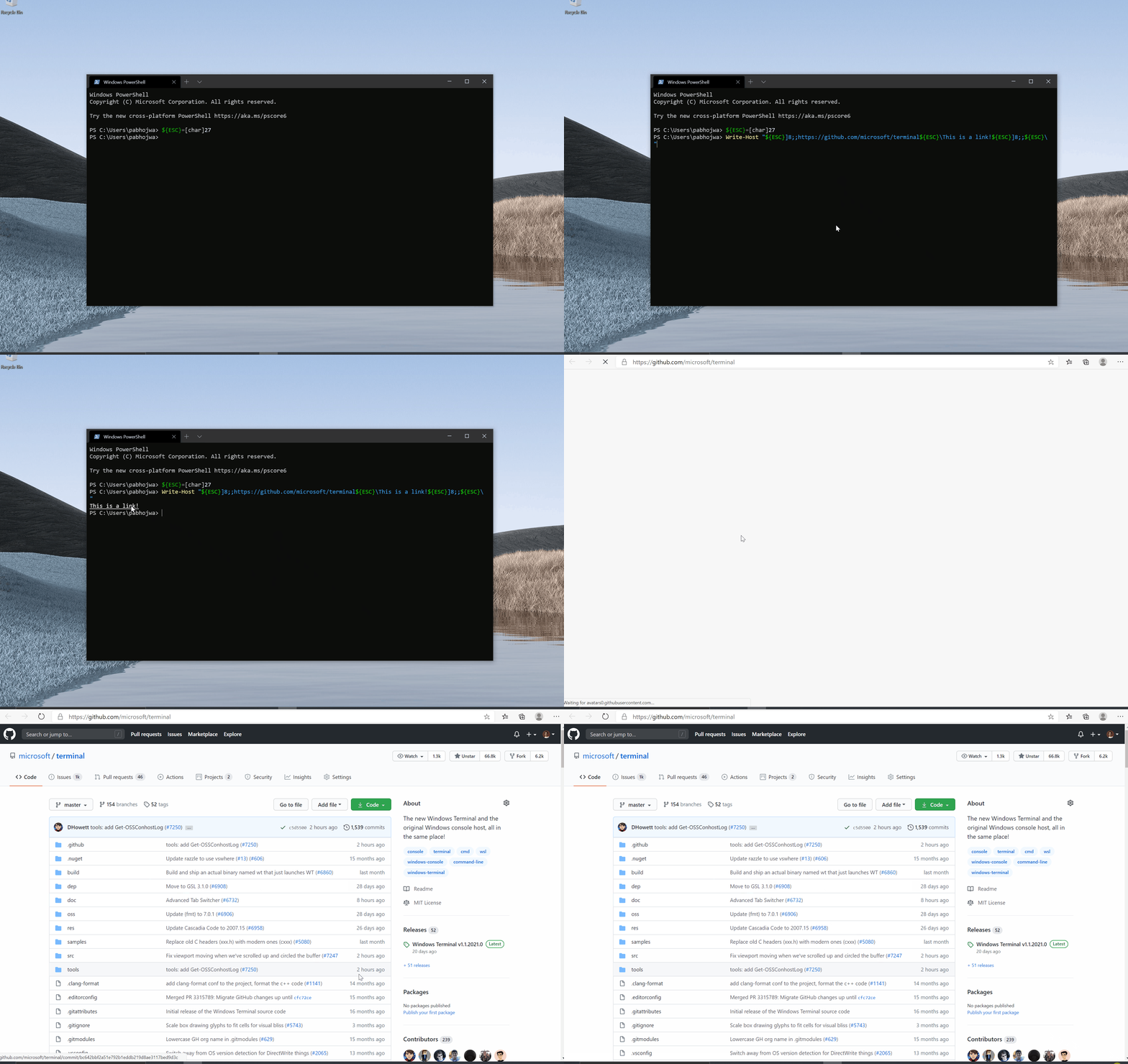
GlobalAppSettings is now a WinRT object in the TerminalApp project.
## References
#7141 - GlobalAppSettings is a settings object
#885 - this new settings object will be moved to a new TerminalSettingsModel project
## PR Checklist
* [x] Tests passed
## Detailed Description of the Pull Request / Additional comments
This one was probably the easiest thus far.
The only weird thing is how we handle InitialPosition. Today, we lose a
little bit of fidelity when we convert from LaunchPosition (int) -->
Point (float) --> RECT (long). The current change converts
LaunchPosition (optional<long>) --> InitialPosition (long) --> RECT
(long).
NOTE: Though I could use LaunchPosition to go directly from TermApp to
AppHost, I decided to introduce InitialPosition because LaunchPosition
will be a part of TerminalSettingsModel soon.
## Validation Steps Performed
- [x] Tests passed
- [x] Deployment succeeded
Profile is now a WinRT object in the TerminalApp project.
As with ColorScheme, all of the serialization logic is not exposed via
the idl. TerminalSetingsModel will handle it when it's all moved over.
I removed the "Get" and "Set" prefixes from all of the Profile
functions. It just makes more sense to use the `GETSET_PROPERTY` macro
to do most of the work for us.
`CloseOnExitMode` is now an enum off of the Profile.idl.
`std::optional<wstring>` got converted to `hstring` (as opposed to
`IReference<hstring>`). `IReference<hstring>` is not valid to MIDL.
## References
#7141 - Profile is a settings object
#885 - this new settings object will be moved to a new TerminalSettingsModel project
## Validation Steps Performed
- [x] Tests passed
- [x] Deployment succeeded
Closes#7435
Dustin L. Howett
* Clear the last error before calling Mb2Wc in ConvertToW (GH-7391)
* Update clang-format to 10.0 (GH-7389)
* Add til::static_map, a constexpr key-value store (GH-7323)
James Holderness
* Refactor VT control sequence identification (CC-7304)
Mike Griese
* Compensate for VS 16.7, part 2 (GH-7383)
* Add support for iterable, nested commands (GH-6856)
Michael Niksa
* Helix Testing (GH-6992)
* Compensate for new warnings and STL changes in VS 16.7 (GH-7319)
nathpete-msft
* Fix environment block creation (GH-7401)
Chester Liu
* Add initial support for VT DCS sequences (CC-6328)
Related work items: #28791050
## Summary of the Pull Request
The `index` action argument is now optional for `closeOtherTabs` and `closeTabsAfter`. When `index` is not defined, `index` is set to the focused tab's index.
Also, adds the non-index version of these actions to defaults.json.
## PR Checklist
* [X] Closes#7181
* [X] CLA signed
* [X] Tests passed
* [ ] Documentation updated. If checked, please file a pull request on [our docs repo](https://github.com/MicrosoftDocs/terminal) and link it here: #xxx
* [X] Schema updated.
## Validation Steps Performed
Opened 4 tabs and ran closeOtherTabs/closeTabsAfter from command palette.
This fixes a regression in environment variable loading introduced as part
of the new environment block creation that prevents some system-defined,
volatile environment variables from being defined.
## References
https://github.com/microsoft/terminal/pull/7243#discussion_r476603599
## Validation Steps Performed
Manually verified locally.
Closes#7399
## Summary of the Pull Request
Previously, if `altGrAliasing` was disabled, all `Ctrl+Alt` combinations were considered to be aliases of `AltGr` including `AltGr` itself and thus considered as key and not character events. But `AltGr` should not be treated as an alias of itself of course, as that prevents one from entering `AltGr` combinations entirely.
## PR Checklist
* [x] Closes#7372
* [x] CLA signed. If not, go over [here](https://cla.opensource.microsoft.com/microsoft/Terminal) and sign the CLA
* [x] Tests added/passed
* [ ] Documentation updated. If checked, please file a pull request on [our docs repo](https://github.com/MicrosoftDocs/terminal) and link it here: #xxx
* [ ] Schema updated.
* [ ] I've discussed this with core contributors already. If not checked, I'm ready to accept this work might be rejected in favor of a different grand plan. Issue number where discussion took place: #xxx
## Validation Steps Performed
* Activate a German keyboard layout
* Run `showkey -a` in WSL
* **Ensure** that `AltGr+Q` produces `@`
* **Ensure** that `Ctrl+Alt+Q` produces `@`
* Disable `altGrAliasing`
* **Ensure** that `AltGr+Q` produces `@`
* **Ensure** that `Ctrl+Alt+Q` produces `^[^Q`
When the console functional tests are running on OneCoreUAP, the
newly-introduced (65bd4e327, #4309) FillOutputCharacterA tests will
actually fail because of radio interference on the return value of GLE.
Fixes MSFT-28163465
This commit removes our local copy of clang-format 8 and replaces it
with a newly-built nuget package containing clang-format 10.
This resolves the inconsistency between our version of clang-format and
the one shipped in Visual Studio.
A couple minor format changes were either required or erroneously forced
upon us--chief among them is a redistribution of `*`s around SAL
annotations in inline class members of COM classes. Don't ask why; I
couldn't figure it out.
We had some aspirational goals for our formatting, which were left in
but commented out. Enabling them changes our format a little more than
I'm comfortable with, so I uncommented them and locked them to the
format style we've been using for the past year. We may not love it, but
our aspirations may not matter here any longer. Consistent formatting is
better than perfect formatting.
Most applications with scrollable content seem to define the "large
jump" distance as about a screenful of content. You can see this in long
pages in Settings and documents in Notepad.
We just weren't configuring ScrollBar here.
Fixes#7367
## Summary of the Pull Request
Adds support for "commandline mode" to the command palette.
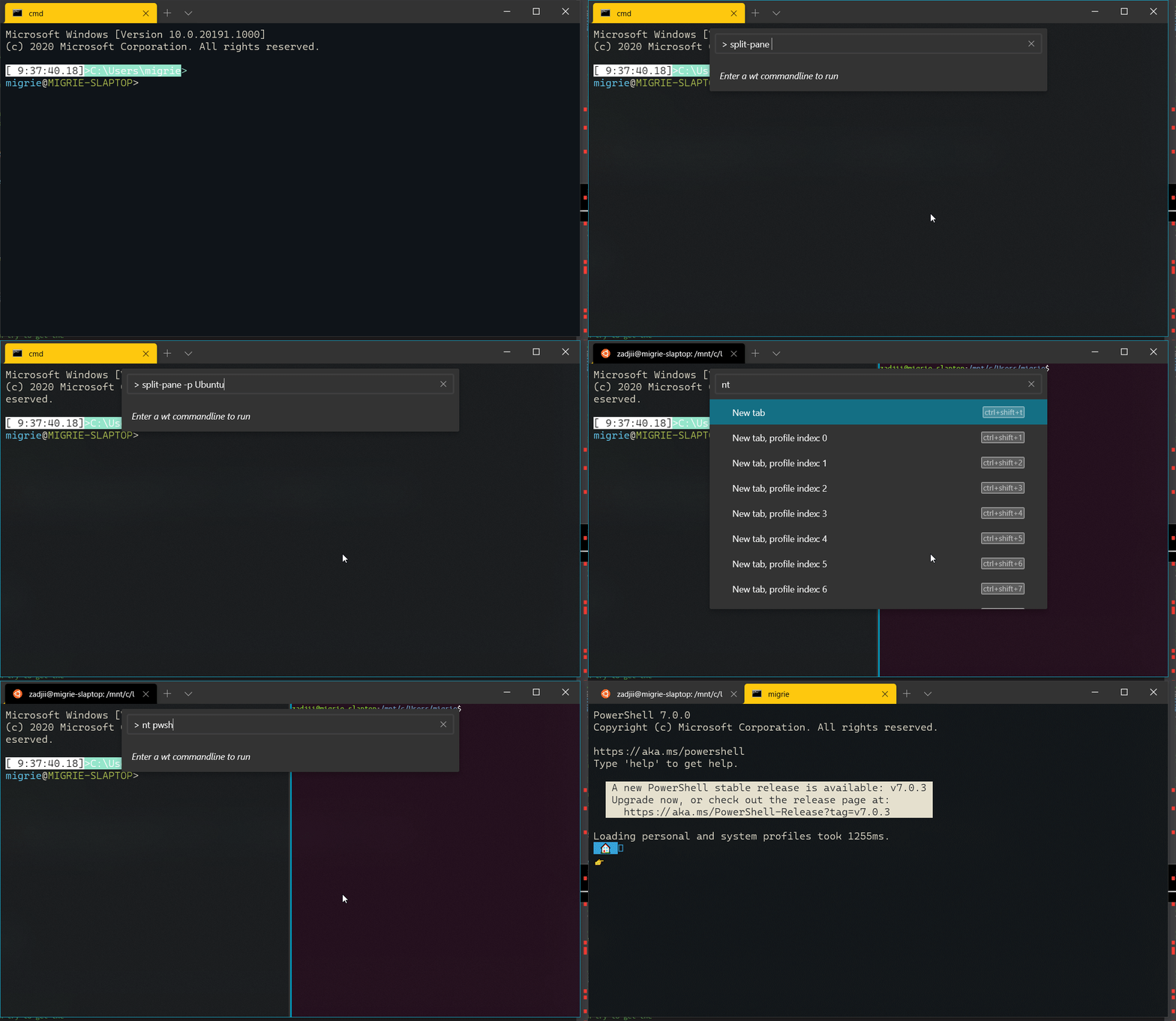
This allows the user to start typing a `wt.exe` commandline directly in the command palette, to run that commandline directly in the current window. This allows the user input something like `> nt -p Ubuntu ; sp -p ssh` and open up a new tab and split it _in the current window_.
## References
* cmdpal megathread: #5400
* Kinda related to #4472
* built with the `wt` action from #6537
## PR Checklist
* [x] Closes#6677
* [x] I work here
* [ ] Tests added/passed
* [ ] Requires documentation to be updated - sure does, when the cmdpal docs are written in the first place :P
## Validation Steps Performed
Tested manually
## Summary of the Pull Request

Adds support for setting a command's `icon`. This supports a couple different scenarios:
* setting a path to an image
* on `"iterateOn": "profiles"` commands, setting the icon to `${profile.icon}` (to use the profile's icon)
* setting the icon to a symbol from [Segoe MDL2 Assets](https://docs.microsoft.com/en-us/windows/uwp/design/style/segoe-ui-symbol-font)
* setting the icon to an emoji
* setting the icon to a character (what is an emoji other than a character, after all?)
## References
* Big s/o to @leonMSFT in #6732, who really did all the hard work here.
## PR Checklist
* [x] Closes#6644
* [x] I work here
* [ ] Tests added/passed
* [n/a] Requires documentation to be updated
## Detailed Description of the Pull Request / Additional comments
Importantly, the creation of these icons must occur on the UI thread. That's why it's done in a "load the path from json", then "get the actual IconSource" structure.
## Validation Steps Performed
see the gif
<!-- Enter a brief description/summary of your PR here. What does it fix/what does it change/how was it tested (even manually, if necessary)? -->
## Summary of the Pull Request
This PR splits the anchored and unanchored tab switcher into two. The anchored tab switcher is now baked into `nextTab`/`prevTab`, and the unanchored tab switcher command is just named `tabSearch`. `tabSearch` takes no arguments. To reflect this distinction, `CommandPalette.cpp` now refers to one as `TabSwitchMode` and the other as `TabSearchMode`.
I've added a global setting named `useTabSwitcher` (name up for debate) that makes the Terminal use the anchored tab switcher experience for `nextTab` and `prevTab`.
I've also given the control the ability to detect <kbd>Alt</kbd> KeyUp events and to dispatch keybinding events. By listening for keybindings, the ATS can react to `nextTab`/`prevTab` invocations for navigation in addition to listening for <kbd>tab</kbd> and the arrow keys.
Closes#7178
<!-- Please review the items on the PR checklist before submitting-->
## PR Checklist
* [x] CLA signed.
* [x] Documentation updates: microsoftdocs/terminal#107
* [x] Schema updated.
## Summary of the Pull Request

Adds a pair of top-level commands that both have nested, iterable sub-commands. The "New Tab..." command has one child for each profile, and will open a new tab for that profile. The "Split Pane..." command similarly has a nested command for each profile, and also has a nested command for split auto/horizontal/vertical.
## References
* megathread: #5400
* Would look better with icons from #6644
## PR Checklist
* [x] Closes#7174
* [x] I work here
* [ ] Tests added/passed
* [n/a] Requires documentation to be updated
The easiest fix was actually just moving all the source files from
`TerminalApp` to `TerminalApp/lib`, where the appropriate `pch.h`
actually resides.
Closes#6866
In #6532, we thought it would be a good idea to add "bindings" as an
overload for "keybindings", as we were no longer going to use the
keybindings array for just keybindings. We were going to add commands.
So we started secretly treating `"bindings"` the same as
`"keybindings"`.
Then, in #7175, we discussed using "actions" as the key for the list of
commands/keybindings/global actions, instead of using "bindings". We're
going to be using this array as the global list of all actions, so it
makes sense to just call it `"actions"`.
This PR renames "bindings" to "actions". Fortunately, we never
documented the "bindings" overload in the first place, so we can get
away with this safely, and preferably before we ship "bindings" for too
long.
References #6899
#6989 forgot to add `togglePaneZoom` to the schema, so this does that.
WHILE I'M HERE:
* The action names in the schema and the actual source were both in _random_ order, so I sorted them alphabetically.
* I also added an unbound `togglePaneZoom` command to defaults.json, so users can use that command from the cmdpal w/o binding it manually.
Activating a template doesn't actually process conditions. Only jobs, stages, and tasks can process a condition. So specify the full condition in the parent template call as a parameter and ask the child job (who can actually evaluate the condition) to use that parameter to determine if it should run.
## Summary of the Pull Request
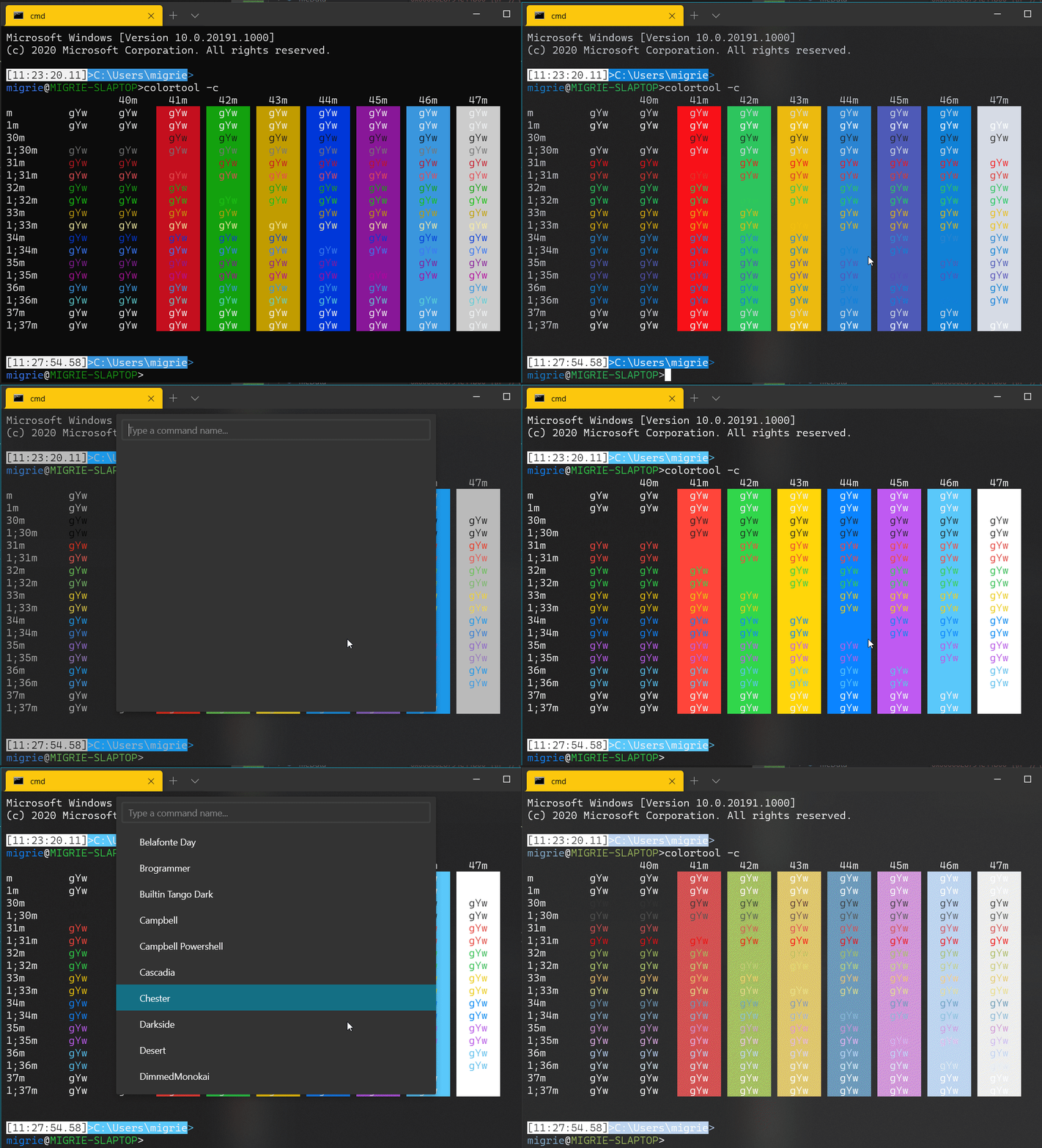
Allows for creating commands that iterate over the user's color schemes. Also adds a top-level nested command to `defaults.json` that allows the user to select a color scheme (pictured above). I'm not sure there are really any other use cases that make sense, but it _really_ makes sense for this one.
## References
* #5400 - cmdpal megathread
* made possible by #6856, _and support from viewers like you._
* All this is being done in pursuit of #6689
## PR Checklist
* [x] Closes wait what? I could have swore there was an issue for this one...
* [x] I work here
* [x] Tests added/passed
* [ ] Requires documentation to be updated - okay maybe now I'll write some docs
## Detailed Description of the Pull Request / Additional comments
Most of the hard work for this was already done in #6856. This is just another thing to iterate over.
## Validation Steps Performed
* Played with this default command. It works great.
* Added tests.
Adds the ability to set the selection background opacity when setting the
selection background. This also exposes the selection background and alpha
through the terminal WPF container.
## Summary of the Pull Request
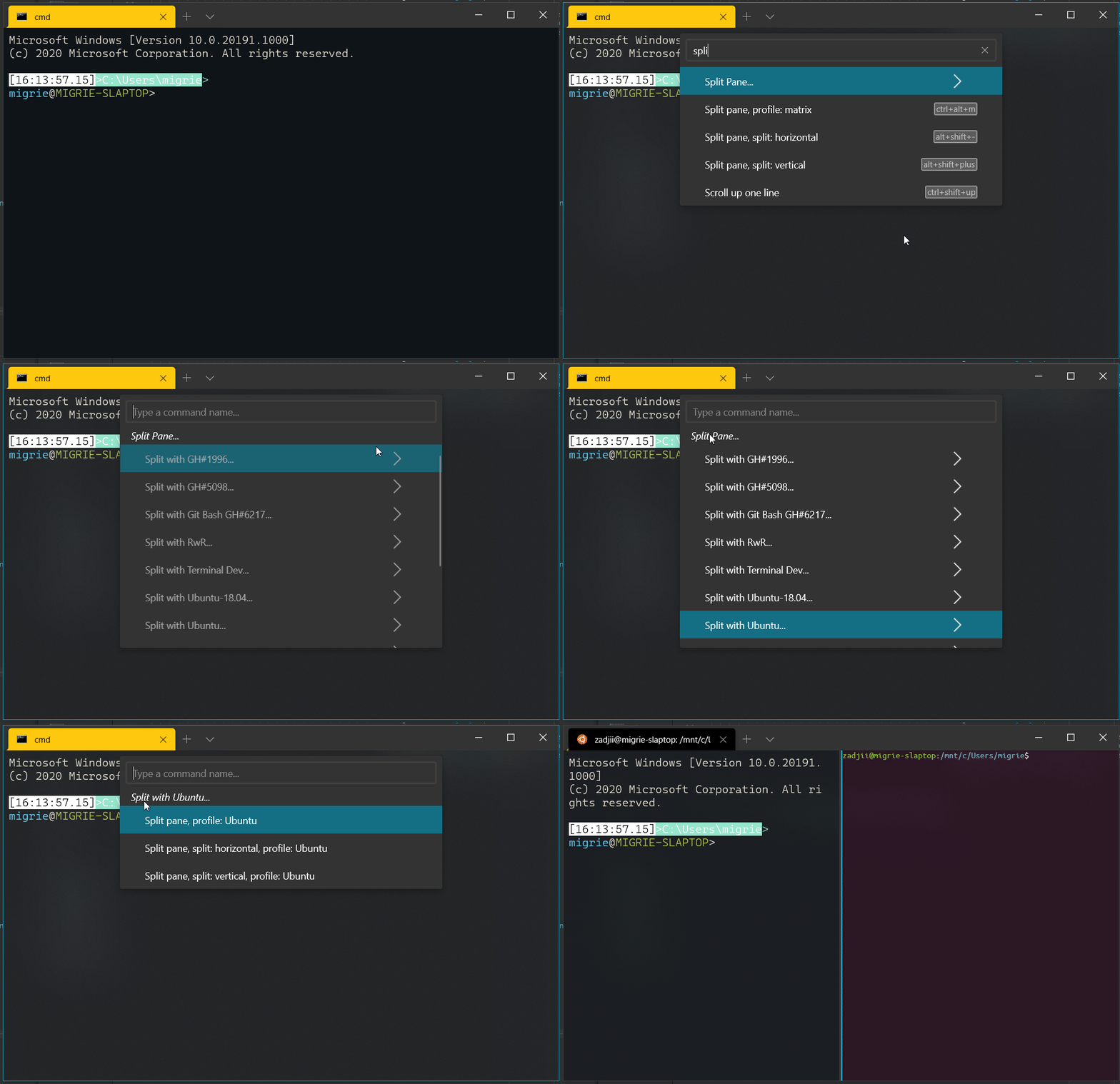
* Add a chevron for nested commands
* Add the text of the parent command when entering a child command
## References
## PR Checklist
* [x] Closes#7265
* [x] I work here
* [n/a] Tests added/passed
* [n/a] Requires documentation to be updated
## Validation Steps Performed
_look at that gif_
This PR changes the way VT control sequences are identified and
dispatched, to be more efficient and easier to extend. Instead of
parsing the intermediate characters into a vector, and then having to
identify a sequence using both that vector and the final char, we now
use just a single `uint64_t` value as the identifier.
The way the identifier is constructed is by taking the private parameter
prefix, each of the intermediate characters, and then the final
character, and shifting them into a 64-bit integer one byte at a time,
in reverse order. For example, the `DECTLTC` control has a private
parameter prefix of `?`, one intermediate of `'`, and a final character
of `s`. The ASCII values of those characters are `0x3F`, `0x27`, and
`0x73` respectively, and reversing them gets you 0x73273F, so that would
then be the identifier for the control.
The reason for storing them in reverse order, is because sometimes we
need to look at the first intermediate to determine the operation, and
treat the rest of the sequence as a kind of sub-identifier (the
character set designation sequences are one example of this). When in
reverse order, this can easily be achieved by masking off the low byte
to get the first intermediate, and then shifting the value right by 8
bits to get a new identifier with the rest of the sequence.
With 64 bits we have enough space for a private prefix, six
intermediates, and the final char, which is way more than we should ever
need (the _DEC STD 070_ specification recommends supporting at least
three intermediates, but in practice we're unlikely to see more than
two).
With this new way of identifying controls, it should now be possible for
every action code to be unique (for the most part). So I've also used
this PR to clean up the action codes a bit, splitting the codes for the
escape sequences from the control sequences, and sorting them into
alphabetical order (which also does a reasonable job of clustering
associated controls).
## Validation Steps Performed
I think the existing unit tests should be good enough to confirm that
all sequences are still being dispatched correctly. However, I've also
manually tested a number of sequences to make sure they were still
working as expected, in particular those that used intermediates, since
they were the most affected by the dispatch code refactoring.
Since these changes also affected the input state machine, I've done
some manual testing of the conpty keyboard handling (both with and
without the new Win32 input mode enabled) to make sure the keyboard VT
sequences were processed correctly. I've also manually tested the
various VT mouse modes in Vttest to confirm that they were still working
correctly too.
Closes#7276
Use the Helix testing orchestration framework to run our Terminal LocalTests and Console Host UIA tests.
## References
#### Creates the following new issues:
- #7281 - re-enable local tests that were disabled to turn on Helix
- #7282 - re-enable UIA tests that were disabled to turn on Helix
- #7286 - investigate and implement appropriate compromise solution to how Skipped is handled by MUX Helix scripts
#### Consumes from:
- #7164 - The update to TAEF includes wttlog.dll. The WTT logs are what MUX's Helix scripts use to track the run state, convert to XUnit format, and notify both Helix and AzDO of what's going on.
#### Produces for:
- #671 - Making Terminal UIA tests is now possible
- #6963 - MUX's Helix scripts are already ready to capture PGO data on the Helix machines as certain tests run. Presuming we can author some reasonable scenarios, turning on the Helix environment gets us a good way toward automated PGO.
#### Related:
- #4490 - We lost the AzDO integration of our test data when I moved from the TAEF/VSTest adapter directly back to TE. Thanks to the WTTLog + Helix conversion scripts to XUnit + new upload phase, we have it back!
## PR Checklist
* [x] Closes#3838
* [x] I work here.
* [x] Literally adds tests.
* [ ] Should I update a testing doc in this repo?
* [x] Am core contributor. Hear me roar.
* [ ] Correct spell-checking the right way before merge.
## Detailed Description of the Pull Request / Additional comments
We have had two classes of tests that don't work in our usual build-machine testing environment:
1. Tests that require interactive UI automation or input injection (a.k.a. require a logged in user)
2. Tests that require the entire Windows Terminal to stand up (because our Xaml Islands dependency requires 1903 or later and the Windows Server instance for the build is based on 1809.)
The Helix testing environment solves both of these and is brought to us by our friends over in https://github.com/microsoft/microsoft-ui-xaml.
This PR takes a large portion of scripts and pipeline configuration steps from the Microsoft-UI-XAML repository and adjusts them for Terminal needs.
You can see the source of most of the files in either https://github.com/microsoft/microsoft-ui-xaml/tree/master/build/Helix or https://github.com/microsoft/microsoft-ui-xaml/tree/master/build/AzurePipelinesTemplates
Some of the modifications in the files include (but are not limited to) reasons like:
- Our test binaries are named differently than MUX's test binaries
- We don't need certain types of testing that MUX does.
- We use C++ and C# tests while MUX was using only C# tests (so the naming pattern and some of the parsing of those names is different e.g. :: separators in C++ and . separators in C#)
- Our pipeline phases work a bit differently than MUX and/or we need significantly fewer pieces to the testing matrix (like we don't test a wide variety of OS versions).
The build now runs in a few stages:
1. The usual build and run of unit tests/feature tests, packaging verification, and whatnot. This phase now also picks up and packs anything required for running tests in Helix into an artifact. (It also unifies the artifact name between the things Helix needs and the existing build outputs into the single `drop` artifact to make life a little easier.)
2. The Helix preparation build runs that picks up those artifacts, generates all the scripts required for Helix to understand the test modules/functions from our existing TAEF tests, packs it all up, and queues it on the Helix pool.
3. Helix generates a VM for our testing environment and runs all the TAEF tests that require it. The orchestrator at helix.dot.net watches over this and tracks the success/fail and progress of each module and function. The scripts from our MUX friends handle installing dependencies, making the system quiet for better reliability, detecting flaky tests and rerunning them, and coordinating all the log uploads (including for the subruns of tests that are re-run.)
4. A final build phase is run to look through the results with the Helix API and clean up the marking of tests that are flaky, link all the screenshots and console output logs into the AzDO tests panel, and other such niceities.
We are set to run Helix tests on the Feature test policy of only x64 for now.
Additionally, because the set up of the Helix VMs takes so long, we are *NOT* running these in PR trigger right now as I believe we all very much value our 15ish minute PR turnaround (and the VM takes another 15 minutes to just get going for whatever reason.) For now, they will only run as a rolling build on master after PRs are merged. We should still know when there's an issue within about an hour of something merging and multiple PRs merging fast will be done on the rolling build as a batch run (not one per).
In addition to setting up the entire Helix testing pipeline for the tests that require it, I've preserved our classic way of running unit and feature tests (that don't require an elaborate environment) directly on the build machines. But with one bonus feature... They now use some of the scripts from MUX to transform their log data and report it to AzDO so it shows up beautifully in the build report. (We used to have this before I removed the MStest/VStest wrapper for performance reasons, but now we can have reporting AND performance!) See https://dev.azure.com/ms/terminal/_build/results?buildId=101654&view=ms.vss-test-web.build-test-results-tab for an example.
I explored running all of the tests on Helix but.... the Helix setup time is long and the resources are more expensive. I felt it was better to preserve the "quick signal" by continuing to run these directly on the build machine (and skipping the more expensive/slow Helix setup if they fail.) It also works well with the split between PR builds not running Helix and the rolling build running Helix. PR builds will get a good chunk of tests for a quick turn around and the rolling build will finish the more thorough job a bit more slowly.
## Validation Steps Performed
- [x] Ran the updated pipelines with Pull Request configuration ensuring that Helix tests don't run in the usual CI
- [x] Ran with simulation of the rolling build to ensure that the tests now running in Helix will pass. All failures marked for follow on in reference issues.
This is based on (cribbed almost directly from) code written by the
inimitable @StephanTLavavej on one of our mailing lists.
This is a nice generic version of the approach used in
JsonUtils::EnumMapper and CodepointWidthDetector: a static array of
key-value pairs that we binary-search at runtime (or at compile time, as
the case may be.)
Keys are not required to be sorted, as we're taking advantage of
constexpr std::sort (VS 16.6+) to get the compiler to do it for us. How
cool is that?
static_map presents an operator[] or at much like
std::map/std::unordered_map does.
I've added some tests, but they're practically fully-solveable at compile
time so they pretty much act like `VERIFY_IS_TRUE(true)`.
- Add MENU key with "menu" "app" as key bindings.
- Updated profiles.schema.json and documentation.
## Validation Steps Performed
Ran tests locally.
Tested out the new key binding.
```{ "command": "openNewTabDropdown", "keys": "app" }```
Closes#7144
New warnings were added in VS 16.7 and `std::map::erase` is now `noexcept`.
Update our code to be compatible with the new enforcement.
## PR Checklist
* [x] Closes broken audit in main after Agents updated over the weekend.
* [x] I work here.
* [x] Audit mode passes now
* [x] Am core contributor.
## Validation Steps Performed
* [x] Ran audit mode locally
As the title suggests, this commit adds initial support for the VT DCS
sequences. The parameters are parsed but not yet used. The pass through
data is yet to be handled. This effectively fixes#120 by making Sixel
graphics sequences *ignored* instead of printed.
* https://vt100.net/docs/vt510-rm/chapter4.html
* https://vt100.net/emu/dec_ansi_parser
Tests added.
References #448Closes#120
Adds array support for the existing `copyFormatting` global setting.
This allows users to define which formats they would specifically like
to be copied.
A boolean value is still accepted and is translated to the following:
- `false` --> `"none"` or `[]`
- `true` --> `"all"` or `["html", "rtf"]`
This also adds `copyFormatting` as a keybinding arg for `copy`. As with
the global setting, a boolean value and array value is accepted.
CopyFormat is a WinRT enum where each accepted format is a flag.
Currently accepted formats include `html`, and `rtf`. A boolean value is
accepted and converted. `true` is a conjunction of all the formats.
`false` only includes plain text.
For the global setting, `null` is not accepted. We already have a
default value from before so no worries there.
For the keybinding arg, `null` (the default value) means that we just do
what the global arg says to do. Overall, the `copyFormatting` keybinding
arg is an override of the global setting **when using that keybinding**.
References #5212 - Spec for formatted copying
References #2690 - disable html copy
Validated behavior with every combination of values below:
- `copyFormatting` global: { `true`, `false`, `[]`, `["html"]` }
- `copyFormatting` copy arg:
{ `null`, `true`, `false`, `[]`, `[, "html"]`}
Closes#4191Closes#5262
ColorScheme is now a WinRT object.
All of the JSON stuff can't be exposed via the idl. So the plan here is
that we'll have the TerminalSettingsModel project handle all of the
serialization when it's moved over. These functions will be exposed off
of the `implementation` namespace, not projected namespace.
References #7141 - ColorScheme is a settings object
References #885 - this new settings object will be moved to a new
TerminalSettingsModel project
## Validation Steps Performed
- [x] Tests passed
- [x] Deployment succeeded
#7145 introduced a check so that we wouldn't dispatch keys unless they
actually had a scancode. Our synthetic events actually _didn't_ have
scancodes. Not because they couldn't--just because they didn't.
Fixes#7297
## Summary of the Pull Request
This PR adds support for both _nested_ and _iterable_ commands in the Command palette.
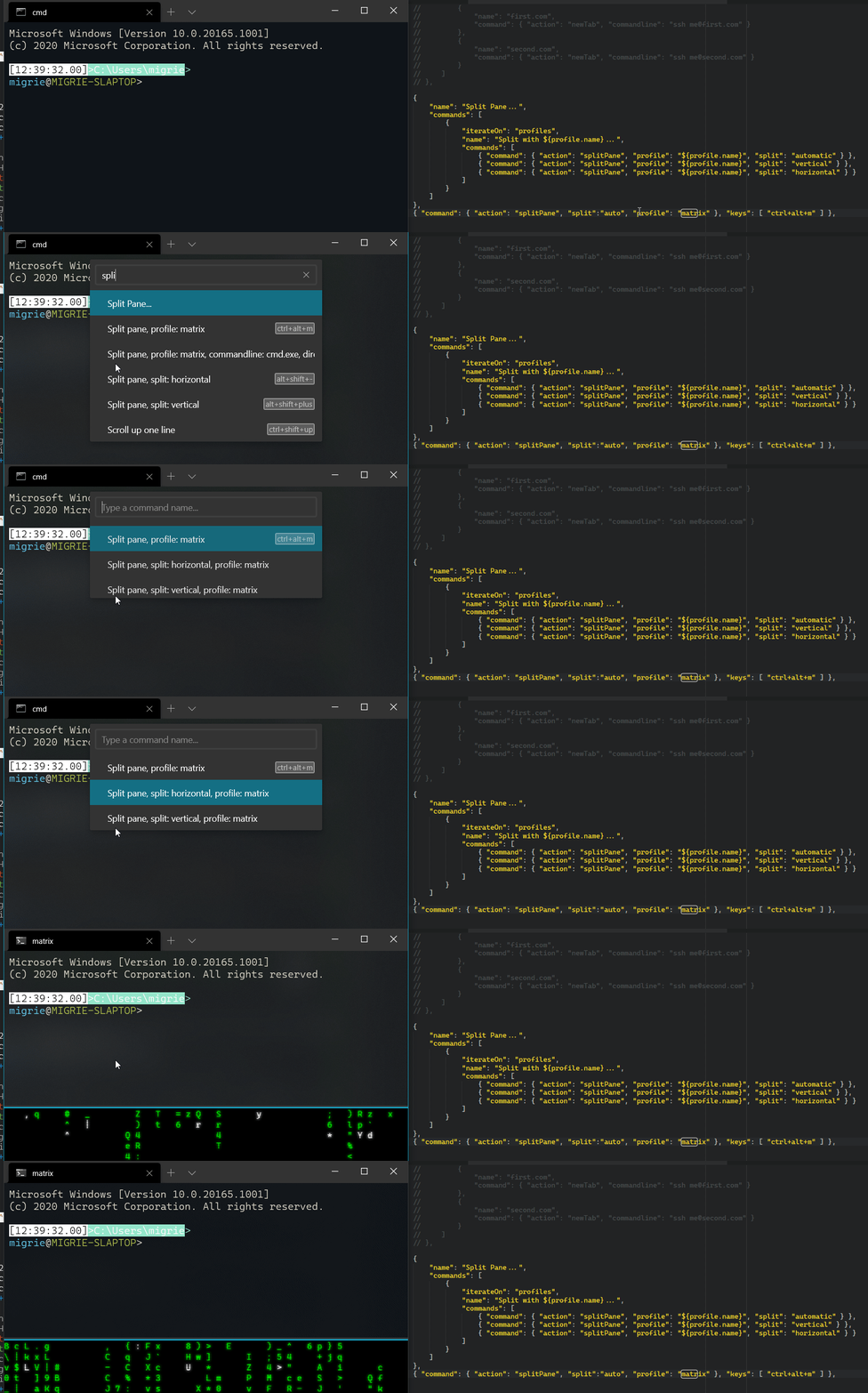
* **Nested commands**: These are commands that include additional sub-commands. When the user selects on of these, the palette will update to only show the nested commands.
* **Iterable commands**: These are commands what allow the user to define only a single command, which is repeated once for every profile. (in the future, also repeated for color schemes, themes, etc.)
The above gif uses the following json:
```json
{
"name": "Split Pane...",
"commands": [
{
"iterateOn": "profiles",
"name": "Split with ${profile.name}...",
"commands": [
{ "command": { "action": "splitPane", "profile": "${profile.name}", "split": "automatic" } },
{ "command": { "action": "splitPane", "profile": "${profile.name}", "split": "vertical" } },
{ "command": { "action": "splitPane", "profile": "${profile.name}", "split": "horizontal" } }
]
}
]
},
```
## References
## PR Checklist
* [x] Closes#3994
* [x] I work here
* [x] Tests added/passed
* [ ] Requires documentation to be updated - Sure does, but we'll finish polishing this first.
## Detailed Description of the Pull Request / Additional comments
We've now gotta keep the original json for a command around, so that once we know what all the profiles will be, we can expand the commands that need it.
We've also got to parse commands recursively, because they might have any number of child commands.
These together made the command parsing a _lot_ more complicated, but it feels good so far.
## Validation Steps Performed
* wrote a bunch of tests
* Played with it a bunch
Removes the if-statement in `UpdateTabIndices` that blocks all scenarios where you delete the second to last tab. This fixes the issue where the ATS gets confused about which item in the ListView is associated with which tab.
Closes#7278
This is a minor fix from #6989. If there's only one pane in the
Terminal, then we'd still "zoom" it and give it a border, but all the
borders would be black.
A single pane is already "zoomed", so it doesn't really make sense to
try and zoom if there's only one.
Whoops, members are zero initialized in Debug builds but most likely not
in Release builds So, this PR adds a couple of default values to
`_currentMode` and its associated XAML strings to make cmdpal/ats work
deterministically on first use. I also added a default value to
`_anchorKey` just to be safe.
Closes#7254
Carlos Zamora (1)
* Pass mouse button state into HandleMouse instead of asking win32 (GH-6765)
James Holderness (1)
* Add support for the "doubly underlined" graphic rendition attribute (CC-7223)
Moshe Schorr (1)
* Batch RTL runs to ensure proper draw order (CC-7190)
Related work items: MSFT-28385436
## Summary of the Pull Request
This PR enables users to send arbitrary text input to the shell via a keybinding.
## PR Checklist
* [x] Closes#3799
* [x] CLA signed. If not, go over [here](https://cla.opensource.microsoft.com/microsoft/Terminal) and sign the CLA
* [ ] Tests added/passed
* [ ] Documentation updated. If checked, please file a pull request on [our docs repo](https://github.com/MicrosoftDocs/terminal) and link it here: #xxx
* [x] Schema updated.
* [x] I've discussed this with core contributors already. If not checked, I'm ready to accept this work might be rejected in favor of a different grand plan. Issue number where discussion took place: #3799
## Detailed Description of the Pull Request / Additional comments
## Validation Steps Performed
Added the following keybindings:
```json
{ "keys": "p", "command": { "action": "sendInput", "input": "foobar" } },
{ "keys": "q", "command": { "action": "sendInput", "input": "\u001b[A" } },
```
Ensured that when pressing <kbd>P</kbd> "foobar" is echoed to the shell and when pressing <kbd>Q</kbd> the shell history is being navigated backwards.
* This is a mini-spec for how I see this working
* good bot
* These were some typos
* Addd a future consideration about the command palette and commands
* Update spec to reflect discussion with Carlos
* update spec to reflect investigations in Command Palette Addenda 1
* add references to #6899, and minor bits of review feedback
* add `remainingProfiles` as a way of adding all the user's other profiles quickly to the menu as well
* clarify why we're not doing it in the profiles list
* no two commits do not contain a misspelling of separate
## Summary of the Pull Request
⚠️ This spec has been moved from #6902. That version was branched off the new tab menu customization, and had a terribly convoluted git history. After discussion with the team, we've decided that it's best that this spec is merged atomically _first_, and used as the basis for #5888, as opposed to the other way around.
> This document is intended to serve as an addition to the [Command Palette Spec],
> as well as the [New Tab Menu Customization Spec].
>
> As we come to rely more on actions being a mechanism by which the user defines
> "do something in the Terminal", we'll want to make it even easier for users to
> re-use the actions that they've already defined, as to reduce duplicated json as
> much as possible. This spec proposes a mechanism by which actions could be
> uniquely identifiable, so that the user could refer to bindings in other
> contexts without needing to replicate an entire json blob.
>
## PR Checklist
* [x] Specs: #6899
* [x] References: #1571, #1912, #3337, #5025, #5524, #5633
* [x] I work here
## Detailed Description of the Pull Request / Additional comments
_\*<sup>\*</sup><sub>\*</sub> read the spec <sub>\*</sub><sup>\*</sup>\*_
[Command Palette Spec]: https://github.com/microsoft/terminal/blob/master/doc/specs/%232046%20-%20Command%20Palette.md
[New Tab Menu Customization Spec]: https://github.com/microsoft/terminal/blob/master/doc/specs/%231571%20-%20New%20Tab%20Menu%20Customization.md
This commit ensures that we always furnish a new process with the
cleanest, most up-to-date environment variables we can. There is a minor
cost here in that WT will no longer pass environment variables that it
itself inherited to its child processes.
This could be considered a reasonable sacrifice. It will also remove
somebody else's TERM, TERM_PROGRAM and TERM_PROGRAM_VERSION from the
environment, which could be considered a win.
I validated that GetCurrentProcessToken returns a token we're
_technically able_ to use with this API; it is roughly equivalent to
OpenProcessToken(GetCurrentProcess) in that it returns the current
active _access token_ (which is what CreateEnvironmentBlock wants.)
There's been discussion about doing a 3-way merge between WT's
environment and the new one. This will be complicated and I'd like to
scream test the 0-way merge first ;P
Related to #1125 (but it does not close it or resolve any of the other
issues it calls out.)
Fixes#7239Fixes#7204 ("App Paths" value creeping into wt's environment)
This regressed around the #7163 timeframe.
We're discussing this on chat currently. It might break the intellisense
on the `#include <winrt/Microsoft.Terminal.TerminalControl.h>` line in
VS 16.7, but we're not _really_ sure? Intellisense has been notoriously
flaky for us.
I'm running 16.6.5, and it works for me. @lhecker is running 16.7 and
confirmed it worked there. If the CI build passes, then this definitely
will work for 16.7.
This script takes a range of commits and generates a commit log with the
git2git-excluded file changes filtered out.
It also replaces GitHub issue numbers with GH-XXX so as to not confuse
Git2Git or Azure DevOps. Community contributions are tagged with CC- so
they can be detected later.
The output looks like this:
```
Carlos Zamora (2)
* Pass mouse button state into HandleMouse instead of asking win32 (GH-6765)
Dustin L. Howett (6)
* Disable MinimalCoreWin when OpenConsoleUniversalApp is false (GH-7203)
James Holderness (1)
* Add support for the "doubly underlined" graphic rendition attribute (CC-7223)
```
Yes, the numbers are wrong. No, it doesn't really matter.
If you scroll up to view the scrollback, then we want the viewport to
"stay in place", as new output comes in (see #6062). This works fine up
until the buffer circles. In this case, the mutable viewport isn't
actually moving, so we never set `updatedViewport` to true.
This regressed in #6062Closes#7222
This pull request completes (and somewhat rewrites) the JsonUtils error
handling arc. Deserialization errors, no longer represented by trees of
exceptions that must be rethrown and caught, are now transformed at
catch time into a message explaining what we expected and where we
expected it.
Instead of exception trees, a deserialization failure will result in a
single type of exception with the originating JSON object from which we
can determine the contents and location of the failure.
Because most of the error message actually comes from the JSON schema
or the actual supported types, and the other jsoncpp errors are not
localized I've made the decision to **not** localize these messages.

## Summary of the Pull Request
This PR adds the Advanced Tab Switcher (ATS) to Terminal. It'll work
similarly to VSCode's tab switcher. Because this implementation rides
off a lot of the Command Palette's XAML code, it'll look just like the
Command Palette, and also have support for tab title search.
## References
#3753 - ATS Spec
Closes#1502
The "default profile as name" feature in 1.1 broke the loading of
default settings, as we would never get to the validation phase where
the default profile string was transformed into a guid.
I moved knowledge of the "unparsed default profile" optional to the
consumer so that we could make sure we only attempted to deserialize it
once (and only if it was present.)
Fixes#7236.
## PR Checklist
* [x] Closes#7236
## Summary of the Pull Request
We're expecting that people have treated `padding` as an integer, and the type-based converter is too strict for that. This PR widens its scope and explicitly allows for it in the schema.
## PR Checklist
* [x] Closes#7234
This PR adds support for the ANSI _doubly underlined_ graphic rendition
attribute, which is enabled by the `SGR 21` escape sequence.
There was already an `ExtendedAttributes::DoublyUnderlined` flag in the
`TextAttribute` class, but I needed to add `SetDoublyUnderlined` and
`IsDoublyUnderlined` methods to access that flag, and update the
`SetGraphicsRendition` methods of the two dispatchers to set the
attribute on receipt of the `SGR 21` sequence. I also had to update the
existing `SGR 24` handler to reset _DoublyUnderlined_ in addition to
_Underlined_, since they share the same reset sequence.
For the rendering, I've added a new grid line type, which essentially
just draws an additional line with the same thickness as the regular
underline, but slightly below it - I found a gap of around 0.05 "em"
between the lines looked best. If there isn't enough space in the cell
for that gap, the second line will be clamped to overlap the first, so
you then just get a thicker line. If there isn't even enough space below
for a thicker line, we move the offset _above_ the first line, but just
enough to make it thicker.
The only other complication was the update of the `Xterm256Engine` in
the VT renderer. As mentioned above, the two underline attributes share
the same reset sequence, so to forward that state over conpty we require
a slightly more complicated process than with most other attributes
(similar to _Bold_ and _Faint_). We first check whether either underline
attribute needs to be turned off to send the reset sequence, and then
check individually if each of them needs to be turned back on again.
## Validation Steps Performed
For testing, I've extended the existing attribute tests in
`AdapterTest`, `VTRendererTest`, and `ScreenBufferTests`, to make sure
we're covering both the _Underlined_ and _DoublyUnderlined_ attributes.
I've also manually tested the `SGR 21` sequence in conhost and Windows
Terminal, with a variety of fonts and font sizes, to make sure the
rendering was reasonably distinguishable from a single underline.
Closes#2916
## Summary of the Pull Request
Adds the `setColorScheme` action, to change the color scheme of the active control to one given by the `name` parameter. `name` is required. If `name` is not the name of a color scheme, the action does nothing.
## References
* Being done as a stepping stone to #6689
## PR Checklist
* [x] Closes#5401
* [x] I work here
* [ ] Tests added/passed
* [n/a] Requires documentation to be updated
## Detailed Description of the Pull Request / Additional comments
Technically, the action is being done by changing the settings of the current `TerminalSettings` of the `TermControl`. Frankly, it should be operating on a copy of the `TermControl`'s `IControlSettings`, then updating the control's settings, or the Control should just listen for changes to it's setting's properties, and update in real time (without a manual call to `UpdateSettings`. However, both those paths are somewhere unknowable beyond #6904, so we'll just do this for now.
## Validation Steps Performed
* tested manually with a scheme that exists
* tested manually with a scheme that doesn't exist
MouseInput was directly asking user32 about the state of the mouse buttons,
which was somewhat of a layering violation. This commit makes all callers
have to pass the mouse state in themselves.
Closes#4869
This PR adds the `togglePaneZoom` action, which can be used to make a
pane expand to fill the entire contents of the window. A tab that
contains a zoomed pane will have a magnifying glass icon prepended
to its title. Any attempts to manage panes with one zoomed will force
the zoomed pane back to normal size.
VALIDATION
Zoomed in and out a bunch. Tried closing panes while zoomed. Tried
splitting panes while zoomed. Etc.
Closes#996
This PR adds support for per-profile tab colors, in accordance with
#7134. This adds a single `tabColor` property, that when set, specifies
the background color for profile's tab. This color can be overridden by
the color picker, and clearing the color with the color picker will
revert to this default color set for the tab.
* Full theming is covered in #3327 & #5772
Validation: Played with setting this color, both on launch and via
hot-reload
Specified in #7134Closes#1337
Consecutive RTL GlyphRuns are drawn from the last to the first.
References
#538, #7149, all those issues asking for RTL closed as dupes.
As @miniksa suggested in a comment on #7149 -- handle the thingy on the
render side.
If we have GlyphRuns abcdEFGh, where EFG are RTL, we draw them now in
order abcdGFEh.
This has ransom-noting, because I didn't touch the font scaling at all.
This should fix the majority of RTL issues, except it *doesn't* fix
issues with colors, because those get split in the TextBuffer phase in
the renderer I think, so they show up separately by the GlyphRun phase.
## Summary of the Pull Request
Move `ICoreSettings` and `IControlSettings` from the TerminalSettings project to the TerminalCore and TerminalControl projects respectively. Also entirely removes the TerminalSettings project.
The purpose of these interfaces is unchanged. `ICoreSettings` is used to instantiate a terminal. `IControlSettings` (which requires an `ICoreSettings`) is used to instantiate a UWP terminal control.
## References
Closes#7140
Related Epic: #885
Related Spec: #6904
## PR Checklist
* [X] Closes#7140
* [X] CLA signed
* [X] Tests ~added~/passed (no additional tests necessary)
* [X] ~Documentation updated~
* [X] ~Schema updated~
## Detailed Description of the Pull Request / Additional comments
A lot of the work here was having to deal with winmd files across all of these projects. The TerminalCore project now outputs a Microsoft.Terminal.TerminalControl.winmd. Some magic happens in TerminalControl.vcxproj to get this to work properly.
## Validation Steps Performed
Deployed Windows Terminal and opened a few new tabs.
This fixes the build the rest of the way in VS 16.7. Something about the
way we were using the Store/Container flags caused some of our projects
to end up linking kernel32.lib only (MinimalCoreWin==KernelOnly).
The best way to solve it once and for all is to make sure MinimalCoreWin
is always set.
References 313568d0e5.
## Summary of the Pull Request
Adds support for two actions, `closeOtherTabs` and `closeTabsAfter`. Both these actions accept an `index` parameter.
* `closeOtherTabs`: Close tabs other than `index`
* `closeTabsAfter`: Close tabs after `index` (This is also "Close tabs to the right")
## References
* This PR is being made to unblock @RahulRavishankar in #1912
## PR Checklist
* [x] I work here
* [ ] Tests added/passed
* [x] Requires documentation to be updated
* [ ] We should file an issue for "add an `index` param to `closeTab`" to add similar support to the close tab action
* [ ] We should file an issue for "make the `index` param to `closeOtherTabs`, `closeTabsAfter` optional" to make them both work on the _active_ tab when there's no `index` provided
## Validation Steps Performed
* _Verified that_ closing all tabs when I have the `index`'th tab selected _works as expected_
* _Verified that_ closing all tabs when I have a tab other than the `index`'th tab selected _works as expected_
* _Verified that_ closing tabs to the right when I have the `index`'th tab selected _works as expected_
* _Verified that_ closing tabs to the right when I have a tab other than the `index`'th tab selected _works as expected_
- This one has one caveat: for whatever reason, if you run this action when the tab that's currently focused is _before_ the `index` param, then the tabs will expand to fill the entire width of the tab row, until you mouse over them. Probably has something to do with tabs not resizing down until there's a mouse exit event.
I've typed this up way too many times now. I'm sticking this comment in Niksa.md, and if it's ever an insufficient explanation of the differences, we can elaborate.
Up until #4999 we deferred all key events to the character event handler
for which `ToUnicodeEx` returned a valid character and alternatively
those who aren't a special key combination as listed in
`TerminalInput`'s implementation.
Since #4999 we started acknowledging/handling all key events no matter
whether they're actually a known key combination. Given non-ASCII inputs
the Win32 `SendInput()` method generates certain sequences that aren't
recognizable combinations though and if they're handled by the key event
handler no follow up character event is sent containing the unicode
character.
This PR adds another condition and defers all key events without scan
code (i.e. those not representable by the current keyboard layout) to
the character event handler.
I'm absolutely not certain that this PR doesn't have a negative effect
on other kinds of inputs.
Is it common for key events to not contain a scan code? I personally
haven't seen it happen before AutoHotKey/SendInput.
Before this PR is merged it'd be nice to have a good testing plan in
place in order to ensure nothing breaks.
## Validation Steps Performed
Remapped `AltGr+8` to `»` using AutoHotKey using `<^>!8::SendInput {Raw}»`.
Ensured `»` is printed if `AltGr+8` is pressed.
Closes#7064Closes#7120
Carlos Zamora (1)
* UIA: use full buffer comparison in rects and endpoint setter (GH-6447)
Dan Thompson (2)
* Tweaks: normalize TextAttribute method names (adjective form) (GH-6951)
* Fix 'bcz exclusive' typo (GH-6938)
Dustin L. Howett (4)
* Fix VT mouse capture issues in Terminal and conhost (GH-7166)
* version: bump to 1.3 on master
* Update Cascadia Code to 2007.15 (GH-6958)
* Move to the TerminalDependencies NuGet feed (GH-6954)
James Holderness (3)
* Render the SGR "underlined" attribute in the style of the font (CC-7148)
* Add support for the "crossed-out" graphic rendition attribute (CC-7143)
* Refactor grid line renderers with support for more line types (CC-7107)
Leonard Hecker (1)
* Added til::spsc, a lock-free, single-producer/-consumer FIFO queue (CC-6751)
Michael Niksa (6)
* Update TAEF to 10.57.200731005-develop (GH-7164)
* Skip DX invalidation if we've already scrolled an entire screen worth of height (GH-6922)
* Commit attr runs less frequently by accumulating length of color run (GH-6919)
* Set memory order on slow atomics (GH-6920)
* Cache the viewport to make invalidation faster (GH-6918)
* Correct comment in this SPSC test as a quick follow up to merge.
Related work items: MSFT-28208358
I found this while crawling through conhost's WindowIo. Mouse wheel
events come in in screen coordinates, unlike literally every other mouse
event.
The WPF control was doing it wrong.
This pull request fixes capture and event generation in VT mouse mode
for both conhost and terminal.
Fixes#6401.
[1/3] Terminal: clamp mouse events to the viewport, don't throw them away
gnome-terminal (at least) sends mouse events whose x/y are at the
extreme ends of the buffer when a drag starts inside the terminal and
then exits it.
We would previously discard any mouse events that exited the borders of
the viewport. Now we will keep emitting events where X/Y=0/w/h.
[2/3] conhost: clamp VT mouse to viewport, capture pointer
This is the same as (1), but for conhost. conhost wasn't already
capturing the pointer when VT mouse mode was in use. By capturing, we
ensure that events that happen outside the screen still result in events
sent to an application (like a release after a drag)
[3/3] wpf: capture the pointer when VT mouse is enabled
This is the same as (2), but for the WPF control. Clamping is handled
in TerminalCore in (1), so we didn't need to do it in WPF.
Move TerminalSettings object from TerminalSettings project
(Microsoft.Terminal.Settings) to TerminalApp project. `TerminalSettings`
specifically operates as a bridge that exposes any necessary information
to a TerminalControl.
Closes#7139
Related Epic: #885
Related Spec: #6904
## PR Checklist
* [X] Closes#7139
* [X] CLA signed
* [X] Tests ~added~/passed (no additional tests necessary)
* [X] ~Documentation updated~
* [X] ~Schema updated~
## Validation Steps Performed
Deployed Windows Terminal and opened a few new tabs.
Add some user research to determine what the average number of characters a user types before executing a cmdpal action.
This might need to be modified when it merges with #6732
Updates TAEF to 10.57.200731005-develop
## PR Checklist
* [x] Helps #6992 by bringing `wttlog.dll` along with the rest of TAEF.
* [x] I work here.
* [x] Automated tests in CI
* [x] No doc/schema update necessary (checked for docs in this repo)
* [x] Am core contributor.
Co-authored-by: Mike Griese <zadjii@gmail.com>
## Summary of the Pull Request
This spec is a subset of #5772, but specific to per-profile tab colors. We've had enough requests for that in the last few days that I want to pull that feature out into it's own spec, so we can get that approved and implemented in a future-proof way.
> This spec describes a way to specify tab colors in a profile in a way that will
> be forward compatible with theming the Terminal. This spec will be largely
> dedicated to the design of a single setting, but within the context of theming.
>
## PR Checklist
* [x] Specs: #1337
* [x] References: #5772
* [x] I work here
## Detailed Description of the Pull Request / Additional comments
_\*<sup>\*</sup><sub>\*</sub> read the spec <sub>\*</sub><sup>\*</sup>\*_
This PR updates the rendering of the _underlined_ graphic rendition
attribute, using the style specified in the active font, instead of just
reusing the grid line at the bottom of the character cell.
* Support for drawing the correct underline effect in the grid line
renderer was added in #7107.
There was already an `ExtendedAttributes` flag defined for the
underlined state, but I needed to update the `SetUnderlined` and
`IsUnderlined` methods in the `TextAttribute` class to use that flag
now in place of the legacy `LVB_UNDERSCORE` attribute. This enables
underlines set via a VT sequence to be tracked separately from
`LVB_UNDERSCORE` grid lines set via the console API.
I then needed to update the `Renderer::s_GetGridlines` method to
activate the `GridLines::Underline` style when the `Underlined`
attribute was set. The `GridLines::Bottom` style is still triggered by
the `LVB_UNDERSCORE` attribute to produce the bottom grid line effect.
Validation
----------
Because this is a change from the existing behaviour, certain unit tests
that were expecting the `LVB_UNDERSCORE` to be toggled by `SGR 4` and
`SGR 24` have now had to be updated to check the `Underlined` flag
instead.
There were also some UI Automation tests that were checking for `SGR 4`
mapping to `LVB_UNDERSCORE` attribute, which I've now substituted with a
test of the `SGR 53` overline attribute mapping to
`LVB_GRID_HORIZONTAL`. These tests only work with legacy attributes, so
they can't access the extended underline state, and I thought a
replacement test that covered similar ground would be better than
dropping the tests altogether.
As far as the visual rendering is concerned, I've manually confirmed
that the VT underline sequences now draw the underline in the correct
position and style, while grid lines output via the console API are
still displayed in their original form.
Closes#2915
This PR adds support for the ANSI _crossed-out_ graphic rendition
attribute, which is enabled by the `SGR 9` escape sequence.
* Support for the escape sequences and storage of the attribute was
originally added in #2917.
* Support for drawing the strikethrough effect in the grid line renderer
was added in #7107.
Since the majority of the code required for this attribute had already
been implemented, it was just a matter of activating the
`GridLines::Strikethrough` style in the `Renderer::s_GetGridlines`
method when the `CrossedOut` attribute was set.
VALIDATION
There were already some unit tests in place in `VtRendererTest` and the
`ScreenBufferTests`, but I've also now extended the SGR tests in
`AdapterTest` to cover this attribute.
I've manually confirmed the first test case from #6205 now works as
expected in both conhost and Terminal.
Closes#6205
When we added support for win32 input mode, we neglected to pass
`ENHANCED_KEY` through the two surfaces that would generate events. This
broke arrow keys in much the same way was #2397, but in a different
layer.
While I was working on the WPF control, I took a moment to refactor the
message cracking out into a helper. It's a lot easier on the eyes than
four lines of bit shifting repeated three times.
Fixes#7074
Allows splitting pane (with default settings) by holding down ALT and pressing the new tab button ('+')
## PR Checklist
* [X] Closes#6757
* [X] Works here.
* [X] Manual test (below)
* [X] Is core contributor.
## More detailed description
Pretty much exactly the code added in #5928 (all credit to @carlos-zamora), but put at the new tab button event binding
## Validation steps
Seems to work - holding ALT while pressing '+' opens a pane instead of a tab. Holding ALT while starting up terminal for the first time does not seem to affect the behaviour.
Retrieved from https://microsoft.visualstudio.com os.2020 OS official/rs_onecore_dep_uxp 29b1a1d663d0047dc0d2125dd05f75959bca27ef
Related work items: MSFT:27866336
This is a refactoring of the grid line renderers, adjusting the line
widths to scale with the font size, and optimising the implementation to
cut down on the number of draw calls. It also extends the supported grid
line types to include true underlines and strike-through lines in the
style of the active font.
The main gist of the optimisation was to render the horizontal lines
with a single draw call, instead of a loop with lots of little strokes
joined together. In the case of the vertical lines, which still needed
to be handled in a loop, I've tried to move the majority of static
calculations outside the loop, so there is bit of optimisation there
too.
At the same time this code was updated to support a variable stroke
width for the lines, instead of having them hardcoded to 1 pixel. The
width is now calculated as a fraction of the font size (0.025 "em"),
which is still going to be 1 pixel wide in most typical usage, but will
scale up appropriately if you zoom in far enough.
And in preparation for supporting the SGR strike-through attribute, and
true underlines, I've extended the grid line renders with options for
handling those line types as well. The offset and thickness of the lines
is obtained from the font metrics (rounded to a pixel width, with a
minimum of one pixel), so they match the style of the font.
VALIDATION
For now we're still only rendering grid lines, and only the top and
bottom lines in the case of the DirectX renderer in Windows Terminal. So
to test, I hacked in some code to force the renderer to use all the
different options, confirming that they were working in both the GDI and
DirectX renderers.
I've tested the output with a number of different fonts, comparing it
with the same text rendered in WordPad. For the most part they match
exactly, but there can be slight differences when we adjust the font
size for grid alignment. And in the case of the GDI renderer, where
we're working with pixel heights rather than points, it's difficult to
match the sizes exactly.
This is a first step towards supporting the strike-through attribute
(#6205) and true underlines (#2915).
Closes#6911
We've been trying to improve the copy/paste experience with the terminal
in Visual Studio. Once of our problematic scenarios is when the terminal
is connected to a remote environment and the user attempts to
copy/paste. This gets forwarded to the remote shell that copy/paste into
the remote clipboard instead of the local one.
So we opted to add ctrl+shift+c/v to the terminal and need access to the
selected text via the terminal control
VALIDATION
Tested with Visual Studio integrated terminal
- Move to GSL 3.1.0 (GH-6908)
- Replace the color table init code with two const arrays (GH-6913)
- Replace basic_string_view<T> with span<const T> (GH-6921)
- Replace gsl::at with a new til::at(span) for pre-checked bounds (GH-6925)
Related work items: MSFT:27866336
[Git2Git] Git Train: Merge of building/rs_onecore_dep_uxp/200720-1445 into official/rs_onecore_dep_uxp
Retrieved from https://microsoft.visualstudio.com os.2020 OS official/rs_onecore_dep_uxp 5e1509a00f1acdefe1e6392468ffc9ae44dc89cb
Related work items: MSFT:25731998
* send alt/F10 through the control
We were not listening for WM_SYSKEY{UP,DOWN}
* extract the actual scancode during WM_CHAR, not the bitfield
We were accidentally sending some of the additional keypress data in with
the character event in Win32 Input Mode
* set default fg/bg to campbell
The WPF control starts up in PowerShell blue even though it's not typically used
in PowerShell blue.
* don't rely on the font to determine wideness
This is a cross-port of #2928 to the WPF control
* deterministic shutdown
In testing, I saw a handful of crashes on teardown because we were not shutting
down the render thread properly.
* don't pass 10 for the font weight ...
When Cascadia Code is set, it just looks silly.
* trigger render when selection is cleared, do it under lock
Fixes#6966.
In UiaTextRange, `_getBufferSize` returns an optimized version of the
size of the buffer to be the origin and the last character in the
buffer. This is to improve performance on search or checking if you are
currently on the last word/line.
When setting the endpoint and drawing the bounding rectangles, we should
be retrieving the true buffer size. This is because it is still possible
to create UiaTextRanges that are outside of this optimized size. The
main source of this is `ExpandToEnclosingUnit()` when the unit is
`Document`. The end _should_ be the last visible character, but it isn't
because that would break our tests.
This is an incomplete solution. #6986 is a follow up to completely test
and implement the solution.
The crash in #6402 was caused by getting the document range (a range of
the full text buffer), then moving the end by one character. When we
get the document range, we get the optimized size of the buffer (the
position of the last character). Moving by one character is valid
because the buffer still has more to explore. We then crash from
checking if the new position is valid on the **optimized size**, not the
**real size**.
REFERENCES
#6986 - follow up to properly handle/test this "end of buffer" problem
Closes#6402
Original notes from @M-Pixel:
> Console applications assume that backgrounds are black, and that
> `lightBlack`/`DarkGrey` are lighter than `black`/`Black`. This
> assumption is accounted for by all color schemes in `defaults.json`,
> except for the Solarized themes.
>
> The Solarized Dark theme, in particular, makes `-Parameters` invisible
> against the background in PowerShell, which is obviously an unacceptable
> usability flaw.
>
> This change makes `black` and `background` to the same (which is common
> throughout the color schemes), and makes `brightBlack` (`DarkGray` in
> .NET) lighter than black (which is obviously more correct given the
> meanings of those words).
Out of the box, we ship a pretty bad behavior.
If I look at all of the existing shipped color schemes--and that
includes things like Tango and One Half--we are universally following a
`background` == `black` rule.
If I consult gnome-terminal or xterm, they do the same thing; Xterm by
default, gnome-terminal for solarized. The background generally matches
color index `0` across all their **dark** schemes. Konsole and
lxterminal disagree and map background to `0 intense` for Solarized.
I want to put our Solarized schemes on a deprecation path, but
unfortunately we still need to ship _something_ for users who we're
going to strand on them.
I'm going to have to swallow my bitter and say that yes, we should
probably just change the index mapping and go with something that works
right out of the box while we figure out how to do perceptual color
nudging and eventually remove bad defaults (like Solarized).
From #6618.
Fixes#4047.
Closes#6618.
## Summary of the Pull Request
Adds a execute commandline action (`wt`), which lets a user bind a key to a specific `wt` commandline. This commandline will get parsed and run _in the current window_.
## References
* Related to #4472
* Related to #5400 - I need this for the commandline mode of the Command Palette
* Related to #5970
## PR Checklist
* [x] Closes oh, there's not actually an issue for this.
* [x] I work here
* [x] Tests added/passed
* [ ] Requires documentation to be updated - yes it does
## Detailed Description of the Pull Request / Additional comments
One important part of this change concerns how panes are initialized at runtime. We've had some persistent trouble with initializing multiple panes, because they rely on knowing how big they'll actually be, to be able to determine if they can split again.
We previously worked around this by ignoring the size check when we were in "startup", processing an initial commandline. This PR however requires us to be able to know the initial size of a pane at runtime, but before the parents have necessarily been added to the tree, or had their renderer's set up.
This led to the development of `Pane::PreCalculateCanSplit`, which is very highly similar to `Pane::PreCalculateAutoSplit`. This method attempts to figure out how big a pane _will_ take, before the parent has necessarily laid out.
This also involves a small change to `TermControl`, because if its renderer hasn't been set up yet, it'll always think the font is `{0, fontHeight}`, which will let the Terminal keep splitting in the x direction. This change also makes the TermControl set up a renderer to get the real font size when it hasn't yet been initialized.
## Validation Steps Performed
This was what the json blob I was using for testing evolved into
```json
{
"command": {
"action":"wt",
"commandline": "new-tab cmd.exe /k #work 15 ; split-pane cmd.exe /k #work 15 ; split-pane cmd.exe /k media-commandline ; new-tab powershell dev\\symbols.ps1 ; new-tab -p \"Ubuntu\" ; new-tab -p \"haunter.gif\" ; focus-tab -t 0",
},
"keys": ["ctrl+shift+n"]
}
```
I also added some tests.
# TODO
* [x] Creating a `{ "command": "wt" }` action without a commandline will spawn a new `wt.exe` process?
- Probably should just do nothing for the empty string
We spend a lot of time invalidating in the DX Renderer. This is a
creative trick to not bother invalidating any further if we can tell
that the bitmap is already completely invalidated. That is, if we've
scrolled at least an entire screen in height... then the entire bitmap
had to have been marked as invalid as the new areas were "uncovered" by
the `InvalidateScroll` command. So further setting invalid bits on top
of a fully invalid map is pointless.
Note: I didn't use `bitmap::all()` here because it is significantly
slower to check all the bits than it is to just reason out that the
bitmap was already fully marked.
## Validation Steps Performed
- Run `time cat big.txt`. Checked average time before/after, WPR traces
before/after.
The act of calling `InsertAttrRuns` is relatively slow. Instead of
calling it a bunch of times to meddle with colors one cell at a time,
we'll accumulate a length of color and call it to make it act all at
once. This is great for when one color full line is getting replaced
with another color full line OR when a line is being replaced with the
same color all at once. There's significantly fewer checks to be made
inside `InsertAttrRuns` if we can help it out by accumulating the length
of each color before asking it to stitch it into the storage.
Validation
----------
- Run `time cat big.txt` and `time cat ls.txt` under VS Performance
Profiler.
By default, the memory order on atomics is `seq_cst`. This is a relatively expensive ordering and it shows in situations where we're rapidly signaling a consumer to pick up something from a producer. I've instead attempted to switch these to `release` (producer) and `acquire` (consumer) to improve the performance of these signals.
## Validation Steps Performed
- Run `time cat big.txt` and `time cat ls.txt` under VS Performance Profiler.
## PR Checklist
* [x] Closes perf itch
* [x] I work here
* [x] Manual test
* [x] Documentation irrelevant.
* [x] Schema irrelevant.
* [x] Am core contributor.
## Summary of the Pull Request
Text can have various attributes, such as "bold", "italic", "underlined", etc. The TextAttribute class embodies this. It has methods to set/query these attributes.
This change tweaks a few of the method names to make them match. I.e. for an imaginary text property "Foo", we should have methods along the lines of:
```
IsFoo
SetFoo(bool isFoo)
```
And variations should match: we should have "Foo" and "OverFoo", not "Fooey" and "OverFoo".
I chose to standardize on the adjective form, since that's what we are closest to already. The attributes I attacked here are:
SetItalic**s** --> SetItalic
SetUnderline --> SetUnderline**d**
SetOverline --> SetOverline**d**
("italic" is an adjective; "italics" is a plural noun, representing letters or words in an italic typeface)
And I also added methods for "DoublyUnderlined" for good measure.
I stopped short of renaming the GraphicsOptions enum values to match, too; but I'd be willing to do that in a follow-up change if people wanted it.
## Validation Steps Performed
It builds, and tests still pass.
This pull request converts the following JSON deserializers to use the
new JSON deserializer pattern:
* Profile
* Command
* ColorScheme
* Action/Args
* GlobalSettings
* CascadiaSettingsSerialization
This is the completion of a long-term JSON refactoring that makes our
parser and deserializer more type-safe and robust. We're finally able to
get rid of all our manual enum conversion code and unify JSON conversion
around _types_ instead of around _keys_.
I've introduced another file filled with template specializations,
TerminalSettingsSerializationHelpers.h, which comprises a single unit
that holds all of the JSON deserializers (and eventually serializers)
for every type that comes from TerminalApp or TerminalSettings.
I've also moved some types out of Profile and GlobalAppSettings into a
new SettingsTypes.h to improve settings locality.
This does to some extent constitute a breaking change for already-broken
settings. Instead of parsing "successfully" (where invalid values are
null or 0 or unknown or unset), deserialization will now fail when
there's a type mismatch. Because of that, some tests had to be removed.
While I was on a refactoring spree, I removed a number of helpless
helpers, like GetWstringFromJson (which converted a u8 string to an
hstring to make a wstring out of its data pointer :|) and
_ConvertJsonToBool.
In the future, we can make the error types more robust and give them
position and type information such that a conformant application can
display rich error information ("line 3 column 3, I expected a string,
you gave me an integer").
Closes#2550.
After we stood up our own NuGet feed in Azure blob storage, Azure DevOps
came out with a public artifact feed feature. I've migrated all our
packages over, and the only thing left to do is switch our project's
NuGet config to use it.
Fixes#6952
The command palette is a ListView of commands. As you type into the
search box, commands are added or removed from the ListView. Currently,
each update is done by completely clearing the backing list, then adding
back any items that should be displayed. However, this defeats the
ListView's built-in animations: upon every keystroke, ListView displays
its list-clearing animation, then animates the insertion of every item
that wasn't deleted. This results in noticeable flickering.
This PR changes the update logic so that it updates the list using
(roughly) the minimum number of Insert and Remove calls, so the ListView
makes smoother transitions as you type.
I implemented it by keeping the existing code that builds the filtered
list, but I changed it to build into a scratch list. Then I grafted on
a generic delta algorithm to make the real list look like the scratch
list.
To verify the delta algorithm, I tested all 360,000 permutations of
pairs of up to 5 element lists in a toy C# app.
## Validation
I'm not sure if my screen capture tool really caught all the flickering
here, but the screencasts below should give a rough idea of the
difference. (All the flickering was becoming a nuisance while I was
testing out the HC changes.)
See the images in #6939 for more info.
Co-authored-by: Jeffrey Tippet <jtippet@microsoft.com>
In `Renderer::TriggerRedraw`, the act of fetching the viewport from the
`pData` over and over is wasted time. We already have a cached variable
of the viewport that is updated on every scroll check (on
`TriggerScroll` and on `PaintFrame`.) Scrolling wouldn't be working
correctly if the clients weren't already notifying us that the viewport
has changed for scroll purposes, so we can just keep using that cached
value for the invalidation restriction to speed things up over fetching
it again.
## Validation Steps Performed
- Run `time cat big.txt`. Checked average time before/after, WPR traces
before/after.
## PR Checklist
* [x] Closes perf itch
* [x] I work here
* [x] Manual test
* [x] Documentation irrelevant.
* [x] Schema irrelevant.
* [x] Am core contributor.
## Summary of the Pull Request
This PR adds the `til::spsc` namespace, which implements a lock-free, single-producer, single-consumer FIFO queue ("channel"). The queue efficiently blocks the caller using Futexes if no data can be written to / read from the queue (e.g. using `WaitOnAddress` on Windows). Furthermore it allows batching of data and contains logic to signal the caller if the other side has been dropped/destructed.
## PR Checklist
* [ ] Closes #xxx
* [x] CLA signed. If not, go over [here](https://cla.opensource.microsoft.com/microsoft/Terminal) and sign the CLA
* [x] Tests added/passed
* [ ] Documentation updated. If checked, please file a pull request on [our docs repo](https://github.com/MicrosoftDocs/terminal) and link it here: #xxx
* [ ] Schema updated.
* [x] I've discussed this with core contributors already. If not checked, I'm ready to accept this work might be rejected in favor of a different grand plan. Issue number where discussion took place: #xxx
## Detailed Description of the Pull Request / Additional comments
`til::spsc::details::arc<T>` contains most of the queue's logic and as such has the relevant documentation for its design.
## Validation Steps Performed
The queue was tested on Windows, Linux and macOS using MSVC, gcc and llvm and each of their available runtime introspection utilities in order to ensure no race conditions or memory leaks occur.
The recent changes to use gsl::span everywhere added a few bounds checks
along codepaths where we were already checking bounds. Some of them may
be non-obvious to the optimizer, so we can now use til::at to help them
along.
To accomplish this, I've added a new overload of til::at that takes a
span and directly accesses its backing buffer.
We were using std::basic_string_view as a stand-in for std::span so that
we could change over all at once when C++20 dropped with full span
support. That day's not here yet, but as of 54a7fce3e we're using GSL 3,
whose span is C++20-compliant.
This commit replaces every instance of basic_string_view that was not
referring to an actual string with a span of the appropriate type.
I moved the `const` qualifier into span's `T` because while
`basic_string_view.at()` returns `const T&`, `span.at()` returns `T&`
(without the const). I wanted to maintain the invariant that members of
the span were immutable.
* Mechanical Changes
* `sv.at(x)` -> `gsl::at(sp, x)`
* `sv.c{begin,end}` -> `sp.{begin,end}` (span's iterators are const)
I had to replace a `std::basic_string<>` with a `std::vector<>` in
ConImeInfo, and I chose to replace a manual array walk in
ScreenInfoUiaProviderBase with a ranged-for. Please review those
specifically.
This will almost certainly cause a code size regression in Windows
because I'm blowing out all the PGO counts. Whoops.
Related: #3956, #975.
This results in smaller code and faster copying. I chose til::color even
though it results in slightly worse codegen (byteswapping in a tight
loop) than COLORREF (SSE-enlightened block copy) because eventually the
internal representations of the color tables will also be til::color and
_then_ it will become a block copy.
This commit adds image assets for High Contrast mode
Tagging this issue so it contains a nice list of all the recent HC
fixes: #5360
I made several changes to DHowett's script and added it to the repo:
* Add support for generating high contrast icons
* Add the ability to easily edit the "intermediate" (previously "zbase")
files for manual hinting
* Appease the spellchecker
I created new SVGs for HC mode. There's one SVG for both Black and White
modes -- I just invert the colors. Then I manually hinted the generated
bitmaps for the production icons. I didn't bother hinting the Dev/Pre
ones, so the text does get unreadable at small sizes.
View the original images in #6915.
Co-authored-by: Jeffrey Tippet <jtippet@microsoft.com>
Co-authored-by: Dustin L. Howett <duhowett@microsoft.com>
Closes#6822
This PR adds support for always on top mode, via two mechanisms:
* The global setting `alwaysOnTop`. When set to true, the window will be
created in the "topmost" group of windows. Changing this value will
hot-reload whether the window is in the topmost group.
* The action `toggleAlwaysOnTop`, which will toggle the `alwaysOnTop`
property at runtime.
## Detailed Description of the Pull Request / Additional comments
All "topmost" windows maintain an internal z-ordering relative to one
another, but they're all always above all other "non-topmost" windows.
So multiple Windows Terminal windows which are both `alwaysOnTop` will
maintain a z-order relative to one another, but they'll all be on top of
all other windows.
## Validation Steps Performed
Toggled always on top mode, both in the settings and also at runtime,
and verified that it largely did what I expected.
Closes#3038
This adds `nt`, `sp`, and `ft` as aliases for `new-tab`, `split-pane`,
and `focus-tab`, respectively. These do exactly the same thing as their
long for counterparts, but are just shorter, for those of us who type
slower than a fifth grader 👀
Now you can do
```
wt nt cmd.exe /k #work 15 ; sp cmd.exe /k #work 15 ; sp cmd.exe /k
media-commandline ; nt powershell dev\\symbols.ps1 ; nt -p \"Ubuntu\" ;
nt -p \"Ubuntu\" ; ft -t 0
```
instead of
```
new-tab cmd.exe /k #work 15 ; split-pane cmd.exe /k #work 15 ;
split-pane cmd.exe /k media-commandline ; new-tab powershell
dev\\symbols.ps1 ; new-tab -p \"Ubuntu\" ; new-tab -p \"Ubuntu\" ;
focus-tab -t 0
```
The pattern I'm using here is that each of these subcommands now has a
little helper lambda that actually sets up the subcommand with the
required arguments, and we just call that lambda twice, once for the
long-form of the command, and again for the short.
I imagine that in the future, we won't necessarily have short-forms for
every subcommands, so if there are future conflicts we'd have to figure
that out pre-emptively, but these all seem like they'll need a short
form.
Closes#5466
GSL 3, the next major version of GSL after the one we're using, replaced
their local implementation of `span` with one that more closely mimics
C++20's span. Unfortunately, that is a breaking change for all of GSL's
consumers.
This commit updates our use of span to comply with the new changes in
GSL 3.
Chief among those breaking changes is:
* `span::at` no longer exists; I replaced many instances of `span::at`
with `gsl::at(x)`
* `span::size_type` has finally given up on `ptrdiff_t` and become
`size_t` like all other containers
While I was here, I also made the following mechanical replacements:
* In some of our "early standardized" code, we used std::optional's
`has_value` and `value` back-to-back. Each `value` incurs an
additional presence test.
* Change: `x.value().member` -> `x->member` (`optional::operator->`
skips the presence test)
* Change: `x.value()` -> `*x` (as above)
* GSL 3 uses `size_t` for `size_type`.
* Change: `gsl::narrow<size_t>(x.size())` -> `x.size()`
* Change: `gsl::narrow<ptrdiff_t>(nonSpan.size())` -> `nonSpan.size()`
during span construction
I also replaced two instances of `x[x.size() - 1]` with `x.back()` and
one instance of a manual array walk (for comparison) with a direct
comparison.
NOTE: Span comparison and `make_span` are not part of the C++20 span
library.
Fixes#6251
{fmt} 7.0.1 improves binary size, compile-time format string handling,
compile time improvements and named arguments.
In a test Windows build, it shrank our binary by ~14kb.
Closes#6905.
## PR Checklist
* [x] Closes#6905
* [x] CLA
## Summary of the Pull Request
This PR adds support for the `SGR 8` and `SGR 28` escape sequences,
which enable and disable the _concealed/invisible_ graphic rendition
attribute. When a character is output with this attribute set, it is
rendered with the same foreground and background colors, so the text is
essentially invisible.
## PR Checklist
* [x] Closes#6876
* [x] CLA signed.
* [x] Tests added/passed
* [ ] Documentation updated.
* [ ] Schema updated.
* [x] I've discussed this with core contributors already. Issue number
where discussion took place: #6876
## Detailed Description of the Pull Request / Additional comments
Most of the framework for this attribute was already implemented, so it
was just a matter of updating the `TextAttribute::CalculateRgbColors`
method to make the foreground the same as the background when the
_Invisible_ flag was set. Note that this has to happen after the
_Reverse Video_ attribute is applied, so if you have white-on-black text
that is reversed and invisible, it should be all white, rather than all
black.
## Validation Steps Performed
There were already existing SGR unit tests covering this attribute in
the `ScreenBufferTests`, and the `VtRendererTest`. But I've added to the
`AdapterTest` which verifies the SGR sequences for setting and resetting
the attribute, and I've extended the `TextAttributeTests` to verify that
the color calculations return the correct values when the attribute is
set.
I've also manually confirmed that we now render the _concealed text_
values correctly in the _ISO 6429_ tests in Vttest. And I've manually
tested the output of _concealed_ when combined with other attributes,
and made sure that we're matching the behaviour of most other terminals.
This parameter was added as a workaround for our fast trackpad
scrolling. Since that was fixed before 1.0 shipped, in #4554, it has
been largely vestigial. There is no reason for us to keep it around any
longer.
It was also the only "logic" in TerminalSettings, which is otherwise a
library that only transits data between two other libraries.
I have not removed it from the schema, as I do not want to mark folks'
settings files invalid to a strict schema parser.
While I was in the area, I added support for "scroll one screen at a
time" (which is represented by the API returning WHEEL_PAGESCROLL),
fixing #5610. We were also storing it in an int (whoops) instead of a
uint.
Fixes#5610
console: switch to /Zc:wchar_t (native wchar_t)
This matches what we use in OpenConsole and makes {fmt} play nice.
I've also removed the workaround we introduced into OutputCellIterator
to work around not using /Zc:wchar_t.
Fixes MSFT:27626309.
Fixes GH-2673.
Retrieved from https://microsoft.visualstudio.com os.2020 OS official/rs_onecore_dep_uxp 1508f7c232ec58bebc37fedfdec3eb8f9bff5502
## Summary of the Pull Request
This PR adds support for the `SGR 2` escape sequence, which enables the
ANSI _faint_ graphic rendition attribute. When a character is output
with this attribute set, it uses a dimmer version of the active
foreground color.
## PR Checklist
* [x] Closes#6703
* [x] CLA signed.
* [x] Tests added/passed
* [ ] Documentation updated.
* [ ] Schema updated.
* [x] I've discussed this with core contributors already. Issue number where discussion took place: #6703
## Detailed Description of the Pull Request / Additional comments
There was already an `ExtendedAttributes::Faint` flag in the
`TextAttribute` class, but I needed to add `SetFaint` and `IsFaint`
methods to access that flag, and update the `SetGraphicsRendition`
methods of the two dispatchers to set the attribute on receipt of the
`SGR 2` sequence. I also had to update the existing `SGR 22` handler to
reset _Faint_ in addition to _Bold_, since they share the same reset
sequence. For that reason, I thought it a good idea to change the name
of the `SGR 22` enum to `NotBoldOrFaint`.
For the purpose of rendering, I've updated the
`TextAttribute::CalculateRgbColors` method to return a dimmer version of
the foreground color when the _Faint_ attribute is set. This is simply
achieved by dividing each color component by two, which produces a
reasonable effect without being too complicated. Note that the _Faint_
effect is applied before _Reverse Video_, so if the output it reversed,
it's the background that will be faint.
The only other complication was the update of the `Xterm256Engine` in
the VT renderer. As mentioned above, _Bold_ and _Faint_ share the same
reset sequence, so to forward that state over conpty we have to go
through a slightly more complicated process than with other attributes.
We first check whether either attribute needs to be turned off to send
the reset sequence, and then check if the individual attributes need to
be turned on again.
## Validation
I've extended the existing SGR unit tests to cover the new attribute in
the `AdapterTest`, the `ScreenBufferTests`, and the `VtRendererTest`,
and added a test to confirm the color calculations when _Faint_ is set
in the `TextAttributeTests`.
I've also done a bunch of manual testing with all the different VT color
types and confirmed that our output is comparable to most other
terminals.
## Summary of the Pull Request
Add support for "focus" mode, which only displays the actual terminal content, no tabs or titlebar. The edges of the window are draggable to resize, but the window can't be moved in borderless mode.
The window looks _slightly_ different bewteen different values for `showTabsInTitlebar`, because switching between the `NonClientIslandWindow` and the `IslandWindow` is _hard_.
`showTabsInTitlebar` | Preview
-- | --
`true` | 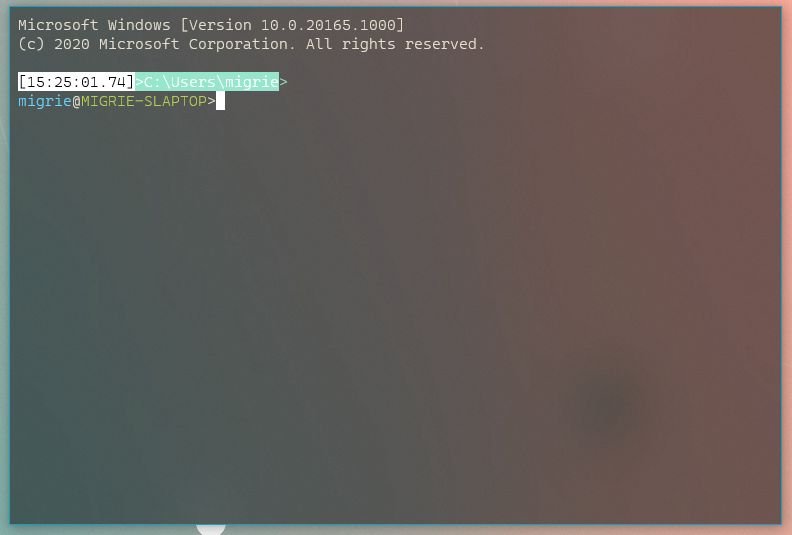
`false` | 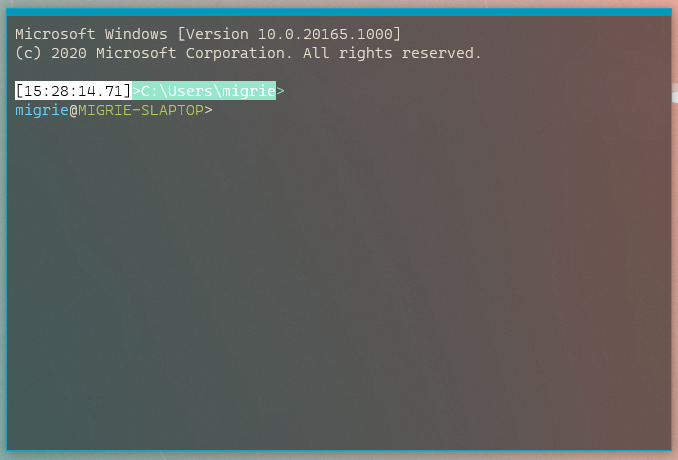
## PR Checklist
* [x] Closes#2238
* [x] I work here
* [ ] Tests added/passed
* [ ] Requires documentation to be updated
## Detailed Description of the Pull Request / Additional comments
* **KNOWN ISSUE**: Upon resizing the NCIW, the top frame margin disappears, making that border disappear entirely. 6356aaf has a bunch of WIP work for me trying to fix that, but I couldn't get it quite right.
## Validation Steps Performed
* Toggled between focus and fullscreen a _bunch_ in both modes.
This commit updates JsonUtilsNew to support winrt
`Windows::Foundation::IReference<T>` as an option type, and cleans up the
optional support code by removing the optional overload on
`GetValue(...)`. Instead of using an overload with a partial
specialization, we're using a constexpr if with a type trait to
determine option-type-ness.
In addition, Carlos reported an issue with deriving from `FlagMapper`
(itself templated) and referring to the base type's members without
fully qualifying them. To make derivation easier, `EnumMapper` and
`FlagMapper` now provide `BaseEnumMapper` and `BaseFlagMapper` type
aliases.
I've taken the opportunity to add a `winrt::hstring` conversion
trait.
Lastly, in casual use, I found out that I'd written the til::color
converter wrong: it supports color strings of length 7 (`#rrggbb`) and
length 4 (`#rgb`). I mistyped (and failed to test) support for 4-length
color strings by pretending they were only 3 characters long.
## References
Merged JsonUtils changes from #6004 and #6590.
## PR Checklist
* [x] Unblocks aforementioned PRs
* [x] cla
* [x] Tests added/passed
* [x] Documentation N/A
* [x] Schema N/A
* [x] Kid tested, mother approved.
Due to a shell limitation, Ctrl+Shift+Enter will not launch Windows
Terminal as Administrator. This is caused by the app execution alias and
the actual targeted executable not having the same name.
In addition, PowerShell has an issue detecting app execution aliases as
GUI/TUI applications. When you run wt from PowerShell, the shell will
wait for WT to exit before returning to the prompt. Having a shim that
immediately re-executes WindowsTerminal and then returns handily knocks
this issue out (as the process that PS was waiting for exits
immediately.)
This could cause a regression for anybody who tries to capture the PID
of wt.exe. Our process tree is not an API, and we have offered no
consistency guarantee on it.
VALIDATION
----------
Tested manual launch in a number of different scenarios:
* [x] start menu "wtd"
* [x] start menu tile
* [x] powertoys run
* [x] powertoys run ctrl+shift (admin)
* [x] powershell inbox, "core"
* [x] cmd
* [x] run dialog
* [x] run dialog ctrl+shift (admin)
* [x] run from a lnk with window mode=maximized
Fixes#4645 (PowerShell waits for wt)
Fixes#6625 (Can't launch as admin using C-S-enter)
This PR adds support for the `DA2` (Secondary Device Attributes) and
`DA3` (Tertiary Device Attributes) escape sequences, which are standard
VT queries reporting basic information about the terminal.
The _Secondary Device Attributes_ response is made up of a number of
parameters:
1. An identification code, for which I've used 0 to indicate that we
have the capabilities of a VT100 (using code 0 for this is an XTerm
convention, since technically DA2 would not have been supported by a
VT100).
2. A firmware revision level, which some terminal emulators use to
report their actual version number, but I thought it best we just
hardcode a value of 10 (the DEC convention for 1.0).
3. Additional hardware options, which tend to be device specific, but
I've followed the convention of the later DEC terminals using 1 to
indicate the presence of a PC keyboard.
The _Tertiary Device Attributes_ response was originally used to provide
a unique terminal identification code, and which some terminal emulators
use as a way to identify themselves. However, I think that's information
we'd probably prefer not to reveal, so I've followed the more common
practice of returning all zeros for the ID.
In terms of implementation, the only complication was the need to add an
additional code path in the `OutputStateMachine` to handle the `>` and
`=` intermediates (technically private parameter prefixes) that these
sequences require. I've done this as a single method - rather than one
for each prefix - since I think that makes the code easier to follow.
VALIDATION
----------
I've added output engine tests to make sure the sequences are dispatched
correctly, and adapter tests to confirm that they are returning the
responses we expect. I've also manually confirmed that they pass the
_Test of terminal reports_ in Vttest.
Closes#5836
This is a refactoring of the renderer color calculations to simplify the
implementation, and to make it easier to support additional
color-altering rendition attributes in the future (e.g. _faint_ and
_conceal_).
## References
* This is a followup to PRs #3817 and #6809, which introduced additional
complexity in the color calculations, and which suggested the need for
refactoring.
## Detailed Description of the Pull Request / Additional comments
When we added support for `DECSCNM`, that required the foreground and
background color lookup methods to be able to return the opposite of
what was requested when the reversed mode was set. That made those
methods unnecessarily complicated, and I thought we could simplify them
considerably just by combining the calculations into a single method
that derived both colors at the same time.
And since both conhost and Windows Terminal needed to perform the same
calculations, it also made sense to move that functionality into the
`TextAttribute` class, where it could easily be shared.
In general this way of doing things is a bit more efficient. However, it
does result in some unnecessary work when only one of the colors is
required, as is the case for the gridline painter. So to make that less
of an issue, I've reordered the gridline code a bit so it at least
avoids looking up the colors when no gridlines are needed.
## Validation Steps Performed
Because of the API changes, quite a lot of the unit tests had to be
updated. For example instead of verifying colors with two separate calls
to `LookupForegroundColor` and `LookupBackgroundColor`, that's now
achieved with a single `LookupAttributeColors` call, comparing against a
pair of values. The specifics of the tests haven't changed though, and
they're all still working as expected.
I've also manually confirmed that the various color sequences and
rendition attributes are rendering correctly with the new refactoring.
There is going to be a very long tail of applications that will
explicitly request VT SGR 40/37 when what they really want is to
SetConsoleTextAttribute() with a black background/white foreground.
Instead of making those applications look bad (and therefore making us
look bad, because we're releasing this as an update to something that
"looks good" already), we're introducing this compatibility quirk.
Before the color reckoning in #6698 + #6506, *every* color was subject
to being spontaneously and erroneously turned into the default color.
Now, only the 16-color palette value that matches the active console
background/foreground color will be destroyed, and only when received
from specific applications.
Removal will be tracked by #6807.
Michael and I discussed what layer this quirk really belonged in. I
originally believed it would be sufficient to detect a background color
that matched the legacy default background, but @j4james provided an
example of where that wouldn't work out (powershell setting the
foreground color to white/gray). In addition, it was too heavyhanded: it
re-broke black backgrounds for every application.
Michael thought that it should live in the server, as a small VT parser
that righted the wrongs coming directly out of the application. On
further investigation, however, I realized that we'd need to push more
information up into the server (so that it could make the decision about
which VT was wrong and which was right) than should be strictly
necessary.
The host knows which colors are right and wrong, and it gets final say
in what ends up in the buffer.
Because of that, I chose to push the quirk state down through
WriteConsole to DoWriteConsole and toggle state on the
SCREEN_INFORMATION that indicates whether the colors coming out of the
application are to be distrusted. This quirk _only applies to pwsh.exe
and powershell.exe._
NOTE: This doesn't work for PowerShell the .NET Global tool, because it
is run as an assembly through dotnet.exe. I have no opinion on how to
fix this, or whether it is worth fixing.
VALIDATION
----------
I configured my terminals to have an incredibly garish color scheme to
show exactly what's going to happen as a result of this. The _default
terminal background_ is purple or red, and the foreground green. I've
printed out a heap of test colors to see how black interacts with them.
Pull request #6810 contains the images generated from this test.
The only color lines that change are the ones where black as a
background or white as a foreground is selected out of the 16-color
palette explicitly. Reverse video still works fine (because black is in
the foreground!), and it's even possible to represent "black on default"
and reverse it into "default on black", despite the black in question
having been `40`.
Fixes#6767.
By storing up the accumulated delta in the mouse input handler, we can
enlighten both conhost and terminal about wheel events that are less
than one line in size. Previously, we had a workaround in conhost that
clamped small scroll deltas to a whole line, which made trackpad
scrolling unimaginably fast. Terminal didn't make this mistake, but it
also didn't handle delta accumulation . . . which resulted in the same
behavior.
MouseInput will now wait until it's received WHEEL_DELTA (well-known
constant, value 120) worth of scrolling delta before it dispatches a
single scroll event.
Future considerations may include sending multiple wheel button events
for every *multiple* of WHEEL_DELTA, but that would be a slightly larger
refactoring that I'm not yet ready to undertake.
There's a chance that we should be dividing WHEEL_DELTA by the system's
"number of lines to scroll at once" setting, because on trackpads
conhost now scrolls a little _slow_. I think the only way to determine
whether this is palatable is to just ship it.
Fixes#6184.
## Summary of the Pull Request
This PR adds full support for the `DECSCNM` reverse screen mode in the Windows Terminal to align with the implementation in conhost.
## References
* The conhost implementation of `DECSCNM` was in PR #3817.
* WT originally inherited that functionality via the colors being passed through, but that behaviour was lost in PR #6506.
## PR Checklist
* [x] Closes#6622
* [x] CLA signed.
* [ ] Tests added/passed
* [ ] Documentation updated. If checked, please file a pull request on [our docs repo](https://github.com/MicrosoftDocs/terminal) and link it here: #xxx
* [ ] Schema updated.
* [x] I've discussed this with core contributors already. If not checked, I'm ready to accept this work might be rejected in favor of a different grand plan. Issue number where discussion took place: #6622
## Detailed Description of the Pull Request / Additional comments
The `AdaptDispatch::SetScreenMode` now checks if it's in conpty mode and simply returns false to force a pass-through of the mode change. And the `TerminalDispatch` now has its own `SetScreenMode` implementation that tracks any changes to the reversed state, and triggers a redraw in the renderer.
To make the renderer work, we just needed to update the `GetForegroundColor` and `GetBackgroundColor` methods of the terminal's `IRenderData` implementation to check the reversed state, and switch the colors being calculated, the same way the `LookupForegroundColor` and `LookupBackgroundColor` methods work in the conhost `Settings` class.
## Validation Steps Performed
I've manually tested the `DECSCNM` functionality for Windows Terminal in Vttest, and also with some of my own test scripts.
## Summary of the Pull Request
Updates the Terminal's scroll response to new output. The Terminal will not automatically scroll if...
- a selection is active, or
- the viewport is at the bottom of the scroll history
## References
#2529 - Spec
#3863 - Implementation
## PR Checklist
* [X] Closes#980
* [X] Closes#3863
* [ ] Tests added/passed
* [ ] Requires documentation to be updated
## Detailed Description of the Pull Request / Additional comments
Updates the `_scrollOffset` value properly in TerminalCore when the cursor moves. We calculate a new `_scrollOffset` based on if we are circling the buffer and how far below the mutable bottom is.
We specifically check for if a selection is active and if the viewport is at the bottom, then use that as a condition for deciding if we should update `_scrollOffset` to the new calculated value or 0 (the bottom of the scroll history).
## Validation Steps Performed
Manual testing. Though I should add automated tests.
- [X] new output
- [X] new output when circling
- [X] new output when circling and viewport is at the top
Looking up the size of the viewport from the underlying dimensions of
the structures seemed like a good idea at the time (so it would only be
in one place), but it turns out to be more of a perf cost than we
expected. Not necessarily on any one hot path, but if we sort by
functions in WPR, it was the top consumer on the Terminal side. This
instead saves the size as a member of the `TextBuffer` and serves that
out. It only changes when it is constructed or resized traditionally, so
it's easy to update/keep track of. It impacted conhost/conpty to a
lesser degree but was still noticeable.
## Validation Steps Performed
- Run `time cat big.txt` under WPR. Checked before and after perf
metrics.
## PR Checklist
* [x] Closes perf itch
* [x] I work here
* [x] Manual test
* [x] Documentation irrelevant.
* [x] Schema irrelevant.
* [x] Am core contributor.
The main change in 16.7 is the separation of `AppContainerApplication`
into `WindowsStoreApp` and `WindowsAppContainer`. There's been a bit of
interest in splitting packaging away from containment, and this is the
first step in that direction.
We're a somewhat unique application, but as WinUI3 becomes more
prevalent we will become _less_ unique.
Some of these things, I've looked at and wondered how they ever worked.
## PR Checklist
* [x] Closes nothing
## Validation Steps Performed
Built locally and in CI. Tested the generated package with the package tester. Built on 16.6 and seen that it still seems to work.
A lot of time was spent between each individual line in the VT paint
engine in allocating some scratch space to assemble the clusters then
deallocating it only to have the next line do that again. Now we just
hold onto that memory space since it should be approximately the size of
a single line wide and will be used over and over and over as painting
continues.
## Validation Steps Performed
- Run `time cat big.txt` under WPR. Checked before and after perf
metrics.
## PR Checklist
* [x] Closes perf itch.
* [x] I work here.
* [x] Manual perf test.
* [x] Documentation irrelevant.
* [x] Schema irrelevant.
* [x] Am core contributor.
## Detailed Description of the Pull Request / Additional comments
Passes the bitmap by ref into the tracing function instead of making a copy on the way in. It's only read anyway for tracing (if enabled) so the copy was a pointless oversight.
## Validation Steps Performed
- Observed WPR trace before and after with `time cat big.txt` in WSL.
This PR enables `ApplicationHighContrastAdjustment::None`. Doing this
disables a set of mitigations in XAML designed to band-aid apps that
were never explicitly designed for High Contrast (HC) modes. Terminal
now has full control of and responsibility for its appearance in HC
mode. This allows Terminal to look a lot better.
On paper, we should be able to set `HighContrastAdjustment="None"` on
the `<Application>` element. But that doesn't have any effect. I don't
know if this is a bug in `<Toolkit:XamlApplication>` or somewhere else.
So instead I set the property in codebehind, which is not as ideal, but
does at least work. I'd love to a way to move this into App.xaml.
The Find box had a couple stray styles to override the ToggleButton's
foreground color. With backplating removed, these styles became
actively harmful (white foreground on highlight color background), so I
just removed them. The built-in style for ToggleButton is perfect
as-is.
Closes#5360
WinUI's `Margin` and `Padding` work very similarly. `Margin` distances
ourselves from our parent. Whereas `Padding` distances our children from
ourselves.
Terminal's `padding` setting is actually implemented by defining
`Margin` on the SwapChainPanel. This means that the "padding" that is
created is actually belongs to SwapChainPanel's parent: Grid (not to be
confused with its parent, "RootGrid").
When a user clicks on the padded area, input goes to Grid. But there's a
twist: you can't actually hit Grid. To be able to hit Grid, you can't
just set IsHitTestVisible. You need to set it's Visibility to Visible,
and it's Background to Transparent (not null) [2].
## Validation Steps Performed
- [X] Start a selection from the padding area
- [X] Click on a SearchBox if one is available
- The SearchBox gets first dibs on the hit test so none gets through
to the SwapChainPanel
## References
[1] https://docs.microsoft.com/en-us/uwp/api/windows.ui.xaml.uielement.ishittestvisible
[2] https://docs.microsoft.com/en-us/windows/uwp/xaml-platform/events-and-routed-events-overview#hit-testing-and-input-eventsCloses#5626
## Summary of the Pull Request
Pretty straightforward. Logs three scenarios:
* The user opened the command palette (and which mode it was opened in)
* The user ran a command from the palette
* The user dismissed the palette without running an action.
We discussed this in team sync yesterday.
## PR Checklist
* [x] I work here
* [n/a] Requires documentation to be updated
See: https://github.com/microsoft/microsoft-ui-xaml/releases/tag/v2.5.0-prerelease.200609001
> ### Notable Changes:
>
> Resize tab view items only once the pointer has left the TabViewItem strip (microsoft/microsoft-ui-xaml#2569)
> Align TabView visuals with Edge (microsoft/microsoft-ui-xaml#2201)
> Fix background of MenuFlyout in white high contrast (microsoft/microsoft-ui-xaml#2446)
> TabView: Make TabViewItem consume the TabViewItemHeaderForeground theme resource (microsoft/microsoft-ui-xaml#2348)
> TabView: Add tooltips to its scrolling buttons. (microsoft/microsoft-ui-xaml#2369)
* [x] Related to #5360 (@jtippet confirms that this alone does not close it.)
* [x] I work here
## Summary of the Pull Request
In the wake of #6635, a couple things got missed in merges:
* `toggleRetroEffect` didn't get into the schema, nor did `renameTab` or
`commandPalette`.
* `toggleRetroEffect` also didn't get a name
Furthermore, I thought it might be a good idea to start sticking
commands into `bindings` even without `keys`. So I tried doing that for
`opentabColorPicker` and `toggleRetroEffect`, and found immediately that
the labels for the key chord still appear even when the text is empty.
So I added some XAML magic to hide those when the text is empty.
## References
* #6762
* #6691
* #6557
* #6635
## PR Checklist
* [x] Closes#6762
* [x] I work here
* [x] Tests added/passed
* [n/a] Requires documentation to be updated
## Detailed Description of the Pull Request / Additional comments
* See also: https://docs.microsoft.com/en-us/windows/uwp/data-binding/data-binding-quickstart#formatting-or-converting-data-values-for-display
- make sure to switch to C++/WinRT at the top!
## Validation Steps Performed
Removed all my manual actions, ran the Terminal:

## Summary of the Pull Request
This proposes a change to how Terminal will scroll in response to newly
generated output. The Terminal will scroll upon receiving new output if
the viewport is at the bottom of the scroll history and no selection is
active.
This spec also explores the possibility of making this response
configurable with a `snapOnOutput` profile setting. It also discusses
the possibility of adding a scroll lock keybinding action.
## PR Checklist
* [X] Spec for #980
Update colors of our custom NewTab button to match MUX's TabView button
MUX has a NewTab button, but Terminal uses a homemade lookalike. The
version in Terminal doesn't use the same brush color resources as MUX's
button, so it looks very slightly different. This PR updates Terminal's
button to use the exact same colors that MUX uses. I literally copied
these brush names out of MUX source code.
## References
This is the color version of the layout fix#6766
This is a prerequisite for fixing #5360
## Detailed Description of the Pull Request / Additional comments
The real reason that this matters is that once you flip on
`ApplicationHighContrastAdjustment::None`, the existing colors will not
work at all. The existing brushes are themed to black foreground on a
black background when High Contrast (HC) Black theme is enabled. The
only thing that's saving you is
`ApplicationHighContrastAdjustment::Auto` is automatically backplating
the glyphs on the buttons, which (by design) hides the fact that the
colors are poor. The backplates are those ugly squares inside the
buttons on the HC themes.
Before I can push a PR that disables automatic backplating (set
`ApplicationHighContrastAdjustment` to `None`), we'll need to select
better brushes that work in HC mode. MUX has already selected brushes
that work great in all modes, so it just makes sense to use their
brushes.
The one very subtle difference here is that, for non-HC themes, the
glyph's foreground has a bit more contrast when the button is in
hovered/pressed states. Again this slight difference hardly matters
now, but using the correct brushes will become critical when we try to
remove the HC backplating.
Closes#6812
## Summary of the Pull Request
Let's try and figure out just how many people are actually using Solarized. I emailed @DHowett about this a week ago, but otherwise we don't really have any other tasks for this.
## PR Checklist
* [x] I work here
* [n/a] Requires documentation to be updated
The MUX TabView control has a uniquely-shaped [+] button. TerminalApp
doesn't use it: instead, it has a SplitView button that is styled to
look like MUX's official button. However, it doesn't get the button's
shape right. This PR updates TerminalApp's custom button to look more
like MUX's.
The difference is that MUX only rounds the top two corners, and it uses
a bigger radius. Without matching MUX's radius, the upper-left corner
of the button makes an awkward asymmetric divot with the abutting tab.
There's also a spot in the lower-left corner that just looks like
someone accidentally spilled a few pixels on the floor.
Current appearance before this PR:

New appearance with this PR:

Most important deltas highlighted with red circles:

Note that this PR does *not* attempt to fix the colors. The colors are
also just slightly different from what MUX uses. I'll save that for a
separate PR, since all those screenshots would clutter this up this PR.
## Summary of the Pull Request
This PR adds support for the `SGR 53` and `SGR 55` escapes sequences,
which enable and disable the ANSI _overline_ graphic rendition
attribute, the equivalent of the console character attribute
`COMMON_LVB_GRID_HORIZONTAL`. When a character is output with this
attribute set, a horizontal line is rendered at the top of the character
cell.
## PR Checklist
* [x] Closes#6000
* [x] CLA signed.
* [x] Tests added/passed
* [ ] Documentation updated.
* [ ] Schema updated.
* [x] I've discussed this with core contributors already.
## Detailed Description of the Pull Request / Additional comments
To start with, I added `SetOverline` and `IsOverlined` methods to the
`TextAttribute` class, to set and get the legacy
`COMMON_LVB_GRID_HORIZONTAL` attribute. Technically there was already an
`IsTopHorizontalDisplayed` method, but I thought it more readable to add
a separate `IsOverlined` as an alias for that.
Then it was just a matter of adding calls to set and reset the attribute
in response to the `SGR 53` and `SGR 55` sequences in the
`SetGraphicsRendition` methods of the two dispatchers. The actual
rendering was already taken care of by the `PaintBufferGridLines` method
in the rendering engines.
The only other change required was to update the `_UpdateExtendedAttrs`
method in the `Xterm256Engine` of the VT renderer, to ensure the
attribute state would be forwarded to the Windows Terminal over conpty.
## Validation Steps Performed
I've extended the existing SGR unit tests to cover the new attribute in
the `AdapterTest`, the `OutputEngineTest`, and the `VtRendererTest`.
I've also manually tested the `SGR 53` and `SGR 55` sequences to confirm
that they do actually render (or remove) an overline on the characters
being output.
The VT reset operations `RIS` and `DECSTR` are implemented as a series
of steps, each of which could potentially fail. Currently these
operations abort as soon as an error is detected, which is particularly
problematic in conpty mode, where some steps deliberately "fail" to
indicate that they need to be "passed through" to the conpty client. As
a result, the reset won't be fully executed. This PR changes that
behaviour, so the error state is recorded for any failures, but the
subsequent steps are still run.
Originally the structure of these operations was of the form:
bool success = DoSomething();
if (success)
{
success = DoSomethingElse();
}
But I've now changed the code so it looks more like this:
bool success = DoSomething();
success = DoSomethingElse() && success;
This means that every one of the steps should execute, regardless of
whether previous steps were successful, but the final _success_ state
will only be true if none of the steps has failed.
While this is only really an issue in the conhost code, I've updated
both the `AdaptDispatch` and `TerminalDispatch` classes, since I thought
it would be best to have them in sync, and in general this seems like a
better way to handle multi-step operations anyway.
VALIDATION
I've manually tested the `RIS` escape sequence (`\ec`) in the Windows
Terminal, and confirmed that it now correctly resets the cursor
position, which it wasn't doing before.
Closes#6545
Pretty straightforward. `toggleRetroEffect` will work to toggle the
retro terminal effect on/off.
* Made possible by contributions from #6551, _and viewers like you_
This PR fixes the scheme resolution bug outlined in #5326
The approach is as follows:
* In [SchemeManager.cs], find the first scheme parser that actually
successfully parses the scheme, as opposed to the existing code, which
finds the first scheme parser which _says it can parse the scheme_, as
that logic spuriously returns `true` currently.
* In [XmlSchemeParser.cs] and [JsonParser.cs], ensure that the contents
of the file are read and the contents passed to XmlDocument.LoadXXX,
as this fails with an UriException on WSL otherwise.
* Remove `CanParse` as it is superfluous. The check for a valid scheme
parser should not just check an extension but also if the file exists
- this is best done by the `ParseScheme` function as it already
returns null on failure.
* Add `FileExtension` to the interface because we need it lifted now.
Closes#5326
Before sending calling the `HandleClipboardData` member function on
the `PasteFromClipboardEventArgs` object when we receive a request
from the `TermControl` to send it the clipboard's text content, we
now display a warning to let the user choose whether to continue or
not if the text is larger than 5 KiB or contains the _new line_
character, which can be a security issue if the user is pasting the
text in a shell.
These warnings can be disabled with the `largePasteWarning` and
`multiLinePasteWarning` global settings respectively.
Closes#2349
This is essentially a rewrite of the
`TerminalDispatch::SetGraphicsRendition` method, bringing it into closer
alignment with the `AdaptDispatch` implementation, simplifying the
`ITerminalApi` interface, and making the code easier to extend. It adds
support for a number of attributes which weren't previously implemented.
REFERENCES
* This is a mirror of the `AdaptDispatch` refactoring in PR #5758.
* The closer alignment with `AdaptDispatch` is a small step towards
solving issue #3849.
* The newly supported attributes should help a little with issues #5461
(italics) and #6205 (strike-through).
DETAILS
I've literally copied and pasted the `SetGraphicsRendition`
implementation from `AdaptDispatch` into `TerminalDispatch`, with only
few minor changes:
* The `SetTextAttribute` and `GetTextAttribute` calls are slightly
different in the `TerminalDispatch` version, since they don't return a
pointless `success` value, and in the case of the getter, the
`TextAttribute` is returned directly instead of by reference.
Ultimately I'd like to move the `AdaptDispatch` code towards that way
of doing things too, but I'd like to deal with that later as part of a
wider refactoring of the `ConGetSet` interface.
* The `SetIndexedForeground256` and `SetIndexedBackground256` calls
required the color indices to be remapped in the `AdaptDispatch`
implementation, because the conhost color table is in a different
order to the XTerm standard. `TerminalDispatch` doesn't have that
problem, so doesn't require the mapping.
* The index color constants used in the 16-color `SetIndexedForeground`
and `SetIndexedBackground` calls are also slightly different for the
same reason.
VALIDATION
I cherry-picked this code on top of the #6506 and #6698 PRs, since
that's only way to really get the different color formats passed-through
to the terminal. I then ran a bunch of manual tests with various color
coverage scripts that I have, and confirmed that all the different color
formats were being rendered as expected.
Closes#6725
This PR reimplements the VT rendering engines to do a better job of
preserving the original color types when propagating attributes over
ConPTY. For the 16-color renderers it provides better support for
default colors and improves the efficiency of the color narrowing
conversions. It also fixes problems with the ordering of character
renditions that could result in attributes being dropped.
Originally the base renderer would calculate the RGB color values and
legacy/extended attributes up front, passing that data on to the active
engine's `UpdateDrawingBrushes` method. With this new implementation,
the renderer now just passes through the original `TextAttribute` along
with an `IRenderData` interface, and leaves it to the engines to extract
the information they need.
The GDI and DirectX engines now have to lookup the RGB colors themselves
(via simple `IRenderData` calls), but have no need for the other
attributes. The VT engines extract the information that they need from
the `TextAttribute`, instead of having to reverse engineer it from
`COLORREF`s.
The process for the 256-color Xterm engine starts with a check for
default colors. If both foreground and background are default, it
outputs a SGR 0 reset, and clears the `_lastTextAttribute` completely to
make sure any reset state is reapplied. With that out the way, the
foreground and background are updated (if changed) in one of 4 ways.
They can either be a default value (SGR 39 and 49), a 16-color index
(using ANSI or AIX sequences), a 256-color index, or a 24-bit RGB value
(both using SGR 38 and 48 sequences).
Then once the colors are accounted for, there is a separate step that
handles the character rendition attributes (bold, italics, underline,
etc.) This step must come _after_ the color sequences, in case a SGR
reset is required, which would otherwise have cleared any character
rendition attributes if it came last (which is what happened in the
original implementation).
The process for the 16-color engines is a little different. The target
client in this case (Windows telnet) is incapable of setting default
colors individually, so we need to output an SGR 0 reset if _either_
color has changed to default. With that out the way, we use the
`TextColor::GetLegacyIndex` method to obtain an approximate 16-color
index for each color, and apply the bold attribute by brightening the
foreground index (setting bit 8) if the color type permits that.
However, since Windows telnet only supports the 8 basic ANSI colors, the
best we can do for bright colors is to output an SGR 1 attribute to get
a bright foreground. There is nothing we can do about a bright
background, so after that we just have to drop the high bit from the
colors. If the resulting index values have changed from what they were
before, we then output ANSI 8-color SGR sequences to update them.
As with the 256-color engine, there is also a final step to handle the
character rendition attributes. But in this case, the only supported
attributes are underline and reversed video.
Since the VT engines no longer depend on the active color table and
default color values, there was quite a lot of code that could now be
removed. This included the `IDefaultColorProvider` interface and
implementations, the `Find(Nearest)TableIndex` functions, and also the
associated HLS conversion and difference calculations.
VALIDATION
Other than simple API parameter changes, the majority of updates
required in the unit tests were to correct assumptions about the way the
colors should be rendered, which were the source of the narrowing bugs
this PR was trying to fix. Like passing white on black to the
`UpdateDrawingBrushes` API, and expecting it to output the default `SGR
0` sequence, or passing an RGB color and expecting an indexed SGR
sequence.
In addition to that, I've added some VT renderer tests to make sure the
rendition attributes (bold, underline, etc) are correctly retained when
a default color update causes an `SGR 0` sequence to be generated (the
source of bug #3076). And I've extended the VT renderer color tests
(both 256-color and 16-color) to make sure we're covering all of the
different color types (default, RGB, and both forms of indexed colors).
I've also tried to manually verify that all of the test cases in the
linked bug reports (and their associated duplicates) are now fixed when
this PR is applied.
Closes#2661Closes#3076Closes#3717Closes#5384Closes#5864
This is only a partial fix for #293, but I suspect the remaining cases
are unfixable.
Essentially what this does is map the default legacy foreground and
background attributes (typically white on black) to the `IsDefault`
color type in the `TextColor` class. As a result, we can now initialize
the buffer for "legacy" shells (like PowerShell and cmd.exe) with
default colors, instead of white on black. This fixes the startup
rendering in conpty clients, which expect an initial default background
color. It also makes these colors update appropriately when the default
palette values change.
One complication in getting this to work, is that the console permits
users to change which color indices are designated as defaults, so we
can't assume they'll always be white on black. This means that the
legacy-to-`TextAttribute` conversion will need access to those default
values.
Unfortunately the defaults are stored in the conhost `Settings` class
(the `_wFillAttribute` field), which isn't easily accessible to all the
code that needs to construct a `TextAttribute` from a legacy value. The
`OutputCellIterator` is particularly problematic, because some iterator
types need to generate a new `TextAttribute` on every iteration.
So after trying a couple of different approaches, I decided that the
least worst option would be to add a pair of static properties for the
legacy defaults in the `TextAttribute` class itself, then refresh those
values from the `Settings` class whenever the defaults changed (this
only happens on startup, or when the conhost _Properties_ dialog is
edited).
And once the `TextAttribute` class had access to those defaults, it was
fairly easy to adapt the constructor to handle the conversion of default
values to the `IsDefault` color type. I could also then simplify the
`TextAttribute::GetLegacyAttributes` method which does the reverse
mapping, and which previously required the default values to be passed
in as a parameter
VALIDATION
I had to make one small change to the `TestRoundtripExhaustive` unit
test which assumed that all legacy attributes would convert to legacy
color types, which is no longer the case, but otherwise all the existing
tests passed as is. I added a new unit test verifying that the default
legacy attributes correctly mapped to default color types, and the
default color types were mapped back to the correct legacy attributes.
I've manually confirmed that this fixed the issue raised in #5952,
namely that the conhost screen is cleared with the correct default
colors, and also that it is correctly refreshed when changing the
palette from the properties dialog. And I've combined this PR with
#6506, and confirmed that the PowerShell and the cmd shell renderings in
Windows Terminal are at least improved, if not always perfect.
This is a prerequisite for PR #6506Closes#5952
With this commit, terminal will be able to copy text to the system
clipboard by using OSC 52 MANIPULATE SELECTION DAATA.
We chose not to implement the clipboard querying functionality offered
by OSC 52, as sending the clipboard text to an application without the
user's knowledge or consent is an immense security hole.
We do not currently support the clipboard specifier Pc to specify which
clipboard buffer should be filled
# Base64 encoded `foo`
$ echo -en "\e]52;;Zm9v\a"
# Multiple lines
# Base64 encoded `foo\r\nbar`
$ echo -en "\e]52;;Zm9vDQpiYXI=\a"
Closes#2946.
Restores the simple text run analysis and skipping of most of the
shaping/layout steps. Corrects one of the fast-path steps to ensure that
offsets and clusters are assigned.
## References
- Bug #6488
- Bug #6664
- Simple run PR #6206
- Simple run revert PR #6665
- Recycle glyph runs PR #6483
The "correction" functions, by which box drawing analysis is one of
them, is dependent on the steps coming before it properly assigning the
four main vectors of the text layout glyphs: indices, advances, offsets,
and clusters. When the fast path is identified by the code from #6206,
only two of those are fully updated: indices and advances. The offsets
doesn't tend to cause a problem because offsets are rarely used so
they're pretty much always 0 already (but this PR enforces that they're
zero for the simple/fast path.) The clusters, however, were not mapped
for the fast path. This showed itself in one of two ways:
1. Before the recycled runs PR #6483, the cluster map had a 0 in every
field for the stock initialized vector.
2. After the recycled runs PR #6483, the cluster map had the previous
run's mapping in it.
This meant that when we reached the steps where glyph runs were
potentially split during the correction phase for box drawing
characters, unexpected values were present to map the glyph indices to
clusters and were corrected, adjusted, or split in an unexpected
fashion.
For instance, the index out of range bug could appear when the default 0
values appended to the end of the clusters vector were decremented down
to a negative value during the run splitter as the true DWrite cluster
mapper doesn't generate that sort of pattern in the slow path case
without also breaking the run itself.
The resolution here is therefore to ensure that all of the fields
related to glyph layout are populated even in the fast path. This
doesn't affect the slow path because that one always populated all
fields by asking DWrite to do it. The fast path just skips a bunch of
DWrite steps because it can implicitly identify patterns and save a
bunch of time.
I've also identified a few vectors that weren't cleared on reset/reuse
of the layout. I'm clearing those now so the `.resize()` operations
performed on them to get to the correct lengths will fill them with
fresh and empty values instead of hanging on to ones that may have been
from the previous. This should be OK memory perf wise because the act of
`.clear()` on a vector shouldn't free anything, just mark it invalid.
And doing `.resize()` from an empty one should just default construct
them into already allocated space (which ought to be super quick).
## Validation
* [x] Far.exe doesn't crash and looks fine
* [x] "\e[30;47m\u{2500} What \u{2500}\e[m" from #6488 appears
appropriately antialiased
* [x] Validate the "\e[30;47m\u{2500} What \u{2500}\e[m" still works
when `FillGeometry` is nerfed as a quick test that the runs are split
correctly.
* [x] Put `u{fffd} into Powershell Core to make a replacement char in
the output. Then press enter a few times and see that shrunken initial
characters on random rows. Verify this is gone.
Closes#6668Closes#6669
Co-Authored-By: Chester Liu <skyline75489@outlook.com>
## Summary of the Pull Request
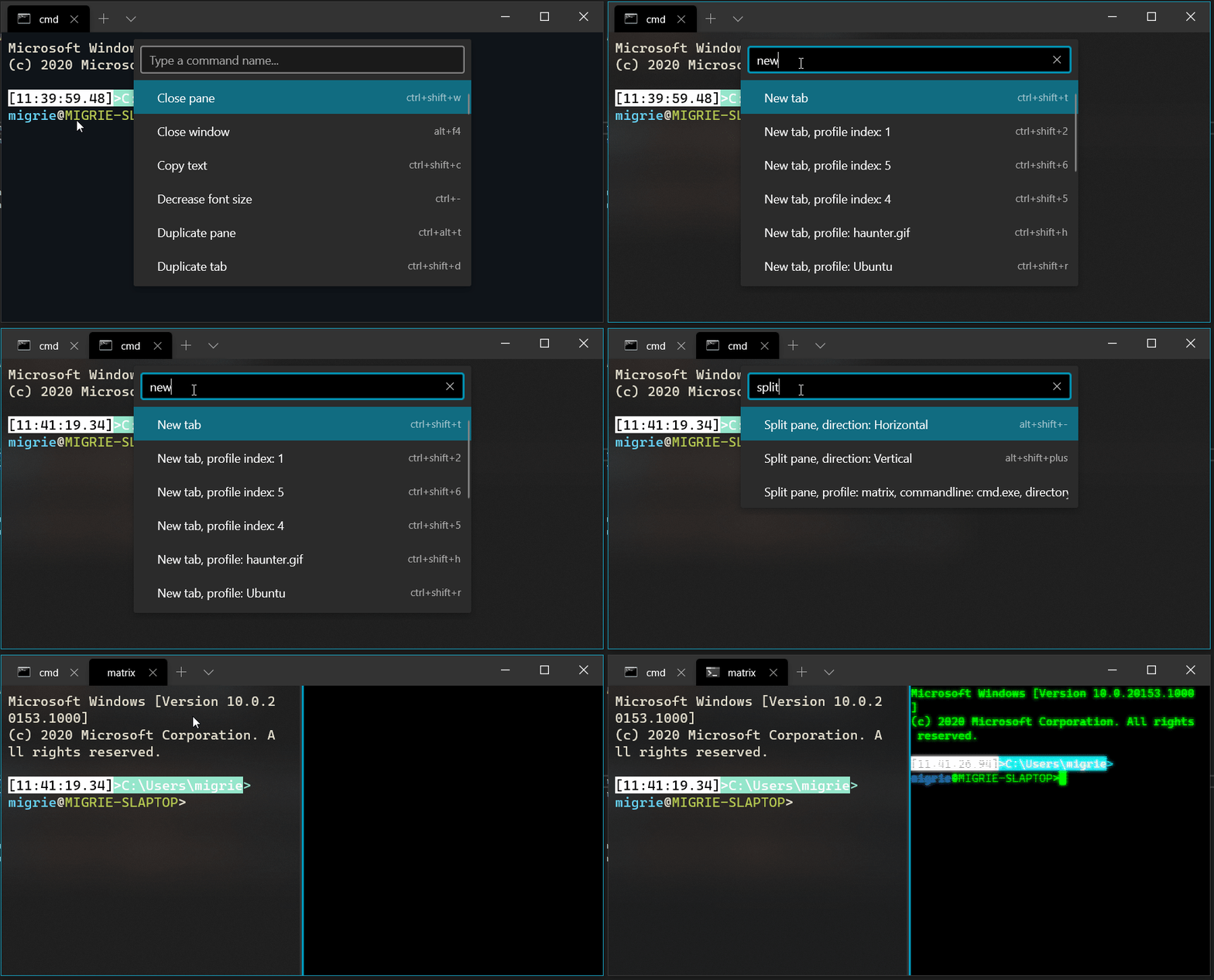
This adds a first iteration on the command palette. Notable missing features are:
* Commandline mode: This will be a follow-up PR, following the merge of #6537
* nested and iterable commands: These will additionally be a follow-up PR.
This is also additionally based off the addenda in #6532.
This does not bind a key for the palette by default. That will be done when the above follow-ups are completed.
## References
* #2046 - The original command palette thread
* #5400 - This is the megathread for all command palette issues, which is tracking a bunch of additional follow up work
* #5674 and #6532 - specs
* #6537 - related
## PR Checklist
* [x] Closes#2046
- incidentally also closes#6645
* [x] I work here
* [x] Tests added/passed
* [ ] Requires documentation to be updated - delaying this until it's more polished.
## Detailed Description of the Pull Request / Additional comments
* There's a lot of code for autogenerating command names. That's all in `ActionArgs.cpp`, because each case is so _not_ boilerplate, unlike the rest of the code in `ActionArgs.h`.
## Validation Steps Performed
* I've been playing with this for months.
* Tests
* Selfhost with the team
Occasionally, we get users with corrupt PATH environment variables: they
can't lauch PowerShell, because for some reason it's dropped off their
PATH. We also get users who have stray applications named
`powershell.exe` just lying around in random system directories.
We can combat both of these issues by simply hardcoding where we expect
PowerShell and CMD to live. %SystemRoot% was chosen over %WINDIR%
because apparently (according to Stack Overflow), SystemPath is
read-only and WINDIR isn't.
Refs #6039, #4390, #4228 (powershell was not found)
Refs #4682, Fixes#6082 (stray powershell.exe)
## Summary of the Pull Request
Adds a pair of `ShortcutAction`s for setting the tab color.
* `setTabColor`: This changes the color of the current tab to the provided color, or can be used to clear the color.
* `openTabColorPicker`: This keybinding immediately activates the tab color picker for the currently focused tab.
## References
## PR Checklist
* [x] scratches my own itch
* [x] I work here
* [x] Tests added/passed
* [x] https://github.com/MicrosoftDocs/terminal/pull/69
## Detailed Description of the Pull Request / Additional comments
## Validation Steps Performed
* hey look there are tests
* Tested with the following:
```json
// { "command": "setTabColor", "keys": [ "alt+c" ] },
{ "keys": "ctrl+alt+c", "command": { "action": "setTabColor", "color": "#123456" } },
{ "keys": "alt+shift+c", "command": { "action": "setTabColor", "color": null} },
{ "keys": "alt+c", "command": "openTabColorPicker" },
```
This pull request implements shift+double/triple click. Proper behavior
(as described in #4557) is to only expand one selection point, not both.
Adding the `bool targetStart` was a bit weird. I decided on this being
the cleanest approach though because I still want `PivotSelection` to be
its own helper function. Otherwise, the concept of "pivoting" gets kinda
messy.
## Validation Steps Performed
Manual testing as described on attached issue.
Tests were added for Shift+Click and pivoting the selection too.
Closes#4557
This reverts commit 94eab6e391.
We'll reintroduce this again after making sure it plays nicely with
recycling and box drawing glyphs.
Fixes#6488Fixes#6664
<!-- Enter a brief description/summary of your PR here. What does it fix/what does it change/how was it tested (even manually, if necessary)? -->
## Summary of the Pull Request
Add keybinding for renaming a tab
<!-- Other than the issue solved, is this relevant to any other issues/existing PRs? -->
## References
<!-- Please review the items on the PR checklist before submitting-->
## PR Checklist
* [X] Fulfills format requirements set by #6567
* [x] CLA signed. If not, go over [here](https://cla.opensource.microsoft.com/microsoft/Terminal) and sign the CLA
* [X] Tests passed
* [X] Requires documentation to be updated
* [X] I've discussed this with core contributors already. If not checked, I'm ready to accept this work might be rejected in favor of a different grand plan. Issue number where discussion took place: #6567 and here (#6557)
This no longer c loses #6256, as the spec changed.
<!-- Provide a more detailed description of the PR, other things fixed or any additional comments/features here -->
## Detailed Description of the Pull Request / Additional comments
<!-- Describe how you validated the behavior. Add automated tests wherever possible, but list manual validation steps taken as well -->
## Validation Steps Performed
* Update _TerminalCursorPositionChanged to use ThrottledFunc.
* Rename previous ThrottledFunc to ThrottledArgFunc because now
ThrottledFunc is for functions that do not take an argument.
* Update ThrottledFunc and ThrottledArgFunc to accept a CoreDispatcher
on which the function should be called for convenience.
* Don't use coroutines/winrt::fire_and_forget in
ThrottledFunc/ThrottledArgFunc because they are too slow (see PR).
_AdjustCursorPosition went from 17% of samples to 3% in performance
testing.
Replace std::map with std::unordered_map when the order doesn't matter
and hash functions are provided. Simple optimizations, but I expect the
performance should be strictly better, especially for
CodepointWidthDetector.hpp.
<!-- Enter a brief description/summary of your PR here. What does it fix/what does it change/how was it tested (even manually, if necessary)? -->
## Summary of the Pull Request
Many places in this codebase has an equality comparison to the boolean FALSE. This adds unneeded complexity as C and C++ has a NOT operand for use of these in if statements. This makes the code more readable in those areas.
<!-- Other than the issue solved, is this relevant to any other issues/existing PRs? -->
## References
<!-- Please review the items on the PR checklist before submitting-->
## PR Checklist
* [X] CLA signed. If not, go over [here](https://cla.opensource.microsoft.com/microsoft/Terminal) and sign the CLA
* [X] Tests added/passed
* [ ] Requires documentation to be updated
* [ ] I've discussed this with core contributors already. If not checked, I'm ready to accept this work might be rejected in favor of a different grand plan. Issue number where discussion took place: #xxx
<!-- Provide a more detailed description of the PR, other things fixed or any additional comments/features here -->
## Detailed Description of the Pull Request / Additional comments
One boolean being compared to FALSE was only used once, with the boolean name being "b", so it is better off not existing at all.
<!-- Describe how you validated the behavior. Add automated tests wherever possible, but list manual validation steps taken as well -->
## Validation Steps Performed
Unit Testing passed, compiler refactoring
## Summary of the Pull Request
This is another iteration on the Command Palette spec, from #5674. These were some ideas that were tossed around by @DHowett, @cinnamon-msft and myself, formalized here. I proposed this as an addendum to the original spec, since I think the first made sense atomically, and this only makes sense as a set of changes to the original. I didn't want to go hacking up the original doc to add this set of changes.
**There are two proposals in this spec - they should be viewed as two atomic units. They can be accepted or rejected independently. I'm suggesting we approve both. They work _together_. I'm realizing now that this is worded confusingly, and it's on me to fix that.**
## PR Checklist
* [x] Another spec in the #2046 / #5400 saga
* [x] I work here
* [x] _is a doc_
> ## Abstract
>
> This document is intended to serve as an addition to the [Command Palette Spec].
> While that spec is complete in it's own right, subsequent discussion revealed
> additional ways to improve the functionality and usability of the command
> palette. This document builds largely on the topics already introduced in the
> original spec, so readers should first familiarize themselves with that
> document.
>
> One point of note from the original document was that the original specification
> was entirely too verbose when defining both keybindings and commands for
> actions. Consider, for instance, a user that wants to bind the action "duplicate
> the current pane". In that spec, they need to add both a keybinding and a
> command:
>
> ```json
> {
> "keybindings": [
> { "keys": [ "ctrl+alt+t" ], "command": { "action": "splitPane", "split":"auto", "splitMode": "duplicate" } },
> ],
> "commands": [
> { "name": "Duplicate Pane", "action": { "action": "splitPane", "split":"auto", "splitMode": "duplicate" }, "icon": null },
> ]
> }
> ```
>
> These two entries are practically the same, except for two key differentiators:
> * the keybinding has a `keys` property, indicating which key chord activates the
> action.
> * The command has a `name` property, indicating what name to display for the
> command in the Command Palette.
>
> What if the user didn't have to duplicate this action? What if the user could
> just add this action once, in their `keybindings` or `commands`, and have it
> work both as a keybinding AND a command?
>
<!-- Enter a brief description/summary of your PR here. What does it fix/what does it change/how was it tested (even manually, if necessary)? -->
## Summary of the Pull Request
When the user double clicks on a tab, show the tab rename box
as if they right clicked on the tab and clicked on "Rename".
<!-- Other than the issue solved, is this relevant to any other issues/existing PRs? -->
## References
<!-- Please review the items on the PR checklist before submitting-->
## PR Checklist
* [x] Closes#6600
* [x] CLA signed. If not, go over [here](https://cla.opensource.microsoft.com/microsoft/Terminal) and sign the CLA
* [ ] Tests added/passed
* [ ] Documentation updated. If checked, please file a pull request on [our docs repo](https://github.com/MicrosoftDocs/terminal) and link it here: #xxx
* [ ] Schema updated.
* [ ] I've discussed this with core contributors already. If not checked, I'm ready to accept this work might be rejected in favor of a different grand plan. Issue number where discussion took place: #xxx
<!-- Provide a more detailed description of the PR, other things fixed or any additional comments/features here -->
## Detailed Description of the Pull Request / Additional comments
I added a handler for the `DoubleTapped` event on the tab view item
when we are constructing it for the tab (in `Tab::_MakeTabViewItem`).
The code for that handler was copied the "rename tab menu item" click
handler.
I did not extract the code into a member function because it is very
short (only 2 lines of code) and only used twice so it is not worth
it IMO.
<!-- Describe how you validated the behavior. Add automated tests wherever possible, but list manual validation steps taken as well -->
## Validation Steps Performed
This saves an awful lot of construction/destruction and memory
allocation, especially with text that changes a lot (see: cacafire).
Three things:
1. Recycling the text layouts. This holds onto the `CustomTextLayout` so
all the things that don't change related to drawing targets and
whatnot aren't freed and recreated every frame.
2. Reordering the runs in place. This saves a vector
allocation/copy/delete every time OrderRuns is called. They can be
rearranged in place.
3. Only clip once per row. This reduces the clip push/pop to only one
time per row. Since we're always redrawing an entire row at a time,
this saves a lot of alloc/free of the clip frame, dramatically
reduces queued commands, and makes less work on the flush since
clipping requires staging the drawing and then bringing it back to
the main surface.
I was told that the DeviceContext version supercedes the RenderTarget
one. This moves us to it so we can gain access to a higher level of
control over the various pieces in our pipeline as we continue to evolve
the renderer.
The underlying motivation here is to potentially use a
`ID2D1CommandList` to batch our commands and run them all later outside
the lock. That can only really be done with this more granular level of
control over the pipeline. So this moves to that in a single step that
is easily findable in history should we have problems
I discussed this with @NiklasBorson of the Direct2D/DirectWrite team as
well as with @DHowett before doing it.
## Validation
- [x] Checked docs to make sure that these work on Windows 7 with
Platform Update
- [x] Manual smoke test real quick
- [ ] Try running on Win7 + Platform Update after change
- [x] Probably do more than just a smoke test manually or otherwise
Closes#6525
`bitmap::_calculateArea` performance can be improved by leveraging the
optimized `find_first`/`find_next` methods instead of iterating through
the bitmap manually.
## Summary of the Pull Request
## PR Checklist
* [x] Closes#3927
* [x] I work here.
* [x] Tested manually.
* [x] Requires documentation to be updated: (generate doc bug here)
* [x] Am core contributor.
## Detailed Description of the Pull Request / Additional comments
- I found four settings that weren't hot reloadable with the 3927 comment above them:
1. Experimental retro terminal effect
2. Experimental software rendering
3. Experimental full repaint rendering
4. Antialiasing settings for text
I made them all hot reloadable by telling the `TermControl` to propagate them on settings change to the `DxEngine`.
Then I set up the `DxEngine` inside the setters to only set them if they changed. And if they do change, to trigger a full repaint and/or a complete drop and recreate of the entire DX device chain (as would happen if it were lost for another reason like a user-mode graphics failure, disconnected display, etc.)
I made the boolean an atomic because the settings can be coming in off of another thread (the XAML eventing one) and the renderer is picking the status up on its thread at the top of the BeginPaint frame.
## Validation Steps Performed
- [x] Opened it up and toggled all the settings while staring at PowerShell
- [x] Opened it up and toggled all the settings while staring at something intensive like a `cacafire` fire
## Summary of the Pull Request
Improve `ATTR_ROW::ReplaceAttrs` performance by only reserving the necessary capacity instead of resizing the new run.
That way `TextAttributeRun`s are only instantiated once instead of twice.
## PR Checklist
* [ ] Closes #xxx
* [x] CLA signed. If not, go over [here](https://cla.opensource.microsoft.com/microsoft/Terminal) and sign the CLA
* [x] Tests added/passed
* [ ] Requires documentation to be updated
* [ ] I've discussed this with core contributors already. If not checked, I'm ready to accept this work might be rejected in favor of a different grand plan. Issue number where discussion took place: #xxx
## Detailed Description of the Pull Request / Additional comments
Performance could be further improved by directly moving `TextAttributeRun`s into the new vector, but I considered this out of scope for this PR.
## Validation Steps Performed
CPU usage when running `cacafire` is slightly reduced.
## Summary of the Pull Request
This PR changes `TermControl::_KeyHandler` to use early returns, which you can think of as "guard clauses".
This has the benefit of a reduced nesting level, easier to understand control flow and opens op the way to more complex conditions.
## PR Checklist
* [ ] Closes #xxx
* [x] CLA signed. If not, go over [here](https://cla.opensource.microsoft.com/microsoft/Terminal) and sign the CLA
* [x] Tests added/passed
* [ ] Requires documentation to be updated
* [ ] I've discussed this with core contributors already. If not checked, I'm ready to accept this work might be rejected in favor of a different grand plan. Issue number where discussion took place: #xxx
## Validation Steps Performed
Everything still works as expected.
## Summary of the Pull Request
Fixes#6377. `TerminalCore` does not initialize `_altGrAliasing`. The impact is minimized in WT because it defaults to `true` in higher layers. It's not initialized when WPF is driving.
<!-- Please review the items on the PR checklist before submitting-->
## PR Checklist
* [x] Closes#6377
* [x] CLA signed. If not, go over [here](https://cla.opensource.microsoft.com/microsoft/Terminal) and sign the CLA
* [x] Tests added/passed
* [ ] Requires documentation to be updated
* [ ] I've discussed this with core contributors already. If not checked, I'm ready to accept this work might be rejected in favor of a different grand plan. Issue number where discussion took place: #xxx
Read the [JsonUtils Spec] for more details.
This pull request introduces the next version of JsonUtils. It is in a
separate file for ease of review and testing.
JsonUtilsNew will be renamed in a subsequent commit that rewrites our
JSON deserializers.
### Implementer's Notes
I went with telescoping exceptions for the key parsing code, because
it's totally possible that you can be five keys deep and encounter a
type error. This lets us encode information about all failures in the
chain instead of just the topmost one.
The original JsonUtilsNew code changed to use `decay` everywhere because
the tests wouldn't compile. We want to treat `GetValue<const guid>` _the
same as_ `GetValue<guid>`, and this lets us do so. `decay` is awesome.
I've been developing this with a shim that redirects `JsonUtils.h` to
`JsonUtilsNew.h`. I am not comfortable deleting the original until we've
moved off of it, and that _will_ be the subject of a followup PR.
## Validation Steps Performed
So many tests.
[JsonUtils Spec]: https://github.com/microsoft/terminal/blob/master/doc/cascadia/Json-Utility-API.md
Refs #2550
<!-- Enter a brief description/summary of your PR here. What does it fix/what does it change/how was it tested (even manually, if necessary)? -->
## Summary of the Pull Request
This is the spec for the Advanced Tab Switcher. This would allow the user to navigate through a vertical list of tabs through a UI, similar to those found in VSCode and Visual Studio.
<!-- Other than the issue solved, is this relevant to any other issues/existing PRs? -->
## References
#1502: Feature Request: Advanced Tab Switcher
#973: Ctrl+Tab toggling between two tabs
<!-- Please review the items on the PR checklist before submitting-->
## PR Checklist
* [x] Spec for #1502
* [x] CLA signed.
## Summary of the Pull Request
Prior to #6309, we'd only snap on input for non-modifier key_down_ events. #6423 fixed this for modifier keys, but didn't fix this for keyups.
## References
* #6423 was an incomplete fix to this problem, which caused this regression
## PR Checklist
* [x] Closes#6481
* [x] I work here
* [ ] Tests added/passed
* [n/a] Requires documentation to be updated
## Summary of the Pull Request
Make sure to set the scancode for the manual alt-up's we're sending. If you don't, then terminalInput in the conpty is going to treat that keypress as an actual NUL, and send that to the connected client.
## References
* regressed in #6421
## PR Checklist
* [x] Closes#6513
* [x] I work here
* [ ] Tests added/passed
* [n/a] Requires documentation to be updated
## Validation Steps Performed
Tested `showkeys -a`
## Summary of the Pull Request
Pulls the `ActionAndArgs` deserializing into its own class, separate from `AppKeyBindings`. Some 2.0 features are going to need to re-use these actions in their json, so we'll want one unified way of deserializing them.
## References
* Done primarily as part of the work on #2046/#5400/#5674
* Also related: #1571/#5888
* Will aggressively conflict with any open PRs that introduced keybindings (looking at #6299)
## PR Checklist
* [x] Closes nothing, this is code refactoring
* [x] I work here
* [x] Current tests passed
* [n/a] Requires documentation to be updated
This commit reverts the removal of the "SSH hack" in #5383. It was
originally added as a solution to #4911, when we realized that SSH would
request the SS3 cursor key encoding but we weren't equipped to handle
it.
A number of folks have filed issues that, in summary, say "when I use
SSH, I can't select/copy/paste text". It turns out that SSH will _also_
pass through requests for mouse input. Terminal dutifully responds to
those requests, of course, by disabling mouse selection/copy/paste. SSH
is **NOT** actually in VT_INPUT_MODE, so it will never receive the mouse
messages.
It's important to note that even with #376 fixed, we are still required
to keep this check. With the closure of #376, we'll be able to convert
VT mouse input back into Win32 mouse input for Win32 applications . . .
but SSH also doesn't know how to handle Win32 mouse input.
Fixes#6476.
Fixes#6196.
Fixes#5704.
Fixes#5608.
This commit adds a fast path to `til::bitmap::translate`: use bit shifts
when the delta is vertical.
Performance while printing the content of a big file, with the patch
from #6492 which hasn't been merged yet, in Release mode:
Before:
* translate represents 13.08% of samples in InvalidateScroll
After:
* translate represents 0.32% of samples in InvalidateScroll
## Validation
Tests passed.
## Summary of the Pull Request
Adds the `target` keybinding arg to `openSettings`. Possible values include: `defaultsFile`, `settingsFile`, and `allFiles`.
## References
#5915 - mini-spec
## PR Checklist
* [x] Closes#2557
* [x] Tests added/passed
## Detailed Description of the Pull Request / Additional comments
Implemented as discussed in the attached spec. A new enum will be added for the SettingsUI when it becomes available.
## Validation Steps Performed
Added the following to my settings.json:
```json
{ "command": "openSettings", "keys":... },
{ "command": { "action": "openSettings" }, "keys":... },
{ "command": { "action": "openSettings", "target": "settingsFile" }, "keys":... },
{ "command": { "action": "openSettings", "target": "defaultsFile" }, "keys":... },
{ "command": { "action": "openSettings", "target": "allFiles" }, "keys":... }
```
In addition to the below (original) description, this commit introduces
a ThrottledFunc template that can throttle _any_ function. It applies
that type to muffle updates to the scrollbar.
---
Redo #3531 but without the bug that it caused (#3622) which is why it
was reverted.
I'm sorry if I explain this badly. If you don't understand a part, make
sure to let me know and I will explain it better.
### Explanation
How it worked before: `Terminal` signals that viewport changed ->
`TermControl::_TerminalScrollPositionChanged` gets called on the
terminal thread -> it dispatches work for later to be ran the UI thread
to updates the scrollbar's values
Why it's bad:
* If we have many viewport changes, it will create a long stack of
operations to run. Instead, we should just update the scroll bar with
the most recent information that we know.
* Imagine if the rate that the work gets pushed on the UI thread is
greater than the rate that it can handle: it might freeze?
* No need to be real time, we can wait just a little bit (8ms) to
accumulate viewport changes before we actually change the scroll bar's
value because it appears to be expensive (see perf below).
Now: `Terminal` signals that viewport changed ->
`TermControl::_TerminalScrollPositionChanged` gets called on the
terminal thread -> it tells the `ScrollBarUpdater` about a new update ->
the `ScrollBarUpdater` only runs one job (I don't know if that's the
right term) on the UI thread at a time. If a job is already running but
hasn't updated the scroll bar yet, it changes the setting in the already
existing job to update the scroll bar with the new values. A job "waits"
some time before doing the update to throttle updates because we don't
need real time scroll bar updates. -> eventually, it updates the scroll
bar If the user scrolls when a scroll bar update is pending, we keep the
scroll bar's Maximum and Minimum but let the user choose its new Value
with the `CancelPendingValueChange` method.
### Note
Also I changed a little bit the code from the Terminal to notify the
TermControl less often when possible.
I tried to scroll with the scroll bar, with the mouse wheel. I tried to
scroll while content is being outputted.
I tried to reproduce the crash from #2248 without success (good).
Co-authored-by: Leonard Hecker <leonard@hecker.io>
Closes#3622
For mysterious reasons lost to the sands of time, XAML will _never_ pass
us a VK_MENU event. This is something that'll probably get fixed in
WinUI 3, but considering we're stuck on system XAML for the time being,
the only way to work around this bug is to pass the event through
manually. This change generalizes the F7 handler into a "direct key
event" handler that uses the same focus and tunneling method to send
different key events, and then uses it to send VK_MENU.
## Validation Steps Performed
Opened the debug tap, verified that I was seeing alt key ups.
Also used some alt keybindings to make sure I didn't break them.
Closes#6421
## Summary of the Pull Request
This PR aims to move the command palette spec out of the draft state and into a finalized state for inclusion in the 2.0 version of the Windows Terminal.
Notably, I've added sections regarding the ability to run `wt` commandlines using the Command Palette UI, something we hadn't considered in the original draft, because `wt` commandlines didn't land for like _4 months_ after this first draft.
## References
* #2046 - the original command palette thread
* #2193 - the original draft PR
* #5400 - the new command palette megathread for WT 2.0, which I'll be updating with follow-up tasks as we work on implementing this.
## PR Checklist
* [x] Specs #2046
* [x] I work here
* [x] Is documentation
## Detailed Description of the Pull Request / Additional comments
_read the spec_
* [wpf] WM_KEYUP crashes on x64 #6444
- Turns out that doing the `(uint)lParam` cast worked fine for the
keydowns, because the value of lParam usually didn't have super
high-order bits set. That's not the case for keyups, where the 30th
bit is _always_ set. This is fixed by explicitly getting the byte
with the scancode in it.
* [wpf] WM_KEYUP generates wrong value in Win32 input mode #6445
- This was fixed by basically the same thing as the above.
* [wpf] WPF control crashes on startup trying to render cursor #6446
- This was a regression from #6337. I forgot to initialize the brush
used to paint the cursor, because the UWP version always uses color
(but the WPF one relies on the text foreground color).
* Also adds a minor change to the WPF test app, so that the user can
actually exit `win32-input-mode`.
* #6337 regressed #6446
* #6309 regressed the other two.
Closes#6444Closes#6445Closes#6446
The spec introduces a keybinding argument of 'target' to be able to open a specific settings file. When the Settings UI gets implemented, it will also become an option.
Alternative designs were presented but the 'target' model was decided on.
Bump Newtonsoft.Json from 10.0.3 to 12.0.3
## References
Part of #5297
## PR Checklist
* [ ] Closes (none)
* [x] CLA signed
* [ ] Tests added/passed N/A
* [ ] Requires documentation to be updated N/A
* [ ] I've discussed this with core contributors already. If not checked, I'm ready to accept this work might be rejected in favor of a different grand plan. Issue number where discussion took place: #xxx
## Validation Steps Performed
CI builds successfully
This pull request reduces input lag, especially with selection, by using
`IDXGISwapChain2::GetFrameLatencyWaitableObject`.
This is based on the [DXGI 1.3 documentation].
Excerpt from the [DXGI 1.3 improvement list]:
> The following functionality has been added in Microsoft DirectX
Graphics Infrastructure (DXGI) 1.3, which is included starting in
Windows 8.1.
Before, during rendering:
1. render frame
2. call `Present` on swap chain:
2.a. blocks until it can present
2.b. meanwhile, selection/text in terminal might have changed, but
we're still using the frame that we rendered before blocking
2.c. presents
After, during rendering:
1. block until we can present
2. render frame with latest data
3. call `Present` on swap chain:
3.a. present without blocking
[DXGI 1.3 documentation]: https://docs.microsoft.com/en-us/windows/uwp/gaming/reduce-latency-with-dxgi-1-3-swap-chains
[DXGI 1.3 improvement list]: https://docs.microsoft.com/en-us/windows/win32/direct3ddxgi/dxgi-1-3-improvements:
## Summary of the Pull Request
Caches vectors in the class and uses a new helper to opportunistically shrink/grow as viewport sizes change in order to save performance on alloc/free of commonly used vectors.
## PR Checklist
* [x] Scratches a perf itch.
* [x] I work here.
* [x] wil tests added
* [x] No add'l doc.
* [x] Am core contributor.
## Detailed Description of the Pull Request / Additional comments
Two fixes:
1. For outputting lots of text, the base renderer class spent a lot of time allocating and freeing and reallocating the `Cluster` vector that adapts the text buffer information into render clusters. I've now cached this vector in the base render class itself and I shrink/grow it based on the viewport update that happens at the top of every frame. To prevent too much thrashing in the downward/shrink direction, I wrote the `til::manage_vector` helper that contains a threshold to only shrink if it asks for small enough of a size relative to the existing one. I used 80% of the existing size as the threshold for this one.
2. For outputting lots of changing colors, the VT graphics output engine spent a bunch of time allocating and reallocating the vector for `GraphicsOptions`. This one doesn't really have a predictable size, but I never expect it to get extremely big. So I just held it in the base class.
## Validation Steps Performed
* [x] Ran the til unit test
* [x] Checked render cluster vector time before/after against `big.txt` from #1064
* [x] Checked VT graphics output vector time before/after against `cacafire`
Case | Before | After
---|---|---|
`big.txt` | 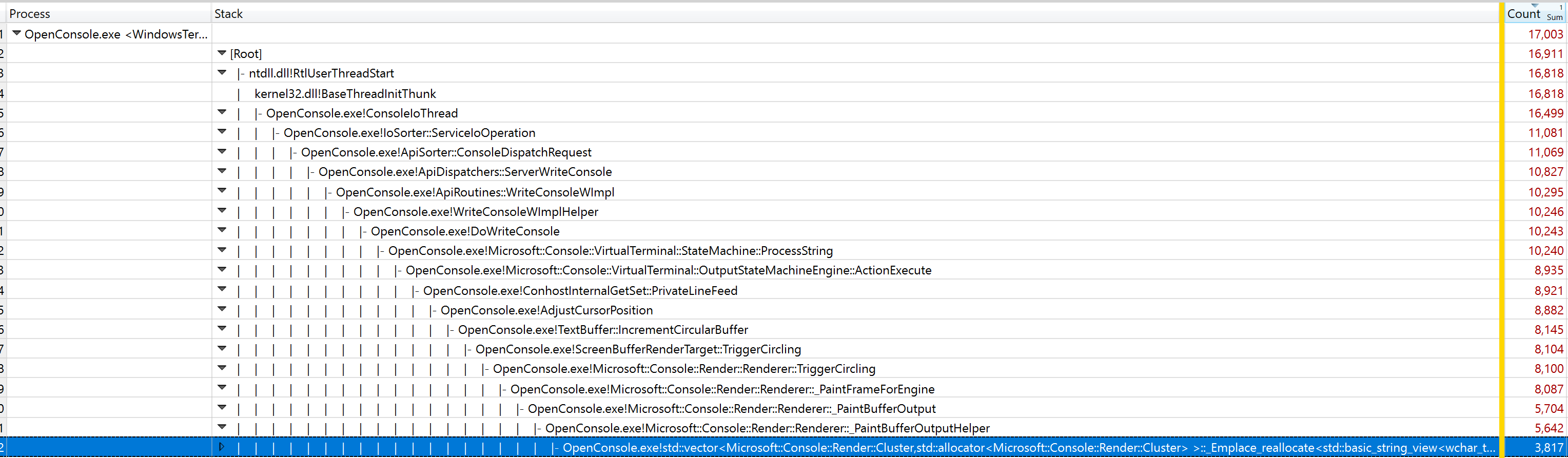 | 
`cacafire` | 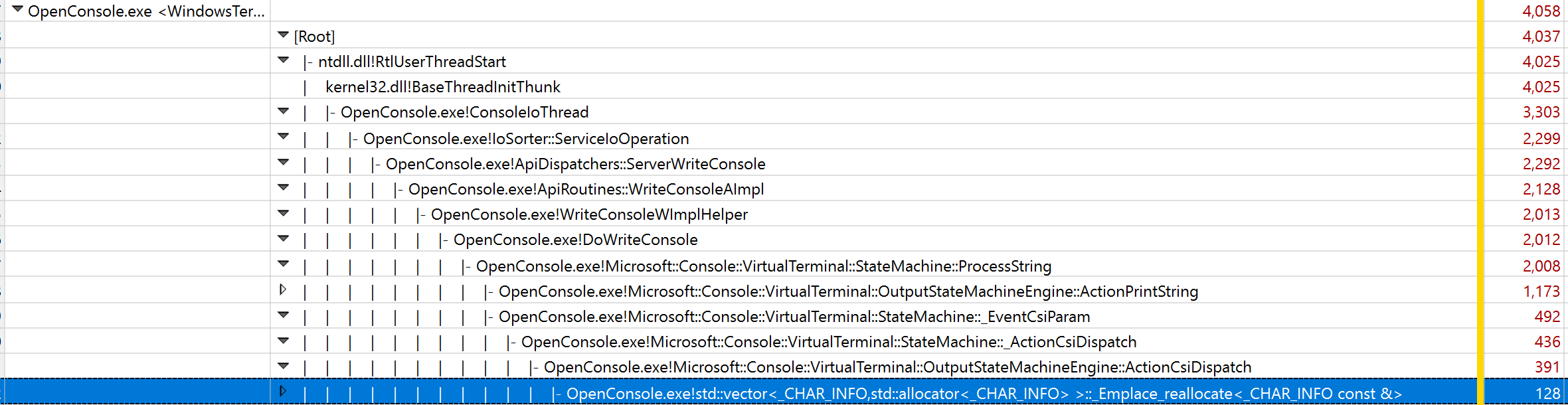 | 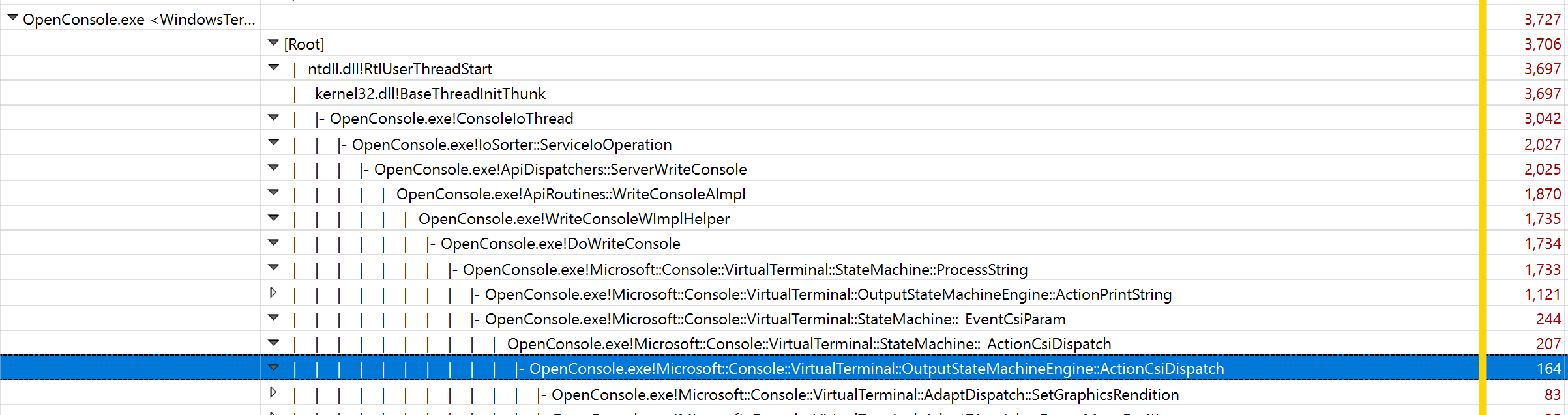
This pull request moves WindowUiaProvider back into Win32 interactivity
and deletes all mention of it from Windows Terminal. Terminal does not
have a single toplevel window that requires Console-like UIA, as each
Xaml control inside it is in charge of its own destiny.
I've also merged `IUiaWindow` and `IConsoleWindow` back together, as
well as `WindowUiaProviderBase` and `WindowUiaProvider`.
Things look a lot more like they did before we tore them apart.
## PR Checklist
* [x] Closes#3564
* [x] CLA
* [x] Tests added/passed (manual)
* [ ] Requires documentation to be updated
* [x] I've discussed this with core contributors already
## Validation
Carlos validated conhost and terminal on this branch.
## Summary of the Pull Request
When someone asked "Do we need to send a F7 keyup too" in #6309, the right answer was actually _no_. Turns out that while XAML will eat the F7 key**down**, it _won't_ eat the F7 key**up**.
## References
* regressed in #6309
## PR Checklist
* [x] Closes#6438
* [x] I work here
* [ ] Tested manually
* [n/a] Requires documentation to be updated
## Validation Steps Performed
* Checked this with the debug tap
Does what it says on the label. Pure modifier keys weren't making it
this far at all prior to #6309. This PR changes these methods to make
sure that we only dismiss a selection or snap on input when the key
pressed isn't a modifier key.
## References
* regressed in #6309
## PR Checklist
* [x] Closes#6423
* [x] I work here
* [ ] Tests added/passed
* [n/a] Requires documentation to be updated
## Validation Steps Performed
* Tried to repro this in the Terminal, couldn't anymore.
When opening a new tab, it takes a few milliseconds before title to
appears. This PR makes it instantaneous.
* Updated the Terminal so that it can load the title from the settings
before it is initialized.
* Load terminal settings in TermControl constructor before the terminal
is initialized (see above).
* Update Tab so that it sets the TabViewItem's title in the constructor
(in Tab::_MakeTabViewItem) instead of waiting for the VT sequence to
set the title (from what I understand).
NOTE 1: there is a similar problem with the tabview icon which is not
fixed by this PR.
NOTE 2: This is only a problem with animations disabled because
otherwise the title fades in so there is enough time for it to be set
when it becomes visible.
## Validation
I ran the terminal and opened a new tab. The title appears instantly.
This commit introduces a new project that lets you F5 a working instance
of the Wpf Terminal Control.
To make the experience as seamless as possible, I've introduced another
solution platform called "DotNet_x64Test". It is set to build the WPF
projects for "Any CPU" and every project that PublicTerminalCore
requires (including itself) for "x64". This is the only way to ensure
that when you press F5, all of the native and managed dependencies get
updated.
It's all quite cool when it works.
<!-- Enter a brief description/summary of your PR here. What does it fix/what does it change/how was it tested (even manually, if necessary)? -->
## Summary of the Pull Request
Upload the roadmap for Windows Terminal 2.0 and link to it on the README.
<!-- Other than the issue solved, is this relevant to any other issues/existing PRs? -->
## References
<!-- Please review the items on the PR checklist before submitting-->
## PR Checklist
* [ ] Closes #xxx
* [x] CLA signed. If not, go over [here](https://cla.opensource.microsoft.com/microsoft/Terminal) and sign the CLA
* [ ] Tests added/passed
* [ ] Requires documentation to be updated
* [x] I've discussed this with core contributors already. If not checked, I'm ready to accept this work might be rejected in favor of a different grand plan. Issue number where discussion took place: #xxx
<!-- Provide a more detailed description of the PR, other things fixed or any additional comments/features here -->
## Detailed Description of the Pull Request / Additional comments
<!-- Describe how you validated the behavior. Add automated tests wherever possible, but list manual validation steps taken as well -->
## Validation Steps Performed
## Summary of the Pull Request
Remove parentheses from the Preview and Dev build. Now they're called Windows Terminal Preview and Windows Terminal Dev Build respectively.
Also removed them from other identifiers of Terminal for consistency.
## PR Checklist
* [X] Closes#5974
Adds support for `win32-input-mode` to conhost, conpty, and the Windows
Terminal.
* The shared `terminalInput` class supports sending these sequences when
a VT client application requests this mode.
* ConPTY supports synthesizing `INPUT_RECORD`s from the input sent to it
from a terminal
* ConPTY requests this mode immediately on startup (if started with a
new flag, `PSEUDOCONSOLE_WIN32_INPUT_MODE`)
* The Terminal now supports sending this input as well, when conpty asks
for it.
Also adds a new ConPTY flag `PSEUDOCONSOLE_WIN32_INPUT_MODE` which
requests this functionality from conpty, and the Terminal requests this
by default.
Also adds `experimental.input.forceVT` as a global setting to let a user
opt-out of this behavior, if they don't want it / this ends up breaking
horribly.
## Validation Steps Performed
* played with this mode in vtpipeterm
* played with this mode in Terminal
* checked a bunch of scenarios, as outlined in a [comment] on #4999
[comment]: https://github.com/microsoft/terminal/issues/4999#issuecomment-628718631
References #4999: The megathread
References #5887: The spec
Closes#879Closes#2865Closes#530Closes#3079Closes#1119Closes#1694Closes#3608Closes#4334Closes#4446
We're removing this because of MSFT:24623699, which prevents us from being able to do the right thing when we're called on the background of a directory for a range of OS builds.
#6414 will track re-adding this to the Terminal when the original issue is closed.
* [x] closes#6245
* I work here
Wildcards are not allowed in toplevel ItemGroups in vcxproj; they must
be generated by targets.
We mostly use wildcards for pulling in PRI files that are dumped on disk
by the translation tool. We don't want to check those in, so we can't
expand references to them.
To that end, I've introduced a new target that will take a list of
folders containing resw files and expand wildcards under them.
All[1] other wildcards have been moved into their respective targets
_or_ simply expanded.
[1]: Nothing has complained about the resource wildcards in
CascadiaResources.build.items, so I haven't exploded it yet.
Fixes#6214.
This PR provides a faster algorithm for converting 8-bit and 24-bit
colors into the 4-bit legacy values that are required by the Win32
console APIs. It also fixes areas of the code that were incorrectly
using a simple 16-color conversion that didn't handle 8-bit and 24-bit
values.
The faster conversion algorithm should be an improvement for issues #783
and #3950.
One of the main points of this PR was to fix the
`ReadConsoleOutputAttribute` API, which was using a simplified legacy
color conversion (the original `TextAttribute:GetLegacyAttributes`
method), which could only handle values from the 16-color table. RGB
values, and colors from the 256-color table, would be mapped to
completely nonsensical values. This API has now been updated to use the
more correct `Settings::GenerateLegacyAttributes` method.
But there were also a couple of other places in the code that were using
`GetLegacyAttributes` when they really had no reason to be working with
legacy attributes at all. This could result in colors being downgraded
to 4-bit values (often badly, as explained above), when the code was
already perfectly capable of displaying the full 24-bits.
This included the fill colors in the IME composer (in `ConsoleImeInfo`),
and the construction of the highlighting colors in the color
search/selection handler (`Selection::_HandleColorSelection`). I also
got rid of some legacy attribute code in the `Popup` class, which was
originally intended to update colors below the popup when the settings
changed, but actually caused more problems than it solved.
The other major goal of this PR was to improve the performance of the
`GenerateLegacyAttributes` method, since the existing implementation
could be quite slow when dealing with RGB values.
The simple cases are handled much the same as they were before. For an
`IsDefault` color, we get the default index from the
`Settings::_wFillAttribute` field. For an `IsIndex16` color, the index
can just be returned as is.
For an `IsRgb` color, the RGB components are compressed down to 8 bits
(3 red, 3 green, 2 blue), simply by dropping the least significant bits.
This 8-bit value is then used to lookup a representative 16-color value
from a hard-coded table. An `IsIndex256` color is also converted with a
lookup table, just using the existing 8-bit index.
The RGB mapping table was calculated by taking each compressed 8-bit
color, and picking a entry from the _Campbell_ palette that best
approximated that color. This was done by looking at a range of 24-bit
colors that mapped to the 8-bit value, finding the best _Campbell_ match
for each of them (using a [CIEDE2000] color difference calculation), and
then the most common match became the index that the 8-bit value would
map to.
The 256-color table was just a simpler version of this process. For each
entry in the table, we take the default RGB palette value, and find it's
closest match in the _Campbell_ palette.
Because these tables are hard-coded, the results won't adjust to changes
in the palette. However, they should still produce reasonable results
for palettes that follow the standard ANSI color range. And since
they're only a very loose approximation of the colors anyway, the exact
value really isn't that important.
That said, I have tried to make sure that if you take an RGB value for a
particular index in a reasonable color scheme, then the legacy color
mapped from that value should ideally match the same index. This will
never be possible for all color schemes, but I have tweaked a few of the
table entries to improve the results for some of the common schemes.
One other point worth making regarding the hard-coded tables: even if we
wanted to take the active palette into account, that wouldn't actually
be possible over a conpty connection, because we can't easily know what
color scheme the client application is using. At least this way the
results in conhost are guaranteed to be the same as in the Windows
Terminal.
[CIEDE2000]: https://en.wikipedia.org/wiki/Color_difference#CIEDE2000
## Validation Steps Performed
This code still passes the `TextAttributeTests` that check the basic
`GetLegacyAttribute` behaviour and verify the all legacy attributes
roundtrip correctly. However, some of the values in the `RgbColorTests`
had to be updated, since we're now intentionally returning different
values as a result of the changes to the RGB conversion algorithm.
I haven't added additional unit tests, but I have done a lot of manual
testing to see how well the new algorithm works with a range of colors
and a variety of different color schemes. It's not perfect in every
situation, but I think it works well enough for the purpose it serves.
I've also confirmed that the issues reported in #5940 and #6247 are now
fixed by these changes.
Closes#5940Closes#6247
In Windows, we build with /Zc:wchar_t- (which makes wchar_t an unsigned
short typedef.) This causes build breaks when we compare two wchar_t
values (or a wchar_t and an enum class that's of type wchar_t) and the
compiler decides that it might want to _promote them to TextAttribute_
before doing the comparison.
Dustin Howett (1):
Merge remote-tracking branch 'openconsole/inbox' into HEAD
James Holderness (1):
Improve support for VT character sets (CC-4496)
Related work items: MSFT:26791619
## Summary of the Pull Request
When we select a color for the tab, we update the foreground color of the text so that it maintains acceptable contrast with the new tab color. However, we weren't also updating the foreground color of the close button.
This is understandable though, because apparently this wasn't fixable until MUX 2.4 arrived. I'm not a XAML expert, but I know that setting this key only works when we're using MUX 2.4, so I'm assuming something about the TabView implementation changed in that release. _This PR is marked as a draft until #5778 is merged, then I'll re-target to master._
## References
* #5778 - PR to move to MUX 2.4
* This bug was introduced with the tab color picker in #3789
## PR Checklist
* [x] Closes#5780
* [x] I work here
* [ ] Tests added/passed
* [n/a] Requires documentation to be updated
## Validation Steps Performed
A light tab color:

A dark tab color:

## Summary of the Pull Request
Really couldn't be more starightforward. MUX 2.4 added support for "compact" sized tabs. This PR (targeting the 2.4 PR currently, will move to `master` when that merges) enables users to specify `"tabWidthMode": "compact"` in their global settings to get this behavior.
## References
* #5778 - PR to move to MUX 2.4
* [microsoft-ui-xaml#2016](https://github.com/microsoft/microsoft-ui-xaml/pull/2016) - the MUX PR for compact tab sizing.
* #597 - Tab sizing options?
## PR Checklist
* [x] I don't think we have an issue for this, though I could be wrong.
* [x] I work here
* [x] Tests added/passed
* [n/a] Requires documentation to be updated
## Detailed Description of the Pull Request / Additional comments
In this screenshot, I'm hovering over tab 2, but the ubuntu tab is focused:

In this screenshot, tab 2 is focused:

This brings support for "Compact" tab sizing, which compresses all inactive tabs to just the size of their icons plus the close button. Neat!
It also just keeps us generally up-to-date and good citizens.
## Summary of the Pull Request
Some people wish to use Ctrl+Alt combinations without Windows treating those as an alias for AltGr combinations. This PR adds a new `altGrAliasing` setting allowing one to control this behavior.
## PR Checklist
* [x] Closes#6211
* [x] CLA signed. If not, go over [here](https://cla.opensource.microsoft.com/microsoft/Terminal) and sign the CLA
* [x] Manual testing
* [x] Requires documentation to be updated: https://github.com/MicrosoftDocs/terminal/issues/50
* [x] I've discussed this with core contributors already. If not checked, I'm ready to accept this work might be rejected in favor of a different grand plan. Issue number where discussion took place: #xxx
## Validation Steps Performed
* Choose a German keyboard layout
* Using `showkey -a` ensured that both `Ctrl+Alt+Q/E` and `AltGr+Q/E` produce `@/€`
* Added `"altGrAliasing": false` to the WSL profile
* Using `showkey -a` ensured `Ctrl+Alt+Q/E` now produces `^[^Q/E` while `AltGr+Q/E` continues to produce `@/€`
This PR improves our VT character set support, enabling the [`SCS`]
escape sequences to designate into all four G-sets with both 94- and
96-character sets, and supports invoking those G-sets into both the GL
and GR areas of the code table, with [locking shifts] and [single
shifts]. It also adds [`DOCS`] sequences to switch between UTF-8 and the
ISO-2022 coding system (which is what the VT character sets require),
and adds support for a lot more characters sets, up to around the level
of a VT510.
[`SCS`]: https://vt100.net/docs/vt510-rm/SCS.html
[locking shifts]: https://vt100.net/docs/vt510-rm/LS.html
[single shifts]: https://vt100.net/docs/vt510-rm/SS.html
[`DOCS`]: https://en.wikipedia.org/wiki/ISO/IEC_2022#Interaction_with_other_coding_systems
## Detailed Description of the Pull Request / Additional comments
To make it easier for us to declare a bunch of character sets, I've made
a little `constexpr` class that can build up a mapping table from a base
character set (ASCII or Latin1), along with a collection of mappings for
the characters the deviate from the base set. Many of the character sets
are simple variations of ASCII, so they're easy to define this way.
This class then casts directly to a `wstring_view` which is how the
translation tables are represented in most of the code. We have an array
of four of these tables representing the four G-sets, two instances for
the active left and right tables, and one instance for the single shift
table.
Initially we had just one `DesignateCharset` method, which could select
the active character set. We now have two designate methods (for 94- and
96- character sets), and each takes a G-set number specifying the target
of the designation, and a pair of characters identifying the character
set that will be designated (at the higher VT levels, character sets are
often identified by more than one character).
There are then two new `LockingShift` methods to invoke these G-sets
into either the GL or GR area of the code table, and a `SingleShift`
method which invokes a G-set temporarily (for just the next character
that is output).
I should mention here that I had to make some changes to the state
machine to make these single shift sequences work. The problem is that
the input state machine treats `SS3` as the start of a control sequence,
while the output state machine needs it to be dispatched immediately
(it's literally the _Single Shift 3_ escape sequence). To make that
work, I've added a `ParseControlSequenceAfterSs3` callback in the
`IStateMachineEngine` interface to decide which behavior is appropriate.
When it comes to mapping a character, it's simply an array reference
into the appropriate `wstring_view` table. If the single shift table is
set, that takes preference. Otherwise the GL table is used for
characters in the range 0x20 to 0x7F, and the GR table for characters
0xA0 to 0xFF (technically some character sets will only map up to 0x7E
and 0xFE, but that's easily controlled by the length of the
`wstring_view`).
The `DEL` character is a bit of a special case. By default it's meant to
be ignored like the `NUL` character (it's essentially a time-fill
character). However, it's possible that it could be remapped to a
printable character in a 96-character set, so we need to check for that
after the translation. This is handled in the `AdaptDispatch::Print`
method, so it doesn't interfere with the primary `PrintString` code
path.
The biggest problem with this whole process, though, is that the GR
mappings only really make sense if you have access to the raw output,
but by the time the output gets to us, it would already have been
translated to Unicode by the active code page. And in the case of UTF-8,
the characters we eventually receive may originally have been composed
from two or more code points.
The way I've dealt with this was to disable the GR translations by
default, and then added support for a pair of ISO-2022 `DOCS` sequences,
which can switch the code page between UTF-8 and ISO-8859-1. When the
code page is ISO-8859-1, we're essentially receiving the raw output
bytes, so it's safe to enable the GR translations. This is not strictly
correct ISO-2022 behavior, and there are edge cases where it's not going
to work, but it's the best solution I could come up with.
## Validation Steps Performed
As a result of the `SS3` changes in the state machine engine, I've had
to move the existing `SS3` tests from the `OutputEngineTest` to the
`InputEngineTest`, otherwise they would now fail (technically they
should never have been output tests).
I've added no additional unit tests, but I have done a lot of manual
testing, and made sure we passed all the character set tests in Vttest
(at least for the character sets we currently support). Note that this
required a slightly hacked version of the app, since by default it
doesn't expose a lot of the test to low-level terminals, and we
currently identify as a VT100.
Closes#3377Closes#3487
## Summary of the Pull Request
Adds support for trailing commas in our json files.
## References
* Enabled due to the excellent work over in https://github.com/open-source-parsers/jsoncpp/pull/1098
## PR Checklist
* [x] I work here
* [x] Tests added/passed
* [n/a] Requires documentation to be updated
## Summary of the Pull Request

This is the plan that @miniksa suggested to me. Instead of trying to do lots of work in all the renderers to do backgrounds as one pass, and foregrounds as another, we can localize this change to basically just the DX renderer.
1. First, we give the DX engine a "heads up" on where the cursor is going to be drawn during the frame, in `PrepareRenderInfo`.
- This function is left unimplemented in the other render engines.
2. While printing runs of text, the DX renderer will try to paint the cursor in `CustomTextRenderer::DrawGlyphRun` INSTEAD of `DxEngine::PaintCursor`. This lets us weave the cursor background between the text background and the text.
## References
* #6151 was a spec in this general area. I should probably go back and update it, and we should probably approve that first.
* #6193 is also right up in this mess
## PR Checklist
* [x] Closes#1203
* [x] I work here
* [ ] Tests added/passed
* [n/a] Requires documentation to be updated
## Detailed Description of the Pull Request / Additional comments
* This is essentially `"cursorTextColor": "textForeground"` from #6151.
* A follow up work item is needed to add support for the current behavior, (`"cursorTextColor": null`), and hooking up that setting to the renderer.
## Summary of the Pull Request
We have a number of bugs in the Terminal that all have the same singular root cause - VT input does not carry the same fidelity that Win32 input does. For Win32 applications there are certain keystrokes that simply cannot be represented with VT sequences.
This is my proposal for how we'll handle all these cases. I'm proposing a _new VT sequence_, which will enable the Terminal to send input with all of the information that an `INPUT_RECORD` might have, to conpty. There, conpty will be able to send input to the client application with the same fidelity they're used to, enabling these keys to work for those applications once again.
## PR Checklist
* [x] Specs #4999
* [x] I work here
* [x] is a spec
## Detailed Description of the Pull Request / Additional comments
_read the spec_
Running `nuget restore` on every build is pretty unnecessary - usually, you _know_ when you need to run it. For the inner dev loop, this is a few seconds on every `bx` build.
This adds a environment variable you can set to skip the `nuget restore` part of a `bcz` build.
Add the following to your `.razzlerc.cmd`:
```cmd
set _SKIP_NUGET_RESTORE=1
```
and `bcz` (and the other helpers) _won't_ perform a nuget restore on every build.
## Summary of the Pull Request
This pull request removes all of the custom `Get` and `Set` implementations from GlobalAppSettings and replaces them with `GETSET_PROPERTY`. This will be required if we ever convert it to a WinRT class, but for now it's simply niceness-improving.
## References
Required #5847 to land.
## PR Checklist
* [ ] Closes norhing
* [x] CLAd
* [x] Tests added/passed
* [ ] Requires documentation to be updated
* [x] I've discussed this with core contributors already
## Summary of the Pull Request
Restores proper line drawing during IME operations in `conhost`
## PR Checklist
* [x] Closes#803
* [x] I work here.
* [x] Tested manually.
* [x] Check the performance of this and see if it's worse-enough to merit a more confusing algorithm. It was worse for the majority case so I scoped it.
* [x] No doc, it should have worked this way.
* [x] Am core contributor.
## Detailed Description of the Pull Request / Additional comments
- Changed `ConsoleImeInfo::s_ConvertToCells` to be less confusing. It's doing about the same thing, but it's way easier to read now and the compiler/linker/optimizer should just be the same.
- Edited `Renderer::_PaintBufferOutputHelper` to check each attribute for line drawing characters as the right half of a two-col character might have different line drawing characters than the left-half.
## Validation Steps Performed
- [x] Manual operation of IME in conhost with Japanese IME.
- [x] Manual operation of IME in conhost with Chinese IME.
- [x] Manual operation of IME in conhost with Chinese (Traditional) IME.
- [x] Manual operation of IME in conhost with and Korean IME. - @leonMSFT says Korean doesn't work this way. But Korean is broken worse in that it's not showing suggestions at all. Filing new bug. #6227
- [x] Validated against API-filling calls through `SetConsoleTextAttribute` per @j4james's sample code
This commit introduces Generate-CodepointWidthsFromUCD, a powershell
(7+) script that will parse a UCD XML database in the UAX 42 format from
https://www.unicode.org/Public/UCD/latest/ucdxml/ and generate
CodepointWidthDetector's giant width array.
By default, it will emit one UnicodeRange for every range of non-narrow
glyphs with a different Width + Emoji + Emoji Presentation class;
however, it can be run in "packing" and "full" mode.
* Packing mode: ignore the width/emoji/pres class and combine adjacent
runs that CPWD will treat the same.
* This is for optimizing the number of individual ranges emitted
into code.
* Full mode: include narrow codepoints (helpful for visualization)
It also supports overrides, provided in an XML document of the same format
as the UCD itself. Entries in the overrides files are applied after the
entire UCD is read and will replace any impacted ranges.
The output (when packing) looks like this:
```c++
// Generated by Generate-CodepointWidthsFromUCD -Pack:True -Full:False
// on 05/17/2020 02:47:55 (UTC) from Unicode 13.0.0.
// 66182 (0x10286) codepoints covered.
static constexpr std::array<UnicodeRange, 23> s_wideAndAmbiguousTable{
UnicodeRange{ 0xa1, 0xa1, CodepointWidth::Ambiguous },
UnicodeRange{ 0xa4, 0xa4, CodepointWidth::Ambiguous },
UnicodeRange{ 0xa7, 0xa8, CodepointWidth::Ambiguous },
.
.
.
UnicodeRange{ 0x1f210, 0x1f23b, CodepointWidth::Wide },
UnicodeRange{ 0x1f37e, 0x1f393, CodepointWidth::Wide },
UnicodeRange{ 0x100000, 0x10fffd, CodepointWidth::Ambiguous },
};
```
The output (when overriding) looks like this:
```c++
// Generated by Generate-CodepointWidthsFromUCD.ps1 -Pack:True -Full:False -NoOverrides:False
// on 5/22/2020 11:17:39 PM (UTC) from Unicode 13.0.0.
// 321205 (0x4E6B5) codepoints covered.
// 240 (0xF0) codepoints overridden.
static constexpr std::array<UnicodeRange, 23> s_wideAndAmbiguousTable{
UnicodeRange{ 0xa1, 0xa1, CodepointWidth::Ambiguous },
...
UnicodeRange{ 0xfe20, 0xfe2f, CodepointWidth::Narrow }, // narrow combining ligatures (split into left/right halves, which take 2 columns together)
...
UnicodeRange{ 0x100000, 0x10fffd, CodepointWidth::Ambiguous },
};
```
## Summary of the Pull Request
I was debugging the terminal unpackaged, and noticed that this method crashes immediately. I'm gonna bet that this functionality only works when the app is installed as a package. Wrapping this whole method up in one big ol' `try/catch` seems to fix the immediate crash.
## References
* Introduced in #4908
## PR Checklist
* [x] I work here
* [ ] Tests added/passed
* [n/a] Requires documentation to be updated
## Detailed Description of the Pull Request / Additional comments
We _could_ display a warning if the user has this property set and is running the terminal unpackaged, to clue them in that it won't work? I'm willing to file a follow-up for that, but I think we should fix the crash _now_.
## Validation Steps Performed
* Ran the terminal successfully unpackaged.
## Summary of the Pull Request
Adds support for setting the terminal `title` with the commandline argument `--title <title>`.
## PR Checklist
* [x] Closes#6183
* [x] I work here
* [ ] Tests added/passed
* [ ] Requires documentation to be updated - probably does, yea
## Detailed Description of the Pull Request / Additional comments
* I wasn't sure how we felt about `-t` being the short version of this argument, so I left it out. If we're cool with that, adding it wouldn't be hard.
## Validation Steps Performed

<!-- Enter a brief description/summary of your PR here. What does it fix/what does it change/how was it tested (even manually, if necessary)? -->
## Summary of the Pull Request
As discussed in #6293 , this PR adds a fade animation to button background when pointer hover ends
<!-- Other than the issue solved, is this relevant to any other issues/existing PRs? -->
## References
<!-- Please review the items on the PR checklist before submitting-->
## PR Checklist
* [x] Closes#6293
* [x] CLA signed. If not, go over [here](https://cla.opensource.microsoft.com/microsoft/Terminal) and sign the CLA
* [ ] Tests added/passed
* [ ] Requires documentation to be updated
* [x] I've discussed this with core contributors already. If not checked, I'm ready to accept this work might be rejected in favor of a different grand plan. Issue number where discussion took place: #xxx
<!-- Provide a more detailed description of the PR, other things fixed or any additional comments/features here -->
## Detailed Description of the Pull Request / Additional comments
Added storyboarded coloranimations to the visualstategroup of captionbuttons
<!-- Describe how you validated the behavior. Add automated tests wherever possible, but list manual validation steps taken as well -->
## Validation Steps Performed
Tested manually
## Summary of the Pull Request
When resizing the window title, a GDI object would be leaked. This has to do with our island message handler using `wil` to track these objects and `wil` having a bug.
## References
microsoft/wil#100
## PR Checklist
* [x] Closes#5949
* [x] I work here.
* [x] Tested manually
* [x] Doc not required.
* [x] Am core contributor.
## Validation Steps Performed
* [x] Added the GDI Objects column to Task Manager, set the Terminal to use the `titleWidth` size tabs, then changed the title a bunch with PowerShell. Confirmed repro before (increasing GDI count). Confirmed it's gone after (no change to object count).
## Summary of the Pull Request
Adds two new flags to the `wt.exe` alias:
* `--maximized,-M`: Launch the new Terminal window maximized. This flag cannot be combined with `--fullscreen`.
* `--fullscreen,-F`: Launch the new Terminal window fullscreen. This flag cannot be combined with `--maximized`.
## References
* This builds on the work done in #6060.
* The cmdline args megathread: #4632
## PR Checklist
* [x] Closes#5801
* [x] I work here
* [ ] Tests added/passed
* [n/a] Requires documentation to be updated
## Detailed Description of the Pull Request / Additional comments
* I had to move the commandline arg parsing up a layer from `TerminalPage` to `AppLogic`, because `AppLogic` controls the Terminal's settings, including launch mode settings. This seems like a reasonable change, to put both the settings from the file and the commandline in the same place.
- **Most of the diff is that movement of code**
* _"What happens when you try to pass both flags, like `wtd -M -F new-tab`?"_:

## Validation Steps Performed
* Ran a bunch of commandlines to see what happened.
## Summary of the Pull Request
This PR adds support for the core VT52 commands, and implements the `DECANM` private mode sequence, which switches the terminal between ANSI mode and VT52-compatible mode.
## References
PR #2017 defined the initial specification for VT52 support.
PR #4044 removed the original VT52 cursor ops that conflicted with VT100 sequences.
## PR Checklist
* [x] Closes#976
* [x] CLA signed. If not, go over [here](https://cla.opensource.microsoft.com/microsoft/Terminal) and sign the CLA
* [x] Tests added/passed
* [ ] Requires documentation to be updated
* [x] I've discussed this with core contributors already. If not checked, I'm ready to accept this work might be rejected in favor of a different grand plan. Issue number where discussion took place: #2017
## Detailed Description of the Pull Request / Additional comments
Most of the work involves updates to the parsing state machine, which behaves differently in VT52 mode. `CSI`, `OSC`, and `SS3` sequences are not applicable, and there is one special-case escape sequence (_Direct Cursor Address_), which requires an additional state to handle parameters that come _after_ the final character.
Once the parsing is handled though, it's mostly just a matter of dispatching the commands to existing methods in the `ITermDispatch` interface. Only one new method was required in the interface to handle the _Identify_ command.
The only real new functionality is in the `TerminalInput` class, which needs to generate different escape sequences for certain keys in VT52 mode. This does not yet support _all_ of the VT52 key sequences, because the VT100 support is itself not yet complete. But the basics are in place, and I think the rest is best left for a follow-up issue, and potentially a refactor of the `TerminalInput` class.
I should point out that the original spec called for a new _Graphic Mode_ character set, but I've since discovered that the VT terminals that _emulate_ VT52 just use the existing VT100 _Special Graphics_ set, so that is really what we should be doing too. We can always consider adding the VT52 graphic set as a option later, if there is demand for strict VT52 compatibility.
## Validation Steps Performed
I've added state machine and adapter tests to confirm that the `DECANM` mode changing sequences are correctly dispatched and forwarded to the `ConGetSet` handler. I've also added state machine tests that confirm the VT52 escape sequences are dispatched correctly when the ANSI mode is reset.
For fuzzing support, I've extended the VT command fuzzer to generate the different kinds of VT52 sequences, as well as mode change sequences to switch between the ANSI and VT52 modes.
In terms of manual testing, I've confirmed that the _Test of VT52 mode_ in Vttest now works as expected.
## Summary of the Pull Request
Users can now open an auto split pane with the mouse.
When opening the dropdown, alt+invoke the profile of choice and it should open in an auto sized pane.
## References
#5025 - further discussion there as to whether this actually closes it.
## Detailed Description of the Pull Request / Additional comments
Had to do a special check for debugTap because that's triggered by holding both alts.
## Validation Steps Performed
alt+click/enter on a new profile. Looks great!
## Summary of the Pull Request
This looks like a big diff, but there's a bunch of existing code that
just got moved around, and there's a cool new Utils template.
The tests all pass, and this passed manual validation. I tried weird
things like "making a profile named `{ }`"
(w/ enough spaces to look like a guid), and yeah it doesn't let you
specify that one as a name, but _why would you do that?!_
Okay, this pull request abstracts the conversion of a profile name into
an optional profile guid out of the "New Terminal Tab Args" handler and
into a common space for all of CascadiaSettings to use.
It also cleans up the conversion of indices and names into optional
GUIDs and turns _those_ into further helpers.
It also introduces a cool new template for running value_or multiple
times on a chain of optionals. CoalesceOptionals is a "choose first,
with fallback" for N>1 optionals.
On top of all this, I've built support for an "unparsed default GUID":
we load the user's defaultProfile as a string, and as part of settings
validation we unpack that string using the helpers outlined above.
## References
Couples well with #5690.
## PR Checklist
* [x] Incidentally fixes#2876
* [x] Core Contributor
* [x] Tests added/passed
* [x] Requires documentation to be updated (done)
* [x] I've discussed this with core contributors already
## Validation Steps Performed
Added additional test collateral to make sure that this works.
<!-- Enter a brief description/summary of your PR here. What does it fix/what does it change/how was it tested (even manually, if necessary)? -->
## Summary of the Pull Request
This PR adds a new boolean global setting, startOnUserLogin, along with associated AppLogic to request enabling or disabling of the StartupTask. Added UAP5 extensions to AppX manifests.
<!-- Other than the issue solved, is this relevant to any other issues/existing PRs? -->
## References
#2189
<!-- Please review the items on the PR checklist before submitting-->
## PR Checklist
* [x] Closes#2189
* [x] CLA signed. If not, go over [here](https://cla.opensource.microsoft.com/microsoft/Terminal) and sign the CLA
* [x] Tests added/passed
* [x] Requires documentation to be updated
* [x] I've discussed this with core contributors already. If not checked, I'm ready to accept this work might be rejected in favor of a different grand plan. Issue number where discussion took place: #2189
<!-- Provide a more detailed description of the PR, other things fixed or any additional comments/features here -->
## Detailed Description of the Pull Request / Additional comments
Please note, I'm a non-practicing C++ developer, there are a number of things I wasn't sure how to handle in the appropriate fashion, mostly around error handling and what probably looks like an incredibly naive (and messy) way to implement the async co_await behavior.
Error handling-wise, I found (don't ask me how!) that if you somehow mismatch the startup task's ID between the manifest and the call to `StartupTask::GetAsync(hstring taskId)`, you'll get a very opaque WinRT exception that boils down to a generic invalid argument message. This isn't likely to happen in the wild, but worth mentioning...
I had enough trouble getting myself familiarized with the project, environment, and C++/WinRT in general didn't want to try to tackle adding tests for this quite yet since (as I mentioned) I don't really know what I'm doing. I'm happy to give it a try with perhaps a bit of assistance in getting started 😃
Further work in this area of the application outside of this immediate PR might need to include adding an additional setting to contain launch args that the startup task can pass to the app so that users can specify a non-default profile to launch on start, window position (e.g., #653).
<!-- Describe how you validated the behavior. Add automated tests wherever possible, but list manual validation steps taken as well -->
## Validation Steps Performed
✔️ Default settings:
Given the user does not have the `startOnUserLogin` setting in their profile.json,
When the default settings are opened (via alt+click on Settings),
Then the global settings should contain the `"startOnUserLogin": false` token
✔️ Applying setting on application launch
Given the `startOnUserLogin` is `true` and
the `Windows Terminal` startup task is `disabled` and
the application is not running
When the application is launched
Then the `Windows Terminal` entry in the user's Startup list should be `enabled`
✔️ Applying setting on settings change
Given the `startOnUserLogin` is `true` and
the `Windows Terminal` startup task is `enabled` and
the application is running
When the `startOnUserLogin` setting is changed to `false` and
the settings file is saved to disk
Then the `Windows Terminal` startup task entry should be `disabled`
✔️ Setting is ignored when user has manually disabled startup
Given the `startOnUserLogin` is `true` and
the application is not running and
the `Windows Terminal` startup task has been set to `disabled` via user action
When the application is launched
Then the startup task should remain disabled and
the application should not throw an exception
#### note: Task Manager does not seem to re-scan startup task states after launch; the Settings -> Apps -> Startup page also requires closing or moving away to refresh the status of entries
Implements what I was suggesting in #6266 where if a shortcut doesn't
specify an icon, the shortcut target full path is used before searching
for a matching executable in the path.
## References
Found due to not getting the right icon in conhost from the Yori
installer. It's fixed in the installer from
5af366b6a5
for all current users of conhost though, so this PR is just trying to
minimize surprises for the next guy.
## Detailed Description of the Pull Request / Additional comments
I know conhost and shortcut settings aren't really the team's focus
which is why I'm doing this. I understand though if there's a better
way or there are factors that I hadn't considered. Note that the path
searching code is used when programs are launched without using a
shortcut, and it will match if the working directory of the shortcut is
the directory containing the executable.
## Validation Steps Performed
Created a shortcut that didn't specify an icon to a binary that wasn't
in the path, and verified that the icon in the upper left of the console
window could resolve correctly when opening the shortcut. I'm not aware
of a way to get into this path (of launching via a shortcut to a command
line process) without replacing the system conhost, which is what I did
to verify it. In order to diagnose it, I used hardcoded DebugBreak()
since even ImageFileExecutionOptions didn't like running against conhost-
is there are better way to debug and test these cases without being so
invasive on the system?
Closes#6266
For a radio button group to work properly, they need sequential IDs.
This moves the cursor radio buttons on the `conhost` property sheet to
be sequential.
## References
- Introduced with #2663
- Found while investigating #4186
## PR Checklist
* [x] Closes unfiled issue found while investigating #4186
* [x] I work here.
* [x] Manual test.
* [x] No documentation required.
* [x] Am core contributor.
## Detailed Description of the Pull Request / Additional comments
- `CheckRadioButton` takes a contiguous group of IDs. It will set one
item in the list and then uncheck the rest. When a new one was added
to the group, it was added to the end of the segment in the IDs file,
but not immediately after the existing radio buttons. This means it
accidentally turned off all the other buttons in the middle.
- To resolve this, I moved all the cursor buttons into their own
sequential group number and I deprecated the old values.
## Validation Steps Performed
- [x] Ensured that the "Discard Old Duplicates" value was set in the
registry, walked through debugger as `conhost` packed the `TRUE` value
into the property sheet blob, walked through the property sheet
`console.dll` as it unpacked the `TRUE`, then observed that the
checkbox was actually set instead of getting unset by the
`CheckRadioButton` call that went from 107 to 119 and accidentally
unchecked number 112, `IDD_HISTORY_NODUP` even though I swear it was
just set.
## Summary of the Pull Request
Adds `"launchMode": "fullscreen"`, which does what it says on the box.
## PR Checklist
* [x] Closes#288
* [x] I work here
* [ ] Tests added/passed
* [n/a] Requires documentation to be updated
## Detailed Description of the Pull Request / Additional comments
It's important to let the winow get created, _then_ fullscreen it, because otherwise, when the user exits fullscreen, the window is sized to like, 0x0 or something, and that's just annoying.
<!-- Enter a brief description/summary of your PR here. What does it fix/what does it change/how was it tested (even manually, if necessary)? -->
## Summary of the Pull Request
Updates the check spelling action to [0.0.16-a](https://github.com/check-spelling/check-spelling/releases/tag/0.0.16-alpha)
* update advice -- [sample](57fc13f6c6 (commitcomment-39489723)) -- I really do encourage others to adjust it as desired
* rename `expect` (there are consumers who were not a fan of the `whitelist` nomenclature)
* prune stale items
* some `patterns` improvements to reduce the number of items in `expect`
<!-- Other than the issue solved, is this relevant to any other issues/existing PRs? -->
⚠️ Anyone with an inflight addition of a new file to the `whitelist` directory will be moderately unhappy as the action would only use items from there if it didn't find `expect` (and this PR includes the rename).
## References
<!-- Please review the items on the PR checklist before submitting-->
## PR Checklist
* [ ] Closes #xxx
* [x] CLA signed. If not, go over [here](https://cla.opensource.microsoft.com/microsoft/Terminal) and sign the CLA
* [ ] Tests added/passed
* [ ] Requires documentation to be updated
* [ ] I've discussed this with core contributors already. If not checked, I'm ready to accept this work might be rejected in favor of a different grand plan. Issue number where discussion took place: #xxx
<!-- Provide a more detailed description of the PR, other things fixed or any additional comments/features here -->
## Detailed Description of the Pull Request / Additional comments
Runs should be ~30s faster.
I was hoping to be able to offer the ability to talk to the bot, but sadly that feature is still not quite ready -- and I suspect that I may want to let projects opt in/out of that feature.
<!-- Describe how you validated the behavior. Add automated tests wherever possible, but list manual validation steps taken as well -->
## Validation Steps Performed
* I added a commit with misspellings: 57fc13f6c6❌ and ran the command it suggested (in bash).
* The commit [itself passes its own testing](78df00dcf6) ✔️
The commands were never `cmd`/`psh` friendly. This iteration is designed to make it easier for a bot to parse and eventually do the work in response to a GitHub request, sadly that feature is behind schedule.
This PR introduces a new `ColorType` to allow us to distinguish between
`SGR` indexed colors from the 16 color table, the lower half of which
can be brightened, and the ISO/ITU indexed colors from the 256 color
table, which have a fixed brightness. Retaining the distinction between
these two types will enable us to forward the correct `SGR` sequences to
conpty when addressing issue #2661.
The other benefit of retaining the color index (which we didn't
previously do for ISO/ITU colors) is that it ensures that the colors are
updated correctly when the color scheme is changed.
## References
* This is another step towards fixing the conpty narrowing bugs in issue
#2661.
* This is technically a fix for issue #5384, but that won't be apparent
until #2661 is complete.
## PR Checklist
* [x] Closes#1223
* [x] CLA signed.
* [x] Tests added/passed
* [ ] Requires documentation to be updated
* [x] I've discussed this with core contributors already.
## Detailed Description of the Pull Request / Additional comments
The first part of this PR was the introduction of a new `ColorType` in
the `TextColor` class. Instead of just the one `IsIndex` type, there is
now an `IsIndex16` and an `IsIndex256`. `IsIndex16` covers the eight
original ANSI colors set with `SGR 3x` and `SGR 4x`, as well as the
brighter aixterm variants set with `SGR 9x` and `SGR 10x`. `IsIndex256`
covers the 256 ISO/ITU indexed colors set with `SGR 38;5` and `SGR
48;5`.
There are two reasons for this distinction. The first is that the ANSI
colors have the potential to be brightened by the `SGR 1` bold
attribute, while the ISO/ITO color do not. The second reason is that
when forwarding an attributes through conpty, we want to try and
preserve the original SGR sequence that generated each color (to the
extent that that is possible). By having the two separate types, we can
map the `IsIndex16` colors back to ANSI/aixterm values, and `IsIndex256`
to the ISO/ITU sequences.
In addition to the VT colors, we also have to deal with the legacy
colors set by the Windows console APIs, but we don't really need a
separate type for those. It seemed most appropriate to me to store them
as `IsIndex256` colors, since it doesn't make sense to have them
brightened by the `SGR 1` attribute (which is what would happen if they
were stored as `IsIndex16`). If a console app wanted a bright color it
would have selected one, so we shouldn't be messing with that choice.
The second part of the PR was the unification of the two color tables.
Originally we had a 16 color table for the legacy colors, and a separate
table for the 256 ISO/ITU colors. These have now been merged into one,
so color table lookups no longer need to decide which of the two tables
they should be referencing. I've also updated all the methods that took
a color table as a parameter to use a `basic_string_view` instead of
separate pointer and length variables, which I think makes them a lot
easier and safer to work with.
With this new architecture in place, I could now update the
`AdaptDispatch` SGR implementation to store the ISO/ITU indexed colors
as `IsIndex256` values, where before they were mapped to RGB values
(which prevented them reflecting any color scheme changes). I could also
update the `TerminalDispatch` implementation to differentiate between
the two index types, so that the `SGR 1` brightening would only be
applied to the ANSI colors.
I've also done a bit of code refactoring to try and minimise any direct
access to the color tables, getting rid of a lot of places that were
copying tables with `memmove` operations. I'm hoping this will make it
easier for us to update the code in the future if we want to reorder the
table entries (which is likely a requirement for unifying the
`AdaptDispatch` and `TerminalDispatch` implementations).
## Validation Steps Performed
For testing, I've just updated the existing unit tests to account for
the API changes. The `TextColorTests` required an extra parameter
specifying the index type when setting an index. And the `AdapterTest`
and `ScreenBufferTests` required the use of the new `SetIndexedXXX`
methods in order to be explicit about the index type, instead of relying
on the `TextAttribute` constructor and the old `SetForeground` and
`SetBackground` methods which didn't have a way to differentiate index
types.
I've manually tested the various console APIs
(`SetConsoleTextAttribute`, `ReadConsoleOutputAttribute`, and
`ReadConsoleOutput`), to make sure they are still setting and reading
the attributes as well as they used to. And I've tested the
`SetConsoleScreenBufferInfoEx` and `GetConsoleScreenBufferInfoEx` APIs
to make sure they can read and write the color table correctly. I've
also tested the color table in the properties dialog, made sure it was
saved and restored from the registry correctly, and similarly saved and
restored from a shortcut link.
Note that there are still a bunch of issues with the color table APIs,
but no new problems have been introduced by the changes in this PR, as
far as I could tell.
I've also done a bunch of manual tests of `OSC 4` to make sure it's
updating all the colors correctly (at least in conhost), and confirmed
that the test case in issue #1223 now works as expected.
This is mostly a codehealth thing - we made these handy macros for just defining basic `{ get; set; }` properties, but we never used them in TerminalSettings, because that file was written before the macros were.
This cleans up that class.
* [x] I work here.
## Summary of the Pull Request
Adds implicit stdexcept header include to u8u16test tool.
## PR Checklist
* [x] Closes regression introduced when moving from VS 16.5 to VS 16.6 (which the CI did of its own accord)
* [x] I work here.
* [x] Built it.
* [x] No doc.
* [x] Am core contributor.
## Detailed Description of the Pull Request / Additional comments
In VS 16.5, the <stdexcept> header was pulled in by `<string>` or `<string_view>` or `<array>` or `<algorithm>` implicitly. In VS 16.6, that's gone. No one wrote it in the header because it was just automatically there in the past. Now I wrote it in the header.
## Validation Steps Performed
* [x] Built it on my machine after upgrading to VS `16.6.0`.
* [x] Built it in CI.
Fixes#6079 by implementing support for IStorageItem clipboard contents. Manually tested, seems to work for both types of address-copying from Explorer (as well as normal text).
## PR Checklist
* [x] Closes#6079
* Not sure what tests would be useful here, it's mostly to do with what Explorer's doing
Not enormously familiar with C++ or this codebase, so happy to make changes as requested.
## Validation Steps Performed
Ran the terminal, pasted from several different sources (explorer's various copy functions + plaintext)
## Summary of the Pull Request
When using an _Input Method Editor_ in conhost for East Asian languages, the text cursor is temporarily hidden while the characters are being composed. When the composition is complete, the cursor visibility is meant to be restored, but that doesn't always happen if the IME composition is cancelled. This PR makes sure the cursor visibility is always restored, regardless of how the IME is closed.
## PR Checklist
* [x] Closes#810
* [x] CLA signed.
* [ ] Tests added/passed
* [ ] Requires documentation to be updated
* [ ] I've discussed this with core contributors already. If not checked, I'm ready to accept this work might be rejected in favor of a different grand plan.
## Detailed Description of the Pull Request / Additional comments
The original implementation hid the cursor whenever `ConsoleImeInfo::WriteCompMessage` was called (which could be multiple times in the course of a composition), and then only restored the visibility when `ConsoleImeInfo::WriteResultMessage` was called. If a composition is cancelled, though, `WriteResultMessage` would never be called, so the cursor visibility wouldn't be restored.
I've now made the `SaveCursorVisibility` and `RestoreCursorVisibility` methods public, so they can instead be called from the `ImeStartComposition` and `ImeEndComposition` functions. This makes sure `RestoreCursorVisibility` is always called, regardless of how the composition ended, and `SaveCursorVisibility` is only called once at the start of the composition (which isn't essential, but seems cleaner to me).
## Validation Steps Performed
I've manually tested opening and closing the IME, both while submitting characters and while cancelling a composition, and in all cases the cursor visibility was correctly restored.
## Summary of the Pull Request
This is an enormously trivial nit - when we launch maximized, we don't draw the maximize button in the "restore" state.
This PR changes the terminal to manually update the Maximize button on launch, once the titlebar is added to the UI tree.
## PR Checklist
* [x] Closes#3440
* [x] I work here
* [ ] Tests added/passed
* [n/a] Requires documentation to be updated
## Summary of the Pull Request
When we maximize the window, shrink the caption buttons (the min, max, close buttons) down to 32px tall, to be the same height as the `TabRowControl`. This way, the tabs will be flush with the top of the display.
## PR Checklist
* [x] Closes#2541
* [x] I work here
* [ ] Tests added/passed
* [n/a] Requires documentation to be updated
## Detailed Description of the Pull Request / Additional comments
I tried for a couple hours this morning to do this as a `VisualState`. First I tried doing it as one on the TabRow, which I had very little success with. Then, I eventually realized that the TabRow wasn't even responsible for the padding there, it was being created by the fact that the caption buttons were too tall. Again, I tried to use the existing `VisualState`s they have defined for this, but I couldn't figure out how to do that.
I think the visual state solution would be _cleaner_, so if someone knows how to do that instead, please let me know.
## Validation Steps Performed
* Maximized/restored the Terminal on my display with the taskbar on the bottom
* Maximized/restored the Terminal on my display with the taskbar on the top
There is a range of 216 colors in the default 256-color table that is
meant to be initialized with a 6x6x6 color cube, with each color
component iterating over the values `00`, `5F`, `87`, `AF`, `D7`, and
`FF`. A few of the entries incorrectly had the _red_ component has `DF`,
when it should have been `D7`. This PR corrects those entries. It also
removes a bit of unnecessary whitespace in the first 100 entries.
## Validation Steps Performed
I have a visual test script that renders the full 256-color palette,
using both the indexed color sequence (`SGR 38;5`) and the equivalent
rgb representation (`SGR 38;2`) side by side. Although the difference
was subtle when it was incorrect, I can now see that it has been fixed.
Closes#5994
This removes all glyphs from the emoji list that do not default to
"emoji presentation" (EPres). It removes all local overrides, but retains
the comments about the emoji we left out that are Microsoft-specific.
This brings us fully in line with the most popular Terminals on OS X,
except that we squash our emoji down to fit in one cell and they let
them hang over the edges and damage other characters. Oh well.
## Detailed Description of the Pull Request / Additional comments
Late Friday evening, I tested my emoji test file on iTerm2. In so doing, I realized
that @j4james and @leonMSFT were right the entire time in #5914: Emoji
that require `U+FE0F` must not be double-width by default.
I finally banged up a powershell script that parses the UCD and emits a codepoint
width table. Once checked in, this will be definitive.
Refs #900, #5914.
Fixes#5941.
The `bcz.cmd` script calls a powershell helper script (bx.ps1), but
(previous to this change) did not pass `-NoProfile`, which means that
powershell.exe would load and run one's personal profile script, which
can only slow things down, and worse, can change default behaviors (such
as turning on strict mode by default, which will cause scripts that
don't run cleanly with strict mode to generate lots of errors--such as
bx.ps1).
This change amends the powershell.exe command line to pass -NoProfile,
as well as to set the execution policy and ensure that interactive
prompts can't inadvertently show up (normal best practices for use of
powershell in build scripts).
This change will speed things up (probably negligibly, but still) and
(more importantly) prevent non-determinism and errors that could result
from running people's profile scripts when running the helper bx.ps1.
This pull request moves swaths of Cascadia to use `til::color` for color
interop. There are still some places where we use `COLORREF`, such as in
the ABI boundaries between WinRT components.
I've also added two more til::color helpers - `with_alpha`, which takes
an existing color and sets its alpha component, and a
`Windows::UI::Color` convertor pair.
Future direction might include a `TerminalSettings::Color` type at the
idl boundary so we can finally stop using UInt32s (!) for color.
## Validation Steps Performed
Tested certain fragile areas:
* [x] setting the background with OSC 11
* [x] setting the background when acrylic is in use (which requires
low-alpha)
The AKB serializer is used in the tracelogging pipeline.
Chatted with @zadjii-msft about ganking the deserializers. The form
they'll take in the future is probably very different from this.
We'll need to have some better tracking of the _source_ or _pass_ a
setting was read during so that we can accurately construct an internal
settings attribution model. Diffing was very extremely cool, but we
didn't end up needing it.
This apparently drops our binary size by a whopping _zero bytes_ because
the optimizer was smarter than us and actually totally deleted it.
This seems to be in line with the emoji-sequences table in the latest
version of the Unicode standard: those glyphs require U+FE0F to activate
their emoji presentation. Since we don't support composing U+FE0F, we
should not present them as emoji by default.
Fixes#5910.
Yes, I hate this.
My workflow is to use Sublime's <kbd>Ctrl+P</kbd> shortcut to navigate to files by name. However, the propsheet version of the files _always_ comes up before the `TerminalApp` one does. This results in me having to close the file and re-open the right one.
This PR renames the propsheet one, so it's unambiguous which one I'm opening.
It's really the most trivial nit.
## Summary of the Pull Request
When we're dragging the tab around, if you execute a `ClosePane`/`CloseTab`, then we should make sure to actually activate a new tab, so that focus doesn't just fall into the void.
## References
* This is almost exactly #5799, but with rearranging tabs
## PR Checklist
* [x] Closes#5559
* [x] I work here
* [ ] Tests added/passed
* [n/a] Requires documentation to be updated
## Detailed Description of the Pull Request / Additional comments
We suppress `_OnTabItemsChanged` events during a rearrange, so if a tab is closed while we're rearranging tabs, the we don't fire the `SelectionChanged` event that we usually do during a close that would select the new tab.
## Validation Steps Performed
* Tested manually
- Confirmed that tragging a tab out, closing it, then dragging it back in does nothing.
This PR reverts a relatively minor change that was made incorrectly to
ConPTY in #5771.
In that PR, I authored two tests. One of them actually caught the bug
that was supposed to be fixed by #5771. The other test was simply
authored during the investigation. I believed at the time that the test
revealed a bug in conpty that was fixed by _removing_ this block of
code. However, an investigation itno #5839 revealed that this code was
actually fairly critical.
So, I'm also _skipping_ this buggy test for now. I'm also adding a
specific test case to this bug.
The problem in the bugged case of `WrapNewLineAtBottom` is that
`WriteCharsLegacy` is wrapping the bottom row of the ConPTY buffer,
which is causing the cursor to automatically move to the next line in
the buffer. This is because `WriteCharsLegacy` isn't being called with
the `WC_DELAY_EOL_WRAP` flag. So, in that test case,
* The client emits a wrapped line to conpty
* conpty fills the bottom line with that text, then dutifully increments
the buffer to make space for the cursor on a _new_ bottom line.
* Conpty reprints the last `~` of the wrapped line
* Then it gets to the next line, which is being painted _before_ the
client emits the rest of the line of text to fill that row.
* Conpty thinks this row is empty, (it is) and manually breaks the row.
However, the test expects this row to be emitted as wrapped. The problem
comes from the torn state in the middle of these frames - the original
line probably _should_ remain wrapped, but this is a sufficiently rare
case that the fix is being punted into the next release.
It's possible that improving how we handle line wrapping might also fix
this case - currently we're only marking a row as wrapped when we print
the last cell of a row, but we should probably mark it as wrapped
instead when we print the first char of the _following_ row. That work
is being tracked in #5800
### The real bug in this PR
The problem in the `DeleteWrappedWord` test is that the first line is
still being marked as wrapped. So when we get to painting the line below
it, we'll see that there are no characters to be printed (only spaces),
we emit a `^[20X^[20C`, but the cursor is still at the end of the first
line. Because it's there, we don't actually clear the text we want to
clear.
So DeleteWrappedWord, #5839 needs the `_wrappedRow = std::nullopt;`
statement here.
## References
* I guess just look at #5800, I put everything in there.
## Validation Steps Performed
* Tested manually that this was fixed for the Terminal
* ran tests
Closes#5839
A couple of codepoints, namely the card suites, male and female signs,
and white and black smiling faces were changed to have a two-column
width as part of #5795 since they were specified as emoji in Unicode's
emoji list v13.0[1].
These particular glyphs also show up in some of the most fundamental
code pages, such as CP437[2] and WGL4[3]. We should
not be touching the width of the glyphs in these codepages, as suddenly
changing a long-time-running narrow glyph to use two-columns all of a
sudden will surely break (and has already broken) things.
[1] https://www.unicode.org/Public/13.0.0/ucd/emoji/emoji-data.txt
[2] https://en.wikipedia.org/wiki/Code_page_437
[3] https://en.wikipedia.org/wiki/Windows_Glyph_List_4Closes#5822
Terminal should try not to join the choir invisible when the clipboard
API straight up horks it.
This accounts for ~3% of the crashes seen in 1.0RC1 and ~1% of the
crashes seen all-up in the last 14 days.
## Repro (prior to this commit)
Set `"copyOnSelect": true`.
Copy something small.
Hold down <kbd>Ctrl+Shift+V</kbd>
Double-click like your life depends on it. Double-click like you're
playing cookie clicker again. 2013 called, it wants its cookies back.
Fixes#4906.
It turns out that we weren't really adequately guarding calls to
SetSelectionEnd and friends.
We're clearing the active selection when the window resizes, but we're
doing so by nulling out the std::optional<Selection> it lives in. Later,
though, when we set the selection endpoint we're using "_selection->".
Optional's operator-> has undefined behavior when the optional doesn't
have a value in it.
In our case, it looks like it was returning whatever the value was prior
to it being emptied out. PivotSelection would attempt to access an
out-of-bounds coordinate when the buffer got smaller during a resize.
The solution is to guard both levels of selection endpoint manipulation
in a check for an active selection.
Apparently, this accounts for somewhere between 7% and 14% of our
crashes on 1.0RC1.
Repro was:
Use Win+Arrow to snap the window while in the middle of a selection.
## Summary of the Pull Request
Adds user settings to adjust rendering behavior to mitigate blurry text on some devices.
## References
- #778 introduced this, almost certainly.
## PR Checklist
* [x] Closes#5759, mostly
* [x] I work here.
* [ ] We need community verification that this will help.
* [x] Updated schema and schema doc.
* [x] Am core contributor. Discussed in Monday sync meeting and w/ @DHowett-MSFT.
## Detailed Description of the Pull Request / Additional comments
When we switched from full-screen repaints to incremental rendering, it seems like we exposed a situation where some display drivers and hardware combinations do not handle scroll and/or dirty regions (from `IDXGISwapChain::Present1`) without blurring the data from the previous frame. As we're really close to ship, I'm offering two options to let people in this situation escape it on their own. We hope in the future to figure out what's actually going on here and mitigate it further in software, but until then, these escape hatches are available.
1. `experimental.rendering.forceFullRepaint` - This one restores the pre-778 behavior to the Terminal. On every single frame paint, we'll invalidate the entire screen and repaint it.
2. `experimental.rendering.software` - This one uses the software WARP renderer instead of using the hardware and display driver directly. The theory is that this will sidestep any driver bugs or hardware variations.
One, the other, or both of these may be field-applied by users who are experiencing this behavior.
Reverting #778 completely would also resolve this, but it would give back our largest performance win in the whole Terminal project. We don't believe that's acceptable when seemingly a majority of the users are experiencing the performance benefit with no detriment to graphical display.
## Validation Steps Performed
- [x] Flipped them on and verified with the debugger that they are being applied to the rendering pipeline
- [ ] Gave a private copy to community members in #5759 and had them try whether one, the other, or both resolved their issue.
This is an attempt to simplify the SGR (Select Graphic Rendition)
implementation in conhost, to cut down on the number of methods required
in the `ConGetSet` interface, and pave the way for future improvements
and bug fixes. It already fixes one bug that prevented SGR 0 from being
correctly applied when combined with meta attributes.
* This a first step towards fixing the conpty narrowing bugs in issue
#2661
* I'm hoping the simplification of `ConGetSet` will also help with
#3849.
* Some of the `TextAttribute` refactoring in this PR overlaps with
similar work in PR #1978.
## Detailed Description of the Pull Request / Additional comments
The main point of this PR was to simplify the
`AdaptDispatch::SetGraphicsRendition` implementation. So instead of
having it call a half a dozen methods in the `ConGetSet` API, depending
on what kinds of attributes needed to be set, there is now just one call
to get current attributes, and another call to set the new value. All
adjustments to the attributes are made in the `AdaptDispatch` class, in
a simple switch statement.
To help with this refactoring, I also made some change to the
`TextAttribute` class to make it easier to work with. This included
adding a set of methods for setting (and getting) the individual
attribute flags, instead of having the calling code being exposed to the
internal attribute structures and messing with bit manipulation. I've
tried to get rid of any methods that were directly setting legacy, meta,
and extended attributes.
Other than the fix to the `SGR 0` bug, the `AdaptDispatch` refactoring
mostly follows the behaviour of the original code. In particular, it
still maps the `SGR 38/48` indexed colors to RGB instead of retaining
the index, which is what we ultimately need it to do. Fixing that will
first require the color tables to be unified (issue #1223), which I'm
hoping to address in a followup PR.
But for now, mapping the indexed colors to RGB values required adding an
an additional `ConGetSet` API to lookup the color table entries. In the
future that won't be necessary, but the API will still be useful for
other color reporting operations that we may want to support. I've made
this API, and the existing setter, standardise on index values being in
the "Xterm" order, since that'll be essential for unifying the code with
the terminal adapter one day.
I should also point out one minor change to the `SGR 38/48` behavior,
which is that out-of-range RGB colors are now ignored rather than being
clamped, since that matches the way Xterm works.
## Validation Steps Performed
This refactoring has obviously required corresponding changes to the
unit tests, but most were just minor updates to use the new
`TextAttribute` methods without any real change in behavior. However,
the adapter tests did require significant changes to accommodate the new
`ConGetSet` API. The basic structure of the tests remain the same, but
the simpler API has meant fewer values needed to be checked in each test
case. I think they are all still covering the areas there were intended
to, though, and they are all still passing.
Other than getting the unit tests to work, I've also done a bunch of
manual testing of my own. I've made sure the color tests in Vttest all
still work as well as they used to. And I've confirmed that the test
case from issue #5341 is now working correctly.
Closes#5341
The table that we refer to in `CodepointWidthDetector.cpp` to determine
whether or not a codepoint should be rendered as Wide vs Narrow was
based off EastAsianWidth[1]. If a codepoint wasn't included in this
table, they're considered Narrow. Many emojis aren't specified in the
EAW list, so this PR supplements our table with emoji codepoints from
emoji-data[2] in order to render most, if not all, emojis as full-width.
There are certain codepoints I've added to the comments (in case we want
to add them officially to the table in the future) that Microsoft
decided to give an emoji presentation even if it's specified as
Narrow/Ambiguous in the EAW list and are _not_ specified in the Unicode
emoji list. These include all of the Mahjong Tiles block, different
direction pencils (✎✐), different pointing index fingers (☜, ☞) among
others. I have no idea if I've captured all of them, as I don't know of
an easy way to detect which are Microsoft specific emojis.
## Validation Steps Performed
I have looked at so many emojis that I dream emoji.
These screenshots aren't encompassing _all_ emoji but I've tried to grab
a couple from all across the codepoint ranges:
Before:

After:

[1] http://www.unicode.org/Public/UCD/latest/ucd/EastAsianWidth.txt
[2] https://www.unicode.org/Public/13.0.0/ucd/emoji/emoji-data.txtCloses#900
## Summary of the Pull Request
We accidentally missed switching one `TriggerRedrawAll` to `TriggerScroll`. This does that.
## References
#5185 - applies logic from this PR
## PR Checklist
* [X] Closes#5756
## Validation Steps Performed
Followed bug repro steps.
## Summary of the Pull Request
This PR resolves an issue with the Git for Windows (MSYS) version of `less`. It _doesn't_ use VT processing for emitting text tothe buffer, so when it hits `WriteCharsLegacy`, `WC_DELAY_EOL_WRAP` is NOT set.
When this happens, `less` is writing some text that's longer than the width of the buffer to the last line of the buffer. We're hitting the
```c++
Status = AdjustCursorPosition(screenInfo, CursorPosition, WI_IsFlagSet(dwFlags, WC_KEEP_CURSOR_VISIBLE), psScrollY);
```
call in `_stream.cpp:560`.
The cursor is _currently_ at `{40, 29}`, the _start_ of the run of text that wrapped. We're trying to adjust it to `{0, 30}`, which would be the start of the next line of the buffer. However, the buffer is only 30 lines tall, so we've got to `IncrementCircularBuffer` first, so we can move the cursor there.
When that happens, we're going to paint frame. At the end of that frame, we're going to try and paint the cursor position. The cursor is still at `{40, 29}` here, so unfortunately, the `cursorIsInDeferredWrap` check in `XtermEngine::PaintCursor` is `false`. That means, conpty is going to try to move the cursor to where the console thinks the cursor actually is at the end of this frame, which is `{40, 29}`.
If we're painting the frame because we circled the buffer, then the cursor might still be in the position it was before the text was written to the buffer to cause the buffer to circle. In that case, then we DON'T want to paint the cursor here either, because it'll cause us to manually break this line. That's okay though, the frame will be painted again, after the circling is complete.
## PR Checklist
* [x] Closes#5691
* [x] I work here
* [x] Tests added/passed
* [n/a] Requires documentation to be updated
## Detailed Description of the Pull Request / Additional comments
I suppose that's the detailed description above
## Validation Steps Performed
* ran tests
* checked that the bug was actually fixed in the Terminal
This allows me to make the build pipeline, instead of the release
engineer, put the version number in the package name.
It also lets us sign multiple packages (if we ever produce more than
one.)
## Summary of the Pull Request
Identifies and scales glyphs in the box and line drawing ranges U+2500-U+259F to fit their cells.
## PR Checklist
* [x] Closes#455
* [x] I work here.
* [x] Manual tests. This is all graphical.
* [x] Metric ton of comments
* [x] Math spreadsheet included in PR.
* [x] Double check RTL glyphs.
* [x] Why is there the extra pixel?
* [x] Scrolling the mouse wheel check is done.
* [x] Not drawing outline?
* [x] Am core contributor. Roar.
* [x] Try suppressing negative scale factors and see if that gets rid of weird shading.
## Detailed Description of the Pull Request / Additional comments
### Background
- We want the Terminal to be fast at drawing. To be fast at drawing, we perform differential drawing, or only drawing what is different from the previous frame. We use DXGI's `Present1` method to help us with this as it helps us compose only the deltas onto the previous frame at drawing time and assists us in scrolling regions from the previous frame without intervention. However, it only works on strictly integer pixel row heights.
- Most of the hit testing and size-calculation logic in both the `conhost` and the Terminal products are based on the size of an individual cell. Historically, a cell was always dictated in a `COORD` structure, or two `SHORT` values... which are integers. As such, when we specify the space for any individual glyph to be displayed inside our terminal drawing region, we want it to fall perfectly inside of an integer box to ensure all these other algorithms work correctly and continue to do so.
- Finally, we want the Terminal to have font fallback and locate glyphs that aren't in the primary selected font from any other font it can find on the system that contains the glyph, per DirectWrite's font fallback mechanisms. These glyphs won't necessarily have the same font or glyph metrics as the base font, but we need them to fit inside the same cell dimensions as if they did because the hit testing and other algorithms aren't aware of which particular font is sourcing each glyph, just the dimensions of the bounding box per cell.
### How does Terminal deal with this?
- When we select a font, we perform some calculations using the design metrics of the font and glyphs to determine how we could fit them inside a cell with integer dimensions. Our process here is that we take the requested font size (which is generally a proxy for height), find the matching glyph width for that height then round it to an integer. We back convert from that now integer width to a height value which is almost certainly now a floating point number. But because we need an integer box value, we add line padding above and below the glyphs to ensure that the height is an integer as well as the width. Finally, we don't add the padding strictly equally. We attempt to align the English baseline of the glyph box directly onto an integer pixel multiple so most characters sit crisply on a line when displayed.
- Note that fonts and their glyphs have a prescribed baseline, line gap, and advance values. We use those as guidelines to get us started, but then to meet our requirements, we pad out from those. This results in fonts that should be properly authored showing gaps. It also results in fonts that are improperly authored looking even worse than they normally would.
### Now how does block and line drawing come in?
- Block and Line drawing glyphs are generally authored so they will look fine when the font and glyph metrics are followed exactly as prescribed by the font. (For some fonts, this still isn't true and we want them to look fine anyway.)
- When we add additional padding or rounding to make glyphs fit inside of a cell, we can be adding more space than was prescribed around these glyphs. This can cause a gap to be visible.
- Additionally, when we move things like baselines to land on a perfect integer pixel, we may be drawing a glyph lower in the bounding box than was prescribed originally.
### And how do we solve it?
- We identify all glyphs in the line and block drawing ranges.
- We find the bounding boxes of both the cell and the glyph.
- We compare the height of the glyph to the height of the cell to see if we need to scale. We prescribe a scale transform if the glyph wouldn't be tall enough to fit the box. (We leave it alone otherwise as some glyphs intentionally overscan the box and scaling them can cause banding effects.)
- We inspect the overhang/underhang above and below the boxes and translate transform them (slide them) so they cover the entire cell area.
- We repeat the previous two steps but in the horizontal direction.
## Validation Steps Performed
- See these commments:
- https://github.com/microsoft/terminal/issues/455#issuecomment-620248375
- https://github.com/microsoft/terminal/issues/455#issuecomment-621533916
- https://github.com/microsoft/terminal/issues/455#issuecomment-622585453
Also see the below one with more screenshots:
- https://github.com/microsoft/terminal/pull/5743#issuecomment-624940567
If we're fullscreen, the TabView isn't `Visible`. If it's not `Visible`,
it's _not_ going to raise a `SelectionChanged` event, which is what we
usually use to focus another tab. Instead, we'll have to do it manually
here.
So, what we're going to try to do is move the focus to the tab to the
left, within the bounds of how many tabs we have.
EX: we have 4 tabs: [A, B, C, D]. If we close:
* A (`tabIndex=0`): We'll want to focus tab B (now in index 0)
* B (`tabIndex=1`): We'll want to focus tab A (now in index 0)
* C (`tabIndex=2`): We'll want to focus tab B (now in index 1)
* D (`tabIndex=3`): We'll want to focus tab C (now in index 2)
`_UpdatedSelectedTab` will do the work of setting up the new tab as the
focused one, and unfocusing all the others.
Also, we need to _manually_ set the SelectedItem of the tabView here. If
we don't, then the TabView will technically not have a selected item at
all, which can make things like ClosePane not work correctly.
## PR Checklist
* [x] Closes#5799
* [x] I work here
* [ ] Tests added/passed
* [n/a] Requires documentation to be updated
## Validation Steps Performed
Played with it a bunch
## Summary of the Pull Request
This adds a new appxmanifest for 'Windows Terminal (Preview)' and links the resources.
Code-wise, split up `WindowsTerminalReleaseBuild` into...
- WindowsTerminalOfficialBuild: [true, false]
- WindowsTerminalBranding: [Dev, Preview, Release]
Added a comment about that in release.yml
## Validation Steps Performed
used msbuild to build...
- [X] Dev
- [X] Preview
- [X] Release
then checked the msix for the correct name/icon.
[Git2Git] Merged PR 4644345: conhost: disable the DX renderer in inbox builds
We're going to be taking on some changes to the Dx renderer that are at
the very least annoying and at the very most inconsequential to the
inbox console. This commit removes support for the DX renderer from the
inbox console.
SizeBench reports that ConRenderDx contributes 55.1kb to the conhost
image (as its third largest constituent library), so this should net us
a couple pleasant WPG improvements down the line.
Related work items: #26291552 Retrieved from https://microsoft.visualstudio.com os OS official/rs_onecore_dep_uxp 6e36786d447b7975298ba31ccd77c5c649fbfbe6
Related work items: #26291552
[Git2Git] Git Train: Merge of building/rs_onecore_dep_uxp/200504-1008 into official/rs_onecore_dep_uxp Retrieved from https://microsoft.visualstudio.com os OS official/rs_onecore_dep_uxp bbdf04608ba96c3f8ee06cf100428cde01f3df79
Related work items: #26071826
This is actually related to another issue we have, #3917. I think if the system is set to "Dark" theme, but the app is set to light theme, then the brush lookup in `_ClearNewTabButtonColor` still returns to us the dark theme brushes.
Fortunately, since we're not actually setting the color of the new tab button anymore, we can just remove the call to that method now, and loop back on it later.
## References
* regressed in #3789
* related to #3917
## PR Checklist
* [x] Closes#5741
The Erase All VT sequence (`^[[2J`) is supposed to erase the entire
contents of the viewport. The way it usually does this is by shifting
the entirety of the viewport contents into scrollback, and starting the
new viewport below it.
Currently, conpty doesn't propagate that state change correctly. When
conpty gets a 2J, it simply erases the content of the connected
terminal's viewport, by writing over it with spaces. Conpty didn't
really have a good way of communicating "your viewport should move", it
only knew "the buffer is now full of spaces".
This would lead to bugs like #2832, where pressing <kbd>ctrl+L</kbd> in
`bash` would delete the current contents of the viewport, instead of
moving the viewport down.
This PR makes sure that when conpty sees a 2J, it passes that through
directly to the connected terminal application as well. Fortunately, 2J
was already implemented in the Windows Terminal, so this actually fixes
the behavior of <kbd>ctrl+L</kbd>/`clear` in WSL in the Terminal.
## References
* #4252 - right now this isn't the _most_ optimal scenario, we're
literally just printing a 2J, then we'll perform "erase line" `height`
times. The erase line operations are all redundant at this point - the
entire viewport is blank, but conpty doesn't really know that.
Fortunately, #4252 was already filed for me to come through and
optimize this path.
## PR Checklist
* [x] Closes#2832
* [x] I work here
* [x] Tests added/passed
* [n/a] Requires documentation to be updated
## Validation Steps Performed
* ran tests
* compared <kbd>ctrl+L</kbd> with its behavior in conhost
* compared `clear` with its behavior in conhost
I never got to fixing these in the original #3789 PR, but I messed up that branch way too many times already that I figured I'd just do it in post.
* [x] Fixes the typo bot in `master`
* [x] I work here
This commit introduces a context menu for Tab and a new item,
"Color...", which will display a color picker.
A flyout menu, containing a custom flyout, is attached to each tab. The
flyout displays a palette of 16 preset colors and includes a color
picker. When the user selects or clears color, an event is fired, which
is intercepted by the tab to which the flyout belongs.
The changing of the color is achieved by putting the selected color in
the resource dictionary of the tab, using well-defined dictionary keys
(e.g. TabViewItemHeaderBackground). Afterwards the visual state of the
tab is toggled, so that the color change is visible immediately.
Custom-colored tabs will be desaturated (somewhat) by alpha blending
them with the tab bar background.
The flyout menu also contains a 'Close' flyout item.
## Validation Steps Performed
I've validated the behavior manually: start the program via the start
menu. Right click on the tab -> Choose a tab color.
The color flyout is going to be shown. Click a color swatch or click
'Select a custom color' to use the color picker. Use the 'Clear the
current color' to remove the custom color.
Closes#2994. References #3327.
Add a note that the user needs to hide dynamic profiles, not just delete them.
* [x] I work here
* [x] Is documentation.
* related to discussion in #3231
<!-- Enter a brief description/summary of your PR here. What does it fix/what does it change/how was it tested (even manually, if necessary)? -->
## Summary of the Pull Request
This fixes the RTL regression caused in #4747. We create the rectangle taking the direction (through the BiDi Level) into account, and then the rendering works again. The GlyphRun shaping could still probably use some work to be a polished thingy, and there are still issues with RTL getting chopped up a lot when there's font fallback going on, but this fixes the regression, and it's now functional again.
<!-- Other than the issue solved, is this relevant to any other issues/existing PRs? -->
## References
#4779#4747
<!-- Please review the items on the PR checklist before submitting-->
## PR Checklist
* [x] Closes#4779
* [x] CLA signed. If not, go over [here](https://cla.opensource.microsoft.com/microsoft/Terminal) and sign the CLA
* [ ] Tests added/passed
* [ ] Requires documentation to be updated
* [ ] I've discussed this with core contributors already. If not checked, I'm ready to accept this work might be rejected in favor of a different grand plan. Issue number where discussion took place: #xxx
<!-- Provide a more detailed description of the PR, other things fixed or any additional comments/features here -->
## Detailed Description of the Pull Request / Additional comments
The baseline is actually direction dependent. So when it was being initialized, the unconditional baseline as left broke it, setting the box off to right of the text. We just check if the `GlyphRun->bidiLevel` is set, and if so, we adjust it so that the baseline lines up with the right, not with the left.
<!-- Describe how you validated the behavior. Add automated tests wherever possible, but list manual validation steps taken as well -->
## Validation Steps Performed

<!-- Enter a brief description/summary of your PR here. What does it fix/what does it change/how was it tested (even manually, if necessary)? -->
## Summary of the Pull Request
Tooltip texts is an important element of each software! Added tooltip text to close button, minimize, restore down, and new tab. Moved from original.
<!-- Other than the issue solved, is this relevant to any other issues/existing PRs? -->
## References
Connected to #5355
<!-- Please review the items on the PR checklist before submitting-->
## PR Checklist
* [X] Closes#5355
* [X] CLA signed. If not, go over [here](https://cla.opensource.microsoft.com/microsoft/Terminal) and sign the CLA
* [ ] Tests added/passed
* [X] No Docs
* [ ] I've discussed this with core contributors already. If not checked, I'm ready to accept this work might be rejected in favor of a different grand plan. Issue number where discussion took place: #5355
<!-- Provide a more detailed description of the PR, other things fixed or any additional comments/features here -->
## Detailed Description of the Pull Request / Additional comments
I'm pretty sure most ppl know what a tooltip text is, but for those who don't, it's a text that tells you what a button does when you over the button with your mouse.
This commit introduces a NOTICE.html file that will be embedded into the
package. It will be stamped down with the real notices during a branded
release build (as part of the build pipeline.)
It, in part, reverts some of the really good work in determining the
commit hash at build time. That work will be preserved in history.
This is more compliant with our duties to the OSS we consume.
## Summary of the Pull Request
This PR implements a pair of shims for `cmd` and `powershell`, so that their `cls` and `Clear-Host` functions will clear the entire terminal buffer (like they do in conhost), instead of just the viewport. With the conpty viewport and buffer being the same size, there's effectively no way to know if an application is calling these API's in this way with the intention of clearing the buffer or the viewport. We absolutely have to guess.
Each of these shims checks to see if the way that the API is being called exactly matches the way `cmd` or `powershell` would call these APIs. If it does, we manually write a `^[[3J` to the connected terminal, to get he Terminal to clear it's own scrollback.
~~_⚠️ If another application were trying to clear the **viewport** with an exactly similar API call, this would also cause the terminal scrollback to get cleared ⚠️_~~
* [x] Should these shims be restricted to when the process that's calling them is actually `cmd.exe` or `powershell.exe`? Can I even do this? I think we've done such a good job of isolating the client process information from the rest of the host code that I can't figure out how to do this.
- YES, this can be done, and I did it.
* [ ] **TODO**: _While I'm here_, should I have `DoSrvPrivateEraseAll` (the implementation for `^[[2J`, in `getset.cpp`) also manually trigger a EraseAll in the terminal in conpty mode?
## PR Checklist
* [x] Closes#3126
* [x] Actually closes#1305 too, which is really the same thing, but probably deserves a callout
* [x] I work here
* [x] Tests added/passed
* [n/a] Requires documentation to be updated
## Validation Steps Performed
* ran tests
* checked `cls` in the Terminal
* checked `Clear-Host` in the Terminal
* Checked running `powershell clear-host` from `cmd.exe`
We've got a weird crash that happens terribly inconsistently, but pretty
readily on migrie's laptop, only in Debug mode. Apparently, there's some
weird ref-counting magic that goes on during teardown, and our
Application doesn't get closed quite right, which can cause us to crash
into the debugger. This of course, only happens on exit, and happens
somewhere in the `...XamlHost.dll` code.
Crazily, if we _manually leak the `Application`_ here, then the crash
doesn't happen. This doesn't matter, because we really want the
Application to live for _the entire lifetime of the process_, so the only
time when this object would actually need to get cleaned up is _during
exit_. So we can safely leak this `Application` object, and have it just
get cleaned up normally when our process exits.
* [x] I discussed this with @DHowett-MSFT and we both agree this is mental
* [x] I'm pretty sure there's not an actual bug on our repo for this
* [x] I verified on my machine where I can crash the terminal 100% of the time on exit in debug, this fixes it
* [x] I verified that it doesn't introduce a _new_ crash in Release on my machine
Turns out we're still being a bit too aggressive when removing spaces.
If there are spaces at the end of the first run painted to a bottom
line, _and the bottom line was a different color than the previous_,
then we can't trim those spaces off the string. We still need to emit
those to make sure the terminal has colored spaces in it as well.
## References
* there's like 80 PRs in the last month for this function
## PR Checklist
* [x] Closes#5502
* [x] I work here
* [x] Tests added/passed
## Validation Steps
* [x] ran the tests
* [x] checked that vtpipeterm still worked
* [x] Checked that the bug was fixed in the Terminal
For our release builds, we're just going to integrate the UWPDesktop CRT
into our package and delete the package dependencies. It's very
difficult for users who do not have access to the store to get our
dependency packages, and we want to be robust and deployable everywhere.
Since these libraries can be redistributed, it's easiest if we simply
redistribute them.
Our package grows by ~550kb per architecture (compressed) because of
this. I've added validation that we don't have both the libs _and_ the
dependencies in the same package.
Fixes#3097.
## Validation
The script does it!
## Summary of the Pull Request
Based on the discussion in #5479, it seems that the crash is caused by a race condition due to not obtaining the write lock before calling `TriggerFontChange`.
I'm not totally sure if my approach is the right one, but I've taken the lock out of `_RefreshSize` since it seems like all calls of `_RefreshSize` come after a `TriggerFontChange`/`UpdateFont`. Then I just
made sure all calls of `TriggerFontChange`/`UpdateFont` are preceded with a `LockForWriting`.
## PR Checklist
* [x] Closes#5479
* [x] CLA signed.
* [x] Tests added/passed
## Validation Steps Performed
Scrolling to change my font size does not kill the Terminal anymore! 🙌
If a class has a constructor which can be called with a single argument,
then this constructor becomes conversion constructor because such a
constructor allows conversion of the single argument to the class being
constructed. To ensure these constructors are passed the argument of its
type, I labeled them explicit.
In some header files, there were constructors that took a value that
could involve implicit conversions, so I added explicit to ensure that
does not happen.
Hide any commandline (cooked read) we have before we begin a resize, and
show it again after the resize.
## References
* I found #5618 while I was working on this.
## PR Checklist
* [x] Closes#1856
* [x] I work here
* [x] Tests added/passed
* [n/a] Requires documentation to be updated
## Detailed Description of the Pull Request / Additional comments
Basically, during a resize, we try to restore the viewport position
correctly, and part of that checks where the current commandline ends.
However, when we do that, the commandline's _current_ state still
reflects the _old_ buffer size, so resizing to be smaller can cause us
to throw an exception, when we find that the commandline doesn't fit in
the new viewport cleanly.
By hiding it, then redrawing it, we avoid this problem entirely. We
don't need to perform the check on the old commandline contents (since
they'll be empty), and we'll redraw it just fine for the new buffer size
## Validation Steps Performed
* ran tests
* checked resizing, snapping in conhost with a cooked read
* checked resizing, snapping in the Terminal with a cooked read
Web apps apparently will paste the <title> as plaintext before the
actual HTML content from the clipboard. Since this seems to be
widespread behavior across web apps, this isn't just a bug in _some
app_, this is a bug on us. We shouldn't emit the title.
This PR removes the title tag from the generated HTML.
Closes#5347
<!-- Enter a brief description/summary of your PR here. What does it fix/what does it change/how was it tested (even manually, if necessary)? -->
## Summary of the Pull Request
In tonight's episode of "Can we be even faster?", we will... you know what, just take a look at the code.
<!-- Other than the issue solved, is this relevant to any other issues/existing PRs? -->
## References
<!-- Please review the items on the PR checklist before submitting-->
## PR Checklist
* [ ] Closes #xxx
* [ ] CLA signed. If not, go over [here](https://cla.opensource.microsoft.com/microsoft/Terminal) and sign the CLA
* [ ] Tests added/passed
* [ ] Requires documentation to be updated
* [ ] I've discussed this with core contributors already. If not checked, I'm ready to accept this work might be rejected in favor of a different grand plan. Issue number where discussion took place: #xxx
<!-- Provide a more detailed description of the PR, other things fixed or any additional comments/features here -->
## Detailed Description of the Pull Request / Additional comments
It is actually a quite common technique seen inside the codebase to first reserve the spaces before pushing something into vectors. I don't know why it is not used here.
Before:

After:

<!-- Describe how you validated the behavior. Add automated tests wherever possible, but list manual validation steps taken as well -->
## Validation Steps Performed
<!-- Enter a brief description/summary of your PR here. What does it fix/what does it change/how was it tested (even manually, if necessary)? -->
## Summary of the Pull Request
In tonight's episode of "I wanna my CPU back", we'll see a quite familiar face whose name is Mr.AttrRow.
<!-- Other than the issue solved, is this relevant to any other issues/existing PRs? -->
## References
#2937
<!-- Please review the items on the PR checklist before submitting-->
## PR Checklist
* [ ] Closes #xxx
* [ ] CLA signed. If not, go over [here](https://cla.opensource.microsoft.com/microsoft/Terminal) and sign the CLA
* [ ] Tests added/passed
* [ ] Requires documentation to be updated
* [ ] I've discussed this with core contributors already. If not checked, I'm ready to accept this work might be rejected in favor of a different grand plan. Issue number where discussion took place: #xxx
<!-- Provide a more detailed description of the PR, other things fixed or any additional comments/features here -->
## Detailed Description of the Pull Request / Additional comments
I knew this is possible a long time ago. Just didn't got the chance to actually implement this. I understand that you guys are busy preparing the v1.0 release. So if this is a bad time, this can wait.
<!-- Describe how you validated the behavior. Add automated tests wherever possible, but list manual validation steps taken as well -->
## Validation Steps Performed
Manually tested. If all goes well, nothing will be broken.
## Summary of the Pull Request
This PR clamp the "new rows" scrolling value to a positive number. We can't create a negative number of new rows. It also adds a test.
## References
## PR Checklist
* [x] Closes#5540
* [x] I work here
* [x] Tests added/passed
* [n/a] Requires documentation to be updated
## Detailed Description of the Pull Request / Additional comments
The origin of this bug is that as newlines are emitted, we'll accumulate an enormous scroll delta into a selection region, to the point of overflowing a `SHORT`. When the overflow occurs, the `Terminal` would fail to send a `NotifyScroll()` to the `TermControl` hosting it.
For this bug to repro, we need to:
- Have a sufficiently large buffer, because each newline we'll accumulate a delta of (0, ~bufferHeight), so (bufferHeight^2 + bufferHeight) > SHRT_MAX
- Have a selection
## Validation Steps Performed
* Dustin verified this actually
* Created a new insane test case
## Summary of the Pull Request
Before this, if the Search Box was open, new selections would not notify automation clients. This was because the UiaEngine (responsible for notifying automation clients) would remain disabled. Now we're enabling it before the early exit in TermControl's FocusHandler
## PR Checklist
* [X] Will close issue #5421 upon verification
## Validation Steps Performed
Verified using NVDA.
Narrator's behavior is not impacted, for some reason.
This PR fixes#5525 by re-adding range checks that were erroneously removed in
a9c9714.
## Validation Steps Performed
* Enabled a German keyboard layout
* Entered `<`, `+`, `7`, `8`, `9`, `0` while holding either Alt+Ctrl or AltGr and...
* Ensuring that both produce `|`, `~`, `{`, `[`, `]`, `}`
Closes#5525
## Summary of the Pull Request
This PR will add a link to the version of `NOTICE.md` in GitHub at the commit that the build was on. It uses the same approach for generating our settings files, where we'll create a header file with the commit hash assigned to a `wstring_view` during build time.
<!-- Please review the items on the PR checklist before submitting-->
## PR Checklist
* [x] Closes#5139
* [x] CLA signed.
* [x] Tests added/passed
<!-- Describe how you validated the behavior. Add automated tests wherever possible, but list manual validation steps taken as well -->
## Validation Steps Performed
The link is there and goes to the expected `NOTICE.md`.
## Summary of the Pull Request
This PR performs a number of miscellaneous clean-up tasks on our schema:
- [X] allow null for some settings
- [X] update some default values to be more useful
- [X] consistently use " instead of '
- [X] remove colorTable
- [X] provide missing description for `backgroundImageOpacity`
- [X] update cursorShape to have options match order displayed in vs code
- [X] if a setting has multiple options, provide a list of those options with a short description on each
- this one I only did a few times
- [X] remove a little bit of ambiguity on some descriptions
## PR Checklist
Closes#5279
## Detailed Description of the Pull Request / Additional comments
Validation was performed for...
- [X] Global Settings
- [X] Profile Settings
- [x] Keybinding Actions
## Validation Steps Performed
I linked VS Code to the my version of the schema. Defined all settings from scratch in settings.json. Anytime I found something off, I updated the schema and saw if it looks right.
This PR fixes a couple of issues with TSFInputControl alignment:
1. The emoji picker IME in particular would show up overlapping the
current buffer row because I stupidly didn't realize that
`TextBlock.ActualHeight` is 0 right after initialization and before
it has any text. So, the emoji picker will show up on the bottom of
the 0 height TextBlock, which overlaps the current buffer row. This
isn't a problem with CJK because inputting text _causes_ the IME to
show up, so by the time the IME shows up, the TextBlock has text and
accordingly has a height.
2. It turns out the emoji picker IME doesn't follow the `TextBlock`
bottom, unlike Chinese and Japanese IME, so if a user were to compose
near the edge of the screen and let the `TextBlock` start line
wrapping, the emoji IME doesn't follow the bottom of the `TextBlock`
as it grows. This means that the `TextBlock` position doesn't update
in the middle of composition, and the `LayoutRequested` event that it
fires at the beginning of composition is the only chance we get to
tell the emoji IME where to place itself. It turns out when we reset
`TextBlock.Text`, the ActualHeight doesn't get immediately reset back
to the min size. So if a user were to bring up the emoji IME before
`ActualHeight` is reset, the IME will show up way below the current
buffer row.
3. We don't currently `TryRedrawCanvas` when the window position changes
(resizing, dragging the window around), so sometimes dragging or
resizing the Terminal doesn't update the position of the IME. Ideally
it should be listening to some "window position changed" event, but
alas we don't have that and it would be much harder than this
incoming fix. We'll just track the window bounds as part of
`TryRedrawCanvas` and redraw if it changes. For the most part, this
will allow the IME to update to where the new window position is, but
it'll only be called if we receive a `LayoutRequested` event.
## PR Checklist
* [x] Closes#5470
* [x] CLA signed.
* [x] Tests added/passed
## Validation Steps Performed
I play with it for quite a bit.
<!-- Enter a brief description/summary of your PR here. What does it fix/what does it change/how was it tested (even manually, if necessary)? -->
## Summary of the Pull Request
A tiny performance fix in `renderer.cpp`.
<!-- Other than the issue solved, is this relevant to any other issues/existing PRs? -->
## References
<!-- Please review the items on the PR checklist before submitting-->
## PR Checklist
* [ ] Closes #xxx
* [X] CLA signed. If not, go over [here](https://cla.opensource.microsoft.com/microsoft/Terminal) and sign the CLA
* [ ] Tests added/passed
* [ ] Requires documentation to be updated
* [ ] I've discussed this with core contributors already. If not checked, I'm ready to accept this work might be rejected in favor of a different grand plan. Issue number where discussion took place: #xxx
<!-- Provide a more detailed description of the PR, other things fixed or any additional comments/features here -->
## Detailed Description of the Pull Request / Additional comments
The cluster construction code is intensively called during rendering. Even though a single `back()` is fast, but accumulated `back()`s still take a noticiable amount of CPU cycles.
Before:

After:

<!-- Describe how you validated the behavior. Add automated tests wherever possible, but list manual validation steps taken as well -->
## Validation Steps Performed
Manually validated.
This property was deprecated in 0.11. We probably should have also added a warning
message to help the community figure out that this property is gone and won't work
anymore.
This PR adds that warning.
* I'm not going to list the enormous number of duped threads _wait yes I am_
* #5581
* #5547
* #5555
* #5557
* #5573
* #5532
* #5527
* #5535
* #5510
* #5511
* #5512
* #5513
* #5516
* #5515
* #5521
* This literally isn't even all of them
* [x] Also mainly related to #5458
* [x] I work here
* [x] Tests added/passed
Followup to ea61aa3b.
The default foreground in the iTerm2 defaults for the Tango Dark color
scheme is too bright, use the value for ANSI 7 (white) instead.
References #5305
Sorry, I should have really done this in the original PR.
Signed-off-by: Rafael Kitover <rkitover@gmail.com>
<!-- Enter a brief description/summary of your PR here. What does it fix/what does it change/how was it tested (even manually, if necessary)? -->
## Summary of the Pull Request
Simple fix to update the example documentation with the recent changes to 0.11.
Also known as "Kill HRGN II: Kills Regions Dead (#5485)"
Copying the description from @greg904 in #4778.
--- 8< ---
My understanding is that the XAML framework uses another way of getting
mouse input that doesn't work with `WM_SYSCOMMAND` with `SC_MOVE`. It
looks like it "steals" our mouse messages like `WM_LBUTTONDOWN`.
Before, we were cutting (with `HRGN`s) the drag bar part of the XAML
islands window in order to catch mouse messages and be able to implement
the drag bar that can move the window. However this "cut" doesn't only
apply to input (mouse messages) but also to the graphics so we had to
paint behind with the same color as the drag bar using GDI to hide the
fact that we were cutting the window.
The main issue with this is that we have to replicate exactly the
rendering on the XAML drag bar using GDI and this is bad because:
1. it's hard to keep track of the right color: if a dialog is open, it
will cover the whole window including the drag bar with a transparent
white layer and it's hard to keep track of those things.
2. we can't do acrylic with GDI
So I found another method, which is to instead put a "drag window"
exactly where the drag bar is, but on top of the XAML islands window (in
Z order). I've found that this lets us receive the `WM_LBUTTONDOWN`
messages.
--- >8 ---
Dustin's notes: I've based this on the implementation of the input sink
window in the UWP application frame host.
Tested manually in all configurations (debug, release) with snap,
drag, move, double-click and double-click on the resize handle. Tested
at 200% scale.
Closes#4744Closes#2100Closes#4778 (superseded.)
Takes the lock inside two routines in `TermControl` that were changing
the selection endpoint while a rendering frame was still drawing,
resulting in several variants of graphical glitches from double-struck
selection boxes to duplicated line text.
## References
- Introduced with #5185
## PR Checklist
* [x] Closes#5471
* [x] Already signed life away to company.
* [x] Manual tests passed since it's visual.
* [x] No extra doc besides the comments.
* [x] Am core contributor: Roar.
The renderer base and specific renderer engine do a lot of work to
remember the previous selection and compensate for scrolling regions and
deltas between frames. However, all that work doesn't quite match up
when the endpoints are changed out from under it. Unfortunately,
`TermControl` doesn't have a robust history of locking correctly in step
with the renderer nor does the renderer's `IRenderData` currently
provide any way of 'snapping' state at the beginning of a frame so it
could work without a full lock. So the solution for now is for the
methods that scroll the display in `TermControl` to take the lock that
is shared with the renderer's frame painter so they can't change out of
sync.
## Validation Steps Performed
- Opened terminal with Powershell core.
Did ls a bunch of times.
Clicked to make selection and held mouse button while wheeling around.
- Opened terminal with Powershell core.;
Did ls a bunch of times.
Clicked to make selection and dragged mouse outside the window to make
auto scroll happen.
- Opened terminal with Powershell core.
Did ls a bunch of times.
Clicked to make selection and released. Wheeled around like a crazy
person to make sure I didn't regress that.
Literally just <kbd>ctrl+f</kbd> find-and-replace all the old `profiles.json` that are sitting around in the repo with `settings.json`. I didn't touch the specs, since it seemed better to leave them in the state that they were originally authored in.
* [x] closes#5522
* [x] I work here.
* [x] This is docs.
These were already in the `SettingsSchema.md`, so I just updated the `profiles.schema.json` to have the descriptions as well.
* [x] closes#5520
* [x] I work here.
* [x] This is docs.
It was brought to our attention that shipping a font with ligatures as our default
font could be an accessibility issue for the visually-impaired. Unfortunately, we
don't have a renderer setting to disable ligatures (#759). Fortunately however, we
DO already have a version of Cascadia that doesn't have ligatures.
If we ship that and set it as our default font, we'll at least let people _opt_ to
have ligatures enabled by switching from `Cascadia Mono` to `Cascadia Code`.
## PR Checklist
* [x] Closes internal discussion
* [x] CLA signed
* [ ] Tests added/passed
* [x] Requires documentation to be updated
* [x] I've discussed this with core contributors already.
In order to support a transparent background for the acrylic effect, the
renderer sets the alpha value to zero for the default background color.
However, when the _reversed video_ attribute is set, the background is
actually filled with the foreground color, and will not be displayed
correctly if it is made transparent. This PR addresses that issue by
making sure the rendered background color is opaque if the reversed
video attribute is set.
## References
* This is not a major issue at the moment, since the _reverse video_
attribute is not typically forwarded though conpty, but that will
change once #2661 is fixed.
## PR Checklist
* [x] Closes#5498
* [x] CLA signed.
* [ ] Tests added/passed
* [ ] Requires documentation to be updated
* [x] I've discussed this with core contributors already. If not
checked, I'm ready to accept this work might be rejected in favor of a
different grand plan. Issue number where discussion took place: #5498
## Detailed Description of the Pull Request / Additional comments
This simply adds an additional check in `Terminal::GetBackgroundColor`
to make sure the returned color is opaque if the _reverse video_
attribute is set. At some point in the future this check may need to be
extended to support the `DECSCNM` reverse screen mode, but for now
that's not an issue.
## Validation Steps Performed
I've run the test case from issue #5498, and confirmed that it now works
as expected. I've also got an experimental fix for #2661 that I've
tested with this patch, and that now displays _reverse video_ attributes
correctly too.
Closes#5498
If Terminal is spawned by a shortcut that requests that it run in a new process group
while attached to a console session, that request is nonsense. That request will, however,
cause WT to start with Ctrl-C disabled. This wouldn't matter, because it's a Windows-subsystem
application. Unfortunately, that state is heritable. In short, if you start WT using cmd in
a weird way, ^C stops working inside the terminal. Mad.
Fixes#5460.
## Summary of the Pull Request
- Adjusts scaling practices in `DxEngine` (and related scaling practices in `TerminalControl`) for pixel-perfect row baselines and spacing at High DPI such that differential row-by-row rendering can be applied at High DPI.
## References
- #5185
## PR Checklist
* [x] Closes#5320, closes#3515, closes#1064
* [x] I work here.
* [x] Manually tested.
* [x] No doc.
* [x] Am core contributor. Also discussed with some of them already via Teams.
## Detailed Description of the Pull Request / Additional comments
**WAS:**
- We were using implicit DPI scaling on the `ID2D1RenderTarget` and running all of our processing in DIPs (Device-Independent Pixels). That's all well and good for getting things bootstrapped quickly, but it leaves the actual scaling of the draw commands up to the discretion of the rendering target.
- When we don't get to explicitly choose exactly how many pixels tall/wide and our X/Y placement perfectly, the nature of floating point multiplication and division required to do the presentation can cause us to drift off slightly out of our control depending on what the final display resolution actually is.
- Differential drawing cannot work unless we can know the exact integer pixels that need to be copied/moved/preserved/replaced between frames to give to the `IDXGISwapChain1::Present1` method. If things spill into fractional pixels or the sizes of rows/columns vary as they are rounded up and down implicitly, then we cannot do the differential rendering.
**NOW:**
- When deciding on a font, the `DxEngine` will take the scale factor into account and adjust the proposed height of the requested font. Then the remainder of the existing code that adjusts the baseline and integer-ifies each character cell will run naturally from there. That code already works correctly to align the height at normal DPI and scale out the font heights and advances to take an exact integer of pixels.
- `TermControl` has to use the scale now, in some places, and stop scaling in other places. This has to do with how the target's nature used to be implicit and is now explicit. For instance, determining where the cursor click hits must be scaled now. And determining the pixel size of the display canvas must no longer be scaled.
- `DxEngine` will no longer attempt to scale the invalid regions per my attempts in #5185 because the cell size is scaled. So it should work the same as at 96 DPI.
- The block is removed from the `DxEngine` that was causing a full invalidate on every frame at High DPI.
- A TODO was removed from `TermControl` that was invalidating everything when the DPI changed because the underlying renderer will already do that.
## Validation Steps Performed
* [x] Check at 150% DPI. Print text, scroll text down and up, do selection.
* [x] Check at 100% DPI. Print text, scroll text down and up, do selection.
* [x] Span two different DPI monitors and drag between them.
* [x] Giant pile of tests in https://github.com/microsoft/terminal/pull/5345#issuecomment-614127648
Co-authored-by: Dustin Howett <duhowett@microsoft.com>
Co-authored-by: Mike Griese <migrie@microsoft.com>
## Summary of the Pull Request
Users were not able to intercept Ctrl-C input using `$Host.UI.RawUI.ReadKey("IncludeKeyUp")`, because we weren't sending a Ctrl-C KeyUp event. This PR simply adds a KeyUp event alongside the existing KeyDown.
<!-- Please review the items on the PR checklist before submitting-->
## PR Checklist
* [x] Closes#1894
* [x] CLA signed.
* [x] Tests added/passed
<!-- Describe how you validated the behavior. Add automated tests wherever possible, but list manual validation steps taken as well -->
## Validation Steps Performed
The repro script in #1894 now works, both options for `ReadKey`: `IncludeKeyUp` and `IncludeKeyDown` work fine.
This PR adds a test for #5428. Mysteriously, after #5398 merged, 5428 went away. However, I already wrote this test for it, so we might as well add it to our collection.
* [x] Closes#5428
* [x] I work here
* [x] Is a test
- build: move oss required to build conhost out of dep/
This change is necessary as the dep/ folder is not synced into the
Windows source tree.
I've also added a build rule producing a lib for {fmt}.
This will be required for our next OS ingestion.
Related work items: #26069643
This change is necessary as the dep/ folder is not synced into the
Windows source tree.
I've also added a build rule producing a lib for {fmt}.
This will be required for our next OS ingestion.
* Cleaning up the whitelist a bit.
* The magic to exclude repeated characters worked 👍
* Every successful run on master now logs its suggested cleanup, e.g. for 5740e197c2 has https://github.com/microsoft/terminal/runs/596271627#step:4:37
* ⚠️ This check-spelling 0.0.15a+ tolerates Windows line endings in the `whitelist.txt` file (another project I touched had some `.gitconfig` magic which required supporting them).
This means that if someone edits the file w/ something that likes Windows line endings, the file will successfully convert (instead of it being ignored and check-spelling complaining about everything). Most likely anyone else who then edits the file will use something that will maintain the line endings.
Improve wide glyph support in UIA (GH-4946)
Add enhanced key support for ConPty (GH-5021)
Set DxRenderer non-text alias mode (GH-5149)
Reduce CursorChanged Events for Accessibility (GH-5196)
Add more object ID tracing for Accessibility (GH-5215)
Add SS3 cursor key encoding to ConPty (GH-5383)
UIA: Prevent crash from invalid UTR endpoint comparison (GH-5399)
Make CodepointWidthDetector::GetWidth faster (CC-3727)
add til::math, use it for float conversions to point, size (GH-5150)
Add support for renderer backoff, don't FAIL_FAST on 3x failures, add UI (GH-5353)
Fix a deadlock and a bounding rects issue in UIA (GH-5385)
Don't duplicate spaces from potentially-wrapped EOL-deferred lines (GH-5398)
Reimplement the VT tab stop functionality (CC-5173)
Clamp parameter values to a maximum of 32767. (CC-5200)
Prevent the cursor type being reset when changing the visibility (CC-5251)
Make RIS switch back to the main buffer (CC-5248)
Add support for the DSR-OS operating status report (CC-5300)
Update the virtual bottom location if the cursor moves below it (CC-5317)
ci: run spell check in CI, fix remaining issues (CC-4799) (CC-5352)
Set Cascadia Code as default font (GH-5121)
Show a double width cursor for double width characters (GH-5319)
Delegate all character input to the character event handler (CC-4192)
Update til::bitmap to use dynamic_bitset<> + libpopcnt (GH-5092)
Merged PR 4465022: [Git2Git] Merged PR 4464559: Console: Ingest OSS changes up to e0550798
Correct scrolling invalidation region for tmux in pty w/ bitmap (GH-5122)
Render row-by-row instead of invalidating entire screen (GH-5185)
Make conechokey use ReadConsoleInputW by default (GH-5148)
Manually pass mouse wheel messages to TermControls (GH-5131)
This fixes C-M-space for WSL but not for Win32, but I'm not sure there's a problem in Win32 quite yet. (GH-5208)
Fix copying wrapped lines by implementing better scrolling (GH-5181)
Emit lines wrapped due to spaces at the end correctly (GH-5294)
Remove unneeded whitespace (CC-5162)
[Git2Git] Git Train: Merge of building/rs_onecore_dep_uxp/200414-1630 into official/rs_onecore_dep_uxp Retrieved from https://microsoft.visualstudio.com os OS official/rs_onecore_dep_uxp 90031afa8114b7d95e3993573fc8449a1524a7fd
Related work items: #25439646
The "Campbell Powershell" color scheme does not have a high enough color contrast
ratio. Campbell does, so we're changing it there.
Closes (only upon validation) #5393.
## Summary of the Pull Request
This is a quick-and-easy solution to #5309. If the ITextRangeProvider API allows us to take in two UiaTextRanges, we need to verify that they are both valid.
With this PR, we make sure they both fit in the current TextBuffer. If not, we return `E_FAIL`. Though this doesn't prove that both UiaTextRanges are from the same TextBuffer, at the very least we don't crash and in cases where we can't make a valid comparison, we return an HRESULT failure.
## References
#5406 - This should be the proper solution to this problem. Each UiaTextRange needs to be aware of which TextBuffer it came from.
## PR Checklist
* [X] Closes#5309
## Validation Steps Performed
1. generate enough output to cause the terminal to scroll
2. execute `nano` to make us go into the alternate buffer
This previously crashed, now NVDA seems to detect that there was an error and keeps moving along.
The logic here, regarding deleting the spaces and just instantly adding
them bad, is incredibly suspect. Given that we're close to 0.11, I don't
think I can change it.
I've added a TODO with an issue number to figure out the right logic
here.
Fixes#5386.
## PR Checklist
* [x] Closes#5386
* [x] CLA signed
* [x] Tests added/passed
* [ ] Requires documentation to be updated
* [x] I'm horrified.
## Validation Steps Performed
Tests, manual validation of the scenario in 5386 and a repro program.
This commit adds a specific error message to the build that tells people
to restore git submodules if they forgot to read the README.
#5416 was the straw that broke the camel's back.
Selection would act up when you were using shift to ignore VT mouse
mode: we would get hundreds of WM_KEYDOWN for VK_SHIFT and dismiss the
selection every time.
I took the opportunity to move the actual responsibility for key event
dispatch into HwndTerminal. In the future, I'd like to make more of the
TerminalXxx calls just call impl methods on HwndTerminal.
This commit adds a `WT_PROFILE_ID` environment variable, which contains
the guid of the active profile.
It also teaches ConptyConnection to take an environment map on creation.
We had to do a little manual jiggery with the WSLENV environment
variable as passed by the creator.
* [x] CLA signed
* [ ] Tests added/passed
* [ ] Requires documentation to be updated
* [x] I've discussed this with core contributors already.
Ran terminal, validated vars and translated paths under windows and WSL.
References #4566 (this PR originally introduced WT_SETTINGS/DEFAULTS)
Closes#3589
The scroll locking rework that landed with the DxRenderer's partial
invalidation change introduced a deadlock. UIA locks the buffer for
reading before asking it to scroll (which now requires a write lock.)
Scrolling is probably _okay_ to have a little bit of torn state that
might arise from us unlocking the read lock early before triggering the
write lock down the line.
While investigating this, I also noticed that our bounding rects stopped
being viewport-relative (and were instead buffer-relative.) That
regressed with the switch to `GetTextRects` in #4991
## PR Checklist
* [ ] Closes (issues noticed in investigating the DPI changes)
* [x] CLA signed.
* [ ] Tests added/passed
* [ ] Requires documentation to be updated
* [x] Core contributor badge
## Validation Steps Performed
Manual pass with inspect.exe
## Summary of the Pull Request
Adds SS3 cursor encoding for cursor keys and home/end button. Reverts a portion of #4913 that checks for VT Input Mode.
## PR Checklist
* [X] Closes#4873
## Validation Steps Performed
1. Open pwsh
2. run `wsl`
3. execute `printf "\e[?1h"`
4. verify keys work
5. exit back to pwsh
6. verify keys work still (didn't previously)
Also verified that those keys work in vim when connected to my Raspberry Pi over SSH.
## Summary of the Pull Request
This pull request ports the VT mouse code from TermControl to WpfTerminalControl. Our WPF control is a lot closer to Win32 than to Xaml, so our mouse event handler looks _nothing_ like the one that we got from Xaml. We can pass events through almost directly, because the window message handling in the mouse input code actually came from _conhost_. It's awesome.
Neither TermControl nor conhost pass hover events through when the control isn't focused, so I wired up focus events to make sure we acted the same.
Just like Terminal and conhost, mouse events are suppressed when <kbd>Shift</kbd> is held.
## Validation Steps Performed
Tested with MC, and tested by manually engaging SGR events in an Echo terminal.
## Summary of the Pull Request
This pull request ports #5096 to WpfTerminalControl, bringing it in line with the selection mechanics in Terminal. It also introduces double- and triple-click selection and makes sure we clear the selection when we resize.
Please read #5096 for more details.
## Detailed Description of the Pull Request / Additional comments
This code is, largely, copy-and-pasted from TermControl with some updates to use `std::chrono` and `til::point`. I love `til::point`. A lot.
## Validation Steps Performed
Lots of manual selection.
## Summary of the Pull Request
This pull request fixes a crash on scrolling down (overflow exception cramming the signed short upper WORD of the wParam into an actual signed short on x64) and a crash on key input caused by improper use of `Marshal.ReadByte` on an integer (instead of a memory address).
## Detailed Description of the Pull Request / Additional comments
## Validation Steps Performed
Manually did those things on x64.
This commit fixes a number of problems and code quality/health issues
with the AzureConnection.
This is a general tidying-up of the azure connection. It improves error
logging (like: it actually emits error logs...) and retry logic and the
state machine and it audits the exit points of the state machine for
exceptions and removes the HRESULT returns (so they either succeed and
transition to a new state or throw an exception or are going down
anyway).
There's also a change in here that changes how we display tenants. It
adds the "default domain" to the name, so that instead of seeing this:
Conhost (aaaaaaaa-aaaa-aaaa-aaaa-aaaaaaaaaaaa)
Default Directory (bbbbbbbb-bbbb-bbbb-bbbb-bbbbbbbbbbbb)
you see this
Conhost (conhost.onmicrosoft.com)
Default Directory (dustinhowett.onmicrosoft.com)
Changes:
* rework tenant/tenant storage and fix display names
Switch to the 2020 tenant API.
Instead of passing around four loose variables, create a Tenant class
and use that for packing/unpacking into/out of json (and the windows
credential store, where we "cleverly" used json for the tenant info
there too).
When displaying a tenant, use its display name if there is one, the
unknown resource string if there isn't, and the default domain if
there is one and the ID if there isn't.
Fixes#5325.
* use {fmt} for formatting request bodies
* remove dead strings
* rework/rename Request/HeaderHelper to
Send(Authenticated)ReqReturningJson
* rewrite polling to use std::chrono
* remove HR returns from state machine
* rename state handlers from _XHelper to _RunXState
* cleanup namespaces, prefix user input with >, remove namespaces
* Rework error handling
- _RequestHelper no longer eats exceptions.
- Delete the "no internet" error message.
- Wrap exceptions coming out of Azure API in a well-known type.
- Catch by type.
- Extract error codes for known failures (keep polling, invalid
grant).
- When we get an Invalid Grant, dispose of the cached refresh token
and force the user to log in again.
- Catch all printable exceptions and print them.
- Remove the NoConnect state completely -- just bail out when an
exception hits the toplevel of the output thread.
- Move 3x logic into _RefreshTokens and pop exceptions out of it.
- Begin abstracting into AzureClient
Fixes#5325 (by addressing its chief complaint).
Fixes#4803 (by triggering auth flow again if the token expires).
Improves diagnosability for #4575.
# Summary of the Pull Request
This PR will allow the cursor to be double width when on top of a double width character. This required changing `IsCursorDoubleWidth` to check whether the glyph the cursor's on top of is double width. This code is exactly the same as the original PR that addressed this issue in #2932. That one got reverted at some point due to the crashes related to it, but due to a combination of Terminal having come further since that PR and other changes to address use-after-frees, some of the crashes may/may not be relevant now. The ones that seemed to be relevant/repro-able, I attempt to address in this PR.
The `IsCursorDoubleWidth` check would fail during the `TextBuffer::Reflow` call inside of `Terminal::UserResize` occasionally, particularly when `newCursor.EndDeferDrawing()` is called. This is because when we tell the newCursor to `EndDefer`, the renderer will attempt to redraw the cursor. As part of this redraw, it'll ask if `IsCursorDoubleWidth`, and if the renderer managed to ask this before `UserResize` swapped out the old buffer with the new one from `Reflow`, the renderer will be asking the old buffer if its out-of-bounds cursor is double width. This was pretty easily repro'd using `cmatrix -u0` and resizing the window like a madman.
As a solution, I've moved the Start/End DeferDrawing calls out of `Reflow` and into `UserResize`. This way, I can "clamp" the portion of the code where the newBuffer is getting created and reflowed and swapped into the Terminal buffer, and only allow the renderer to draw once the swap is done. This also means that ConHost's `ResizeWithReflow` needed to change slightly.
In addition, I've added a WriteLock to `SetCursorOn`. It was mentioned as a fix for a crash in #2965 (although I can't repro), and I also figured it would be good to try to emulate where ConHost locks with regards to Cursor operations, and this seemed to be one that we were missing.
## PR Checklist
* [x] Closes#2713
* [x] CLA signed
* [x] Tests added/passed
## Validation Steps Performed
Manual validation that the cursor is indeed chonky, added a test case to check that we are correctly saying that the cursor is double width (not too sure if I put it in the right place). Also open to other test case ideas and thoughts on what else I should be careful for since I am quite nervous about what other crashes might occur.
## Summary of the Pull Request
When WSL vim prints the initial empty buffer (the one that's just a bunch of '\~'s), it prints this by doing the following:
* Print '\~' followed by enough spaces to clear the line
* Use CUP (`^[[H`) to move the cursor to the start of the next line
* repeat until the buffer is full
When we'd get the line of "\~ "... in conhost, we'd mark that line as wrapped.
Logically, it doesn't really make any sense that when we follow that up by moving the cursor, the line is wrapped. However, this is just how conhost is right now.
This wasn't ever a problem in just conhost before, because we really didn't care if lines in the alt buffer were "wrapped" or not. Plus, when vim would get resized, it would just reprint it's own buffer anyways. Nor was this a problem in conpty before this year (2020). We've only just recently added logic to conpty to try and preserve wrapped lines.
Initially, I tried fixing this by breaking the line manually when the cursor was moved. This seemed to work great, except for the win32 vim.exe. Vim.exe doesn't emit a newline or a CUP to get to the next line. It just _goes for it_ and keeps printing. So there's _no way_ for us to know the line broke, because they're essentially just printing one long line, assuming we'll automatically move the cursor.
So instead, I'm making sure to emit the proper number of spaces at the end of a line when the line is wrapped. We won't do any funny business in that scenario and try to optimize for them, we'll _just print the spaces_.
## References
* #5181 - This change regressed this
* #4415 - Actually implemented wrapped lines in conpty
## PR Checklist
* [x] Closes#5291
* [x] I work here
* [x] Tests added/passed
* [n/a] Requires documentation to be updated
## Validation Steps Performed
* Wrote a unittest first and foremost
* Checked vtpipeterm to make sure vim still works
* checked Terminal to make sure vim still works
Loc issues are given to us through the internal bug tracker.
* Lock some strings, or parts of strings, that should not be localized.
* Switch to positional format parameters
* Remove the forced newlines in the warning resources; insert them at
runtime
Fixes MSFT:25936156.
If an application writes to the screen while not in VT mode, and the
user has scrolled forward in the screen buffer, the _virtual bottom_
location is not updated to take that new content into account. As a
result, the viewport can later jump back to the previous _virtual
bottom_, making the content disappear off screen. This PR attempts to
fix that issue by updating the _virtual bottom_ location whenever the
cursor moves below that point.
## PR Checklist
* [x] CLA signed.
* [x] Tests added/passed
## Detailed Description of the Pull Request / Additional comments
This simply adds a condition in the
`SCREEN_INFORMATION::SetCursorPosition` to check if the new _Y_
coordinate is below the current _virtual bottom_, and if so, updates the
_virtual bottom_ to that new value.
I considered trying to make it only update when something is actually
written to the screen, but this seemed like a cleaner solution, and is
less likely to miss out on a needed update.
## Validation Steps Performed
I've manually tested the case described in issue #5302, and confirmed
that it now works as expected. I've also added a unit test that checks
the virtual bottom is updated correctly under similar conditions.
Closes#5302
This fixes an issue where a shift+click selection with `copyOnSelect`
enabled would result in copying the content as a single line.
## Detailed Description of the Pull Request / Additional comments
I've been thinking a lot about this issue and how it relates to the
copy/paste discussions we've been having over the past few weeks.
Considering that the majority of users want regular copy, it makes sense
to default to that in this case too.
If a user wants to perform a special form of copy, it makes sense that
they should use their custom keybinding to accomplish that. This kind of
behavior aligns with that kind of philosophy.
## Validation Steps Performed
The following scenarios were tested with `copyOnSelect` enabled.
| scenario | behavior |
|-----------------------------------------|-------------------------------|
| Perform a shift+click selection | content copied w/ newlines |
| right-click | clipboard paste |
| copy keybinding (`singleLine` disabled) | content copied w/ newlines |
| copy keybinding (`singleLine` enabled) | content copied as single line |
Closes#4737
_This is literally just #1357, but moved to the `drafts/` folder_. Since
@dsafa doesn't have the time to finish this on their own, we'll take it
from here for 2.0 ☺️
## Summary of the Pull Request
Adds a spec describing jumplist integration and adding profiles to the jumplist. Includes details about previous investigations into adding the jumplist.
## PR Checklist
* [x] Specs #576
* [x] CLA signed. If not, go over [here](https://cla.opensource.microsoft.com/microsoft/Terminal) and sign the CLA
* [n/a] Tests added/passed
* [x] Requires documentation to be updated
* [x] I've discussed this with core contributors already. If not checked, I'm ready to accept this work might be rejected in favor of a different grand plan. Issue number where discussion took place: #576
## Detailed Description of the Pull Request / Additional comments
Details in the spec.
## Validation Steps Performed
N/A
Co-authored-by: Brandon Chong <brndnchong@gmail.com>
## Summary of the Pull Request
Renderer: Add support for backoff and auto-disable on failed retry
This commit introduces a backoff (150ms * number of tries) to the
renderer's retry logic (introduced in #2830). It also changes the
FAIL_FAST to a less globally-harmful render thread disable, so that we
stop blowing up any application hosting a terminal when the graphics
driver goes away.
In addition, it adds a callback that a Renderer consumer can use to
determine when the renderer _has_ failed, and a public method to kick it
back into life.
Fixes#5340.
This PR also wires up TermControl so that it shows some UI when the renderer tastes clay.
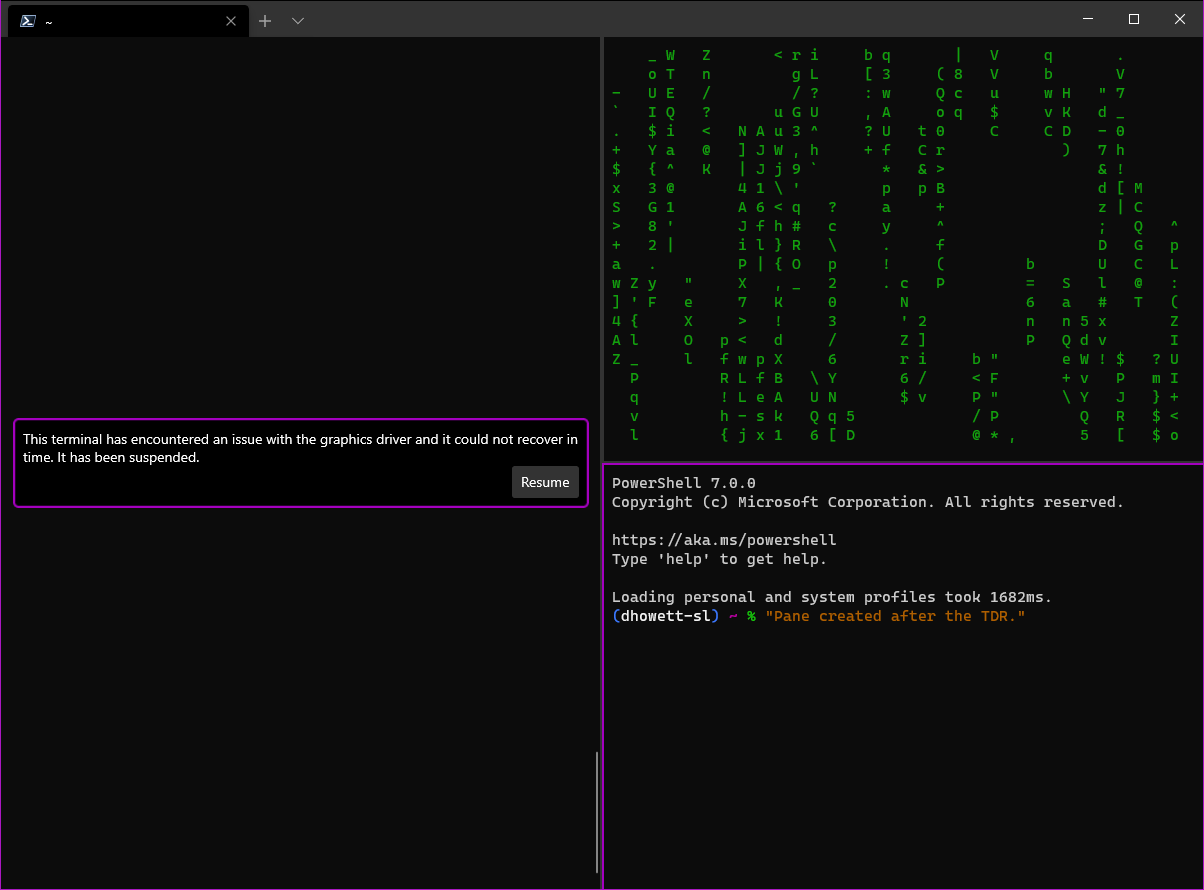
## PR Checklist
* [x] Closes#5340
* [x] cla
* [ ] Tests added/passed
* [ ] Requires documentation to be updated
* [x] I've discussed this with core contributors already.
## Validation Steps Performed
I tested this by dropping the number of retries to 1 and forcing a TDR while doing `wsl cmatrix -u0`. It picked up exactly where it left off.
As a bonus, you can actually still type into the terminal when it's graphically suspended (and `exit` still works.). The block is _entirely graphical_.
We received a request from our localization team to switch from
printf-style format strings (%s, %u) to format strings with positional
argument support. I've been hoping for a long time to take a dependency
on C++20's std::format, but we're just not somewhere we can do that.
Enter fmt. fmt is _exactly_ the library we need.
Minor comparison:
std::wstring_view world = /* ... */;
auto str{ wil::str_printf<std::wstring>(L"hello %.*s",
gsl::narrow_cast<size_t>(world.size()),
world.data()) };
---
auto str{ fmt::format(L"hello {0}", world) };
If you really want to use the print specifiers:
auto str{ fmt::printf(L"hello %s", world) };
It's got optional compile-time checking for format strings and is
MIT-licensed. Eventually, we should be able to replace fmt:: with std::
and end up pretty much where we left off.
What more could you ask for?
The Tango color scheme is part of the Tango Desktop Project, which was
released to the public domain in 2009.
More information is available at http://tango-project.org/.
This commit adds the "Tango Dark" and "Tango Light" color scheme
presets.
Closes#5281
Signed-off-by: Rafael Kitover <rkitover@gmail.com>
## Summary of the Pull Request
Adjusts DirectX renderer to use `til::bitmap` to track invalidation
regions. Uses special modification to invalidate a row-at-a-time to
ensure ligatures and NxM glyphs continue to work.
## References
Likely helps #1064
## PR Checklist
* [x] Closes#778
* [x] I work here.
* [x] Manual testing performed. See Performance traces in #778.
* [x] Automated tests for `til` changes.
* [x] Am core contributor. And discussed with @DHowett-MSFT.
## Detailed Description of the Pull Request / Additional comments
- Applies `til::bitmap` as the new invalidation scheme inside the
DirectX renderer and updates all entrypoints for collecting
invalidation data to coalesce into this structure.
- Semi-permanently routes all invalidations through a helper method
`_InvalidateRectangle` that will expand any invalidation to cover the
entire line. This ensures that ligatures and NxM glyphs will continue
to render appropriately while still allowing us to dramatically reduce
the number of lines drawn overall. In the future, we may come up with
a tighter solution than line-by-line invalidation and can modify this
helper method appropriately at that later date to further scope the
invalid region.
- Ensures that the `experimental.retroTerminalEffects` feature continues
to invalidate the entire display on start of frame as the shader is
applied at the end of the frame composition and will stack on itself
in an amusing fashion when we only redraw part of the display.
- Moves many member variables inside the DirectX renderer into the new
`til::size`, `til::point`, and `til::rectangle` methods to facilitate
easier management and mathematical operations. Consequently adds
`try/catch` blocks around many of the already-existing `noexcept`
methods to deal with mathematical or casting failures now detected by
using the support classes.
- Corrects `TerminalCore` redraw triggers to appropriately communicate
scrolling circumstances to the renderer so it can optimize the draw
regions appropriately.
- Fixes an issue in the base `Renderer` that was causing overlapping
scroll regions due to behavior of `Viewport::TrimToViewport` modifying
the local. This fix is "good enough" for now and should go away when
`Viewport` is fully migrated to `til::rectangle`.
- Adds multiplication and division operators to `til::rectangle` and
supporting tests. These operates will help scale back and forth
between a cell-based rectangle and a pixel-based rectangle. They take
special care to ensure that a pixel rectangle being divided downward
back to cells will expand (with the ceiling division methods) to cover
a full cell when even one pixel inside the cell is touched (as is how
a redraw would have to occur).
- Blocks off trace logging of invalid regions if no one is listening to
optimize performance.
- Restores full usage of `IDXGISwapChain1::Present1` to accurately and
fully communicate dirty and scroll regions to the underlying DirectX
framework. This additional information allows the framework to
optimize drawing between frames by eliminating data transfer of
regions that aren't modified and shuffling frames in place. See
[Remarks](https://docs.microsoft.com/en-us/windows/win32/api/dxgi1_2/nf-dxgi1_2-idxgiswapchain1-present1#remarks)
for more details.
- Updates `til::bitmap` set methods to use more optimized versions of
the setters on the `dynamic_bitset<>` that can bulk fill bits as the
existing algorithm was noticeably slow after applying the
"expand-to-row" helper to the DirectX renderer invalidation.
- All `til` import hierarchy is now handled in the parent `til.h` file
and not in the child files to prevent circular imports from happening.
We don't expect the import of any individual library file, only the
base one. So this should be OK for now.
## Validation Steps Performed
- Ran `cmatrix`, `cmatrix -u0`, and `cacafire` after changes were made.
- Made a bunch of ligatures with `Cascadia Code` in the Terminal
before/after the changes and confirmed they still ligate.
- Ran `dir` in Powershell and fixed the scrolling issues
- Clicked all over the place and dragged to make sure selection works.
- Checked retro terminal effect manually with Powershell.
* Add a spec for the Command Palette
specs #2046.
* Apply suggestions from code review
Co-Authored-By: Carlos Zamora <carlos.zamora@microsoft.com>
* * Add note from Carlos about UIA
* Add a note about nested commands
* fix Michael's comments
* Move to `doc/specs/`
* Apply suggestions from code review
Co-Authored-By: Dustin L. Howett (MSFT) <duhowett@microsoft.com>
* Add updates from Dustin
esp. considering keybindings args, localization
* add notes about expanding profiles, localization
* move this spec to the drafts folder
Co-authored-by: Carlos Zamora <carlos.zamora@microsoft.com>
Co-authored-by: Dustin L. Howett (MSFT) <duhowett@microsoft.com>
## Summary of the Pull Request
Implements `copyFormatting` as a global setting. When enabled, formatting such as font and foreground/background colors are copied to the clipboard on _all_ copy operations.
Also updates the schema and docs.
## References
#5212 - Spec for Formatted Copying
#4191 - Setting to enable/disable formatted copy
#5263 - PR prematurely merged without approval of #5212
This feature will also have an impact on these yet-to-be-implemented features:
- #5262 - copyFormatting Keybinding Arg for Copy
- #1553 - Pointer Bindings
- #4191 - add array support for `copyFormatting`
## Detailed Description of the Pull Request
We already check if the hstring passed into the clipboard is empty before setting it. So the majority of the changes are actually just adding the global setting in.
## Validation Steps Performed
| `copyFormatting` | Mouse Copy | Keyboard Copy |
|--|--|--|
| not set (`false`) | ✔ | ✔ |
| `true` | ✔ | ✔ |
| `false` | ✔ | ✔ |
## Summary of the Pull Request
When a pane is closed by a connection, we want to wait until the connection is actually `Closed` before we fire the actual `Closed` event. If the connection didn't close gracefully, there are scenarios where we want to print a message to the screen.
However, when a pane is closed by the UI, we don't really care to wait for the connection to be completely closed. We can just do it whenever. So I've moved that call to be on a background thread.
## PR Checklist
* [x] Closes#1996
* [x] I work here
* [ ] Tests added/passed
* [n/a] Requires documentation to be updated
## Detailed Description of the Pull Request / Additional comments
Previously we'd wait for the connection to close synchronously when closing tabs or panes. For misbehaving applications like `ssh.exe`, that could result in the `Close` needing to `WaitForSingleObject` _on the UI thread_. If the user closed the tab / pane either with a keybinding or with some other UI element, they don't really care to see the error message anymore. They just want the pane closed. So there's no need to wait for the actual connection to close - the app can just continue on with whatever it was doing.
## Validation Steps Performed
Messed around with closing tabs, panes, tabs with many panes, the entire window. Did this with keybindings, or by clicking on the 'x' on the tab, the 'x' on the window, or using middle-click.
I'm always scared of things like this, so there's a 50% chance this makes things horribly worse.
## Summary of the Pull Request
This updates defaults.json to include the default values for all global and profile settings. Most default keybinding args are added too. This also updates a few outdated items found in the docs.
## PR Checklist
* [X] Closes#5189
## Validation Steps Performed
After making the changes, I made sure all of the settings are deserialized by debugging and stepping through the `LayerJson` code.
- [X] Global Settings
I was mainly looking for two things:
- the key/value pair is found and read
- the value did not change before/after the pair was read
This pull request makes sure we still get a usable (for troubleshooting purposes) version number in the about dialog and settings file when the user is running unpackaged.
This introduces a magic LCID constant (0x0409).B y default, Package ES emits
version resource information that says we're localized to ... language zero.
It also emits a language-coded version block for 0x0409 (en-US).
These two things cannot both be true. Collapse the wave function by hardcoding
0x0409.
This adds support for the VT escape sequence that requests the
terminal's operating status. There is no attempt to actually verify the
status of the app, though. We always return a response indicating a good
operating condition (the same as most terminal emulators).
## PR Checklist
* [x] CLA signed.
* [x] Tests added/passed
## Detailed Description of the Pull Request / Additional comments
This required an update to the `OutputStateMachineEngine` to accept the
`DSR-OS` type, since it only dispatches types that it recognises (I
think that's unnecessary, but that's an issue for another day).
The actual processing of the request is handled in the `AdaptDispatch`
class, where it simply responds with a hard coded sequence (`CSI 0 n`),
indicating a good operating condition.
## Validation Steps Performed
I've added unit tests to confirm that the request is dispatched
correctly, and the appropriate response is returned. I've also manually
confirmed that the test of the _Device Status Report_ in _Vttest_ is now
succeeding.
Closes#5052
## Summary of the Pull Request
Implements `copyFormatting` as a global setting. When enabled, formatting such as font and foreground/background colors are copied to the clipboard on _all_ copy operations.
Also updates the schema and docs.
## References
#5212 - Spec for Formatted Copying
#4191 - Setting to enable/disable formatted copy
This feature will also have an impact on these yet-to-be-implemented features:
- #5262 - copyFormatting Keybinding Arg for Copy
- #1553 - Pointer Bindings
## PR Checklist
* [X] Closes#4191
## Detailed Description of the Pull Request / Additional comments
We already check if the hstring passed into the clipboard is empty before setting it. So the majority of the changes are actually just adding the global setting in.
## Validation Steps Performed
| `copyFormatting` | Mouse Copy | Keyboard Copy |
|--|--|--|
| not set (`false`) | ✔ | ✔ |
| `true` | ✔ | ✔ |
| `false` | ✔ | ✔ |
Now that the Terminal is doing a better job of actually marking which
lines were and were not wrapped, we're not always copying lines as
"wrapped" when they should be. We're more correctly marking lines as not
wrapped, when previously we'd leave them marked wrapped.
The real problem is here in the `ScrollFrame` method - we'd manually
newline the cursor to make the terminal's viewport shift down to a new
line. If we had to scroll the viewport for a _wrapped_ line, this would
cause the Terminal to mark that line as broken, because conpty would
emit an extra `\n` that didn't actually exist.
This more correctly implements `ScrollFrame`. Now, well move where we
"thought" the cursor was, so when we get to the next `PaintBufferLine`,
if the cursor needs to newline for the next line, it'll newline, but if
we're in the middle of a wrapped line, we'll just keep printing the
wrapped line.
A couple follow up bugs were found to be caused by the same bad logic.
See #5039 and #5161 for more details on the investigations there.
## References
* #4741 RwR, which probably made this worse
* #5122, which I branched off of
* #1245, #357 - a pair of other conpty wrapped lines bugs
* #5228 - A followup issue for this PR
## PR Checklist
* [x] Closes#5113
* [x] Closes#5180 (by fixing DECRST 25)
* [x] Closes#5039
* [x] Closes#5161 (by ensuring we only `removeSpaces` on the actual
bottom line)
* [x] I work here
* [x] Tests added/passed
* [n/a] Requires documentation to be updated
## Validation Steps Performed
* Checked the cases from #1245, #357 to validate that they still work
* Added more and more tests for these scenarios, and then I added MORE
tests
* The entire team played with this in selfhost builds
When the connection printed text immediately, synchronously, as part of
Start() it would cause terminal to deadlock. We should start the
connection outside of lock.
The ConptyConnection would do this when it failed to launch something
(trivial repro: `wt -- xyz`).
The TelnetConnection would do this all the time, because local loopback
telnet is fast and easy.
This commit introduces another template replacement for the user's
default settings, COMMAND_PROMPT_LOCALIZED_NAME, which will be replaced
with the contents of the CommandPromptDisplayName resource.
By default, that will be "Command Prompt." This name change will apply
only for new users, and only on first launch. Changes in the system
locale after first launch will not impact the name of the profile.
If the user _removes_ the name from their command prompt profile, its
name will revert irrecoverably to "Command Prompt". They will not be
given a chance to regenerate a localized name.
Fixes#4476.
## Summary of the Pull Request
Renames the `requestedTheme` global setting to `theme`. Propagates updates to...
- schema
- doc
- defaults.json
- universal-defaults.json
## PR Checklist
* [X] Closes#5264
## Validation Steps Performed
| `theme` | Success? |
|--|--|
| `system` | ✔ |
| `light` | ✔ |
| `dark` | ✔ |
But we really know that `dark` is the one we care about here 😉
My basic idea was that `WM_CHAR` is just the better `WM_KEYDOWN`.
The latter fails to properly support common dead key sequences like in
#3516.
As such I added some logic to `Terminal::SendKeyEvent` to make it return
false if the pressed key represents a printable character.
This causes us to receive a character event with a (hopefully) correctly
composed code unit, which then gets sent to `Terminal::SendCharEvent`.
`Terminal::SendCharEvent` in turn had to be modified to support
potentially pressed modifier keys, since `Terminal::SendKeyEvent` isn't
doing that for us anymore.
Lastly `TerminalInput` had to be modified heavily to support character
events with modifier key states. In order to do so I merged its
`HandleKey` and `HandleChar` methods into a single one, that now handles
both cases.
Since key events will now contain character data and character events
key codes the decision logic in `TerminalInput::HandleKey` had to be
rewritten.
## PR Checklist
* [x] CLA signed
* [x] Tests added/passed
* [x] I've discussed this with core contributors already.
## Validation Steps Performed
* See #3516.
* I don't have any keyboard that generates surrogate characters. Due to
this I modified `TermControl::_SendPastedTextToConnection` to send the
data to `_terminal->SendCharEvent()` instead. I then pasted the test
string ""𐐌𐐜𐐬" and ensured that the new `TerminalInput::_SendChar`
method still correctly assembles surrogate pairs.
Closes#3516Closes#3554 (obsoleted by this PR)
Potentially impacts #391, which sounds like a duplicate of #3516
This pull request introduces unexpanded variables (`%DEFAULT_PROFILE%`,
`%VERSION%` and `%PRODUCT%`) to the user settings template and code to
expand them.
While doing this, I ran into a couple things that needed to widen from
accepting strings to accepting string views. I also had to move
application name and version detection up to AppLogic and expose the
AppLogic singleton.
The dynamic profile generation logic had to be moved to before we inject
the templated variables, as the new default profile depends on the
generated dynamic profiles.
References #5189, #5217 (because it has a dependency on `VERSION` and
`PRODUCT`).
## PR Checklist
* [x] Closes#2721
* [x] CLA signed
* [x] Tests added/passed
* [ ] Requires documentation to be updated
* [x] I've discussed this with core contributors already
## Validation Steps Performed
Deleted my settings and watched them regenerate.
The terminal lock is really only for the terminal; since the renderer is
fully owned by the control, not the Terminal, and we'll only be
receiving swap chain events after we register them during
initialization, we don't need to lock before _or_ after firing off the
coroutine.
Fixes#5203.
## Summary of the Pull Request
If we receive a _Reset to Initial State_ (`RIS`) sequence while in the alternate screen buffer, we should be switching back to the main buffer. This PR fixes that behavior.
## PR Checklist
* [x] Closes#3685
* [x] CLA signed. If not, go over [here](https://cla.opensource.microsoft.com/microsoft/Terminal) and sign the CLA
* [x] Tests added/passed
* [ ] Requires documentation to be updated
* [ ] I've discussed this with core contributors already. If not checked, I'm ready to accept this work might be rejected in favor of a different grand plan. Issue number where discussion took place: #xxx
## Detailed Description of the Pull Request / Additional comments
I've added a condition at the start of the `AdaptDispatch::HardReset` method to check whether we're using the alt buffer, and if so, call the `ConGetSet::PrivateUseMainScreenBuffer` API to switch back to the main buffer.
Calling `AdaptDispatch::UseMainScreenBuffer` would probably be neater for this, but it would also attempt to restore the cursor state, which seems pointless when we're in the process of resetting everything anyway.
## Validation Steps Performed
I've added a screen buffer test to confirm that the `RIS` sequence does actually switch back to the main buffer. I've also manually confirmed that the test case in issue #3685 does now behave as expected.
A side effect of the `SetConsoleCursorInfo` API is that it resets the
cursor type to _Legacy_. This makes it impossible to change the cursor
visibility via the console APIs without also resetting the user's
preferred cursor type. This PR attempts to fix that limitation, by only
resetting the cursor type if the size has also been changed.
## PR Checklist
* [x] Closes#4124
* [x] CLA signed
* [ ] Tests added/passed
* [ ] Requires documentation to be updated
## Detailed Description of the Pull Request / Additional comments
I suspect the reason for the original behaviour was because the
`SetConsoleCursorInfo` API sets both the visibility and the size, and if
you're setting the size, it's assumed you'd want the _Legacy_ cursor
type, because that's the only style for which the size is applicable.
So my solution was to only reset the cursor type if the requested cursor
size was actually different from the current size. That should be
reasonably backwards compatible with most size-changing code, but also
allow for changing the visibility without resetting the cursor type.
## Validation Steps Performed
I've tested the example code from issue #4124, and confirmed that it now
works correctly without resetting the cursor type.
I've also tested the console's _mark mode_, which temporarily changes
the cursor size while selecting. I've confirmed that the size still
changes, and that the original cursor type is restored afterwards.
## Summary of the Pull Request
Edits the definition file to distinguish further between the rolling build (the one that happens in master as it's updated) and the PR builds (that happen on every push to a pull request to master.) We will build less in PR since it rolls so often by removing the lines that reveal very few to no bugs at PR time. We'll leave them on in rolling so stuff can still be caught.
## PR Checklist
* [x] Closes a desire to not waste builds.
* [x] I work here.
* [ ] We'll see if the build still works.
* [x] No specific docs.
* [x] I talked about this with @DHowett-MSFT already.
## Validation Steps Performed
* [x] This PR itself should validate that the definition still works in PRs. I think we have to wait for it to go to master to see if the trigger still works there.
This is a subset of #3578 which I think is harmless and the first step towards making things right.
References #3546#3578
## Detailed Description of the Pull Request / Additional comments
For more robust Unicode support, `CodepointWidthDetector` should provide concrete width information rather than a simple boolean of `IsWide`. Currently only `IsWide` is widely used and optimized using quick lookup table and fallback cache. This PR moves those optimization into `GetWidth`.
## Validation Steps Performed
API remains unchanged. Things are not broken.
## Summary of the Pull Request
Minor cleanup on the schema. Globals isn't accepted anymore,
so the schema should not help you autocomplete anymore.
## Validation Steps Performed
Imported the new schema. You do _not_ get a warning when globals
is in. But, the schema won't suggest things when inside globals.
It's just treated as an unknown item.
However, "defaultProfile" is still required (more of a sanity test)
## Summary of the Pull Request
In preparation for getting more accessibility-related issues, I added an ID to the `ScreenInfoUiaProvider` (SIUP) and abstracted the one from `UiaTextRange`. Using this, I noticed that we are creating SIUPs when a new tab/pane is created. This is _good_. This means that we need to somehow notify a UIA Client that out structure has changed, and we need to use the new SIUP because the old one has been removed.
I'll be investigating that more after this PR lands.
Because we cannot set RequestedTheme at the application level, we
occasionally run into issues where parts of our UI end up themed
incorrectly. Dialogs, for example, live under a different Xaml root
element than the rest of our application. This makes our popup menus and
buttons "disappear" when the user wants Terminal to be in a different
theme than the rest of the system. This hack---and it _is_ a
hack--walks up a dialog's ancestry and forces the theme on each element
up to the root. We're relying a bit on Xaml's implementation details
here, but it does have the desired effect.
It's not enough to set the theme on the dialog alone.
Fixes#3654.
Fixes#5195.
## Summary of the Pull Request
Added `splitMode` to settings schema JSON and md files.
The definition might need some tweaking.
## References
## PR Checklist
* [x] Closes#4939
## Summary of the Pull Request
`TrimWhitespace` is misleading. So it is now renamed as 'singleLine'. If true, it comes out as a single line! That makes more sense!
## PR Checklist
* [X] Closes#3824
## Validation Steps Performed
Attempted the keybinding with both settings (and none set).
Attempted mouse copy with and without shift.
## Summary of the Pull Request
Add `null`, `unbound` to schema for keybindings
## PR Checklist
* [x] Closes#4751
* [x] I work here
* [n/a] Tests added/passed
* [x] Requires documentation to be updated
## Summary of the Pull Request
When conpty is in VT input mode, we pass through all the input we receive. This includes all the other `Action*Dispatch` methods, but missed this one.
## References
* Missed during #4856
* Discovered during the course of the #4192 review
* #5205 Also investigated part of the issue, but found a different bug.
## PR Checklist
* [x] Doesn't close anything, just related to above things.
* [x] I work here
* [ ] Tests added/passed
* [n/a] Requires documentation to be updated
## Detailed Description of the Pull Request / Additional comments
This will fix the <kbd>ctrl+alt+space</kbd> in the Terminal thing mentioned in #4192, but doesn't actually resolve the root cause of that bug (which is tracked in #5205).
## Summary of the Pull Request
When we're restoring from minimized, that `MonitorFromWindow` call is returning null. Curious that we're getting null here, when [MSDN states](https://docs.microsoft.com/en-us/windows/win32/api/winuser/nf-winuser-monitorfromwindow):
> If the window is currently minimized, MonitorFromWindow uses the rectangle of the window before it was minimized.
Turns out, `MONITOR_DEFAULTTONEAREST` just fixes this.
## References
* #4857 - original PR that added this code block
## PR Checklist
* [x] Closes#5209
* [x] I work here
* [ ] Tests added/passed
* [n/a] Requires documentation to be updated
## Validation Steps Performed
Verified manually
_Technically_, "wether" is a word but I'd be shocked if there's a scenario for
us to use it properly in this repo, so I'm pulling it from the dictionary.
Also, in #5200, we added "VTE", which is totally a valid acronym, to the codebase,
but not the whitelist. I'm not sure why the bot let me merge it anyways, but I'm
fixing it now.
This pull request migrates `profiles.json` to `settings.json` and removes the legacy roaming AppData settings migrator.
It also:
* separates the key bindings in defaults.json into logical groups
* syncs the universal terminal defaults with the primary defaults
* removes some stray newlines that ended up at the beginning of settings.json and defaults.json
Fixes#5186.
Fixes#3291.
### categorize key bindings
### sync universal with main
### kill stray newlines in template files
### move profiles.json to settings.json
This commit also changes Get*Settings from returning a string to
returning a std::filesystem::path. We gain in expressiveness without a
loss in clarity (since path still supports .c_str()).
NOTE: I tried to do an atomic rename with the handle open, but it didn't
work for reparse points (it moves the destination of a symbolic link
out into the settings folder directly.)
(snip for atomic rename code)
```c++
auto path{ pathToSettingsFile.wstring() };
auto renameBufferSize{ sizeof(FILE_RENAME_INFO) + (path.size() * sizeof(wchar_t)) };
auto renameBuffer{ std::make_unique<std::byte[]>(renameBufferSize) };
auto renameInfo{ reinterpret_cast<FILE_RENAME_INFO*>(renameBuffer.get()) };
renameInfo->Flags = FILE_RENAME_FLAG_REPLACE_IF_EXISTS | FILE_RENAME_FLAG_POSIX_SEMANTICS;
renameInfo->RootDirectory = nullptr;
renameInfo->FileNameLength = gsl::narrow_cast<DWORD>(path.size());
std::copy(path.cbegin(), path.cend(), std::begin(renameInfo->FileName));
THROW_IF_WIN32_BOOL_FALSE(SetFileInformationByHandle(hLegacyFile.get(),
FileRenameInfo,
renameBuffer.get(),
gsl::narrow_cast<DWORD>(renameBufferSize)));
```
(end snip)
### Stop resurrecting dead roaming profiles
## Summary of the Pull Request
As we've learned in #979, not all touchpads are created equal. Some of them have bad drivers that makes scrolling inactive windows not work. For whatever reason, these devices think the Terminal is all one giant inactive window, so we don't get the mouse wheel events through the XAML stack. We do however get the event as a `WM_MOUSEWHEEL` on those devices (a message we don't get on devices with normally functioning trackpads).
This PR attempts to take that `WM_MOUSEWHEEL` and manually dispatch it to the `TermControl`, so we can at least scroll the terminal content.
Unfortunately, this solution is not very general purpose. This only works to scroll controls that manually implement our own `IMouseWheelListener` interface. As we add more controls, we'll need to continue manually implementing this interface, until the underlying XAML Islands bug is fixed. **I don't love this**. I'd rather have a better solution, but it seems that we can't synthesize a more general-purpose `PointerWheeled` event that could get routed through the XAML tree as normal.
## References
* #2606 and microsoft/microsoft-ui-xaml#2101 - these bugs are also tracking a similar "inactive windows" / "scaled mouse events" issue in XAML
## PR Checklist
* [x] Closes#979
* [x] I work here
* [ ] Tests added/passed
* [n/a] Requires documentation to be updated
## Detailed Description of the Pull Request / Additional comments
I've also added a `til::point` conversion _to_ `winrt::Windows::Foundation::Point`, and some scaling operators for `point`
## Validation Steps Performed
* It works on my HP Spectre 2017 with a synaptics trackpad
- I also made sure to test that `tmux` works in panes on this laptop
* It works on my slaptop, and DOESN'T follow this hack codepath on this machine.
## Summary of the Pull Request
Reduce the number of times we dispatch a cursor changed event. We were firing it every time the renderer had to do anything related to the cursor. Unfortunately, blinking the cursor triggered this behavior. Now we just check if the position has changed.
## PR Checklist
* [X] Closes#5143
## Validation Steps Performed
Verified using Narrator
Also verified #3791 still works right
## Summary of the Pull Request
This PR clamps the parameter values in the VT `StateMachine` parser to 32767, which was the initial limit prior to PR #3956. This fixes a number of overflow bugs (some of which could cause the app to crash), since much of the code is not prepared to handle values outside the range of a `short`.
## References
#3956 - the PR where the cap was changed to the range of `size_t`
#4254 - one example of a crash caused by the higher range
## PR Checklist
* [x] Closes#5160
* [x] CLA signed. If not, go over [here](https://cla.opensource.microsoft.com/microsoft/Terminal) and sign the CLA
* [x] Tests added/passed
* [ ] Requires documentation to be updated
* [ ] I've discussed this with core contributors already. If not checked, I'm ready to accept this work might be rejected in favor of a different grand plan. Issue number where discussion took place: #xxx
## Detailed Description of the Pull Request / Additional comments
The DEC STD 070 reference recommends supporting up to at least 16384 for parameter values, so 32767 should be more than enough for any standard VT sequence. It might be nice to increase the limit to 65535 at some point, since that is the cap used by both XTerm and VTE. However, that is not essential, since there are very few situations where you'd even notice the difference. For now, 32767 is the safest choice for us, since anything greater than that has the potential to overflow and crash the app in a number of places.
## Validation Steps Performed
I had to make a couple of modifications to the range checks in the `OutputEngineTest`, more or less reverting to the pre-#3956 behavior, but after that all of the unit tests passed as expected.
I manually confirmed that this fixes the hanging test case from #5160, as well as overflow issues in the cursor operations, and crashes in `IL` and `DL` (see https://github.com/microsoft/terminal/issues/4254#issuecomment-575292926).
## Summary of the Pull Request
This is essentially a rewrite of the VT tab stop functionality, implemented entirely within the `AdaptDispatch` class. This significantly simplifies the `ConGetSet` interface, and should hopefully make it easier to share the functionality with the Windows Terminal VT implementation in the future.
By removing the dependence on the `SCREEN_INFORMATION` class, it fixes the problem of the the tab state not being preserved when switching between the main and alternate buffers. And the new architecture also fixes problems with the tabs not being correctly initialized when the screen is resized.
## References
This fixes one aspect of issue #3545.
It also supersedes the fix for #411 (PR #2816).
I'm hoping the simplification of `ConGetSet` will help with #3849.
## PR Checklist
* [x] Closes#4669
* [x] CLA signed. If not, go over [here](https://cla.opensource.microsoft.com/microsoft/Terminal) and sign the CLA
* [x] Tests added/passed
* [ ] Requires documentation to be updated
* [ ] I've discussed this with core contributors already. If not checked, I'm ready to accept this work might be rejected in favor of a different grand plan. Issue number where discussion took place: #xxx
## Detailed Description of the Pull Request / Additional comments
In the new tab architecture, there is now a `vector<bool>` (__tabStopColumns_), which tracks whether any particular column is a tab stop or not. There is also a __initDefaultTabStops_ flag indicating whether the default tab stop positions need to be initialised when the screen is resized.
The way this works, the vector is initially empty, and only initialized (to the current width of the screen) when it needs to be used. When the vector grows in size, the __initDefaultTabStops_ flag determines whether the new columns are set to false, or if every 8th column is set to true.
By default we want the latter behaviour - newly revealed columns should have default tab stops assigned to them - so __initDefaultTabStops_ is set to true. However, after a `TBC 3` operation (i.e. we've cleared all tab stops), there should be no tab stops in any newly revealed columns, so __initDefaultTabStops_ is set to false.
Note that the __tabStopColumns_ vector is never made smaller when the window is shrunk, and that way it can preserve the state of tab stops that are off screen, but which may come into range if the window is made bigger again.
However, we can can still reset the vector completely after an `RIS` or `TBC 3` operation, since the state can then be reconstructed automatically based on just the __initDefaultTabStops_ flag.
## Validation Steps Performed
The original screen buffer tests had to be rewritten to set and query the tab stop state using escape sequences rather than interacting with the `SCREEN_INFORMATION` class directly, but otherwise the structure of most tests remained largely the same.
However, the alt buffer test was significantly rewritten, since the original behaviour was incorrect, and the initialization test was dropped completely, since it was no longer applicable. The adapter tests were also dropped, since they were testing the `ConGetSet` interface which has now been removed.
I also had to make an addition to the method setup of the screen buffer tests (making sure the viewport was appropriately initialized), since there were some tests (unrelated to tab stops) that were previously dependent on the state being set in the tab initialization test which has now been removed.
I've manually tested the issue described in #4669 and confirmed that the tabs now produce the correct spacing after a resize.
## Summary of the Pull Request
You no longer _need_ to specify the `split` argument to `splitPane`, it will default to `Automatic` instead of `None`
## PR Checklist
* [x] Closes a discussion we had in team sync
* [x] I work here
* [x] Tests updated
* [n/a] Requires documentation to be updated
## Detailed Description of the Pull Request / Additional comments
Also disables the tests that are broken in #5169 while I investigate
This commit removes support for:
* legacy keybindings of all types
* `colorScheme.colors`, as an array
* A `globals` object in the root of the settings file
* `profile.colorTable` and `profile.colorscheme` (the rare v0.1 all-lowercase variety)
Fixes#4091.
Fixes#1069.
<!-- Enter a brief description/summary of your PR here. What does it fix/what does it change/how was it tested (even manually, if necessary)? -->
## Summary of the Pull Request
This PR will allow TSFInputControl to redraw its Canvas and TextBlock in response to when the Terminal cursor position updates. This will fix the issue where during Korean composition, the first symbol of the next composition will appear on top of the previous composed character. Since the Terminal Cursor updates a lot, I've added some checks to see if the TSFInputControl really needs to redraw. This will also decrease the number of actual redraws since we receive a bunch of `LayoutRequested` events when there's no difference between them.
<!-- Please review the items on the PR checklist before submitting-->
## PR Checklist
* [x] Closes#4963
* [x] CLA signed. If not, go over [here](https://cla.opensource.microsoft.com/microsoft/Terminal) and sign the CLA
* [x] Tests added/passed
<!-- Describe how you validated the behavior. Add automated tests wherever possible, but list manual validation steps taken as well -->
## Validation Steps Performed
Startup, teardown, CJK IME gibberish testing, making sure the IME block shows up in the right place.
This PR updates our internal tool `conechokey` to use `ReadConsoleInputW` by default. It also adds a flag `-a` to force it to use `ReadConsoleInputA`.
I discovered this while digging around for #1503, but figured I'd get this checked in now while I'm still investigating.
Since this is just a helper tool, I spent as little effort writing this change - yea the whole tool could benefit from cleaner code but _ain't nobody got time for that_.
<!-- Enter a brief description/summary of your PR here. What does it fix/what does it change/how was it tested (even manually, if necessary)? -->
## Summary of the Pull Request
Every single time a PR is run, there are a bunch of warnings about whitespace in the .cs files, so I ran the code format on those files, without changing their contents, so it won't be flagged anymore.
<!-- Other than the issue solved, is this relevant to any other issues/existing PRs? -->
## References
<!-- Please review the items on the PR checklist before submitting-->
## PR Checklist
* [X] CLA signed. If not, go over [here](https://cla.opensource.microsoft.com/microsoft/Terminal) and sign the CLA
* [X] Tests added/passed
<!-- Provide a more detailed description of the PR, other things fixed or any additional comments/features here -->
## Detailed Description of the Pull Request / Additional comments
<!-- Describe how you validated the behavior. Add automated tests wherever possible, but list manual validation steps taken as well -->
## Validation Steps Performed
Ran the code-format utility on the .cs files
This pull request introduces the `til::math` namespace, which provides some casting functions to be used in support of `til::point` and `til::size`. When point/size want to ingest a floating-point structure, they _must_ be instructed on how to convert those floating-point values into integers.
This enables:
```
Windows::Foundation::Point wfPoint = /* ... */;
til::point tp{ til::math::rounding, wfPoint };
```
Future thoughts: should the TilMath types be stackable? Right now, you cannot get "checked + rounding" behavior (where it throws if it doesn't fit) so everything is saturating.
## PR Checklist
* [x] Closes a request by Michael
* [x] I've discussed this with core contributors already
Correct scrolling invalidation region for tmux in pty w/ bitmap
Add tracing for circling and scrolling operations. Fix improper
invalidation within AdjustCursorPosition routine in the subsection about
scrolling down at the bottom with a set of margins enabled.
## References
- Introduced with #5024
## Detailed Description of the Pull Request / Additional comments
- This occurs when there is a scroll region restriction applied and a
newline operation is performed to attempt to spin the contents of just
the scroll region. This is a frequent behavior of tmux.
- Right now, the Terminal doesn't support any sort of "scroll content"
operation, so what happens here generally speaking is that the PTY in
the ConHost will repaint everything when this happens.
- The PTY when doing `AdjustCursorPosition` with a scroll region
restriction would do the following things:
1. Slide literally everything in the direction it needed to go to take
advantage of rotating the circular buffer. (This would force a
repaint in PTY as the PTY always forces repaint when the buffer
circles.)
2. Copy the lines that weren't supposed to move back to where they were
supposed to go.
3. Backfill the "revealed" region that encompasses what was supposed to
be the newline.
- The invalidations for the three operations above were:
1. Invalidate the number of rows of the delta at the top of the buffer
(this part was wrong)
2. Invalidate the lines that got copied back into position (probably
unnecessary, but OK)
3. Invalidate the revealed/filled-with-spaces line (this is good).
- When we were using a simple single rectangle for invalidation, the
union of the top row of the buffer from 1 and the bottom row of the
buffer from 2 (and 3 was irrelevant as it was already unioned it)
resulted in repainting the entire buffer and all was good.
- When we switched to a bitmap, it dutifully only repainted the top line
and the bottom two lines as the middle ones weren't a consequence of
intersect.
- The logic was wrong. We shouldn't be invalidating rows-from-the-top
for the amount of the delta. The 1 part should be invalidating
everything BUT the lines that were invalidated in parts 2 and 3.
(Arguably part 2 shouldn't be happening at all, but I'm not optimizing
for that right now.)
- So this solves it by restoring an entire screen repaint for this sort
of slide data operation by giving the correct number of invalidated
lines to the bitmap.
## Validation Steps Performed
- Manual validation with the steps described in #5104
- Automatic test `ConptyRoundtripTests::ScrollWithMargins`.
Closes#5104
## Summary of the Pull Request
This pull request replaces about a hundred lines of manual xaml DOM code with a few lines of actual xaml, and wires up bound properties and event handlers in the good and correct way.
As part of this change, I've replaced the giant TextBlock in the about dialog with StackPanels, and replaced the Hyperlinks with HyperlinkButtons. This is in line with other platform applications.
URLs are _not_ localizable resources, so I moved them into the about dialog's xaml. Per #5138, we'll likely change them so that they get localization for "free" (dispatching based on the browser's language, without having to localize the URL in the application).
* Add a note about Binding multiple keys
From discussion in #4992
* Update doc/user-docs/UsingJsonSettings.md
Co-Authored-By: Josh Soref <jsoref@users.noreply.github.com>
* update the comment here to be a little clearer
Co-authored-by: Josh Soref <jsoref@users.noreply.github.com>
This commit rewrites a large swath of TermControl's initialization code.
* `TermControl` now _always_ has a `_terminal`; it will never be null
* Event registration for `_terminal` and any other available-at-init
fixtures has been moved into the constructor.
* Event handlers how more uniformly check `_closing` if they interact
with the _terminal.
* Swap chain attachment has been cleaned up and no longer uses a
coroutine when it's spawned from the UI thread.
* We have to register the renderer's swapchain change notification
handler after we set the swap chain, otherwise it'll call us back
when it initializes itself.
* `InitializeTerminal` now happens under the `_terminal`'s write lock
* Certain things that InitializeTerminal were calling themselves
attempted to take the lock. They no longer do so.
* TermControlAutomationPeer cannot take the read lock, because setting
the scrollbar's `Maximum` during `InitializeTerminal` will trigger
vivification of the automation peer tree; if it attempts to take the
lock it will deadlock during initialization.
* `BlinkCursor` was renamed to `CursorTimerTick` because it's the "Tick"
handler for the "CursorTimer".
* `DragDropHandler` was converted into a coroutine instead of just
_calling_ a coroutine.
Caveats:
Terminal may not have a `_buffer` until InitializeTerminal happens.
There's a nasty coupling between RenderTarget and TextBuffer that means
that we need to have a renderer before we have a buffer.
There's a second nasty coupling between RenderThread and Renderer: we
can't create a RenderThread during construction because it needs to be
given a renderer, and we can't create a Renderer during construction
because it needs a RenderThread. We don't want to kick off a thread
during construction.
Testing:
I wailed on this by opening and closing and resizing terminals and panes
and tabs, up to a hundred open tabs and one tab with 51 panes. I set one
tab to update the title as fast as it possibly could and tested
teardown, zoom, resize, mouse movement, etc. while this was all
happening.
Closes#4613.
This commit adds a debugging feature that can be activated by holding
down Left Alt _and_ Right Alt when a new tab is being created, if you
have the global setting "debugFeatures" set to true. That global setting
will default to true in DEBUG builds.
That debugging feature takes the form of a split pane that shows the raw
VT sequences being written to and received from the connection.
When those buttons are held down, every connection that's created as
part of a new tab is wrapped and split into _two_ connections: one to
capture input (and stand in for the main connection) and one to capture
output (and be displayed off to the side)
Closes#3206
Retrieved from https://microsoft.visualstudio.com os OS official/rs_onecore_dep_uxp cba60cafaadfcc7890a45dea3e1a24412c3d0ec6
Related work items: MSFT:25631386
This PR has evolved to encapsulate two related fixes that I can't really
untie anymore.
#2455 - Duplicating a tab that doesn't exist anymore
This was the bug I was originally fixing in #4429.
When the user tries to `duplicateTab` with a profile that doesn't exist
anymore (like might happen after a settings reload), don't crash.
As I was going about adding tests for this, got blocked by the fact that
the Terminal couldn't open _any_ panes while the `TerminalPage` was size
0x0. This had two theoretical solutions:
* Fake the `TerminalPage` into thinking it had a real size in the test -
probably possible, though I'm unsure how it would work in practice.
* Change `Pane`s to not require an `ActualWidth`, `ActualHeight` on
initialization.
Fortuately, the second option was something else that was already on my
backlog of bugs.
#4618 - `wt` command-line can't consistently parse more than one arg
Presently, the Terminal just arbitrarily dispatches a bunch of handlers
to try and handle all the commands provided on the commandline. That's
lead to a bunch of reports that not all the commands will always get
executed, nor will they all get executed in the same order.
This PR also changes the `TerminalPage` to be able to dispatch all the
commands sequentially, all at once in the startup. No longer will there
be a hot second where the commands seem to execute themselves in from of
the user - they'll all happen behind the scenes on startup.
This involved a couple other changes areound the `TerminalPage`
* I had to make sure that panes could be opened at a 0x0 size. Now they
use a star sizing based off the percentage of the parent they're
supposed to consume, so that when the parent _does_ get laid out,
they'll take the appropriate size of that parent.
* I had to do some math ahead of time to try and calculate what a
`SplitState::Automatic` would be evaluated as, despite the fact that
we don't actually know how big the pane will be.
* I had to ensure that `focus-tab` commands appropriately mark a single
tab as focused while we're in startup, without roundtripping to the
Dispatcher thread and back
## References
#4429 - the original PR for #2455#5047 - a follow-up task from discussion in #4429#4953 - a PR for making panes use star sizing, which was immensly
helpful for this PR.
## Detailed Description of the Pull Request / Additional comments
`CascadiaSettings::BuildSettings` can throw if the GUID doesn't exist.
This wraps those calls up with a try/catch.
It also adds a couple tests - a few `SettingsTests` for try/catching
this state. It also adds a XAML-y test in `TabTests` that creates a
`TerminalPage` and then performs som UI-like actions on it. This test
required a minor change to how we generate the new tab dropdown - in the
tests, `Application::Current()` is _not_ a `TerminalApp::App`, so it
doesn't have a `Logic()` to query. So wrap that in a try/catch as well.
While working on these tests, I found that we'd crash pretty agressively
for mysterious reasons if the TestHostApp became focused while the test
was running. This was due to a call in
`TSFInputControl::NotifyFocusEnter` that would callback to
`TSFInputControl::_layoutRequested`, which would crash on setting the
`MaxSize` of the canvas to a negative value. This PR includes a hotfix
for that bug as well.
## Validation Steps Performed
* Manual testing with a _lot_ of commands in a commandline
* run the tests
* Team tested in selfhost
Closes#2455Closes#4618
This repository tends to use `/`s in branch names.
Unfortunately, `branch: "*"` at present only matches a single
level, which means it would match a branch named `foo` but not `bar/foo`.
Given that I don't think this repository is actively using tags,
and given that the general cost for the spell checker isn't particularly
high, it's better to remove the filtering so that all branches get
checked.
Worst case, a branch that is also tagged and has spelling errors
will get two comments complaining about those spelling errors.
This is just some minor whitelisting/additions to dictionaries to catch
up between when the spell checker PR was written and when it was finally
merged.
This is basically taking the spelling output from
499f24a29e and putting it into files.
The choice of files is arbitrary. I'm adding a `math.txt` dictionary
because it's a reasonable example.
The goal here is to get master to a green check mark
## Validation
When I pushed this commit to my fork, the spell check action ran and
gave me a check mark: https://github.com/jsoref/terminal/runs/534783276
## Summary of the Pull Request
Changes default font from Consolas to Cascadia Code.
## PR Checklist
* [x] Closes#4943
* [x] CLA signed. If not, go over [here](https://cla.opensource.microsoft.com/microsoft/Terminal) and sign the CLA
* [ ] Tests added/passed
* [ ] Requires documentation to be updated
* [x] I've discussed this with core contributors already. If not checked, I'm ready to accept this work might be rejected in favor of a different grand plan. Issue number where discussion took place: #xxx
## Validation Steps Performed
I deleted my profiles.json and built from source. All profiles appeared in Cascadia Code.
This commit rewrites selection handling at the TermControl layer.
Previously, we were keeping track of a number of redundant variables
that were easy to get out of sync.
The new selection model is as follows:
* A single left click will always begin a _pending_ selection operation
* A single left click will always clear a selection (#4477)
* A double left click will always begin a word selection
* A triple left click will always begin a line selection
* A selection will only truly start when the cursor moves a quarter of
the smallest dimension of a cell (usually its width) in any direction
_This eliminates the selection of a single cell on one click._
(#4282, #5082)
* We now keep track of whether the selection has been "copied", or
"updated" since it was last copied. If an endpoint moves, it is
updated. For copy-on-select, it is only copied if it's updated.
(#4740)
Because of this, we can stop tracking the position of the focus-raising
click, and whether it was part of click-drag operation. All clicks can
_become_ part of a click-drag operation if the user drags.
We can also eliminate the special handling of single cell selection at
the TerminalCore layer: since TermControl determines when to begin a
selection, TerminalCore no longer needs to know whether copy on select
is enabled _or_ whether the user has started and then backtracked over a
single cell. This is now implicit in TermControl.
Fixes#5082; Fixes#4477
This pull request includes a localization config file that identifies
the modules we need to localize. It also moves us back to the
`Resources\LANGUAGE\Resources.resw` resource layout, but using wildcards
so that the build system can pick up any number of languages.
This commit introduces a github action to check our spelling and fixes
the following misspelled words so that we come up green.
It also renames TfEditSes to TfEditSession, because Ses is not a word.
currently, excerpt, fallthrough, identified, occurred, propagate,
provided, rendered, resetting, separate, succeeded, successfully,
terminal, transferred, adheres, breaks, combining, preceded,
architecture, populated, previous, setter, visible, window, within,
appxmanifest, hyphen, control, offset, powerpoint, suppress, parsing,
prioritized, aforementioned, check in, build, filling, indices, layout,
mapping, trying, scroll, terabyte, vetoes, viewport, whose
This commit replaces `std::vector<bool>` with `dynamic_bitset<>` by
@pinam45 (https://github.com/pinam45/dynamic_bitset) and with
`libpopcnt` for high-performance bit counting by @kimwalisch
(https://github.com/kimwalisch/libpopcnt).
* [x] In support of performance, incremental rendering, and Terminal
"not speed enough" as well as my sanity relative to
`std::vector<bool>`
* [x] Tests updated and passed.
* [x] `LICENSE`, `NOTICE`, and provenance files updated.
* [x] I'm a core contributor. I discussed it with @DHowett-MSFT and
cleared the licensing checks before pulling this in.
## Details `std::vector<bool>` provided by the Microsoft VC Runtime is
incapable of a great many things. Many of the methods you come to expect
off of `std::vector<T>` that are dutifully presented through the `bool`
variant will spontaneously fail at some future date because it decides
you allocated, resized, or manipulated the `vector<bool>` specialization
in an unsupported manner. Half of the methods will straight up not work
for filling/resizing in bulk. And you will tear your hair out as it will
somehow magically forget the assignment of half the bits you gave it
part way through an iteration then assert out and die.
As such, to preserve my sanity, I searched for an alternative. I came
across the self-contained header-only library `dynamic_bitset` by
@pinam45 which appears to do as much of `boost::dynamic_bitset` as I
wanted, but without including 400kg of boost libraries. It also has a
nifty optional dependency on `libpopcnt` by @kimwalisch that will use
processor-specific extensions for rapidly counting bits. @DHowett-MSFT
and I briefly discussed how nice `popcnt` would have been on
`std::vector<bool>` last week... and now we can have it. (To be fair, I
don't believe I'm using it yet... but we'll be able to easily dial in
`til::bitmap` soon and not worry about a performance hit if we do have
to walk bits and count them thanks to `libpopcnt`.)
This PR specifically focuses on swapping the dependencies out and
ingesting the new libraries. We'll further tune `til::bitmap` in future
pulls as necessary.
## Validation
* [x] Ran the automated tests for bitmap.
* [x] Ran the terminal manually and it looks fine still.
## Summary of the Pull Request
This PR fixes an out of bounds access when deleting composition during Chinese IME. What's happening is that we're receiving a CompositionCompleted before receiving the TextUpdate to tell us to delete the last character in the composition. This creates two problems for us:
1. The final character gets sent to the Terminal when it should have been deleted.
2. `_activeTextStart` gets set to `_inputBuffer.length()` when sending the character to the terminal, so when the `TextUpdate` comes right after the `CompositionCompleted` event, `_activeTextStart` is out of sync.
This PR fixes the second issue, by updating `_activeTextStart` during a `TextUpdate` in case we run into this issue.
The first issue is trickier to resolve since we assume that if the text server api tells us a composition is completed, we should send what we have. It'll be tracked here: #5110.
At the very least, this PR will let users continue to type in Chinese IME without it breaking, but it will still be annoying to see the first letter of your composition reappear after deleting it.
## PR Checklist
* [x] Closes#5054
* [x] CLA signed. If not, go over [here](https://cla.opensource.microsoft.com/microsoft/Terminal) and sign the CLA
* [x] Tests added/passed
## Validation Steps Performed
Play around with Chinese IME deleting and composing, and play around with Korean and Japanese IME to see that it still works as expected.
The pattern regex now correctly disallows keybindings consisting of only
modifiers, modifiers not separated by "+", and unknown keys. Certain
shift+numpad combinations are also not allowed.
The description lists allowed key names in tabular format (assuming the
client renders \t correctly).
## Summary of the Pull Request
One of our great contributors already hooked up all the logic for this,
we just needed a theme library that could handle the request.
## PR Checklist
* [x] Fixes#4980
* [x] CLA signed
* [x] Tests added/passed
* [ ] Requires documentation to be updated
## Summary of the Pull Request
ConPty did not set the ENHANCED_KEY flag when generating new input. This change helps detect when it's supposed to do so, and sends it.
## References
[Enhanced Key Documentation](https://docs.microsoft.com/en-us/windows/console/key-event-record-str)
## PR Checklist
* [X] Closes#2397
## Detailed Description of the Pull Request / Additional comments
| KEY_EVENT_RECORD modifiers | VT encodable? | Detectable on the way out? |
|----------------------------|---------------|----------------------------|
| CAPSLOCK_ON | No | No |
| ENHANCED_KEY | No | Yes** |
| LEFT_ALT_PRESSED | Yes* | Yes* |
| LEFT_CTRL_PRESSED | Yes* | Yes* |
| NUMLOCK_ON | No | No |
| RIGHT_ALT_PRESSED | Yes* | Yes* |
| RIGHT_CTRL_PRESSED | Yes* | Yes* |
| SCROLLLOCK_ON | No | No |
| SHIFT_PRESSED | Yes | Yes |
```
* We can detect Alt and Ctrl, but not necessarily which one
** Enhanced Keys are limited to the following:
- off keypad: INS, DEL, HOME, END, PAGE UP, PAGE DOWN, direction keys
- on keypad: / and ENTER
Since we can't detect the keypad keys, those will _not_ send the ENHANCED_KEY modifier.
For the following CSI action codes, we can assume that they are Enhanced Keys:
case CsiActionCodes::ArrowUp:
case CsiActionCodes::ArrowDown:
case CsiActionCodes::ArrowRight:
case CsiActionCodes::ArrowLeft:
case CsiActionCodes::Home:
case CsiActionCodes::End:
case CsiActionCodes::CSI_F1:
case CsiActionCodes::CSI_F3:
case CsiActionCodes::CSI_F2:
case CsiActionCodes::CSI_F4:
These cases are handled in ActionCsiDispatch
```
## Validation Steps Performed
Followed bug repro steps. It now matches!
## Summary of the Pull Request
- Added better wide glyph support for UIA. We used to move one _cell_ at a time, so wide glyphs would be read twice.
- Converted a few things to use til::point since I'm already here.
- fixed telemetry for UIA
## PR Checklist
* [x] Closes#1354
## Detailed Description of the Pull Request / Additional comments
The text buffer has a concept of word boundaries, so it makes sense to have a concept of glyph boundaries too.
_start and _end in UiaTextRange are now til::point
## Validation Steps Performed
Verified using Narrator
This commit upgrades C++/WinRT to 2.0.200316.3 and fixes a couple of the
transitive dependency issues we had in the process.
Because the latest version has better dependency resolution, we're able
to properly depend on Microsoft.UI.Xaml and the Toolkit in TerminalApp
and TerminalAppLib so we no longer need to manually include .dll and
.pri files.
Because of nebulous _other_ changes in dependency resolution,
WindowsTerminalUniversal isn't picking up transitive .winmd dependencies
from TerminalApp, and needs to include them as ProjectReferences
directly. This was already happening transitively, so now it's explicit.
I've also taken the time to upgrade GSL to v2.1.0, the last release
before they removed span::at and blew up our world.
## Summary of the Pull Request
When I did my last PR that was merged, the PR #4960, there were two more cases I forgot to include, so I included them here, for the sake of consistency and completion
## References
PR #4690
## PR Checklist
* [X] CLA signed. If not, go over [here](https://cla.opensource.microsoft.com/microsoft/Terminal) and sign the CLA
* [X] Tests added/passed
## Detailed Description of the Pull Request / Additional comments
Replacing pointer casts to 0 with nullptr in two tests.
## Validation Steps Performed
Manual Testing
Automated Testing
## Summary of the Pull Request
Moves the ConPTY drawing mechanism (`VtRenderer`) to use the fine-grained `til::bitmap` individual-dirty-bit tracking mechanism instead of coarse-grained rectangle unions to improve drawing performance by dramatically reducing the total area redrawn.
## PR Checklist
* [x] Part of #778 and #1064
* [x] I work here
* [x] Tests added and updated.
* [x] I'm a core contributor
## Detailed Description of the Pull Request / Additional comments
- Converted `GetDirtyArea()` interface from `IRenderEngine` to use a vector of `til::rectangle` instead of the `SMALL_RECT` to banhammer inclusive rectangles.
- `VtEngine` now holds and operates on the `til::bitmap` for invalidation regions. All invalidation operation functions that used to be embedded inside `VtEngine` are deleted in favor of using the ones in `til::bitmap`.
- Updated `VtEngine` tracing to use new `til::bitmap` on trace and the new `to_string()` methods detailed below.
- Comparison operators for `til::bitmap` and complementary tests.
- Fixed an issue where the dirty rectangle shortcut in `til::bitmap` was set to 0,0,0,0 by default which means that `|=` on it with each `set()` operation was stretching the rectangle from 0,0. Now it's a `std::optional` so it has no value after just being cleared and will build from whatever the first invalidated rectangle is. Complementary tests added.
- Optional run caching for `til::bitmap` in the `runs()` method since both VT and DX renderers will likely want to generate the set of runs at the beginning of a frame and refer to them over and over through that frame. Saves the iteration and creation and caches inside `til::bitmap` where the chance of invalidation of the underlying data is known best. It is still possible to iterate manually with `begin()` and `end()` from the outside without caching, if desired. Complementary tests added.
- WEX templates added for `til::bitmap` and used in tests.
- `translate()` method for `til::bitmap` which will slide the dirty points in the direction specified by a `til::point` and optionally back-fill the uncovered area as dirty. Complementary tests added.
- Moves all string generation for `til` types `size`, `point`, `rectangle`, and `some` into a `to_string` method on each object such that it can be used in both ETW tracing scenarios AND in the TAEF templates uniformly. Adds a similar method for `bitmap`.
- Add tagging to `_bitmap_const_iterator` such that it appears as a valid **Input Iterator** to STL collections and can be used in a `std::vector` constructor as a range. Adds and cleans up operators on this iterator to match the theoretical requirements for an **Input Iterator**. Complementary tests added.
- Add loose operators to `til` which will allow some basic math operations (+, -, *, /) between `til::size` and `til::point` and vice versa. Complementary tests added. Complementary tests added.
- Adds operators to `til::rectangle` to allow scaling with basic math operations (+, -, *) versus `til::size` and translation with basic math operations (+, -) against `til::point`. Complementary tests added.
- In-place variants of some operations added to assorted `til` objects. Complementary tests added.
- Update VT tests to compare invalidation against the new map structure instead of raw rectangles where possible.
## Validation Steps Performed
- Wrote additional til Unit Tests for all additional operators and functions added to the project to support this operation
- Updated the existing VT renderer tests
- Ran perf check
## Summary of the Pull Request
If the _Alternate Scroll Mode_ is enabled, the terminal generates up/down keystrokes when the mouse wheel is scrolled. However, the expected escape sequences for those keys are dependent on the state of the _Cursor Keys Mode_ ( `DECCKM`), but we haven't taken that into account. This PR updates the alternate scroll implementation to make sure the appropriate sequences are sent for both `DECCKM` modes.
## References
#3321
## PR Checklist
* [ ] Closes #xxx
* [x] CLA signed. If not, go over [here](https://cla.opensource.microsoft.com/microsoft/Terminal) and sign the CLA
* [x] Tests added/passed
* [ ] Requires documentation to be updated
* [ ] I've discussed this with core contributors already. If not checked, I'm ready to accept this work might be rejected in favor of a different grand plan. Issue number where discussion took place: #xxx
## Detailed Description of the Pull Request / Additional comments
I've simply added a condition in the `TerminalInput::_SendAlternateScroll` method to send a different pair of sequences dependent on the state of `_cursorApplicationMode` flag.
## Validation Steps Performed
Manually tested in VIM (although that required me enabling the _Alternate Scroll Mode_ myself first). Also added a new unit test in `MouseInputTest` to confirm the correct sequences were generated for both `DECCKM` modes.
## Summary of the Pull Request
Seriously just read the code on this one, it's so incredibly obvious what I did wrong
## References
Regressed with #4741
## PR Checklist
* [x] Closes#5029
* [x] I work here
* [ ] Tests added/passed
* [n/a] Requires documentation to be updated
## Summary of the Pull Request
Currently, if the Terminal attempts to parse a setting that _should_ be a `bool`
and the user provided a string, then we'll throw an exception while parsing the
settings, and display an error message that's pretty unrelated to the actual
problem.
The same goes for `bool`s as `int`s, `float`s as `int`s, etc.
This PR instead updates our settings parsing to ensure that we check the type of
a json value before actually trying to get its parsed value.
## References
## PR Checklist
* [x] Closes#4299
* [x] I work here
* [x] Tests added/passed
* [n/a] Requires documentation to be updated
## Detailed Description of the Pull Request / Additional comments
I made a bunch of `JsonUtils` helpers for this in the same vein as the
`GetOptionalValue` ones.
Notably, any other value type can safely be treated as a string value.
## Validation Steps Performed
* added tests
* ran the Terminal and verified we can parse settings with the wrong types
These projects load Xaml components that have Uids, but those Uids just
weren't working because Xaml components are, by default, loaded in
"Application" scope. Application scope is great if the resource producer
is the EXE project.
Application scope means that resources are looked up at the resource
root, but DLLs with resources don't produce resources at the root. They
produce resources at a root named after the DLL.
Setting the Xaml component resource location to Nested makes sure the
Xaml resource loader loads resources from the right places.
## Summary of the Pull Request
This PR turns on TextWrapping on `TSFInputControl::TextBlock`. Once the TextBlock hits the end of the Terminal window, it will wrap downwards, but the TextBlock will have as much width as it had when composition started. Unfortunately, this means if composition starts right at the end of the Terminal with enough width for just one character, there will be a vertical line of characters down the right side of the Terminal 😅. It's definitely not ideal, and I imagine this won't be the last time we visit this issue, but for now users can see what they're typing.
## PR Checklist
* [x] Closes#3657
* [x] CLA signed. If not, go over [here](https://cla.opensource.microsoft.com/microsoft/Terminal) and sign the CLA
* [x] Tests added/passed
## Validation Steps Performed
Played around with IME towards the edge of the Terminal window.
The first issue is in the console host: when we erase a command history,
we also clear its _allocated_ flag. It's supposed to remain allocated
but become "reset". When we later check that a command history that
exists in the list is allocated, we fail loudly because allocated has
been cleared.
The second is that in Windows Server 2003, we rewrote the console client
APIs (in kernelbase!) regarding command history and changed one internal
function from taking char** to taking char*. Since the signature was
_actually_ void** and that changed to void*, the compiler didn't notice
when in only one single place we continued to pass a char** instead of a
char*. This caused us to send the wrong filename length for the ExeName
in SetConsoleNumberOfCommands.
Fixes MSFT:25265854
Retrieved from https://microsoft.visualstudio.com os OS official/rs_onecore_dep_uxp b493fb5a06975c53b2fbb7b9fc0546244b551fa9
Found a bug where the following won't work:
```c++
COORD inclusiveEnd{ _end };
```
where `_end` is a `til::point`.
The only fix for this is to replace these instances with this:
```c++
COORD inclusiveEnd = _end;
```
What was happening in the first notation is the implicit conversion of `til::point` to `bool` to `SHORT`. The constructor for COORD only sees one SHORT so it thinks the value should be the definition for X, and Y should stay as 0. So we end up getting `1, 0`.
By adding the explicit keyword to the bool operators, we prevent the accident above from occurring.
## Summary of the Pull Request
Introduces type `til::bitmap` which implements an NxM grid of bits that can be used to track dirty/clean state on a per-cell basis throughout a rectangle.
## PR Checklist
* [x] In support of Differential Rendering #778
* [X] I work here.
* [x] Tests added/passed
* [x] I'm a core contributor.
## Detailed Description of the Pull Request / Additional comments
- Adds `const_iterator` to `til::rectangle` that will walk from top to bottom, left to right every position in the rectangle as a `til::point` and associated test.
- Adds `bool til::rectangle::contains(til::point)` to determine if a point lies within the rectangle and the associated test
- Adds complementary methods to `til::rectangle` of `index_of(til::point)` and `point_at(ptrdiff_t)` which will convert between a valid `point` position that lies inside the `rectangle` and the index as a count of cells from the top left corner (origin) in a top to bottom & left to right counting fashion (and associated tests).
- Adds `til::some<T, N>::clear()` to empty out the contents of the `some` and associated test.
THEN with all that support...
- Adds `til::bitmap` which represents a 2 dimensional grid of boolean/bit flags. This class contains set and reset methods for the entire region, and set only for a single `til::point` or a subregion as specified by a `til::rectangle` (and associated tests.)
- Adds convenience methods of `any()`, `one()`, `none()`, and `all()` to the `til::bitmap` to check some of its state.
- Adds convenience method of `resize()` to `til::bitmap` that will grow or shrink the bitmap, copying whatever is left of the previous one that still fits and optionally filling or blanking the new space.
- Adds a `const_iterator` for `til::bitmap` that will walk top to bottom, left to right and return a `til::rectangle` representing a run of bits that are all on sequentially in a row. Breaks per row. Exactly as we expect to be drawing things (and associated tests.)
## Validation Steps Performed
- See automated tests of functionality.
For some functions, the overriding implementation is set to default, but
the deletion is not explicitly set at all. For those functions, I
changed default to delete
There's an issue in the UAC consent dialog where it cannot read an
application's name if it's stored in a resource. When it fails, it deems
us an "Unknown Program" and that looks pretty silly.
Fixes#2289.
## Summary of the Pull Request
Fixes the <kbd>Ctrl+Num</kbd> keys in both conhost and the Terminal. These keys are supposed to be mapped to specific characters according to [this doc](https://vt100.net/docs/vt220-rm/table3-5.html). Now we actually handle them correctly.
## PR Checklist
* [x] Closes#3507
* [x] I work here
* [x] Tests added/passed
* [n/a] Requires documentation to be updated
## Validation Steps Performed
* Ran test
* tested in `gnome-terminal` with `showkeys -a`
* tested in conhost with `showkeys -a`
* tested in Windows Terminal with `showkeys -a`
## Summary of the Pull Request
Ctrl+/ and Ctrl-? are complicated in VT input.
* C-/ is supposed to be `^_` (the C0 character US)
* C-? is supposed to be `DEL`
* C-M-/ is supposed to be `^[^_` (ESC US)
* C-M-? is supposed to be `^[^?` (ESC DEL)
The astute reader will note that these characters also share the same key on a
standard en-us keyboard layout, which makes the problem even more complicated.
This PR does a better job of handling these weird cases.
# References
* #3079 - At first, I thought this PR would close this issue, but as I've learned below, this won't solve that one. This bug was merely found during that investigation.
## PR Checklist
* [x] Related to #3079
* [x] I work here
* [x] Tests added/passed
* [n/a] Requires documentation to be updated
## Validation Steps Performed
* ran tests
* checked `showkey -a` in gnome-terminal, which gives you the wrong results for C-M-/, C-M-?
* checked `showkey -a` in xterm, which gives you the _right_ results for C-M-/, C-M-?
* checked `showkey -a` in conhost
* checked `showkey -a` in Windows Terminal
## Summary of the Pull Request
This is 100% on me. Even after mucking around in this function for the last 3
months, I missed that there was a single addition where we weren't doing a
clamped addition. This would lead to us creating a buffer with negative height,
and all sorts of badness.
Clamping this addition was enough to fix the bug.
## PR Checklist
* [x] Closes#2815
* [x] Closes#4972
* [x] I work here
* [x] Tests added/passed
* [n/a] Requires documentation to be updated
## Validation Steps Performed
* ran tests
* Created a profile with `"historySize" : 32728`, then filled the viewport with
text, then maximized, and saw that the viewport indeed did resize to the new
size of the window.
## Summary of the Pull Request
Block selections were always read and displayed as line selections in UIA. This fixes that.
## PR Checklist
* [x] Closes#4509
## Detailed Description of the Pull Request / Additional comments
1. Expose `IsBlockSelection()` via IUiaData
2. Update the constructor to be able to take in a block selection parameter
3. Make ScreenInfoUiaProviders pass step 1 output into step 2 constructor
4. Update all instances of `UiaTextRange::GetTextRects()` to include this new flag
## Validation Steps Performed
Manually tested.
Additional tests would be redundant as GetTextRects() is tested in the text buffer.
When we painted spaces up until the character right before the right
edge of the screen, we would erroneously use Erase in Line instead of
Erase Character due to an off-by-one.
Fixes#4727
## Summary of the Pull Request
This notifies automation clients (i.e.: NVDA, narrator, etc...) of new output being rendered to the screen.
## References
Close#2447 - Signaling for new output and cursor
Close#3791 - fixed by signaling cursor changes
## Detailed Description of the Pull Request / Additional comments
- Added tracing for UiaRenderer. This makes it easier to debug issues with notifying an automation client.
- Fire TextChanged automation events when new content is output to the screen.
## Validation Steps Performed
Verified with NVDA [1]
## Narrator
Narrator works _better_, but is unable to detect new output consistently. There is no harm for narrator when this change goes in.
[1] https://github.com/microsoft/terminal/issues/2447#issuecomment-595879890
## Summary of the Pull Request
Alt-Numpad# input would be escaping each numkey before sending it through. This would result in some weird behavior, for example, in powershell, where the first alt-numpad# would start digit argument and once the user releases alt, a character is sent through and digit argument would repeat that character X times. To resolve this, we simply need to ignore KeyDowns where Alt is held and a Numpad# is pressed.
Once Alt is released, we'll receive a character through `TSFInputControl`, not `TermControl::CharacterHandler`. It seems that the `CoreTextEditContext` in `TSFInputControl` intercepts the character before it gets to `TermControl`. TSF will then send the received character through as normal.
<!-- Please review the items on the PR checklist before submitting-->
## PR Checklist
* [x] Closes#1401
* [x] CLA signed. If not, go over [here](https://cla.opensource.microsoft.com/microsoft/Terminal) and sign the CLA
* [x] Tests added/passed
<!-- Describe how you validated the behavior. Add automated tests wherever possible, but list manual validation steps taken as well -->
## Validation Steps Performed
Testing various combinations of Alt-Numpad# consistently sends through only one instance of the expected symbols.
## Summary of the Pull Request
We (the royal "we") broke key unbinding in #4746. We didn't run the local tests after this, which actually would have caught this. The comment even suggests what we should have done here. We need to make sure that when we bail, it's because there's a parsing function that returned nothing. `null`, `"unbound"`, etc actually don't even have a parsing function at all, so they should just keep on keepin' on.
## References
Source of this regression: #4746
## PR Checklist
* [x] Closes#3729
* [x] I work here
* [x] Tests added/passed
* [n/a] Requires documentation to be updated
## Detailed Description of the Pull Request / Additional comments
This is a great example of why your unittests should run in CI always
## Validation Steps Performed
* **ran the tests**
* tested the following unbindings:
```json
{ "command": null, "keys": [ "ctrl+shift+t" ] },
{ "command": "unbound", "keys": [ "ctrl+shift+t" ] },
{ "command": "null", "keys": [ "ctrl+shift+t" ] },
```
and they each individually worked.
Add the option to set the cursor color as part of the color scheme.
This is very useful for light themes, where the cursor disappears unless its color
is set in the profile.
Related to issue #764, but doesn't fully resolve it.
## Validation
I tested this manually by creating a light color scheme, setting the cursor color
to black and setting the profile color scheme to the newly created color scheme.
I validated the cursor is black, then set the cursor color in the profile (to red)
and saw it trumps the cursor color from the color scheme.
In IInputEvent, there are two for loops. One is a range based loop operating on "records", and the other is a classic for-loop doing the same. For consistency, the for-loop was changed into the more modern variation via a compiler refactoring, which has the exact same behavior as the other for-loop in the main function.
Yes, of course this was tested manually and with the unit tests.
# Validation Steps
Unit testing passed. In addition, for the manual validation tests, I compared the output for sample values between the two loops ensuring the same results.
## Summary of the Pull Request
Most of the methods in the `ITermDispatch` interface have a comment following them that indicates the VT function that they implement. These comments are then used by the script in PR #1884 to generate a table of supported VT functions. This PR updates some of those comments, to more accurately reflect the functions that are actually supported.
## References
PR #1884
## PR Checklist
* [ ] Closes #xxx
* [x] CLA signed.
* [x] No new tests.
* [x] No new docs.
* [ ] I've discussed this with core contributors already. If not checked, I'm ready to accept this work might be rejected in favor of a different grand plan. Issue number where discussion took place: #1884
## Detailed Description of the Pull Request / Additional comments
In some cases there are methods that implement multiple VT functions which are essentially aliases. Originally the comments listed only one of the functions, so I've now updated them to list both. This includes `HPA` as an alias of `CHA`, and `HVP` as an alias of `CUP`.
Similarly, some control characters are implemented in terms of another VT function, but only the main function was listed in the comment. Again I've now updated the comments to list both the main function and any related control characters. This includes `BS` (sharing the same method as `CUB`), `HT` (the same method as `CHT`), and `LF`, `FF`, and `VT` (the same method as `IND` and `NEL`).
Then there were some minor corrections. The `DeviceAttributes` method was commented as `DA`, but it really should be `DA1`. `DesignateCharset` was simply commented as _DesignateCharset_, when it should be `SCS`. The `DECSCNM` comment was missing a space, so it wasn't picked up by the script. And the `SetColumns` comment mistakenly included `DECSCPP`, but we don't actually support that.
Finally there is the `DeviceStatusReport` method, which potentially covers a wide range of different reports. But for now we only support the _Cursor Position Report_, so I've commented it as `DSR, DSR-CPR` to more clearly indicate our level of support. In the long term we'll probably need a better way of handling these reports though.
## Validation Steps Performed
I've run the script from PR #1884 and confirmed that the output is now a more accurate reflection of our actual VT support.
Retrieved from https://microsoft.visualstudio.com os OS official/rs_onecore_dep_uxp 5b3acd8b5bac38da02fc86a29c81dfd252e79d1f
Related work items: MSFT:25505535
When WSL.exe would hang for users, WslDistroGenerator would also hang
while waiting for its `wsl.exe --list` call to return. The timeout was
`INFINITE` in the `WaitForSingleObject` call, but we should slap a
timeout on it instead (here we choose 2 seconds). In addition, if it
times out, we should also just return profiles and let the Terminal
continue to start up without the WSL distro profiles loaded.
# Validation Steps Performed
Made a sleep 30 executable as the command instead, made sure it hit the
`WAIT_TIMEOUT` and continued to start up without loading my Ubuntu
profile.
Closes#3987
## Summary of the Pull Request
This PR ensures that Conpty properly treats `^[^Z` and `^[^X` as
<kbd>Ctrl+Alt+z</kbd> and <kbd>Ctrl+Alt+x</kbd>, instead of <kbd>Ctrl+z</kbd>
and <kbd>Ctrl+x</kbd>.
## References
## PR Checklist
* [x] Closes#4201
* [x] I work here
* [x] Tests added/passed
* [n/a] Requires documentation to be updated
## Detailed Description of the Pull Request / Additional comments
`^Z` and `^X` are special control characters, SUB and CAN. For the output state
machine, these characters are supposed to be executed from _any_ state. However,
we shouldn't do this for the input engine. With the current behavior, these
characters are immediately executed regardless of what state we're in. That
means we end up synthesizing <kbd>Ctrl+z/x</kbd> for these characters. However,
for the InputStateMachine engine, when these characters are preceeded by `^[`
(ESC), we want to treat them as <kbd>Ctrl+Alt+z/x</kbd>.
This just adds a check in `StateMachine` to see if we should immediately execute
these characters from any state, similar to many of the other exceptions we
already perform in the StateMachine for the input engine.
## Validation Steps Performed
* ran tests
* checked `showkey -a` in gnome-terminal
* checked `showkey -a` in conhost
* checked `showkey -a` in vt pipeterm (conhost as a conpty terminal)
* checked `showkey -a` in Windows Terminal
<!-- Enter a brief description/summary of your PR here. What does it fix/what does it change/how was it tested (even manually, if necessary)? -->
## Summary of the Pull Request
Always use the system's locale to render text to ensure the correct font variants are used.
`_ResolveFontFaceWithFallback()` overrides the last argument with the locale name of the font, but users normally configure fonts with latin alphabet only and use font linking to display non-latin characters, which causes the the locale names of the latin fonts are used to render the non-latin fonts. https://github.com/microsoft/terminal/issues/4508#issuecomment-598552472
<!-- Please review the items on the PR checklist before submitting-->
## PR Checklist
* [x] Closes#4508
* [x] CLA signed. If not, go over [here](https://cla.opensource.microsoft.com/microsoft/Terminal) and sign the CLA
* [ ] Tests added/passed
* [ ] Requires documentation to be updated
* [ ] I've discussed this with core contributors already. If not checked, I'm ready to accept this work might be rejected in favor of a different grand plan. Issue number where discussion took place: #xxx
## Validation
On a zh-hans system, simplified Chinese hans are used after this patch (above), versus Japanese hans before (below).

## Summary of the Pull Request
This _actually_ implements `\033c`
([RIS](https://vt100.net/docs/vt220-rm/chapter4.html)) for the Windows Terminal.
I thought I had done this in #4433, but that PR actually only passthrough'd
`\x1b[3J`. I didn't realize at the time that #2715 was mostly about hard reset,
not erase scrollback.
Not only should conpty pass through RIS, but the Terminal should also be
prepared to actually handle that sequence. So this PR adds that support as well.
## References
* #4433: original PR I thought fixed this.
## PR Checklist
* [x] Closes#2715 for real this time
* [x] I work here
* [x] Tests added/passed
* [n/a] Requires documentation to be updated
## Validation Steps Performed
Actually tested `printf \033c` in the Terminal this time
## Summary of the Pull Request
Currently, when the user resizes the Terminal, we'll snap the visible viewport back to the bottom of the buffer. This PR changes the visible viewport of the Terminal to instead remain in the same relative location it was before the resize.
## References
Made possible by our sponsors at #4741, and listeners like you.
## PR Checklist
* [x] Closes#3494
* [x] I work here
* [ ] Tests added/passed
* [n/a] Requires documentation to be updated
## Detailed Description of the Pull Request / Additional comments
We already hated the `std::optional<short>&` thing I yeet'd into #4741 right at the end to replace a `short*`. So I was already going to change that to a `std::optional<std::reference_wrapper<short>>`, which is more idomatic. But then I was looking through the list of bugs and #3494 caught my eye. I realized it would be trivial to not only track the top of the `mutableViewport` during a resize, but we could use the same code path to track the _visible_ viewport's start as well.
So basically I'm re-using that bit of code in `Reflow` to calculate the visible viewport's position too.
## Validation Steps Performed
Gotta love just resizing things all day, errday
## Summary of the Pull Request
Introduces convenience type `til::rectangle` which automatically implements our best practices for rectangle-related types and provides automatic conversions in/out of the relevant types.
## PR Checklist
* [x] In support of Differential Rendering #778
* [X] I work here.
* [x] Tests added/passed
* [x] I'm a core contributor.
## Detailed Description of the Pull Request / Additional comments
- Automatically converts in from anything with a Left/Top/Right/Bottom or left/top/right/bottom (Win32 `RECT`)
- Automatically converts Console type `SMALL_RECT` and shifts it from **inclusive** to **exclusive** on instantiation
- Automatically converts out to `SMALL_RECT` (converting back to **inclusive**), `RECT`, or `D2D1_RECT_F`.
- Constructs from bare integers written into source file
- Constructs from a single `til::point` as a 1x1 size rectangle with top-left corner (origin) at that point
- Constructs from a single `til::size` as a WxH size rectangle with top-left corner (origin) at 0,0
- Constructs from a `til::point` and a `til::size` representing the top-left corner and the width by height.
- Constructs from a `til::point` and another `til::point` representing the top-left corner and the **exclusive** bottom-right corner.
- Default constructs to empty
- Uses Chromium numerics for all basic math operations (+, -, *, /)
- Provides equality tests
- Provides `operator bool` to know when it's valid (has an area > 0) and `empty()` to know the contrary
- Accessors for left/top/right/bottom
- Type converting accessors (that use safe conversions and throw) for left/top/right/bottom
- Convenience methods for finding width/height (with Chromium numerics operations) and type-converting templates (with Chromium numerics conversions).
- Accessors for origin (top-left point) and the size/dimensions (as a `til::size`).
- Intersect operation on `operator &` to find where two `til::rectangle`s overlap, returned as a `til::rectangle`.
- Union operation on `operator |` to find the total area covered by two `til::rectangles`, returned as a `til::rectangle`.
- Subtract operation on `operator -` to find the area remaining after one `til::rectangle` is removed from another, returned as a `til::some<til::rectangle, 4>`.
- TAEF/WEX Output and Comparators so they will print very nicely with `VERIFY` and `Log` macros in our testing suite.
- Additional comparators, TAEF/WEX output, and tests written on `til::some` to support the Subtract operation.
- A natvis
## Validation Steps Performed
- See automated tests of functionality.
## Summary of the Pull Request
When the auto-hide taskbar setting is enabled, then we don't
always get another window message to trigger us to remove the drag bar.
So, make sure to update the size of the drag region here, so that it
_definitely_ goes away.
## References
## PR Checklist
* [x] Closes#4224
* [x] I work here
* [ ] Tests added/passed
* [n/a] Requires documentation to be updated
## Validation Steps Performed
Manually tested it
Adds support for setting the cursor visibility in Terminal. Visibility
is a property entirely independent from whether the cursor is "on" or
not. The cursor blinker _should_ change the "IsOn" property. It was
actually changing the "Visible" property, which was incorrect. This PR
additionally corrects the naming of the method used by the cursor
blinker, and makes it do the right thing.
I added a pair of tests, one taken straight from conhost. In
copy-pasting that test, I took it a step further and implemented
`^[[?12h`, `^[[?12l`, which enables/disables cursor blinking, for the
`TerminalCore`. THIS DOES NOT ADD SUPPORT FOR DISABLING BLINKING IN THE
APP. Conpty doesn't emit the blinking on/off sequences quite yet, but
when it _does_, the Terminal will be ready.
## References
* I'd bet this conflicts with #2892
* This isn't a solution for #1379
* There shockingly isn't an issue for cursor blink state via conpty...?
## PR Checklist
* [x] Closes#3093
* [x] Closes#3499
* [x] Closes#4644
* [x] I work here
* [x] Tests added/passed
* [n/a] Requires documentation to be updated
## Summary of the Pull Request
This changes the renederer to make sure to not draw the cursor when it is placed outside the viewport. When the window height isn't an exact multiple of a row's height, then there's a little bit of space below the last line we're actually drawing. If cursor is on the line below the viewport, then it can actually get drawn into this space. Since we're not drawing the text for that line, this is a little odd.
This PR fixes the issue by simply ensuring the cursor is in the veiwport before we draw it.
## References
## PR Checklist
* [x] Closes#3166
* [x] I work here
* [ ] Tests added/passed
* [n/a] Requires documentation to be updated
## Detailed Description of the Pull Request / Additional comments
## Validation Steps Performed
Checked with the GDI renderer as well as the DX renderer in conhost to make sure this is fixed for both of them, as well as the Terminal
cmatrix is somewhat of a pathological case for our infrastructure: it
prints out a bunch of green and white characters and then updates them a
million times a second.
It also maintains a column of space between every green character. When
it prints this column, it prints it in "default" or "white". This ends
up making runs of text that look like this:
(def: G=green B=bright white W=white *=matrix char =space)
G W G W G W G W G W G W G W G W
G W G W G W G W G W G W G W G W
G W G W G W G W G W G W G W G W
G W G W G W G W G W G W G W G W
G W G W G W G W G W G W G W G W
G W G W G W G W G W G W G W G W
G W G W G W G W G W G W G W G W
G W G W G W G W G W G W G W G W
As characters trickle in:
G*W G*W G*W G*W G*W G*W G*W B*W
G*W G*W G*W G*W G*W G*W G*W G W
G*W G*W G*W B*W G*W G*W G*W G W
G*W B*W G*W G W G*W G*W G*W G*W
G*W G W G*W G W G*W B*W G*W G*W
B*W G W G*W G W G*W G W B*W G*W
G W G W G*W G W G*W G W G W B*W
G W G W B*W G W G*W G W G W G W
Every one of those color transitions causes us to break up the run of
text and start rendering it again. This impacts GDI, Direct2D *and*
ConPTY. In the example above, there are 120 runs.
The problem is, printing a space doesn't **use** the foreground color!
This commit introduces an optimization. When we're about to break a text
cluster because its attributes changed, we make sure that it's not just
filled with spaces and doesn't differ in any visually-meaningful way
(like underline or strikethrough, considering global invert state).
This lets us optimize both the rendering _and_ the PTY output to look
like this:
G* * * * * * * B*G
G* * * * * * *
G* * * B*G * * *
G* B*G * * * * *
G* * * B*G * *
B*G * * B*G *
G * * B*G
G B*G *
Text will be printed at best line-by-line and at worst only when the
visible properties of the screen actually change. In the example
above, there are only 21 runs.
This speeds up cmatrix remarkably.
Refs #1064
## Summary of the Pull Request
Make TerminalControl synthesize mouse events and Terminal send them to
the TerminalInput's MouseInput module.
The implementation here takes significant inspiration from how we handle
KeyEvents.
## References
Closes#545 - VT Mouse Mode (Terminal)
References #376 - VT Mouse Mode (ConPty)
### TerminalControl
- `_TrySendMouseEvent` attempts to send a mouse event via TermInput.
Similar to `_TrySendKeyEvent`
- Use the above function to try and send the mouse event _before_
deciding to modify the selection
### TerminalApi
- Hookup (re)setting the various modes to handle VT Input
- Terminal is _always_ in VT Input mode (important for #4856)
### TerminalDispatch
- Hookup (re)setting the various modes to handle VT Input
### TerminalInput
- Convert the mouse input position from viewport position to buffer
position
- Then send it over to the MouseInput in TerminalInput to actually do it
(#4848)
## Validation Steps Performed
Tests should still pass.
This PR adds support for "Resize with Reflow" to the Terminal. In
conhost, `ResizeWithReflow` is the function that's responsible for
reflowing wrapped lines of text as the buffer gets resized. Now that
#4415 has merged, we can also implement this in the Terminal. Now, when
the Terminal is resized, it will reflow the lines of it's buffer in the
same way that conhost does. This means, the terminal will no longer chop
off the ends of lines as the buffer is too small to represent them.
As a happy side effect of this PR, it also fixed#3490. This was a bug
that plagued me during the investigation into this functionality. The
original #3490 PR, #4354, tried to fix this bug with some heavy conpty
changes. Turns out, that only made things worse, and far more
complicated. When I really got to thinking about it, I realized "conhost
can handle this right, why can't the Terminal?". Turns out, by adding
resize with reflow, I was also able to fix this at the same time.
Conhost does a little bit of math after reflowing to attempt to keep the
viewport in the same relative place after a reflow. By re-using that
logic in the Terminal, I was able to fix#3490.
I also included that big ole test from #3490, because everyone likes
adding 60 test cases in a PR.
## References
* #4200 - this scenario
* #405/#4415 - conpty emits wrapped lines, which was needed for this PR
* #4403 - delayed EOL wrapping via conpty, which was also needed for
this
* #4354 - we don't speak of this PR anymore
## PR Checklist
* [x] Closes#1465
* [x] Closes#3490
* [x] Closes#4771
* [x] Tests added/passed
## EDIT: Changes to this PR on 5 March 2020
I learned more since my original version of this PR. I wrote that in
January, and despite my notes that say it was totally working, it
_really_ wasn't.
Part of the hard problem, as mentioned in #3490, is that the Terminal
might request a resize to (W, H-1), and while conpty is preparing that
frame, or before the terminal has received that frame, the Terminal
resizes to (W, H-2). Now, there aren't enough lines in the terminal
buffer to catch all the lines that conpty is about to emit. When that
happens, lines get duplicated in the buffer. From a UX perspective, this
certainly looks a lot worse than a couple lost lines. It looks like
utter chaos.
So I've introduced a new mode to conpty to try and counteract this
behavior. This behavior I'm calling "quirky resize". The **TL;DR** of
quirky resize mode is that conpty won't emit the entire buffer on a
resize, and will trust that the terminal is prepared to reflow it's
buffer on it's own.
This will enable the quirky resize behavior for applications that are
prepared for it. The "quirky resize" is "don't `InvalidateAll` when the
terminal resizes". This is added as a quirk as to not regress other
terminal applications that aren't prepared for this behavior
(gnome-terminal, conhost in particular). For those kinds of terminals,
when the buffer is resized, it's just going to lose lines. That's what
currently happens for them.
When the quirk is enabled, conpty won't repaint the entire buffer. This
gets around the "duplicated lines" issue that requesting multiple
resizes in a row can cause. However, for these terminals that are
unprepared, the conpty cursor might end up in the wrong position after a
quirky resize.
The case in point is maximizing the terminal. For maximizing
(height->50) from a buffer that's 30 lines tall, with the cursor on
y=30, this is what happens:
* With the quirk disabled, conpty reprints the entire buffer. This is
60 lines that get printed. This ends up blowing away about 20 lines
of scrollback history, as the terminal app would have tried to keep
the text pinned to the bottom of the window. The term. app moved the
viewport up 20 lines, and then the 50 lines of conpty output (30
lines of text, and 20 blank lines at the bottom) overwrote the lines
from the scrollback. This is bad, but not immediately obvious, and
is **what currently happens**.
* With the quirk enabled, conpty doesn't emit any lines, but the
actual content of the window is still only in the top 30 lines.
However, the terminal app has still moved 20 lines down from the
scrollback back into the viewport. So the terminal's cursor is at
y=50 now, but conpty's is at 30. This means that the terminal and
conpty are out of sync, and there's not a good way of re-syncing
these. It's very possible (trivial in `powershell`) that the new
output will jump up to y=30 override the existing output in the
terminal buffer.
The Windows Terminal is already prepared for this quirky behavior, so it
doesn't keep the output at the bottom of the window. It shifts it's
viewport down to match what conpty things the buffer looks like.
What happens when we have passthrough mode and WT is like "I would like
quirky resize"? I guess things will just work fine, cause there won't be
a buffer behind the passthrough app that the terminal cares about. Sure,
in the passthrough case the Terminal could _not_ quirky resize, but the
quirky resize won't be wrong.
## Summary of the Pull Request
Introduces convenience type `til::point` which automatically implements our best practices for point-related types and provides automatic conversions in/out of the relevant types.
## PR Checklist
* [x] In support of Differential Rendering #778
* [X] I work here.
* [x] Tests added/passed
* [x] I'm a core contributor.
## Detailed Description of the Pull Request / Additional comments
- Automatically converts in from anything with a X/Y (console `COORD`) or x/y (Win32 `POINT`)
- Automatically converts out to `COORD`, `POINT`, or `D2D1_POINT_2F`.
- Constructs from bare integers written into source file
- Default constructs to empty
- Uses Chromium Math for all basic math operations (+, -, *, /)
- Provides equality tests
- Accessors for x/y
- Type converting accessors (that use safe conversions and throw) for x/y
- TAEF/WEX Output and Comparators so they will print very nicely with `VERIFY` and `Log` macros in our testing suite.
- A natvis
## Validation Steps Performed
- See automated tests of functionality.
When ConPTY encounters a string we don't understand, immediately flush the frame.
## References
This PR supersedes #2665. This solution is much simpler than what was proposed in that PR.
As mentioned in #2665: "This might have some long-term consequences for #1173."
## PR Checklist
* [x] Closes#2011
* [x] Closes#4106
* [x] I work here
* [x] Tests added/passed
## Summary of the Pull Request
Move the contents and functionality of MouseInput from TerminalAdapter
to TerminalInput.
## References
#545 - VT Mouse Mode (Terminal)
#376 - VT Mouse Mode (ConPty)
## Detailed Description of the Pull Request / Additional comments
Pretty straightforward. The MouseInput class was a bit large though so I
split it up into a few files. This should make TerminalInput a bit
easier to manage.
- `mouseInputState`: enable some of the modes for mouse input. All saved
to `_mouseInputState`.
- `mouseInput`: basically just `HandleMouse()` and any helper functions
## Validation Steps Performed
Tests should still pass.
When we had to flush unknown sequences to the terminal, we were only
taking the _most recent run_ with us; therefore, if we received `\e[?12`
and `34h` in separate packets we would _only_ send out `34h`.
This change fixes that issue by ensuring that we cache partial bits of
sequences we haven't yet completed, just in case we need to flush them.
Fixes#3080.
Fixes#3081.
## Summary of the Pull Request
Allows VT engine methods that print formatted strings (cursor movements, color changes, etc.) to provide a guess at the max buffer size required eliminating the double-call for formatting in the common case.
## PR Checklist
* [x] Found while working on #778
* [x] CLA signed. If not, go over [here](https://cla.opensource.microsoft.com/microsoft/Terminal) and sign the CLA
* [x] Tests added/passed
* [x] Am core contributor.
## Detailed Description of the Pull Request / Additional comments
- The most common case for VT rendering is formatting a few numbers into a sequence. For the most part, we can already tell the maximum length that the string could be based on the number of substitutions and the size of the parameters.
- The existing formatting method would always double-call. It would first call for how long the string was going to be post-formatting, allocate that memory, then call again and fill it up. This cost two full times of running through the string to find a length we probably already knew for the most part.
- Now if a size is provided, we allocate that first and attempt the "second pass" of formatting directly into the buffer. This saves the count step in the common case.
- If this fails, we fall back and do the two-pass method (which theoretically means the bad case is now 3 passes.)
- The next biggest waste of time in this method was allocating and freeing strings for every format pass. Due to the nature of the VT renderer, many things need to be formatted this way. I've now instead moved the format method to hold a static string that really only grows over the course of the session for all of these format operations. I expect a majority of the time, it will only be consuming approximately 5-15 length of a std::string of memory space. I cannot currently see a circumstance where it would use more than that, but I'm consciously trading memory usage when running as a PTY for overall runtime performance here.
## Validation Steps Performed
- Ran the thing manually and checked it out with wsl and cmatrix and Powershell and such attached to Terminal
- Wrote and ran automated tests on formatting method
## Summary of the Pull Request
This fixes our calculation for the initial size of the window. WE weren't accounting for the height of the tabs, so the `initialRows` was consistently wrong.
## PR Checklist
* [x] Closes#2061
* [x] I work here
* [ ] Tests added/passed
* [n/a] Requires documentation to be updated
## Detailed Description of the Pull Request / Additional comments
For the tabs below the titlebar case, there's 6px (unscaled) of space that I cannot account for. I seriously have no idea where it's coming from. When we end up creating the first `TermControl` after startup, there's an inexplicable `6*scale` difference between the height of the `tabContent` and the `SwapChainPanel`'s size.
## Validation Steps Performed
Checked all six of the following cases:
* 1.0 DPI scaling, Tabs in Titlebar
* 1.25 DPI scaling, Tabs in Titlebar
* 1.0 DPI scaling, Tabs NOT in Titlebar, always show tabs
* 1.0 DPI scaling, Tabs NOT in Titlebar, DON'T always show tabs
* 1.25 DPI scaling, Tabs NOT in Titlebar, always show tabs
* 1.25 DPI scaling, Tabs NOT in Titlebar, DON'T always show tabs
If UseAcrylic is disabled, CTRL+SHIFT+SCROLL would enable it, without
having to change the setting in profile.json manually.
1. Set "useAcrylic" to false for the any profile in profile.json
2. Open terminal window for that profile.
3. CTRL+SHIFT+MouseScroll
Acrylic background opacity should change according to mouse scroll
## PR Checklist
* [x] CLA signed.
* [x] Tested manually
* [x] Updated documentation
Closes#661
There's a platform limitation that causes us to crash when we rearrange
tabs. Xaml tries to send a drag visual (to wit: a screenshot) to the
drag hosting process, but that process is running at a different IL than
us.
For now, we're disabling elevated drag.
Fixes#3581
This commit enables passthrough mode for VT Input Mode in ConPty. This
will be used to pass VT Input from Mouse Mode directly to the app on the
other side.
## References
#545 - VT Mouse Mode (Terminal)
#376 - VT Mouse Mode (ConPty)
## Detailed Description of the Pull Request / Additional comments
### ConHost
- Set the callback for the InputEngine.
- Retrieve `IsInVirtualTerminalInputMode` from the InputBuffer
### Adapter (Dispatch)
Retrieve `VTInputMode` setting from ConHost
### Parser
- Add a callback to passthrough unknown input sequences directly to the
input queue.
- If we're in VTInputMode, use the callback
## Validation Steps Performed
Tests should still pass.
I noticed a crash in debug builds when a connected application terminates;
we get its exit code, then we destruct, and the u16state is used after it's
destructed by us parsing the process's last words.
We should have been doing this all along.
## Summary of the Pull Request
Introduces convenience type `til::size` which automatically implements our best practices for size-related types and provides automatic conversions in/out of the relevant types.
## PR Checklist
* [x] In support of Differental Rendering #778
* [X] I work here.
* [x] Tests added/passed
* [x] I'm a core contributor.
## Detailed Description of the Pull Request / Additional comments
- Automatically converts in from anything with a X/Y (console `COORD`) or cx/cy (Win32 `SIZE`)
- Automatically converts out to `COORD`, `SIZE`, or `D2D1_SIZE_F`.
- Constructs from bare integers written into source file
- Default constructs to empty
- Uses Chromium Math for all basic math operations (+, -, *, /)
- Provides equality tests
- Adds initial proposal for division-to-ceiling (round up division) that attempts to `ceil` without any floating point math.
- Accessors for height/width
- Type converting accessors (that use safe conversions and throw) for height/width
- Convenience function for area calculation (as that's common with type) and uses safe math to do it.
- TAEF/WEX Output and Comparators so they will print very nicely with `VERIFY` and `Log` macros in our testing suite.
## Validation Steps Performed
- See automated tests of functionality.
## Summary of the Pull Request
- Changes the `IRenderEngine` interface to return a vector of values instead of just a single one. Engines that want to report one still can. Engines that want to report multiple smaller ones will be able to do so going forward.
## PR Checklist
* [x] In support of differential rendering #778
* [x] I work here.
* [x] Manually tested it still works.
* [x] Am core contributor.
## Detailed Description of the Pull Request / Additional comments
- Some of my ideas for the `DxEngine` require the ability to specify multiple smaller rectangles instead of one giant one, specifically to mitigate the case where someone refreshes just one cell in two opposite corners of the display (which currently coalesces into refreshing the entire display.)
- This is pulled out into an individual PR to make it easier to review that concept changing.
## Validation Steps Performed
- Ran the Terminal
With certain font faces at certain sizes, the advances seem to be
slightly more than the pixel grid; Cascadia Code at 13pt (though, 200%
scale) had an advance of 10.000001.
This commit makes it so that anything sub-1/100 of a cell won't make us
break up runs, because doing so results in suboptimal rendering.
Fixes#4806.
<!-- Enter a brief description/summary of your PR here. What does it fix/what does it change/how was it tested (even manually, if necessary)? -->
## Summary of the Pull Request
I originally thought that setting `TSFInputControl::_editContext.InputPaneDisplayPolicy` to be Automatic would allow the InputPanel to show and hide automatically when `TSFInputControl` gains and loses focus. It doesn't seem to behave that way, so we'll show the InputPanel manually.
I'll show the panel during `PointerPressedHandler` and during `GotFocusHandler`. A user will have the on-screen keyboard pop up when getting focus, but if they close the keyboard, they can simply re-tap on the terminal to bring it back up.
<!-- Please review the items on the PR checklist before submitting-->
## PR Checklist
* [x] Closes#3639
* [x] CLA signed.
* [x] Tests added/passed
## Validation Steps Performed
Played on my surfaces book with the on screen keyboard by closing/tapping on the terminal and using the search box.
## Summary of the Pull Request
When we are maximized or fullscreened, check for the presence of the taskbar in auto-hide mode. If the Terminal finds the taskbar on any side of the monitor, adjust our window rect by just a little bit, so that the taskbar can still be revealed by the user mousing over that edge.
## References
## PR Checklist
* [x] Closes#1438
* [x] I work here
* [ ] Tests added/passed
* [n/a] Requires documentation to be updated
## Detailed Description of the Pull Request / Additional comments
Note to future code archeologists:
This doesn't seem to work for fullscreen on the primary display. However, testing a bunch of other apps with fullscreen modes and an auto-hiding taskbar has shown that _none_ of them reveal the taskbar from fullscreen mode. This includes Edge, Firefox, Chrome, Sublime Text, Powerpoint - none seemed to support this.
This does however work fine for maximized.
## Validation Steps Performed
I'm maximized and fullscreened the Terminal a lot in the last two days.
<!-- Enter a brief description/summary of your PR here. What does it fix/what does it change/how was it tested (even manually, if necessary)? -->
## Summary of the Pull Request
Right clicking on a focused tab while Copy On Select is active currently copies any active selection. This is because `PointerReleasedHandler` doesn't check for the mouse button that was released.
During a mouse button release, only the left mouse button release should be doing anything.
<!-- Please review the items on the PR checklist before submitting-->
## PR Checklist
* [x] Closes#4740
* [x] CLA signed.
* [x] Tests added/passed
<!-- Describe how you validated the behavior. Add automated tests wherever possible, but list manual validation steps taken as well -->
## Validation Steps Performed
These are the scenarios I've tested. They're a combination of in focus/out of focus, Copy On Select on/off, left/right click pressed and their move and release variants.
From Out of Focus:
- Left Click = Focus
- Left Click Move = Focus + Selection
- Left Click Release
- CoS on = Copy
- CoS off = Nothing
- Shift Left Click = Focus
- Right Click
- Focus
- CoS on = Paste
- CoS off = Copy if Active Selection, Paste if not.
- Right Click Move = Nothing
- Right Click Release = Nothing
From In Focus
- Left Click = Selection if CoS off
- Left Click Move = Selection
- Left Click Release
- CoS on = Copy
- CoS off = Nothing
- Shift Left Click = Set Selection Anchor
- Right Click
- CoS on = Paste
- CoS off = Copy if Active Selection, Paste if not.
- Right Click Move = Nothing
- Right Click Release = Nothing
til::color will help us move away from COLORREF internally. It supports
conversion to/from COLORREF, and from all types of structs containing
members named R, G, B and A (or r, g, b, and a).
## Validation Steps Performed
Tests; run through profile/colorScheme deserialization with `til::color`
instead of `uint32_t` or `COLORREF`.
checkpointing this since it's so close. It works for everything but fullscreen on my primary, 125% display which has the taskbar on top, and autohides. Every other case works fine.
[Git2Git] Merged PR 4314209: Fix some TVS warnings in Console UIA
1. We were doing `FAILED(X || FAILED(Y))` instead of `FAILED(X) || FAILED(Y)`.
Fixes MSFT:24904151. Fixes MSFT:24904224.
2. You cannot SAL-annotate a `gsl::not_null`.
Fixes MSFT:24904221
Related work items: #24904151, #24904221, #24904224 Retrieved from https://microsoft.visualstudio.com os OS official/rs_onecore_dep_uxp 46167d4415c888d4d6a52ea7d3e3cc57a0f5a78d
Related work items: #24904151, #24904221, #24904224
## Summary of the Pull Request
Add a `SizeChanged` handler to the titlebar content UI element. It's possible that this element's size will change after the dragbar's. When that happens, the drag bar won't send another `SizeChanged` event, because the dragbar's _size_ didn't change, only it's position.
## References
We originally duped this issue to #4166, but after #4829 fixed that issue, this one persisted. They're all related, and _look_ like dupes, but they weren't.
## PR Checklist
* [x] Closes#4288
* [x] I work here
* [ ] Tests added/passed
* [n/a] Requires documentation to be updated
## Detailed Description of the Pull Request / Additional comments
## Validation Steps Performed
I had a solid 100% repro that doesn't repro anymore.
I've maximized, restored, resized, and generally played with the window a bunch.
<!-- Enter a brief description/summary of your PR here. What does it fix/what does it change/how was it tested (even manually, if necessary)? -->
## Summary of the Pull Request
Emoji composition was only being shown one letter at a time. This is because of the way I expected `CoreTextTextUpdatingEventArgs.Range` to be provided to TSFInputControl during composition (for Chinese/Japanese IME). Emoji IME composition gives the `StartCaretPosition` as the same as `EndCaretPosition`, unlike how for Chinese/Japanese IME, `StartCaretPosition` is usually the start of the composition and `EndCaretPosition` is the latest character in the composition. The solution is to change the `_inputBuffer.substr()` call to simply grab all of the buffer starting from `_activeTextStart`. This way I can ensure that I grab all of the "active text", instead of trusting the given `args.Range` to tell me the active text.
<!-- Please review the items on the PR checklist before submitting-->
## PR Checklist
* [x] Closes#4828
* [x] CLA signed.
* [x] Tests added/passed
<!-- Describe how you validated the behavior. Add automated tests wherever possible, but list manual validation steps taken as well -->
## Validation Steps Performed
Chinese, Japanese, Korean, Emoji composition performed. Emoji selection through pointer also performed.
## Summary of the Pull Request
`GetTextForClipboard` already exists in the TextBuffer. It makes sense to use that for UIA as well. This changes the behavior or `GetText()` such that it does not remove leading/trailing whitespace anymore. That is more of an expected behavior.
## References
This also contributes to...
- #4509: UIA Box Selection
- #2447: UIA Signaling for Selection
- #1354: UIA support for Wide Glyphs
Now that the expansion occurs at before render-time, the selection anchors are an accurate representation of what is selected. We just need to move GetText to the TextBuffer. Then we can have those three issues just rely on code from the text buffer. This also means ConHost gets some of this stuff for free 😀
## Detailed Description of the Pull Request / Additional comments
- `TextBuffer::GetTextForClipboard()` --> `GetText()`
- `TextBuffer::GetText()` no longer requires GetForegroundColor/GetBackgroundColor. If either of these are not defined, we return a `TextAndColor` with only the `text` field populated.
- renamed a few parameters for copying text to the clipboard for clarity
- Updated `UiaTextRange::GetText()` to use `TextBuffer::GetText()`
## Validation Steps Performed
Manual tests for UIA using accessibility insights and Windows Terminal's copy action (w/ and w/out shift)
Added tests as well.
<!-- Enter a brief description/summary of your PR here. What does it fix/what does it change/how was it tested (even manually, if necessary)? -->
## Summary of the Pull Request
Translate automatically generated message text from German into English.
<!-- Other than the issue solved, is this relevant to any other issues/existing PRs? -->
## References
#4799
<!-- Please review the items on the PR checklist before submitting-->
## PR Checklist
* [ ] Closes #xxx
* [x] CLA signed. If not, go over [here](https://cla.opensource.microsoft.com/microsoft/Terminal) and sign the CLA
* [ ] Tests added/passed
* [ ] Requires documentation to be updated
* [ ] I've discussed this with core contributors already. If not checked, I'm ready to accept this work might be rejected in favor of a different grand plan. Issue number where discussion took place: #xxx
<!-- Provide a more detailed description of the PR, other things fixed or any additional comments/features here -->
## Detailed Description of the Pull Request / Additional comments
@miniksa mentioned in https://github.com/microsoft/terminal/pull/4799#discussion_r389166916
> Actually..... we would consider that block to be wrong. It should have had the English error text there. [...] It's just our practice to have everything be in English as that's our company's working language. [...]
The translation is based on the message text found in the official docs: https://docs.microsoft.com/en-us/nuget/Consume-Packages/Package-restore-troubleshooting
<!-- Describe how you validated the behavior. Add automated tests wherever possible, but list manual validation steps taken as well -->
## Validation Steps Performed
## Summary of the Pull Request
We're deref'ing a null `_terminal`. Don't do that. This is a _okay_ fix, mostly to stem the bleeding. @DHowett-MSFT's got a mind for a real fix to #4166, but this isn't it.
## PR Checklist
* [x] related to #4166
* [x] I work here
* [ ] Tests added/passed
* [n/a] Requires documentation to be updated
## Summary of the Pull Request
Pretty straightforward. When we get a `WM_DISPLAYCHANGE`, that means the
display's DPI changed. When that happens, resize the drag bar, so that
it'll reflect the new scaling.
Unblocks #4778Closes#4166
## Validation
Man I've changed the DPI of my displays so many times in the last 30
minutes. I dragged the window across a bunch of DPI boundaries too.
AutomationProperties of interest in this PR include...
- Name: the name of a UI element (generally used as the main identifier
for it)
- HelpText: an additional description for a more complex UI element
- AccessibilityView[1]
- Raw: hide from the UIA tree. Only navigate to this if you know what
you're doing
- Control: a control without any content in it. Basically, a point at
which the user can make a decision as to how to navigate the tree or
invoke an action.
- Content: a control that also has content to present to the user.
I set a few more AutomationProperties throughout Windows Terminal...
- MinMaxClose Control: hidden (we can/should rely on the true buttons
that we are hiding)
- SplitButton: Name and Help text (currently ignored due to #4804, but
having it in the resource file won't cause any problems)
- SearchBox: added a more specific name to the close button
- BackgroundImage: hide it
## References
A few additional work items have been created for tracking...
- SplitButton: https://github.com/microsoft/terminal/issues/4804
## PR Checklist
* [X] Closes#2099
* [X] Closes#2102
## Validation Steps Performed
Verified using Accessibility Insights and Inspect.exe
[1] https://docs.microsoft.com/en-us/windows/win32/winauto/uiauto-treeoverview
## Summary of the Pull Request
Adds warning messages for a pair of keybindings-related scenarios. This covers the following two bugs:
* #4239 - If the user has supplied more than one key chord in their `"keys"` array.
* #3522 - If a keybinding has a _required_ argument, then we'll display a message to the user
- currently, the only required parameter is the `direction` parameter for both `resizePane` and `moveFocus`
## References
When we get to #1334, we'll want to remove the `TooManyKeysForChord` warning.
## PR Checklist
* [x] Closes#4239
* [x] Closes#3522
* [x] I work here
* [x] Tests added/passed
* [n/a] Requires documentation to be updated

## Validation Steps Performed
Tested manually, added tests.
The Xaml input stack doesn't allow an application to suppress the "caret
browsing" dialog experience triggered when you press F7.
The official recommendation from the Xaml team is to catch F7 before we
hand it off.
This commit introduces a special F7 handler and an ad-hoc implementation of event bubbling.
Runtime classes implementing a custom IF7Listener interface are
considered during a modified focus parent walk to determine who can
handle F7 specifically.
If the recipient control handles F7, we suppress the message completely.
This event bubbler has some minor issues -- the search box will not be
able to receive F7 because its parent control implements the handler.
Since search is already mostly a text box, it doesn't _need_ special
caret browsing functionality as far as I can tell.
TermControl implements its OnF7Pressed handler by synthesizing a
keybindings event and an event to feed into Terminal Core directly.
It's not possible to create a synthetic KeyPressRoutedEvent; if it were,
I would have just popped one into the traditional input queue. :)
Fixes#638.
## Summary of the Pull Request
1) Improves the performance of word-recognition operations such as word
navigation in UIA and selection.
2) Fixes a bug where attempting to find the next word in UIA, when none
exists, would hang
3) TraceLogging code only runs when somebody is listening
## Detailed Description of the Pull Request / Additional comments
- The concept of a delimiter class got moved to the CharRow.
- The buffer iterator used to save a lot more information than we needed
- I missed updating a tracing function after making GetSelection return
one text range. That is fixed now.
## Validation Steps Performed
Performed Word Navigation under Narrator and NVDA.
NOTE: The release build should be used when testing to optimize
performance
Closes#4703
## Summary of the Pull Request
Korean IME was not working correctly due to way we were clearing the input buffer inside of `TSFInputControl`. We wanted to clear our input buffer and tell TSF to clear its input buffer as well when we receive a `CompositionCompleted` event. This works fine in some IME languages such as Chinese and Japanese. However, Korean IME composes characters differently in such a way where we can't tell TSF to clear their buffer during a `CompositionCompleted` event because it would clear the character that triggered the `CompositionCompleted` event in the first place.
The solution in this PR is to keep our `_inputBuffer` intact until the user presses <kbd>Enter</kbd> or <kbd>Esc</kbd>, in which case we clear our buffer and the TSF buffer. I've chosen these two keys because it seems to make sense to clear the buffer after text is sent to the terminal with <kbd>Enter</kbd>, and <kbd>Esc</kbd> usually means to cancel a current composition anyway.
This means we need to keep track of our last known "Composition Start Point", which is represented by `_activeTextStart`. Whenever we complete a composition, we'll send the portion of the input buffer between `_activeTextStart` and the end of the input buffer to the terminal. Then, we'll update `_activeTextStart` to be the end of the input buffer so that the next time we send text to the terminal, we'll only send the portion of our buffer that's "active".
## PR Checklist
* [x] Closes#4226
* [x] CLA signed
* [x] Tests added/passed
## Validation Steps Performed
Manual testing with Chinese, Japanese, and Korean IME.
* Azure: rewrite user input handler
This commit replaces the AzureConnection's input handler with one that
acts more like "getline()". Instead of the Read thread setting a state
and WriteInput filling in the right member variable, the reader blocks
on the user's input and receives it in an optional<string>.
This moves the input number parsing and error case handling closer to
the point where those inputs are used, as opposed to where they're
collected.
It also switches our input to be "line-based", which is a huge boon for
typing tenant numbers >9. This fixes#3233. A simple line editor
(supporting only backspace and CR) is included.
It also enables echo on user input, and prints it in a nice pretty green
color.
It also enables input queueing: if the user types anything before the
connection is established, it'll be sent once it is.
Fixes#3233.
* Azure: display the user's options and additional information in color
This commit colorizes parts of the AzCon's strings that include "user
options" -- things the user can type -- in yellow. This is to help with
accessibility.
The implementation here is based on a discussion with the team.
Alternative options for coloration were investigated, such as:
* Embedding escape sequences in the resource file.
This would have been confusing for translators.
The RESW file format doesn't support  escapes, so we would need
some magic post-processing.
* Embedding "markup" in the resource file (like #{93m}, ...)
This still would have been annoying for translators.
We settled on an implementation that takes resource names, colorizes
them, and string-formats them into other resources.
* Azure: follow the user's shell choice from the online portal
Fixes#2266.
* Azure: remove all credentials instead of just the first one
- don't decrement backIter ahead of the string begin
- ensure partial multibyte characters are still captured correctly if
the state class gets them byte by byte
- while we're here, switch to chromium math
Closes#4791Closes#4290
## Summary of the Pull Request
Adjusts column padding code in `CustomTextLayout` to only pad out for surrogate pairs, not anything that reports two columns.
## References
- See also #4747
## PR Checklist
* [x] Closes#4780
* [x] I work here.
* [x] Manual tests.
* [x] No doc, this fixes code to match comment. Oops.
* [x] Am core contributor. Also discussed with @leonMSFT.
## Detailed Description of the Pull Request / Additional comments
For surrogate pairs like high Unicode emoji, we receive two wchar_ts but only one column count (which is usually 2 because emoji are usually inscribed in the full-width squares.) To compensate for this, I added in a little padding function at the top of the `CustomTextLayout` construction that adds a column of 0 aligned with the second half of a surrogate pair so the text-to-glyph mapping lines up correctly.
Unfortunately, I made a mistake while either responding to PR feedback in #4747 or in the first place and I made it pad out extra 0 columns based on the FIRST column count, not based on whether or not there is a trailing surrogate pair. The correct thing to do is to pad it out based on the LENGTH of text associated with the given column count. This means that full width characters which can be represented in one wchar_t, like those coming from the IME in most cases (U+5C41 for example) will have a column count of 2. This is perfectly correct for mapping text-to-glyphs and doesn't need a 0 added after it. A house emoji (U+1F3E0) comes in as two wchar_ts (0xD83C 0xDFE0) with the column count of 2. To ensure that the arrays are aligned, the 2 matches up with the 0xD83C but the 0xDFE0 needs a 0 on it so it will be skipped over. (Don't worry, because it's a surrogate, it's naturally consumed correctly by the glyph mapper.)
The effect was that every OTHER character inserted by the IME was scaled to 0 size (as an advance of 0 was expected for 0 columns).
The fix restores it so those characters don't have an associated count and aren't scaled.
## Validation Steps Performed
- Opened it up
- Put in the house emoji like #4747 (U+1f3e0)
- Put in some characters with simplified Chinese IME (fixed now)
- Put in the utf83.txt sample text used in #4747
## Summary of the Pull Request
Match conhost behavior and clear selection on viewport/font resize.
## PR Checklist
* [X] Closes#1165
## Validation Steps Performed
Retried attached bug repro steps
## Summary of the Pull Request
- Improves the correction of the scaling and spacing that is applied to
glyphs if they are too large or too small for the number of columns that
the text buffer is expecting
## References
- Supersedes #4438
Co-authored-by: Mili (Yi) Zhang <milizhang@gmail.com>
- Related to #4704 (#4731)
## PR Checklist
* [x] Closes#696
* [x] Closes#4375
* [x] Closes#4708
* [x] Closes a crash that @DHowett-MSFT complained about with
`"x" * ($Host.UI.RawUI.BufferSize.Width - 1) + "`u{241b}"`
* [x] Eliminates an exception getting thrown with the U+1F3E0 emoji in
`_CorrectGlyphRun`
* [x] Corrects several graphical issues that occurred after #4731 was
merged to master (weird repeats and splits of runs)
* [x] I work here.
* [x] Tested manually versus given scenarios.
* [x] Documentation written into comments in the code.
* [x] I'm a core contributor.
## Detailed Description of the Pull Request / Additional comments
- The `_CorrectGlyphRun` function now walks through and uses the
`_glyphClusters` map to determine the text span and glyph span for each
cluster so it can be considered as a single unit for scaling.
- The total number of columns expected across the entire cluster
text/glyph unit is considered for the available spacing for drawing
- The total glyph advances are summed to see how much space they will
take
- If more space than necessary to draw, all glyphs in the cluster are
offset into the center and the extra space is padded onto the advance of
the last glyph in the range.
- If less space than necessary to draw, the entire cluster is marked for
shrinking as a single unit by providing the initial text index and
length (that is back-mapped out of the glyph run) up to the parent
function so it can use the `_SetCurrentRun` and `_SplitCurrentRun`
existing functions (which operate on text) to split the run into pieces
and only scale the one glyph cluster, not things next to it as well.
- The scale factor chosen for shrinking is now based on the proportion
of the advances instead of going through some font math wizardry
- The parent that calls the run splitting functions now checks to not
attempt to split off text after the cluster if it's already at the end.
This was @DHowett-MSFT's crash.
- The split run function has been corrected to fix the `glyphStart`
position of the back half (it failed to `+=` instead of `=` which
resulted in duplicated text, sometimes).
- Surrogate pair emoji were not allocating an appropriate number of
`_textClusterColumns`. The constructor has been updated such that the
trailing half of surrogate pairs gets a 0 column width (as the lead is
marked appropriately by the `GetColumns()` function). This was the
exception thrown.
- The `_glyphScaleCorrections` array stored up over the calls to
`_CorrectGlyphRun` now uses a struct `ScaleCorrection` as we're up to 3
values.
- The `ScaleCorrection` values are named to clearly indicate they're in
relation to the original text span, not the glyph spans.
- The values that are used to construct `ScaleCorrection`s within
`_CorrectGlyphRun` have been double checked and corrected to not
accidentally use glyph index/counts when text index/counts are what's
required.
## Validation Steps Performed
- Tested the utf82.txt file from one of the linked bugs. Looked
specifically at Burmese through Thai to ensure restoration (for the most
part) of the behavior
- Ensured that U+1f3e0 emoji (🏠) continues to draw correctly
- Checked Fixedsys Excelsior font to ensure it's not shrinking the line
with its ligatures
- Checked ligatureness of Cascadia Code font
- Checked combining characters U+0300-U+0304 with a capital A
PR #4548 inadvertantly broke mouse button input in the WPF control. This happened due to the extra layer of HWND indirection. The fix is to move the mouse button handling down into the native control where the window messages are now being sent.
- When performing chunk selection, the expansion now occurs at the time
of the selection, not the rendering of the selection
- `GetSelectionRects()` was moved to the `TextBuffer` and is now shared
between ConHost and Windows Terminal
- Some of the selection variables were renamed for clarity
- Selection COORDs are now in the Text Buffer coordinate space
- Fixes an issue with Shift+Click after performing a Multi-Click
Selection
## References
This also contributes to...
- #4509: UIA Box Selection
- #2447: UIA Signaling for Selection
- #1354: UIA support for Wide Glyphs
Now that the expansion occurs at before render-time, the selection
anchors are an accurate representation of what is selected. We just need
to move `GetText` to the `TextBuffer`. Then we can have those three
issues just rely on code from the text buffer. This also means ConHost
gets some of this stuff for free 😀
### TextBuffer
- `GetTextRects` is the abstracted form of `GetSelectionRects`
- `_ExpandTextRow` is still needed to handle wide glyphs properly
### Terminal
- Rename...
- `_boxSelection` --> `_blockSelection` for consistency with ConHost
- `_selectionAnchor` --> `_selectionStart` for consistency with UIA
- `_endSelectionPosition` --> `_selectionEnd` for consistency with
UIA
- Selection anchors are in Text Buffer coordinates now
- Really rely on `SetSelectionEnd` to accomplish appropriate chunk
selection and shift+click actions
## Validation Steps Performed
- Shift+Click
- Multi-Click --> Shift+Click
- Chunk Selection at...
- top of buffer
- bottom of buffer
- random region in scrollback
Closes#4465Closes#4547
Defines the following automation properties for a Terminal Control:
- [**Orientation**](https://docs.microsoft.com/en-us/uwp/api/windows.ui.xaml.automation.peers.automationpeer.getorientationcore):
- The orientation of the control
- None --> Vertical
- [**Name**](https://docs.microsoft.com/en-us/uwp/api/windows.ui.xaml.automation.peers.automationpeer.getnamecore):
- The name as used by assistive technology and other Microsoft UI
Automation clients. Generally presented by automation clients as the
primary way to identify an element (along with the control type)
- "" --> <profile name>
- [**HelpText**](https://docs.microsoft.com/en-us/uwp/api/windows.ui.xaml.automation.peers.automationpeer.gethelptextcore):
- The help text. Generally presented by automation clients if
requested by the user. This would be something that you would normally
expect to appear from tooltips.
- "" --> <tab title>
- [**LiveSetting**](https://docs.microsoft.com/en-us/uwp/api/windows.ui.xaml.automation.peers.automationpeer.getlivesettingcore):
- reports the live setting notification behavior. A representation of
how assertive this control should be when content changes.
- none --> Polite
## Detailed Description of the Pull Request / Additional comments
ProfileName had to be added to the TerminalSettings (IControlSettings)
to pass that information along to the automation peer. In the rare event
that somebody purposefully decided to make their ProfileName empty, we
fallback to the tab title.
## Validation Steps Performed
Verified using Accessibility Insights and inspect.exe
This is are some examples of the information a general user can expect
to receive about a Terminal Control.
- Type: Terminal Control
- Name: Command Prompt
- Help Text (if requested): Command Prompt - ping bing.com
- Type: Terminal Control
- Name: Ubuntu
- Help Text (if requested): cazamor@PC-cazamor:/mnt/c/Users/cazamor$
Note, it is generally read by an automation client as follows:
"<type>, <name>"
References #2099 - Automation Properties for TerminalControl, Search Box
References #2142 - Localization
Closes#2142
## Summary of the Pull Request
`keys` in `keybindings` now accepts a string value. This assumes that you wanted a keychord of size 1. The schema and user docs were properly updated too.
This means that the following keybinding is now accepted in your profiles.json:
```json
{ "command": "copy", "keys": "ctrl+c" }
```
as opposed to...
```json
{ "command": "copy", "keys": [ "ctrl+c" ] }
```
## PR Checklist
* [X] Closes#4713
* [X] CLA signed.
* [X] Tests added/passed
* [X] Requires documentation to be updated
## Validation Steps Performed
- [X] tested the new schema
- [X] added test
## Summary of the Pull Request
Fix a bug where the `Renderer::PaintFrame` method:
1. is not called until the next `RenderThread::NotifyThread` call but needs to be called because there the terminal was updated (theoretical bug)
2. is called twice but needs to be called only once (verified bug)
## References
The bug was introduced by #3511.
## PR Checklist
* [x] CLA signed. If not, go over [here](https://cla.opensource.microsoft.com/microsoft/Terminal) and sign the CLA
## Detailed Description of the Pull Request / Additional comments
### Before
#### First bug
In the original code, `_fNextFrameRequested` is set to `true` in render thread because `std::atomic_flag::test_and_set` is called.
This is wrong because it means that the render thread will render the terminal again even if there is no change after the last render.
I think the the goal was to load the boolean value for `_fNextFrameRequested` to check whether the thread should sleep or not.
The problem is that there is no method on `std::atomic_flag` to load its boolean value. I guess what happened was that the "solution" that was found was to use `std::atomic_flag::test_and_set`, followed by `std::atomic_flag::clear` if the value was `false` originally (if `std::atomic_flag::test_and_set` returned `false`) to restore the original value. I guess that this was believed to be equivalent to just a simple load, without doing any change to the value because it restores it at the end.
But it's not: this is dangerous because if the value is changed to `true` between the call to `std::atomic_flag::test_and_set` and the call to `std::atomic_flag::clear`, then the value ends up being `false` at the end which is wrong because we don't want to change it! And if that value ends up being `false`, it means that we miss a render because we will wait on `_hEvent` during the next iteration on the render thread.
Well actually, here, this not even a problem because when that code is ran, `_fPainting` is `false` which means that the other thread that modifies the `_fNextFrameRequested` value through `RenderThread::NotifyPaint` will not actually modify `_fNextFrameRequested` but rather call `SetEvent` (see the method's body).
But wait! There is a problem there too! `std::atomic_flag::test_and_set` is called for `_fPainting` which sets its value to `true`. It was probably unintended. So actually, the next call to `RenderThread::NotifyPaint` _will_ end up modifying `_fNextFrameRequested` which means that the data race I was talking about _might_ happen!
#### Second bug
Let's go back a little bit in my explanation. I was talking about the fact that:
> I guess what happened was that the "solution" that was found was to use `std::atomic_flag::test_and_set`, followed by `std::atomic_flag::clear` if the value was `false` originally (if `std::atomic_flag::test_and_set` returned `false`) to restore the original value.
The problem is that the reverse was done in the implementation: `std::atomic_flag::clear` is called if the value was _`true`_ originally!
So at this point, if the value of `_fNextFrameRequested` was `false`, then `std::atomic_flag::test_and_set` sets its is set to `true` and returns `false`. So for the next iteration, `_fNextFrameRequested` is `true` and the render thread will re-render but that was not needed.
### After
I used `std::atomic<bool>` instead of `std::atomic_flag` for `_fNextFrameRequested` and the other atomic field because it has a `load` and a `store` method so we can actually load the value without changing it.
I also replaced `_fPainting` by `_fWaiting`, which is basically the opposite of `_fPainting` but stays `true` for a little shorter than `_fPainting` would stay `false`. Indeed, I think that it makes more sense to directly wrap/scope _just_ the call to `WaitForSingleObject` by setting my atomic variable to `true` _just_ before and to `false` _just_ after because:
* It makes more sense while you're reading the code: it's easier IMO to understand what the purpose of `_fWaiting` is (that is, to call `SetEvent` from `RenderThread::NotifyPaint` if it's `true`).
* It's probably a tiny bit better for performance because it will become `true` for a little shorter which means less calls to `SetEvent`.
#### Warning
I don't really understand [std::memory_order](https://en.cppreference.com/w/cpp/atomic/memory_order)s.
So I used the default one (`std::memory_order_seq_cst`) which is the safest.
I believe that if no read or write are reordered in the two threads (`RenderThread::NotifyPaint` and `RenderThread::_ThreadProc`), then the code I wrote will behave correctly.
I think that `std::memory_order_seq_cst` enforces that so it should be fine, but I'm not sure.
## Validation Steps Performed
**I tried to reproduce the second bug that I described in the first section of this PR.**
I put a breakpoint on `RenderThread::NotifyPaint` and on `Renderer::PaintFrame`. Initially they are disabled. Then I ran the terminal in Release mode, waited a bit for the prompt to display and the cursor to start blinking. Then I enabled the breakpoints.
### Before
Each `RenderThread::NotifyPaint` is followed by 2 `Renderer::PaintFrame` calls. ❌
### After
Each `RenderThread::NotifyPaint` is followed by 1 `Renderer::PaintFrame` call. ✔️
## Summary of the Pull Request
Changes how conpty emits text to preserve line-wrap state, and additionally adds rudimentary support to the Windows Terminal for wrapped lines.
## References
* Does _not_ fix (!) #3088, but that might be lower down in conhost. This makes wt behave like conhost, so at least there's that
* Still needs a proper deferred EOL wrap implementation in #780, which is left as a todo
* #4200 is the mega bucket with all this work
* MSFT:16485846 was the first attempt at this task, which caused the regression MSFT:18123777 so we backed it out.
* #4403 - I made sure this worked with that PR before I even sent #4403
## PR Checklist
* [x] Closes#405
* [x] Closes#3367
* [x] I work here
* [x] Tests added/passed
* [n/a] Requires documentation to be updated
## Detailed Description of the Pull Request / Additional comments
I started with the following implementation:
When conpty is about to write the last column, note that we wrapped this line here. If the next character the vt renderer is told to paint get is supposed to be at the start of the following line, then we know that the previous line had wrapped, so we _won't_ emit the usual `\r\n` here, and we'll just continue emitting text.
However, this isn't _exactly_ right - if someone fills the row _exactly_ with text, the information that's available to the vt renderer isn't enough to know for sure if this line broke or not. It is possible for the client to write a full line of text, with a `\n` at the end, to manually break the line. So, I had to also add the `lineWrapped` param to the `IRenderEngine` interface, which is about half the files in this changelist.
## Validation Steps Performed
* Ran tests
* Checked how the Windows Terminal behaves with these changes
* Made sure that conhost/inception and gnome-terminal both act as you'd expect with wrapped lines from conpty
This commit removes all of the custom UI initialization code in
TermControl and replaces it with a xaml file. Some dead or reundant code
was removed as part of this refactoring.
It also fixes two (quasi-related) issues:
* The search box, on first launch, was offset by the scrollbar even if
the scrollbar was invisible.
* The scrollbar state wasn't hot-reloadable.
The new UIA code in PublicTerminalCore broke windows 7 support by referring
to API set dlls for UIA. This PR changes the link line to link to
UIAutomationcore.dll directly.
## Summary of the Pull Request
- Surrogate pairs are being split in half with the run splitting check.
## References
- Related to #4708 but not going to fix it.
## PR Checklist
* [x] Closes#4704
* [x] I work here.
* [x] I am a core contributor.
## Detailed Description of the Pull Request / Additional comments
- The adjustment of the run heights in the correction function reports back a text index and a scaling factor. However, I didn't remember at the time that the text is being stored as UTF-16. So the index given can be pointing to the high surrogate of a pair. Thus adding 1 to split "after" the text character, then backing up by 1 isn't valid in if the index given was for a high surrogate.
The quick fix is to advance by two if it's a high surrogate and one otherwise.
## Validation Steps Performed
- Used the sample code from #4704 to print the house emoji in various situations into the buffer.
## Summary of the Pull Request
Currently, when the user attempts to type using IME while the Search Box is focused, the input goes to the terminal instead. This is due to the fact that the `TSFInputControl` assumes it's in control whenever TermControl gets focus. So, it'll intercept IME input before the Search Box receives it. We simply need to modify `TermControl::GotFocus` to check if the SearchBox has focus. If it does, `TSFInputControl::NotifyFocusEnter` shouldn't be called.
As a small side fix, I've also disabled the terminal cursor blinking when the Search Box has focus.
Thinking a little further, if we have more features in the future that behave like search box (i.e. advanced tab switcher, or any other XAML controls that pop up) and require text input, we might need to create a sort of "AnyOtherTextControlInFocus" function to see if TSFInputControl should receive focus or not.
## PR Checklist
* [x] Closes#4434
* [x] CLA signed. If not, go over [here](https://cla.opensource.microsoft.com/microsoft/Terminal) and sign the CLA
* [x] Tests added/passed
## Validation Steps Performed
Search works as expected with IME. Composition picker appears underneath Search Box when typing IME in the Search Box. Clicking outside of the Search Box still returns control to TSFInputControl/TermControl.
Terminal Cursor blinks when it has focus, and doesn't when the Search Box has focus.
## Summary of the Pull Request
Currently, while in IME mode, selections with the Emoji/Kaomoji/Symbol Picker (which is brought up with <kbd>win+.</kbd>) are not displayed until the user starts a new composition. This is due to the fact that we hide the TextBlock when we receive a CompositionCompleted event, and we only show the TextBlock when we receive a CompositionStarted event. Input from the picker does not count as a composition, so we were never showing the text box, even if the symbols were thrown into the inputBuffer. In addition, we weren't receiving CompositionStarted events when we expected to.
We should be showing the TextBlock when we receive _any_ text, so we should make the TextBlock visible inside of `TextUpdatingHandler`. Furthermore, some really helpful discussion in #3745 around wrapping the `NotifyTextChanged` call with a `NotifyFocusLeave` and a `NotifyFocusEnter` allowed the control to much more consistently determine when a CompositionStarted and a CompositionEnded.
I've also went around and replaced casts with saturating casts, and have removed the line that sets the `textBlock.Width()` so that it would automatically set its width. This resolves the issue where while composing a sentence, the textBlock would be too small to contain all the text, so it would be cut off, but the composition is still valid and still able to continue.
## PR Checklist
* [x] Closes#4148
* [x] CLA signed. If not, go over [here](https://cla.opensource.microsoft.com/microsoft/Terminal) and sign the CLA
* [x] Tests added/passed
## Validation Steps Performed
Tested picking emojis, kaomojis, and symbols with numerous different languages.
This commit introduces two fixes for C5205 (delete of an abtract class
without a virtual dtor) and one fix for a very hopeful VS version gating
that didn't pan out.
<!-- Enter a brief description/summary of your PR here. What does it fix/what does it change/how was it tested (even manually, if necessary)? -->
## Summary of the Pull Request
- Scale the retro terminal effects (#3468) scan lines with the screen's DPI.
- Remove artifacts from sampling wrap around.
Before & after, with my display scale set to 350%:

Before & after showing artifact removal, with my display scale set to 100%, and image enlarged to 400%:

<!-- Please review the items on the PR checklist before submitting-->
## PR Checklist
* [x] Closes#4362
* [x] CLA signed. If not, go over [here](https://cla.opensource.microsoft.com/microsoft/Terminal) and sign the CLA
* [ ] Tests added/passed
* [ ] Requires documentation to be updated
* [ ] I've discussed this with core contributors already. If not checked, I'm ready to accept this work might be rejected in favor of a different grand plan. Issue number where discussion took place: #xxx
<!-- Provide a more detailed description of the PR, other things fixed or any additional comments/features here -->
## Detailed Description of the Pull Request / Additional comments
Adds a constant buffer, which could be used for other settings for the retro terminal pixel shader.
I haven't touched C++ in over a decade before this change, and this is the first time I've played with DirectX, so please assume my code isn't exactly best practice. 🙂
<!-- Describe how you validated the behavior. Add automated tests wherever possible, but list manual validation steps taken as well -->
## Validation Steps Performed
- Changed display scale with experimental.retroTerminalEffect enabled, enjoyed scan lines on high resolution monitors.
- Enabled experimental.retroTerminalEffect, turned the setting off, changed display scale. Retro tabs still scale scan lines.
This PR hooks up the existing UIA implementation to the WPF control. Some existing code that was specific to the UWP terminal control could be shared so that has been refactored to a common location as well.
## Validation Steps Performed
WPF control was brought up in UISpy and the UIA tree was verified. NVDA was then used to check that screen readers were operating properly.
## Summary of the Pull Request
Fixes a flaw that happened if `til::u8u16` received a single lead byte.
## PR Checklist
* [x] Closes#4673
* [x] Tests added/passed
## Detailed Description of the Pull Request / Additional comments
The loop for caching partials didn't run and thus, the lead byte was
converted to U+FFFD. That's because the loop starts with `sequenceLen`
initialized with 1. And if the string has a length of 1 the initial
condition is `1<1` which is evaluated to `false` and the body of the
loop was never executed.
## Validation Steps Performed
1) updated the code of the state class and tested manually that `printf
"\xE2"; printf "\x98\xBA\n"` prints a U+263A character
2) updated the unit tests to make sure that still up to 3 partials are
cached
3) updated the unit tests to make sure caching also works if the string
consists of a lead byte only
4) tested manually that #4086 is still resolved
## Summary of the Pull Request
Adjusts `DrawGlyphRun` method inside DirectX renderer to restrict text
to be clipped within the boundaries of the row.
## PR Checklist
* [x] Closes#1703
* [x] I work here.
* [x] No tests.
* [x] No docs.
* [x] I am core contributor.
## Detailed Description of the Pull Request / Additional comments
For whatever reason, some of these shade glyphs near U+2591 tend to
extend way above the height of where we expect they should. This didn't
look like a problem in conhost because it clipped every draw inside the
bounds. This therefore applies the same clip logic as people don't
really expect text to pour out of the box.
It could, theoretically, get us into trouble later should someone
attempt zalgo text. But doing zalgo text is more of a silliness that
varies in behavior across rendering platforms anyway.
## Validation Steps Performed
- Ran the old conhost GDI renderer and observed
- Ran the new Terminal DX renderer and observed
- Made the code change
- Observed that the height and approximate display characteristics of
the U+2591 shade and neighboring characters now matches with the conhost
GDI style to stay within its lane.
## Summary of the Pull Request
- Height adjustment of a glyph is now restricted to itself in the DX
renderer instead of applying to the entire run
- ConPTY compensates for drawing the right half of a fullwidth
character. The entire render base has this behavior restored now as
well.
## PR Checklist
* [x] Closes#2191
* [x] I work here
* [x] Tests added/passed
* [x] No doc
* [x] Am core contributor.
## Detailed Description of the Pull Request / Additional comments
Two issues:
1. On the DirectX renderer side, when confronted with shrinking a glyph,
the correction code would apply the shrunken size to the entire run, not
just the potentially individual glyph that needed to be reduced in size.
Unfortunately while adjusting the horizontal X width can be done for
each glyph in a run, the vertical Y height has to be adjusted for an
entire run. So the solution here was to split the individual glyph
needing shrinking out of the run into its own run so it can be shrunk.
2. On the ConPTY side, there was a long standing TODO that was never
completed to deal with a request to draw only the right half of a
two-column character. This meant that when encountering a request for
the right half only, we would transmit the entire full character to be
drawn, left and right halves, struck over the right half position. Now
we correct the cursor back a position (if space) and draw it out so the
right half is struck over where we believe the right half should be (and
the left half is updated as well as a consequence, which should be OK.)
The reason this happens right now is because despite VIM only updating
two cells in the buffer, the differential drawing calculation in the
ConPTY is very simplistic and intersects only rectangles. This means
from the top left most character drawn down to the row/col cursor count
indicator in vim's modeline are redrawn with each character typed. This
catches the line below the edited line in the typing and refreshes it.
But incorrectly.
We need to address making ConPTY smarter about what it draws
incrementally as it's clearly way too chatty. But I plan to do that with
some of the structures I will be creating to solve #778.
## Validation Steps Performed
- Ran the scenario listed in #2191 in vim in the Terminal
- Added unit tests similar to examples given around glyph/text mapping
in runs from Microsoft community page
This commit introduces a small console-subsystem application whose sole
job is to consume TerminalConnection.dll and hook it up to something
other than Terminal. It is 99% of the way to a generic solution.
I've introduced a stopgap in TerminalPage that makes sure we launch
TerminalAzBridge using ConptyConnection instead of AzureConnection.
As a bonus, this commit includes a class whose sole job it is to make
reading VT input off a console handle not terrible. It returns you a
string and dispatches window size change callbacks.
Fixes#2267.
Fixes#4589.
Related to #2266 (since pwsh needs better VT).
This unifies the rest of the projects around the resource structure laid out in WindowsTerminalUniversal. Now we'll have a single flat structure for resource files and keep the qualifiers in their filenames. It's easier to manage this way.
## Summary of the Pull Request
Debugging our custom UIA providers has been a painful experience because outputting content to VS may result in UIA Clients getting impatient and giving up on extracting data.
Adding tracing allows us to debug these providers without getting in the way of reproducing a bug. This will help immensely with developing accessibility features on Windows Terminal and Console.
This pull request additionally contains payload from #4526:
* Make GetVisibleRanges() return one range (and add tracing for it).
`ScreenInfoUiaProvider::GetVisibleRanges()` used to return one range per line of visible text. The documentation for this function says that we should return one per contiguous span of text. Since all of the text in the TermControl will always be contiguous (at least by our standards), we should only ever be returning one range.
## PR Checklist
* [x] Closes#1914. Closes#4507.
* [x] CLA signed
## Detailed Description of the Pull Request / Additional comments
`UiaTracing` is a singleton class that is in charge of registration for trace logging. `TextRange` is used to trace `UiaTextRange`, whereas `TextProvider` is used to trace `ScreenInfoUiaProviderBase`.
`_getValue()` is overloaded to transform complex objects and enums into a string for logging.
`_getTextValue()` had to be added to be able to trace the text a UiaTextRange included. This makes following UiaTextRanges much simpler.
## Validation Steps Performed
Performed a few operations when under NVDA/Narrator and manually checked the results.
## Summary of the Pull Request
Adds an ETW provider for tracing out operations inside the DirectX Renderer.
## References
This supports #2191 and #778 and other rendering issues.
## PR Checklist
* [x] I work here
## Detailed Description of the Pull Request / Additional comments
This declares and defines the provider with the a GUID appropriate for the namespace and adds an initial invalidation rectangle method for figuring out what is being drawn mostly to understand what could be differential.
## Validation Steps Performed
Implemented provider.
Opened real-time ETW tracing tool
Ran the Terminal and watched invalidation events appear live
## Summary of the Pull Request
We used to return multiple text ranges to represent one selection. We only support one selection at a time, so we should only return one range.
Additionally, I moved all TriggerSelection() calls to the renderer from Terminal to TermControl for consistency. This ensures we only call it _once_ when we make a change to our selection state.
## References
#2447 - helps polish Signaling for Selection
#4465 - This is more apparent as the problem holding back Signaling for Selection
## PR Checklist
* [x] Closes#4452
Tested using Accessibility Insights.
## Summary of the Pull Request
Currently, clicking on an unfocused terminal with a selection active will trigger `copyOnSelect`. This is because the check for `copyOnSelect` and copying to the clipboard is bound to when the Pointer is released. This works fine for when a user performs a click-drag selection, but it inadvertently also triggers when the user performs a single click on an unfocused terminal. We expect `copyOnSelect` to trigger only on the first time a selection is completed.
This PR will allow the user to single click on an unfocused terminal that has a selection active without triggering a copyOnSelect. It also ensures that any click-drag selection, whether it's on an unfocused or focused terminal, will trigger copyOnSelect.
## PR Checklist
* [x] Closes#4255
## Validation Steps Performed
Performed manual testing involving permutations of multiple panes, tabs, in focus, and out of focus.
## Summary of the Pull Request
This will allow us to run the ConPTY tests in CI.
## PR Checklist
* [x] Closes MSFT:24265197
* [X] I've discussed this with core contributors already.
## Validation Steps Performed
I've run the tests.
Please note: this code is unchanged (apart from `wil::ScopeExit` -> `wil::scope_exit`) from Windows. Now is not the time to comment on their perfectness.
Fixed inconsistent scrolling when using both touchscreen and precision
touchpad.
Scrolling jumpiness is caused by rounding errors. Instead of retrieving
the current scrolling value from `GetScrollOffset`, which is already
rounded in `int`, let the scrolling operation to operate on
`_scrollBar`'s `Value` directly (which uses `double`) in
`TermControl.cpp`.
TermControl now also respects WHEEL_DELTA, which it was previously
ignoring, to determine how many scroll wheel detents were used.
Testing scrolling on the following scenario manually:
- nonscrollable terminal (e.g. the window is large enough to contain the
current buffer).
- scrolling to the topmost and bottom-most.
- scrolling TUI apps such as `nano` and `more` in WSL.
- after clearing the terminal, both in cmd and WSL.
... has the same behavior between using touchscreen or precision trackpad
and regular mouse wheel.
Closes#4554 (original pull request)
Closes#1066Closes#4542
Reduce unnecessary SetEvent CPU overhead by using `std::atomic_flag` to avoid setting kernel events when the painting thread is already awake and running.
## Summary of the Pull Request
- If no one is listening to the ETW provider for the VT Renderer for diagnostic purposes, do not spend time allocating/deleting/formatting strings for presentation in TraceLogging messages.
<!-- Please review the items on the PR checklist before submitting-->
## PR Checklist
* [x] Closes something I noticed while working on the renderer.
* [x] I work here.
* [x] Existing tests should pass
* [x] No doc
* [x] Am core contributor.
## Validation Steps Performed
WPR/WPA
Before: 321/3016 samples on hot path (10.64%)

After: 0/1266 samples on the same path (0%)

## Summary of the Pull Request
The issue seems to be how `SwapChainScaleChanged` gets fired and attempts to tell the renderer
to `UpdateDPI` when the renderer is gone. So, as a quick bandaid, we'll put a quick check to only do the thing if the renderer is alive.
## PR Checklist
* [x] Closes#4539
* [x] CLA signed. If not, go over [here](https://cla.opensource.microsoft.com/microsoft/Terminal) and sign the CLA
* [x] Tests added/passed
## Validation Steps Performed
Held my new tab button for about thirty seconds then held the close tab button until all tabs closed without a crash.
## Summary of the Pull Request
This PR tries to address some of the weird interactions with pointer pressed events when the Terminal isn't in focus. Here's the four things that have changed as part of this PR;
1. This PR will allow the user to be able to make a selection with a click-drag without having to first perform a single click on a tab/pane to bring it to focus.
2. Another weird bug that's fixed in this PR is where trying to make a selection on an unfocused tab when it already has a selection active will simply extend the existing selection instead of making a new one.
3. Not related to the issue that his PR closes: a right click will now focus the tab/pane.
I've made sure that we still have the existing functionality where a single click on an unfocused tab/pane does not make a single-cell selection and just focuses the tab/pane.
## PR Checklist
* [x] Closes#4282
* [x] CLA signed. If not, go over [here](https://cla.opensource.microsoft.com/microsoft/Terminal) and sign the CLA
* [x] Tests added/passed
## Validation Steps Performed
Played around with all sorts of selection when in-focus and out of focus with multiple panes and tabs.
Unit tests still pass as well.
This will attempt to match the style of the user's JSON.
Caveats:
1. If the user has no profiles, it'll explode. This isn't new.
2. If the user's indentation style if `{profile}, {profile}, {profile}` (that is: no indentation), you'll get this:
```
{profile}, {profile}, {profile},
{
new profile content
}
```
There may be something better we can do by copying their newline (or lack thereof) and using it in our generator or detecting the indentation of their members as well.
That's an exercise for later.
Ref #2805
## Summary of the Pull Request
This will collect some user choices related to profiles and tab settings to help us understand if and how we should change the in-built defaults.
## PR Checklist
* [x] Closes#3855
* [x] I work here.
* [x] Manual test only.
* [x] Meh, no doc update.
* [x] Am core contributor.
## Detailed Description of the Pull Request / Additional comments
The following data is collected with examples of the types of questions we intend to answer:
1. What is the name of the executable attached to the PTY? (What shells are popular? Should we focus our testing on them? Are there any common ones we are blind to that we should know about?)
- "Microsoft.Windows.Terminal.Connection" {e912fe7b-eeb6-52a5-c628-abe388e5f792}
- "ConPtyConnected" event
- "SessionGuid" value = WT_SESSION
- "Client" value = Name of EXE
2. Is Acrylic used on a tab? And with what opacity? (Do people really want acrylic? Should it be default? What opacity is most pleasing in our context?)
- "Microsoft.Windows.Terminal.App" {24a1622f-7da7-5c77-3303-d850bd1ab2ed}
- "TabInformation" event
- "EventVer" value is now 1u
- "UseAcrylic" value is now TRUE/FALSE on the setting choice
- "TintOpacity" value is now Float on the setting choice
3. What font are people choosing? (Do people move away from Cascadia Code? Which ones are the most popular for us to validate when updating the renderer?)
- "Microsoft.Windows.Terminal.App" {24a1622f-7da7-5c77-3303-d850bd1ab2ed}
- "TabInformation" event
- "FontFace" value is now string font from settings
4. What keybindings do people choose to customize (Add or Remove)? (Are there extremely common keys that folks bind or unbind that we should have adjusted by default in a fresh install?)
- "Microsoft.Windows.Terminal.App" {24a1622f-7da7-5c77-3303-d850bd1ab2ed}
- "CustomKeybindings" event
- "Keybindings" value is the entire JSON segment that describes the user keybindings from `settings.json`.
5. Do people change their default profile from the PowerShell one we set? If so, to what? (Should we not set PowerShell as the default? Should we adjust the ranking of our dynamic generators to favor the most popular ones to bubble to the top?)
- "Microsoft.Windows.Terminal.App" {24a1622f-7da7-5c77-3303-d850bd1ab2ed}
- "CustomDefaultProfile" event
- "DefaultProfile" value is the GUID of the chosen profile
## Validation Steps Performed
1. Implemented the events
2. Launched the ETL channel viewer
3. Triggered the events
4. Saw the data come out
The Terminal would crash when closing it when there are multiple tabs
open. This was due to `TerminalPage` attempting to select a nonexistent
tab.
The block of code that was removed was causing issues when trying to
close all tabs at once. The way we close all our tabs in
`_CloseAllTabs()` was by repeatedly calling
`_RemoveTabViewItemByIndex(0)` until `_tabs.Size() == 0`. The problem
was that `_RemoveTabViewItemByIndex` would eventually call a coroutine
to set the next tab as the `SelectedItem` after removing a tab. The
coroutine would then pass control back to `_CloseAllTabs()` to finish
its loop, and by the time the coroutine resumes control, `_tabs` and
`TabView().TabItems()` would both be empty and it would crash attempting
to focus a tab.
Luckily, the functionality that this block of code provided is really no
longer needed . This code was used to focus on the next tab after
closing a tab. This might have been written way back when TabView
didn't have this functionality built in. It seems now that after
removing a `TabItem` from the `TabView`, the `SelectedItem` of the
TabView automatically updates, making this block of code unnecessary.
## Validation Steps Performed
Did a lot of multiple tab open and closings and closing the window after
opening a ton of tabs. No crashes seem to occur anymore!
Test cases still pass.
Closes#4482
The UIA Provider now scrolls the viewport when necessary. This just fills in the missing virtual function in Terminal to have the same behavior as what it does in ConHost.
* [X] Closes#2361
* [X] CLA signed.
`ChangeViewport` is now a virtual function at the `ScreenInfoUiaProvider` layer to have access to the TermControl.
In ConHost, we pass this call up to the WindowUiaProvider layer. In Terminal, we don't need to do that because the concept of updating the viewport is handled at the TermControl layer. So we just call that function and _voila_!
## Summary of the Pull Request
Forgot to include the scaling factor. Also went ahead and used chromium math for this portion.
## References
<!-- Please review the items on the PR checklist before submitting-->
## PR Checklist
* [x] Closes#2551
* [x] CLA signed.
## Validation Steps Performed
Tested on 200% display and 100% display. Rects are aligned on both.
## Summary of the Pull Request
This is a fix that technically was caused by #357, though we didn't have the Terminal at the time, so I only fixed conhost then. When a client app prints the very last column in the buffer, the cursor is often not _actually_ moved to the next row quite yet. The cursor usually just "floats" on the last character of the row, until something happens. This could be a printable character, which will print it on the next line, or a newline, which will move the cursor to the next line manually, or it could be a backspace, which might take the cursor back a character.
Conhost and gnome-terminal behave slightly differently here, and wt behaves differently all together. Heck, conhost behaves differently depending on what output mode you're in.
The scenario in question is typing a full row of text, then hitting backspace to erase the last char of the row.
What we were emitting before in this case was definitely wrong - we'd emit a space at that last row, but then not increment our internal tracker of where the cursor is, so the cursor in conpty and the terminal would be misaligned. The easy fix for this is to make sure to always update the `_lastText` member appropriately. This is the `RightExclusive` change.
The second part of this change is to not be so tricksy immediately following a "delayed eol wrap". When we have just printed the last char like that, always use the VT sequence CUP the next time the cursor moves. Depending on the terminal emulator and it's flags, performing a BS in this state might not bring the cursor to the correct position.
## References
#405, #780, #357
## PR Checklist
* [x] Closes#1245
* [x] I work here
* [ ] Tests added/passed
* [n/a] Requires documentation to be updated
## Detailed Description of the Pull Request / Additional comments
With the impending #405 PR I have, this still works, but the sequences that are emitted change, so I didn't write a test for this currently.
## Validation Steps Performed
Tried the scenario for both #357 and #1245 in inception, `gnome-temrinal` and `wt` all, and they all display the cursor correctly.
## Summary of the Pull Request
In UIA Providers, update the concept of the size of the text buffer to just go down to the virtual bottom. This significantly increases performance to the point that it can even be used in the Debug build.
## PR Checklist
* [x] Closes#4485
* [x] CLA signed.
## Detailed Description of the Pull Request / Additional comments
We already actually have this concept exposed to us via the IUiaData. So we're just leveraging that and putting it in a helper function `_getBufferSize()`.
## Validation Steps Performed
Tested word nav on Narrator (previously hung). Now it works on the Debug build. Previously, using the release build was necessary to be able to test this feature.
<!-- Enter a brief description/summary of your PR here. What does it fix/what does it change/how was it tested (even manually, if necessary)? -->
## Summary of the Pull Request
Fixes a bug where scrolling up/down doesn't update the viewport after the window is resized and in other cases. Also changes other things, please read the detailed description.
<!-- Other than the issue solved, is this relevant to any other issues/existing PRs? -->
## References
<!-- Please review the items on the PR checklist before submitting-->
## PR Checklist
* [x] Closes#1494
* [x] CLA signed. If not, go over [here](https://cla.opensource.microsoft.com/microsoft/Terminal) and sign the CLA
* [ ] Tests added/passed
* [ ] Requires documentation to be updated
* [ ] I've discussed this with core contributors already. If not checked, I'm ready to accept this work might be rejected in favor of a different grand plan. Issue number where discussion took place: #xxx
<!-- Provide a more detailed description of the PR, other things fixed or any additional comments/features here -->
## Detailed Description of the Pull Request / Additional comments
There are two ways scroll can happen:
- the user scrolls using the scroll bar and the `Terminal` is notified
- the `Terminal` changed the viewport and the scroll bar is updated to reflect the change
The code to notify the `Terminal` that the user scrolled is in the event handler for when the scroll bar's value changes. However this poses a problem because it means that when the `Terminal` changes the viewport, the scroll bar is updated so it would then also notify the `Terminal` that the scroll changed. But it already knows because it's coming from itself!
To fix this, the `TermControl` class had a member called `_lastScrollOffset` that would be set when the `Terminal` decides to change the viewport so that the event handler for the scroll bar could check the new scroll value against `_lastScrollOffset` and if it matches, then everything is fine and there is nothing to update.
This is what happens when the `Terminal` changes the viewport:
1. set `_lastScrollOffset`
2. dispatch job on the UI thread: update the scrollbar which is going to call the event handler which is going to check for `_lastScrollOffset` and clear it
There are two bugs introduced by this approach:
1. (I am not sure about this.) The dispatcher appears to store jobs in a LIFO stack so it sometimes reorders the "update the scrollbar" jobs when there are too many. When I run `1..10000` on PowerShell, then I get this from the event handler (format: `_lastScrollOffset newValue`):
```
8988 8988
8989 8989
8990 8990
8992 8991
8993 8992
...
9001 8997
9001 8998
9001 8999
9001 9000
9001 9001
9001 8985
9001 8968
9001 8953
...
9001 7242
9001 7226
9001 7210
```
This causes the following issues:
1. `_lastScrollOffset` wouldn't be reset because it wouldn't be equal to the current scroll bar value (see example above) so the next scrolls wouldn't do anything as the event handler would still be waiting for an event with the good scroll bar value which would never happen because it happened earlier
2. the `TermControl` would notify the `Terminal` about its own scroll
2. If the `Terminal` didn't actually changed its viewport but still called the `TermControl::_TerminalScrollPositionChanged` method, then it would set the `_lastScrollOffset` member as usual but the scroll bar value change event handler would not be called because it is only called when the value actually changes so the `_lastScrollOffset` member wouldn't be cleared and subsequent scroll bar value change events would be ignored because again the event handler would still be waiting for an event with the good scroll bar value which would never happen. This is actually the reason for #1494: when the window is resized, the `Terminal` will call `TermControl::_TerminalScrollPositionChanged` even if the scroll position didn't actually change (444de5b166/src/cascadia/TerminalCore/Terminal.cpp (L183)). Maybe this should also be fixed in another PR?
I replaced `_lastScrollOffset` by a flag `_isTerminalInitiatedScroll`. I set the flag just before and unset it just after the terminal changes the scrollbar on the UI thread to eliminate the race conditions and the bug when the scroll bar's value doesn't actually change.
Other changes:
- I also fixed a potential bug where if the user scrolls just after the terminal updates the viewport, it would en up ignoring the user scroll. To do this, when the user scrolls, I cancel any update with `_willUpdateScrollBarToMatchViewport`.
- I also removed the original `ScrollViewport` method because it was not used anywhere and I think it can potentially create confusion (and therefore bugs) because this method updates the viewport but not the scroll bar unlike `KeyboardScrollViewport` which functions as you would expect. I then renamed `KeyboardScrollViewport` into `ScrollViewport`. So, now, there is only one method to scroll the viewport from the `TermControl`. Please, tell me if this shouldn't be in this PR.
- I also removed `_terminal->UserScrollViewport(viewTop);` in the `KeyboardScrollViewport` method because it will be updated later anyways in the scroll bar's value change event handler because of the `_scrollBar.Value(viewTop);`.
<!-- Describe how you validated the behavior. Add automated tests wherever possible, but list manual validation steps taken as well -->
## Validation Steps Performed
I tested manually by doing this:
- For bug 1:
1. Start the terminal
2. Run the `1..30000` command in PowerShell and wait for it to end (maybe more if you have a fast computer?)
3. Hold left click on the scrollbar slider and start moving it
- For bug 2:
1. Start the terminal
2. Run the `1..100` command in PowerShell and wait for it to end
3. Resize the window horizontally
4. Hold left click on the scrollbar slider and start moving it
Without this patch, the viewport doesn't update.
With the patch, the viewport updates correctly.
## Summary of the Pull Request
Despite being specified as `noexcept`, `FillConsoleOutputCharacterA` emits an exception when a call to `ConvetToW` is made with an argument character which can't be converted. This PR fixes this throw, by wrapping `ConvertToW` in a try-catch_return.
## PR Checklist
* [x] Closes#4258
* [x] CLA signed. If not, go over [here](https://cla.opensource.microsoft.com/microsoft/Terminal) and sign the CLA
* [x] Tests added/passed: thanks @miniksa
## Detailed Description of the Pull Request / Additional comments
Following the semantics of other `FillConsoleOutputCharacter*` the output param `cellsModified` is set to `0`. The try-catch_return is also what other functions of this family perform in case of errors.
## Validation Steps Performed
Original repro no longer crashes.
Generated by https://github.com/jsoref/spelling `f`; to maintain your repo, please consider `fchurn`
I generally try to ignore upstream bits. I've accidentally included some items from the `deps/` directory. I expect someone will give me a list of items to drop, I'm happy to drop whole files/directories, or to split the PR into multiple items (E.g. comments/locals/public).
Closes#4294
In debug builds that haven't been LTO'd or had unused refs removed,
there will still be a spurious reference to api-ms-win-winrt-core (or
something similar.)
In release builds, that reference is gone.
Fixes#4519.
## Summary of the Pull Request
Conpty doesn't need `CSI 3 J`, it doesn't have a scrollback. The terminal that's connected should use that. This makes conpty pass it through, like other sequences that conpty has no need for.
## References
## PR Checklist
* [x] Closes#2715
* [x] I work here
* [x] Tests added/passed
* [n/a] Requires documentation to be updated
This fixes a crash caused by Narrator starting *before* terminal.
Fixes#2907.
For context,
```
// We must initialize the main thread as a single-threaded apartment before
// constructing any Xaml objects. Failing to do so will cause some issues
// in accessibility somewhere down the line when a UIAutomation object will
// be queried on the wrong thread at the wrong time.
// We used to initialize as STA only _after_ initializing the application
// host, which loaded the settings. The settings needed to be loaded in MTA
// because we were using the Windows.Storage APIs. Since we're no longer
// doing that, we can safely init as STA before any WinRT dispatches.
```
Moves the tests from using the `vstest.console.exe` route to just using `te.exe`.
PROs:
- `te.exe` is significantly faster for running tests because the TAEF/VSTest adapter isn't great.
- Running through `te.exe` is closer to what our developers are doing on their dev boxes
- `te.exe` is how they run in the Windows gates.
- `te.exe` doesn't seem to have the sporadic `0x6` error code thrown during the tests where somehow the console handles get lost
- `te.exe` doesn't seem to repro the other intermittent issues that we have been having that are inscrutable.
- Fewer processes in the tree (te is running anyway under `vstest.console.exe`, just indirected a lot
- The log outputs scroll live with all our logging messages instead of suppressing everything until there's a failure
- The log output is actually in the order things are happening versus vstest.
CONs:
- No more code coverage.
- No more test records in the ADO build/test panel.
- Tests really won't work inside Visual Studio at all.
- The log files are really big now
- Testing is not a test task anymore, just another script.
Refuting each CON:
- We didn't read the code coverage numbers
- We didn't look at the ADO test panel results or build-over-build velocities
- Tests didn't really work inside Visual Studio anyway unless you did the right incantations under the full moon.
- We could tone down the logging if we wanted at either the te.exe execution time (with a switch) or by declaring properties in the tests/classes/modules that are very verbose to not log unless it fails.
- I don't think anyone cares how they get run as long as they do.
## Summary of the Pull Request
This PR will make the existing `Tab` class into a WinRT type. This will allow any XAML to simply bind to the `ObservableVector` of Tabs.
This PR will be followed up with a future PR to change our TabView to use the ObservableVector, which will in turn eliminate the need for maintaining two vectors of Tabs. (We currently maintain `_tabs` in `TerminalPage` and we also maintain `TabView().TabViewItems()` at the same time as described here: #2740)
## References
#3922
## PR Checklist
* [x] CLA signed.
* [x] Tests added/passed
## Detailed Description of the Pull Request / Additional comments
I've currently only exposed a Tab's Title and IconPath to keep things simple. I foresee XAML elements that bind to Tabs to only really need these two properties for displaying.
I've also converted `TerminalPage`'s `std::vector<std::shared_ptr> _tabs` into a `IObservableVector<winrt::TerminalPage::Tab> _tabs` just so that future PRs will have the ground set for binding to this vector of tabs.
## Validation Steps Performed
Played around with Tabs and Panes and all sorts of combinations of keybindings for interacting with tabs and dragging and whatnot, it all seemed fine! Tab Tests also all pass.
pwsh parent process has been changed, confirmations in the replies to the referenced tweet.
<!-- Enter a brief description/summary of your PR here. What does it fix/what does it change/how was it tested (even manually, if necessary)? -->
## Description
Updating documentation to reflect changes in pwsh parent process.
<!-- Other than the issue solved, is this relevant to any other issues/existing PRs? -->
## References
<!-- Please review the items on the PR checklist before submitting-->
## PR Checklist
* [ ] Closes #xxx
* [x] CLA signed. If not, go over [here](https://cla.opensource.microsoft.com/microsoft/Terminal) and sign the CLA
* [ ] Tests added/passed
* [x] Requires documentation to be updated
* [ ] I've discussed this with core contributors already. If not checked, I'm ready to accept this work might be rejected in favor of a different grand plan. Issue number where discussion took place: #xxx
<!-- Provide a more detailed description of the PR, other things fixed or any additional comments/features here -->
## Detailed Description of the Pull Request / Additional comments
<!-- Describe how you validated the behavior. Add automated tests wherever possible, but list manual validation steps taken as well -->
## Validation Steps Performed
Replace `utf8Parser` with `til::u8u16` in order to have the same
conversion algorithms used in terminal and conhost.
This PR addresses item 2 in this list:
1. ✉ Implement `til::u8u16` and `til::u16u8` (done in PR #4093)
2. ✔ **Unify UTF-8 handling using `til::u8u16` (this PR)**
2.1. ✔ **Update VtInputThread::_HandleRunInput()**
2.2. ✔ **Update ApiRoutines::WriteConsoleAImpl()**
2.3. ❌ (optional / ask the core team) Remove Utf8ToWideCharParser from the code base to avoid further use
3. ❌ Enable BOM discarding (follow up)
3.1. ❌ extend `til::u8u16` and `til::u16u8` with a 3rd parameter to enable discarding the BOM
3.2. ❌ Make use of the 3rd parameter to discard the BOM in all current function callers, or (optional / ask the core team) make it the default for `til::u8u16` and `til::u16u8`
4. ❌ Find UTF-16 to UTF-8 conversions and examine if they can be unified, too (follow up)
Closes#4086Closes#3378
## Summary of the Pull Request
This adds support for the [`DECAWM`](https://vt100.net/docs/vt510-rm/DECAWM) private mode escape sequence, which controls whether or not the output wraps to the next line when the cursor reaches the right edge of the screen. Tested manually, with [Vttest](https://invisible-island.net/vttest/), and with some new unit tests.
## PR Checklist
* [x] Closes#3826
* [x] CLA signed. If not, go over [here](https://cla.opensource.microsoft.com/microsoft/Terminal) and sign the CLA
* [x] Tests added/passed
* [ ] Requires documentation to be updated
* [x] I've discussed this with core contributors already. If not checked, I'm ready to accept this work might be rejected in favor of a different grand plan. Issue number where discussion took place: #3826
## Detailed Description of the Pull Request / Additional comments
The idea was to repurpose the existing `ENABLE_WRAP_AT_EOL_OUTPUT` mode, but the problem with that was it didn't work in VT mode - specifically, disabling it didn't prevent the wrapping from happening. This was because in VT mode the `WC_DELAY_EOL_WRAP` behaviour takes affect, and that bypasses the usual codepath where `ENABLE_WRAP_AT_EOL_OUTPUT` is checked,
To fix this, I had to add additional checks in the `WriteCharsLegacy` function (7dbefe06e41f191a0e83cfefe4896b66094c4089) to make sure the `WC_DELAY_EOL_WRAP` mode is only activated when `ENABLE_WRAP_AT_EOL_OUTPUT` is also set.
Once that was fixed, though, another issue came to light: the `ENABLE_WRAP_AT_EOL_OUTPUT` mode doesn't actually work as documented. According to the docs, "if this mode is disabled, the last character in the row is overwritten with any subsequent characters". What actually happens is the cursor jumps back to the position at the start of the write, which could be anywhere on the line.
This seems completely broken to me, but I've checked in the Windows XP, and it has the same behaviour, so it looks like that's the way it has always been. So I've added a fix for this (9df98497ca38f7d0ea42623b723a8e2ecf9a4ab9), but it is only applied in VT mode.
Once that basic functionality was in place, though, we just needed a private API in the `ConGetSet` interface to toggle the mode, and then that API could be called from the `AdaptDispatch` class when the `DECAWM` escape sequence was received.
One last thing was to reenable the mode in reponse to a `DECSTR` soft reset. Technically the auto wrap mode was disabled by default on many of the DEC terminals, and some documentation suggests that `DECSTR` should reset it to that state, But most modern terminals (including XTerm) expect the wrapping to be enabled by default, and `DECSTR` reenables that state, so that's the behaviour I've copied.
## Validation Steps Performed
I've add a state machine test to confirm the `DECAWM` escape is dispatched correctly, and a screen buffer test to make sure the output is wrapped or clamped as appropriate for the two states.
I've also confirmed that the "wrap around" test is now working correctly in the _Test of screen features_ in Vttest.
## Summary of the Pull Request
Upgrades the `InputStateMachineEngine` to take SGR Mouse VT Sequences and translate them into `MOUSE_EVENT_RECORDS`.
## References
https://docs.microsoft.com/en-us/windows/console/mouse-event-record-strhttps://invisible-island.net/xterm/ctlseqs/ctlseqs.html#h3-Extended-coordinates#376
## PR Checklist
* [X] Contributes to #376
* [X] CLA signed.
* [X] Tests added/passed
* [ ] Requires documentation to be updated
## Detailed Description of the Pull Request / Additional comments
### Modifications to `InputStateMachineEngine`
I introduced various enum types...
- `CsiIntermediateCodes`: our supported intermediate codes. Currently only `<`
- `CsiEndCodes`: the last code used for SGR Mouse Mode
- `CsiMouseButtonCodes`: which button was pressed. Mutually exclusive. Buttons beyond button 11 are ambiguous.
- `CsiMouseModifierCodes`: bitfield of modifiers active for SGR Mouse Mode.
`CsiIntermediateCodes` is used first in `ActionCsiDispatch` to detect the VT Sequence. This kicks off a chain of function calls...
- `_GetXYPosition()`: figure out where the mouse was clicked
- `_UpdateSGRMouseButtonState`: read in what we found and update our internal state
- `_WriteMouseEvent()`: generate an INPUT_RECORD and send it off
### Modifications to Testing Suite
read below.
Also, made the test state a globally accessible/modifiable variable.
## Validation Steps Performed
Added tests that cover...
- button clicks
- button clicks with modifiers
- mouse movement
- mouse movement and entering/exiting a state where multiple buttons were pressed
GetBoundingRect() has inclusive endpoints. I previously assumed end was exclusive so I drew the bounding rect wrong.
This also means that we should allow start and end to be the same. Which means that FailFastIf would get hit...
[Git2Git] Merged PR 4264676: Guards the exceptions from PaintFrameForEngine to head off the Watsons
Guards the exceptions from PaintFrameForEngine to head off the Watsons.
This will just enable it to retry again later. There's no real reason for it to crash and exceptions should never have left this function, so I made it noexcept as well.
Related work items: #21270995 Retrieved from official/rs_onecore_dep_uxp 08f8855377bde6d05fade032335fedf4d1387de2
Related work items: #21270995
Moved `FindText` to `UiaTextRangeBase`. Now that Search is a shared component (thanks #3279), I can just reuse it basically as-is.
#3279 - Make Search a shared component
#4018 - UiaTextRange Refactor
I removed it from the two different kinds of UiaTextRange and put it in the base class.
I needed a very minor change to ensure we convert from an inclusive end (from Search) to an exclusive end (in UTR).
Worked with `FindText` was globally messed with in windows.h. So we had to do a few weird things there (thanks Michael).
No need for additional tests because it _literally_ just sets up a Searcher and calls it.
## Summary of the Pull Request
When dragging _DEBUG_ conhost across a DPI boundary, we'd crash. This doesn't repro for some reason on Release builds. Maybe @miniksa can share some light why that is.
## PR Checklist
* [x] Closes#4012
* [x] I work here
* [ ] Tests added/passed
* [n/a] Requires documentation to be updated
## Validation Steps Performed
Dragged it across the boundary again, doesn't crash anymore 🙏
## Summary of the Pull Request
This pull request is intended to achieve the following goals...
1) reduce duplicate code
2) remove static functions
3) improve readability
4) improve reliability
5) improve code-coverage for testing
6) establish functioning text buffer navigation in Narrator and NVDA
This also required a change to the wrapper class `XamlUiaTextRange` that has been causing issues with Narrator and NVDA.
See below for additional context.
## References
#3976 - I believe this might have been a result of improperly handling degenerate ranges. Fixed here.
#3895 - reduced the duplicate code. No need to separate into different files
#2160 - same as #3976 above
#1993 - I think just about everything is no longer static
## PR Checklist
* [x] Closes#3895, Closes#1993, Closes#3976, Closes#2160
* [x] CLA signed
* [x] Tests added/passed
## Detailed Description of the Pull Request / Additional comments
### UiaTextRange
- converted endpoints into the COORD system in the TextBuffer coordinate space
- `start` is inclusive, `end` is exclusive. A degenerate range is when start == end.
- all functions are no longer static
- `MoveByUnit()` functions now rely on `MoveEndpointByUnit()` functions
- removed unnecessary typedefs like `Endpoint`, `ScreenInfoRow`, etc..
- relied more heavily on existing functionality from `TextBuffer` and `Viewport`
### XamlUiaTextRange
- `GetAttributeValue()` must return a special HRESULT that signifies that the requested attribute is not supported. This was the cause of a number of inconsistencies between Narrator and NVDA.
- `FindText()` should return `nullptr` if nothing was found. #4373 properly fixes this functionality now that Search is a shared module
### TextBuffer
- Word navigation functionality is entirely in `TextBuffer` for proper abstraction
- a total of 6 functions are now dedicated to word navigation to get a good understanding of the differences between a "word" in Accessibility and a "word" in selection
As an example, consider a buffer with this text in it:
" word other "
In selection, a "word" is defined as the range between two delimiters, so the words in the example include [" ", "word", " ", "other", " "].
In accessibility , a "word" includes the delimiters after a range of readable characters, so the words in the example include ["word ", "other "].
Additionally, accessibility word navigation must be able to detect if it is on the first or last word. This resulted in a slight variant of word navigation functions that return a boolean instead of a COORD.
Ideally, these functions can be consolidated, but that is too risky for a PR of this size as it can have an effect on selection.
### Viewport
- the concept of `EndExclusive` is added. This is used by UiaTextRange's `end` anchor as it is exclusive. To signify that the last character in the buffer is included in this buffer, `end` must be one past the end of the buffer. This is `EndExclusive`
- Since many functions check if the given `COORD` is in bounds, a flag must be set to allow `EndExclusive` as a valid `COORD` that is in bounds.
### Testing
- word navigation testing relies more heavily on TextBuffer tests
- additional testing was created for non-movement focused functions of UiaTextRange
- The results have been compared to Microsoft Word and some have been verified by UiAutomation/Narrator contacts as expected results.
## Validation Steps Performed
Tests pass
Narrator works
NVDA works
This pull request teaches the PowerShell Core generator about a bunch of different locations in which it might find a PowerShell.
These instances will be sorted, a leader will be elected, and that leader will be promoted and given the vaunted title of "PowerShell".
Names will be generated for the rest.
The sort order is documented in the comments, but that comment will be replicated here:
```
// <-- Less Valued .................................... More Valued -->
// | All instances of PS 6 | All PS7 |
// | Preview | Stable | ~~~ |
// | Non-Native | Native | Non-Native | Native | ~~~ |
// | Trd | Pack | Trd | Pack | Trd | Pack | Trd | Pack | ~~~ |
// (where Pack is a stand-in for store, scoop, dotnet, though they have their own orders,
// and Trd is a stand-in for "Traditional" (Program Files))
```
Closes#2300
This PR addresses the following two issues:
#4203: If a selection is active, a <kbd>shift</kbd>-LeftClick will set the SelectionEnd to where the pointer is.
#3911: Currently, any keypress will clear selection, and will pass through to the terminal. This PR will make it so that if a selection is active, _any_ keypress will clear the selection and then any keypress _except_ <kbd>esc</kbd> will pass through to the terminal.
## PR Checklist
* [x] Closes#4203; Closes#3911
* [x] CLA signed. If not, go over [here](https://cla.opensource.microsoft.com/microsoft/Terminal) and sign the CLA
* [x] Tests added/passed
## Validation Steps Performed
Played around a whole bunch with shift-clicking selections and regular clicking selections.
Also played around with selections and dismissing with all sorts of keypresses and keychords.
Tests all pass still!
Fixes#4155.
## Validation steps
```
Summary: Total=23, Passed=22, Failed=1, Blocked=0, Not Run=0, Skipped=0
```
The failing test is the same one as before. It is not germane to this pull request.
<!-- Enter a brief description/summary of your PR here. What does it fix/what does it change/how was it tested (even manually, if necessary)? -->
## Summary of the Pull Request
So this PR adds a profile setting called "confirmCloseAllTabs", that allows one to enable or disable the "Do you want close all tabs?" dialog that appears when you close a window with multiple open tabs. It current defaults to "true". Also adds a checkbox to that dialog that also sets "confirmCloseAllTabs"
<!-- Other than the issue solved, is this relevant to any other issues/existing PRs? -->
## References
<!-- Please review the items on the PR checklist before submitting-->
## PR Checklist
* [x] Closes#3883
* [x] CLA signed. If not, go over [here](https://cla.opensource.microsoft.com/microsoft/Terminal) and sign the CLA
* [ ] Tests added/passed
* [ ] Requires documentation to be updated
* [ ] I've discussed this with core contributors already. If not checked, I'm ready to accept this work might be rejected in favor of a different grand plan. Issue number where discussion took place: #xxx
<!-- Provide a more detailed description of the PR, other things fixed or any additional comments/features here -->
## Detailed Description of the Pull Request / Additional comments
I added a checkbox to the close dialog to set this setting, but I'm not sure how to best go about actually changing the setting from code; am open to suggestions, as to how it should be done, or if I should also just remove it and stick with the profile setting.
<!-- Describe how you validated the behavior. Add automated tests wherever possible, but list manual validation steps taken as well -->
## Validation Steps Performed
1. Set "confirmCloseAllTabs" to false in my profile.json file.
2. Opened a 2nd tab.
3. Closed the window
4. Observed that there was no confirmation before the window closed.
5. Set "confirmCloseAllTabs" to true
6. Repeat steps 2 and 3
7. Observe that there was a confirmation before the window closed.
This commit also fixes default buttons and default button styling
in all other dialogs and properly hooks up ESC and Enter for the
Close dialog.
Closes#4307.
Closes#3379.
We were overriding the button foreground and the placeholder foreground using our
own custom resource names. They didn't exist in HC.
Instead of making them exist in HC, I made us use and override the real resource
names. Those ones have HC colors defined by the platform!
Fixes#4393.
## Summary of the Pull Request
This is a pair of related fixes to conpty. For both of these bugs, the root cause was that the cursor was getting set to Off in conpty. Without the `CursorBlinkerTimer`, the cursor would remain off, and frames that only had cursor movements would not update the cursor position in the terminal.
## References
## PR Checklist
* [x] Closes#4102
* [x] Closes#2642
* [x] I work here
* [ ] Tests added/passed
* [n/a] Requires documentation to be updated
## Detailed Description of the Pull Request / Additional comments
Recall that there's a bunch of cursor state that's hard to parse without looking up:
* `Visibility` This controls whether the cursor is visible _at all_, regardless if it's been blinked on or off
* `Blinking` controls whether the blinker timer should do something, or leave the cursor alone.
* `IsOn`: When the cursor is blinking, this alternates between true and false.
The trick here is that we only `TriggerCursorMoved` when the cursor is `On`, and there are some scenarios where the cursor is manually set to off.
Fundamentally, these two bugs are similar cases, but they are triggered by different things:
* #2642 was caused by `DoSrvPrivateAllowCursorBlinking(false)` (`^[[?12l`) also manually turning the cursor off.
* #4102 was caused by the client calling `SetConsoleScreenBuffer` to change the active buffer. `win-curses` actually uses that API instead of the alt buffer.
## Summary of the Pull Request
I took the code from conhost that handles this and just copy-pasted it into the terminal codebase.
## References
Original conhost code:
027f1228cb/src/interactivity/win32/windowproc.cpp (L854-L889)
## PR Checklist
* [x] Closes#904
* [x] I work here
* [ ] Tests added/passed
* [n/a] Requires documentation to be updated
## Detailed Description of the Pull Request / Additional comments
Okay it was a little more complicated than that. I had `IslandWindow` handle the drop, which then raises a generic event for `AppHost` to handle. `AppHost` handles this by writing the path as input to the terminal, traversing `AppLogic`, `TerminalPage` and finally landing in `TermControl`
## Validation Steps Performed
Tested manually with both paths with and without spaces.
This commit fixes an issue where "wt -d C: wsl -d Alpine" would be
parsed as "wt -d C: -d Alpine wsl" and rejected as invalid due to the
repeated -d. It also fixes support for the option parsing terminator,
--, in all command lines.
Fixes#4277.
## Summary of the Pull Request
This PR removes all of the VT-specific functionality from the `WriteCharsLegacy` function that dealt with control characters, since those controls are now handled in the state machine when in VT mode. It also removes most of the control character handling from the `Terminal::_WriteBuffer` method for the same reason.
## References
This is a followup to PR #4171
## PR Checklist
* [x] Closes#3971
* [x] CLA signed. If not, go over [here](https://cla.opensource.microsoft.com/microsoft/Terminal) and sign the CLA
* [ ] Tests added/passed
* [ ] Requires documentation to be updated
* [x] I've discussed this with core contributors already. If not checked, I'm ready to accept this work might be rejected in favor of a different grand plan. Issue number where discussion took place: https://github.com/microsoft/terminal/issues/780#issuecomment-570287435
## Detailed Description of the Pull Request / Additional comments
There are four changes to the `WriteCharsLegacy` implementation:
1. The `TAB` character had special case handling in VT mode which is now no longer required. This fixes a bug in the Python REPL editor (when run from a cmd shell in Windows Terminal), which would prevent you tabbing past the end of the line. It also fixes#3971.
2. Following on from point 1, the `WC_NONDESTRUCTIVE_TAB` flag could also now be removed. It only ever applied in VT mode, in which case the `TAB` character isn't handled in `WriteCharsLegacy`, so there isn't a need for a non-destructive version.
3. There used to be special case handling for a `BS` character at the beginning of the line when in VT mode, and that is also no longer required. This fixes an edge-case bug which would prevent a glyph being output for code point 8 when `ENABLE_PROCESSED_OUTPUT` was disabled.
4. There was quite a lot of special case handling for control characters in the "end-of-line wrap" implementation, which is no longer required. This fixes a bug which would prevent "low ASCII" characters from wrapping when output at the end of a line.
Then in the `Terminal::_WriteBuffer` implementation, I've simply removed all control character handling, except for `LF`. The Terminal is always in VT mode, so the control characters are always handled by the state machine. The exception for the `LF` character is simply because it doesn't have a proper implementation yet, so it still passes the character through to `_WriteBuffer`. That will get cleaned up eventually, but I thought that could wait for a later PR.
Finally, with the removal of the VT mode handling in `WriteCharsLegacy`, there was no longer a need for the `SCREEN_INFORMATION::InVTMode` method to be publicly accessible. That has now been made private.
## Validation Steps Performed
I've only tested manually, making sure the conhost and Windows Terminal still basically work, and confirming that the above-mentioned bugs are fixed by these changes.
## Summary of the Pull Request
#4354 is a pretty complicated PR. It's got a bunch of conpty changes, but what it also has was some critical improvements to the roundtrip test suite. I'm working on some other bugfixes in the same area currently, and need these tests enhancements in those branches _now_. The rest of #4354 is complex enough that I don't trust it will get merged soon (if ever). However, these fixes _should_ be in regardless.
## PR Checklist
* [x] Taken directly from #4354
* [x] I work here
* [x] Tests added/passed
* [n/a] Requires documentation to be updated
## Detailed Description of the Pull Request / Additional comments
This is four main changes:
* Enable conpty to be fully enabled in unittests. Just setting up a VT renderer isn't enough to trick the host into being in conpty mode - it also needs to have some other flags set.
* Some minor changes to `CommonState` to better configure the common test state for conpty
* Move some of the verify helpers from `ConptyRoundtripTests` into their own helper class, to be shared in multiple tests
* Add a `TerminalBufferTests` class, for testing the Terminal buffer directly (without conpty).
This change is really easier than

would suggest, I promise.
* Remove unneeded c_str() calls when converting an hstring to a wstring_view.
* Remove unneeded c_str() calls when constructing a FontInfo class with a wstring face name.
* Remove unneeded winrt::to_hstring calls when passing a wstring to a method that expects an hstring.
* Remove unneeded c_str() calls when passing an hstring to a method that already accepts hstrings without conversion.
* Remove unneeded c_str() and data() calls when explicitly constructing an hstring from a wstring.
## Summary of the Pull Request
Adds support for commandline arguments to the Windows Terminal, in accordance with the spec in #3495
## References
* Original issue: #607
* Original spec: #3495
## PR Checklist
* [x] Closes#607
* [x] I work here
* [x] Tests added/passed
* [ ] We should probably add some docs on these commands
* [x] The spec (#3495) needs to be merged first!
## Detailed Description of the Pull Request / Additional comments
🛑 **STOP** 🛑 - have you read #3495 yet? If you haven't, go do that now.
This PR adds support for three initial sub-commands to the `wt.exe` application:
* `new-tab`: Used to create a new tab.
* `split-pane`: Used to create a new split.
* `focus-tab`: Moves focus to another tab.
These commands are largely POC to prove that the commandlines work. They're not totally finished, but they work well enough. Follow up work items will be filed to track adding support for additional parameters and subcommands
Important scenarios added:
* `wt -d .`: Open a new wt instance in the current working directory #878
* `wt -p <profile name>`: Create a wt instance running the given profile, to unblock #576, #1357, #2339
* `wt ; new-tab ; split-pane -V`: Launch the terminal with multiple tabs, splits, to unblock #756
## Validation Steps Performed
* Ran tests
* Played with it a bunch
This commit introduces a new recursive pane shutdown that will give all
controls under a tab a chance to clean up their state before beign
detached from the UI. It also reorders the call to LastTabClosed() so
that the application does not exit before the final connections are
terminated.
It also teaches TSFInputControl how to shut down to avoid a dramatic
platform bug.
Fixes#4159.
Fixes#4336.
## PR Checklist
* [x] CLA signed
* [x] I've discussed this with core contributors already.
## Validation Steps Performed
Validated through manual terminal teardown within and without the debugger, given a crazy number of panes and tabs.
## Summary of the Pull Request
This adds support for the [`DECSCNM`](https://vt100.net/docs/vt510-rm/DECSCNM.html) private mode escape sequence, which toggles the display between normal and reverse screen modes. When reversed, the background and foreground colors are switched. Tested manually, with [Vttest](https://invisible-island.net/vttest/), and with some new unit tests.
## References
This also fixes issue #72 for the most part, although if you toggle the mode too fast, there is no discernible flash.
## PR Checklist
* [x] Closes#3773
* [x] CLA signed. If not, go over [here](https://cla.opensource.microsoft.com/microsoft/Terminal) and sign the CLA
* [x] Tests added/passed
* [ ] Requires documentation to be updated
* [ ] I've discussed this with core contributors already. If not checked, I'm ready to accept this work might be rejected in favor of a different grand plan. Issue number where discussion took place: #xxx
## Detailed Description of the Pull Request / Additional comments
I've implemented this as a new flag in the `Settings` class, along with updates to the `LookupForegroundColor` and `LookupBackgroundColor` methods, to switch the returned foreground and background colors when that flag is set.
It also required a new private API in the `ConGetSet` interface to toggle the setting. And that API is then called from the `AdaptDispatch` class when the screen mode escape sequence is received.
The last thing needed was to add a step to the `HardReset` method, to reset the mode back to normal, which is one of the `RIS` requirements.
Note that this does currently work in the Windows Terminal, but once #2661 is implemented that may no longer be the case. It might become necessary to let the mode change sequences pass through conpty, and handle the color reversing on the client side.
## Validation Steps Performed
I've added a state machine test to make sure the escape sequence is dispatched correctly, and a screen buffer test to confirm that the mode change does alter the interpretation of colors as expected.
I've also confirmed that the various "light background" tests in Vttest now display correctly, and that the `tput flash` command (in a bash shell) does actually cause the screen to flash.
## Summary of the Pull Request
In #4213 I added a dependency to the `UnitTests_TerminalCore` project on basically all of conhost. This _worked on my machine_, but it's consistently not working on other machines. This should fix those issues.
## References
## PR Checklist
* [x] Closes#4285
* [x] I work here
* [n/a] Tests added/passed
* [n/a] Requires documentation to be updated
## Validation Steps Performed
Made a fresh clone and built it.
## Summary of the Pull Request
This PR adds support for the `HPR` and `VPR` escape sequences from the VT510 terminal. `HPR` moves the cursor position forward by a given number of columns, and `VPR` moves the cursor position downward by a given number of rows. They're similar in function to the `CUF` and `CUD` escape sequences, except that they're not constrained by the scrolling margins.
## References
#3628 provided the new `_CursorMovePosition` method that made these operations possible
## PR Checklist
* [x] Closes#3428
* [x] CLA signed. If not, go over [here](https://cla.opensource.microsoft.com/microsoft/Terminal) and sign the CLA
* [x] Tests added/passed
* [ ] Requires documentation to be updated
* [ ] I've discussed this with core contributors already. If not checked, I'm ready to accept this work might be rejected in favor of a different grand plan. Issue number where discussion took place: #xxx
## Detailed Description of the Pull Request / Additional comments
Most of the implementation is in the new `_CursorMovePosition` method that was created in PR #3628, so all we're really doing here is hooking up the escape sequences to call that method with the appropriate parameters.
## Validation Steps Performed
I've extended the existing state machine tests for CSI cursor movement to confirm that the `HPR` and `VPR` sequences are dispatched correctly, and also added screen buffer tests to make sure the movement is clamped by the screen boundaries and not the scrolling margins (we don't yet support horizontal margins, but the test is at least in place for when we do eventually add that support).
I've also checked the `HPR` and `VPR` tests in Vttest (under _Test non-VT100 / ISO-6429 cursor-movement_) and confirmed that they are now working as expected.
<!-- Enter a brief description/summary of your PR here. What does it fix/what does it change/how was it tested (even manually, if necessary)? -->
## Summary of the Pull Request
This change tries to fix column size calculation when shaping return glyphs that represents multiple characters (e.g. ligature).
<!-- Other than the issue solved, is this relevant to any other issues/existing PRs? -->
## References
This should fix#696.
<!-- Please review the items on the PR checklist before submitting-->
## PR Checklist
* [ ] Closes #xxx
* [X] CLA signed. If not, go over [here](https://cla.opensource.microsoft.com/microsoft/Terminal) and sign the CLA
* [ ] Tests added/passed
* [ ] Requires documentation to be updated
* [ ] I've discussed this with core contributors already. If not checked, I'm ready to accept this work might be rejected in favor of a different grand plan. Issue number where discussion took place: #xxx
<!-- Provide a more detailed description of the PR, other things fixed or any additional comments/features here -->
## Detailed Description of the Pull Request / Additional comments
Currently, it seems like CustomTextLayout::_CorrectGlyphRun generally assumes that glyphs and characters have a 1:1 mapping relationship - which holds true for most trivial scenarios with basic western scripts, and also many, but unfortunately not all, monospace "programming" fonts with programming ligatures.
This change makes terminal correctly processes glyphs that represents multiple characters, by properly accumulating the column counts of all these characters together (which I believe is more close to what this code originally intended to do).
There are still many issues existing in both CustomTextLayout as well as the TextBuffer, and the correct solution to them will likely demand large-scale changes, at least at the scale of #3578. I wish small changes like this can serve as a stop gap solution while we take our time to work on the long-term right thing.
<!-- Describe how you validated the behavior. Add automated tests wherever possible, but list manual validation steps taken as well -->
## Validation Steps Performed
Builds and runs. Manual testing confirmed that it solves #696 with both LigConsalata and Fixedsys Excelsior.
<!-- Enter a brief description/summary of your PR here. What does it fix/what does it change/how was it tested (even manually, if necessary)? -->
## Summary of the Pull Request
Let's give it a test drive.
<!-- Other than the issue solved, is this relevant to any other issues/existing PRs? -->
## References
<!-- Please review the items on the PR checklist before submitting-->
## PR Checklist
* [x] Closes#4162
* [x] CLA signed. If not, go over [here](https://cla.opensource.microsoft.com/microsoft/Terminal) and sign the CLA
* [ ] Tests added/passed
* [ ] Requires documentation to be updated
* [ ] I've discussed this with core contributors already. If not checked, I'm ready to accept this work might be rejected in favor of a different grand plan. Issue number where discussion took place: #xxx
<!-- Provide a more detailed description of the PR, other things fixed or any additional comments/features here -->
## Detailed Description of the Pull Request / Additional comments
<!-- Describe how you validated the behavior. Add automated tests wherever possible, but list manual validation steps taken as well -->
## Validation Steps Performed
Build and run it.
## Summary of the Pull Request
This PR adds two tests:
* First, I started by writing a test where I could write output to the console host and inspect what output came out of conpty. This is the `ConptyOutputTests` in the host unit tests.
* Then I got crazy and thought _"what if I could take that output and dump it straight into the `Terminal`"_? Hence, the `ConptyRoundtripTests` were born, into the TerminalCore unit tests.
## References
Done in pursuit of #4200, but I felt this warranted it's own atomic PR
## PR Checklist
* [x] Doesn't close anything on it's own.
* [x] I work here
* [x] you better believe this adds tests
* [n/a] Requires documentation to be updated
## Detailed Description of the Pull Request / Additional comments
From the comment in `ConptyRoundtripTests`:
> This test class creates an in-proc conpty host as well as a Terminal, to
> validate that strings written to the conpty create the same resopnse on the
> terminal end. Tests can be written that validate both the contents of the
> host buffer as well as the terminal buffer. Everytime that
> `renderer.PaintFrame()` is called, the tests will validate the expected
> output, and then flush the output of the VtEngine straight to th
Also, some other bits had to be updated:
* The renderer needed to be able to survive without a thread, so I hadded a simple check that it actually had a thread before calling `pThread->NotifyPaint`
* Bits in `CommonState` used `NTSTATUS_FROM_HRESULT` which did _not_ work outside the host project. Since the `NTSTATUS` didn't seem that important, I replaced that with a `HRESULT`
* `CommonState` likes to initialize the console to some _weird_ defaults. I added an optional param to let us just use the defaults.
WT crashes when an unparseable/invalid `backgroundImage` or `icon`
resource path is provided in `profiles.json`. This PR averts the crash
by the validating and correcting resource paths as a part of the
`_ValidateSettings()` function in `CascadiaSettings`.
`_ValidateSettings()` is run on start up and any time `profiles.json` is
changed, so a user can not change a file path and avoid the validation
step.
When a bad `backgroundImage` or `icon` resource path is detected, a
warning screen will be presented.
References #4002, which identified a consistent repro for the crash.
To validate the resource, a `Windows::Foundation::Uri` object is
constructed with the path. The ctor will throw if the resource path is
invalid. Whether or not this validation method is robust enough is a
subject worth review. The correction method for when a bad resource path
is detected is to reset the `std::optional<winrt::hstring>` holding the
file path.
The text in the warning display was cribbed from the text used when an
invalid `colorScheme` is used. Whether or not the case of a bad
background image file path warrants a warning display is a subject worth
review.
Ensured the repro steps in #4002 did not trigger a crash. Additionally,
some potential backdoor paths to a crash were tested:
- Deleting the file of a validated background image file path
- Changing the actual file name of a validated background image file
path
- Replacing the file of a validated background image file path with a
non-image file (of the same name)
- Using a non-image file as a background image
In all the above cases WT does not crash, and instead defaults to the
background color specified in the profile's `colorScheme`. This PR does
not implement this recovery behavior (existing error catching code
does).
Closes#2329
This commit moves the handling of the `BEL`, `BS`, `TAB`, and `CR`
controls characters into the state machine (when in VT mode), instead of
forwarding them on to the default string writer, which would otherwise
have to parse them out all over again.
This doesn't cover all the control characters, but `ESC`, `SUB`, and
`CAN` are already an integral part of the `StateMachine` itself; `NUL`
is filtered out by the `OutputStateMachineEngine`; and `LF`, `FF`, and
`VT` are due to be implemented as part of PR #3271.
Once all of these controls are handled at the state machine level, we
can strip out all the VT-specific code from the `WriteCharsLegacy`
function, which should simplify it considerably. This would also let us
simplify the `Terminal::_WriteBuffer` implementation, and the planned
replacement stream writer for issue #780.
On the conhost side, the implementation is handled as follows:
* The `BS` control is dispatched to the existing `CursorBackward`
method, with a distance of 1.
* The `TAB` control is dispatched to the existing `ForwardTab` method,
with a tab count of 1.
* The `CR` control required a new dispatch method, but the
implementation was a simple call to the new `_CursorMovePosition` method
from PR #3628.
* The `BEL` control also required a new dispatch method, as well as an
additional private API in the `ConGetSet` interface. But that's mostly
boilerplate code - ultimately it just calls the `SendNotifyBeep` method.
On the Windows Terminal side, not all dispatch methods are implemented.
* There is an existing `CursorBackward` implementation, so `BS` works
OK.
* There isn't a `ForwardTab` implementation, but `TAB` isn't currently
required by the conpty protocol.
* I had to implement the `CarriageReturn` dispatch method, but that was
a simple call to `Terminal::SetCursorPosition`.
* The `WarningBell` method I've left unimplemented, because that
functionality wasn't previously supported anyway, and there's an
existing issue for that (#4046).
## Validation Steps Performed
I've added a state machine test to confirm that the updated control
characters are now forwarded to the appropriate dispatch handlers. But
since the actual implementation is mostly relying on existing
functionality, I'm assuming that code is already adequately tested
elsewhere. That said, I have also run various manual tests of my own,
and confirmed that everything still worked as well as before.
References #3271
References #780
References #3628
References #4046
## Summary of the Pull Request
Originally there were 3 different methods for implementing VT cursor movement, and between them they still couldn't handle some of the operations correctly. This PR unifies those operations into a single method that can handle every type of cursor movement, and which fixes some of the issues with the existing implementations. In particular it fixes the `CNL` and `CPL` operations, so they're now correctly constrained by the `DECSTBM` margins.
## References
If this PR is accepted, the method added here should make it trivial to implement the `VPR` and `HPR` commands in issue #3428.
## PR Checklist
* [x] Closes#2926
* [x] CLA signed. If not, go over [here](https://cla.opensource.microsoft.com/microsoft/Terminal) and sign the CLA
* [x] Tests added/passed
* [ ] Requires documentation to be updated
* [ ] I've discussed this with core contributors already. If not checked, I'm ready to accept this work might be rejected in favor of a different grand plan. Issue number where discussion took place: #xxx
## Detailed Description of the Pull Request / Additional comments
The new [`AdaptDispatch::_CursorMovePosition`](d6c4f35cf6/src/terminal/adapter/adaptDispatch.cpp (L169)) method is based on the proposal I made in issue #3428 for the `VPR` and `HPR` comands. It takes three arguments: a row offset (which can be absolute or relative), a column offset (ditto), and a flag specifying whether the position should be constrained by the `DECSTBM` margins.
To make the code more readable, I've implemented the offsets using [a `struct` with some `constexpr` helper functions for the construction](d6c4f35cf6/src/terminal/adapter/adaptDispatch.hpp (L116-L125)). This lets you specify the parameters with expressions like `Offset::Absolute(col)` or `Offset::Forward(distance)` which I think makes the calling code a little easier to understand.
While implementing this new method, I noticed a couple of issues in the existing movement implementations which I thought would be good to fix at the same time.
1. When cursor movement is constrained horizontally, it should be constrained by the buffer width, and not the horizontal viewport boundaries. This is an issue I've previously corrected in other parts of the codebase, and I think the cursor movement was one of the last areas where it was still a problem.
2. A number of the commands had range and overflow checks for their parameters that were either unnecessary (testing for a condition that could never occur) or incorrect (if an operation overflows, the correct behavior is to clamp it, and not just fail). The new implementation handles legitimate overflows correctly, but doesn't check for impossible ranges.
Because of the change of behavior in point 1, I also had to update the implementations of [the `DECSC` and `CPR` commands](9cf7a9b577) to account for the column offset now being relative to the buffer and not the viewport, otherwise those operations would no longer work correctly.
## Validation Steps Performed
Because of the two changes in behavior mentioned above, there were a number of adapter tests that stopped working and needed to be updated. First off there were those that expected the column offset to be relative to the left viewport position and constrained by the viewport width. These now had to be updated to [use the full buffer width](49887a3589) as the allowed horizontal extent.
Then there were all the overflow and out-of-range tests that were testing conditions that could never occur in practice, or where the expected behavior that was tested was actually incorrect. I did spend some time trying to see if there was value in updating these tests somehow, but in the end I decided it was best to just [drop them](6e80d0de19) altogether.
For the `CNL` and `CPL` operations, there didn't appear to be any existing tests, so I added some [new screen buffer tests](d6c4f35cf6) to check that those operations now work correctly, both with and without margins.
## Summary of the Pull Request
<!-- Please review the items on the PR checklist before submitting-->
## PR Checklist
* [x] Closes#4013
* [x] I work here.
* [x] Existing tests should be OK. Real changes, just adding a lib to use.
* [x] Couldn't find any existing docs about intsafe.
* [x] Am core contributor.
## Detailed Description of the Pull Request / Additional comments
* [x] Can we remove min/max completely or rename it in the two projects where it had to be reintroduced? This is now moved into #4152
* [x] How many usages of the old safe math are there? **79**
* [x] If not a ton, can we migrate them here or in a follow on PR? This is now moved into #4153
Files with old safe math:
- TerminalControl: TSFInputControl.cpp
- TerminalCore: TerminalDispatch.cpp
- TerminalCore: TerminalSelection.cpp
- Host: directio.cpp
- RendererGdi: invalidate.cpp
- RendererGdi: math.cpp
- RendererGdi: paint.cpp
- RendererVt: paint.cpp
- TerminalAdapter: adaptDispatch.cpp
- Types: viewport.cpp
- Types: WindowUiaProviderBase.cpp
## Validation Steps Performed
## Summary of the Pull Request
This is the spec for adding commandline arguments to the Windows Terminal. This includes design work for a powerful future version of the commandline args for the Terminal, as well as a way that system could be implemented during 1.0 to provide basic functionality, while creating commandlines that will work without modification in (a future Windows Terminal version).
## References
Referenced in the course of this spec:
* #607 Feature Request: wt.exe supports command line arguments (profile, command, directory, etc.)
* #1060 Add "open Windows terminal here" into right-click context menu
* #576 Feature Request: Task Bar jumplist should show items from profile
* #1357 Draft spec for adding profiles to the Windows jumplist
* #2080 Spec for tab tear off and default app
* #632 [Question] Configuring Windows Terminal profile to always launch elevated
* #2068 New window key binding not working
## PR Checklist
* [x] Specs #607
* [x] I work here
* [x] _it's a spec_
## Detailed Description of the Pull Request / Additional comments
Read the spec.
-----------------------------------------------------
* Let's commit this bewfore I go hog-wild on new-window
* new-window vs new-tab discussion
* Well, this is ready for a review
* -P -> -% for --percent
* Big note on powershell
of course, powershell has to use `;` as the command seperator
* Minor typos
* This is a lot of feedback from PR
bigly, it's focus-pane and focus-tab
* Add notes on implementation, based on investigation
* Apply suggestions from @miniksa
* some updates after actually implementing the thing
* some minor things from PR
* Apply suggestions from code review
Co-Authored-By: Dustin L. Howett (MSFT) <duhowett@microsoft.com>
* comments from dustin's latest review
* more comments from dustin
* mostly just typos
Co-authored-by: Dustin L. Howett (MSFT) <duhowett@microsoft.com>
## Summary of the Pull Request
This adds support for the `FF` (form feed) and `VT` (vertical tab) [control characters](https://vt100.net/docs/vt510-rm/chapter4.html#T4-1), as well as the [`NEL` (Next Line)](https://vt100.net/docs/vt510-rm/NEL.html) and [`IND` (Index)](https://vt100.net/docs/vt510-rm/IND.html) escape sequences.
## References
#976 discusses the conflict between VT100 Index sequence and the VT52 cursor back sequence.
## PR Checklist
* [x] Closes#3189
* [x] CLA signed. If not, go over [here](https://cla.opensource.microsoft.com/microsoft/Terminal) and sign the CLA
* [x] Tests added/passed
* [ ] Requires documentation to be updated
* [x] I've discussed this with core contributors already. If not checked, I'm ready to accept this work might be rejected in favor of a different grand plan. Issue number where discussion took place: #3189
## Detailed Description of the Pull Request / Additional comments
I've added a `LineFeed` method to the `ITermDispatch` interface, with an enum parameter specifying the required line feed type (i.e. with carriage return, without carriage return, or dependent on the [`LNM` mode](https://vt100.net/docs/vt510-rm/LNM.html)). The output state machine can then call that method to handle the various line feed control characters (parsed in the `ActionExecute` method), as well the `NEL` and `IND` escape sequences (parsed in the `ActionEscDispatch` method).
The `AdaptDispatch` implementation of `LineFeed` then forwards the call to a new `PrivateLineFeed` method in the `ConGetSet` interface, which simply takes a bool parameter specifying whether a carriage return is required or not. In the case of mode-dependent line feeds, the `AdaptDispatch` implementation determines whether the return is necessary or not, based on the existing _AutoReturnOnNewLine_ setting (which I'm obtaining via another new `PrivateGetLineFeedMode` method).
Ultimately we'll want to support changing the mode via the [`LNM` escape sequence](https://vt100.net/docs/vt510-rm/LNM.html), but there's no urgent need for that now. And using the existing _AutoReturnOnNewLine_ setting as a substitute for the mode gives us backwards compatible behaviour, since that will be true for the Windows shells (which expect a linefeed to also generate a carriage return), and false in a WSL bash shell (which won't want the carriage return by default).
As for the actual `PrivateLineFeed` implementation, that is just a simplified version of how the line feed would previously have been executed in the `WriteCharsLegacy` function. This includes setting the cursor to "On" (with `Cursor::SetIsOn`), potentially clearing the wrap property of the line being left (with `CharRow::SetWrapForced` false), and then setting the new position using `AdjustCursorPosition` with the _fKeepCursorVisible_ parameter set to false.
I'm unsure whether the `SetIsOn` call is really necessary, and I think the way the forced wrap is handled needs a rethink in general, but for now this should at least be compatible with the existing behaviour.
Finally, in order to make this all work in the _Windows Terminal_ app, I also had to add a basic implementation of the `ITermDispatch::LineFeed` method in the `TerminalDispatch` class. There is currently no need to support mode-specific line feeds here, so this simply forwards a `\n` or `\r\n` to the `Execute` method, which is ultimately handled by the `Terminal::_WriteBuffer` implementation.
## Validation Steps Performed
I've added output engine tests which confirm that the various control characters and escape sequences trigger the dispatch method correctly. Then I've added adapter tests which confirm the various dispatch options trigger the `PrivateLineFeed` API correctly. And finally I added some screen buffer tests that check the actual results of the `NEL` and `IND` sequences, which covers both forms of the `PrivateLineFeed` API (i.e. with and without a carriage return).
I've also run the _Test of cursor movements_ in the [Vttest](https://invisible-island.net/vttest/) utility, and confirmed that screens 1, 2, and 5 are now working correctly. The first two depend on `NEL` and `IND` being supported, and screen 5 requires the `VT` control character.
## Summary of the Pull Request
See [my code comment](https://github.com/microsoft/terminal/pull/4150#discussion_r364392640) below for technical details of the issue that caused #4145.
## PR Checklist
* [x] Closes#1360, Closes#4145.
* [x] CLA signed. If not, go over [here](https://cla.opensource.microsoft.com/microsoft/Terminal) and sign the CLA
* [ ] Tests added/passed
* [ ] Requires documentation to be updated
* [ ] I've discussed this with core contributors already. If not checked, I'm ready to accept this work might be rejected in favor of a different grand plan. Issue number where discussion took place: #xxx
## Detailed Description of the Pull Request / Additional comments
TBH I kinda hope this project could migrate to an internal use of UTF-8 in the future. 😶
## Validation Steps Performed
Followed the "Steps to reproduce" in #4145 and ensured the "Expected behavior" happens.
## Summary of the Pull Request
In pursuit of reflowing the terminal buffer on resize, move the reflow algorithm to the TextBuffer. This does _not_ yet add support for reflowing in the Windows Terminal.
## References
## PR Checklist
* [ ] There's not really an issue for this yet, I'm just breaking this work up into as many PRs as possible to help the inevitable bisect.
* [x] I work here
* [x] Ideally, all the existing tests will pass
* [n/a] Requires documentation to be updated
## Detailed Description of the Pull Request / Additional comments
In `SCREEN_INFORMATION::ResizeScreenBuffer`, the screenbuffer needs to create a new buffer, and copy the contents of the old buffer into the new one. I'm moving that "copy contents from the old buffer to the new one" step to it's own helper, as a static function on `TextBuffer`. That way, when the time comes to implement this for the Terminal, the hard part of the code will already be there.
## Validation Steps Performed
Ideally, all the tests will still pass.
## Summary of the Pull Request
When `GenHTML` or `GenRTF` encountered an empty line, they assumed that `CR` is the last character of the row and wrote it, even though in general `CR` and `LF` just break the line and instead of them either `<BR>` in HTML or `\line` in RTF is written. Don't know how I missed that in #2038.
Another question is whether the `TextAndColor` structure which these methods receive and which is generated by `TextBuffer::GetTextForClipboard` should really contain `\r\n` at the end of each row. I think it'd be cleaner if it didn't esp. that afaik these last 2 characters don't have associated valid color information.
## References
<!-- Please review the items on the PR checklist before submitting-->
## PR Checklist
* [X] Closes#4187
* [X] CLA signed. If not, go over [here](https://cla.opensource.microsoft.com/microsoft/Terminal) and sign the CLA
* [ ] Tests added/passed - there aren't any related tests, right?
* [ ] Requires documentation to be updated
* [ ] I've discussed this with core contributors already. If not checked, I'm ready to accept this work might be rejected in favor of a different grand plan. Issue number where discussion took place: #4147
<!-- Describe how you validated the behavior. Add automated tests wherever possible, but list manual validation steps taken as well -->
## Validation Steps Performed
Copied various terminal states and verified the generated HTML.
## Summary of the Pull Request
This PR reverses the behaviour of the `IS_GLYPH_CHAR` macro, so it now actually returns true if the given char is a glyph, and false if it isn't. Previously it returned the opposite of that, which meant it had to be called as `!IS_GLYPH_CHAR` to get the correct result.
## PR Checklist
* [x] Closes#4185
* [x] CLA signed. If not, go over [here](https://cla.opensource.microsoft.com/microsoft/Terminal) and sign the CLA
* [ ] Tests added/passed
* [ ] Requires documentation to be updated
* [x] I've discussed this with core contributors already. If not checked, I'm ready to accept this work might be rejected in favor of a different grand plan. Issue number where discussion took place: #4185
## Detailed Description of the Pull Request / Additional comments
The original implementation returned true if the given character was a C0 control, or a DEL:
#define IS_GLYPH_CHAR(wch) (((wch) < L' ') || ((wch) == 0x007F))
It's now the exact opposite, so returns true for characters that are _not_ C0 controls, and are not the DEL character either:
#define IS_GLYPH_CHAR(wch) (((wch) >= L' ') && ((wch) != 0x007F))
The macro was only used in one place, where is was being called as `!IS_GLYPH_CHAR` when the intent was actually to test whether the char _was_ a glyph. That code could now be updated to remove the `!`, so it makes more sense.
## Validation Steps Performed
I've just tested manually and confirmed that basic output of text and control chars still worked as expected in a conhost shell.
## Summary of the Pull Request
Perform checking on `std::basic_string_view<T>.substr()` calls to
prevent running out of bounds and sporadic Privileged Instruction throws
during x86 tests.
## PR Checklist
* [x] Closes the x86 tests failing all over the place since #4125 for no
apparent reason
* [x] I work here
* [x] Tests pass
## Detailed Description of the Pull Request / Additional comments
It appears that not all `std::basic_string_view<T>.substr()` calls are
created equally. I rooted around for other versions of the code in our
source tree and found several versions that were less careful about
checking the start position and the size than the one that appears when
building locally on dev machines.
My theory is that one of these older versions is deployed somewhere in
the CI. Instead of clamping down the size parameter appropriately or
throwing correctly when the position is out of bounds, I believe that
it's just creating a substring with a bad range over an
invalid/uninitialized memory region. Then when the test operates on
that, sometimes it turns out to trigger the privileged instruction
NTSTATUS error we are seeing in CI.
## Test Procedure
1. Fixed the thing
2. Ran the CI and it worked
3. Reverted everything and turned off all of the CI build except just
the parser tests (and supporting libraries)
4. Ran CI and it failed
5. Put the fix back on top (cherry-pick)
6. It worked.
7. Ran it again.
8. It worked.
9. Turn all the rest of the CI build back on
<!-- Enter a brief description/summary of your PR here. What does it fix/what does it change/how was it tested (even manually, if necessary)? -->
## Summary of the Pull Request
Changes the <kbd>Ctrl+Backspace</kbd> input sequence and how it is processed by `InputStateMachineEngine`. Now <kbd>Ctrl+Backspace</kbd> deletes a whole word at a time (tested on WSL, CMD, and PS).
<!-- Other than the issue solved, is this relevant to any other issues/existing PRs? -->
## References
<!-- Please review the items on the PR checklist before submitting-->
## PR Checklist
* [x] Closes#755
* [x] CLA signed. If not, go over [here](https://cla.opensource.microsoft.com/microsoft/Terminal) and sign the CLA
* [ ] Tests added/passed -> made minor edits to tests
* [ ] Requires documentation to be updated
* [x] I've discussed this with core contributors already. If not checked, I'm ready to accept this work might be rejected in favor of a different grand plan. Issue number where discussion took place: #755
<!-- Provide a more detailed description of the PR, other things fixed or any additional comments/features here -->
## Detailed Description of the Pull Request / Additional comments
Changed the input sequence for <kbd>Ctrl+Backspace</kbd> to `\x1b\x8` so the sequence would pass through `_DoControlCharacter`. Changed `_DoControlCharacter` to process `\b` in a way which forms the correct `INPUT_RECORD`s to delete whole words.
<!-- Describe how you validated the behavior. Add automated tests wherever possible, but list manual validation steps taken as well -->
## Validation Steps Performed
<kbd>Ctrl+Backspace</kbd> works 🎉
## Summary of the Pull Request
New year, new unittests.
This PR introduces a new project, `TestHostApp`. This project is largely taken from the TAEF samples, and allows us to easily construct a helper executable and `resources.pri` for running TerminalApp unittests.
## References
## PR Checklist
* [x] Closes#3986
* [x] I work here
* [x] is Tests
* [n/a] Requires documentation to be updated
* [x] **Waiting for an updated version of TAEF to be available**
## Detailed Description of the Pull Request / Additional comments
Unittesting for the TerminalApp project has been a horrifying process to try getting everything pieced together just right. Dependencies need to get added to manifests, binplaced correctly, and XAML resources need to get compiled together as well. In addition, using a MUX `Application` (as opposed to the Windows.UI.Xaml `Application`) has led to additional problems.
This was always a horrifying house of cards for us. Turns out, the reason this was so horrible is that the test infrastructure for doing what we're doing _literally didn't exist_ when I started doing all that work last year.
So, with help from the TAEF team, I was able to get rid of our entire house of cards, and use a much simpler project to build and run the tests.
Unfortunately, the latest TAEF release has a minor bug in it's build rules, and only publishes the x86 version of a dll we need from them. But, the rest of this PR works for x86, and I'll bump this when that updated version is available. We should be able to review this even in the state it's in.
## Validation Steps Performed
ran the tests yo
<!-- Enter a brief description/summary of your PR here. What does it fix/what does it change/how was it tested (even manually, if necessary)? -->
## Summary of the Pull Request
It's 2020 now. It's *about* time that we move on from 1990's macros.
<!-- Other than the issue solved, is this relevant to any other issues/existing PRs? -->
## References
<!-- Please review the items on the PR checklist before submitting-->
## PR Checklist
* [X] Closes#4152
* [X] CLA signed. If not, go over [here](https://cla.opensource.microsoft.com/microsoft/Terminal) and sign the CLA
* [ ] Tests added/passed
* [ ] Requires documentation to be updated
* [ ] I've discussed this with core contributors already. If not checked, I'm ready to accept this work might be rejected in favor of a different grand plan. Issue number where discussion took place: #xxx
<!-- Provide a more detailed description of the PR, other things fixed or any additional comments/features here -->
## Detailed Description of the Pull Request / Additional comments
Remove global namespaced min/max and replace it with STL min/max.
<!-- Describe how you validated the behavior. Add automated tests wherever possible, but list manual validation steps taken as well -->
## Validation Steps Performed
Run it.
<!-- Enter a brief description/summary of your PR here. What does it fix/what does it change/how was it tested (even manually, if necessary)? -->
## Summary of the Pull Request
This PR turns all* instances of `Dispatcher().RunAsync` to WinRT coroutines 👌.
This was good coding fodder to fill my plane ride ✈️. Enjoy your holidays everyone!
*With the exception of three functions whose signatures cannot be changed due to inheritance and function overriding in `TermControlAutomationPeer` [`L44`](https://github.com/microsoft/terminal/blob/master/src/cascadia/TerminalControl/TermControlAutomationPeer.cpp#L44), [`L58`](https://github.com/microsoft/terminal/blob/master/src/cascadia/TerminalControl/TermControlAutomationPeer.cpp#L58), [`L72`](https://github.com/microsoft/terminal/blob/master/src/cascadia/TerminalControl/TermControlAutomationPeer.cpp#L72).
<!-- Other than the issue solved, is this relevant to any other issues/existing PRs? -->
## References
<!-- Please review the items on the PR checklist before submitting-->
## PR Checklist
* [x] Closes#3919
* [x] CLA signed. If not, go over [here](https://cla.opensource.microsoft.com/microsoft/Terminal) and sign the CLA
* [ ] Tests added/passed
* [ ] Requires documentation to be updated
* [x] I've discussed this with core contributors already. If not checked, I'm ready to accept this work might be rejected in favor of a different grand plan. Issue number where discussion took place: #3919
<!-- Provide a more detailed description of the PR, other things fixed or any additional comments/features here -->
## Detailed Description of the Pull Request / Additional comments
My thought pattern here was to minimally disturb the existing code where possible. So where I could, I converted existing functions into coroutine using functions (like in the [core example](https://github.com/microsoft/terminal/issues/3919#issue-536598706)). For ~the most part~ all instances, I used the format where [`this` is accessed safely within a locked scope](https://github.com/microsoft/terminal/issues/3919#issuecomment-564730620). Some function signatures were changed to take objects by value instead of reference, so the coroutines don't crash when the objects are accessed past their original lifetime. The [copy](https://github.com/microsoft/terminal/blob/master/src/cascadia/TerminalApp/TerminalPage.cpp#L1132) and [paste](https://github.com/microsoft/terminal/blob/master/src/cascadia/TerminalApp/TerminalPage.cpp#L1170) event handler entry points were originally set to a high priority; however, the WinRT coroutines don't appear to support a priority scheme so this priority setting was not preserved in the translation.
<!-- Describe how you validated the behavior. Add automated tests wherever possible, but list manual validation steps taken as well -->
## Validation Steps Performed
Compiles and runs, and for every event with a clear trigger repro, I triggered it to ensure crashes weren't introduced.
These utility distributions are used by Docker for Windows' WSL2
integration. They are not intended for user consumption.
* [x] Closes#3556
* [x] CLA signed.
* [x] Tests added/passed
* [x] Requires documentation to be updated
* [x] I've discussed this with core contributors already.
There is a minimal chance that a user _has_ a distribution named `docker-desktop` or some superstring thereof, but this is taken as an acceptable level of risk.
We were eating an exception on exit in debug mode because we were using
wil to clean up half of a named pipe we'd already handed ownership of
over to the CRT. The CRT likes to tie up all its loose ends when it gets
unloaded, so it was coming along at exit and closing the handle again.
Big no-no.
## Summary of the Pull Request
Adds a setting `snapToGridOnResize` to disable snapping the window on resize, and defaults it to `false`.
## References
Introduced by pr #3181
## PR Checklist
* [x] Closes#3995
* [x] I work here
* [ ] Tests added/passed
* [ ] Requires documentation to be updated
## Summary of the Pull Request
Introduces a type that is basically an array (stack allocated, fixed size) that reports size based on how many elements are actually filled (from the front), iterates only the filled ones, and has some basic vector push/pop semantics.
## PR Checklist
* [x] I work here
* [x] I work here
* [x] I work here
* [ ] I'd love to roll this out to SomeViewports.... maybe in this commit or a follow on one.
* [ ] We need a TIL tests library and I should test this there.
## Detailed Description of the Pull Request / Additional comments
The original gist of this was used for `SomeViewports` which was a struct to hold between 0 and 4 viewports, based on how many were left after subtraction (since rectangle subtraction functions in Windows code simply fail for resultants that yield >=2 rectangle regions.)
I figured now that we're TIL-ifying useful common utility things that this would be best suited to a template because I'm certain there are other circumstances where we would like to iterate a partially filled array and want it to not auto-resize-up like a vector would.
## Validation Steps Performed
* [ ] TIL tests added
[Git2Git] Merged PR 4177564: Use CopyTo when returning WindowUiaProvider child to ensure proper ref count
`WindowUiaProvider` was giving up copies of the pointer to its child `ScreenInfoUiaProvider` without `AddRef`ing them. This means that the receiver of those pointers was `Release`ing them at some later time, causing the internal count to decrement, sometimes all the way to zero.
The crash occurs when a `Signal` comes in and `WindowUiaProvider` attempts to resolve it through `ScreenInfoUiaProvider` but it is already gone because it has been `Release`d all the way to 0 (despite the pointer still being held by `WindowUiaProvider`). The crash then manifests in a bunch of different stacks depending on what part of `ScreenInfoUiaProvider` gets the most unlucky at executing through the now uninitialized memory.
I searched the codebase for more instances of `*ppProvider` and assignments of bare pointers. @<Carlos Zamora> appears to have already got nearly all of them in a previous refactoring operation to prepare our classes to use `WRL` more broadly. These were the only two I could find remaining.
Related work items: #24409562 Retrieved from https://microsoft.visualstudio.com os OS official/rs_onecore_dep_uxp b6008a49c9ce109869ed43ca4e68ceddbad98bc6
Related work items: #24409562
When user resizes window, snap the size to align with the character grid
(like e.g. putty, mintty and most unix terminals). Properly resolves
arbitrary pane configuration (even with different font sizes and
padding) trying to align each pane as close as possible.
It also fixes terminal minimum size enforcement which was not quite well
handled, especially with multiple panes.
This PR does not however try to keep the terminals aligned at other user
actions (e.g. font change or pane split). That is to be tracked by some
other activity.
Snapping is resolved in the pane tree, recursively, so it (hopefully)
works for any possible layout.
Along the way I had to clean up some things as so to make the resulting
code not so cumbersome:
1. Pane.cpp: Replaced _firstPercent and _secondPercent with single
_desiredSplitPosition to reduce invariants - these had to be kept in
sync so their sum always gives 1 (and were not really a percent). The
desired part refers to fact that since panes are aligned, there is
usually some deviation from that ratio.
2. Pane.cpp: Fixed _GetMinSize() - it was improperly accounting for
split direction
3. TerminalControl: Made dedicated member for padding instead of
reading it from a control itself. This is because the winrt property
functions turned out to be slow and this algorithm needs to access it
many times. I also cached scrollbar width for the same reason.
4. AppHost: Moved window to client size resolution to virtual method,
where IslandWindow and NonClientIslandWindow have their own
implementations (as opposite to pointer casting).
One problem with current implementation is I had to make a long call
chain from the window that requests snapping to the (root) pane that
implements it: IslandWindow -> AppHost's callback -> App ->
TerminalPage -> Tab -> Pane. I don't know if this can be done better.
## Validation Steps Performed
Spam split pane buttons, randomly change font sizes with ctrl+mouse
wheel and drag the window back and forth.
Closes#2834Closes#2277
## Summary of the Pull Request
When refactoring the `StateMachine::ProcessString` algorithm to use safer structures, I made an off-by-one error when attempting to simplify the loop.
## References
- Introduced in #3956
## PR Checklist
* [x] Closes#4116
* [x] I work here.
* [x] Tests added/passed
* [x] No documentation
* [x] I'm a core contributor.
## Detailed Description of the Pull Request / Additional comments
The algorithm in use exploited holding onto some pointers and sizes as it rotated around the loop to call back as member variables in the pass-through function `FlushToTerminal`.
As a part of the refactor, I adjusted to persisting a `std::wstring_view` of the currently processing string instead of pointer/size. I also attempted to simplify the loop at the same time as both the individual and group branches were performing some redundant operations in respect to updating the "run" length.
Turns out, I made a mistake here. I wrote it so it worked correctly for the bottom half where we transition from bulk printing to an escape but then I messed up the top case.
## Validation Steps Performed
- [x] Manual validation of the exact command given in the bug report.
- [x] Wrote automated tests to validate both paths through the `ProcessString` loop that work with the `_run` variable.
The first argument to `NotifyTextChanged` incorrectly was `[0,0]`
instead of the length of the text to be removed from the
`CoreTextEditContext`.
Best source of documentation for `NotifyTextChanged`:
https://docs.microsoft.com/en-us/windows/uwp/design/input/custom-text-input#overriding-text-updates
FYI @DHowett-MSFT (just in case): C++/WinRT uses `winrt::param::hstring`
for string parameters which intelligently borrows strings. As such you
can simply pass a `std::wstring` to most WinRT methods without the need
of having to allocate an intermediate `hstring`. 🙂
## Validation Steps Performed
I followed the reproduction instructions of #3706 and #3745 and ensured
the issue doesn't happen anymore.
Closes#3645Closes#3706Closes#3745
The terminal will use the system setting to determine the number of lines to scroll at a time.
This can be overridden by adding rowsToScroll to app global settings file.
terminal will use the system setting if the app setting is 0, or not specified. No restart is needed to reflect setting changes in system or the settings file.
The default was hardcoded to 4 in the code with a todo comment. 1 works better on precision touchpads, where 4 scrolls too fast.
Co-authored-by: Hannes Nel <hannesne@microsoft.com>
## Summary of the Pull Request
- Enables auditing of some Terminal libraries (Connection, Core, Settings)
- Also audit WinConPTY.LIB since Connection depends on it
## PR Checklist
* [x] Rolls audit out to more things
* [x] I work here
* [x] Tests should still pass
* [x] Am core contributor
## Detailed Description of the Pull Request / Additional comments
This is turning on the auditing of these projects (as enabled by the heavier lifting in the other refactor) and then cleaning up the remaining warnings.
## Validation Steps Performed
- [x] Built it
- [x] Ran the tests
<!-- Enter a brief description/summary of your PR here. What does it fix/what does it change/how was it tested (even manually, if necessary)? -->
## Summary of the Pull Request
- Enables auditing of Virtual Terminal libraries (input, adapter, parser)
<!-- Please review the items on the PR checklist before submitting-->
## PR Checklist
* [x] Rolls audit out to more things
* [x] I work here
* [x] Tests should still pass
* [x] Am core contributor
* [x] Closes#3957
<!-- Provide a more detailed description of the PR, other things fixed or any additional comments/features here -->
## Detailed Description of the Pull Request / Additional comments
This is turning on the auditing of these projects (as enabled by the heavier lifting in the other refactor) and then cleaning up the remaining warnings.
<!-- Describe how you validated the behavior. Add automated tests wherever possible, but list manual validation steps taken as well -->
## Validation Steps Performed
- [x] Built it
- [x] Ran the tests
## Summary of the Pull Request
When dragging _DEBUG_ conhost across a DPI boundary, we'd crash. This doesn't repro for some reason on Release builds. Maybe @miniksa can share some light why that is.
## PR Checklist
* [x] Closes#4012
* [x] I work here
* [ ] Tests added/passed
* [n/a] Requires documentation to be updated
## Validation Steps Performed
Dragged it across the boundary again, doesn't crash anymore 🙏
<!-- Enter a brief description/summary of your PR here. What does it fix/what does it change/how was it tested (even manually, if necessary)? -->
## Summary of the Pull Request
Before, when a terminal window was focused, the blinking cursor would initially be hidden. This PR will immediately show the cursor when the window is focused, making it easier to keep track of the cursor.
<!-- Other than the issue solved, is this relevant to any other issues/existing PRs? -->
## References
#3761
<!-- Please review the items on the PR checklist before submitting-->
## PR Checklist
* [x] Closes#3761
* [x] CLA signed. If not, go over [here](https://cla.opensource.microsoft.com/microsoft/Terminal) and sign the CLA
* [ ] Tests added/passed
* [ ] Requires documentation to be updated
* [ ] I've discussed this with core contributors already. If not checked, I'm ready to accept this work might be rejected in favor of a different grand plan. Issue number where discussion took place: #xxx
<!-- Provide a more detailed description of the PR, other things fixed or any additional comments/features here -->
## Detailed Description of the Pull Request / Additional comments
I guess I'm the cursor guy now
<!-- Describe how you validated the behavior. Add automated tests wherever possible, but list manual validation steps taken as well -->
## Validation Steps Performed
* Switched rapidly between different panes, different tabs and focused and unfocused the main window repeatedly.
<!-- Enter a brief description/summary of your PR here. What does it fix/what does it change/how was it tested (even manually, if necessary)? -->
## Summary of the Pull Request
Adds proper `type` for `ProfilesObject` definition to avoid warnings about matches of multiple schemas.
<!-- Other than the issue solved, is this relevant to any other issues/existing PRs? -->
## References
Original issue: #3909
Related PR: #3892
Relates VSCode issue: https://github.com/microsoft/vscode/issues/86738
<!-- Please review the items on the PR checklist before submitting-->
## PR Checklist
* [X] Closes#3909
* [X] CLA signed. If not, go over [here](https://cla.opensource.microsoft.com/microsoft/Terminal) and sign the CLA
* [ ] No new tests ~Tests added/passed~
* [ ] No docs update needed ~Requires documentation to be updated~
* [X] I've discussed this with core contributors already. If not checked, I'm ready to accept this work might be rejected in favor of a different grand plan. Issue number where discussion took place: #3909 (marked as help wanted)
<!-- Provide a more detailed description of the PR, other things fixed or any additional comments/features here -->
## Detailed Description of the Pull Request / Additional comments
<!-- Describe how you validated the behavior. Add automated tests wherever possible, but list manual validation steps taken as well -->
## Validation Steps Performed
1. Download `doc/cascadia/profiles.schema.json` locally
1. Open `profiles.json` from WT in VSCode
1. Replace `$schema` value with path to local copy (verified that all errors are still in place and validations works as before)
1. Update it with `type` on `ProfilesObject`
1. Check that `Matches multiple schemas when only one must validate` warning is fixed
## Summary of the Pull Request
This removes support for the the VT52 cursor movement operations, in preparation for PR #3271, since the cursor back operation conflicts with the VT100 [`IND`](https://vt100.net/docs/vt510-rm/IND.html) sequence, which we're planning to add. Eventually these ops will be brought back as part of a proper VT52 implementation, when appropriately activated by the [`DECANM`](https://vt100.net/docs/vt510-rm/DECANM.html) mode.
## References
#976#3271
## PR Checklist
* [ ] Closes #xxx
* [x] CLA signed. If not, go over [here](https://cla.opensource.microsoft.com/microsoft/Terminal) and sign the CLA
* [ ] Tests added/passed
* [ ] Requires documentation to be updated
* [x] I've discussed this with core contributors already. If not checked, I'm ready to accept this work might be rejected in favor of a different grand plan. Issue number where discussion took place: #3271
## Detailed Description of the Pull Request / Additional comments
The operations were removed from the `OutputStateMachineEngine`, and their associated test cases were removed from `StateMachineExternalTest`. There is no real loss of functionality here, since these sequences were never valid as implemented.
## Validation Steps Performed
I've just tested manually to confirm that the sequences no longer work.
* search box text localization and search parameters refactoring
* format fix
* remvove unecessary spaces
* Tooltips text localization, CR chanegs
* Move ESC handling to SearchBoxControl
* format check
* mark Esc key input as handled in SearchBoxControl
## Summary of the Pull Request
Refactors parsing/adapting libraries and consumers to use safer and/or more consistent mechanisms for passing information.
## PR Checklist
* [x] I work here
* [x] Tests still pass
* [x] Am a core contributor.
## Detailed Description of the Pull Request / Additional comments
This is in support of hopefully turning audit mode on to more projects. If I turned it on, it would immediately complain about certain classes of issues like pointer and size, pointer math, etc. The changes in this refactoring will eliminate those off the top.
Additionally, this has caught a bunch of comments all over the VT classes that weren't updated to match the parameters lists.
Additionally, this has caught a handful of member variables on classes that were completely unused (and now gone).
Additionally, I'm killing almost all hungarian and shortening variable names. I'm only really leaving 'p' for pointers.
Additionally, this is vaguely in support of a future where we can have "infinite scrollback" in that I'm moving things to size_t across the board. I know it's a bit of a memory cost, but all the casting and moving between types is error prone and unfun to save a couple bytes.
## Validation Steps Performed
- [x] build it
- [x] run all the tests
- [x] everyone looked real hard at it
## Summary of the Pull Request
Adds support for `auto` as a potential value for a `splitPane` keybinding's `split` argument. For example:
```json
{ "keys": [ "ctrl+shift+z" ], "command": { "action": "splitPane", "profile": "matrix", "commandline": "cmd.exe", "split":"auto" } },
```
When set to `auto`, Panes will decide which direction to split based on the available space within the terminal. If the pane is wider than it is tall, the pane will introduce a new vertical split (and vice-versa).
## References
## PR Checklist
* [x] Closes#3960
* [x] I work here
* [x] Tests added/passed
* [n/a] Requires documentation to be updated
## Validation Steps Performed
Ran tests, played with it.
## Summary of the Pull Request
This latest MUX prerelease fixes the issue where the tab row wouldn't expand to fill the width of the window after shrinking the window size.
## PR Checklist
* [x] Closes#3300
* [x] I work here
* [n/a] Tests added/passed
* [n/a] Requires documentation to be updated
## Detailed Description of the Pull Request / Additional comments
Thanks again @teaP for help fixing this
## Validation Steps Performed
Launched the terminal, played with it a bit
This pull request also includes build break fixes for things that do not build in the OSS repo
and disables the retro terminal effect in conhost.
Retrieved from https://microsoft.visualstudio.com os OS official/rs_onecore_dep_uxp f10445678e59197c1ae2ee29d8f009c9607c4e5d
Related work items: #24387718
We unintentionally broke the build in #2930. If you're building the entire solution,
then you won't have any problems, because the `UiaRenderer` project will get built
before the `TerminalControl`. However, if you're like me and you only really build the
solution one project at a time, you'll find that building `TerminalControl` won't
build `UiaRenderer` automagically.
This fixes that.
s/o to @Rrogntudju for catching this
## Summary of the Pull Request
This adds support for the [`DECALN`](https://vt100.net/docs/vt510-rm/DECALN.html) escape sequence, which produces a kind of test pattern, originally used on VT terminals to adjust the screen alignment. It's needed to pass several of the tests in the [Vttest](https://invisible-island.net/vttest/) suite.
## PR Checklist
* [x] Closes#3671
* [x] CLA signed. If not, go over [here](https://cla.opensource.microsoft.com/microsoft/Terminal) and sign the CLA
* [x] Tests added/passed
* [ ] Requires documentation to be updated
* [ ] I've discussed this with core contributors already. If not checked, I'm ready to accept this work might be rejected in favor of a different grand plan. Issue number where discussion took place: #xxx
## Detailed Description of the Pull Request / Additional comments
To start with, the `ActionEscDispatch` method in the `OutputStateMachineEngine` needed to be extended to check for a new intermediate type (`#`). Then when that intermediate is followed by an `8`, it dispatches to a new `ScreenAlignmentPattern` method in the `ITermDispatch` interface.
The implementation of the `ScreenAlignmentPattern` itself is fairly simple. It uses the recently added `PrivateFillRegion` API to fill the screen with the character `E` using default attributes. Then in addition to that, a bunch of VT properties are reset:
* The meta/extended attributes are reset (although the active colors must be left unchanged).
* The origin mode is set to absolute positioning.
* The scrolling margins are cleared.
* The cursor position is moved to home.
## Validation Steps Performed
I've added a screen buffer test that makes sure the `DECALN` sequence fills the screen with the correct character and attributes, and that the above mentioned properties are all updated appropriately.
I've also tested in Vttest, and confirmed that the first two pages of the _Test of cursor movements_ are now showing the frame of E's that are expected there.
<!-- Enter a brief description/summary of your PR here. What does it fix/what does it change/how was it tested (even manually, if necessary)? -->
This is the PR for feature Search: #605
This PR includes the newly introduced SearchBoxControl in TermControl dir, which is the search bar for the search experience. And the codes that enable Search in Windows Terminal.
<!-- Other than the issue solved, is this relevant to any other issues/existing PRs? -->
The PR that migrates the Conhost search module: https://github.com/microsoft/terminal/pull/3279
Spec (still actively updating): https://github.com/microsoft/terminal/pull/3299
<!-- Please review the items on the PR checklist before submitting-->
## PR Checklist
* [x] Closes#605
* [ ] CLA signed. If not, go over [here](https://cla.opensource.microsoft.com/microsoft/Terminal) and sign the CLA
* [ ] Tests added/passed
* [ ] Requires documentation to be updated
* [ ] I've discussed this with core contributors already. If not checked, I'm ready to accept this work might be rejected in favor of a different grand plan. Issue number where discussion took place: #xxx
<!-- Provide a more detailed description of the PR, other things fixed or any additional comments/features here -->
These functionalities are included in the search experience.
1. Search in Terminal text buffer.
2. Automatic wrap-around.
3. Search up or down switch by clicking different buttons.
4. Search case sensitively/insensitively by clicking a button. S. Move the search box to the top/bottom by clicking a button.
6. Close by clicking 'X'.
7. Open search by ctrl + F.
When the searchbox is open, the user could still interact with the terminal by clicking the terminal input area.
While I already have the search functionalities, currently there are still some known to-do works and I will keep updating my PR:
1. Optimize the search box UI, this includes:
1) Theme adaptation. The search box background and font color
should change according to the theme,
2) Add background. Currently the elements in search box are all
transparent. However, we need a background.
3) Move button should be highlighted once clicked.
2. Accessibility: search process should be able to performed without mouse. Once the search box is focused, the user should be able to navigate between all interactive elements on the searchbox using keyboard.
<!-- Describe how you validated the behavior. Add automated tests wherever possible, but list manual validation steps taken as well -->
To test:
1. checkout this branch.
2. Build the project.
3. Start Windows Terminal and press Ctrl+F
4. The search box should appear on the top right corner.
This PR fixes the ability to move between already-split panes
## Summary of the Pull Request
## PR Checklist
* [x] Closes#3045
* [x] CLA signed. If not, go over [here](https://cla.opensource.microsoft.com/microsoft/Terminal) and sign the CLA
* [ ] Tests added/passed
* [ ] Requires documentation to be updated
* [ ] I've discussed this with core contributors already. If not checked, I'm ready to accept this work might be rejected in favor of a different grand plan. Issue number where discussion took place: #xxx
## Detailed Description of the Pull Request / Additional comments
## Validation Steps Performed
Tested manually.
<!-- Enter a brief description/summary of your PR here. What does it fix/what does it change/how was it tested (even manually, if necessary)? -->
## Summary of the Pull Request
Fixes the sides disappearing when entering full screen mode when the window is maximized.
However, now, a Vista-style frame briefly appears when entering/exiting full screen.
<!-- Other than the issue solved, is this relevant to any other issues/existing PRs? -->
## References
<!-- Please review the items on the PR checklist before submitting-->
## PR Checklist
* [x] Closes#3709
* [x] CLA signed. If not, go over [here](https://cla.opensource.microsoft.com/microsoft/Terminal) and sign the CLA
* [ ] Tests added/passed
* [x] Requires documentation to be updated (no)
* [ ] I've discussed this with core contributors already. If not checked, I'm ready to accept this work might be rejected in favor of a different grand plan. Issue number where discussion took place: #xxx
<!-- Provide a more detailed description of the PR, other things fixed or any additional comments/features here -->
## Detailed Description of the Pull Request / Additional comments
When the non-client island window is maximized and has the WS_OVERLAPPEDWINDOW style, SetWindowPos is "lying": the position ends up being offset compared to the one we gave it (found by debugging). So I changed it to use WS_POPUP like the client island window was already doing. But now it has the Vista frame that appears briefly when entering/exiting full screen like the client island window.
<!-- Describe how you validated the behavior. Add automated tests wherever possible, but list manual validation steps taken as well -->
## Validation Steps Performed
<!-- Enter a brief description/summary of your PR here. What does it fix/what does it change/how was it tested (even manually, if necessary)? -->
## Summary of the Pull Request
Uses the verification in `at` to ensure the index is correct (as @j4james suggests). If `at` throws, then returns false.
<!-- Other than the issue solved, is this relevant to any other issues/existing PRs? -->
## References
<!-- Please review the items on the PR checklist before submitting-->
## PR Checklist
* [x] Closes#3720
* [x] CLA signed. If not, go over [here](https://cla.opensource.microsoft.com/microsoft/Terminal) and sign the CLA
* [ ] Tests added/passed
* [ ] Requires documentation to be updated
* [x] ~~I've~~ discussed this with core contributors already. If not checked, I'm ready to accept this work might be rejected in favor of a different grand plan. Issue number where discussion took place: #3720
<!-- Provide a more detailed description of the PR, other things fixed or any additional comments/features here -->
## Detailed Description of the Pull Request / Additional comments
<!-- Describe how you validated the behavior. Add automated tests wherever possible, but list manual validation steps taken as well -->
## Validation Steps Performed
Can no longer repro the issue after the fix.
<!-- Enter a brief description/summary of your PR here. What does it fix/what does it change/how was it tested (even manually, if necessary)? -->
## Summary of the Pull Request
An asynchronous event handler capturing raw `this` in `TermControl` was causing an exception to be thrown when a scroll update event occurred after closing the active tab. This PR replaces all non-auto_revoke lambda captures in `TermControl` to capture (and validate) a `winrt::weak_ref` instead of using raw `this`.
<!-- Other than the issue solved, is this relevant to any other issues/existing PRs? -->
## References
<!-- Please review the items on the PR checklist before submitting-->
## PR Checklist
* [x] Closes#2947
* [x] CLA signed. If not, go over [here](https://cla.opensource.microsoft.com/microsoft/Terminal) and sign the CLA
* [ ] Tests added/passed
* [ ] Requires documentation to be updated
* [x] I've discussed this with core contributors already. If not checked, I'm ready to accept this work might be rejected in favor of a different grand plan. Issue number where discussion took place: #2947
<!-- Provide a more detailed description of the PR, other things fixed or any additional comments/features here -->
## Detailed Description of the Pull Request / Additional comments
`TermControl` is already a WinRT type so no changes were required to enable the `winrt::weak_ref` functionality. There was only one strange change I had to make. In the destructor's helper function `Close`, I had to remove two calls to [`Stop`](https://docs.microsoft.com/en-us/uwp/api/windows.ui.xaml.dispatchertimer.stop#Windows_UI_Xaml_DispatcherTimer_Stop) which were throwing under [some circumstances](https://github.com/microsoft/terminal/issues/2947#issuecomment-562914135). Fortunately, these calls don't appear to be critical, but definitely a spot to look into when reviewing this PR.
Beyond scrolling, any anomalous crash related to the following functionality while closing a tab or WT may be fixed by this PR:
- Settings updating
- Changing background color
<!-- Describe how you validated the behavior. Add automated tests wherever possible, but list manual validation steps taken as well -->
## Validation Steps Performed
Before these changes I was able to consistently repro the issue in #2947. Now, I can no longer repro the issue.
Enables support for word navigation when using an automation client (i.e.: Narrator, etc...). Specifically, adds this functionality to the UiaTextRange class. The only delimiter used is whitespace because that's how words are separated in English.
# General "Word Movement" Expectations
The resulting text range should include any word break characters that are present at the end of the word, but before the start of the next word. (Source)
If you already are on a word, getting the "next word" means you skip the word you are on, and highlight the upcoming word appropriately. (similar idea when moving backwards)
# Word Expansion
Since word selection is supposed to detect word delimiters already, I figured I'd reuse that code. I moved it from TerminalCore to the TextBuffer.
Then I built on top of it by adding an optional additional parameter that decides if you want to include...
- the delimiter run when moving forward
- the character run when moving backwards
It defaults to false so that we don't have to care when using it in selection. But we change it to true when using it in our UiaTextRange
# UiaTextRange
The code is based on character movement. This allows us to actually work with boundary conditions.
The main thing to remember here is that each text range is recorded as a MoveState. The text range is most easily defined when you think about the start Endpoint and the end Endpoint. An Endpoint is just a linear 1-dimensional indexing of the text buffer. Examples:
- Endpoint 0 --> (0,0)
- Endpoint 79 --> (79,0) (when the buffer width is 80)
- Endpoint 80 -->(0,1) (when the buffer width is 80)
- When moving forward, the strategy is to focus on moving the end Endpoint. That way, we properly get the indexing for the "next" word (this also fixes a wrapping issue). Then, we update the start Endpoint. (This is reversed for moving backwards).
- When moving a specific Endpoint, we just have a few extra if statements to properly adjust for moving start vs end.
# Hooking it up
All we really had to do is add an enum. This part was super easy :)
I originally wanted the delimiters to be able to be defined. I'm not so sure about that anymore. Either way, I hardcoded our delimiter into a variable so if we ever want to expand on it or make that customizable, we just modify that variable.
# Defining your own word delimiters
- Import a word delimiter into the constructor of the ScreenInfoUiaProvider (SIUP)
- This defines a word delimiter for all the UiaTextRanges (UTR) created by in this context
- import a word delimiter into the UTR directly
- this provides more control over what a "word" is
- this can be useful if you have an idea of what text a particular UTR will encounter and you want to customize the word navigation for it (i.e consider adding / or \\ for file paths)
The default param of " " is scattered throughout because this is the word delimiter used in the English language.
## Summary of the Pull Request
The original PR had a few TODOs in it without issue numbers. IMO, this wasn't important enough to block the PR over. _Also I'm impatient and wanted that setting_.
After I merged the PR I created the issues and added the numbers myself.
## References
## PR Checklist
* [x] Closes nothing, this just adds a couple TODOs
* [x] I work here
* [x] this _really_ doesn't need tests
* [x] This _is_ a docs update
## Summary of the Pull Request
Pretty much the title here.
## References
## PR Checklist
* [x] Closes#3780
* [x] I work here
* [x] documentation updated
<!-- Enter a brief description/summary of your PR here. What does it fix/what does it change/how was it tested (even manually, if necessary)? -->
## Summary of the Pull Request
Cool retro terminal effects
- glow
- scan lines
- cool
- will make terminal competitive with iterm2
<!-- Other than the issue solved, is this relevant to any other issues/existing PRs? -->
## References
<!-- Please review the items on the PR checklist before submitting-->
## PR Checklist
* [ ] Closes #xxx
* [x] CLA signed. If not, go over [here](https://cla.opensource.microsoft.com/microsoft/Terminal) and sign the CLA
* [ ] Tests added/passed
* [ ] Requires documentation to be updated
* [ ] I've discussed this with core contributors already. If not checked, I'm ready to accept this work might be rejected in favor of a different grand plan. Issue number where discussion took place: #xxx
<!-- Provide a more detailed description of the PR, other things fixed or any additional comments/features here -->
## Detailed Description of the Pull Request / Additional comments
<!-- Describe how you validated the behavior. Add automated tests wherever possible, but list manual validation steps taken as well -->
## Validation Steps Performed

## Summary of the Pull Request
Turns on Audit for WinRTUtils, fixes audit failures.
## PR Checklist
* [x] I work here
* [x] Still builds
* [x] Am core contributor.
## Validation Steps Performed
Built it.
## Summary of the Pull Request
When the `DECSTBM` margins are set, scrolling should only allowed within
those margins. So if the cursor is below the bottom margin, it should
just be clamped when it tries to move down from the bottom line of the
viewport, instead of scrolling the screen up. This PR implements that
restriction, i.e. it prevents scrolling taking place outside the
`DECSTBM` margins, which was previously allowed.
## PR Checklist
* [x] Closes#2657
* [x] CLA signed.
* [x] Tests added/passed
## Detailed Description of the Pull Request / Additional comments
This simply adds a condition in the `AdjustCursorPosition` function to
check if the cursor is moving below the bottom of the viewport when the
margins are set. If so, it clamps the y coordinate to the bottom line of
the viewport.
The only time it's acceptable for scrolling to happen when margins are
set, is if the scrolling is taking place within those margins. But those
cases would already have been handled earlier in the function (in the
`fScrollDown` or `scrollDownAtTop` conditions), and thus the y
coordinate would have already been prevented from moving out of the
viewport.
## Validation Steps Performed
I've added some screen buffer tests to confirm this new behaviour, and
I've also checked the test case from the initial bug report (#2657) and
made sure it now matches the results in XTerm.
This PR makes use of the UiaRenderer by attaching it to the TerminalControl and setting up selectionChanged events for accessibility.
Part 1: attaching the UiaRenderer
The uiaRenderer is treated very similarly to the dxRenderer. We have a unique_ptr ref to it in the TermControl. This gets populated when the TermControlAutomationPeer is created (thus enabling accessibility).
To prevent every TermControl from sending signals simultaneously, we specifically only enable whichever one is in an active pane.
The UiaRenderer needs to send encoded events to the automation provider (in this case, TermControlAutomationPeer). We needed our own automation events so that we can reuse this model for ConHost. This is the purpose of IUiaEventDispatcher.
We need a dispatcher for the UiaRenderer. Otherwise, we would do a lot of work to find out when to fire an event, but we wouldn't have a way of doing that.
Part 2: hooking up selection events
This provides a little bit of polish to hooking it up before. Primarily to actually make it work. This includes returning S_FALSE instead of E_NOTIMPL.
The main thing here really is just how to detect if a selection has changed. This also shows how clean adding more events will be in the future!
Refer to the original issue: **Default Profile for Common Profile Settings** #2325
So this is my summary of everything we discussed regarding "default profile settings". The original PR was #3369, but we were _not_ in agreement on the UX, so this PR is for discussion about that.
I put forth 4 proposals that were mentioned in the discussion.
In the discussion that followed, we decided the 3rd proposal was the best. The doc reflects that choice.
## Summary of the Pull Request
On this month's episode of "Mike accidentally breaks this":
Mike forgets that `==` is defined on a pair of winrt objects as "do these point to the _SAME_ object", not "do they have the same values".
This just slipped right through code review.
## References
Broken in #3825
## PR Checklist
* [x] Closes#3896
* [x] I work here
* [ ] Tests added/passed
* [n/a] Requires documentation to be updated
## Detailed Description of the Pull Request / Additional comments
## Validation Steps Performed
Manually checked that these are still there
## Summary of the Pull Request
I accidentally did the wrong check here to see if the value exists. For an `IReference`, you need to do `variable != nullptr`. I did `variable.Value()`.
## References
Introduced in #3825
## PR Checklist
* [x] Closes#3897
* [x] I work here
* [ ] Tests added/passed - wow this was a lot harder than I expected
* [n/a] Requires documentation to be updated
## Detailed Description of the Pull Request / Additional comments
This includes a maybe unrelated fix to make `TerminalPage`'s `ShortcutActionDispatch` a `com_ptr`. While I was messing with the tests for this, I caught that we're not supposed to direct allocate winrt types like that. Ofc, the `TerminalAppLib` project doesn't catch this.
## Validation Steps Performed
Ran the terminal manually, instead of just running the tests
## Summary of the Pull Request
_This is attempt 2 at this feature_. The original PR can be found at #3369.
These are settings that apply to _every_ profile, before user customizations.
If the user wants to add "default profile settings", they can make the `"profiles"` property an _object_, instead of a list, and add `"defaults"` key underneath that object. The users list of profiles should then be under the `list` property of the `profiles` object.
## References
#2515, #2603, #3369, #3569
## PR Checklist
* [x] Closes#2325
* [x] I work here
* [x] Tests added/passed
* [x] schema, docs updated
## Detailed Description of the Pull Request / Additional comments
~~Discussion in #2325 itself serves as the "spec" for this task. I thought we'd need more discussion on the topic, but it ended up being pretty straightforward.~~
I should not have said that in the original PR. We've had a better spec review now that I think we're happier with.
## Validation Steps Performed
_ran the tests_
## Summary of the Pull Request
Operations that erase areas of the screen are typically meant to do so using the current color attributes, but with the rendition attributes reset (what we refer to as meta attributes). This also includes scroll operations that have to clear the area of the screen that has scrolled into view. The only exception is the _Erase Scrollback_ operation, which needs to reset the buffer with the default attributes. This PR updates all of these cases to apply the correct attributes when scrolling and erasing.
## PR Checklist
* [x] Closes#2553
* [x] CLA signed. If not, go over [here](https://cla.opensource.microsoft.com/microsoft/Terminal) and sign the CLA
* [x] Tests added/passed
* [ ] Requires documentation to be updated
* [ ] I've not really discussed this with core contributors. I'm ready to accept this work might be rejected in favor of a different grand plan.
## Detailed Description of the Pull Request / Additional comments
My initial plan was to use a special case legacy attribute value to indicate the "standard erase attribute" which could safely be passed through the legacy APIs. But this wouldn't cover the cases that required default attributes to be used. And then with the changes in PR #2668 and #2987, it became clear that our requirements could be better achieved with a couple of new private APIs that wouldn't have to depend on legacy attribute hacks at all.
To that end, I've added the `PrivateFillRegion` and `PrivateScrollRegion` APIs to the `ConGetSet` interface. These are just thin wrappers around the existing `SCREEN_INFORMATION::Write` method and the `ScrollRegion` function respectively, but with a simple boolean parameter to choose between filling with default attributes or the standard erase attributes (i.e the current colors but with meta attributes reset).
With those new APIs in place, I could then update most scroll operations to use `PrivateScrollRegion`, and most erase operations to use `PrivateFillRegion`.
The functions affected by scrolling included:
* `DoSrvPrivateReverseLineFeed` (the RI command)
* `DoSrvPrivateModifyLinesImpl` (the IL and DL commands)
* `AdaptDispatch::_InsertDeleteHelper` (the ICH and DCH commands)
* `AdaptDispatch::_ScrollMovement` (the SU and SD commands)
The functions affected by erasing included:
* `AdaptDispatch::_EraseSingleLineHelper` (the EL command, and most ED variants)
* `AdaptDispatch::EraseCharacters` (the ECH command)
While updating these erase methods, I noticed that both of them also required boundary fixes similar to those in PR #2505 (i.e. the horizontal extent of the erase operation should apply to the full width of the buffer, and not just the current viewport width), so I've addressed that at the same time.
In addition to the changes above, there were also a few special cases, the first being the line feed handling, which required updating in a number of places to use the correct erase attributes:
* `SCREEN_INFORMATION::InitializeCursorRowAttributes` - this is used to initialise the rows that pan into view when the viewport is moved down the buffer.
* `TextBuffer::IncrementCircularBuffer` - this occurs when we scroll passed the very end of the buffer, and a recycled row now needs to be reinitialised.
* `AdjustCursorPosition` - when within margin boundaries, this relies on a couple of direct calls to `ScrollRegion` which needed to be passed the correct fill attributes.
The second special case was the full screen erase sequence (`ESC 2 J`), which is handled separately from the other ED sequences. This required updating the `SCREEN_INFORMATION::VtEraseAll` method to use the standard erase attributes, and also required changes to the horizontal extent of the filled area, since it should have been clearing the full buffer width (the same issue as the other erase operations mentioned above).
Finally, there was the `AdaptDispatch::_EraseScrollback` method, which uses both scroll and fill operations, which could now be handled by the new `PrivateScrollRegion` and `PrivateFillRegion` APIs. But in this case we needed to fill with the default attributes rather than the standard erase attributes. And again this implementation needed some changes to make sure the full width of the active area was retained after the erase, similar to the horizontal boundary issues with the other erase operations.
Once all these changes were made, there were a few areas of the code that could then be simplified quite a bit. The `FillConsoleOutputCharacterW`, `FillConsoleOutputAttribute`, and `ScrollConsoleScreenBufferW` were no longer needed in the `ConGetSet` interface, so all of that code could now be removed. The `_EraseSingleLineDistanceHelper` and `_EraseAreaHelper` methods in the `AdaptDispatch` class were also no longer required and could be removed.
Then there were the hacks to handle legacy default colors in the `FillConsoleOutputAttributeImpl` and `ScrollConsoleScreenBufferWImpl` implementations. Since those hacks were only needed for VT operations, and the VT code no longer calls those methods, there was no longer a need to retain that behaviour (in fact there are probably some edge cases where that behaviour might have been considered a bug when reached via the public console APIs).
## Validation Steps Performed
For most of the scrolling operations there were already existing tests in place, and those could easily be extended to check that the meta attributes were correctly reset when filling the revealed lines of the scrolling region.
In the screen buffer tests, I made updates of that sort to the `ScrollOperations` method (handling SU, SD, IL, DL, and RI), the `InsertChars` and `DeleteChars` methods (ICH and DCH), and the `VtNewlinePastViewport` method (LF). I also added a new `VtNewlinePastEndOfBuffer` test to check the case where the line feed causes the viewport to pan past the end of the buffer.
The erase operations, however, were being covered by adapter tests, and those aren't really suited for this kind of functionality (the same sort of issue came up in PR #2505). As a result I've had to reimplement those tests as screen buffer tests.
Most of the erase operations are covered by the `EraseTests` method, except the for the scrollback erase which has a dedicated `EraseScrollbackTests` method. I've also had to replace the `HardReset` adapter test, but that was already mostly covered by the `HardResetBuffer` screen buffer test, which I've now extended slightly (it could do with some more checks, but I think that can wait for a future PR when we're fixing other RIS issues).
For our Universal terminal for development purposes, we will use telnet to escape the universal application container and empower developers to debug/diagnose issues with their own machine on loopback to the already-elevated telnet context.
## Summary of the Pull Request
This enables the user to set a number of extra settings in the `NewTab` and `SplitPane` `ShortcutAction`s, that enable customizing how a new terminal is created at runtime. The following four properties were added:
* `profile`
* `commandline`
* `tabTitle`
* `startingDirectory`
`profile` can be used with either a GUID or the name of a profile, and the action will launch that profile instead of the default.
`commandline`, `tabTitle`, and `startingDirectory` can all be used to override the profile's values of those settings. This will be more useful for #607.
With this PR, you can make bindings like the following:
```json
{ "keys": ["ctrl+a"], "command": { "action": "splitPane", "split": "vertical" } },
{ "keys": ["ctrl+b"], "command": { "action": "splitPane", "split": "vertical", "profile": "{6239a42c-1111-49a3-80bd-e8fdd045185c}" } },
{ "keys": ["ctrl+c"], "command": { "action": "splitPane", "split": "vertical", "profile": "profile1" } },
{ "keys": ["ctrl+d"], "command": { "action": "splitPane", "split": "vertical", "profile": "profile2" } },
{ "keys": ["ctrl+e"], "command": { "action": "splitPane", "split": "horizontal", "commandline": "foo.exe" } },
{ "keys": ["ctrl+f"], "command": { "action": "splitPane", "split": "horizontal", "profile": "profile1", "commandline": "foo.exe" } },
{ "keys": ["ctrl+g"], "command": { "action": "newTab" } },
{ "keys": ["ctrl+h"], "command": { "action": "newTab", "startingDirectory": "c:\\foo" } },
{ "keys": ["ctrl+i"], "command": { "action": "newTab", "profile": "profile2", "startingDirectory": "c:\\foo" } },
{ "keys": ["ctrl+j"], "command": { "action": "newTab", "tabTitle": "bar" } },
{ "keys": ["ctrl+k"], "command": { "action": "newTab", "profile": "profile2", "tabTitle": "bar" } },
{ "keys": ["ctrl+l"], "command": { "action": "newTab", "profile": "profile1", "tabTitle": "bar", "startingDirectory": "c:\\foo", "commandline":"foo.exe" } }
```
## References
This is a lot of work that was largely started in pursuit of #607. We want people to be able to override these properties straight from the commandline. While they may not make as much sense as keybindings like this, they'll make more sense as commandline arguments.
## PR Checklist
* [x] Closes#998
* [x] I work here
* [x] Tests added/passed
* [x] Requires documentation to be updated
## Validation Steps Performed
There are tests 🎉
Manually added some bindings, they opened the correct profiles in panes/tabs
## Summary of the Pull Request
Fix the `TabTests`, and enable testing of types with XAML content. The `TabTests` were written many, many moons ago. they were intended to be our tests of XAML-like content within the Terminal app, so we could have unittests of Tabs, Panes, etc. Between their initial authoring and the day they were checked in, we had a bunch of build changes come in and break them irreperably.
We've gotten them fixed now with _one weird trick_ <sup>doctors hate me</sup>. As long as there isn't an `App.xbf` in the test's output directory, then the tests will deploy just fine.
We also needed a bit of magic, cribbed straight from TAEF, to enable running test code synchronously on the UI thread. Hence, `CppwinrtTailored.h`.
## References
## PR Checklist
* [x] Closes#2472
* [x] I work here
* [x] Tests added/passed - you better believe it
* [n/a] Requires documentation to be updated
## Validation Steps Performed
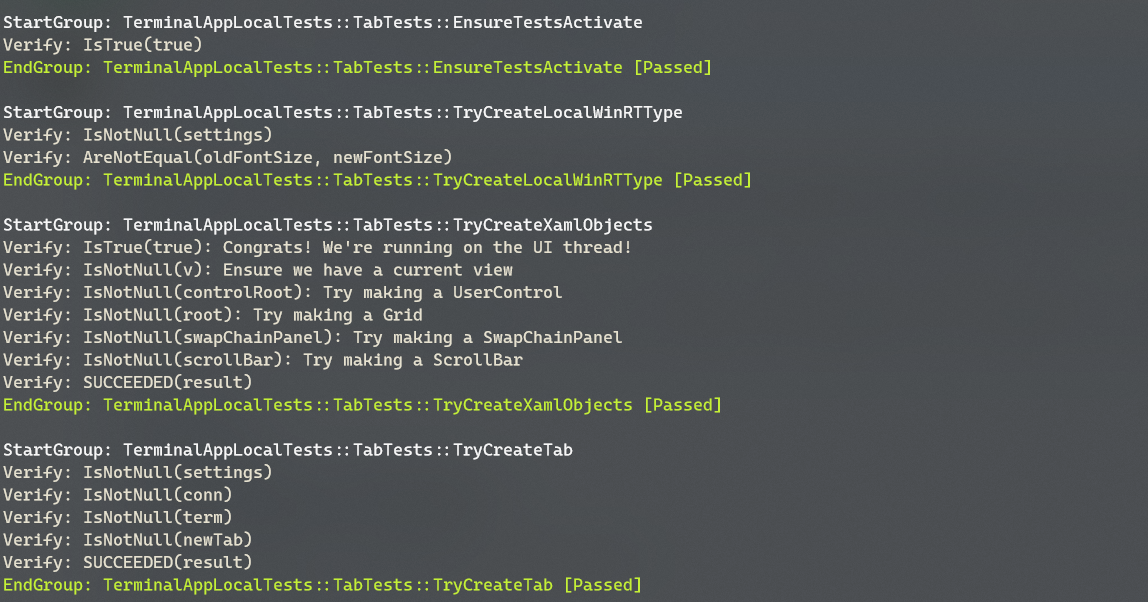
## Summary of the Pull Request
I believe this fixes#3861 but I honestly don't know how to test that part of the code. Just from reading the issue description that @dhowett-msft provided.
## References
## PR Checklist
* [x] Closes#3861
* [x] I work here
* [ ] Are there tests for this?
* [n/a] Requires documentation to be updated
## Validation Steps Performed
Really none, I just built it and :fingers_crossed:
<!-- Enter a brief description/summary of your PR here. What does it fix/what does it change/how was it tested (even manually, if necessary)? -->
## Summary of the Pull Request
Every lambda capture in `Tab` and `TerminalPage` has been changed from capturing raw `this` to `std::weak_ptr<Tab>` or `winrt::weak_ref<TerminalPage>`. Lambda bodies have been changed to check the weak reference before use.
Capturing raw `this` in `Tab`'s [title change event handler](https://github.com/microsoft/terminal/blob/master/src/cascadia/TerminalApp/Tab.cpp#L299) was the root cause of #3776, and is fixed in this PR among other instance of raw `this` capture.
The lambda fixes to `TerminalPage` are unrelated to the core issue addressed in the PR checklist. Because I was already editing `TerminalPage`, figured I'd do a [weak_ref pass](https://github.com/microsoft/terminal/issues/3776#issuecomment-560575575).
<!-- Other than the issue solved, is this relevant to any other issues/existing PRs? -->
## References
<!-- Please review the items on the PR checklist before submitting-->
## PR Checklist
* [x] Closes#3776, potentially #2248, likely closes others
* [x] CLA signed. If not, go over [here](https://cla.opensource.microsoft.com/microsoft/Terminal) and sign the CLA
* [ ] Tests added/passed
* [ ] Requires documentation to be updated
* [x] I've discussed this with core contributors already. If not checked, I'm ready to accept this work might be rejected in favor of a different grand plan. Issue number where discussion took place: #3776
<!-- Provide a more detailed description of the PR, other things fixed or any additional comments/features here -->
## Detailed Description of the Pull Request / Additional comments
`Tab` now inherits from `enable_shared_from_this`, which enable accessing `Tab` objects as `std::weak_ptr<Tab>` objects. All instances of lambdas capturing `this` now capture `std::weak_ptr<Tab>` instead. `TerminalPage` is a WinRT type which supports `winrt::weak_ref<TerminalPage>`. All previous instance of `TerminalPage` lambdas capturing `this` has been replaced to capture `winrt::weak_ref<TerminalPage>`. These weak pointers/references can only be created after object construction necessitating for `Tab` a new function called after construction to bind lambdas.
Any anomalous crash related to the following functionality during closing a tab or WT may be fixed by this PR:
- Tab icon updating
- Tab text updating
- Tab dragging
- Clicking new tab button
- Changing active pane
- Closing an active tab
- Clicking on a tab
- Creating the new tab flyout menu
Sorry about all the commits. Will fix my fork after this PR! 😅
<!-- Describe how you validated the behavior. Add automated tests wherever possible, but list manual validation steps taken as well -->
## Validation Steps Performed
Attempted to repro the steps indicated in issue #3776 with the new changes and failed. When before the changes, the issue could consistently be reproed.
RTF data is now copied to the clipboard. The clipboard format name
used for RTF data is `Rich Text Format`.
Refactored some code in `Clipboard.cpp` so that the code for setting
data to the clipboard is re-used. Also, renamed parameter
`fAlsoCopyHtml` to `fAlsoCopyFormatting` to make it more generic.
Tested by copying text from console to WordPad. Also verified that
HTML copy is not regressed by copying to Word.
Closes#3560.
# Summary of the Pull Request
When a horizontal tab ('\t') is output on the last column of the screen, the current implementation moves the cursor position to the start of the next line. However, the DEC STD 070 manual specifies that a horizontal tab shouldn't move past the last column of the active line (or the right margin, if we supported horizontal margins). This PR updates the forward tab implementation, to prevent it wrapping onto a new line when it reaches the end of a line.
# Detailed Description of the Pull Request / Additional comments
Originally the SCREEN_INFORMATION::GetForwardTab method had a condition which handled a tab at the end of the line as a special case, moving the cursor to the start of the next line. I've simply removed that condition, so an end-of-line tab is handled the same way as any other position (in this case it will just leaves the cursor where it is).
While testing, though, I found that there were circumstances where you could have tab stops greater than the width of the screen, and when that happens, a tab can still end up wrapping onto the next line. To fix that I had to add an additional check to make sure the tab position was always clamped to the width of the buffer.
With these fixes in place, a tab control should now never move off the active line, so I realised that the DoPrivateTabHelper function could be optimized to calculate all of the tab movements in advance, and then only make a single call to AdjustCursorPosition with the final coordinates. This change is not strictly necessary, though, so it can easily be reverted if there are any objections.
Regarding backwards compatibility, note that the GetForwardTab method is only used in two places:
when handling a tab character in the WriteCharsLegacy function, but this only applies in VT mode (see here).
when handling the CHT escape sequence in the DoPrivateTabHelper function, and obviously an escape sequence would also only be applicable in VT mode.
So this change should have no effect on legacy console applications, which wouldn't have VT mode activated.
# Validation Steps Performed
I've added another step to the TestGetForwardTab test which makes sure that a horizontal tab won't wrap at the end of a line.
I've also confirmed that this fixes the last remaining issue in the Test of autowrap in Vttest (pages 3 and 4 of the Test of cursor movements). Although I should note that this only works in conhost.
## Summary of the Pull Request
Updates MUX to the latest pre-release version. This prerelease has a fix for a certain `E_LAYOUTCYCLE` bug in the TabView that was causing an untold number of crashes for us.
Thanks again @teaP!
## PR Checklist
* [x] Closes#3303
* [x] Closes#2277
* [x] I work here
* [n/a] Tests added/passed
* [n/a] Requires documentation to be updated
First, my changes to `build.bat`:
1. `Build.bat` now looks for Visual Studio 2019 too.
2. `Build.bat` now ensures that the linker places ColorTool.exe into
`\debug` or `\release` folders, not `\debug\net471` or
`\release\net471`.
3. `Build.bat` is now smarter in its search. It determines the operating
system's CPU architecture before deciding whether to search in "Program
Files (x86)" or "Program Files".
Second, my changes to the help text displayed to the user:
1. The help text now makes it clear that some switches cannot be used
with certain others.
2. Some typos are fixed. e.g. "ct" to "ColorTool" (it took me two hours
to figure this one out!) and "schemename" to "scheme name".
I've made a minor change to the order of `switch (arg)` in Program.cs
too, to ensure that the terminating switches are analyzed first. This
way, there will be fewer surprises if the user supplies malformed input.
But feel free to reject this one.
# Unresolved issues
`Build.bat` is inherently faulty. On a pristine computer, a user cannot
just install the latest version of Microsoft Build Tool and run
`build.bat` to build ColorTool. The reason is the absence of certain
NuGet packages. Either NuGet or Visual Studio must download the
dependencies first.
# Validation Steps Performed
Since the changes to the code are minor, I don't know what test I can
possibly devise, other than compiling it and seeing that it works.
## Summary of the Pull Request
Fixes the LocalTests that should work. This does _not_ fix the TabTests.
## PR Checklist
* [x] Closes#3536
* [x] I work here
* [x] This is literally making the tests work
* [n/a] Requires documentation to be updated
## Detailed Description of the Pull Request / Additional comments
In a previous PR, we broke unpackaged activation. This had the unintended side-effect of breaking these tests. The solution here is to run these unittests _packaged_.
This also makes things a little bit better for the TabTests, but doesn't fix them (inexplicably). A mail thread internally is tracking the progress of fixing those tests.
<!-- Enter a brief description/summary of your PR here. What does it fix/what does it change/how was it tested (even manually, if necessary)? -->
## Summary of the Pull Request
Fixed the noexcept specifier on `GetGuid`, and corrected `FindProfile` and `FindGuid` so they don't throw. Also, adjusted `SettingsTests` to reflect these changes.
<!-- Other than the issue solved, is this relevant to any other issues/existing PRs? -->
## References
<!-- Please review the items on the PR checklist before submitting-->
## PR Checklist
* [x] Closes#3763
* [x] CLA signed. If not, go over [here](https://cla.opensource.microsoft.com/microsoft/Terminal) and sign the CLA
* [x] Tests added/passed updated a test group in `SettingsTests`
* [ ] Requires documentation to be updated
* [x] I've discussed this with core contributors already. If not checked, I'm ready to accept this work might be rejected in favor of a different grand plan. Issue number where discussion took place: #3763
<!-- Provide a more detailed description of the PR, other things fixed or any additional comments/features here -->
## Detailed Description of the Pull Request / Additional comments
The `noexcept` specifier on `GetGuid` was not removed when `Profile` was [updated](https://github.com/microsoft/terminal/issues/3763#issuecomment-559497094) to `std::optional<GUID>`. This PR fixes that and modifies two helper functions `FindProfile` and `FindGuid` in `CascadiaSettings` to work correctly if `GetGuid` does throw.
<!-- Describe how you validated the behavior. Add automated tests wherever possible, but list manual validation steps taken as well -->
## Validation Steps Performed
Updated the `TestHelperFunctions` test group in `SettingsTests` and made sure the tests pass.
<!-- Enter a brief description/summary of your PR here. What does it fix/what does it change/how was it tested (even manually, if necessary)? -->
## Summary of the Pull Request
Replaced a `gsl::narrow` call to `gsl::narrow_cast` call. The `gsl::narrow` call used to throw when the user had custom display scaling due to a bad comparison between floating point values.
<!-- Other than the issue solved, is this relevant to any other issues/existing PRs? -->
## References
Possible other [startup crashes](https://github.com/microsoft/terminal/issues/3749#issuecomment-559900267). I'll update this as they're found.
<!-- Please review the items on the PR checklist before submitting-->
## PR Checklist
* [x] Closes#3749, likely #3747
* [x] CLA signed. If not, go over [here](https://cla.opensource.microsoft.com/microsoft/Terminal) and sign the CLA
* [ ] Tests added/passed
* [ ] Requires documentation to be updated
* [x] I've discussed this with core contributors already. If not checked, I'm ready to accept this work might be rejected in favor of a different grand plan. Issue number where discussion took place: #3749
<!-- Provide a more detailed description of the PR, other things fixed or any additional comments/features here -->
## Detailed Description of the Pull Request / Additional comments
It's a one line fix. If you want more context, here's the [full description](https://github.com/microsoft/terminal/issues/3749#issuecomment-559911062) of the problem.
<!-- Describe how you validated the behavior. Add automated tests wherever possible, but list manual validation steps taken as well -->
## Validation Steps Performed
Set my machine to a custom scaling and opened a fixed build of the WT. My WT started up without crashing and continued to operate without issues (including maximizing, minimizing, and fullscreen toggle).
<!-- Enter a brief description/summary of your PR here. What does it fix/what does it change/how was it tested (even manually, if necessary)? -->
## Summary of the Pull Request
This PR updates the TitleBar buttons to be more consistent with other Windows apps.
Current buttons are a tiny bit smaller as compared to Chrome/Credge/Settings:

<!-- Other than the issue solved, is this relevant to any other issues/existing PRs? -->
<!-- Please review the items on the PR checklist before submitting-->
## PR Checklist
* [X] CLA signed
* [ ] Tests added/passed
* [ ] Requires documentation to be updated
* [ ] I've discussed this with core contributors already.
<!-- Provide a more detailed description of the PR, other things fixed or any additional comments/features here -->
## Detailed Description of the Pull Request / Additional comments
This PR changes the PointerHover Background of the close button on the TitleBar to match other Windows apps, from "#ff0000" to "#e81123". Also, the button width has been changed to 46 to be the same as other windows apps.
<!-- Describe how you validated the behavior. Add automated tests wherever possible, but list manual validation steps taken as well -->
------------------------------------------
* Fix Close Button Color
Changed the color of the Close Button on mouse hover from Red to "#e81123" which is the color used by other uwp apps.
* Updated Button Width
Changed the button width to be consistent with other uwp apps.
<!-- Enter a brief description/summary of your PR here. What does it fix/what does it change/how was it tested (even manually, if necessary)? -->
## Summary of the Pull Request
Adds a simple helper function to look up the GUID associated with a profile name.
<!-- Other than the issue solved, is this relevant to any other issues/existing PRs? -->
## References
<!-- Please review the items on the PR checklist before submitting-->
## PR Checklist
* [x] Closes#3680
* [x] CLA signed. If not, go over [here](https://cla.opensource.microsoft.com/microsoft/Terminal) and sign the CLA
* [x] Tests added/passed. Yes, new test group in `SettingsTests`!
* [ ] Requires documentation to be updated
* [x] I've discussed this with core contributors already. If not checked, I'm ready to accept this work might be rejected in favor of a different grand plan. Issue number where discussion took place: #3680
<!-- Provide a more detailed description of the PR, other things fixed or any additional comments/features here -->
## Detailed Description of the Pull Request / Additional comments
Very simple function, for-each through profiles checking for a match. Returns the associated GUID if found, else returns the null GUID.
This function is marked as `noexcept` to comply with assumption made by other `CascadiaSettings` functions that [`Profiles::GetGuid`](https://github.com/microsoft/terminal/blob/master/src/cascadia/TerminalApp/Profile.cpp#L141) does not throw, despite it throwing.
<!-- Describe how you validated the behavior. Add automated tests wherever possible, but list manual validation steps taken as well -->
## Validation Steps Performed
The new function is simple and can be visually validated, but added tests regardless. A new test group was added in `SettingsTests` called `TestHelperFunctions` to validate the new function `FindGuid` and older function `FindProfile`. This test group could be used to validate more helper functions in `CascadiaSettings` as they're added. The new test group passes after running `te.exe TerminalApp.LocalTests.dll`.
--------------------------------------------
* Added FindGuid helper function
* Style change
* Tests for FindGuid and FindProfile
* Fixed code format?
* Code format guess
No feedback from the Azure pipeline
* optional<GUID> fix
* Updated function desc
## Summary of the Pull Request
We already have "splitHorizontal" and "splitVertical", but those will both be deprecated in favor of "splitPane" with arguments.
Currently, there's one argument: "style", which is one of "vertical" or "horizontal."
## References
This is being done in pursuit of supporting #607 and #998. I don't really want to lob #998 in with this one, since both that and this are hefty enough PRs even as they are. (I have a branch for #998, but it needs this first)
This will probably conflict with #3658
## PR Checklist
* [ ] Doesn't actually close anything, only enables #998
* [x] I work here
* [ ] Tests added/passed - yea okay no excuses here
* [x] Requires documentation to be updated
## Validation Steps Performed
Added new keybindings with the args - works
Tried the old keybindings without the args - still works
---------------------------------------
* Add a 'splitPane' keybinding that can be used for splitting a pane either vertically or horizontally
* Update documentation too
* Good lord this is important
* Add a test too, though I have no idea if it works
* "style" -> "split"
* pr comments from carlos
## Summary of the Pull Request
Moves all the code responsible for dispatching an `ActionAndArgs` to it's own class, `ShortcutActionDispatch`. Now, the `AppKeyBindings` just uses the single instance of a `ShortcutActionDispatch` that the `TerminalPage` owns to dispatch events, without the need to re-attach the event handlers every time we reload the settings.
## References
This is something I originally did as a part of #2046.
I need this now for #607.
It's also a part of work for #3475
## PR Checklist
* [x] This is a bullet point within #3475
* [x] I work here
* [ ] Tests added/passed
* [n/a] Requires documentation to be updated
## Detailed Description of the Pull Request / Additional comments
With this change, we'll be able to have other things dispatch `ShortcutAction`s easily, by constructing an `ActionAndArgs` and just passing it straight to the `ShortcutActionDispatch`.
## Validation Steps Performed
Ran the Terminal, tried out some keybindings, namely <kbd>Ctrl+c</kbd> for copy when there is a selection, or send `^C` when there isn't. That still works.
Reloading settings also still works.
-----------------------------------------------
* Move action handling to it's own class separate from AKB. This is the first checkbox in #3475
(cherry picked from commit 696726b571d3d1fdf1d59844c76e182fc72cb2ea)
* clean up doc comments
This PR creates a Universal entrypoint for the Windows Terminal solution
in search of our goals to run everywhere, on all Windows platforms.
The Universal entrypoint is relatively straightforward and mostly just
invokes the App without any of the other islands and win32 boilerplate
required for the centennial route. The Universal project is also its own
packaging project all in one and will emit a relevant APPX.
A few things were required to make this work correctly:
* Vcxitems reuse of resources (and link instructions on all of them
for proper pkg layout)
* Move all Terminal project CRT usages to the app ones (and ensure
forwarders are only Nugetted to the Centennial package to not pollute
the Universal one)
* Fix/delay dependencies in `TerminalApp` that are not available in
the core platform (or don't have an appropriate existing platform
forwarder... do a loader snaps check)
* vcpkg needs updating for the Azure connection parser
* font fallbacks because Consolas isn't necessarily there
* fallbacks because there are environments without a window handle
Some of those happened in other small PRs in the past week or two. They
were relevant to this.
Note, this isn't *useful* as such yet. You can run the Terminal in this
context and even get some of the shells to work. But they don't do a
whole lot yet. Scoping which shells appear in the profiles list and only
offering those that contextually make sense is future work.
* Break everything out of App except the base initialization for XAML. AppLogic is the new home.
* deduplicate logics by always using the app one (since it has to be there to support universal launch).
* apparently that was too many cross-boundary calls and we can cache it because winrt objects are magic.
* Put UWP project into solution.
* tabs in titlebar needs disabling from uwp context as the non-client is way different. This adds a method to signal that to logic and apply the setting override.
* Change to use App CRT in preparation for universal.
* Try to make project build again by setting winconpty to static lib so it'll use the CRT inside TerminalConnection (or its other consumers) instead of linking its own.
* Remove test for conpty dll, it's a lib now. Add additional commentary on how CRT linking works for future reference. I'm sure this will come up again.
* This fixes the build error.
* use the _apiset variant until proven otherwise to match the existing one.
* Merge branch 'master' into dev/miniksa/uwp3
* recorrect spacing in cppwinrt.build.pre.props
* Add multiple additional fonts to fallback to. Also, guard for invalid window handle on title update.
* Remove ARMs from solution.
* Share items resources between centennial and universal project.
* cleanup resources and split manifest for dev/release builds.
* Rev entire solution to latest Toolkit (6.0.0 stable release).
* shorten the items file using include patterns
* cleanup this filters file a bit.
* Fix C26445 by using string_view as value, not ref. Don't build Universal in Audit because we're not auditing app yet.
* some PR feedback. document losing the pointer. get rid of 16.3.9 workarounds. improve consistency of variable decl in applogic.h
* Make dev phone product ID not match prod phone ID. Fix universal package identity to match proposed license information.
This pull request implements the new
`ITerminalConnection::ConnectionState` interface (enum, event) and
connects it through TerminalControl to Pane, Tab and App as specified in
#2039. It does so to implement `closeOnExit` = `graceful` in addition to
the other two normal CoE types.
It also:
* exposes the singleton `CascadiaSettings` through a function that
looks it up by using the current Xaml application's `AppLogic`.
* In so doing, we've broken up the weird runaround where App tells
TerminalSettings to CloseOnExit and then later another part of App
_asks TerminalControl_ to tell it what TerminalSettings said App
told it earlier. `:crazy_eyes:`
* wires up a bunch of connection state points to `AzureConnection`.
This required moving the Azure connection's state machine to use another
enum name (oops).
* ships a helper class for managing connection state transitions.
* contains a bunch of template magic.
* introduces `WINRT_CALLBACK`, a oneshot callback like `TYPED_EVENT`.
* replaces a bunch of disparate `_connecting` and `_closing` members
with just one uberstate.
* updates the JSON schema and defaults to prefer closeOnExit: graceful
* updates all relevant documentation
Specified in #2039Fixes#2563
Co-authored-by: mcpiroman <38111589+mcpiroman@users.noreply.github.com>
This location and name is practically mandated by PackageES. Sorry ☹️.
This will ensure that all artifacts that we produce are versioned
properly:
| thing | version (ex.) |
|---------|-----------------|
| dll/exe | 0.7.1911.22009 |
| nupkg | 0.7.191122009 |
| appx | 0.7.3269.0 |
For reference, here's the version format:
### EXE, DLL, .NET Assembly
0.7.1911.22009
^ ^ ^ ^ ^ ^
| | | | | `-Build # on that date
| | | | `-Day
| | | `-Month
| | `-Year
| `-Minor
`-Major
### NuGet Package
0.7.191122009
^ ^ ^ ^ ^ ^
| | | | | `-Build # on that date
| | | | `-Day
| | | `-Month
| | `-Year
| `-Minor
`-Major
### AppX Package
0.7.03269.0
^ ^ ^ ^^ ^
| | | || `-Contractually always zero (a waste)
| | | |`-Build # on that date
| | | `-Number of days in [base year]
| | `-Number of years since [base year]
| `-Minor
`-Major
[base year] = $(XesBaseYearForStoreVersion)
It is expected that the base year is changed every time the version
number is changed.
## Summary of the Pull Request
This PR implements resetFontSize keybindings, with default keybindings `ctrl+0`.
## PR Checklist
* [x] Closes#3319
* [x] CLA signed. If not, go over [here](https://cla.opensource.microsoft.com/microsoft/Terminal) and sign the CLA
* [ ] Tests added/passed
* [ ] Requires documentation to be updated
## Validation Steps Performed
Tested manually.
-----------------------------------------
* Add resetFontSize keybindings (#3319)
* update doc files
* Refactor AdjustFontSize & ResetFontSize to use _SetFontSize (#3319)
* Ran clang-format on TermControl
* Fix function usage change
TerminalControl doesn't use any of the built in text input and edit
controls provided by XAML for text input, which means TermianlControl
needs to communicate with the Text Services Framework (TSF) in order to
provide Input Method Editor (IME) support. Just like the rest of
Terminal we get to take advantage of newer APIs (Windows.UI.Text.Core)
namespace to provide support vs. the old TSF 1.0.
Windows.UI.Text.Core handles communication between a text edit control
and the text services primarily through a CoreTextEditContext object.
This change introduces a new UserControl TSFInputControl which is a
custom EditControl similar to the CustomEditControl sample[1].
TSFInputControl is similar (overlay with IME text) to how old console
(conimeinfo) handled IME.
# Details
TSFInputControl is a Windows.UI.Xaml.Controls.UserControl
TSFInputControl contains a Canvas control for absolution positioning a
TextBlock control within its containing control (TerminalControl).
The TextBlock control is used for displaying candidate text from the
IME. When the user makes a choice in the IME the TextBlock is cleared
and the text is written to the Terminal buffer like normal text.
TSFInputControl creates an instance of the CoreTextEditContext and
attaches appropriate event handlers to CoreTextEditContext in order to
interact with the IME.
A good write-up on how to interact with CoreTextEditContext can be found
here[2].
## Text Updates
Text updates from the IME come in on the TextUpdating event handler,
text updates are stored in an internal buffer (_inputBuffer).
## Completed Text
Once a user selects a text in the IME, the CompositionCompleted handler
is invoked. The input buffer (_inputBuffer) is written to the Terminal
buffer, _inputBuffer is cleared and Canvas and TextBlock controls are
hidden until the user starts a composition session again.
## Positioning
Telling the IME where to properly position itself was the hardest part
of this change. The IME expects to know it's location in screen
coordinates as supposed to client coordinates. This is pretty easy if
you are a pure UWP, but since we are hosted inside a XAMLIsland the
client to screen coordinate translation is a little harder.
### Calculating Screen Coordinates
1. Obtaining the Window position in Screen coordinates.
2. Determining the Client coordinate of the cursor.
3. Converting the Client coordinate of the cursor to Screen coordinates.
4. Offsetting the X and Y coordinate of the cursor by the position of
the TerminalControl within the window (tabs if present, margins, etc..).
5. Applying any scale factor of the display.
Once we have the right position in screen coordinates, this is supplied
in the LayoutBounds of the CoreTextLayoutRequestedEventArgs which lets
the IME know where to position itself on the Screen.
## Font Information/Cursor/Writing to Terminal
3 events were added to the TSFInputControl to create a loosely-coupled
implementation between the TerminalControl and the TSFInputControl.
These events are used for obtaining Font information from the
TerminalControl, getting the Cursor position and writing to the terminal
buffer.
## Known Issues
- Width of TextBlock is hardcoded to 200 pixels and most likely should
adjust to the available width of the current input line on the console
(#3640)
- Entering text in the middle of an existing set of text has TextBlock
render under existing text. Current Console behavior here isn't good
experience either (writes over text)
- Text input at edges of window is clipped versus wrapping around to
next line. This isn't any worse than the original command line, but
Terminal should be better (#3657)
## Future Considerations
Ideally, we'd be able to interact with the console buffer directly and
replace characters as the user types.
## Validation
General steps to try functionality
- Open Console
- Switch to Simplified Chinese (Shortcut: Windows+Spacebar)
- Switch to Chinese mode on language bar
Scenarios validated:
- As user types unformatted candidates appear on command line and IME
renders in correct position under unformatted characters.
- User can dismiss IME and text doesn't appear on command line
- Switch back to English mode, functions like normal
- New tab has proper behavior
- Switching between tabs has proper behavior
- Switching away from Terminal Window with IME present causes IME to
disappear
[1]: https://github.com/Microsoft/Windows-universal-samples/tree/master/Samples/CustomEditControl
[2]: https://docs.microsoft.com/en-us/windows/uwp/design/input/custom-text-inputCloses#459Closes#2213Closes#3641
* first take at suppressApplicationTitle rewrite
* Rebased tab title fixes
* updated settings doc
* incomplete - not suppressing where application title is changing
* added original startingTitle functionality back
* moved suppressApplicationTitle to ICoreSettings
* suppression is working, but tab navigation overrides it
* suppression works, but not with panes
* it works!
* code cleanup
* added suppressApplicationTitle to JSON schema
* more code cleanup
* changed starting title from wstring_view to wstring
* Formatting fix
## Summary of the Pull Request
With #3391, I almost certainly regressed the ability for the new tab dropdown to display the keybindings for each profile. This adds them back.
## PR Checklist
* [x] Closes#3603
* [x] I work here
* [ ] Tests added/passed
* [n/a] Requires documentation to be updated
## Detailed Description of the Pull Request / Additional comments
Now, we can lookup keybindings not only for `ShortcutAction`s, but also `ActionAndArgs`s, so we can look up the binding for an action with a particular set of arguments.
---------------------------------------------
* fixes#3603 by searching for ActionAndArgs too
* Apply suggestions from code review
Co-Authored-By: Carlos Zamora <carlos.zamora@microsoft.com>
<!-- Enter a brief description/summary of your PR here. What does it fix/what does it change/how was it tested (even manually, if necessary)? -->
## Summary of the Pull Request
Fixes#3604 where Increase/Decrease font size bindings were not working.
<!-- Please review the items on the PR checklist before submitting-->
## PR Checklist
* [x] Closes#3604
* [x] CLA signed. If not, go over [here](https://cla.opensource.microsoft.com/microsoft/Terminal) and sign the CLA
<!-- Describe how you validated the behavior. Add automated tests wherever possible, but list manual validation steps taken as well -->
## Validation Steps Performed
Increase and decrease font size works once again!
-------------------------------------
* adding FromJson to AdjustFontSizeArgs
* made a legacy function that just allows you to do 1/-1 delta for adjusting font size
* adding test case
* removing extra quotes
* comments lmao
* FORMATTING WHY
## Summary of the Pull Request
Unties the concept of "focused control" from "active control".
Previously, we were exclusively using the "Focused" state of `TermControl`s to determine which one was active. This was fraught with gotchas - if anything else became focused, then suddenly there was _no_ pane focused in the Tab. This happened especially frequently if the user clicked on a tab to focus the window. Furthermore, in experimental branches with more UI added to the Terminal (such as [dev/migrie/f/2046-command-palette](https://github.com/microsoft/terminal/tree/dev/migrie/f/2046-command-palette)), when these UIs were added to the Terminal, they'd take focus, which again meant that there was no focused pane.
This fixes these issue by having each Tab manually track which Pane is active in that tab. The Tab is now the arbiter of who in the tree is "active". Panes still track this state, for them to be able to MoveFocus appropriately.
It also contains a related fix to prevent the tab separator from stealing focus from the TermControl. This required us to set the color of the un-focused Pane border to some color other that Transparent, so I went with the TabViewBackground. Panes now look like the following:
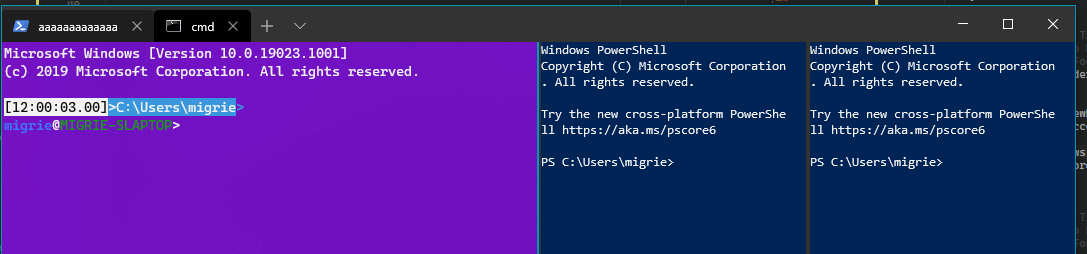
## References
See also: #2046
## PR Checklist
* [x] Closes#1205
* [x] Closes#522
* [x] Closes#999
* [x] I work here
* [😢] Tests added/passed
* [n/a] Requires documentation to be updated
## Validation Steps Performed
Tested manually opening panes, closing panes, clicking around panes, the whole dance.
---------------------------------------------------
* this is janky but is close for some reason?
* This is _almost_ right to solve #1205
If I want to double up and also fix#522 (which I do), then I need to also
* when a tab GetsFocus, send the focus instead to the Pane
* When the border is clicked on, focus that pane's control
And like a lot of cleanup, because this is horrifying
* hey this autorevoker is really nice
* Encapsulate Pane::pfnGotFocus
* Propogate the events back up on close
* Encapsulate Tab::pfnFocusChanged, and clean up TerminalPage a bit
* Mostly just code cleanup, commenting
* This works to hittest on the borders
If the border is `Transparent`, then it can't hittest for Tapped events, and it'll fall through (to someone)
THis at least works, but looks garish
* Match the pane border to the TabViewHeader
* Fix a bit of dead code and a bad copy-pasta
* This _works_ to use a winrt event, but it's dirty
* Clean up everything from the winrt::event debacle.
* This is dead code that shouldn't have been there
* Turn Tab's callback into a winrt::event as well
This commit renames the functions in conpty.lib to Conpty* so that they
can be explicitly linked and introduces a header so they can be located.
It also updates the DEF for conpty.dll to reexport them with their
original names.
The crux of the issue here is that TerminalConnection is consuming the
_import_ symbols for the *PseudoConsole family of APIs, which simply
cannot be supplanted by a static library.
Avenues explored: * Exporting __imp_x from the static library to get all
up in kernel32's business. * Using /ALTERNATENAME:__imp_X=StaticX. It
turns out ALTERNATENAME is only consulted when the symbol isn't found
through traditional means.
This, renaming them, is the straightest path forward.
Fixes#3553.
* Adds HasBackgroundImage() and GetExpandedBackgroundImagePath() to
Profiles.cpp/h
* Fills Terminal Settings with expanded path, rather than path value
from profiles.json
* Adds simple regression tests to detect and fail if this fix is
circumvented in the future
Fixes#2922
* Make search a shared component for conhost and terminal
* Remove inclusion of deprecated interface file
* Code review changes, remove text buffer modification in Terminal
* remove unreferenced objects to fix build errors
* Fix test failure, guarantee uiaData object is correctly initialized in Search
* minor comment typo fix and format fix
* minor PR comments change
* ColorSeclection directly throw and return
* remove coordAnchor initialization
* minor method signature change
## Summary of the Pull Request
Enables the user to provide arbitrary argument values to shortcut actions through a new `args` member of keybindings. For some keybindings, like `NewTabWithProfile<N>`, we previously needed 9 different `ShortcutAction`s, one for each value of `Index`. If a user wanted to have a `NewTabWithProfile11` keybinding, that was simply impossible. Now that the args are in their own separate json object, each binding can accept any number of arbitrary argument values.
So instead of:
```json
{ "command": "newTab", "keys": ["ctrl+shift+t"] },
{ "command": "newTabProfile0", "keys": ["ctrl+shift+1"] },
{ "command": "newTabProfile1", "keys": ["ctrl+shift+2"] },
{ "command": "newTabProfile2", "keys": ["ctrl+shift+3"] },
{ "command": "newTabProfile3", "keys": ["ctrl+shift+4"] },
```
We can now use:
```json
{ "command": "newTab", "keys": ["ctrl+shift+t"] },
{ "command": { "action": "newTab", "index": 0 }, "keys": ["ctrl+shift+1"] },
{ "command": { "action": "newTab", "index": 1 }, "keys": ["ctrl+shift+2"] },
{ "command": { "action": "newTab", "index": 2 }, "keys": ["ctrl+shift+3"] },
```
Initially, this does seem more verbose. However, for cases where there are multiple args, or there's a large range of values for the args, this will quickly become a more powerful system of expressing keybindings.
The "legacy" keybindings are _left in_ in this PR. They have helper methods to generate appropriate `IActionArgs` values. Prior to releasing 1.0, I think we should remove them, if only to remove some code bloat.
## References
See [the spec](https://github.com/microsoft/terminal/blob/master/doc/specs/%231142%20-%20Keybinding%20Arguments.md) for more details.
This is part two of the implementation, part one was #2446
## PR Checklist
* [x] Closes#1142
* [x] I work here
* [x] Tests added/passed
* [x] Schema updated
## Validation Steps Performed
* Ran Tests
* Removed the legacy keybindings from the `defaults.json`, everything still works
* Tried leaving the legacy keybingings in my `profiles.json`, everything still works.
-------------------------------------------------
* this is a start, but there's a weird linker bug if I take the SetKeybinding(ShortcutAction, KeyChord) implementation out, which I don't totally understand
* a good old-fashioned clean will fix that right up
* all these things work
* hey this actually _functionally_ works
* Mostly cleanup and completion of implementation
* Hey I bet we could just make NewTab the handler for NewTabWithProfile
* Start writing tests for Keybinding args
* Add tests
* Revert a bad sln change, and clean out dead code
* Change to include "command" as a single object
This is a change to make @dhowett-msft happy. Changes the args to be a part
of the "command" object, as opposed to an object on their own.
EX:
```jsonc
// Old style
{ "command": "switchToTab0", "keys": ["ctrl+1"] },
{ "command": { "action": "switchToTab", "index": 0 }, "keys": ["ctrl+alt+1"] },
// new style
{ "command": "switchToTab0", "keys": ["ctrl+1"] },
{ "command": "switchToTab", "args": { "index": 0 } "keys": ["ctrl+alt+1"] },
```
* schemas are hard yo
* Fix the build?
* wonder why my -Wall settings are different than CI...
* this makes me hate things
* Comments from PR
* Add a `Direction::None`
* LOAD BEARING
* add some GH ids to TODOs
* add a comment
* PR nits from carlos
* Make ConPTY build as both LIB and DLL.
* Update TerminalConnection reference to LIB version (because Terminal builds both UWP and Centennial, requiring different CRTs each).
* DLL is now available (and against desktop CRT) to be PInvokable from C# for WPF terminal.
Note, DLL MUST BUILD PRECOMP to get the magic pragma linking information to the Desktop CRT.
* don't audit PTY lib. I can't do safe things because the safe things we use don't fit back inside kernelbase.dll.
Closes#3563.
## Summary of the Pull Request
RTF data is now copied to the clipboard. Tested by copy pasting text from terminal to WordPad.
<!-- Please review the items on the PR checklist before submitting-->
## PR Checklist
* [x] Closes#2487
* [x] CLA signed. If not, go over [here](https://cla.opensource.microsoft.com/microsoft/Terminal) and sign the CLA
* [ ] Tests added/passed
* [ ] Requires documentation to be updated
* [x] I've discussed this with core contributors already. If not checked, I'm ready to accept this work might be rejected in favor of a different grand plan. Issue number where discussion took place: #2487
<!-- Provide a more detailed description of the PR, other things fixed or any additional comments/features here -->
## Detailed Description of the Pull Request / Additional comments
Mostly similar to PR #1224. Added a new static method `GenRTF` in `TextBuffer` that is responsible
for generating the RTF representation of a given text. The generated RTF is added to the `DataPackage` that is ultimately passed to the clipboard.
<!-- Describe how you validated the behavior. Add automated tests wherever possible, but list manual validation steps taken as well -->
## Validation Steps Performed
Validated by copy pasting text from the terminal to WordPad. Validated with different colors to make sure that is working. (MS Word seems to prefer HTML data from the clipboard instead of RTF.)
<hr>
* Copy RTF data to the clipboard
* Added comment explaining various parts of the header
* Fixed static code analysis issues and added noexcept to GenRTF()
* Removed noexcept
<!-- Enter a brief description/summary of your PR here. What does it fix/what does it change/how was it tested (even manually, if necessary)? -->
## Summary of the Pull Request
This introduces a setting to both Profiles and ColorSchemes called <code>selectionBackground</code> that allows you to change the selection background color to what's specified. If <code>selectionBackground</code> isn't set in either the profile or color scheme, it'll default to what it was before - white.
<!-- Please review the items on the PR checklist before submitting-->
## PR Checklist
* [x] Closes#3326
* [x] CLA signed. If not, go over [here](https://cla.opensource.microsoft.com/microsoft/Terminal) and sign the CLA
* [x] Tests added/passed
* [x] Requires documentation to be updated
<!-- Describe how you validated the behavior. Add automated tests wherever possible, but list manual validation steps taken as well -->
## Validation Steps Performed
- Added selectionBackground to existing profile and colorscheme tests.
- Verified that the color does change to what I expect it to be when I add "selectionBackground" to either/both a profile and a color scheme.
<hr>
* adding selectionBackground to ColorScheme and TerminalSettings
* Changing PaintSelection inside the renderers to take a SelectionBackground COLORREF
* changes to conhost and terminal renderdata, and to terminal settings and core
* IT WORKS
* modification of unit tests, json schemas, reordering of functions
* more movement
* changed a couple of unit tests to add selectionBackground, added the setting to schemas, also added the optional setting to profiles
* default selection background should be slightly offwhite like the default foreground is
* reverting changes to .sln
* cleaning up
* adding comment
* oops
* added clangformat to my vs hehe
* moving selectionBackground to IControlSettings and removing from ICoreSettings
* trying to figure out why the WHOLE FILE LOOKS LIKE ITS CHANGED
* here it goes again
* pls
* adding default foreground as the default for selection background in dx
## Summary of the Pull Request
This PR potentially fixes#3101.
## PR Checklist
* [x] Closes#3101.
* [x] CLA signed. If not, go over [here](https://cla.opensource.microsoft.com/microsoft/Terminal) and sign the CLA
* [ ] Tests added/passed
* [ ] Requires documentation to be updated
* [ ] I've discussed this with core contributors already. If not checked, I'm ready to accept this work might be rejected in favor of a different grand plan. Issue number where discussion took place: #xxx
## Detailed Description of the Pull Request / Additional comments
This PR fixes#3101 by setting flag 0 in `ToUnicodeEx()` even though the documentation says "If bit 0 is set, a menu is active.". I'm not 100% sure why it works, but it definitely does in this case.
I thought that bit 2, which claims that "keyboard state is not changed" would be sufficient to prevent this from happening, but it seems that's not the case.
I believe this PR should be verified by a developer at Microsoft who's familiar with the internal workings of `ToUnicodeEx()`.
We need this function (or something similar) to translate Alt+Key combinations to proper unicode.
But at the same time it should not send us any additional IBM-style Alt Codes to our character handler if that translation fails (and `ToUnicodeEx()` returns 0).
## Validation Steps Performed
See #3101 for more information. I ensured that Alt+Arrow-Key combinations do not print ◘☻♠♦ anymore.
<!-- Enter a brief description/summary of your PR here. What does it fix/what does it change/how was it tested (even manually, if necessary)? -->
## Summary of the Pull Request
Another tiny performance fix.
<!-- Provide a more detailed description of the PR, other things fixed or any additional comments/features here -->
## Detailed Description of the Pull Request / Additional comments
Correct me if I'm wrong, It doesn't really make sense to update scroll status faster than frame rate limit.
<!-- Describe how you validated the behavior. Add automated tests wherever possible, but list manual validation steps taken as well -->
## Validation Steps Performed
<hr>
* Throttle scroll position update
* Review
This new cpprestsdk package, 2.10.14, switches us to the app CRT.
cpprestsdk turns fof a bunch of boost and openssl dependencies when it's
built for the Windows Store subplatform, so we got a bunch of stuff for
free.
Incidentally, I fixed#2338 the real/correct way -- the build rules in
the package now make sure they're not using the system vcpkg root.
* Change to use App CRT in preparation for universal.
* Try to make project build again by setting winconpty to static lib so it'll use the CRT inside TerminalConnection (or its other consumers) instead of linking its own.
* Remove test for conpty dll, it's a lib now. Add additional commentary on how CRT linking works for future reference. I'm sure this will come up again.
* use the _apiset variant until proven otherwise to match the existing one.
* Clarification in the comments for linking.
This commit deletes ConhostConnection and replaces it with
ConptyConnection. The ConptyConnection uses CreatePseudoConsole and
depends on winconpty to override the one from kernel32.
* winconpty must be packageable, so I've added GetPackagingOutputs.
* To validate this, I added conpty.dll to the MSIX regression script.
* I moved the code from conpty-universal that deals with environment
strings into the types library.
This puts us in a way better place to implement #2563, as we can now
separately detect a failure to launch a pseudoconsole, a failure to
CreateProcess, and an unexpected termination of the launched process.
Fixes#1131.
* Create a doc for adding common third-party tools
Maybe it would be helpful to have a comprehensive guide on adding some common third-party tools as profiles.
* add some additional tools from PR
It's apparently perfectly possible that DWM will just crash or close, and when
it does, `DwmExtendFrameIntoClientArea` will return a failure. If we
THROW_IF_FAILED that call, then we'll also crash when DWM does.
This converts that THROW_IF_FAILED to a LOG_IF_FAILED. When DWM comes back,
we'll hit this codepath again, and all will be right again in the world.
<!-- Enter a brief description/summary of your PR here. What does it fix/what does it change/how was it tested (even manually, if necessary)? -->
## Summary of the Pull Request
<!-- Other than the issue solved, is this relevant to any other issues/existing PRs? -->
## References
#1091#1094#2390#3314
<!-- Please review the items on the PR checklist before submitting-->
## PR Checklist
* [x] Closes#1091
* [x] CLA signed. If not, go over [here](https://cla.opensource.microsoft.com/microsoft/Terminal) and sign the CLA
* [ ] Tests added/passed
* [ ] Requires documentation to be updated
* [x] I've discussed this with core contributors already. If not checked, I'm ready to accept this work might be rejected in favor of a different grand plan. Issue number where discussion took place: #xxx
<!-- Provide a more detailed description of the PR, other things fixed or any additional comments/features here -->
## Detailed Description of the Pull Request / Additional comments
Combination of the PRs #1094, #2390, and #3314, especially as discussed in #3314.
In short, this changes line endings from Windows-space \r\n to the more universal \r.
<!-- Describe how you validated the behavior. Add automated tests wherever possible, but list manual validation steps taken as well -->
## Validation Steps Performed
Copied and pasted text into the terminal without the patch, line endings were doubled.
With the patch, line endings weren't doubled.
--------------------
* Replacing \r\n line endings with \r line endings
* Fixing Formatting
This commit cleans up and deduplicates all of the common build
preamble/postamble across exe, dll, lib and c++/winrt projects.
The following specific changes have been made:
* All projects now define their ConfigurationType
* All projects now set all their properties *before* including a common
build file (or any other build files)
* cppwinrt.pre and cppwinrt.post now delegate most of their
configuration to common.pre and common.post
* (becuase of the above,) all build options are conserved between
console and c++/winrt components, including specific warnings and
preprocessor definitions.
* More properties that are configurable per-project are now
conditioned so the common props don't override them.
* The exe, dll, exe.or.dll, and lib postincludes have been merged into
pre or post and switched based on condition as required
* Shared items (-shared, -common) are now explicitly vcxitems instead of
vcxproj files.
* The link line is now manipulated after Microsoft.Cpp sets it, so the
libraries we specify "win". All console things link first against
onecore_apiset.lib.
* Fix all compilation errors caused by build unification
* Move CascadiaPackage's resources into a separate item file
Fixes#922.
* Ensure rights check and increments pass before assigning an object to a handle (since deallocation of handles will automatically attempt to cleanup).
The current DECSC implementation only saves the cursor position and
origin mode. This PR improves that functionality with additional support
for saving the SGR attributes, as well as the active character set.
It also fixes the way the saved state interacts with the alt buffer
(private mode 1049), triggering a save when switching to the alt buffer,
and a restore when switching back, and tracking the alt buffer state
independently from the main state.
In order to properly save and restore the SGR attributes, we first
needed to add a pair of APIs in the `ConGetSet` interface which could
round-trip the attributes with full 32-bit colors (the existing methods
only work with legacy attributes).
I then added a struct in the `AdaptDispatch` implementation to make it
easier to manage all of the parameters that needed to be saved. This
includes the cursor position and origin mode that we were already
tracking, and now also the SGR text attributes and the active character
set (via the `TermOutput` class).
Two instances of this structure are required, since changes made to the
saved state in the alt buffer need to be tracked separately from changes
in the main buffer. I've added a boolean property that specifies whether
we're in the alt buffer or not, and use that to decide which of the two
instances we're working with.
I also needed to explicitly trigger a save when switching to the alt
buffer, and a restore when switching back, since we weren't already
doing that (the existing implementation gave the impression that the
state was saved, because each buffer has its own cursor position, but
that doesn't properly match the XTerm behaviour).
For the state tracking itself, we've now got two additional properties -
the SGR attributes, which we obtain via the new private API, and the
active character set, which we get from a local `AdaptDispatch` field.
I'm saving the whole `TermOutput` class for the character set, since I'm
hoping that will make it automatically supports future enhancements.
When restoring the cursor position, there is also now a fix to handle
the relative origin mode correctly. If the margins are changed between
the position being saved and restored, it's possible for the cursor to
end up outside of the new margins, which would be illegal. So there is
now an additional step that clamps the Y coordinate within the margin
boundaries if the origin mode is relative.
# Validation
I've added a couple of screen buffer tests which check that the various
parameters are saved and restored as expected, as well as checking that
the Y coordinate is clamped appropriately when the relative origin mode
is set.
I've also tested manually with vttest and confirmed that the
_SAVE/RESTORE CURSOR_ test (the last page of the _Test of screen
features_)) is now working a lot better than it used to.
Closes#148.
## Summary of the Pull Request
Enables the `toggleFullscreen` action to be able to enter fullscreen mode, bound by default to <kbd>alt+enter</kbd>.
The action is bubbled up to the WindowsTerminal (Win32) layer, where the window resizes itself to take the entire size of the monitor.
This largely reuses code from conhost. Conhost already had a fullscreen mode, so I figured I might as well re-use that.
## References
Unfortunately there are still very thin borders around the window when the NonClientIslandWindow is fullscreened. I think I know where the problem is. However, that area of code is about to get a massive overhaul with #3064, so I didn't want to necessarily make it worse right now.
A follow up should be filed to add support for "Always show / reveal / never show tabs in fullscreen mode". Currently, the only mode is "never show tabs".
Additionally, some of this code (particularily re:drawing the nonclient area) could be re-used for #2238.
## PR Checklist
* [x] Closes#531, #3411
* [x] I work here
* [n/a] Tests added/passed 😭
* [x] Requires documentation to be updated
## Validation Steps Performed
* Manually tested both the NonClientIslandWindow and the IslandWindow.
* Cherry-pick commit 8e56bfe
* Don't draw the tab strip when maximized
(cherry picked from commit bac4be7c0f3ed1cdcd4f9ae8980fc98103538613)
* Fix the vista window flash for the NCIW
(cherry picked from commit 7d3a18a893c02bd2ed75026f2aac52e20321a1cf)
* Some code cleanup for review
(cherry picked from commit 9e22b7730bba426adcbfd9e7025f192dbf8efb32)
* A tad bit more notes and cleanup
* Update schema, docs
* Most of the PR comments
* I'm not sure this actually works, so I'm committing it to revert it and check
* Update some comments that were lost.
* Fix a build break?
* oh no
We take the standard window frame except that we remove the top part
(see `NonClientIslandWindow::_OnNcCalcSize`), then we put little 1 pixel
wide top border back in the client area using
`DwmExtendFrameIntoClientArea` and then we put the XAML island and the
drag bar on top.
Most of this PR is comments to explain how the code works and also
removing complex code that was needed to handle the weird cases when the
borders were custom.
I've also refactored a little bit the `NonClientIslandWindow` class.
* Fix DwmExtendFrameIntoClientArea values
* Fix WM_NCHITTEST handling
* Position the XAML island window correctly
* Fix weird colors in drag bar and hide old title bar buttons
* Fix the window's position when maximized
* Add support for dark theme on the frame
* DRY shared code between conhost and new terminal
* Fix drag bar and remove dead code
* Remove dead code and use cached DPI
* Refactor code
* Remove impossible TODO
* Use system metrics instead of hardcoding resize border height
* Use theme from app settings instead of system theme. Improve comments. Remove unused DWM frame on maximize.
* Fix initial position DPI handling bug and apply review changes
* Fix thick borders with DPI > 96
Closes#3064.
Closes#1307.
Closes#3136.
Closes#1897.
Closes#3222.
Closes#1859.
This commit introduces a C++/WinRT utility library and moves
ScopedResourceLoader into it. I decided to get uppity and introduce
something I like to call "checked resources." The idea is that every
resource reference from a library is knowable at compile time, and we
should be able to statically ensure that all resources exist.
This is a system that lets us immediately failfast (on launch) when a
library makes a static reference to a resource that doesn't exist at
runtime.
It exposes two new (preprocessor) APIs:
* `RS_(wchar_t)`: loads a localizable string resource by name.
* `USES_RESOURCE(wchar_t)`: marks a resource key as used, but is intended
for loading images or passing static resource keys as parameters to
functions that will look them up later.
Resource checking relies on diligent use of `USES_RESOURCE()` and `RS_()`
(which uses `USES_RESOURCE`), but can make sure we don't ship something
that'll blow up at runtime.
It works like this:
**IN DEBUG MODE**
- All resource names referenced through `USES_RESOURCE()` are emitted
alongside their referencing filenames and line numbers into a static
section of the binary.
That section is named `.util$res$m`.
- We emit two sentinel values into two different sections, `.util$res$a`
and `.util$res$z`.
- The linker sorts all sections alphabetically before crushing them
together into the final binary.
- When we first construct a library's scoped resource loader, we
iterate over every resource reference between `$a` and `$z` and check
residency.
**IN RELEASE MODE**
- All checked resource code is compiled out.
Fixes#2146.
Macros are the only way to do something this cool, incidentally.
## Validation Steps Performed
Made references to a bunch of bad resources, tried to break it a lot.
It looks like this when it fails:
### App.cpp
```
36 static const std::array<std::wstring_view, 2> settingsLoadErrorsLabels {
37 USES_RESOURCE(L"NoProfilesText"),
38 USES_RESOURCE(L"AllProfilesHiddenText_HA_JUST_KIDDING")
39 };
```
```
WinRTUtils\LibraryResources.cpp(68)\TerminalApp.dll:
FailFast(1) tid(1034) 8000FFFF Catastrophic failure
Msg:[Resource AllProfilesHiddenText_HA_JUST_KIDDING not found in
scope TerminalApp/Resources (App.cpp:38)] [EnsureAllResourcesArePresent]
```
The WAP packaging project in VS <= 16.3.7 produces a couple global
properties as part of its normal operation that cause MSBuild to flag
our projects as out-of-date and requiring a rebuild. By forcing those
properties to match the WAP values, we can get consistent builds.
One of those properties, however, is "GenerateAppxPackageOnBuild", and
WAP sets it to *false*. When we set that, of course, we don't get an
MSIX out of our build pipeline. Therefore, we have to break our build
into two phases -- build, then package.
This required us to change our approach to PCH deletion. A project
without a PCH is *also* considered out-of-date. Now, we keep all PCH
files but truncate them to 0 bytes.
TerminalApp, however, is re-linked during packaging because the Xaml
compiler emits a new generated C++ file on every build. We have to keep
those PCHs around.
* Remove WpfTerminalControl AnyCPU from Arch-specific builds
This removes another source of build nondeterminism: that WpfTerminalControl was propagating TargetFramework into architecture-specific C++ builds. Its "Any CPU" platform has been removed from architecture builds at the solution level.
This also cleans up some new projects that were added and build for "Any
CPU".
## Summary of the Pull Request
Adds a small border with the accent color to indicate a pane is focused
<img src="https://user-images.githubusercontent.com/18356694/66218711-560e4b80-e68f-11e9-85b0-1f387d35bb92.png" width="480">
<img src="https://user-images.githubusercontent.com/18356694/66218757-6f16fc80-e68f-11e9-8d39-db9ab748c4de.png" width="480">
<img src="https://user-images.githubusercontent.com/18356694/66219194-55c28000-e690-11e9-9835-8b5212e70e8a.png" width="480">
## PR Checklist
* [x] Closes#994
* [x] I work here
* [😢] Tests added/passed
* [n/a] Requires documentation to be updated
## Detailed Description of the Pull Request / Additional comments
I've removed the simple Grid we were using as the pane separator, and replaced it with a Border that might appear on any side of a pane.
When we add a split, we'll create each child with one of the `Border` flags set (each child with one of a pair of flags). E.g. creating a horizontal split creates one child with the `Top` border, and another with the `Bottom`.
Then, if one of those panes is split, it will pass it's border flag to is new children, with the additional flag set. So adding another Vertical split to the above scenario would create a set of panes with either (`Top|Left`, `Top|Right`) or (`Bottom|Left`, `Bottom|Right`) borders set, depending on which pane was split.
<hr>
* start work on this by tracking border state
* Colorize the border
* Use the accent color for highlighting
* Cleanup the accent color code
* Don't buy any rural real estate when closing a pane
* Closing panes works well now too
* Cleanup for review
* Update src/cascadia/TerminalApp/Pane.cpp
* try some things that don't work to fix the resizing crash
* Revert "try some things that don't work to fix the resizing crash"
This reverts commit 3fc14da113.
* this _does_ work, but I think it's not semantically correct
* This doesn't seem to work either.
I tried adding the pane seperators to the Pane::_GetMinWidth calculation. That
works for prevent the crash, but the resizing is wonky now. If you add a
Vertical split, then a second, then resize the middle pane really small,
you'll see that the _last_ resize doesn't work properly. The text seems to
overhand into the border.
Additionally, there's really weird behavior resizing panes to be small. They
don't always seem to be resizable to the smallest size.
* Revert "This doesn't seem to work either."
This reverts commit 2fd8323e7b.
* Merge the changes from the "this is the one" branch
Again, no idea what I really did that worked, but it does
* Cleanup from my mess of a commit
This makes so much more sense now
* Other PR feedback from @carlos-zamora
* Fix a typo
* Add support for the HPA escape sequence as an alias for CHA.
* Extend the output engine tests for cursor movement to confirm that HPA is dispatched in the same way as CHA.
The _FindMatchingColorScheme currently iterates through all pairs in the
map to find the matching color scheme for a given JSON.
Improved this by using the name from the JSON to lookup the color scheme
in the map.
As a part of setting up UIA Events, we need to be able to identify WHEN to notify the client. We'll be adopting the RendererEngine model that the VTRenderer and DxRenderer follow to identify when something on the screen is changing and what to alert the automation clients about.
This PR just introduces the UiaRenderer. There's a lot of E_NOTIMPLs and S_FALSEs and a few comments throughout as to my thoughts. This'll make diffing future PRs easier and can make this process more iterative. The code does run with the PR so I plan on merging this into master as normal.
Due to a platform issue, elevated application packages occasionally fail
to find all of their dependencies. The real fix for this is going to
take a lot of time and probably a new build of Windows.
The fix we have here switches us to a non-"release" build of
Microsoft.UI.Xaml. The critical thing about their non-release builds is
that they prefer to embed their DLLs into the hosting package instead of
expressing a platform dependency.
This build of Microsoft.UI.Xaml was produced from the same commit as
the original and official build; the only difference is that it will
embed into our package.
Fixes#3275.
[Git2Git] Git Train: Merge of building/rs_onecore_dep_uxp/191011-1234 into official/rs_onecore_dep_uxp Retrieved from https://microsoft.visualstudio.com os OS official/rs_onecore_dep_uxp b80345479891d1e7a9f7e38b6b5f40083c6a564a
sources changes from 21H1
Merged PR 3896217: [Git2Git] Changes from vb_release_dep_dev1
server init changes from 20H1 (onecore headless mode)
conhost has been leaving the clipboard open for all HTML copies because
StringCchCopyA needs an extra byte for the null terminator and we
haven't been giving it one. We should also make sure that we always
close the clipboard (always).
This PR includes the code changes that enable users to set an initial position
(top left corner) and launch maximized. There are some corner cases:
1. Multiple monitors. The user should be able to set the initial position to
any monitors attached. For the monitors on the left side of the major monitor,
the initial position values are negative.
2. If the initial position is larger than the screen resolution and the window
is off-screen, the current solution is to check if the top left corner of the
window intersect with any monitors. If it is not, we set the initial position
to the top left corner of the nearest monitor.
3. If the user wants to launch maximized and provides an initial position, we
launch the maximized window on the monitor where the position is located.
# Testing
To test:
1. Check-out this branch and build on VS2019
2. Launch Terminal, and open Settings. Then close the terminal.
3. Add the following setting into Json settings file as part of "globals", just
after "initialRows":
"initialPosition": "1000, 1000",
"launchMode": "default"
My test data:
I have already tested with the following variables:
1. showTabsInTitlebar true or false
2. The initial position of the top left corner of the window
3. Whether to launch maximized
4. The DPI of the monitor
Test data combination:
Non-client island window (showTabsInTitlebar true)
1. Three monitors with the same DPI (100%), left, middle and right, with the
middle one as the primary, resolution: 1980 * 1200, 1920 * 1200, 1920 * 1080
launchMode: default
In-Screen test: (0, 0), (1000, 500), (2000, 300), (-1000, 400),
(-100, 200), (-2000, 100), (0, 1119)
out-of-screen:
(200, -200): initialize to (0, 0)
(200, 1500): initialize to (0, 0)
(2000, -200): initialize to (1920, 0)
(2500, 2000): initialize to (1920, 0)
(4000 100): initialize to (1920, 0)
(-1000, -100): initialize to (-1920, 0)
(-3000, 100): initialize to (-1920, 0)
(10000, -10000): initialize to (1920, 0)
(-10000, 10000): initialize to (-1920, 0)
(0, -10000): initialize to (0, 0)
(0, -1): initialize to (0, 0)
(0, 1200): initialize to (0, 0)
launch mode: maximize
(100, 100)
(-1000, 100): On the left monitor
(0, -2000): On the primary monitor
(10000, 10000): On the primary monitor
2. Left monitor 200% DPI, primary monitor 100% DPI
In screen: (-1900, 100), (-3000, 100), (-1000, 100)
our-of-screen: (-8000, 100): initialize at (-1920, 0)
launch Maximized: (-100, 100): launch maximized on the left monitor
correctly
3. Left monitor 100% DPI, primary monitor 200% DPI
In-screen: (-1900, 100), (300, 100), (-800, 100), (-200, 100)
out-of-screen: (-3000, 100): initialize at (-1920, 0)
launch maximized: (100, 100), (-1000, 100)
For client island window, the test data is the same as above.
Issues:
1. If we set the initial position on the monitor with a different DPI as the
primary monitor, and the window "lays" across two monitors, then the window
still renders as it is on the primary monitor. The size of the window is
correct.
Closes#1043
From Egmont Koblinger:
> In terminal emulation, apps have to be able to print something and
keep track of the cursor, whereas they by design have no idea of the
font being used. In many terminals the font can also be changed runtime
and it's absolutely not feasible to then rearrange the cells. In some
other cases there is no font at all (e.g. the libvterm headless terminal
emulation library, or a detached screen/tmux), or there are multiple
fonts at once (a screen/tmux attached from multiple graphical
emulators).
> The only way to do that is via some external agreement on the number
of cells, which is typically the Unicode EastAsianWidth, often accessed
via wcwidth(). It's not perfect (changes through Unicode versions, has
ambiguous characters, etc.) but is still the best we have.
> glibc's wcwidth() reports 1 for ambiguous width characters, so the de
facto standard is that in terminals they are narrow.
> If the glyph is wider then the terminal has to figure out what to do.
It could crop it (newer versions of Konsole, as far as I know), overflow
to the right (VTE), shrink it (Kitty I believe does this), etc.
See Also:
https://bugzilla.gnome.org/show_bug.cgi?id=767529https://gitlab.freedesktop.org/terminal-wg/specifications/issues/9https://www.unicode.org/reports/tr11/tr11-34.html
Salient point from proposed update to Unicode Standard Annex 11:
> Note: The East_Asian_Width property is not intended for use by modern
terminal emulators without appropriate tailoring on a case-by-case
basis.
Fixes#2066Fixes#2375
Related to #900
* We had to move to the final API:
* Items -> TabItems
* Items.VectorChanged -> TabItemsChanged
* TabClose -> TabCloseRequested
* TabViewItem.Icon -> TabViewItem.IconSource
* TabRowControl has been converted to a ContentPresenter, which
simplifies its logic a little bit.
* TerminalPage now differentiates MUX and WUX a little better
* Because of the change from Icon to IconSource in TabViewItem,
Utils::GetColoredIcon needed to be augmented to support MUX IconSources.
It was still necessary to use for WUX, so it's been templatized.
* I moved us from WUX SplitButton to MUX SplitButton and brought the
style in line with the one typically provided by TabView.
* Some of our local controls have had their backgrounds removed so
they're more amenable to being placed on other surfaces.
* I'm suppressing the TabView's padding.
* I removed a number of apparently dead methods from App.
* I've simplified the dragbar's sizing logic and eventing.
* The winmd harvester needed to be taught to not try to copy winmds for
framework packages.
* We now only initialize the terminal once we know the size
Closes#1896.
Closes#444.
Closes#857.
Closes#771.
Closes#760.
Add a warning when the user sets their colorScheme to a scheme that doesn't exist. When that occurs, we'll set their color table to the campbell scheme, to prevent it from being just entirely black.
This commit also switches scheme storage to a map keyed on name.
Closes#2547
We now truncate the font name as it goes out to GDI APIs, in console API
servicing, and in the propsheet.
I attempted to defer truncating the font to as far up the stack as
possible, so as to make FontInfo usable for the broadest set of cases.
There were a couple questions that came up: I know that `Settings` gets
memset (memsat?) by the registry deserializer, and perhaps that's
another place for us to tackle. Right now, this pull request enables
fonts whose names are >= 32 characters _in Windows Terminal only_, but
the underpinnings are there for conhost as well. We'd need to explicitly
break at the API, or perhaps return a failure or log something to
telemetry.
* Should we log truncation at the API boundary to telemetry?
-> Later; followup filed (#3123)
* Should we fix Settings here, or later?
-> Later; followup filed (#3123)
* `TrueTypeFontList` is built out of things in winconp, the private
console header. Concern about interop structures.
-> Not used for interop, followup filed to clean it up (#3123)
* Is `unsigned int` right for codepage? For width?
-> Yes: codepage became UINT (from WORD) when we moved from Win16 to
Win32
This commit also includes a workaround for #3170. Growing
CONSOLE_INFORMATION made us lose the struct layout lottery during
release builds, and this was an expedient fix.
Closes#602.
Related to #3123.
This adds the WPF control to our project, courtesy of the Visual Studio team.
It re-hosts the Terminal Control components inside a reusable WPF adapter so it can be composed onto C# type surfaces like Visual Studio requires.
The VT parser used to be keeping a boolean used to determine whether it
was in bulk or single-character parse mode in a function-level static.
That turned out to not be great.
Fixes#3108; fixes#3073.
## Summary of the Pull Request
Layer the `globals` globals on top of the root globals.
## PR Checklist
* [x] Closes#2906
* [x] I work here
* [x] Tests added/passed
* [n/a] Requires documentation to be updated
## Detailed Description of the Pull Request / Additional comments
We added the ability for the root to be used as the globals object in #2515. However, if you have a globals object, then the settings in the root will get ignored. That's bad. We should layer them.
## Summary of the Pull Request
Adds support for Italics, Blinking, Invisible, CrossedOut text, THROUGH CONPTY. This does **NOT** add support for those styles to conhost or the terminal.
We will store these "Extended Text Attributes" in a `TextAttribute`. When we go to render a line, we'll see if the state has changed from our previous state, and if so, we'll appropriately toggle that state with VT. Boldness has been moved from a `bool` to a single bit in these flags.
Technically, now that these are stored in the buffer, we only need to make changes to the renderers to be able to support them. That's not being done as a part of this PR however.
## References
See also #2915 and #2916, which are some follow-up tasks from this fix. I thought them too risky for 20H1.
## PR Checklist
* [x] Closes#2554
* [x] I work here
* [x] Tests added/passed
* [n/a] Requires documentation to be updated
<hr>
* store text with extended attributes too
* Plumb attributes through all the renderers
* parse extended attrs, though we're not renderering them right
* Render these states correctly
* Add a very extensive test
* Cleanup for PR
* a block of PR feedback
* add 512 test cases
* Fix the build
* Fix @carlos-zamora's suggestions
* @miniksa's PR feedback
## Summary of the Pull Request
The InputStateMachineEngine was incorrectly not returning to the ground state after flushing the last sequence. That means that something like alt+backspace would leave us in the Escape state, not the ground state. This makes sure we return to ground.
Additionally removes the "Parser.UnitTests-common.vcxproj" file, which was originally used for a theoretical time when we only open-sourced the parser. It's unnecessary now, and we can get rid of it.
Also includes a small patch to bcz.cmd, to make sure bx works with projects with a space in their name.
<!-- Please review the items on the PR checklist before submitting-->
## PR Checklist
* [x] Closes#2746
* [x] I work here
* [x] Tests added/passed
* [n/a] Requires documentation to be updated
<hr>
* Return to ground when we flush the last char
The InputStateMachineEngine was incorrectly not returning to the ground state
after flushing the last sequence. That means that something like alt+backspace
would leave us in the Escape state, not the ground state. This makes sure we
return to ground.
Fixes#2746.
Additionally removes the "Parser.UnitTests-common.vcxproj" file, which was
originally used for a theoretical time when we only open-sourced the parser.
It's unnecessary now, and we can get rid of it.
Also includes a small patch to bcz.cmd, to make sure bx works with projects
with a space in their name.
* Update src/terminal/parser/stateMachine.cpp
Co-Authored-By: Dustin L. Howett (MSFT) <duhowett@microsoft.com>
* add the comment @miniksa wanted
* [contributing.md] add how to report security bugs
I think it's a good idea mentioning how to report vulnerabilities in contributing.md, by pointing them to SECURITY.md. This is useful in case people only read contributing.md but not security.md, and incorrectly believe that your team prefers discussing security issues on GitHub.
* Use full name of MSRC
As suggested by miniksa, change "MSRC" to "Microsoft Security Response Center (MSRC)"
* Edits doc section: Starting Windows Terminal
* Proposes using the search function to locate the app.
* Restructures as a procedure.
* Adds misc edits.
* Made step 1 more generic, rather than prescribing the search method.
* Added tip about shortcut for elevated app
[skip ci]
* Potentially fixes#1825
I haven't had a chance to test this fix on my machine with a CentOS VM quite yet, but this _should_ work
Also adds a test
* add a comment
* woah hey this test was wrong
* Revert bx.ps1
* This fixes the registry path
What's happening is the console is writing the Forcev2 setting, then the v1
console is ignoring those settings, then when you check the checkbox to save
the v2 settings, we'll write the zeros out. That's obviously bad. So we'll
only write the v2 settings back to the registry if the propsheet was launched
from a v2 console.
This does not fix the shortcut path. That'll be the next commit.
* Fix the shortcut loading too
fixes#2319
* remove the redundant property I added
* add some notes to the bx.ps1 change
It turns out that our WM_LBUTTONDOWN handler wasn't even necessary, as
our NCHITTEST tells win32 that all of the titlebar is actually
non-client area. This brings the code in line with
NonNonClientIslandWindow.
Fixes#2513
As per prior agreement with WinUI team, disabling acrylic for Cmd (and Windows PowerShell, already complete) by default.
PowerShell Core/7 and WSL distros allowed to have Acrylic enabled by default.
If we're moving the cursor up, its vertical movement should be stopped
at the top margin. It should not magically jump up to the bottom margin.
Similarly, this applies to moving down and the bottom margin.
Furthermore, this constraint should always apply, not just when the
start position is within BOTH margins
Fixes#2929.
* Patch fix for #1360 until WriteStream (#780) can be implemented.
* Add a test that hangs in the broken state and passes in the success stat. Writes a bisecting character to the right most cell in the window.
* Code format! *shakes fist at sky*
* Update src/cascadia/TerminalCore/Terminal.cpp
EraseInLine calls `FillConsoleOutputCharacterW()`. In filling the row with
chars, we were setting the wrap flag. We need to specifically not do this on
ANY _FILL_ operation. Now a fill operation UNSETS the wrap flag if we fill to
the end of the line.
Originally, we had a boolean `setWrap` that would mean...
- **true**: if writing to the end of the row, SET the wrap value to true
- **false**: if writing to the end of the row, DON'T CHANGE the wrap value
Now we're making this bool a std::optional to allow for a ternary state. This
allows for us to handle the following cases completely. Refer to the table
below:
,- current wrap value
| ,- are we filling the last cell in the row?
| | ,- new wrap value
| | | ,- comments
|-- |-- |-- |
| 0 | 0 | 0 |
| 0 | 1 | 0 |
| 0 | 1 | 1 | THIS CASE WAS HANDLED CORRECTLY
| 1 | 0 | 0 | THIS CASE WAS UNHANDLED
| 1 | 0 | 1 |
| 1 | 1 | 1 |
To handle that special case (1-0-0), we need to UNSET the wrap. So now, we have
~setWrap~ `wrap` mean the following:
- **true**: if writing to the end of the row, SET the wrap value to TRUE
- **false**: if writing to the end of the row, SET the wrap value to FALSE
- **nullopt**: leave the wrap value as it is
Closes#1126
It turns out that if you CATCH_LOG without including this file, and you
end up catching a C++/WinRT hresult_exception, IT TURNS IT INTO A
FAILFAST.
Fixes#2591.
Fixes#2881.
Fixes#2807.
* Revert "Add source linking information during the build (#2857)"
This reverts commit 6b728cd6d0.
* Need reference to renderer base inside UnitTests_TerminalCore
* add dependency for TerminalControl to Types project.
* Set build to single threaded as parallel build is broken by 16.3 build toolchain.
* Disable new rule C26814 as it's breaking builds
Wrote a follow up task #2941 to roll it out later.
* Add noexcept to dx header.
fixes#1222
PSReadline calls SetConsoleCursorPosition on each character they emit (go
figure). When that function is called, and we set the cursor position, we'll
try and "snap" the viewport to the location of the cursor, so that the cursor
remains visible.
However, we'd only ever do this with the visible viewport, the viewport
defined by `SCREEN_INFORMATION::_viewport`. When there's a virtual viewport in
Terminal Scrolling mode, we actually need to snap the virtual viewport, so
that this behavior looks more regular.
Copies source linking scripts and processes from Microsoft/Microsoft-UI-XAML. This embeds source information inside the PDBs in two formats: One for WinDBG using a PowerShell script that runs during the build, and one for Visual Studio using the Microsoft.SourceLink.GitHub NuGet pacakge. Sources are automatically pulled from raw.githubusercontent.com when debugging a release build inside either of these utilities as of this change.
* conhost: if we start with invalid terminal colors, reset them to sanity
We've seen a number of cases where the user's settings can get corrupted
and their default foreground/background and cursor color get set to all
black (black on black). This results in a fairly unhappy user and
probably a great number of support incidents.
Let's declare that an invalid state.
* Add some comments to the comments
The `DECSTBM` margins are meant to define the range of lines within which
certain vertical scrolling operations take place. However, we were applying
these margin restrictions in the `ScrollRegion` function, which is also used in
a number of places that shouldn't be affected by `DECSTBM`.
This includes the `ICH` and `DCH` escape sequences (which are only affected by
the horizontal margins, which we don't yet support), the
`ScrollConsoleScreenBuffer` API (which is public Console API, not meant to be
affected by the VT terminal emulation), and the `CSI 3 J` erase scrollback
extension (which isn't really scrolling as such, but uses the `ScrollRegion`
function to manipulate the scrollback buffer).
This commit moves the margin clipping out of the `ScrollRegion` function, so it
can be applied exclusively in the places that need it.
With the margin clipping removed from the `ScrollRegion` function, it now had
to be applied manually in the places it was actually required. This included:
* The `DoSrvPrivateReverseLineFeed` function (for the `RI` control): This was
* just a matter of updating the bottom of the scroll rect to the bottom margin
* (at least when the margins were actually set), since the top of the scroll
* rect would always be the top of the viewport. The
* `DoSrvPrivateModifyLinesImpl` function (for the `IL` and `DL` commands):
* Again this was just a matter of updating the bottom of the scroll rect, since
* the cursor position would always determine the top of the scroll rect. The
* `AdaptDispatch::_ScrollMovement` method (for the `SU` and `SD` commands):
* This required updating both the top and bottom coordinates of the scroll
* rect, and also a simpler destination Y coordinate (the way the `ScrollRegion`
* function worked before, the caller was expected to take the margins into
* account when determining the destination).
On the plus side, there was now no longer a need to override the margins when
calling `ScrollRegion` in the `AdjustCursorPosition` function. In the first
case, the margins had needed to be cleared (_stream.cpp 143-145), but that is
now the default behaviour. In the second case, there had been a more
complicated adjustment of the margins (_stream.cpp 196-209), but that code was
never actually used so could be removed completely (to get to that point either
_fScrollUp_ was true, so _scrollDownAtTop_ couldn't also be true, or
_fScrollDown_ was true, but in that case there is a check to make sure
_scrollDownAtTop_ is false).
While testing, I also noticed that one of the `ScrollRegion` calls in the
`AdjustCursorPosition` function was not setting the horizontal range correctly
- the scrolling should always affect the full buffer width rather than just the
viewport width - so I've fixed that now as well.
## Validation Steps Performed
For commands like `RI`, `IL`, `DL`, etc. where we've changed the implementation
but not the behaviour, there were already unit tests that could confirm that
the new implementation was still producing the correct results.
Where there has been a change in behaviour - namely for the `ICH` and `DCH`
commands, and the `ScrollConsoleScreenBuffer` API - I've extended the existing
unit tests to check that they still function correctly even when the `DECSTBM`
margins are set (which would previously have caused them to fail).
I've also tested manually with the test cases in issues #2543 and #2659, and
confirmed that they now work as expected.
Closes#2543Closes#2659
This change enables VT processing by default for _all_ conpty clients. See #1965 for a discussion on why we believe this is a righteous change.
Also mentioned in the issue was the idea of only checking the `VirtualTerminalLevel` reg key in the conpty startup. I don't think this would be a more difficult change, looks like all we'd need is a simple `reg.LoadGlobalsFromRegistry();` call instead of this change.
# Validation Steps Performed
Manually launched a scratch app in both the terminal and the console. The console launch's output mode was 0x3, and the terminal's was 0x7. 0x4 is the ` ENABLE_VIRTUAL_TERMINAL_PROCESSING` flag, which the client now had by default in the Terminal.
Closes#1965
If _PaintFrameForEngine returns E_PENDING, we'll give it another two
tries to get itself straight. If it continues to fail, we'll take down
the application.
We observed that the DX renderer was failing to present the swap chain
and failfast'ing when it did so; however, there are some errors from
which DXGI guidance suggests we try to recover. We'll now return
E_PENDING (and destroy our device resources) when we hit those errors.
Fixes#2265.
* Bugfix: line selection copy
* Revert clipboard change
Change VT renderer to do erase line instead of a ton of erase chars
* revert TerminalApi change
* Remove WindowUiaProvider entry points
Make TerminalAutomationPeer not crash the app if creation failed.
* code format
* prefer universal initialization
Co-Authored-By: Dustin L. Howett (MSFT) <duhowett@microsoft.com>
Adjusts the startup and shutdown behavior of most threads in the console host to alleviate race conditions that are either exacerbated or introduced by the VT PTY threads.
In the legacy console, it used to be possible to write out characters
from the C0 range of a PC code page (e.g. CP437), and get the actual
glyphs defined for those code points (at least those that weren't
processed as control codes). In the v2 console this stopped working so
you'd get an FFFD replacement glyph (�) for those characters instead.
This PR fixes the issue so the correct glyphs are displayed again.
There was already code in place to achieve this in the
`WriteCharsLegacy` method. It used the `GetStringTypeW` method to
determine the character type of the value being output, and if it was a
`C1_CNTRL` character it performed the appropriate mapping. The problem
was that the test of the character type flag was done as a direct
comparision, when it should have been a bit test, so the condition was
never met.
With this condition fixed, the code also needed to be reordered slightly
to handle the null character. That had a special-case mapping to space,
which was previously performed after the control test, but since a null
character now successfully matches `C1_CNTRL`, it no longer falls
through to that special case. To address that, I've had to move the null
check above the control test.
I've tested this manually, by trying to output all the characters in the
affected range (ASCII values 0 to 31, and 127, excluding the actual
control codes 8,9,10 and 13). In all cases they now match the output
that the legacy console produced.
Note that this only applies to PC code pages that have glyphs defined
for the C0 range, so it won't work with the UTF-8 code page, but that
was to be expected - the legacy console behaved the same way.
Also, note that this only works when the `ENABLE_PROCESSED_OUTPUT`
console mode is set. That seems wrong to me (I'd expect the glyphs to
work in both cases), but that's the way the legacy console behaved as
well, so if that's a bug it's a separate issue.
I haven't added any unit tests, because I expect the behaviour of some
of these characters to change over time (as support is added for more
control codes), which could then cause the tests to fail. But if that's
not a concern, I could probably add something to the ScreenBufferTests
(perhaps with a comment warning that the tests might be expected to fail
in the future).
Closes#166.
* fixes#411
* update this comment to actually match
* run this test in isolation so it doesn't break other tests, @dhowett-msft
* This fixes the test that's broken?
Kinda raises more questions tbh
* Add a test for #2782
* Attempt to do something weird with _GenerateStub
I was thinking maybe we have the stubs have a GUID included. I like that less though I think. That would mean that DPGs would always have the GUID generated for them, even if the DPG doesn't specify a GUID. I guess that's fine though. No DPG's _aren't_ generating names now so this shouldn't change anything.
* Add some more notes on why this was a bad idea
* Actually fix the issue at hand
If the profile doesn't have a guid, it's a name-only profile.
During validation, we'll generate a GUID for the profile, but
validation occurs after this. We should ignore these types of
profiles.
If a dynamic profile was generated _without_ a GUID, we also
don't want it serialized here. The first check in
Profile::ShouldBeLayered checks that the profile hasa guid. For a
dynamic profile without a GUID, that'll _never_ be true, so it
would be impossible to be layered.
* Revert "Add some more notes on why this was a bad idea"
This reverts commit 85b8b8a53c.
* Revert "Attempt to do something weird with _GenerateStub"
This reverts commit f204b98177.
* Little test fixes
* Update src/cascadia/TerminalApp/CascadiaSettingsSerialization.cpp
Co-Authored-By: Dustin L. Howett (MSFT) <duhowett@microsoft.com>
* Edits doc section `Installing Windows Terminal`
* Adds some light edits throughout.
* Adds link to `winver` documentation.
* Adds link to Microsoft Store listing
Updates procedure to link to https://aka.ms/install-terminal
_**This PR targets the #2515 PR**_. It does that for the sake of diffing. When this PR and #2515 are both ready, I'll merge #2515 first, then change the target of this branch, and merge this one.
<!-- Enter a brief description/summary of your PR here. What does it fix/what does it change/how was it tested (even manually, if necessary)? -->
## Summary of the Pull Request
This PR adds support for "dynamic profiles", in accordance with the [Cascading Settings Spec](https://github.com/microsoft/terminal/blob/master/doc/cascadia/Cascading-Default-Settings.md#dynamic-profiles). Currently, we have three types of default profiles that fit the category of dynamic profile generators. These are profiles that we want to create on behalf of the user, but require runtime information to be able to create correctly. Because they require runtime information, we can't ship a static version of these profiles as a part of `defaults.json`. These three profile generators are:
* The Powershell Core generator
* The WSL Distro generator
* The Azure Cloud Shell generator
<!-- Other than the issue solved, is this relevant to any other issues/existing PRs? -->
## References
<!-- Please review the items on the PR checklist before submitting-->
## PR Checklist
* [x] Closes#754
* [x] I work here
* [x] look at all these **Tests**
* [x] Requires documentation to be updated - This is done as part of the parent PR
<!-- Provide a more detailed description of the PR, other things fixed or any additional comments/features here -->
## Detailed Description of the Pull Request / Additional comments
We want to be able to enable the user to edit dynamic profiles that are generated from DPGs. When dynamic profiles are added, we'll add entries for them to the user's `profiles.json`. We do this _without re-serializing_ the settings. Instead, we insert a partial serialization for the profile into the user's settings.
### Remaining TODOs:
* Make sure that dynamic profiles appear in the right place in the order of profiles -> #2722
* [x] don't serialize the `colorTable` key for dynamic profiles.
* [x] re-parse the user settings string if we've changed it.
* Handle changing the default profile to pwsh if it exists on first launch, or file a follow-up issue -> #2721
<!-- Describe how you validated the behavior. Add automated tests wherever possible, but list manual validation steps taken as well -->
## Validation Steps Performed
<hr>
* Create profiles by layering them
* Update test to layer multiple times on the same profile
* Add support for layering an array of profiles, but break a couple tests
* Add a defaults.json to the package
* Layer colorschemes
* Moves tests into individual classes
* adds support for layering a colorscheme on top of another
* Layer an array of color schemes
* oh no, this was missed with #2481
must have committed without staging this change, uh oh. Not like those tests actually work so nbd
* Layer keybindings
* Read settings from defaults.json + profiles.json, layer appropriately
This is like 80% of #754. Needs tests.
* Add tests for keybindings
* add support to unbind a key with `null` or `"unbound"` or `"garbage"`
* Layer or clear optional properties
* Add a helper to get an optional variable for a bunch of different types
In the end, I think we need to ask _was this worth it_
* Do this with the stretch mode too
* Add back in the GUID check for profiles
* Add some tests for global settings layering
* M A D W I T H P O W E R
Add a MsBuild target to auto-generate a header with the defaults.json as a
string in the file. That way, we can _always_ load the defaults. Literally impossible to not.
* When the user's profile.json doesn't exist, create it from a template
* Re-order profiles to match the order set in the user's profiles.json
* Add tests for re-ordering profiles to match user ordering
* Add support for hiding profiles using `"hidden": true`
* Use the hardcoded defaults.json for the exception->"use defaults" case
* Somehow I messed up the git submodules?
* woo documentation
* Fix a Terminal.App.Unit.Tests failure
* signed/unsigned is hard
* Use Alt+Settings button to open the default settings
* Missed a signed/unsigned
* Start dynamically creating profiles
* Give the inbox generators a namespace
and generally hack this a lot less
* Some very preliminary PR feedback
* More PR feedback
Use the wil helper for the exe path
Move jsonutils into their own file
kill some dead code
* Add templates to these bois
* remove some code for generating defaults, reorder defaults.json a tad
* Make guid a std::optional
* Large block of PR feedback
* Remove some dead code
* add some comments
* tag some todos
* stl is love, stl is life
* Serialize the source key
* Make the Azure cloud shell a dynamic profile
* Make the built-in namespaces public
* Add a mechanism for quick-diffing a profile
This will be used to generate the json snippets for dynamically generated profiles.
* Generate partial serializations of dynamic profiles _not_ in the user settings
* Start writing tests for generating dyn profiles
* dyn profiles generate GUIDs based on _source
* we won't run DPGs when they'd disabled?
* Add more DPG tests - TestDontRunDisabledGenerators
* Don't layer profiles with a source that's also different
* Add another test, DoLayerUserProfilesOnDynamicsWhenSourceMatches
* Actually insert new dynamic profiles into the file
* Minor cleanup of `Profile::ShouldBeLayered`
* Migrate legacy profiles gracefully
* using namespace winrt::Windows::UI::Xaml;
* _Only_ layer dynamic profiles from user settings, never create
* Write a test for migrating dynamic profiles
* Comments for dayssssss
* add `-noprofile`
* Fix the crash that dustin found
* -Encoding ASCII
* Set a profile's default scheme to Campbell
* Fix the tests I regressed
* Update UsingJsonSetting.md to reflect that changes from these PRs
* Change how GenerateGuidForProfile works
* Make AppKeyBindings do its own serialization
* Remove leftover dead code from the previous commit
* Fix up an enormous number of PR nits
* Don't layer a profile if the json doesn't have a GUID
* Fix a test I unfixed
* get rid of extraneous bois{};
* Piles of PR feedback
* Collection of PR nits
* PR nits
* Fix a typo; Update the defaults to match #2378
* Tiny nits
* In-den-taition!
* Some typos, PR nits
* Fix this broken defaults case
* Apply suggestions from code review
Co-Authored-By: Carlos Zamora <carlos.zamora@microsoft.com>
* PR nits
This PR represents the start of the work on Cascading User + default settings, #754.
Cascading settings will be done in two parts:
* [ ] Layered Default+User settings (this PR)
* [ ] Dynamic Profile Generation (#2603).
Until _both_ are done, _neither are going in. The dynamic profiles PR will target this PR when it's ready, but will go in as a separate commit into master.
This PR covers adding one primary feature: the settings are now in two separate files:
* a static `defaults.json` that ships with the package (the "default settings")
* a `profiles.json` with the user's customizations (the "user settings)
User settings are _layered_ upon the settings in the defaults settings.
## References
Other things that might be related here:
* #1378 - This seems like it's definitely fixed. The default keybindings are _much_ cleaner, and without the save-on-load behavior, the user's keybindings will be left in a good state
* #1398 - This might have honestly been solved by #2475
## PR Checklist
* [x] Closes#754
* [x] Closes#1378
* [x] Closes#2566
* [x] I work here
* [x] Tests added/passed
* [x] Requires documentation to be updated - it **ABSOLUTELY DOES**
## Detailed Description of the Pull Request / Additional comments
1. We start by taking all of the `FromJson` functions in Profile, ColorScheme, Globals, etc, and converting them to `LayerJson` methods. These are effectively the same, with the change that instead of building a new object, they are simply layering the values on top of `this` object.
2. Next, we add tests for layering properties like that.
3. Now, we add a `defaults.json` to the package. This is the file the users can refer to as our default settings.
4. We then take that `defaults.json` and stamp it into an auto generated `.h` file, so we can use it's data without having to worry about reading it from disk.
5. We then change the `LoadAll` function in `CascadiaSettings`. Now, the function does two loads - one from the defaults, and then a second load from the `profiles.json` file, layering the settings from each source upon the previous values.
6. If the `profiles.json` file doesn't exist, we'll create it from a hardcoded `userDefaults.json`, which is stamped in similar to how `defaults.json` is.
7. We also add support for _unbinding_ keybindings that might exist in the `defaults.json`, but the user doesn't want to be bound to anything.
8. We add support for _hiding_ a profile, which is useful if a user doesn't want one of the default profiles to appear in the list of profiles.
## TODO:
* [x] Still need to make Alt+Click work on the settings button
* [x] Need to write some user documentation on how the new settings model works
* [x] Fix the pair of tests I broke (re: Duplicate profiles)
<hr>
* Create profiles by layering them
* Update test to layer multiple times on the same profile
* Add support for layering an array of profiles, but break a couple tests
* Add a defaults.json to the package
* Layer colorschemes
* Moves tests into individual classes
* adds support for layering a colorscheme on top of another
* Layer an array of color schemes
* oh no, this was missed with #2481
must have committed without staging this change, uh oh. Not like those tests actually work so nbd
* Layer keybindings
* Read settings from defaults.json + profiles.json, layer appropriately
This is like 80% of #754. Needs tests.
* Add tests for keybindings
* add support to unbind a key with `null` or `"unbound"` or `"garbage"`
* Layer or clear optional properties
* Add a helper to get an optional variable for a bunch of different types
In the end, I think we need to ask _was this worth it_
* Do this with the stretch mode too
* Add back in the GUID check for profiles
* Add some tests for global settings layering
* M A D W I T H P O W E R
Add a MsBuild target to auto-generate a header with the defaults.json as a
string in the file. That way, we can _always_ load the defaults. Literally impossible to not.
* When the user's profile.json doesn't exist, create it from a template
* Re-order profiles to match the order set in the user's profiles.json
* Add tests for re-ordering profiles to match user ordering
* Add support for hiding profiles using `"hidden": true`
* Use the hardcoded defaults.json for the exception->"use defaults" case
* Somehow I messed up the git submodules?
* woo documentation
* Fix a Terminal.App.Unit.Tests failure
* signed/unsigned is hard
* Use Alt+Settings button to open the default settings
* Missed a signed/unsigned
* Some very preliminary PR feedback
* More PR feedback
Use the wil helper for the exe path
Move jsonutils into their own file
kill some dead code
* Add templates to these bois
* remove some code for generating defaults, reorder defaults.json a tad
* Make guid a std::optional
* Large block of PR feedback
* Remove some dead code
* add some comments
* tag some todos
* stl is love, stl is life
* add `-noprofile`
* Fix the crash that dustin found
* -Encoding ASCII
* Set a profile's default scheme to Campbell
* Fix the tests I regressed
* Update UsingJsonSetting.md to reflect that changes from these PRs
* Change how GenerateGuidForProfile works
* Make AppKeyBindings do its own serialization
* Remove leftover dead code from the previous commit
* Fix up an enormous number of PR nits
* Fix a typo; Update the defaults to match #2378
* Tiny nits
* Some typos, PR nits
* Fix this broken defaults case
CLS calls two functions:
- `SetConsoleCursorPositionImpl()`
- `ScrollConsoleScreenBufferWImpl()`
Both of these were not checking which buffer to apply to (main vs active buffer).
Now we get the active buffer and apply the changes to that one.
Also, we forgot to switch out of the alt buffer in the previous test. Added that in.
Closes#1189.
* Move cursor position to the left margin after execution of the IL and DL escape sequences.
* Update IL and DL screen buffer tests to account for the cursor moving to the left margin.
* Edits doc section `Configuring Windows Terminal`
* Converts into a procedure.
* Uses `⌵` character to replace the `down` UI element.
* Additional minor edit
Updates formatting, edits for brevity.
* Fixed json path
Added `8wekyb3d8bbwe` to file path.
There are a number of VT escape sequences that rely on the `ScrollRegion`
function to scroll the viewport (RI, DL, IL, SU, SD, ICH, and DCH) , and all of
them have got the clipping rect or scroll boundaries wrong in some way,
resulting in content being scrolled off the screen that should have been
clipped, revealed areas not being correctly filled, or parts of the screen not
being moved that should have been. This PR attempts to fix all of those issues.
The `ScrollRegion` function is what ultimately handles the scrolling, but it's
typically called via the `ApiRoutines::ScrollConsoleScreenBufferWImpl` method,
and it's the callers of that method that have needed correcting.
One "mistake" that many of these operations made, was in setting a clipping
rect that was different from the scrolling rect. This should never have been
necessary, since the area being scrolled is also the boundary into which the
content needs to be clipped, so the easiest thing to do is just use the same
rect for both parameters.
Another common mistake was in clipping the horizontal boundaries to the width
of the viewport. But it's really the buffer width that represents the active
width of the screen - the viewport width and offset are merely a window on that
active area. As such, the viewport should only be used to clip vertically - the
horizontal extent should typically be the full buffer width.
On that note, there is really no need to actually calculate the buffer width
when we want to set any of the scrolling parameters to that width. The
`ScrollRegion` function already takes care of clipping everything within the
buffer boundary, so we can simply set the `Left` of the rect to `0` and the
`Right` to `SHORT_MAX`.
More details on individual commands:
* RI (the `DoSrvPrivateReverseLineFeed` function)
This now uses a single rect for both the scroll region and clipping boundary,
and the width is set to `SHORT_MAX` to cover the full buffer width. Also the
bottom of the scrolling region is now the bottom of the viewport (rather than
bottom-1), otherwise it would be off by one.
* DL and IL (the `DoSrvPrivateModifyLinesImpl` function)
Again this uses a single rect for both the scroll region and clipping
boundary, and the width is set to `SHORT_MAX` to cover the full width. The
most significant change, though, is that the bottom boundary is now the
viewport bottom rather than the buffer bottom. Using the buffer bottom
prevented it clipping the content that scrolled off screen when inserting,
and failed to fill the revealed area when deleting.
* SU and SD (the `AdaptDispatch::_ScrollMovement` method)
This was already using a single rect for both the scroll region and clipping
boundary, but it was previously constrained to the width of the viewport
rather than the buffer width, so some areas of the screen weren't correctly
scrolled. Also, the bottom boundary was off by 1, because it was using an
exclusive rect while the `ScrollRegion` function expects inclusive rects.
* ICH and DCH (the `AdaptDispatch::_InsertDeleteHelper` method)
This method has been considerably simplified, because it was reimplementing a
lot of functionality that was already provided by the `ScrollRegion`
function. And like many of the other cases, it has been updated to use a
single rect for both the scroll region and clipping boundary, and clip to the
full buffer width rather than the viewport width.
I should add that if we were following the specs exactly, then the SU and SD
commands should technically be panning the viewport over the buffer instead of
moving the buffer contents within the viewport boundary. So SU would be the
equivalent of a newline at the bottom of the viewport (assuming no margins).
And SD would assumedly do the opposite, scrolling the back buffer back into
view (an RI at the top of the viewport should do the same).
This doesn't seem to be something that is consistently implemented, though.
Some terminals do implement SU as a viewport pan, but I haven't seen anyone
implement SD or RI as a pan. If we do want to do something about this, I think
it's best addressed as a separate issue.
## Validation Steps Performed
There were already existing tests for the SU, SD, ICH, and DCH commands, but
they were implemented as adapter tests, which weren't effectively testing
anything - the `ScrollConsoleScreenBufferW` method used in those tests was just
a mock (an incomplete reimplementation of the `ScrollRegion` function), so
confirming that the mock produced the correct result told you nothing about the
validity of the real code.
To address that, I've now reimplemented those adapter tests as screen buffer
tests. For the most part I've tried to duplicate the functionality of the
original tests, but there are significant differences to account for the fact
that scrolling region now covers the full width of the buffer rather than just
the viewport width.
I've also extended those tests with additional coverage for the RI, DL, and IL
commands, which are really just a variation of the SU and SD functionality.
Closes#2174
* this actually fixes#1219
* the terminal page should check the checkbox on the options page
* Discard these changes from #2651
* Add comments, pull function out to helper
* Amends user-docs procedure
Amends docs procedure for `Running a Different Shell`:
* Adds an overview sentence.
* Adds some light rephrasing.
* Proposes using the countersink arrow `⌵` to depict the `down` GUI element.
* Adds link to WSL installation guide
We were using a tag to trigger the bot for the verbose feedback hub response.
But...
1. We have run into several instances of the bot aggressively replying multiple times before the tag is removed.
2. We asked for a "comment contains" function in the bot and the Fabric Bot team obliged.
So I've changed it to `/duplicate` from the tag trigger and will remove the tag.
Adds a number of TL events we can use to track startup time better. Adds events for:
* Initial exe start
* Time the window is created
* time we start loading settings
* time we finish loading setings
* time when a connection recieves its first byte
Also updates our `ConnectionCreated` event to include the session GUID, so that we can correlate that with the connection's `RecievedFirstByte` event.
## Summary of the Pull Request
When a user had "Disable Scroll Forward" enabled and switched to the alt buffer and maximized the console, then restored down, we'd crash. Now we don't.
## References
## PR Checklist
* [x] Closes#1206
* [x] I work here
* [x] Tests added/passed
## Detailed Description of the Pull Request / Additional comments
The problem is that we'd previously try to "anchor" the viewport to the virtual bottom when resizing like this. This would also cause us to move the top of the viewport down, into the buffer. However, if the alt buffer is getting smaller, we don't want to do this - if we anchor to the old _virtualBottom, the bottom of the viewport will actually be outside the current buffer.
This could theoretically happen with the main buffer too, but it's much easier to repro with the alt buffer.
* change 1: add settings pointer and some member variables to page
* clean up the boundary between Page and App - First working version
* First CR review change
* Sync and remove declaration of TraceLogger provider
* Code review round 2 - apply missed new changes
* remove useless comment
* CR change round 3
* CR minor changes
* apply changes from Aug 6th to Aug 14th
* Code review changes round 4
* Apply changes on Aug 16
* Cr changes on 8/20
* CR changes on 8-26
* correct syncing mistakes and fix formatting issues
* CR changes on 8-29
* CR changes 9-4
* apply new changes of App
* Format fix
This pull request introduces a copy of the code from kernel32.dll that
implements CreatePseudoConsole, ClosePseudoConsole and
ResizePseudoConsole. Apart from some light modifications to fit into the
infrastructure in this project and support launching OpenConsole.exe, it
is intended to be 1:1 with the code that ships in Windows.
Any guideline violations in this code are likely intentional. Since this
was built into kernel32, it uses the STL only _very sparingly._
Consumers of this library must make sure that conpty.lib lives earlier
in the link line than onecoreuap_apiset, onecoreuap, onecore_apiset,
onecore or kernel32.
Refs #1130.
[Git2Git] Git Train: Merge of building/rs_onecore_dep_uxp/190820-1847 into official/rs_onecore_dep_uxp Retrieved from https://microsoft.visualstudio.com os OS official/rs_onecore_dep_uxp 73e964d4046c37df3030970cae1ae32e83103fb5
(cherry picked from commit 8c63dff982093db1af7e2bb46b49af884dfec0c5)
* Merge pane splitting methods
Having separate Horizontal/Vertical versions made it hard to manage, and App.cpp already made use of Pane::SplitState so it made sense to have that be the descriminator
* Rename Tab::(Can)AddSplit to (Can)SplitPane to align with Pane methods
Split was used as a noun in Tab but a verb in Pane, which felt odd
* Remove unused local variable in Pane::_CanSplit
* Remove redundant 'else' branches in Pane
Improves readibility for all 'low hanging fruit' cases where the 'if' was returning.
When the scrollback buffer is empty, the RIS escape sequence (Reset to Initial
State) will fail to clear the screen, or reset any of the state. And when there
is something in the scrollback, it doesn't get cleared completely, and the
screen may get filled with the wrong background color (it should use the
default color, but it actually uses the previously active background color).
This commit attempts to fix those issues.
The initial failure is caused by the `SCREEN_INFORMATION::WriteRect` method
throwing an exception when passed an empty viewport. And the reason it's passed
an empty viewport is because that's what the `Viewport::Subtract` method
returns when the result of the subtraction is nothing. The PR fixes the
problem by making the `Viewport::Subtract` method actually return nothing in
that situation.
This is a change in the defined behavior that also required the associated
viewport tests to be updated. However, it does seem a sensible change, since
the `Subtract` method never returns empty viewports under any other
circumstances. And the only place the method seems to be used is in the
`ScrollRegion` implementation, where the previous behavior is guaranteed to
throw an exception.
The other issues are fixed simply by changing the order in which things are
reset in the `AdaptDispatch::HardReset` method. The call to `SoftReset` needed
to be made first, so that the SGR attributes would be reset before the screen
was cleared, thus making sure that the default background color would be used.
And the screen needed to be cleared before the scrollback was erased, otherwise
the last view of the screen would be retained in the scrollback buffer.
These changes also required existing adapter tests to be updated, but not
because of a change in the expected behaviour. It's just that certain tests
relied on the `SoftReset` happening later in the order, so weren't expecting it
to be called if say the scrollback erase had failed. It doesn't seem like the
tests were deliberately trying to verify that the SoftReset _hadn't_ been
called.
In addition to the updates to existing tests, this PR also add a new screen
buffer test which verifies the display and scrollback are correctly cleared
under the conditions that were previously failing.
Fixes#2307.
On occasion, in certain delegated access scenarios, we'll fail to read
the name of one or more of the user's Azure tenants. We would summarily
explode (because we're being strict about our incoming JSON, and we
didn't know that this was possible.)
Now we'll substitute in an alternate name and present the ID.
Fixes#2249.
* Update src/cascadia/TerminalConnection/AzureConnection.cpp
When we change the client ID, we're going to need to force people to log
in again.
We can do that either by:
1. Trying to log in and refresh the user's token and failing (displaying
a cryptic message like "you aren't on the internet, please get on the
internet"), **OR** by...
2. Getting out ahead of it, detecting when we would have failed for client
ID (and other) reasons, and _not trying at all._
This is option 2.
Refactors the accessibility providers (ScreenInfoUiaProvider and UiaTextRange) into a better separated model between ConHost and Windows Terminal.
ScreenInfoUiaProviderBase and UiaTextRangeBase are introduced. ConHost and Windows Terminal implement their own versions of ScreenInfoUiaProvider and UiaTextRange that inherit from their respective base classes.
WindowsTerminal's ScreenInfoUiaProvider --> TermControlUiaProvider
Since we're rendering with antialiasing enabled, we need to make sure
we're stroking actual pixels; to do that, we need to adjust all of our
coordinates by the StrokeWidth / 2. We're always using a stroke width of
1, so that means 0.5.
While I was here, I took the opportunity to fix the color of the grid
lines. Fixes#543.
This is more trouble than it's worth. We had code before to re-serialize
settings when they changed, to try and gracefully migrate settings from old
schemas to new ones. This is good in theory, but with #754 coming soon, this
is going to become a minefield. In the future we'll just always be providing a
base schema that's reasonable, so this won't matter so much. Keys that users
have that aren't understood will just be ignored, and that's _fine_.
Fixes a crash that can occur when splitting pane that was so small that the target panes would have a width/height of 0, causing DxRenderer to fail when creating the device resources.
This PR prevents both the call to `App::AddHorizontal/VerticalSplit` and the creation of the `TermControl` if the split would fail.
Closes#2401
## Details
`App::_SplitPane` calls `focusedTab->CanAddHorizontalSplit/CanAddHorizontalSplit` before it initializes the `TermControl` to avoid having to deal with the cleanup. If a split cannot occur, it will simply return.
**Question: Should we beep or something here?**
It then follows the same naming/flow style as the split operation, so: `Tab::CanAddHorizontalSplit -> Pane::CanSplitHorizontal ->Pane::_CanSplit`. The public pane methods will handle leaf/child the same as the current Split methods.
`_CanSplit` reuses existing logic like `_root.GetActualWidth/Height`, `Pane::_GetMinSize`, and the `Half` constant.
## Validation Steps Performed
1. Open a new tab
2. Attempt to split horizontally/vertically more than 6-8 times
Success: Pane will will eventually stop splitting rather than crashing the process.
* Start working on drafting this spec
* Really add a LOT of notes
* More spec updates.
* Remove `hiddenProfiles` in favor of `profile.hidden`
* Add info on how layering will work
* add more powershell core info
* Finish remaining TODO sections
* Apply suggestions from code review
Fix simple typos
Co-Authored-By: Dustin L. Howett (MSFT) <duhowett@microsoft.com>
* Lots of feedback from PR
* Try and make dynamic settings a bit clearer
* more clearly call out serializing only what's different from a default-
constructed `Profile`
* Add more goals
* add a blurb for user-default profile objects
* Add updates concerning dynamic profile generation (#1321)
* Add updates concerning dynamic profile generation
This is based on discussion with @dhowett-msft we had o*line. We're trying to
work through a way to prevent dynamic profiles from roaming to machines the
dynamic profiles might not exist on.
After writing this up, I'm not totally sure that it's a better design.
* Add some initial updates from discussion
* Pushing some updates here. I haven't given it a once over to ensure it's all consistent but it's worth reviewing @dhowett-msft
* Some minor updates from Dustin
* Fix a bunch of slightly more minor points in the spec
* Move "Profile Ordering" to "Future considerations"
* Add some notes on migrating profiles, GUID generation, de-duping profiles, and O R A N G E
* Fix the indenting here
* Update powershell core to be a dynamic profile, don't even mention other options.
* Remaining PR feedback
* Apply suggestions from code review
Co-Authored-By: Michael Niksa <miniksa@microsoft.com>
* remove a dead comment
* Move Clipboard::GenHTML to TextBuffer (add params)
Refactor RetrieveSelectedTextFromBuffer
Modify CopyToClipboardEventArgs to include HTML data
* minor code format fix
* PR Changes
NOTE: refactoring text buffer code is a separate task. New issue to be created.
* Refactor TextBuffer::GenHTML (#2038)
Fixes#1846.
* nit change
* x86 build fix
* nit changes
This commit also transitions our keybinding events and event handlers to a
TypedEventHandler model with an "event args" class, as specified in the
keybinding arguments specification (#1349). In short, every event can be marked
Handled independently, and a Handled event will stop bubbling out to the
terminal. An unhandled event will be passed off to the terminal as a standard
keypress.
This unifies our keybinding event model and provides a convenient place for
binding arguments to live.
Fixes#2285.
Related to #1349, #1142.
* Add a spec draft for Keybindings Arguments.
Specs #1142.
Just read the spec :)
* Apply suggestions from code review
Co-Authored-By: Carlos Zamora <carlos.zamora@microsoft.com>
* Include notes on reliability, security, and `Handle`ing Keybinding Args
* Add some extra details from review
* Split up ActionArgs and ActionEventArgs
* Clarify _not_ handling an action
* Add some notes on parsing args
* Add some future considerations on extensions
* Updating spec to remove the bulk of the `IActionArgs` and `IActionEventArgs` implementations, as they're redundant.
* Warn the user when their settings are bad
The start of work on #1348
* Display an error dialog for errors during validation
* Polish for PR
* Add a ton of tests
* Polish the _GetMessageText bits
* Add code to check for duplicate profiles
* Verify that many warnings work at the same time
* comments y'all
* Apply fixes for dustin's thoughts from PR
* Add a proper exception type, use an array instead of a map
* PR Fixes
* Fix x86 build break
* Add a bit on "using the defaults" when we encountering an exception
* remove a redundant variable
* guid->GUID
* Address Michael's PR comments
* Clean up this error text, and catch exceptions better
* Update src/cascadia/TerminalApp/Resources/en-US/Resources.resw
This commit replaces CodepointWidthDetector's
dynamically-generated map with a static constexpr one that's compiled
into the binary.
It also almost totally removes the notion of an `Invalid` width. We
definitely had gaps in our character coverage where we'd report a
character as invalid, but we'd then flatten that down to `Narrow` when
asked. By combining the not-present state and the narrow state, we get
to save a significant chunk of data.
I've tested this by feeding it all 0x10FFFF codepoints (and then some)
and making sure they 100% match the old code's outputs.
|------------------------------|---------------|----------------|
| Metric | Then | Now |
|------------------------------|---------------|----------------|
| disk space | 56k (`.text`) | 3k (`.rdata`) |
| runtime memory (allocations) | 1088 | 0 |
| runtime memory (bytes) | 51k | ~0 |
| memory behavior | not shared | fully shared |
| lookup time | ~31ns | ~9ns |
| first hit penalty | ~170000ns | 0ns |
| lines of code | 1088 | 285 |
| clarity | extreme | slightly worse |
|------------------------------|---------------|----------------|
I also took a moment and cleaned up a stray boolean that we didn't need.
This seemed like it fit the style & depth of the other Niksa posts, so I'm proposing we add it here. We could always make a `Howett.md` if that seems more reasonable
Double/Triple click create a selection expanding beyond one cell. This PR makes it so that when you're dragging your mouse to expand the selection, you expand to the next delimiter defined by double/triple click.
So, double click expands by doubleClickDelimiter ranges. Triple click expands by line.
When you double/triple click, a word/line is selected. When you drag, that word/line will remain selected after the expansion occurs.
Closes#1933
## Details
Rather than resizing the selection when the mouse event occurs, I figured I'd do what I did with wide glyph selection: expand at render time.
We needed an enum `multiClickSelectionMode` to keep track of which expansion mode we're in.
Minor modifications to `_ExpandDoubleClickSelection*(COORD)` had to be made so that we can re-use them.
Actual expansion occurs in `_GetSelectionRects()`
## Validation Steps Performed
- generic double click test
- `dir` or `ls`
- double click a word
- drag up
- Works! ✔
- double click on delimiter test
- `dir` or `ls`
- double click a word delimiter (i.e.: space between words)
- drag up
- Works! ✔
- generic triple click test
- `dir` or `ls`
- triple click a line
- drag up
- Works! ✔
- ALT + double click test
- `dir` or `ls`
- hold ALT
- double click a word
- drag up
- Works! ✔
repeat above tests in following scenarios:
- when at top of scrollback
- drag down instead of up
### User Stories:
1. A user wants to be able to use the executable path as their starting title
- Does anyone want this?
2. A user wants to be able to set a custom starting title, but have that title be overridable
3. A user wants to be able to set an overridable starting title, different from the profile name
- Presumably someone will want this
4. A user totally wants to ignore the VT title and use something else
- This will make more sense in the post [#1320] "Support runtime variables in the custom user title" settings
### Solutions:
1. `name`, `startingTitle`, `tabTitle`
* a. `name` is only ever used as the profile name.
* b. If `startingTitle` isn't set, then the executable path is used
* c. If `startingTitle` is set, it's used as the initial title
* d. If `tabTitle` is set, it overrides the title from the terminal
* e. Current users of `tabTitle` need to manually update to the new behavior.
2. `name` as starting title, `tabTitle` as a different starting title
* a. `name` is used as the starting title and the profile name in the dropdown
* b. If `tabTitle` is set, we'll use that as the overridable starting title instead.
* c. In the future, `dynamicTabTitle` or `tabTitleOverride` could be added to support [#1320]
* d. Current users of `tabTitle` automatically get the new (different!) behavior.
* e. User Story 1 is impossible
- Does anyone want the behavior _ever_? Perhaps making that scenario impossible is good?
3. `name` unchanged, `tabTitle` as the starting title
* a. `name` is only ever used as the profile name.
* b. If `tabTitle` is set, we'll use that as the overridable starting title.
* c. In the future, `dynamicTabTitle` or `tabTitleOverride` could be added to support [#1320]
* d. Current users of `tabTitle` automatically get the new (different!) behavior.
4. `name` as starting title, `tabTitle` as different starting title, `suppressApplicationTitle` Boolean to force it to override
* a. `name`, `tabTitle` work as in Solution 2.
* b. When someone wants to be able to statically totally override that title (story 4), they can use `suppressApplicationTitle`
* c. `suppressApplicationTitle` name is WIP
* d. We'll add `suppressApplicationTitle` when someone complains
* e. If you really want story 1, use `tabTitle: c:\path\to\foo.exe` and `suppressApplicationTitle`.
[#1320]: https://github.com/microsoft/terminal/issues/1320
We've decided to pursue path 4.
In #1164 we learned that our CI doesn't support WinRT testing. This made us all sad. Since that merged, we haven't really added any TerminalApp tests, because it's a little too hard. You'd have to uncomment the entire file, and if the list of types changed you'd have to manually update the sxs manifest and appxmanifest.
Since that was all insane, I created a new Terminal App unittesting project without those problems.
1. The project is not named *Unit*Test*, so the CI won't run it, but it will run locally.
2. The project will auto-generate its SxS manifest, using the work from #1987.
3. We'll use the SxS manifest from step 2 to generate an AppxManifest for running packaged tests.
* This is the start of me trying to enable local unittesting again
* We've got a new unittests project that isn't named *unit*test*
* We're manually generating the SxS manifest for it. B/C we need to use it at runtime, we need to manually combine it into one manifest file
* the runas:UAP thing still doesn't work. We'll investigate.
* This shockingly works
but I'm still stuck with:
```
Summary of Errors Outside of Tests:
Error: TAEF: [HRESULT: 0x80270254] Failed to create the test host process for
out of process test execution. (The
IApplicationActivationManager::ActivateApplication call failed while using a
default host. TAEF's ETW logs which are gathered with the /enableEtwLogging
switch should contain events from relevant providers that may help to diagnose
the failure.)
```
* Cleaning this all up for review.
Frankly just pushing to see if it'll work in CI
* Couple things I noticed in the diff from master
* Apply @dhowett-msft's suggestions from code review
* Stop Roaming settings
Also migrate existing settings from RoamingState to LocalState.
Fixes#1770.
* * de-dupe these functions
* const a pair of things
* This should be in the previous commit
* use `unique_hfile`'s
* Make some of these wil things cleaner
* - moving string parameter into data member instead of copying it.
- removing noexcept from methods where an exception could be raised.
If std::terminate() call is desired instead, I guess those should be
left and std::move_if_noexcept() used to document the fact that it's
on purpose.
- std::moving local variable into argument when possible.
- change maxversiontested XML element to maxVersionTested.
- used of gsl::narrow_cast where appropriate to prevent warnings.
- fixed bug in TerminalSettings::SetColorTableEntry()
Fixes#1844
* Cleanup PCHs as the build rolls along to leave enough space on CI agents.
* Attempt to restrict pch cleanup to only CI agents.
* Write message when objects are deleted.
* Try createing a script to only build the current working directory
Inspired by #2078.
I wanted to use this for WindowsTerminal, but I can't generate the
resources.pri from just building WindowsTerminal. Maybe @dhowett-msft has
some ideas.
* Cleanup for PR
* fix some bugs with building outside a project directory.
* PR nits
[Git2Git] Git Train: Merge of building/rs_onecore_dep_uxp/190804-1600 into official/rs_onecore_dep_uxp Retrieved from https://microsoft.visualstudio.com os OS official/rs_onecore_dep_uxp 22945cd6ead96a82fc5c5d21015ed32fc6b77f4b
Related work items: #18974333
This moves the detection of AltGr keypresses in front of the shortcut
handling. This allows one to have Ctrl+Alt shortcuts, while
simultaneously being able to use the AltGr key for special characters.
The default azure connector profile only shows up if a) its a release build and b) its non-ARM64
Co-Authored-By: Dustin L. Howett (MSFT) <duhowett@microsoft.com>
* First draft of a spec for splitting off the existing VT52 escape sequences, and extending the VT52 support.
* Make the issue ID visible on GitHub.
* Added suggested mappings for the Graphics Mode character set.
* Add escape sequences for all the commands and clarify the use of the ESC < sequence when switching back to ANSI mode.
* Add details about the differing boundary rules of the VT100 CUP command and the VT52 Direct Cursor Address command.
* Specify the identifying sequence that the Identify command should return.
* Add details of the print commands.
* Add a list of keyboard sequences that are different in the VT52 mode, and make the description of the Keypad Mode commands a little clearer.
* Add a section describing the testing needed to cover the new functionality.
* Attempt to remove all test and utility projects from audit mode (and turn it back on) to see if that keeps it within the disk space boundaries.
* drop x86 and arm configs for the test projects too.
Builds on the work of #1691 and #1915
Let's start with the easy change:
- `TermControl`'s `controlRoot` was removed. `TermControl` is a `UserControl`
now.
Ok. Now we've got a story to tell here....
### TermControlAP - the Automation Peer
Here's an in-depth guide on custom automation peers:
https://docs.microsoft.com/en-us/windows/uwp/design/accessibility/custom-automation-peers
We have a custom XAML element (TermControl). So XAML can't really hold our
hands and determine an accessible behavior for us. So this automation peer is
responsible for enabling that interaction.
We made it a FrameworkElementAutomationPeer to get as much accessibility as
possible from it just being a XAML element (i.e.: where are we on the screen?
what are my dimensions?). This is recommended. Any functions with "Core" at the
end, are overwritten here to tweak this automation peer into what we really
need.
But what kind of interactions can a user expect from this XAML element?
Introducing ControlPatterns! There's a ton of interfaces that just define "what
can I do". Thankfully, we already know that we're supposed to be
`ScreenInfoUiaProvider` and that was an `ITextProvider`, so let's just make the
TermControlAP an `ITextProvider` too.
So now we have a way to define what accessible actions can be performed on us,
but what should those actions do? Well let's just use the automation providers
from ConHost that are now in a shared space! (Note: this is a great place to
stop and get some coffee. We're about to hop into the .cpp file in the next
section)
### Wrapping our shared Automation Providers
Unfortunately, we can't just use the automation providers from ConHost. Or, at
least not just hook them up as easily as we wish. ConHost's UIA Providers were
written using UIAutomationCore and ITextRangeProiuder. XAML's interfaces
ITextProvider and ITextRangeProvider are lined up to be exactly the same.
So we need to wrap our ConHost UIA Providers (UIAutomationCore) with the XAML
ones. We had two providers, so that means we have two wrappers.
#### TermControlAP (XAML) <----> ScreenInfoUiaProvider (UIAutomationCore)
Each of the functions in the pragma region `ITextProvider` for
TermControlAP.cpp is just wrapping what we do in `ScreenInfoUiaProvider`, and
returning an acceptable version of it.
Most of `ScreenInfoUiaProvider`'s functions return `UiaTextRange`s. So we need
to wrap that too. That's this next section...
#### XamlUiaTextRange (XAML) <----> UiaTextRange (UIAutomationCore)
Same idea. We're wrapping everything that we could do with `UiaTextRange` and
putting it inside of `XamlUiaTextRange`.
### Additional changes to `UiaTextRange` and `ScreenInfoUiaProvider`
If you don't know what I just said, please read this background:
- #1691: how accessibility works and the general responsibility of these two
classes
- #1915: how we pulled these Accessibility Providers into a shared area
TL;DR: `ScreenInfoUiaProvider` lets you interact with the displayed text.
`UiaTextRange` is specific ranges of text in the display and navigate the text.
Thankfully, we didn't do many changes here. I feel like some of it is hacked
together but now that we have a somewhat working system, making changes
shouldn't be too hard...I hope.
#### UiaTextRange
We don't have access to the window handle. We really only need it to draw the
bounding rects using WinUser's `ScreenToClient()` and `ClientToScreen()`. I
need to figure out how to get around this.
In the meantime, I made the window handle optional. And if we don't have
one....well, we need to figure that out. But other than that, we have a
`UiaTextRange`.
#### ScreenInfoUiaProvider
At some point, we need to hook up this automation provider to the
WindowUiaProvider. This should help with navigation of the UIA Tree and make
everything just look waaaay better. For now, let's just do the same approach
and make the pUiaParent optional.
This one's the one I'm not that proud of, but it works. We need the parent to
get a bounding rect of the terminal. While we figure out how to attach the
WindowUiaProvider, we should at the very least be able to get a bunch of info
from our xaml automation peer. So, I've added a _getBoundingRect optional
function. This is what's called when we don't have a WindowUiaProvider as our
parent.
## Validation Steps Performed
I've been using inspect.exe to see the UIA tree.
I was able to interact with the terminal mostly fine. A few known issues below.
Unfortunately, I tried running Narrator on this and it didn't seem to like it
(by that I mean WT crashed). Then again, I don't really know how to use
narrator other than "click on object" --> "listen voice". I feel like there's a
way to get the other interactions with narrator, but I'll be looking into more
of that soon. I bet if I fix the two issues below, Narrator will be happy.
## Miscellaneous Known Issues
- `GetSelection()` and `GetVisibleRanges()` crashes. I need to debug through
these. I want to include them in this PR.
Fixes#1353.
When we snap across a DPI boundary, we'll get the DPI changed message _after_ the resize message. So when we try to calculate the new terminal position, we'll use the _old_ DPI to calculate the size. When snapping to a lower DPI, this means the terminal will be smaller, with "padding" all around the actual app.
Instead, when we get a new DPI, force us to update out UI layout for the new DPI.
Closes#2057
* Don't trigger a frame due to circling when in the middle of a resize operation
This fixes#1795, and shined quite a bit of light on the whole conpty resize process.
* Move the Begin/End to ResizeScreenBuffer, to catch more cases.
* Stop the crash with fonts by trying a few fallback/backup fonts if we can't find what was selected.
* Create fallback pattern for finding a font. Resolve and pass the locale name. Retrieve the font name while retrieving the font object. Use retrieved data in the _GetProposedFont methods instead of re-resolving it.
* Add details to schema about fallback. Finish comment explaining fallback pattern to doc comment on method.
This commit adds some tracelogging (and telemetry) to answer the following questions:
* Do people use padding? If so, what is the common range of values?
* Are people turning off showTabsInTitlebar?
* How many different profiles are in use, and how do they break down between custom and default?
* Are people manually launching specific profiles, or using "default" fairly often?
* Are people using the Azure Cloud Shell connection?
* Are people leveraging the feature added in #2108 (autogenerating GUIDs)?
**The Basics of Accessibility**
- [What is a User Interaction Automation (UIA) Tree?](https://docs.microsoft.com/en-us/dotnet/framework/ui-automation/ui-automation-tree-overview)
- Other projects (i.e.: Narrator) can take advantage of this UIA tree and are used to present information within it.
- Some things like XAML already have a UIA Tree. So some UIA tree navigation and features are already there. It's just a matter of getting them hooked up and looking right.
**Accessibility in our Project**
There's a few important classes...
regarding Accessibility...
- **WindowUiaProvider**: This sets up the UIA tree for a window. So this is the top-level for the UIA tree.
- **ScreenInfoUiaProvider**: This sets up the UIA tree for a terminal buffer.
- **UiaTextRange**: This is essential to interacting with the UIA tree for the terminal buffer. Actually gets portions of the buffer and presents them.
regarding the Windows Terminal window...
- **BaseWindow**: The foundation to a window. Deals with HWNDs and that kind of stuff.
- **IslandWindow**: This extends `BaseWindow` and is actually what holds our Windows Terminal
- **NonClientIslandWindow**: An extension of the `IslandWindow`
regarding ConHost...
- **IConsoleWindow**: This is an interface for the console window.
- **Window**: This is the actual window for ConHost. Extends `IConsoleWindow`
- `IConsoleWindow` changes:
- move into `Microsoft::Console::Types` (a shared space)
- Have `IslandWindow` extend it
- `WindowUiaProvider` changes:
- move into `Microsoft::Console::Types` (a shared space)
- Hook up `WindowUiaProvider` to IslandWindow (yay! we now have a tree)
### Changes to the WindowUiaProvider
As mentioned earlier, the WindowUiaProvider is the top-level UIA provider for our projects. To reuse as much code as possible, I created `Microsoft::Console::Types::WindowUiaProviderBase`. Any existing functions that reference a `ScreenInfoUiaProvider` were virtual-ized.
In each project, a `WindowUiaProvider : WindowUiaProviderBase` was created to define those virtual functions. Note that that will be the main difference between ConHost and Windows Terminal moving forward: how many TextBuffers are on the screen.
So, ConHost should be the same as before, with only one `ScreenInfoUiaProvider`, whereas Windows Terminal needs to (1) update which one is on the screen and (2) may have multiple on the screen.
🚨 Windows Terminal doesn't have the `ScreenInfoUiaProvider` hooked up yet. We'll have all the XAML elements in the UIA tree. But, since `TermControl` is a custom XAML Control, I need to hook up the `ScreenInfoUiaProvider` to it. This work will be done in a new PR and resolve GitHub Issue #1352.
### Moved to `Microsoft::Console::Types`
These files got moved to a shared area so that they can be used by both ConHost and Windows Terminal.
This means that any references to the `ServiceLocator` had to be removed.
- `IConsoleWindow`
- Windows Terminal: `IslandWindow : IConsoleWindow`
- `ScreenInfoUiaProvider`
- all references to `ServiceLocator` and `SCREEN_INFORMATION` were removed. `IRenderData` was used to accomplish this. Refer to next section for more details.
- `UiaTextRange`
- all references to `ServiceLocator` and `SCREEN_INFORMATION` were removed. `IRenderData` was used to accomplish this. Refer to next section for more details.
- since most of the functions were `static`, that means that an `IRenderData` had to be added into most of them.
### Changes to IRenderData
Since `IRenderData` is now being used to abstract out `ServiceLocator` and `SCREEN_INFORMATION`, I had to add a few functions here:
- `bool IsAreaSelected()`
- `void ClearSelection()`
- `void SelectNewRegion(...)`
- `HRESULT SearchForText(...)`
`SearchForText()` is a problem here. The overall new design is great! But Windows Terminal doesn't have a way to search for text in the buffer yet, whereas ConHost does. So I'm punting on this issue for now. It looks nasty, but just look at all the other pretty things here. :)
Fixes#1913.
_AplyTheme raises an event for the IslandWindow to handle and actually apply
the theme, so we don't _really_ need to worry about it, but we do need to
worry for ContentDialogs.
First, I tried reusing the existing ExpandEnvironmentVariableStrings()
helper in TerminalApp/CascadiaSettings.cpp, but then I realized that
WIL already provides its own wrapper for ExpandEnvironmentStrings(),
so instead I deleted ExpandEnvironmentVariableStrings() and replaced
its usages with wil::ExpandEnvironmentStringsW().
I then used wil::ExpandEnvironmentStringsW() when resolving the
icon path as well. In addition, to allow empty strings,
I made changes to treat empty strings for "icon" the same
as JSON `null` or not setting the property at all.
Co-Authored-By: Michael Niksa <miniksa@microsoft.com>
* Map the code point 0x5F to a blank glyph in the Special Graphics character set.
* Map code point 0x60 in the Special Graphics character set to the Unicode "black diamond suite", rather than the "black diamond", since the latter is currently rendered as a double width glyph.
* Correct a couple of the comments on the Special Graphics translation table to match the DEC documentation.
* Make hex values consistently lowercase for the Unicode characters in the Special Graphics translation table.
* Implement base background image alignment settings
TerminalSettings now has two new properties:
* BackgroundImageHorizontalAlignment
* BackgroundImageVerticalAlignment
These properties are used in TermControl::_InitializeBackgroundBrush to specify the alignment for TermControl::_bgImageLayer.
This is a base commit that will split into two possible branches:
* Use one setting in profiles.json: "backgroundImageAlignment"
* Use two settings in profiles.json: "backgroundImageHorizontal/VerticalAlignment"
* Implement background image alignment profile setting
Implement background image alignment as one profile setting.
* This has the benefit of acting as a single setting when the user would likely want to change both horizontal and vertical alignment.
* HorizontalAlignment and VerticalAlignment are still stored as a tuple in Profile because they are an optional field. And thus, it would not make sense for one of the alignments to be left unused while the other is not.
* Cons are that the tuple signature is quite long, but it is only used in a small number of locations. The Serialize method is also a little mishapen with the nested switch statements. Empty lines have been added between base-level cases to improve readability.
* Fix capitalization typo for BackgroundImageStretchModeKey
In Profiles.cpp, the key for the image stretch mode json property had a lowercase 'i' in "Backgroundimage", not following proper UpperCamelCase.
The "i" has been capitalized and the two usages of the constant have been updated as well.
* Document Background Image settings
* Adds entries SettingsSchema.md for the original 3 backgroundImage settings in addition to the new backgroundImageAlignment setting.
* Fix setting capitalization error in UsingJsonSettings.md
* The background image example in UsingJsonSettings.md listing a backgroundImageStretchMode of "Fill" has been corrected to "fill".
Fixes#1949.
* Doc of stuff I've explained.
* add a few more
* archive fulltext of comments and link back to originals, attempt to make relative anchor links for jumping.
* If IDWriteTextFormat1 does not exist, return directly
* We use DXGI_SCALING_NONE create SwapChain first, if failed switch to DXGI_SCALING_STRETCH
Co-Authored-By: Michael Niksa <miniksa@microsoft.com>
Co-Authored-By: Dustin L. Howett (MSFT) <duhowett@microsoft.com>
This commit introduces support for key bindings containing keys
traditionally classified as "OEM" keys. It uses VkKeyScanW and
MapVirtualKeyW, and translates the modifiers that come out of
VkKeyScanW to key chord modifiers.
The net result of this is that you can use bindings like "ctrl+|" in
your settings. That one in particular will be reserialized (and
displayed in any menus) as "ctrl+shift+\". Admittedly, this is not
clear, but it _is_ the truest representation of the key.
This commit also moves the Xaml key chord name override generator into
App as a static function, *AND* it forces its use for all modifier
names. This will present a localization issue, which will be helped in
part by #1972. This is required to work around
microsoft/microsoft-ui-xaml#708. I've kept the original code around
guarded by a puzzling ifdef, because it absolutely has value.
Fixes#1212.
* Move TerminalApp's resources into the TerminalApp project
This commit also introduces a scoped resource accessor, lightly taken
from microsoft-ui-xaml. It also moves all static UI strings out of
App.cpp and into localizable resources.
Fixes#792.
Since ColorTool shares the same Release page as Windows Terminal, it is more difficult to navigate to it. So whenever ColorTool is updated with a new release, we will update the link to the latest release. The link I changed to is the latest available from April 2019.
[Git2Git] Git Train: FI of official/rs_onecore_dep into official/rs_onecore_dep_acioss Retrieved from https://microsoft.visualstudio.com os OS official/rs_onecore_dep_acioss 9638166d8c8374081a2aa8b8f9ecabf2bae0df0a
Related work items: #18974333
[Git2Git] Git Train: FI of official/rs_onecore_dep into official/rs_onecore_dep_acioss Retrieved from https://microsoft.visualstudio.com os OS official/rs_onecore_dep_acioss 6fa4fbe485365ed72be2f557621fe58d4fc75197
Related work items: #18974333
[Git2Git] Merged PR 3344233: Fix build warnings and namespace issues introduced by GitHub merge
Related work items: #18974333 Retrieved from https://microsoft.visualstudio.com os OS official/rs_onecore_dep_acioss 76d61f82da64f58b615a9a7f1528f0e55443777e
Related work items: #18974333
Change ParseNext function in UTF16 parser to never yield invalid data… (GH1129)
The solution here isn't perfect and isn't going to solve all of our problems. I was basically trying to stop the crash while not getting in the way of the other things coming down the pipe for the input channels.
I considered the following:
1. Remove the fail fast assertion from the buffer
- I didn't want to do this because it really is invalid to get all the way to placing the text down into the buffer and then request a string of 0 length get inserted. I feel the fail fast is a good indication that something is terribly wrong elsewhere that should be corrected.
2. Update the UTF16 parser in order to stop returning empty strings
- This is what I ultimately did. If it would ever return just a lead, it returns �. If it would ever return just a trail, it returns �. Otherwise it will return them as a pair if they're both there, or it will return a single valid codepoint. I am now assuming that if the parse function is being called in an Output Iterator and doesn't contain a string with all pieces of the data that are needed, that someone at a higher level messed up the data, it is in valid, and it should be repaired into replacements.
- This then will move the philosophy up out of the buffer layer to make folks inserting into the buffer identify half a sequence (if they're sitting on a stream where this circumstance could happen... one `wchar_t` at a time) and hold onto it until the next bit arrives. This is because there can be many different routes into the buffer from many different streams/channels. So buffering it low, right near the insertion point, is bad as it might pair loose `wchar_t` across stream entrypoints.
3. Update the iterator, on creating views, to disallow/transform empty strings.
- I considered this solution as well, but it would have required, under some circumstances, a second parsing of the string to identify lead/trail status from outside the `Utf16Parser` class to realize when to use the � character. So I avoided the double-parse.
4. Change the cooked read classes to identify that they pulled the lead `wchar_t` from a sequence then try to pull another one.
- I was going to attempt this, but @adiviness said that he tried it and it made all sorts of other weirdness happen with the edit line.
- Additionally, @adiviness has an outstanding series of effort to make cooked read significantly less horrible and disgusting. I didn't want to get in the way here.
5. Change the `GetChar` method off of the input buffer queue to return a `char32_t`, a `wstring_view`, transform a standalone lead/trail, etc.
- The `GetChar` method is used by several different accessors and API calls to retrieve information off of the input queue, transforming the Key events into straight up characters. To change this at that level would change them all. Long-term, it is probably warranted to do so as all of those consumers likely need to become aware of hand ...
Related work items: #20990158
Flush input queue before running test. #1137 (#1139)
Flushes the input queue on RawReadUnpacksCoalescedInputRecords test to ensure that other tests cannot cause failure by leaving extraneous input records behind after they run.
This only failed in the core operating system gate tests. This is because those tests run a subset of the complete test suite (subtracting the ones that do not make sense in a core environment). Apparently one of the tests that was skipped that normally runs prior to the UnpacksCoalesced test ensured that the input queue was clean enough for this test to succeed. But in the core environment, the test that ran prior left stuff behind.
To resolve this, I'm making the Coalesced test more resilient by cleaning out the queue prior to performing its operations.
(Also, bonus, I'm fixing the typo in the name Coalesced.)
This is less complicated/expensive than tracking down the tests that are leaving garbage behind, should prevent issues in the future related to ordering (since the tests run alphabetically, by default), and isn't as expensive as running the test in isolation (with its own conhost stood up for just the one test.)
Validated by running te.exe Microsoft.Console.Host.FeatureTests.dll /name:*InputTests* against a core operating system variant. Prior to change, this test failed. After the change, this test succeeded.
This will be automatically double-checked by the gates run after check-in.
[Git2Git] Merged PR 3330475: Synchronize the font between the WDDMCon Renderer and the SCREEN_INFORMATION
Synchronize the font between the WDDMCon Renderer and the SCREEN_INFORMATION when the OneCore Interactivity library starts up. #21717424
Related work items: #21717424 Retrieved from https://microsoft.visualstudio.com os OS official/rs_onecore_dep_acioss ccca0315e7db34c09f5fcd9dfabae666ede1687b
Related work items: #21717424
Even wil::com_ptr_nothrow can still inadvertantly throw an 'access violation exception' when null pointer deref-ing (WIL won't check if it's null before attempting, CComQIPtr apparently didn't care.
Related work items: #21776133, #21781836
* cfc72cee (origin/dev/duhowett/ibxint, github/master) Make sure cursor blinks after opening new tab (1030)
* 9ad25440Fix#936: misuse of uninitialized objects causes AppVerifier breaks on Windows Terminal startup (1015)
* 5f938a04 Update Terminal.cpp (1034)
* 4c47631b Cleanup - termDispatch.hpp & adaptDispatch.hpp overrides (1004)
* cc304759 add audit mode to ci (948)
* 80f10796 Fix the bell sound when Alt+key is pressed. (1006)
* 42e87ed3 fix build break from using `await` instead of `co_await` (1009)
* 40b557a4 Update manifest to correct 1903 version, unref param fix (1008)
* 0f62ec81 Eat all tap keypresses no matter what. (985)
* ce0eaab9 inbox: Merge accumulated build fixes from RS_ONECORE_DEP_ACIOSS (1002)
* 1c509683 add .editorconfig file (585)
* efd69990 Add support for OSC 10 and 11 to set the default colors (891)
Related work items: #21610659, #21838182
[Git2Git] Git Train: Merge of building/rs_onecore_dep_acioss/190523-1700 into official/rs_onecore_dep_acioss Retrieved from official/rs_onecore_dep_acioss 3fceea90bee761aa93d91c0184a7217d1e2d404b
Related work items: #18974333
Fix a bunch of static analysis issues (GH553)
* static analysis fixes
* using C++ style casts
* explicit delete changed to reset(nullptr)
* fix for null apiMsg.OtherId during tracing in Compare()
* changed INVALID_ID macro to constexpr
* properly handle null ReplyMsg in ConsoleIoThread()
* Fixed wrong static_cast for State.InputBuffer
* compensate for null reply message to fix deref problem of ReplyMsg in srvinit.cpp by changing signature in DeviceComm.h
Related work items: #21767097
[Git2Git] Merged PR 3285709: Add chafa resource into the DLL built by Windows Razzle #21439265
Add chafa resource into the DLL built by Windows Razzle #21439265
2019-05-21 00:01:52 +00:00
2074 changed files with 161322 additions and 40668 deletions
title: "Bug Report (IF I DO NOT CHANGE THIS THE ISSUE WILL BE AUTO-CLOSED)"
title: ''
labels: ''
assignees: ''
@@ -26,6 +26,8 @@ This bug tracker is monitored by Windows Terminal development team and other tec
**Important: When reporting BSODs or security issues, DO NOT attach memory dumps, logs, or traces to Github issues**.
Instead, send dumps/traces to secure@microsoft.com, referencing this GitHub issue.
If this is an application crash, please also provide a Feedback Hub submission link so we can find your diagnostic data on the backend. Use the category "Apps > Windows Terminal (Preview)" and choose "Share My Feedback" after submission to get the link.
Please use this form and describe your issue, concisely but precisely, with as much detail as possible.
-->
@@ -33,7 +35,7 @@ Please use this form and describe your issue, concisely but precisely, with as m
# Environment
```none
Windows build number: [run "ver" at a command prompt]
Windows build number: [run `[Environment]::OSVersion` for powershell, or `ver` for cmd]
about: Suggest a new feature or improvement (this does not mean you have to implement it)
title: "Feature Request"
labels: Issue-Feature
assignees: ''
---
<!--
🚨🚨🚨🚨🚨🚨🚨🚨🚨🚨
I ACKNOWLEDGE THE FOLLOWING BEFORE PROCEEDING:
1. If I delete this entire template and go my own path, the core team may close my issue without further explanation or engagement.
2. If I list multiple bugs/concerns in this one issue, the core team may close my issue without further explanation or engagement.
3. If I write an issue that has many duplicates, the core team may close my issue without further explanation or engagement (and without necessarily spending time to find the exact duplicate ID number).
4. If I leave the title incomplete when filing the issue, the core team may close my issue without further explanation or engagement.
5. If I file something completely blank in the body, the core team may close my issue without further explanation or engagement.
All good? Then proceed!
-->
# Summary of the new feature/enhancement
<!--
A clear and concise description of what the problem is that the new feature would solve.
Describe why and how a user would use this new functionality (if applicable).
A clear and concise description of what you want to happen.
-->
---
name: "Feature Request/Idea 🚀"
about: Suggest a new feature or improvement (this does not mean you have to implement
it)
title: ''
labels: Issue-Feature
assignees: ''
---
<!--
🚨🚨🚨🚨🚨🚨🚨🚨🚨🚨
I ACKNOWLEDGE THE FOLLOWING BEFORE PROCEEDING:
1. If I delete this entire template and go my own path, the core team may close my issue without further explanation or engagement.
2. If I list multiple bugs/concerns in this one issue, the core team may close my issue without further explanation or engagement.
3. If I write an issue that has many duplicates, the core team may close my issue without further explanation or engagement (and without necessarily spending time to find the exact duplicate ID number).
4. If I leave the title incomplete when filing the issue, the core team may close my issue without further explanation or engagement.
5. If I file something completely blank in the body, the core team may close my issue without further explanation or engagement.
All good? Then proceed!
-->
# Description of the new feature/enhancement
<!--
A clear and concise description of what the problem is that the new feature would solve.
Describe why and how a user would use this new functionality (if applicable).
* [ ] CLA signed. If not, go over [here](https://cla.opensource.microsoft.com/microsoft/Terminal) and sign the CLA
* [ ] Tests added/passed
* [ ]Requires documentation to be updated
* [ ]Documentation updated. If checked, please file a pull request on [our docs repo](https://github.com/MicrosoftDocs/terminal) and link it here: #xxx
* [ ] Schema updated.
* [ ] I've discussed this with core contributors already. If not checked, I'm ready to accept this work might be rejected in favor of a different grand plan. Issue number where discussion took place: #xxx
<!-- Provide a more detailed description of the PR, other things fixed or any additional comments/features here -->
[allow/*.txt](allow/) | Add words to the dictionary | one word per line (only letters and `'`s allowed) | [allow](https://github.com/check-spelling/check-spelling/wiki/Configuration#allow)
[reject.txt](reject.txt) | Remove words from the dictionary (after allow) | grep pattern matching whole dictionary words | [reject](https://github.com/check-spelling/check-spelling/wiki/Configuration-Examples%3A-reject)
[patterns/*.txt](patterns/) | Patterns to ignore from checked lines | perl regular expression (order matters, first match wins) | [patterns](https://github.com/check-spelling/check-spelling/wiki/Configuration-Examples%3A-patterns)
[candidate.patterns](candidate.patterns) | Patterns that might be worth adding to [patterns.txt](patterns.txt) | perl regular expression with optional comment block introductions (all matches will be suggested) | [candidates](https://github.com/check-spelling/check-spelling/wiki/Feature:-Suggest-patterns)
[line_forbidden.patterns](line_forbidden.patterns) | Patterns to flag in checked lines | perl regular expression (order matters, first match wins) | [patterns](https://github.com/check-spelling/check-spelling/wiki/Configuration-Examples%3A-patterns)
[expect/*.txt](expect.txt) | Expected words that aren't in the dictionary | one word per line (sorted, alphabetically) | [expect](https://github.com/check-spelling/check-spelling/wiki/Configuration#expect)
[advice.md](advice.md) | Supplement for GitHub comment when unrecognized words are found | GitHub Markdown | [advice](https://github.com/check-spelling/check-spelling/wiki/Configuration-Examples%3A-advice)
Note: you can replace any of these files with a directory by the same name (minus the suffix)
and then include multiple files inside that directory (with that suffix) to merge multiple files together.
<!-- See https://github.com/check-spelling/check-spelling/wiki/Configuration-Examples%3A-advice --> <!-- markdownlint-disable MD033 MD041 -->
<details>
<summary>
:pencil2: Contributor please read this
</summary>
By default the command suggestion will generate a file named based on your commit. That's generally ok as long as you add the file to your commit. Someone can reorganize it later.
:warning: The command is written for posix shells. If it doesn't work for you, you can manually _add_ (one word per line) / _remove_ items to `expect.txt` and the `excludes.txt` files.
If the listed items are:
* ... **misspelled**, then please *correct* them instead of using the command.
* ... *names*, please add them to `.github/actions/spelling/allow/names.txt`.
* ... APIs, you can add them to a file in `.github/actions/spelling/allow/`.
* ... just things you're using, please add them to an appropriate file in `.github/actions/spelling/expect/`.
* ... tokens you only need in one place and shouldn't *generally be used*, you can add an item in an appropriate file in `.github/actions/spelling/patterns/`.
See the `README.md` in each directory for more information.
:microscope: You can test your commits **without***appending* to a PR by creating a new branch with that extra change and pushing it to your fork. The [check-spelling](https://github.com/marketplace/actions/check-spelling) action will run in response to your **push** -- it doesn't require an open pull request. By using such a branch, you can limit the number of typos your peers see you make. :wink:
<details><summary>If the flagged items are :exploding_head: false positives</summary>
If items relate to a ...
* binary file (or some other file you wouldn't want to check at all).
Please add a file path to the `excludes.txt` file matching the containing file.
File paths are Perl 5 Regular Expressions - you can [test](
https://www.regexplanet.com/advanced/perl/) yours before committing to verify it will match your files.
`^` refers to the file's path from the root of the repository, so `^README\.md$` would exclude [README.md](
../tree/HEAD/README.md) (on whichever branch you're using).
* well-formed pattern.
If you can write a [pattern](https://github.com/check-spelling/check-spelling/wiki/Configuration-Examples:-patterns) that would match it,
try adding it to the `patterns.txt` file.
Patterns are Perl 5 Regular Expressions - you can [test](
https://www.regexplanet.com/advanced/perl/) yours before committing to verify it will match your lines.
# Update Lorem based on your content (requires `ge` and `w` from https://github.com/jsoref/spelling; and `review` from https://github.com/check-spelling/check-spelling/wiki/Looking-for-items-locally )
This project has adopted the [Microsoft Open Source Code of Conduct][conduct-code].
For more information see the [Code of Conduct FAQ][conduct-FAQ] or contact [opencode@microsoft.com][conduct-email] with any additional questions or comments.
This project has adopted the [Microsoft Open Source Code of Conduct](https://opensource.microsoft.com/codeofconduct/).
@@ -14,13 +14,16 @@ The point of doing all this work in public is to ensure that we are holding ours
The team triages new issues several times a week. During triage, the team uses labels to categorize, manage, and drive the project workflow.
We employ [a bot engine](https://github.com/microsoft/terminal/blob/master/doc/bot.md) to help us automate common processes within our workflow.
We employ [a bot engine](https://github.com/microsoft/terminal/blob/main/doc/bot.md) to help us automate common processes within our workflow.
We drive the bot by tagging issues with specific labels which cause the bot engine to close issues, merge branches, etc. This bot engine helps us keep the repo clean by automating the process of notifying appropriate parties if/when information/follow-up is needed, and closing stale issues/PRs after reminders have remained unanswered for several days.
Therefore, if you do file issues, or create PRs, please keep an eye on your GitHub notifications. If you do not respond to requests for information, your issues/PRs may be closed automatically.
---
## Reporting Security Issues
**Please do not report security vulnerabilities through public GitHub issues.** Instead, please report them to the Microsoft Security Response Center (MSRC). See [SECURITY.md](./SECURITY.md) for more information.
## Before you start, file an issue
@@ -122,7 +125,7 @@ Team members will be happy to help review specs and guide them to completion.
### Help Wanted
Once the team have approved an issue/spec, development can proceed. If no developers are immediately available, the spec can be parked ready for a developer to get started. Parked specs' issues will be labeled "Help Wanted". To find a list of development opportunities waiting for developer involvement, visit the Issues and filter on [the Help-Wanted label](https://github.com/microsoft/terminal/labels/Help-Wanted).
Once the team have approved an issue/spec, development can proceed. If no developers are immediately available, the spec can be parked ready for a developer to get started. Parked specs' issues will be labeled "Help Wanted". To find a list of development opportunities waiting for developer involvement, visit the Issues and filter on [the Help-Wanted label](https://github.com/microsoft/terminal/labels/Help%20Wanted).
---
@@ -137,6 +140,13 @@ Once you've discussed your proposed feature/fix/etc. with a team member, and you
1. Create & push a feature branch
1. Create a [Draft Pull Request (PR)](https://github.blog/2019-02-14-introducing-draft-pull-requests/)
1. Work on your changes
1. Build and see if it works. Consult [How to build OpenConsole](./doc/building.md) if you have problems.
### Testing
Testing is a key component in the development workflow. Both Windows Terminal and Windows Console use TAEF(the Test Authoring and Execution Framework) as the main framework for testing.
If your changes affect existing test cases, or you're working on brand new features and also the accompanying test cases, see [TAEF](./doc/TAEF.md) for more information about how to validate your work locally.
### Code Review
@@ -146,10 +156,10 @@ When you'd like the team to take a look, (even if the work is not yet fully-comp
### Merge
Once your code has been reviewed and approved by the requisite number of team members, it will be merged into the master branch. Once merged, your PR will be automatically closed.
Once your code has been reviewed and approved by the requisite number of team members, it will be merged into the main branch. Once merged, your PR will be automatically closed.
---
## Thank you
Thank you in advance for your contribution! Now, [what's next on the list](https://github.com/microsoft/terminal/labels/Help-Wanted)? 😜
Thank you in advance for your contribution! Now, [what's next on the list](https://github.com/microsoft/terminal/labels/Help%20Wanted)? 😜
Please take a few minutes to review the overview below before diving into the code:
## Terminal & Console Overview
## Windows Terminal
Please take a few minutes to review the overview below before diving into the
code:
Windows Terminal is a new, modern, feature-rich, productive terminal application for command-line users. It includes many of the features most frequently requested by the Windows command-line community including support for tabs, rich text, globalization, configurability, theming & styling, and more.
### Windows Terminal
The Terminal will also need to meet our goals and measures to ensure it remains fast, and efficient, and doesn't consume vast amounts of memory or power.
Windows Terminal is a new, modern, feature-rich, productive terminal application
for command-line users. It includes many of the features most frequently
requested by the Windows command-line community including support for tabs, rich
text, globalization, configurability, theming & styling, and more.
## The Windows console host
The Terminal will also need to meet our goals and measures to ensure it remains
fast and efficient, and doesn't consume vast amounts of memory or power.
The Windows console host, `conhost.exe`, is Windows' original command-line user experience. It implements Windows' command-line infrastructure, and is responsible for hosting the Windows Console API, input engine, rendering engine, and user preferences. The console host code in this repository is the actual source from which the `conhost.exe` in Windows itself is built.
### The Windows Console Host
Console's primary goal is to remain backwards-compatible with existing console subsystem applications.
The Windows Console host, `conhost.exe`, is Windows' original command-line user
experience. It also hosts Windows' command-line infrastructure and the Windows
Console API server, input engine, rendering engine, user preferences, etc. The
console host code in this repository is the actual source from which the
`conhost.exe` in Windows itself is built.
Since assuming ownership of the Windows command-line in 2014, the team has added several new features to the Console, including window transparency, line-based selection, support for [ANSI / Virtual Terminal sequences](https://en.wikipedia.org/wiki/ANSI_escape_code), [24-bit color](https://devblogs.microsoft.com/commandline/24-bit-color-in-the-windows-console/), a [Pseudoconsole ("ConPTY")](https://devblogs.microsoft.com/commandline/windows-command-line-introducing-the-windows-pseudo-console-conpty/), and more.
Since taking ownership of the Windows command-line in 2014, the team added
several new features to the Console, including background transparency,
line-based selection, support for [ANSI / Virtual Terminal
However, because the Console's primary goal is to maintain backward compatibility, we've been unable to add many of the features the community has been asking for, and which we've been wanting to add for the last several years--like tabs!
However, because Windows Console's primary goal is to maintain backward
compatibility, we have been unable to add many of the features the community
(and the team) have been wanting for the last several years including tabs,
unicode text, and emoji.
These limitations led us to create the new Windows Terminal.
## Shared Components
> You can read more about the evolution of the command-line in general, and the
> Windows command-line specifically in [this accompanying series of blog
While overhauling the Console, we've modernized its codebase considerably. We've cleanly separated logical entities into modules and classes, introduced some key extensibility points, replaced several old, home-grown collections and containers with safer, more efficient [STL containers](https://docs.microsoft.com/en-us/cpp/standard-library/stl-containers?view=vs-2019), and made the code simpler and safer by using Microsoft's [WIL](https://github.com/Microsoft/wil) header library.
### Shared Components
This overhaul work resulted in the creation of several key components that would be useful for any terminal implementation on Windows, including a new DirectWrite-based text layout and rendering engine, a text buffer capable of storing both UTF-16 and UTF-8, and a VT parser/emitter.
While overhauling Windows Console, we modernized its codebase considerably,
cleanly separating logical entities into modules and classes, introduced some
key extensibility points, replaced several old, home-grown collections and
This overhaul resulted in several of Console's key components being available
for re-use in any terminal implementation on Windows. These components include a
new DirectWrite-based text layout and rendering engine, a text buffer capable of
storing both UTF-16 and UTF-8, a VT parser/emitter, and more.
When we started building the new terminal application, we explored and evaluated several approaches and technology stacks. We ultimately decided that our goals would be best met by sticking with C++ and sharing the aforementioned modernized components, placing them atop the modern Windows application platform and UI framework.
### Creating the new Windows Terminal
Further, we realized that this would allow us to build the terminal's renderer and input stack as a reusable Windows UI control that others can incorporate into their applications.
When we started planning the new Windows Terminal application, we explored and
evaluated several approaches and technology stacks. We ultimately decided that
our goals would be best met by continuing our investment in our C++ codebase,
which would allow us to reuse several of the aforementioned modernized
components in both the existing Console and the new Terminal. Further, we
realized that this would allow us to build much of the Terminal's core itself as
a reusable UI control that others can incorporate into their own applications.
# FAQ
The result of this work is contained within this repo and delivered as the
Windows Terminal application you can download from the Microsoft Store, or
Make sure you are building for your computer's architecture. If your box has a 64-bit Windows, change your Solution Platform to x64.
To check your OS architecture go to Settings -> System -> About (or Win+X -> System) and under `Device specifications` check for the `System type`.
---
## I built and ran the new Terminal, but it looks just like the old console! What gives?
## FAQ
Firstly, make sure you're building & deploying `CascadiaPackage` in Visual Studio, _NOT_`Host.EXE`. `OpenConsole.exe` is just `conhost.exe`, the same old console you know and love. `opencon.cmd` will launch `openconsole.exe`, and unfortunately, `openterm.cmd` is currently broken.
### I built and ran the new Terminal, but it looks just like the old console
Secondly, try pressing <kbd>Ctrl</kbd> + <kbd>T</kbd>. The tabs are hidden when you only have one tab by default. In the future, the UI will be dramatically different, but for now, the defaults are _supposed_ to look like the console defaults.
Cause: You're launching the incorrect solution in Visual Studio.
## I tried running WindowsTerminal.exe and it crashes!
Solution: Make sure you're building & deploying the `CascadiaPackage` project in
Visual Studio.
* Don't try to run it unpackaged. Make sure to build & deploy `CascadiaPackage` from Visual Studio, and run the Windows Terminal (Dev Build) app.
* Make sure you're on the right version of Windows. You'll need to be on Insider's builds, or wait for the 1903 release, as the Windows Terminal **REQUIRES** features from the latest Windows release.
> ⚠ Note: `OpenConsole.exe` is just a locally-built `conhost.exe`, the classic
> Windows Console that hosts Windows' command-line infrastructure. OpenConsole
> is used by Windows Terminal to connect to and communicate with command-line
* To debug in VS, right click on CascadiaPackage (from VS Solution Explorer) and go to properties, in the Debug menu, change "Application process" and "Background task process" to "Native Only".
## Contributing
We are excited to work alongside you, our amazing community, to build and enhance Windows Terminal\!
We ask that **before you start work on a feature that you would like to contribute**, please read our [Contributor's Guide](https://github.com/microsoft/terminal/blob/master/doc/contributing.md). We will be happy to work with you to figure out the best approach, provide guidance and mentorship throughout feature development, and help avoid any wasted or duplicate effort.
> 👉 **Remember\!** Your contributions may be incorporated into future versions of Windows\! Because of this, all pull requests will be subject to the same level of scrutiny for quality, coding standards, performance, globalization, accessibility, and compatibility as those of our internal contributors.
> ⚠ **Note**: The Command-Line Team is actively working out of this repository and will be periodically re-structuring the code to make it easier to comprehend, navigate, build, test, and contribute to, so **DO expect significant changes to code layout on a regular basis**.
---
## Documentation
All documentation is located in the `./doc` folder. If you would like to contribute to the documentation, please submit a pull request.
All project documentation is located at aka.ms/terminal-docs. If you would like
to contribute to the documentation, please submit a pull request on the [Windows
We are excited to work alongside you, our amazing community, to build and
enhance Windows Terminal\!
***BEFORE you start work on a feature/fix***, please read & follow our
[Contributor's
Guide](https://github.com/microsoft/terminal/blob/main/CONTRIBUTING.md) to
help avoid any wasted or duplicate effort.
## Communicating with the Team
The easiest way to communicate with the team is via GitHub issues. Please file new issues, feature requests and suggestions, but **DO search for similar open/closed pre-existing issues before you do**.
The easiest way to communicate with the team is via GitHub issues.
Please help us keep this repository clean, inclusive, and fun\! We will not tolerate any abusive, rude, disrespectful or inappropriate behavior. Read our [Code of Conduct](https://opensource.microsoft.com/codeofconduct/) for more details.
Please file new issues, feature requests and suggestions, but **DO search for
similar open/closed pre-existing issues before creating a new issue.**
If you would like to ask a question that you feel doesn't warrant an issue (yet), please reach out to us via Twitter:
If you would like to ask a question that you feel doesn't warrant an issue
(yet), please reach out to us via Twitter:
*Rich Turner, Program Manager: [@richturn\_ms](https://twitter.com/richturn_ms)
* Michael Niksa, Senior Developer: [@michaelniksa](https://twitter.com/MichaelNiksa)
## Developer Guidance
* Kayla Cinnamon, Program Manager (especially for UX issues): [@cinnamon\_msft](https://twitter.com/cinnamon_msft)
# Developer Guidance
## Build Prerequisites
* You must be running Windows 1903 (build >= 10.0.18362.0) or above in order to run Windows Terminal.
* You must have the [1903 SDK](https://developer.microsoft.com/en-us/windows/downloads/windows-10-sdk) (build 10.0.18362.0) installed.
* You must have at least [VS 2019](https://visualstudio.microsoft.com/downloads/) installed.
* You must install the following Workloads via the VS Installer. Opening the solution will [prompt you to install missing components automatically](https://devblogs.microsoft.com/setup/configure-visual-studio-across-your-organization-with-vsconfig/).
- Desktop Development with C++
- Universal Windows Platform Development
- **The following Individual Components**
- C++ (v142) Universal Windows Platform Tools
* You must also [enable Developer Mode in the Windows Settings app](https://docs.microsoft.com/en-us/windows/uwp/get-started/enable-your-device-for-development) to locally install and run the Terminal app.
## Prerequisites
* You must be running Windows 1903 (build >= 10.0.18362.0) or later to run
Windows Terminal
* You must [enable Developer Mode in the Windows Settings
This repository uses [git submodules](https://git-scm.com/book/en/v2/Git-Tools-Submodules) for some of its dependencies. To make sure submodules are restored or updated, be sure to run the following prior to building:
This repository uses [git
submodules](https://git-scm.com/book/en/v2/Git-Tools-Submodules) for some of its
dependencies. To make sure submodules are restored or updated, be sure to run
the following prior to building:
```shell
git submodule update --init --recursive
```
OpenConsole.sln may be built from within Visual Studio or from the command-line using MSBuild. To build from the command line, find your shell below.
OpenConsole.sln may be built from within Visual Studio or from the command-line
using a set of convenience scripts & tools in the **/tools** directory:
### PowerShell
### Building in PowerShell
```powershell
Import-Module.\tools\OpenConsole.psm1
@@ -145,33 +308,53 @@ Set-MsBuildDevEnvironment
Invoke-OpenConsoleBuild
```
### CMD
### Building in Cmd
```shell
.\tools\razzle.cmd
bcz
```
We've provided a set of convenience scripts as well as [README](./tools/README.md) in the **/tools** directory to help automate the process of building and running tests.
## Running & Debugging
## Coding Guidance
To debug the Windows Terminal in VS, right click on `CascadiaPackage` (in the
Solution Explorer) and go to properties. In the Debug menu, change "Application
process" and "Background task process" to "Native Only".
Please review these brief docs below relating to our coding standards etc.
You should then be able to build & debug the Terminal project by hitting
<kbd>F5</kbd>.
> 👉 If you find something missing from these docs, feel free to contribute to any of our documentation files anywhere in the repository (or make some new ones\!)
> 👉 You will _not_ be able to launch the Terminal directly by running the
> WindowsTerminal.exe. For more details on why, see
- [Exceptions in our legacy codebase](https://github.com/Microsoft/Terminal/blob/master/doc/EXCEPTIONS.md)
- [Helpful smart pointers and macros for interfacing with Windows in WIL](https://github.com/Microsoft/Terminal/blob/master/doc/WIL.md)
Please review these brief docs below about our coding practices.
# Code of Conduct
> 👉 If you find something missing from these docs, feel free to contribute to
> any of our documentation files anywhere in the repository (or write some new
> ones!)
This project has adopted the [Microsoft Open Source Code of Conduct][conduct-code].
For more information see the [Code of Conduct FAQ][conduct-FAQ] or contact [opencode@microsoft.com][conduct-email] with any additional questions or comments.
This is a work in progress as we learn what we'll need to provide people in
order to be effective contributors to our project.
Microsoft takes the security of our software products and services seriously, which includes all source code repositories managed through our GitHub organizations, which include [Microsoft](https://github.com/Microsoft), [Azure](https://github.com/Azure), [DotNet](https://github.com/dotnet), [AspNet](https://github.com/aspnet), [Xamarin](https://github.com/xamarin), and [many more](https://opensource.microsoft.com/).
If you believe you have found a security vulnerability in any Microsoft-owned repository that meets Microsoft's [definition](https://docs.microsoft.com/en-us/previous-versions/tn-archive/cc751383(v=technet.10)) of a security vulnerability, please report it to us as described below.
## Reporting Security Issues
**Please do not report security vulnerabilities through public GitHub issues.**
Instead, please report them to the Microsoft Security Response Center (MSRC) at [https://msrc.microsoft.com/create-report](https://msrc.microsoft.com/create-report).
If you prefer to submit without logging in, send email to [secure@microsoft.com](mailto:secure@microsoft.com). If possible, encrypt your message with our PGP key; please download it from the [Microsoft Security Response Center PGP Key page](https://www.microsoft.com/en-us/msrc/pgp-key-msrc).
You should receive a response within 24 hours. If for some reason you do not, please follow up via email to ensure we received your original message. Additional information can be found at [microsoft.com/msrc](https://www.microsoft.com/msrc).
Please include the requested information listed below (as much as you can provide) to help us better understand the nature and scope of the possible issue:
* Type of issue (e.g. buffer overflow, SQL injection, cross-site scripting, etc.)
* Full paths of source file(s) related to the manifestation of the issue
* The location of the affected source code (tag/branch/commit or direct URL)
* Any special configuration required to reproduce the issue
* Step-by-step instructions to reproduce the issue
* Proof-of-concept or exploit code (if possible)
* Impact of the issue, including how an attacker might exploit the issue
This information will help us triage your report more quickly.
If you are reporting for a bug bounty, more complete reports can contribute to a higher bounty award. Please visit our [Microsoft Bug Bounty Program](https://microsoft.com/msrc/bounty) page for more details about our active programs.
## Preferred Languages
We prefer all communications to be in English.
## Policy
Microsoft follows the principle of [Coordinated Vulnerability Disclosure](https://www.microsoft.com/en-us/msrc/cvd).
This project uses [GitHub issues][gh-issue] to [track bugs][gh-bug] and [feature requests][gh-feature]. Please search the existing issues before filing new issues to avoid duplicates. For new topics, file your bug or feature request as a new issue.
For help and questions about using this project, please look at the [docs site for Windows Terminal][docs] and our [Contributor's Guide][contributor] if you want to work on Windows Terminal.
## Microsoft Support Policy
Support for Windows Terminal is limited to the resources listed above.
<Command>call%HELIX_CORRELATION_PAYLOAD%\runtests.cmd/select:"(@Name='$($testClass.Name)*'$(if($testSuiteExists){"and not @TestSuite='*'"}))$($TaefQueryToAppend)"</Command>
Write-Host" Test $($testResult.testCaseTitle) passed on $passCount of $attemptCount attempts, which is greater than or equal to the $RerunPassesRequiredToAvoidFailure passes required to avoid being marked as failed. Marking as unreliable."
}
else
{
Write-Host" Test $($testResult.testCaseTitle) passed on only $passCount of $attemptCount attempts, which is less than the $RerunPassesRequiredToAvoidFailure passes required to avoid being marked as failed. Marking as failed."
@@ -7,4 +7,31 @@ This file contains notes about debugging various items in the repository.
If you want to debug code in the Cascadia package via Visual Studio, your breakpoints will not be hit by default. A tweak is required to the *CascadiaPackage* project in order to enable this.
1. Right-click on *CascadiaPackage* in Solution Explorer and select Properties.
2. Change the *Application process* type from *Mixed (Managed and Native)* to *Native Only*.
2. Change the *Application process* type from *Mixed (Managed and Native)* to *Native Only*.
## Popping into the Debugger from Running Code
Sometimes you will encounter a scenario where you need to break into the console or terminal code under the debugger but you cannot, for whatever reason, do so by launching it from the beginning under the debugger. This can be especially useful for debugging tests with TAEF which usually launch through several child processes and modules before hitting your code.
To accomplish this, add a `DebugBreak()` statement somewhere in the code and ensure you have a Post-Mortem debugger set.
**NOTE:**`conhost.exe` already has a provision for a conditional `DebugBreak()` very early in the startup code if it was built in debug mode. Set `HKCU\Console` with `DebugLaunch` as a `REG_DWORD` with the value of `1`.
### Setting Visual Studio as Post Mortem Debugger
Go to `Tools > Options` and then make sure that `Native` is checked as the `Just-In-Time Debugging` provider. (Checking the box, if it is not checked, will require that Visual Studio is launched as Administrator.)
The top ones will be new instances of the Visual Studios installed on your system. The bottom ones will be the running instances of Visual Studio. You can see in the image that one is open already. If you choose the bottom one, VS will attach straight up as if you F5'd from the solution at the point from the `DebugBreak()`. Step up to get out of the break and back into the code.
### Setting WinDBG as Post Mortem Debugger
From an elevated context (a command prompt or whatnot...), run `windbg /I`. This will install the debugger as Post Mortem.
Then run the thing and it will pop straight into a new WinDBG session. Step up to get out of the break and back into the code.
**Caveat:** If you are on an x64 system, you may need to do `windbg /I` with both the x64 and x86 versions of the debugger to catch all circumstances (like if you're trying to run x86 code.)
Sometimes @miniksa will write a big, long explanatory comment in an issue thread that turns out to be a decent bit of reference material.
This document serves as a storage point for those posts.
- [Why do we avoid changing CMD.exe?](#cmd)
- [Why is typing-to-screen performance better than every other app?](#screenPerf)
- [How are the Windows graphics/messaging stack assembled?](#gfxMsgStack)
- [Output Processing between "Far East" and "Western"](#fesb)
- [Why do we not backport things?](#backport)
- [Why can't we have mixed elevated and non-elevated tabs in the Terminal?](#elevation)
- [What's the difference between a shell and a terminal?](#shell-vs-terminal)
## <a name="cmd"></a>Why do we avoid changing CMD.exe?
`setlocal` doesn't behave the same way as an environment variable. It's a thing that would have to be put in at the top of the batch script that is `somefile.cmd` as one of its first commands to adjust the way that one specific batch file is processed by the `cmd.exe` engine. That's probably not suitable for your needs, but that's the way we have to go.
I don't think anyone is disagreeing with you, @mikemaccana, that this would be a five minute development change to read that environment variable and change the behavior of `cmd.exe`. It absolutely would be a tiny development time.
It's just that from our experience, we know there's going to be a 3-24 month bug tail here where we get massive investigation callbacks by some billion dollar enterprise customer who for whatever reason was already using the environment variable we pick for another purpose. Their script that they give their rank-and-file folks will tell them to press Ctrl+C at some point in the batch script to do whatever happens, it will do something different, those people will notice the script doesn't match the computer anymore. They will then halt the production line and tell their supervisor. The supervisor tells some director. Their director comes screaming at their Microsoft enterprise support contract person that we've introduced a change to the OS that is costing them millions if not billions of dollars in shipments per month. Our directors at Microsoft then come bashing down our doors angry with us and make us fix it ASAP or revert it, we don't get to go home at 5pm to our families or friends because we're fixing it, we get stressed the heck out, we have to spin up servicing potentially for already shipped operating systems which is expensive and headache-causing...etc.
We can see this story coming a million miles away because it has happened before with other 'tiny' change we've been asked to make to `cmd.exe` in the past few years.
I would just ask you to understand that `cmd.exe` is very, very much in a maintenance mode and I just want to set expectations here. We maintain it, yes. We have a renewed interest in command-line development, yes. But our focuses are revolving around improving the terminal and platform itself and bringing modern, supported shells to be the best they can be on Windows. Paul will put this on the backlog of things that people want in `cmd.exe`, yes. But it will sink to the bottom of the backlog because changing `cmd.exe` is our worst nightmare as its compatibility story is among the heaviest of any piece of the operating system.
I would highly recommend that Gulp convert to using PowerShell scripts and that if such an issue exists with PowerShell, that we get their modern, supported, and better-engineered platform to support the scenario. I don't want you to sit around waiting for `cmd.exe` to change this because it's really not going to happen faster than that script could be converted to `ps1` and it fixed in PowerShell Core (if that's even a problem in that world.)
Original Source: https://github.com/microsoft/terminal/issues/217#issuecomment-404240443
## <a name="screenPerf"></a>Why is typing-to-screen performance better than every other app?
I really do not mind when someone comes by and decides to tell us that we're doing a good job at something. We hear so many complaints every day that a post like this is a breath of fresh air. Thanks for your thanks!
Also, I'm happy to discuss this with you until you're utterly sick of reading it. Please ask any follow-ons you want. I thrive on blathering about my work. :P
If I had to take an educated guess as to what is making us faster than pretty much any other application on Windows at putting your text on the screen... I would say it is because that is literally our only job! Also probably because we are using darn near the oldest and lowest level APIs that Windows has to accomplish this work.
Pretty much everything else you've listed has some sort of layer or framework involved, or many, many layers and frameworks, when you start talking about Electron and JavaScript. We don't.
We have one bare, super un-special window with no additional controls attached to it. We get our keys fed into us from just barely above the kernel given that we're processing them from window messages and not from some sort of eventing framework common to pretty much any other more complicated UI framework than ours (WPF, WinForms, UWP, Electron). And we dump our text straight onto the window surface using GDI's [PolyTextOut](https://docs.microsoft.com/en-us/windows/desktop/api/wingdi/nf-wingdi-polytextoutw) with no frills.
Even `notepad.exe` has multiple controls on its window at the very least and is probably (I haven't looked) using some sort of library framework in the edit control to figure out its text layout (which probably is using another library framework for internationalization support...)
Of course this also means that we have trade offs. We don't support fully international text like pretty much every other application will. RTL? No go zone right now. Surrogate pairs and emoji? We're getting there but not there yet. Indic scripts? Nope.
Why are we like this? For one, `conhost.exe` is old as dirt. It has to use the bare metal bottom layer of everything because it was created before most of those other frameworks were created. And also it maintains as low/bottom level as possible because it is pretty much the first thing that one needs to bring up when bringing up a new operating system edition or device before you have all the nice things like frameworks or what those frameworks require to operate. Also it's written in C/C++ which is about as low and bare metal as we can get.
Will this UI enhancement come to other apps on Windows? Almost certainly not. They have too much going on which is both a good and a bad thing. I'm jealous of their ability to just call one method and layout text in an uncomplicated manner in any language without manually calculating pixels or caring about what styles apply to their font. But my manual pixel calculations, dirty region math, scroll region madness, and more makes it so we go faster than them. I'm also jealous that when someone says "hey can you add a status bar to the bottom of your window" that they can pretty much click and drag that into place with their UI Framework and it will just work where as for us, it's been a backlog item forever and gives me heartburn to think about implementing.
Will we try to keep it from regressing? Yes! Right now it's sort of a manual process. We identify that something is getting slow and then we go haul out [WPR](https://docs.microsoft.com/en-us/windows-hardware/test/wpt/windows-performance-recorder) and start taking traces. We stare down the hot paths and try to reason out what is going on and then improve them. For instance, in the last cycle or two, we focused on heap allocations as a major area where we could improve our end-to-end performance, changing a ton of our code to use stack-constructed iterator-like facades over the underlying request buffer instead of translating and allocating it into a new heap space for each level of processing.
As an aside, @bitcrazed wants us to automate performance tests in some conhost specific way, but I haven't quite figured out a controlled environment to do this in yet. The Windows Engineering System runs performance tests each night that give us a coarse grained way of knowing if we messed something up for the whole operating system, and they technically offer a fine grained way for us to insert our own performance tests... but I just haven't got around to that yet. If you have an idea for a way for us to do this in an automated fashion, I'm all ears.
If there's anything else you'd like to know, let me know. I could go on all day. I deleted like 15 tangents from this reply before posting it....
Original Source: https://github.com/microsoft/terminal/issues/327#issuecomment-447391705
## <a name="gfxMsgStack"></a>How are the Windows graphics/messaging stack assembled?
@stakx, I am referring to USER32 and GDI32.
I'll give you a cursory overview of what I know off the top of my head without spending hours confirming the details. As such, some of this is subject to handwaving and could be mildly incorrect but is probably in the right direction. Consider every statement to be my personal knowledge on how the world works and subject to opinion or error.
For the graphics part of the pipeline (GDI32), the user-mode portions of GDI are pretty far down. The app calls GDI32, some work is done in that DLL on the user-mode side, then a kernel call jumps over to the kernel and drawing occurs.
The portion that you're thinking of regarding "silently converted to sit on top of other stuff" is probably that once we hit the kernel calls, a bunch of the kernel GDI stuff tends to be re-platformed on top of the same stuff as DirectX when it is actually handled by the NVIDIA/AMD/Intel/etc. graphics driver and the GPU at the bottom of the stack. I think this happened with the graphics driver re-architecture that came as a part of WDDM for Windows Vista. There's a document out there somewhere about what calls are still really fast in GDI and which are slower as a result of the re-platforming. Last time I found that document and checked, we were using the fast ones.
On top of GDI, I believe there are things like Common Controls or comctl32.dll which provided folks reusable sets of buttons and elements to make their UIs before we had nicer declarative frameworks. We don't use those in the console really (except in the property sheet off the right click menu).
As for DirectWrite and D2D and D3D and DXGI themselves, they're a separate set of commands and paths that are completely off to the side from GDI at all both in user and kernel mode. They're not really related other than that there's some interoperability provisions between the two. Most of our other UI frameworks tend to be built on top of the DirectX stack though. XAML is for sure. I think WPF is. Not sure about WinForms. And I believe the composition stack and the window manager are using DirectX as well.
As for the input/interaction part of the pipeline (USER32), I tend to find most other newer things (at least for desktop PCs) are built on top of what is already there. USER32's major concept is windows and window handles and everything is sent to a window handle. As long as you're on a desktop machine (or a laptop or whatever... I mean a classic-style Windows-powered machine), there's a window handle involved and messages floating around and that means we're talking USER32.
The window message queue is just a straight up FIFO (more or less) of whatever input has occurred relevant to that window while it's in the foreground + whatever has been sent to the window by other components in the system.
The newer technologies and the frameworks like XAML and WPF and WinForms tend to receive the messages from the window message queue one way or another and process them and turn them into event callbacks to various objects that they've provisioned within their world.
However, the newer technologies that also work on other non-desktop platforms like XAML tend to have the ability to process stuff off of a completely different non-USER32 stack as well. There's a separate parallel stack to USER32 with all of our new innovations and realizations on how input and interaction should occur that doesn't exactly deal with classic messaging queues and window handles the same way. This is the whole Core* family of things like CoreWindow and CoreMessaging. They also have a different concept of "what is a user" that isn't so centric around your butt in rolling chair in front of a screen with a keyboard and mouse on the desk.
Now, if you're on XAML or one of the other Frameworks... all this intricacy is handled for you. XAML figures out how to draw on DirectX for you and negotiates with the compositor and window manager for cool effects on your behalf. It figures out whether to get your input events from USER32 or Core* or whatever transparently depending on your platform and the input stacks can handle pen, touch, keyboard, mouse, and so on in a unified manner. It has provisions inside it embedded to do all the sorts of globalization, accessibility, input interaction, etc. stuff that make your life easy. But you could choose to go directly to the low-level and handle it yourself or skip handling what you don't care about.
The trick is that GDI32 and USER32 were designed for a limited world with a limited set of commands. Desktop PCs were the only thing that existed, single user at the keyboard and mouse, simple graphics output to a VGA monitor. So using them directly at the "low level" like conhost does is pretty easy. The new platforms could be used at the "low level" but they're orders of magnitude more complicated because they now account for everything that has happened with personal computing in 20+ years like different form factors, multiple active users, multiple graphics adapters, and on and on and on and on. So you tend to use a framework when using the new stuff so your head doesn't explode. They handle it for you, but they handle more than they ever did before so they're slower to some degree.
So are GDI32 and USER32 "lower" than the new stuff? Sort of.
Can you get that low with the newer stuff? Mostly yes, but you probably shouldn't and don't want to.
Does new live on top of old or is old replatformed on the new? Sometimes and/or partially.
Basically... it's like the answer to anything software... "it's an unmitigated disaster and if we all stepped back a moment, we should be astounded that it works at all." :P
Anyway, that's enough ramble for one morning. Hopefully that somewhat answered your questions and gave you a bit more insight.
Original Source: https://github.com/microsoft/terminal/issues/327#issuecomment-447926388
## <a name="fesb"></a>Output Processing between "Far East" and "Western"
>
> ```
> if (WI_IsFlagSet(CharType, C1_CNTRL))
> ```
In short, this is probably fine to fix.
However, I would personally feed a few characters through `WriteCharsLegacy` under the debugger and assert that your theory is correct first (that multiple flags coming back are what the problem is) before making the change.
I am mildly terrified, less than Dustin, because it is freaking `WriteCharsLegacy` which is the spawn of hell and I fear some sort of regression in it.
In long, why is it fine to fix?
For reference, this particular segment of code https://github.com/microsoft/terminal/blob/9b92986b49bed8cc41fde4d6ef080921c41e6d9e/src/host/_stream.cpp#L514-L539 appears to only be used when the codepoint is < 0x20 or == 0x7F https://github.com/microsoft/terminal/blob/9b92986b49bed8cc41fde4d6ef080921c41e6d9e/src/host/_stream.cpp#L408 and ENABLE_PROCESSED_OUTPUT is off. https://github.com/microsoft/terminal/blob/9b92986b49bed8cc41fde4d6ef080921c41e6d9e/src/host/_stream.cpp#L320
I looked back at the console v1 code and this particular section had a divergence for "Western" countries and "Far East" countries (a geopolitically-charged term, but what it was, nonetheless.)
For "Western" countries, we would unconditionally run all the characters through `MultiByteToWideChar` with `MB_USEGLYPHCHARS` without the `C1_CNTRL` test and move the result into the buffer.
For "Eastern" countries, we did the `C1_CNTRL` test and then if true, we would run through `MultiByteToWideChar` with `MB_USEGLYPHCHARS`. Otherwise, we would just move the original character into the buffer and call it a day.
Note in both of these, there is a little bit of indirection before `MultiByteToWideChar` is called through some other helper methods like `ConvertOutputToUnicode`, but that's the effective conversion point, as far as I can tell. And that's where the control characters would turn into acceptable low ASCII symbols.
When we took over the console codebase, this variation between "Western" and "Eastern" countries was especially painful because `conhost.exe` would choose which one it was in based on the `Codepage for Non-Unicode Applications` set in the Control Panel's Regional > Administrative panel and it could only be changed with a reboot. It wouldn't even change properly when you `chcp` to a different codepage. Heck, `chcp` would deny you from switching into many codepages. There was a block in place to prevent going to an "Eastern" codepage if you booted up in a "Western" codepage. There was also a block preventing you from going between "Eastern" codepages, if I recall correctly.
In modernizing, I decided a few things:
1. What's good for the "Far East" should be good for the rest of the world. CJK languages that encompassed the "Far East" code have to be able to handle "Western" text as well even if the reverse wasn't true.
2. We need to scrub all usages of "Far East" from the code. Someone already started that and replaced them with "East Asia" except then they left behind the shorthand of "FE" prefixing dozens of functions which made it hard to follow the code. It took us months to realize "FE" and "East Asia" were the same thing.
3. It's obnoxious that the way this was handled was to literally double-define every output function in the code base to have two definitions, compile them both into the conhost, then choose to run down the SB_ versions or the FE_ versions depending on the startup Non-Unicode codepage. It was a massive pile of complex pre-compilation `#ifdef` and `#else`s that would sometimes surround individual lines in the function bodies. Gross.
4. The fact that the FE_ versions of the functions were way slower than the SB_ ones was unacceptable even for the same output of Latin-character text.
5. Anyone should be free to switch between any codepage they want at any time and restricting it based on a value from OS startup or region/locale is not acceptable in the modern world.
6. I concluded by all of the above that I was going to tank/delete/remove the SB_ versions of everything and force the entire world to use the FE_ versions as truth. I would fix the FE_ versions to handle everything correctly, I would fix the performance characteristics of the FE_ versions so they were only slower when things were legitimately more complicated and never otherwise, I would banish all usage of "Far East", "East Asia", "FE_", and "SB_" from the codebase, and codepages would be freely switchable.
7. Oh. Also, the conhost used to rewrite its entire backing buffer into whatever your current codepage was whenever you switched codepages. I changed that to always hold it as UTF-16.
Now, after that backstory. This is where the problem comes in. It looks like the code you're pointing to that didn't check flags and instead checked direct equality... is the way that it was ALWAYS done for the "Eastern" copy of the code. So it was ALWAYS broken for the "Eastern" codepages and country variants of the OS.
I don't know why the "Eastern" copy was checking `C1_CNTRL` at all in the first place. There is no documentation. I presume it has to do with Shift-JIS or GB-2312 or Unified Hangul or something having a conflict < 0x20 || == 0x7F. Or alternatively, it's because someone wrote the code naively thinking it was a good idea in a hurry and never tested it. Very possible and even probable.
Presuming CJK codepages have no conflict in this range for their DBCS codepages... we could probably remove the check with `GetStringTypeW` entirely and always run everything through `ConvertOutputToUnicode`. More risky than just the flag test change... but theoretically an option as well.
Original Source: https://github.com/microsoft/terminal/issues/166#issuecomment-510953359
## <a name="backport"></a>Why do we not backport things?
Someone has to prove that this is costing millions to billions of dollars of lost productivity or revenue to outweigh the risks of shipping the fix to hundreds of millions of Windows machines and potentially breaking something.
Our team generally finds it pretty hard to prove that against the developer audience given that they're only a small portion of the total installed market of Windows machines.
Our only backport successes really come from corporations with massive addressable market (like OEMs shipping PCs) who complain that this is fouling up their manufacturing line (or something of that ilk). Otherwise, our management typically says that the risks don't outweigh the benefits.
It's also costly in terms of time, effort, and testing for us to validate a modification to a released OS. We have a mindbogglingly massive amount of automated machinery dedicated to processing and validating the things that we check in while developing the current OS builds. But it's a special costly ask to spin up some to all of those activities to validate backported fixes. We do it all the time for Patch Tuesday, but in those patches, they only pass through the minimum number of fixes required to maximize the restoration of productivity/security/revenue/etc. because every additional fix adds additional complexity and additional risk.
So from our little team working hard to make developers happy, we virtually never make the cut for servicing. We're sorry, but we hope you can understand. It's just the reality of the situation to say "nope" when people ask for a backport. In our team's ideal world, you would all be running the latest console bits everywhere everytime we make a change. But that's just not how it is today.
Original Source: https://github.com/microsoft/terminal/issues/279#issuecomment-439179675
## <a name="elevation"></a>Why can't we have mixed elevated and non-elevated tabs in the Terminal?
_guest speaker @DHowett-MSFT_
[1] It is trivial when you are _hosting traditional windows_ with traditional window handles. That works very well in the conemu case, or in the tabbed shell case, where you can take over a window in an elevated session and re-parent it under a window in a non-elevated session.
When you do that, there's a few security features that I'll touch on in [2]. Because of those, you can parent it but you can't really force it to do anything.
There's a problem, though. The Terminal isn't architected as a collection of re-parentable windows. For example, it's not running a console host and moving its window into a tab. It was designed to support a "connection" -- something that can read and write text. It's a lower-level primitive than a window. We realized the error of our ways and decided that the UNIX model was right the entire time, and pipes and text and streams are _where it's at._
Given that we're using Xaml islands to host a modern UI and stitching a DirectX surface into it, we're far beyond the world of standard window handles anyway. Xaml islands are fully composed into a single HWND, much like Chrome and Firefox and the gamut of DirectX/OpenGL/SDL games. We don't **have** components that can be run in one process (elevated) and hosted in another (non-elevated) that aren't the aforementioned "connections".
Now, the obvious followup question is _"why can't you have one elevated connection in a tab next to a non-elevated connection?"_ This is where @sba923 should pick up reading (:smile:). I'm probably going to cover some things that you (@robomac) know already.
[2] When you have two windows on the same desktop in the same window station, they can communicate with eachother. I can use `SendKeys` easily through `WScript.Shell` to send keyboard input to any window that the shell can see.
Running a process elevated _severs_ that connection. The shell can't see the elevated window. No other program at the same integrity level as the shell can see the elevated window. Even if it has its window handle, it can't really interact with it. This is also why you can't drag/drop from explorer into notepad if notepad is running elevated. Only another elevated process can interact with another elevated window.
That "security" feature (call it what you like, it was probably intended to be a security feature at one point) only exists for a few session-global object types. Windows are one of them. Pipes aren't really one of them.
Because of that, it's trivial to break that security. Take the terminal as an example of that. If we start an elevated connection and host it in a _non-elevated_ window, we've suddenly created a conduit through that security boundary. The elevated thing on the other end isn't a window, it's just a text-mode application. It immediately does the bidding of the non-elevated host.
Anybody that can _control_ the non-elevated host (like `WScript.Shell::SendKeys`) _also_ gets an instant conduit through the elevation boundary. Suddenly, any medium integrity application on your system can control a high-integrity process. This could be your browser, or the bitcoin miner that got installed with the `left-pad` package from NPM, or really any number of things.
It's a small risk, but it _is_ a risk.
---
Other platforms have accepted that risk in preference for user convenience. They aren't wrong to do so, but I think Microsoft gets less of a "pass" on things like "accepting risk for user convenience". Windows 9x was an unmitigated security disaster, and limited user accounts and elevation prompts and kernel-level security for window management were the answer to those things. They're not locks to be loosened lightly.
Original Source: https://github.com/microsoft/terminal/issues/632#issuecomment-519375707
## <a name="shell-vs-terminal"></a>What's the difference between a shell and a terminal?
_guest speaker @zadjii-msft_
I think there might be a bit of a misunderstanding here - there are two different kinds of applications we're talking about here:
* shell applications, like `cmd.exe`, `powershell`, `zsh`, etc. These are text-only applications that emit streams of characters. They don't care at all about how they're eventually rendered to the user. These are also sometimes referred to as "commandline client" applications.
* terminal applications, like the Windows Terminal, gnome-terminal, xterm, iterm2, hyper. These are graphical applications that can be used to render the output of commandline clients.
On Windows, if you just run `cmd.exe` directly, the OS will create an instance of `conhost.exe` as the _terminal_ for `cmd.exe`. The same thing happens for `powershell.exe`, the system will creates a new conhost window for any client that's not already connected to a terminal of some sort. This has lead to an enormous amount of confusion for people thinking that a conhost window is actually a "`cmd` window". `cmd` can't have a window, it's just a commandline application. Its window is always some other terminal.
Any terminal can run any commandline client application. So you can use the Windows Terminal to run whatever shell you want. I use mine for both `cmd` and `powershell`, and also WSL:
It's not the Terminal's responsibility to remember the commands executed by a commandline client. That's the responsibility of the _shell_. How would the terminal remember commands executed by something like `emacs` or `vim`? Those are both applications where the user is typing input and hitting enter, like they would at a cmd prompt, but without something that resembles a command history.
Original Source: https://github.com/microsoft/terminal/issues/6500#issuecomment-670035468
Some files were not shown because too many files have changed in this diff
Show More
Reference in New Issue
Block a user
Blocking a user prevents them from interacting with repositories, such as opening or commenting on pull requests or issues. Learn more about blocking a user.